Category Archives: Uncategorized
Maelstrom Gambit
As expected by everyone, the prices of Maelstrom Crystals have plummeted with the release of the quasi-farmable ZA/ZG heroic duo. Prices on Auchindoun have a floor of ~400g but it can creep up to 850g depending on availability. As is often the case however, just because material prices have gone down, that does not mean the prices of finished products need follow. At least not yet.
If you have a max-level enchanter, I suggest looking at the high-end scroll market.

I am talking about big-ticket items like Landslide, Windwalker, and Power Torrent. I am also talking about things like the wrist enchants. The weapon enchant patterns take around 2000g to purchase with Maelstroms at 400g, which is a reasonably expensive barrier to entry, keeping competition low. But just because Maelstroms are 400g does not mean you have to price them accordingly. Landslide might not be going for 26,000g anymore, but a “reasonable” 6,000g is still a particularly ridiculous margin now that Maelstroms are low. This is a sweet-spot time in terms of high-end enchants, insofar that everyone knows Maelstroms are less valuable than before (although still nothing to scoff at) but before the greater server groupthink expects weapon enchants to be cheap.
And as I mentioned in New Crafting Paradigm and/or Using the AH as your Bank, do not forget to put your leftover supplies on AH while waiting for the scrolls themselves to sell. I had four Maelstrom Crystals left over after making a Windwalker scroll and I simply undercut someone in the mid-level of crystal prices. Next day?

.
Flipping 400g Maelstrom Crystals for 650g might not be particularly glamorous, but that 250g is damn far more than I have ever made trying to sell things like the buff potions that I am tempted to just vendor out of spite at this point. Mythical and Mysterious? Sell well. Other potions? Not so much.
One final thing that I will drill into your head at every available opportunity: I highly recommend never crafting something that you could not eventually use. This applies more to the high-end scroll market or other markets that require steep up-front costs than, say, cut gems or potions. My first Maelstrom Gambit was actually a scroll of Windwalker that I can up and enchant my tank’s weapon with right now if I felt like it. Merely knowing that fact gives me the psychological freedom to price it more aggressively (e.g. at the upper end of the price curve) without worrying about what happens if my gambit “fails.” Worst case scenario: I (likely) have the cheapest Windwalker scroll available anywhere. Conversely, if you make a Power Torrent scroll and have no spellcasting toons, you might end up getting into undercutting wars with someone in a race to the bottom, or maybe discover there appears to be no market for the scroll above the cost of mats. Stranger things have happened, but this sort of uncertainty period is precisely what we will be capitalizing on.
Gemocalypse
…because “Gemmass” just sounded lame.
Jewelcrafting has been one of my go-to professions since I started playing the AH in TBC, but this latest patch has been the biggest jump in profits I have seen outside the introduction of epic gems (in both prior expansions). This was my haul on Friday, for example:

Here is the local Undermine Journal graph for Inferno Rubies in the last week:

The new average in the above graph is ~90g. There are some obvious reasons for this surge, such as the shiny new epics from ZA/ZG and some additional sockets on the crafted gear. Then we had the near collapse of the Obsidium Shuffle when the botters seemingly abandoned mining ore on even the possibility that the vendor floor would drop, constraining the supply of gems – suddenly I am turning around and selling Obsidium Ore I was too bored to prospect for 150g a stack. The third factor? More people coming back, or at least having a nominal reason (e.g. new content) to log back on more often.
I generally try not to spend time on the “whys” of market upticks like we see with gems, because a player simply undercutting whatever gem cut is currently selling higher than the cost of the uncut gem will achieve 90% of the success with 0% of the effort. Indeed, that is exactly what I have been doing lately as Auctionator makes it particularly easy.

Props to Alto for being the one that pointed out the More tab in Auctionator last month that was staring me in the face for half a year without ever having clicked on it. Basically, click the More tab, press Check for Undercuts, wait a bit, and then spam-click Cancel Auction Track & Field-style. I used to get fancy with undercutting prices, but the gem market is sufficiently busy that you are liable to be undercut within a few hours no matter the price – it is faster to just let Auctionator undercut by the standard 10s anyway.
Like all upswings, the gem market will be correcting itself before too much longer. DPS queues went from the Wrath-like 8 minutes on patch day to the depressingly standard 35 minutes tonight, for example, which is a sign to me that all those people “coming back” are leaving out the same revolving door they came in on. Ore bots are also returning, correctly reasoning that guaranteed 30g sales is better than the hit-or-miss herb sales.
While the market is going to correct itself, one thing will remain different going forward: we are approaching the sweet-spot of sockets in gear. There are only 40 items (8 of which are relics) with sockets in the ilevel 318-339 range. In comparison, there are 51 items with sockets that drop out of ZA/ZG alone. Percentage-wise, the number of pre-raid items with sockets rose 18.4% (225 –> 276) in 4.1. If Blizzard sticks to the word circa September 2010, coming along in Patch 4.2 will be the ability of Blacksmiths, Tailors, and Leatherworkers to craft Bloodthirsty Gladiator gear, which is currently only bought with Honor points. So not only will ZA/ZG become more fashionable (and possible) to farm by solo-queueing in LFD and Valor gear hitting the Justice vendors, you can probably expect a second renaissance on the PvP side of things. And a lot of those PvP items have sockets that will need to be filled by somebody.
Bottom line: if you haven’t been selling sackfuls of gems since the patch, you have been missing out. And if you don’t start soon, it will only be worse for you/better for your competition.

In the Meantime
Not a whole lot to talk about in the gold space, at the moment. Patch 4.1 may or may not be next week, and that will surely shake things up quite a bit, but you already knew that. In the meantime, enjoy these Trade Chat finds:
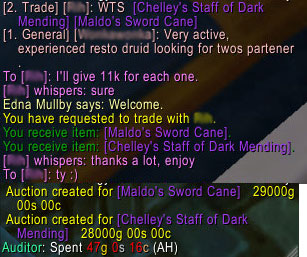

The text version of the first picture is I bought Maldo’s Sword Cane and Chelley’s Staff of Dark Mending for 11,000g apiece and then turned and listed them for 28k and 29k. Sadly, they did not sell instantly like the tanking shoulders, but I relisted them tonight for a more reasonable 21k and 22k – I have every confidence of moving them before next Tuesday, but even if I do not, 11k for a 359 weapon is certainly something I would be willing to pay to buy from a vendor, if there were such a thing.
The second picture is of a guy whispering me about my 21k Darkmoon Card: Tsunami. Turns out he bought a Tsunami deck for 16.5k, but didn’t realize that he had to wait until the Darkmoon Faire was in town to get the trinket. His deal? He would trade me his deck + 2 Maelstrom Crystals + 1000g for my completed trinket. All because he did not feel like waiting two weeks. Hey, I don’t blame him, I hate waiting too. So I sealed the deal, put the deck in the bank, and pulled out Darkmoon Card: Tsunami #2 and listed that one for the same 21k. Got to keep the shelves stocked to keep the customers happy, you know?
Uber trade deals like these could be flukes, sure. It certainly is not some sort of residual business or source of daily income. But the thing about lightning not striking twice is that few people think to set up a lightning rod… which simply means more potential lightning for you.

Using the AH as Your Bank
A few weeks ago, you may recall that I made a completely unnecessary personal purchase of Fury of Angerforge, ostensively to twink out one of my almost-85 alts. Even after both the DK and Warrior hit 85, I held off, as increasingly it is becoming apparent that my love of certain classes revolves around individual abilities and not the total package. For example, the first time I saw a warrior Heroic Leaping from the AH to the bank, I knew I wanted to level mine up. As a paladin, I have mobility-envy all the time anyway, but the ability to just kind of get goofy on a minute cooldown? Sign me up. Hell, I would have race-changed to Worgen (or goblin even!) had that race been able to be paladins.
Anyway, as it turns out, you spend a lot of time rooted in PvP, as a warrior. And without a healbot, you die rather quickly. I probably spend an equivalent amount of time Feared on the paladin, but the uselessness I feel is greater rooted as a warrior than Feared as a paladin.
In between the purchase of the trinket for 28,500g and my figuring out whether the warrior was for me, I was listing the Angerforge trinket on the AH for 45,000g. I had zero expectation that the trinket would sell for this amount. The principal here is simple. Sequestered away in my bank, the value of the trinket is effectively zero – I wasn’t planning on selling it, but I was not using it either, despite having spent ~7% of my liquid bank for the option; I consider the initial 28.5k to be sunk costs. Meanwhile, if there even existed a 0.1% chance it would sell for 45,000g (a return of 16,500g), that would be worth the periodic 10g deposit every few days. Worst case scenario? I equip it on one of my toons a month or two from now and am out ~150g over the course of the month, which is minuscule compared to the kind of gold I write off as business expenses, e.g. canceling and reposting cut gems.
Then, I got this surprise:
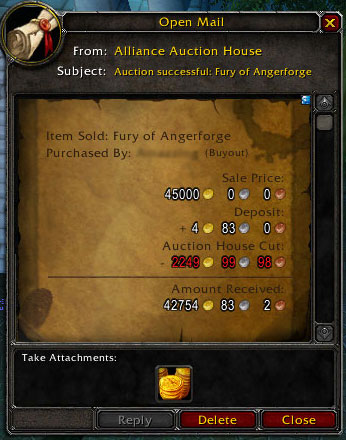
Using the AH as your bank is not always feasible, of course. For example, there is no real point in keeping stacks of 400g Hypnotic Dust in there. Okay, well there actually might be a point in doing that, but not in the sense I am talking about today. Epic BoE items work amazingly well for this principal, as the supply is understandbly limited. Some crafted epics work as well, like Tsunami Decks.
In any case, when choosing your price, the important thing is not chosing a price based on what you would consider a good return on the “initial investment.” That term is in air quotes because (presumably) you did not buy the item for its investment properties, but rather for your own future use. Rather, choose a price at which you would feel good about losing the future utility of the item. This isn’t about opportunity cost, this is about pricing items that you had not planned on selling at all. Angerforge at 28.5k was at the upper end of the bang-for-my-buck scale. Flipping it for 35,000g might have been a reasonable return for some people, but an anemic 19% return on five-digit investment is not good enough for me. Nearly double that percentage though? Now we’re talking.
Let me use a more pedestrian example: Inferno Rubies. I have a bunch of cut gems up on the AH at any given time, but I always try to maintain at least 10 uncut Inferno Rubies in my bank. Why? Because the absolute last thing I want to happen is to get a new piece of PvP gear or whatever, not have any Inferno Rubies to socket into it, go to the AH, and suddenly see that Inferno Rubies happen to be at 150g or something ridiculous. The personal value of the 11th Infero Ruby in my bank is signifigantly less than the first 10 – I would sell the 11th for whatever the market price happens to be at the moment, but the other ten would have to be at least double that for me to sacrifice the feeling of safety that having them conveys.
So, what I suggest is for you to head to your bank, take a gander at all of the varied sort of sellable knick-nacks or epics or stockpiled goods, and simply put them up on the AH for a price you feel is high enough for you to have justified selling them at to begin with (instead of warhousing them for the indefinite future) and see what happens. Most, if not all, will come back to you and you’ll be out the deposit cost. Sometimes though, you will be that one guy out there with an item that someone else just cannot wait until tomorrow to purchase at a fraction of the cost. Being out there is always better than not.
Either way, enjoy the extra bank space.
Data-Mine Shaft
Nearly every blogger has talked about the data-mined gem vendor changes (including myself), but there have been a few people questioning the potential veracity of the change itself. This is from Stede over at Venture LLT:
Is this bad news? Not really. Blizzard gets about 2-3 weeks to test a patch build on the PTR. To understand how a drop in the vendor price would work its way through the WoW economy over a much longer span of time, they have to take it to the extreme. The good news is that 75s won’t make it ever make it onto live servers. The not so good news is that Blizzard is seems to be openly considering dropping the vendor price of cut uncommon gems. My best guess, the vendor price will likely be about half of what it is now – that’s ~4.5 gold.
Other people have pointed out, repeatedly, that this is data-mined information, and “remember epic gem cooldowns in Wrath?!” Well, of course. The issue is that this vendor price change was long overdue:
| Gem | Uncut Vendor | Cut Vendor |
| Blood Garnet | 25s | 25s |
| Living Ruby | 3g | 3g |
| Crimson Spinel | 5g | 6g |
| Bloodstone | 25s | 50s / 1g |
| Scarlet Ruby | 3g | 4.5g |
| Cardinal Ruby | 5g | 9g |
| Carnelian | 5g | 9g |
| Inferno Ruby | 3g | 3.75g |
| ??? | ??? | ??? |
It never made any sense that the uncommon gem cut and vendored for more than the rare gem, let alone how uncommon gems vendored for the same as the epic gems of the previous expansion. While this high vendor price provided a fairly stable floor price in ore despite the flooding of bots, an unintended consequence is that it never made any sense to sell cut/perfect uncommon gems on the AH (e.g. Bold Carnelian, Perfect Solid Zephyrite). As Wrath frequently demonstrated, there was a fairly stable, low-volume market of parsimonious gemmers that were okay saving 5-10g by putting +12 Strength into an empty slot instead of +16 Strength.
This market has undoubtedly been underserved by this artificially high price in Cataclysm, so I would not necessarily despair when it comes to ore prices. It makes prospecting riskier from an absolute standpoint, but there will be people making gold out there by selling cut uncommon gems competitively without having to worry about the rather obscene deposit cost (which is a function of an item’s vendor cost).

The Paper Tiger of Paper Losses
Let me begin with an example written by an Anonymous poster way back on Cold’s blog on Opportunity Cost:
Let’s try a thought experiment. Say hypnotic dust currently sells for 100g per stack on the AH. Your friend decides to quit WoW and gifts you 1000 stacks of dust before he deletes his account. Did you just gain 100kg? Can you sell all of that dust at 100g per stack before the price depreciates? Let’s assume that every crafted item you can make using dust values dust at less than 100g per stack, and the demand is such that I can only sell 10 stacks a day at the 100g price point. It’s going to take me 100 days to sell that entire stockpile. Is a stack of dust going to retain its 100g value by the end of those 100 days (fwiw, on my server, dust is selling for roughly 50% of what it was 1.5 months ago)? If I can sell 30 stacks a day at 95g (either through undercutting or crafting or some combination of the two) is there value in paying that 5g per stack so that I can move everything in 1/3rd of the time?
Now instead of a friend gifting you the dust, let’s say you can generate 10 stacks a day, every day, for the cost of 50g in raw mats from the AH. Hypnotic dust sells for 100g a stack, but due to the supply and demand in your market, you could sell 1 stack a day at 100g, or 10 stacks a day at 90g (again, either through undercutting or crafting). At the lower price point, I can make 400g a day everyday (at a 100g “paper” loss). Or, I could stick to the 100g price point and make 50g a day and bank 9 stacks a day for later sales and hope that those stacks will sell at 100g eventually. Only there’s another 9 stacks coming in tomorrow, and another 9 the day after that, and the day after that. Or maybe I should just make the 1 stack a day, because 50g profit a day is much better than the 100g loss I was making selling 10 stacks at 90g. Right?
The defining characteristic of paper losses (or paper gains) is the unrealized part. Namely, they have not happened yet. In the real world, you can realize paper losses/gains rather easily considering IRL market prices are prices at which you have a ready buyer, by definition – if a stock price is $10 a share, that means someone (or a computer) will buy your stock at $10 right now with cash in hand. If no one would, the market price would be lower. As we all know in-game however, “market price” is really short-hand for average price for X period of time, or expected price given Y profit margin, or (as is often the case) simply wishful thinking.
It is in this context that I consider paper losses in WoW as a paper tiger, e.g. something that seems threatening but really isn’t. In the example scenario posted earlier, there is really no circumstance under which “undercutting” the market price is a loss because there is no way to know what the market price even is. In the WoW economy, there is either a sale or there isn’t one. Any other analysis is ispo facto navel gazing.
On Friday, as I was semi-AFK in Stormwind, someone was advertising in Trade for Heaving Plates of Protection and Kilt of Trollish Dreams “9k obo.” In case you did not know, “obo” technically means “Or Best Offer,” but in practice it means “I’m terrible at haggling, please gouge me.” As I said in my two–part Haggling post, information is power, so why would you ever want to lead off with an admission that you would be willing to go lower? Who is going to ever offer 9k? Anyway, I whisper him with a 7,000g offer for the Heaving Plates which he accepts immediately. After paying him, I run 20 feet to the AH and list them for 21,000g.

A sale of something of that magnitude within two hours could be a fluke (the one person on the realm that would have spent that amount just happened to be browsing at that exact moment), or it could be an indication that whatever you just listed could have been listed for more. A lot more. If that was the case then, did I not experience a paper loss? And since the dude accepted my 7,000g offer instantly, does that not indicate I could have gotten it for less, perhaps 6000g? Another paper loss! And hell, what about the guy in Trade? What about his paper losses?
My first instinct is to say that my own successful sale “realized” the paper loss for the Trade guy; there was a chance to sell it for 21k (or whatever) vs guarenteed sale at 7k… at least until I guarenteed the 21k sale. But… what if the Trade guy doesn’t read this blog? What if my buyer turned and sold the shoulders for 28k and I never know? What sense does a concept of paper loss make unless there is concrete, non-subjective market price?
Ultimately, I do not believe paper losses make any sense in WoW. The scenario which it attempts to describe is legitimate, e.g. being on the lookout for times when you could have sold something for more (or perhaps what will happen to Pyrite stockpiles if epic gems come from elsewhere), but in practice there is no such thing as paper losses. Return on investments? Recouping costs? Fire sales? Sure… but those only exist because the successful sale existed first.
Buying Stuff: Hard to Do
I did one of the hardest things for me in the game last Friday… I bought something.
Specifically, I bought something for myself that I had no intention of trying to get a return out of it, e.g. for pleasure. *shudder*
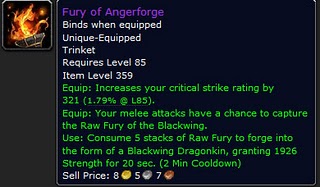
The price tag was 28,500g bid with 30,000g buyout, and I assuaged some of my trepidation by winning it via bid. My main is Azuriel, a Prot paladin that I spec as Ret when I want to punish myself in PvP, so it was not even for my main. Who was it for? My level 83 (at the time) Warrior, or potentially my level 84 Death Knight. In other words, a total twink item for an alt I am not even 100% sure will get 30,000g worth of enjoyment out of it.
I do not bat an eye at investing 13,000g in, say, Chelley’s Staff of Dark Mending and reselling for 21,000g. I am still bullish on the Strength version of Hurricane and Tsunami decks. I will (and indeed have) poured thousands of gold into power-leveling professions on my alts, including the now level 84 Blacksmith, buying all the Chaos Orb patterns even though the BS cannot acquire any just yet. To me, these are business expenses to be written off at tax time, so to speak. The cost of doing business, just like gold for repairs or the buying of mats for flasks and such.
Fury of Angerforge though? It was not particularly cheap. Even if I did resell it, the margin would probably not be that great. You do not see very many BoE trinkets on Auchindoun though, which is a point in its favor. And my mortal weakness in WoW are things that change your character model and/or debris you can set up in the game world, as opposed to pets or mounts that other people fawn over.

Why bring this up at all? Tell me… is it easy for you to spend gold in WoW?
One of the hooks of gold blogs is getting you enough gold so that “you never have to worry about gold ever again!” While it is true that I never really glance at how much repairs are after a night of wipes, I feel every individual gold piece evaporate any time I spend it on buying flasks instead of making them, or essentially anytime I am trading money for time. Do you have any expectation that your accumulated gold meter will reach 0g by the time you hang up your WoW hat? Or is gold really what it objectively is: play money in a finite, virtual game? Am I alone in feeling miserly despite not needing to be? Is there not some point at which a person cannot rationally justify making more gold without gold becoming its own game (e.g. you have to spend a significant effort to even give it all away)?
Let me know in the comments below. I’m especially curious to hear from other gold bloggers and/or people with 250k+ about this one.
Crafting Paradigm Follow-up
The following is a portion of the comments replying to the New Crafting Paradigm article.
[…] The constituent parts of a combo sell at a higher a la carte price than the combined cost of the combo. This is done to move more product than they otherwise would.
And your loss leader explanation is exactly my point. For example, let’s say embersilk bags sell for 300g per unit. Let’s say that the current AH price of embersilk cloth is 3g per cloth, but there is so much cloth on the market, and I know my competitors have so much stockpiled, that to move any amount of cloth in quantity, I’ll have to keep on undercutting and so will only average about 2.5g per cloth. Let’s also say that hypnotic dust is 6g per dust. A naive person might say “The raw mat cost of the bag is 75*3 + 15*6 = 225 + 90 = 315g, therefore I shouldn’t craft it”. A more wily person might say “In order to extract 3g per cloth, I will sell some of it raw on the AH, and I will package some of it in groups of 75 with 15 hypnotic dust @5g per dust (acting as my loss leader) by crafting embersilk bags and selling it for 300g”.
This was a good example… had the topic been solely focused on why people make/sell flasks (etc) below the market price of mats. As I noted in the article though, there could be any number of reasons why people do that, and it is not entirely relevant anyway since we can never really know what price our competition is getting mats at. But that is not really the point of the article – the point is that depending on the volatility of the raw materials, it may never make sense to make any finished goods compared to simply warehousing them.
Let’s look at the given Embersilk Bag example, since that is more tangible.
First, it was established that Embersilk Cloth is 3g/each, but will probably need to sell at 2.5g/each to push our supply; Hypnotic Dust at 6g/each, but 5g/each to push. The market price of the final product, Embersilk Bags, is 300g.
Market Price (Buying Mats) = 75*3 + 15*6 = 225 + 90 = 315g
Market Price (Selling Mats) = 75*2.5 + 15*5 = 187.5 + 75 = 262.5g
Market Price (Selling Bag) = 75*3 + 15*5 = 225 + 75 = 300g
So… is this a 37.5g profit or a 15g loss?*
It was never specified what it cost to get the Embersilk Cloth/Dust to begin with, so calculating profit is impossible. It is also debatable how much sense it makes to call something a “market price” when you cannot realistically sell items at that price, but nevermind that for now. My point to you is that if Embersilk is 3g today but 5g tomorrow, that Embersilk Bag better be getting crafted at a 150g profit margin or you were better off holding onto the cloth. Or even if it goes from 3g –> Xg such that you can push your supply at 3g.
Meanwhile, the Embersilk Bag market isn’t likely to move from 300g even if it suddenly costs 1000g to make one. We cannot even say “no one would make any new bags at that price” because we don’t know how much mats someone may have squirrelled away (and not chosen to sell at the higher prices), or if perhaps the bags have already been created months ago, etc etc.
The Anonymous commenter is absolutely correct that “locking in” Embersilk at 3g each via making bags > selling Embersilk at 2.5g. He is also correct in that selling mats in a package (e.g. any crafted item) allows you to conceivably move more product than individual listings – it is difficult to move Hypnotic Dust at any price on Auchindoun some days, so having the opportunity to “sneak” some into Embersilk is better than not selling any. The issue I wanted to highlight yesterday is this: “locking in” cheap mats into a finished product does not save you gold, it saves you bank space. If crafting something makes economic sense, craft and sell it. Do not craft more than you (believe you) can sell today though, unless you know that the price of your mats will not increase (beyond X% of the profit margin of the crafted good) tomorrow.
There is exactly one scenario in which it might make sense to turn all your mats into crafted items today, rather than crafting only when necessary: Alchemy specializations. It costs 150g to change between Potions, Elixirs/Flasks, and Transmute specs, and it typically is not profitable to, say, make flasks without being Elixir-spec’d – competiters having a 15% competitive advantage over you is massive, and the market itself is generally priced in such a way that the 15% proc bonus is assumed. So, if I wanted to crank out some Mythical Mana potions, it makes the most sense to go ahead and make as many potions as possible after switching specs if I plan on going back to Elixirs afterwards. Transmuting via daily cooldowns is generally profitable enough in of itself that you do not need to be specialized, but… transmuting a bunch of rare gems and/or metagems? You definitely will want to switch.
Incidentally, transmuting rare gems is an example of where locking in prices actually works out most of the time. Uncommon gems typically have extremely low margins compared to their rather massive listing fees such that being able to lock-in a price that works out to be higher than 9g/each has no real downside… provided the rare gem itself doesn’t plummet to 15g or something ridiculous.
Hopefully the topic makes a bit more sense now.
*Exploring the concept of paper profit vs paper loss and the realization of both will be the subject of a seperate post.

New Crafting Paradigm
I have been thinking a lot on various comments made both here and over at Cold’s blog (specifically his Opportunity Cost Part 2 posting), all related to the variance between the market price of mats and of the market price of finished products. It seems like a no-brainer to say the market price of finished products moves independently of the price of mats – even beginning auctioneers can pick up on the fact that, say, cut gems generally go for more than uncut gems, or that profit can be made on making flasks at certain herb prices, and so on. It makes intuitive sense that by adding work to an object, i.e. turning apples into applesause or herbs into flasks, you increase the value of the object.
But… how do we thus explain when the finished product ends up being valued below the cost of materials? We already answered that question: the market price of finished products moves independently of the price of mats. The only real connection we could have is that when, say, flasks go “underwater” (e.g. become worth less than the mats needed to craft them), it becomes less likely that more flasks would be created. I say “less likely” because there is no real way of knowing what price points other Alchemists bought their herbs at, or if they are the type of people who overestimate the 15% Elixir Master bonus, or perhaps the people that sell whatever they have at whatever the current going rate is regardless of “paper profit.”
What this is leading me to do is codify a new crafting paradigm for myself, putting numbers and words to a concept I was subconsciously doing anyway.
Twilight Jasmine = 4.32 – 10.5 | (x8) 34.56 – 84 (avg 59.28)
Azshara’s Veil = 4.4 – 10.65 | (x8) 35.2 – 85.2 (avg 60.2)
Volatile Life = 8.07 – 12.5 | (x8) 64.56 – 100 (avg 82.28)Draconic Mind = 132.54 – 241.55 (avg 187.04)
Highest End Mats = 269.2
Lowest End Mats = 134.32
Avg Mats = 201.7660 flasks = 12,905.76 flasks (60 + 15%) – 12,105.6 mats (60) = 800.16 = 11.6 per flask
To put it into words, on average, you only ever make ~11.6g in profit making a Flask of Draconic Mind as an Elixir Master alchemist based on the last two weeks of TUJ numbers. Profit is increased when you buy mats below average and sell flasks above average, obviously. However, in comparison, the profit you would make buying 60 flasks’ worth of Azhara’s Veil at it’s lowest price of 4.4g/each (2112g) and selling at it’s average price of 7.5g/each (3600g) is immense: 1488g profit before the AH cut. Buying Azshara’s Veil at 88g/stack and selling it at 150g/stack is on average more profitable than making flasks, without even considering the price of the other herbs.
Almost a “duh” moment, right? Flipping a 88g item into 150g is a 62g return that no one would miss, let alone the opportunity to do that with a bunch of stacks of herbs. As I mentioned though, this is a new crafting paradigm for me, or way of looking at things. Alchemy is one of my go-to professions, and thus I have an unconscious bias towards making things even when it appears to make no economic sense. Why even bother having professions if you are not going to use them, right?
In other words, in this paradigm it is not enough that a profit could be had by purchasing mats at X price and crafting something to sell at Y. The price at which I can sell Y has to be higher than the highest price of X, or I was probably better off just warehousing the mats until their market value swung higher.
I say I have been doing is subconsciously, and the reason is basically my Foundation article on Finding the Margin. By keeping my personal margin relatively high, I was inadvertently keeping myself from jumping into “profitable” albeit volatile markets which were prone to going underwater. With a personal margin of 30g, I would avoid making flasks at 11.6g average profit and thus expose myself to less risk. When mats are really cheap and flasks are really expensive, that margin increases up to 100g per flask – an obvious market signal that I should move in and set up shop… for a while at least.
One thing I wish I could do is be able to present this data in a graph or picture form, but I have no idea how to do so.

Cleaning the Bank
One of my first posts in PVSAH dealt largely with throwing a wet blanket over the long-term investment craze in Wrath commodities like Saronite Ore and Abyss Crystals and such. As I went to collect my proceeds from selling stacks of Cobalt Bars for 300g today, it occurred to me that I should perhaps revisit the advice.


 In An Age