Blog Archives
Review: Dawncaster
Dawncaster is mobile deckbuilding roguelite that is in the esteemed company of Slay the Spire and Balatro for how many hours I have played, and how willing I was to pay real dollars for the privilege. While it does have some design choices that limit its depth, I can consistently find myself playing runs lasting for hours while also experimenting with different strategies.
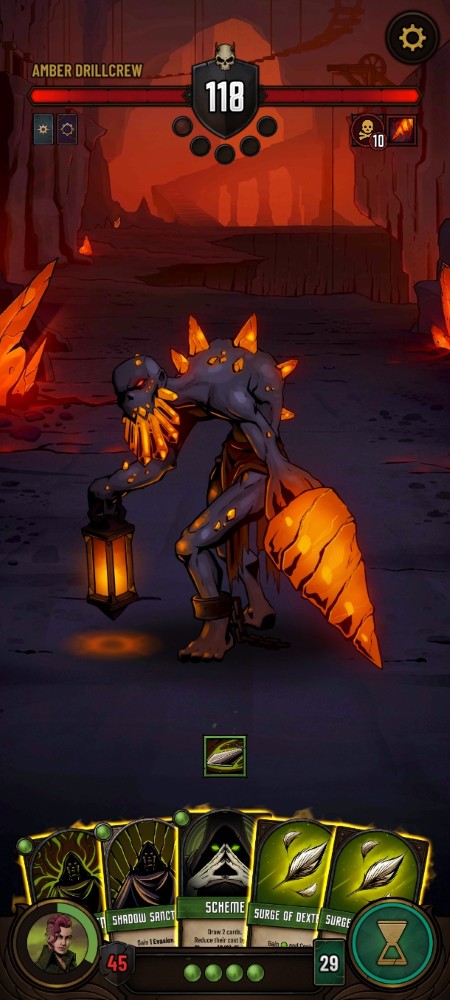
As mentioned, Dawncaster is a deckbuilding roguelite. At the beginning of each run, you can choose between one of six classes, which is then customized with a selection of Basic Attacks, a Weapon Ability, and then a special Starting Card. Alternative options can be unlocked using in-game currency earned from daily quests and completing runs (win or lose). Once you begin a run, you enter “Canto 1” (of 9) and are presented with three encounter options from a “deck,” which can include treasures, shrines, NPCs, or monsters. With the exception of treasures, the two non-selected encounter cards are then reshuffled into the deck. Your goal is to work your way to the boss of the Canto and defeat them.
Monster combat is fairly typical for the genre. Each turn, you gain energy of a specific type (Blue, Green, Red, etc) for your class and draw 5 cards; leftover energy is carried over into future turns, but cards are discarded. From this base, a wide variety of scenarios and strategies develop. There are debuffs like Bleeding, Poison, Doom, and buffs like Armor, Barrier, Focus. There are cards that draw cards, cards that discard cards, cards that stay in your hand from turn to turn, curses that go into your deck or the enemy’s deck, enchantments, temporary cards, and so on and so forth. Also, cards can be upgraded and even have keywords added to them.
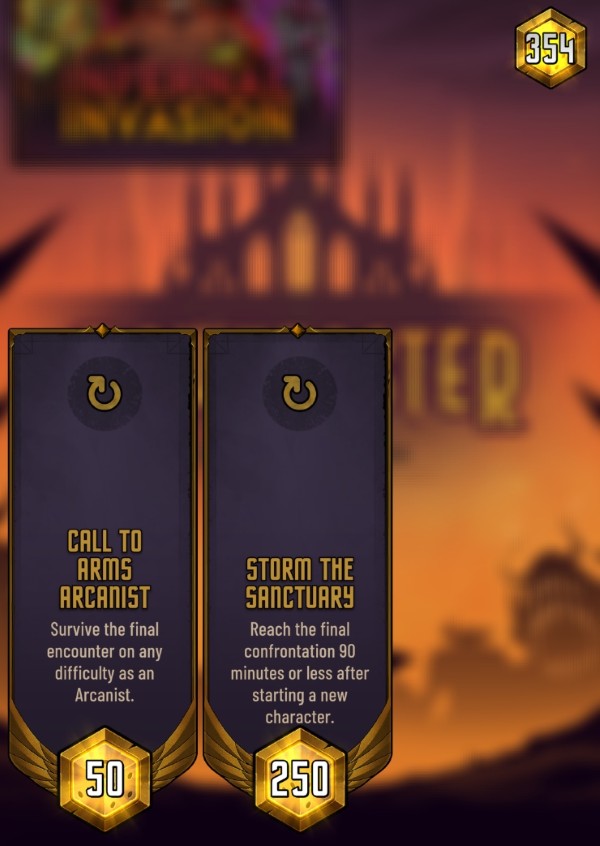
If anything, the sheer breadth of options is one of the shortcomings of Dawncaster. And, paradoxically, that same breadth leads to many runs feeling the same.
As mentioned previously, there are six classes… but there are no specific class cards, only color cards. Certain classes start locked to a specific color, such as the Arcanist and Blue energy. After each successful combat encounter, you get to select one of three card rewards that are tied to what energy you have access to. Generally speaking, the mechanics within each color are synergistic, but even when they aren’t, at least you can try to focus on the one you want. The problem is when you gain access to other colors, which can happen at class selection or even during a given run depending on your choices. At that point, you still only get three card rewards after each encounter, but now the card pool expands to include both colors. Sometimes this can be a good thing – some colors are better at card draw or specific debuffs, etc – but often this means you will be offered useless rewards for most of a run, leading to failed decks. Alternatively, even when things go perfectly, it usually does so because a specific combo is so much better than the other available options.
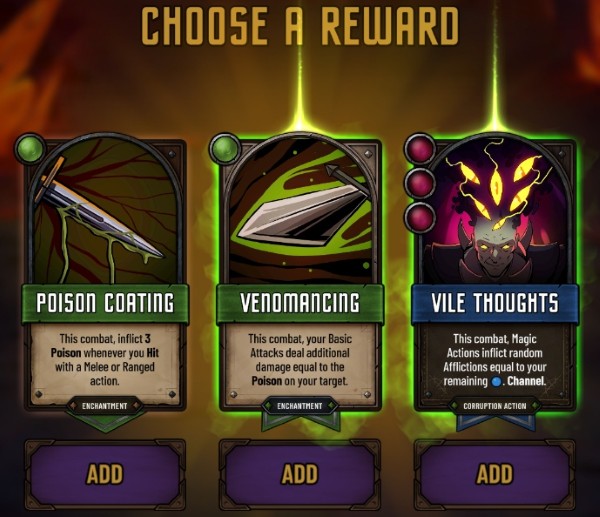
Dawncaster has multiple DLCs available for purchase, which adds more cards, enemies, encounters, and bosses. Tragically, the additional cards do not feel all that good because of the specific issue above: if they are not directly related to your strategy, they just pollute your limited card choices. There is a shopkeeper NPC that gives you a bunch of card choices, but again, there are so many cards out there that you can hit them up a half dozen times and still never find the necessary cards to make your strategy work. Of course, targeting a specific strategy is probably not the best idea; I would never start a Slay the Spire run and say “I’m doing a Poison build this time” before seeing some good Poison cards. But at least with Slay the Spire, I would only see The Silent cards as rewards, rather than every class.
Anyway, this is the quibble I have with Dawncaster after literally a hundred hours or more of gameplay. I still feel like Slay the Spire is the better deck-building roguelike, but Dawncaster is in the top 5 for the genre, if not directly second place (especially on mobile). If you are looking for something to play on your phone that isn’t F2P and/or gacha, I can definitely recommend this game.
Going in Blind
Now that enough time has past since GenCon, allow me to admit to a little secret: I don’t actually like card/board games that much. Crazy, right?
My issue with these games have nothing to do with their mechanics or pieces, so perhaps it’s a little misleading to say that I don’t like them. What I actually don’t enjoy is learning a new game in a competitive environment. I have no problem with the inherent randomness of rolling dice or drawing cards, but having to make blind decisions based on rules I’ve been introduced to moments ago? It always feels horrible to me.
One of the evenings after GenCon, the group retired to a hotel lobby to play Ladies & Gentlemen. The game itself was utterly fascinating in the way it effectively kept 9 people engaged 100% of the time without any awkward waiting for everyone else to take their turn. You pretty much have to have a minimum of 7 players for it to be fun (three teams + the Mistress), but it’s definitely a game I would recommend.
Unfortunately, I lost by two points. Not even “my partner and I lost”: me specifically. Because during one of the early turns I bought a purse (I was a Lady, of course) that was worth two points… but due to a rules misinterpretation on my part, it could not be counted as part of my “outfit score” at the end. And nearly three weeks later I am still stewing about it. Not because I lost, but because I lost for a really dumb reason.
Same deal back when I was learning to play Dominion with friends. I understood the rules for the most part, but it wasn’t until Game 3 or so that I began to understand the cadence, the rhythm behind the game. Which cards were better than others, the tension between buying more cards and diluting your own deck, the power of trashing certain cards, and so on. I went from the guy blindly spamming the A button in Super Smash Brothers to Sheik, nightmare princess. Until I get halfway down the mastery route though, I have close to zero fun playing these games, friends notwithstanding.
“Just go with it.” NO U. I’d rather flip a coin than make a blind decision, because at least with the coin we can all acknowledge that there was no actual choice involved. I will lose Risk, Texas Hold’em, and a dozen other card/board games graciously all night because I clearly made meaningful choices (or risk assessments) that did not pan out. A blind choice has no meaning to me, and a choice is blind until I fully understand the choice’s place in the full context of the game. Which, as you may imagine, is hard to do when you are playing it for the first time and have no reason to ever own it yourself.
 In An Age