Blog Archives
Balatro
If you haven’t heard about the latest indie darling, Balatro, let me tell you: it’s legit. Balatro is available on both Steam and now on mobile, the latter of which is what I recommend picking up, as there aren’t many non-exploitative mobile games out there.
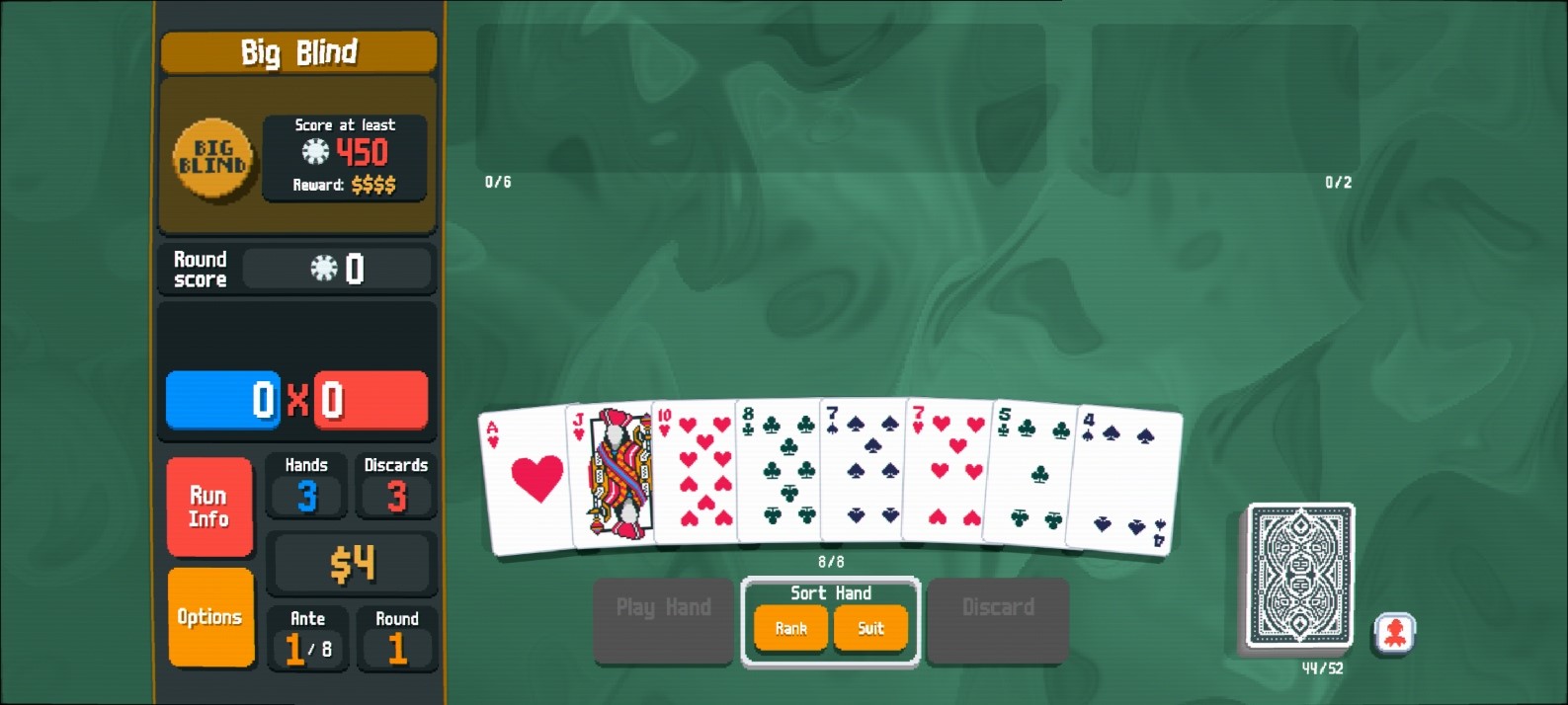
Fundamentally, Balatro is a deckbuilding roguelike based around making poker hands using a standard deck of cards. Your overall goal is to clear eight “levels” (Antes) that consist of three “battles” (Blinds) apiece, one of which is a boss that has negative modifiers. Battles are won by exceeding a score (Chips), which is generated based on the poker hands you play… plus any modifiers. For example, let’s say you have two pairs: a pair of Queens and a pair of 5s. A two pair hand is worth 20 Chips x 2 multiplier by itself. You then add the face value of the cards used to the Chip value, so it ends up being 50 x 2, or 100 Chips. The very first Blind requires 300 Chips or more to beat, so you would be well on your way to success there. Under normal settings, you get to play a total of 4 hands to beat the Blind, and get a total of 4 discards (up to 5 cards each time) in order to make said hands.
Winning battles gives you a base level of money ($3-$5) with bonuses based on unused hands remaining and “interest” on unused cash from prior rounds. You use this money in-between rounds in a shop phase that lets you purchase various things.
The twist with the game comes from the modifiers available.
The Jokers are the most famous elements of the game, and they truly run the gamut. The most basic Joker grants you +4 to your multiplier; if we had that with our earlier two pair hand, the Chips score would have been 300 by itself (50 x 6). Some Jokers give you a scaling buff, some revolve around increasing your economy, some focus on enhancing specific suits or poker hands, some give bonuses to other Jokers, and so on. You get to equip up to five Jokers under default settings. Then there are Planet cards. These are consumables that permanently (for this run) upgrade the scoring of poker hands. Then there are Tarot cards, which are consumables that do a bunch of different things, including giving you more Tarot cards, more Planet cards, changing the suits of specific cards, etc. Oh, and the deck of cards itself can be enhanced or augmented to a variety of ways – cards can be deleted, added, changed to give +4 multiplier when scored, give more points when not played, etc. etc.

As you can probably tell, the dopamine hits come from the combination of regular poker RNG along with Joker RNG, boss RNG, shop RNG, and generally shenanigan RNG. You could be just scraping by, hit an amazing shop, and walk into the next round flush with cash and scaling Jokers. You could be breezing through the game and then hit a boss modifier like “Diamonds are debuffed” and do a ShockedPikachu.jpg when your “turned all the cards into Diamonds” deck is shafted. And, yeah, while I mentioned the word RNG a bunch previously, at the end of the day it is still about poker – there are strategies and probabilities that you can leverage to improve your expected outcomes.
Perhaps the best part of Balatro is the simple fact that it is a complete experience. There are no micro-transactions, no DLC, no real-world money intervention. I purchased it from Google Play for $10 and that’s that. Overall, I would still claim Slay the Spire to be the best deckbuilding roguelike, but Balatro certainly jumped out of nowhere to land in the top-5, if not second place. Not bad for a 1-man team.
That JAB vs Trump Hearthstone Game
The Hearthstone Americas Champion tournament aired this past weekend, and one particular game stood out: JAB vs Trump, Game 5. Or more specifically, this game-deciding bit of RNG at the final moments:
Now, the first thing I’m going to say is this: listen to that crowd. They’re loving it. I was watching the stream live and even I was going “OoooOOOoooh!” For all the derogatory “coin-flipping” and RNG flak Hearthstone gets, I think it’s pretty clear that watching these games can still be pretty exciting. Certainly more exciting than watching a perfectly mechanical, zero RNG game in which the outcome is known by turn four.
But as someone who watched the entire match-up, what gets me is how everyone always boils the RNG down to the final sequence… but seemingly ignore everything that lead up to it. This the final match in its entirety:
There is a ton of RNG at the beginning of the match, including a lot of amazing top-decks that changed the tone of the game. If Trump didn’t draw that Big Game Hunter to answer Dr. Boom, if the Shredder outcomes were different, if some other combination of cards were drawn… and so on. It reminds me of sports like football or baseball when mistakes are made with the final field goal or bottom-of-the-ninth plays. Everyone always remembers that last failure, and not all the other equally critical failures that lead up to it.
That thought then brought me to the Reddit thread in which someone wrote this:
You missed the whole pont, people say Hearthstone can’t be an esport because RNG isn’t affected by skill (mostly), so it’s more like playing bingo than a real sport in which there is 0% luck like soccer, or an esport like StarCraft 2.
There is no question that there is a lot of RNG in Hearthstone. But it is also beyond absurd to not recognize how much random bullshit occurs in meatspace sports as well. It is like suggesting all these soccer goals were 100% intentional, including the one where the guy tries to headbutt the ball, misses, and it bounces off his hip into the goal. Is the fact that a literal random number generator is not involve somehow make those “1cm to the right and it’d have bounced off the pole” scores less random?
Point being: randomness is involved in every asymmetric game, up to and especially including real-life sports. Are soccer games determined by coin-flips? Not ones we can see, anyway. But how else would you describe a penalty kick-off in soccer? That goalie has to arbitrarily decide to jump left or right, pretty much instinctually and before they see where the ball is heading. Or going back to card games like Poker – which a lot of people take very seriously – the most skillful aspect of the game is… bluffing. But what is that? If you read someone perfectly, all that really tells you is “they like/don’t their hand.” It doesn’t tell you what cards they have, or if yours could beat theirs.
I dunno. I don’t play Hearthstone as much as I used to, but I still enjoy watching it quite a bit. To suggest it can’t be an esport due to it having RNG moments though, is just ridiculously wrong. The randomness in other games is just more well-hidden. Perhaps we can say Hearthstone has too much of some arbitrary amount of RNG to be successful in an esports sense, but… is that really the criteria? Or is it “this is fun and exciting to watch?”
 In An Age