Blog Archives
The Pulitzer Prize for Videogame Narrative Goes to…
…Diablo 3, of course.
Super Meat Boy had just pulled ahead with the judges, until this narrative bomb dropped:
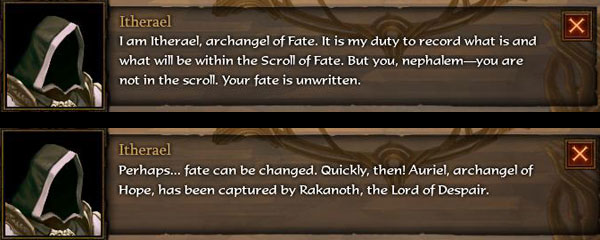
Technically, I guess this constitutes a spoiler…?
Do not let that last line wash over you; let it sink in. “Auriel, archangel of Hope, has been captured by Rakanoth, the Lord of Despair.” Hope had been captured by Despair! Is there a word to describe a metaphor so superficial and goddamn literal that it becomes a mockery unto itself?
All I can think of is “nadir.”
Neither the Diablo series¹ nor the hack-n-slash genre is exactly known for their compelling narratives, and that is fine. Campiness has its place, and that is fine too. But the shit Diablo 3 attempts to pull with a completely straight face is simply ridiculous, bordering on insulting. It feels like placeholder plot, especially in a severely truncated Act IV.
Take, for example, the exchange I posted above. Scroll of Fate? What does it add to this story that such a thing exists, or that the character is outside of it? I am not talking about the idea of a Scroll of Fate and an unbounded main character – that is perfectly fine as a story device, such as in Kingdoms of Amalur, etc – but the Diablo series has never been about that. Remove that bit of dialog (please), and nothing materially changes about the narrative. Maybe there is a tie-in between the prophesy at the beginning of the game and this Scroll of Fate, but that link is so tenuous that the writer is either being too subtle by half, or in wont of an editor with a backbone.
And then there is the Enchantress, whom is introduced as a character by being a wizard kept in stasis for 1,500 years to aid the hero in his/her prophesied time of need. While there was apparently a legitimate attempt to have this add something to the story, I could not help but think that maybe the Prophet should have let the Archangel of Fate look at his crib notes since the hero was apparently featured in them.
It could be that all of this is a setup to an expansion (or two) in which we explore all the random, seemingly banal things the companions said. But, again, that would necessitate a level of subtlety on the part of the writer(s) that is simply incongruent with the John Madden-ning the Prime Evils do throughout every step of Acts II-IV. “What’s that, Diablo? I will never close your portals to Hell? I will never close your other portal to Hell? I will never make it past your lieutenant? I will never make it to you in time? I will never actually read in-game text that is not magic item properties after this and all subsequent playthroughs?”
Damn, you’re good.
¹ I realize that this is actually an arguable point. As one forum poster described, the narrative was much more poetic and Biblical throughout (most of) D2 at a minimum. The Moldy Tome, for instance.
 In An Age