Monthly Archives: April 2012
Review: Mass Effect 3
Game: Mass Effect 3 + Multiplayer + DLC
Recommended price: $40
Metacritic Score: 89
Completion Time: ~32 hours
Buy If You Like: Mass Effect; story-driven, cover-based sci-fi shooter RPGs.
By far, Mass Effect 3 (hereafter ME3) is the hardest review I have ever tried to write.

Cue the Stages of Grief
There are three entirely different prisms through which this game can be judged. The first is as the 5-year culmination of arguably the most important sci-fi videogame story of our time. The second is as a comparison between the individual components of the trilogy, as in how it stacks up compared to the first two titles. The third is as an independent game, divorced from the accumulated emotional detritus and hype of the series.
The distinctions are important precisely because no matter how grating certain features or design decisions are in isolation, I have found myself literally incapable of escaping the rose hue of the first prism. This is not to say I did not notice the deficiencies, but rather they seemed to matter less in the final analysis. Your mileage may vary.
For example, things feel off from the very start. The Reaper invasion – the nightmare scenario that formed the impetus to action in the first two games – has finally arrived. Earth is under attack. And… I feel nothing. Outside of a Lunar sidequest in Mass Effect 1, this is the first time Earth has ever actually appeared in the series in any real way. My Paragon Commander Shepard has never been fighting for Earth, or even humans specifically, but for the right of all sentient life in the galaxy to exist. Indeed, humanity has almost represented a background bumbling bureaucratic force, a one-dimensional foil to Shepard’s actions throughout the trilogy that lacks the novelty of the alien scenarios.
It does not help that throughout the Earth invasion, throughout your leaping from burning building to burning building, throughout the panning of cameras to the monstrous Reaper capital ships landing among the skyscrapers… there is nothing but an eerie, empty silence. Where is the stirring music? I spent the first twenty minutes of Mass Effect 3 wondering if my game had glitched, perhaps setting the music volume slider at 0%. There are plenty of amazing songs in the rest of the game – the absolutely haunting “Leaving Earth” comes to mind, or the stirring “The Fleets Arrive” – so the lack has to be some inexplicable design choice.
Certainly, it won’t be the last such inexplicable choice.
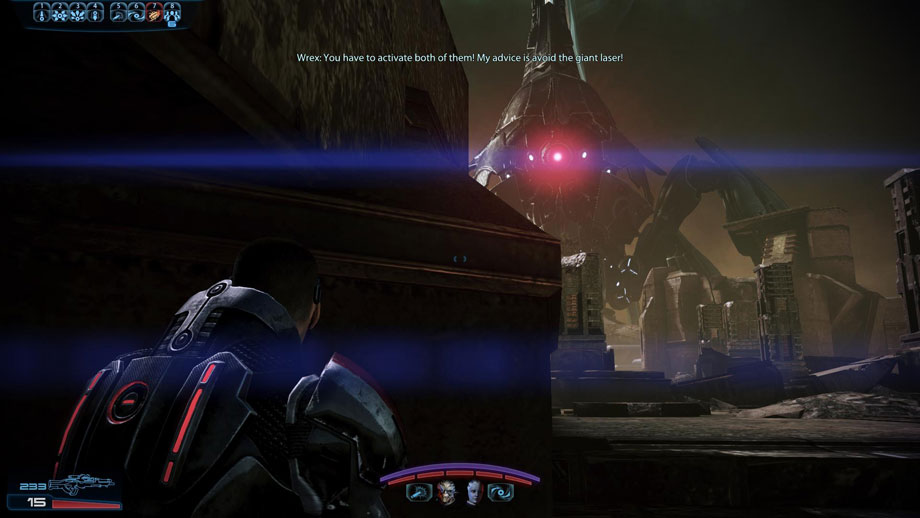
Wrex: the Krogan Sun Tzu
Once Commander Shepard is back aboard the Normandy though, the game once again feels like Mass Effect. And it really was not until ME3 that I could point out what that even meant. The brilliance of the series, in my mind, is the notion that one ship and one crew can make a difference, in a relatively believable manner – the sort of “right place, right time” effect. At no point did I feel like Shepard was a god amongst men, even as I was performing miracles and uniting species after centuries of war. Flying around the galaxy in a desperate attempt to cobble together a coalition for a final stand against the Reapers… yes, this is Mass Effect.
One thing that deserves special attention is the combat system. Simply put, it’s rather brilliant. For the most part, combat in ME3 is the same as ME2 aside from some subtle, key differences. The first is the inclusion of Carrying Capacity, which I will admit to having a strong negative reaction to at first. Shepard and crew can carry all five types of weapons if they wish, but the lower the percentage of Carrying Capacity utilized, the greater rate at which Biotic/Tech abilities recharge. In other words, if Shepard takes an assault rifle, shotgun, and sniper rifle into battle, he/she may get a -150% modifier on cooldown times. Alternatively, if Shepard only takes a sniper rifle and pistol, he/she may have a +50% modifier. Given the radically increased power of Biotic/Tech abilities this time around, choosing a loadout actually becomes a choice, especially since some guns are balanced around their weight.
On a related note, the gunplay in the missions themselves has never felt more fun and exciting. You will still spend 80% of the game crouching behind chest-high walls, but the obstructions are less obviously arbitrary, and the environment/graphics look amazing. More importantly, the enemies are radically more varied, have a deeply cunning AI that will flank you or flush you out of cover with grenades, and otherwise keep you in the moment and on your toes.
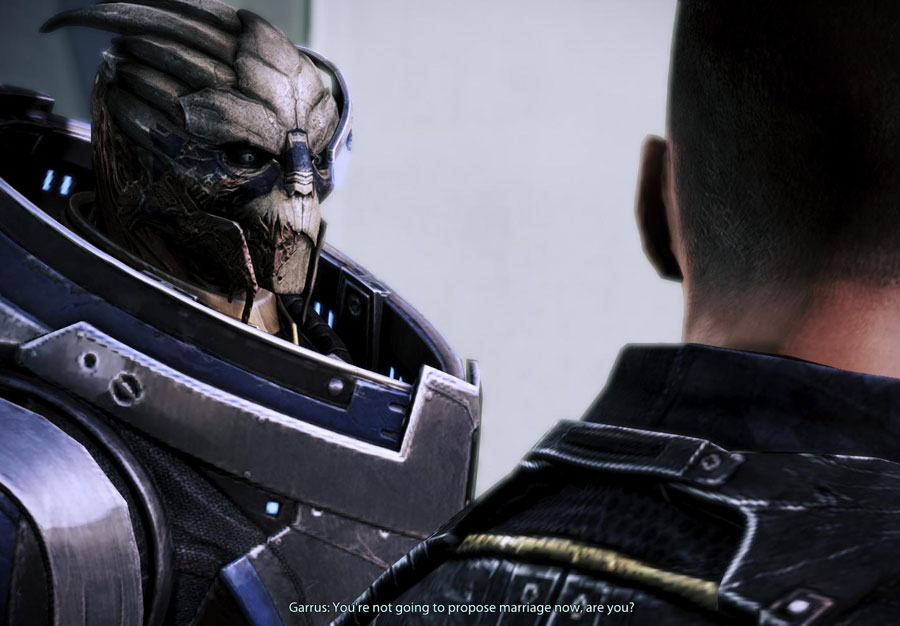
Damn, Garrus. Way to shoot me down.
Any review of ME3 would be remiss to not mention what has become, if not the most, at least one of the most controversial endings in gaming history. Without getting into spoilers, the thing to understand about why it is as big a deal as it has been in the gaming media comes down to this: catharsis. Simply put, there was not any. And with as much passion as the franchise has generated, I do not find it surprising in the least that so many people have taken the pent-up energy to the forums and blogs (as I myself have done). As of the time of this writing, Bioware has taken the rather extraordinary step (if you think about it) to begin development of a free, epilogue DLC to be released this summer. If said epilogue is able to honor the choices players have made in this franchise, if it is capable of giving me the catharsis I hunger for months after the fact, then Mass Effect could very well unseat the sacred cows of Chrono Trigger, Final Fantasy 7, and perhaps even Xenogears in my Top 3 games of all time.
As it stands, there is really no question that you should play Mass Effect 3 if you have at all enjoyed the first two titles in any capacity. Objectively, I think Mass Effect 2 as an independent experience (insofar as that is possible) edges out Mass Effect 3, but… well. To quote Fight Club: “You know how they say you only hurt the ones you love? Well, it works both ways.” Without a doubt, Mass Effect 3 has wounded me in ways no other game has ever done, and that in itself is a remarkable triumph.
“I think we ought to read only the kind of books that wound and stab us… We need the books that affect us like a disaster, that grieve us deeply, like the death of someone we loved more than ourselves, like being banished into forests far from everyone, like a suicide. A book must be the axe for the frozen sea inside us.”
–Franz Kafka
Multiplayer
The multiplayer that comes with Mass Effect 3 deserves its own special section, because in many ways it is almost a second, complete game. Indeed, its development started originally as a first-person shooter spinoff before it was enfolded into ME3 proper.
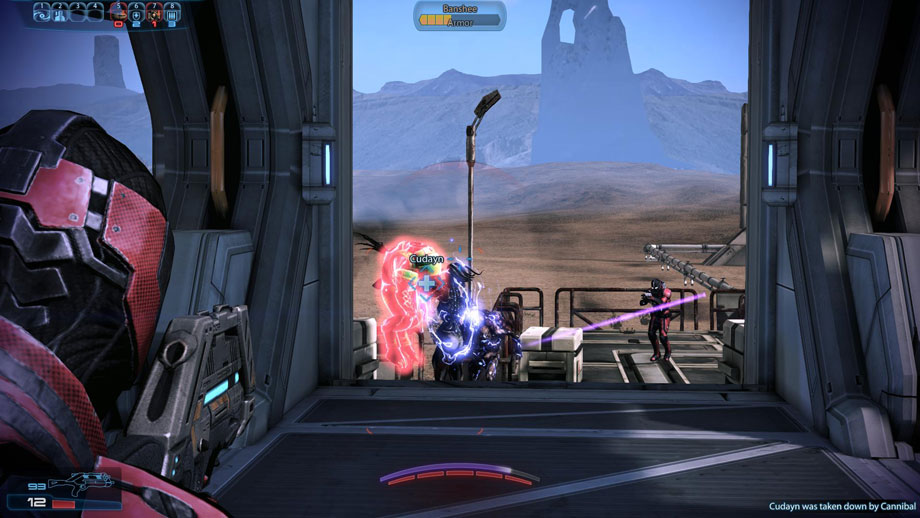
You're going to need a LOT of Medigel for that one, buddy.
In effect, multiplayer is a stand-alone, four-person co-op survival mode. Although winning multiplayer matches increases the Galactic Readiness Rating in the single-player game (essentially allowing you to skip sidequests and still achieve your goals), there is otherwise zero overlap. You pick one of the six classes, one of the five races, a weapon loadout, a difficulty level, and then head into one of the six maps to face one of the three enemy factions. Each map has 11 waves, three of which will consist of special objectives that will be a King-of-the-Hill, activating four beacons, or assassinating four specific enemies amongst the others. Successfully completed maps will take around ~30 minutes, you will gain XP for the class you chose (with a level cap of 20), and Credits.
The replay factor, aside from the entertaining gunplay, comes from the unlocking of packs. Starting out, you have access only to the five most basic weapons and human versions of the six classes. As you earn Credits, you can purchase different levels of packs – Recruit, Veteran, and Spectre – which unlocks new weapons, weapon mods, races, character customization options, and one-use items or buffs to give you an edge. Obviously this can lead to frustration at times, especially if you opt to buy packs via Bioware Points (i.e. microtransactions) instead of Credits, but it does give you an incentive to try and make weapons or classes you would not typically pick, work.
The sort of bottom line is this: if you had fun with Mass Effect’s combat system, you will have a ton of fun with the multiplayer. I have already spent more time playing multiplayer than I have playing Mass Effect 3 itself. And at the time of this writing, there is a free multiplayer DLC (Mass Effect 3: Resurgence Pack) coming to introduce two new maps, new race combinations (including Geth and Batarian), and new weapons. Given that packs can be purchased with real money via Bioware Points, it is entirely possible all future multiplayer DLC may be free.
DLC: From Ashes ($9.99)
From Ashes is the poster-child for everything evil about Day 1 DLC: it is hideously overpriced, lacking in content, and has fundamentally shifted my perspective about the nature of the Mass Effect plot. What you are purchasing is one throwaway stand-alone mission, a Prothean squad-mate (Javik), a new weapon (a particle rifle with regenerating ammo), and a bunch of new dialog between Javik and the other party members (especially with Liara).
The problem is that without the DLC, the Protheans were always this unknown, almost magical race who fell to the Reapers in the last cycle and whose artifacts you spend a lot of time collecting. Interacting with Javik, however, reveals the Protheans as a belligerent, almost xenophobic race that would have enslaved or destroyed the races we have come to love in the Mass Effect franchise. In other words, by the end of the game I honestly felt that the Reapers did us a big favor by wiping out the Protheans.
So while From Ashes is not in any way essential to the plot of Mass Effect 3, I personally believe that its absence radically limits the scope of the narrative. In other words, I consider it both required and overpriced. Then again, honestly, you could probably just read the Mass Effect Wiki and watch the Youtube videos for the same effect, saving yourself $10.
The Virtual Line
Tobold has an interesting post up today on what he considers the defining characteristic of games: “a game is a risk-free environment in which you can try out various actions for fun or for learning without fear of the consequences, because the consequences aren’t real.”
The second paragraph is this:
As you can see there is a growing trend of “games” turning into “ungames”. There are many reasons for that, one of which is Maslow’s hierarchy of needs. Once you climb up that pyramid high enough, you are leaving the real world needs behind. If somebody’s needs are for status and achievement, he can fulfill that need in a virtual environment, and these virtual environments are usually designed to offer a lot of that status and virtual achievements for less effort than it would take to achieve something in the real world. There are now a sufficient number of people who are sufficiently well-off that they can spend real money on virtual status symbols or game achievements. That is bound to be used by those who are still lower on the pyramid and are just trying to make a buck. The danger is that people become confused about where the border between real and virtual is, which leads to stories like the Chinese guy who murdered a friend who borrowed and then sold his virtual sword.
Hagu knocks it out of the park with the very first comment:
I think “”played” to earn real money” is a bit restrictive.
In real life, if I had a $5 bill, a glass I paid $20 for but with no resale value, and a manuscript I spent 1000 hours creating, then I would be increasingly unhappy with the item being destroyed.
I would regret far more the lost of an item I spent hundreds of hours acquiring than a D3 sword I can sell for $5
The question I want to ask, though, is this: where is the border between real and virtual?
I am not asking that to be cute or contrary. I am literally asking what difference does it make? When have the consequences of a game not been real? Is the emotion you feel by reading fiction different to you than the emotion from an encounter in the real world? Is the frustration you feel at work different to you than the frustration you feel playing a videogame? Anger? Sadness? Disappointment? Embarrassment? Social pressure? Joy? Victory?
One cannot derive nourishment from a virtual apple. A virtual fire will not stave off hypothermia. Beyond that though? How exactly “real” is, say, Security under Maslow’s hierarchy? As any parent, victim of a crime, or survivalist can tell you, security is, at most, a state of mind. A paranoid schizophrenic won’t feel safe in a padded cell; conversely, there are people who voluntarily live in Detroit and St. Louis, the two US cities with the highest violent crime rates as of 2010. If you can feel safe without actually being safe, I think that begins to call into question “consequence-less gaming.”
When I play videogames, I do not think of the stresses of the day, the drama, the frustration with my job, or really anything from the real world. About the only difference between my gaming state and actually having no stresses, drama, or a frustrating job is that, perhaps, the feeling would persist beyond the end of the gaming session. Then again, biologically, we are designed to take things for granted; happiness has diminishing returns. Nevermind that (arguably) the persistence and permanence of anything is just wishful thinking on our parts.
Obviously, the subjective solipsism rabbit hole can get pretty deep.
I am not advocating that virtual relationships are as equally valuable as real ones, all other things being equal. If someone has the choice between a friend IRL and a game friend, I hope you would choose the one whose couch you could actually crash on. I just think it should be recognized that gaming is not really all that far removed from real life as Tobold (or Syncaine for that matter) might suggest. And that the things you experience in your head are as real to you as anything else; phantom limb pain is still pain.
The Chinese guy who murdered his friend over a game item gets our attention because the item wasn’t as “real” as, say, a family heirloom with no monetary value but priceless sentimental value. I’m suggesting that perhaps that is a distinction without all that much difference. Is the attachment to one more real than the other? Is murder more “understandable” over one than the other? The virtual sword isn’t real, but the emotions are.
“It’s just a game.” Sure. That folded American flag is just cloth and dye too. It’s what it means to you that matters. And meaning only exists in your head.
Entitlement
“Entitlement,” like “casual” before it, is such a loaded word these days that I consider any gaming argument in which it is included to be a lost cause. How can you reason with someone who sees no merit in criticism, or (apparently) believes the rightful state of the consumer is to be one of permanent, ingratiatory groveling? I suppose we should be happy developers deign to part with their digital goods at all, yes?
Keen made a recent post on the subject of people being skeptical about proposed game features that have already been “proven” to work in older titles; things like 500 people fighting over keeps in DAoC, non-instanced player housing, and so on. I was going to write on the subject, when this section of a user comment jumped out of nowhere:
For an entitled gamer, why play a game where you can’t have something when there are plenty of games that will bend over backwards to hand it all to you on a silver platter? And unfortunately, the majority of gamers are entitled. Note that I am not using the word casual here because there are some casual games who are not entitled and some serious gamers who are.
I hate this system. I hate that the vast majority of new games shoot for the lowest common denominator to get as many subs as possible rather than finding a niche in the market and shooting for a reasonable slice of the pie.
At first blush, you may be tempted to agree. Don’t.
It’s dumb, it’s contradictory, it’s asinine. Look at all the whiny, entitled gamers in these sort of comments wanting player housing and 100+ player PvP battles, amirite? Having a preference does not make someone entitled. Wanting to be catered to as a consumer does not make someone entitled. Seeking maximum value for one’s gaming dollars does not make someone entitled. Buying/supporting only the games you like is not being entitled.
I wonder if people even understand what they are saying when they type things like “the vast majority of new games shoot for the lowest common denominator to get as many subs as possible.” That presupposes there is a “higher common denominator” that is being neglected when their own desires are equally fantasy bullshit. It is suggesting that games and mechanics these days are not being built to the satisfaction of their own refined palate, as if they were entitled to that.
You can’t have the argument both ways.
I understand and empathize with the sentiment. We live in a world where Firefly gets canned after a dozen episodes while Jersey Shore will be running its sixth season. Shit is unfair. And I would also agree that (MMO) gaming is in an era of extreme loss aversion; if something like Darkfall could make enough money to finance a sequel, surely that is “successful” enough, right? An investor flight to AAA quality has, in many respects, killed off the “middle class” of game designers. Without said middle class, it is entirely possible there are no designers catering to your preferred play style, and indie games can only go so far.
That said, twisting “entitlement” into (even more of) a pejorative and otherwise demonizing your fellow consumers is ultimately counter-productive. Begrudging them their satisfaction of capitalism working as intended (to them), gets you no closer to your dream game sequel. Instead, it leaves us all bitterly divided, rooting for each others’ failures, while those actually responsible continue eroding consumer surplus in the form of on-disc DLC, always-online DRM serving no other game purpose, and similar nonsense.
In other words: don’t blame the players, blame the game (designers). It is the latter saying your money isn’t good enough.
 In An Age