Murder Hobo
In Starfield, I roleplay exclusively as a murder hobo. Oddly enough, Wikipedia has an entry on that:
murderhobo (plural murderhobos or murderhoboes)
- (roleplaying games, derogatory or humorous) A character who wanders the gameworld, unattached to any community, indiscriminately killing and looting.
I was reflecting on this the other day. I found myself on a planet and inexplicably, irrationally, exploring. Everything is procedurally generated, there is zero environmental storytelling, and the payout for fully scanning a planet is not even remotely worth your time. But… I do it occasionally. So there I was, walking towards a Point of Interest, and then a ship landed nearby. These are technically a random encounter, but the ships often leave the area stupidly quickly, making you wonder why Bethesda bothered programming them in.

So, I zip over there fast as I can, expecting some pirate action. Instead, they were neutral NPCs. I talk to them, they say they are low on supplies, and ask for some water. I give it to them. Then I check out their ship. Lockpick my way past the hatch, empty their cargo hold of cash and valuables, and then… look at the captain chair. Then I sit in the captain chair and blast off into space. A few menu screens later, I land the ship in New Atlantis, register it, sell it, and then fast travel back to the planet I was exploring originally.
In the abstract, I think this sequence was literally the most psychopathic thing I have ever done in a (non-Rimworld) videogame. This small group of people landed on an uncharted planet, desperate for supplies. A random passerby graciously gave them water. Then, moments later, they had to watch as their only means of survival is stolen out from under them. They are literally stranded on a desolate planet with no breathable atmosphere, no shelter, no hope.
Also, no consequences.
Now, obviously that is the problem here. I do not usually murder hobo my way through Baldur’s Gate 3, or Cyberpunk 2077, or Mass Effect, or really most other games. I was thinking about that though: why don’t I? What is enough of a consequence to augment my behavior? Some kind of automatic karma penalty like in Fallout? That often led to some arguably more murder hobo-ish behavior insofar that stealing from “bad guy” was apparently worse than just killing him and taking the now-ownerless items. Companion dissatisfaction? That can certainly be annoying, especially when you want to be a bit more “Renegade” in your dialog choices. Often though, this can be gamed by simply selecting different companions, doing what you wanted to do, and then swapping them back in once you’re done.
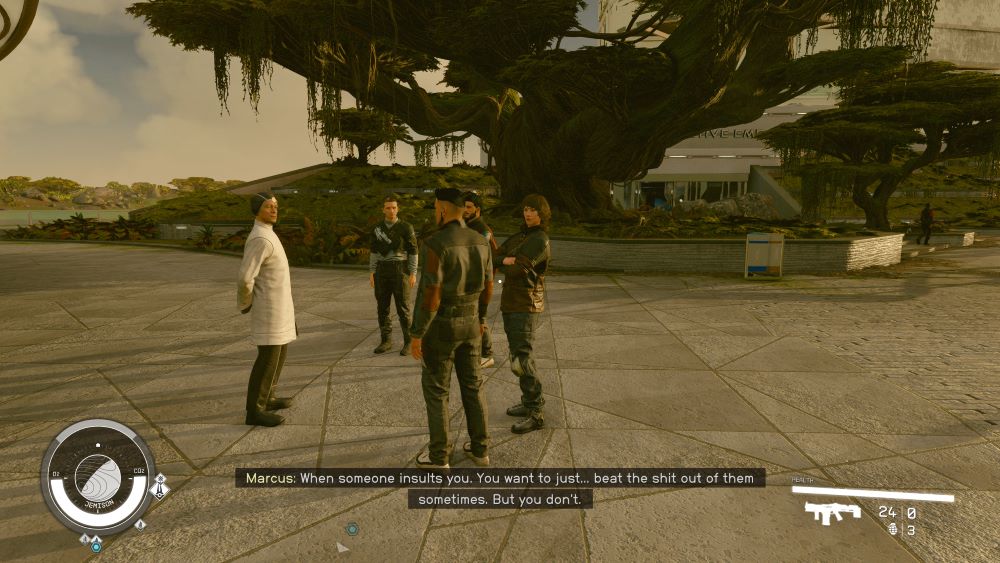
Honestly, I think it comes down to the possibility of accountability. I do not know every permutation to your choices in Baldur’s Gate 3, but I have read enough posts and interviews to know that characters you interact with in Act 1 may or may not show up in Act 2 and Act 3 based on your actions. That leads one to a different posture when it comes to negotiations; the more people survive, the more possible quest givers exist for the late-game. This requires a certain level of detail though, which is not always possible in a more sandbox-lite environment.
One method I would like to see though, is almost a metagame appeal to empathy. Every named NPC in Starfield carries 800-1200 credits, which is kind of a lot for how easy it is to pickpocket them. If you lose the roll, you get caught, and have to Quick Load your way out of consequence. But if you succeed… nothing happens other than credits in your pocket. What if NPCs had dialog lamenting their loss of credits? About how they won’t be able to make rent payments? What if they asked other NPCs (or even you) for help looking for a lost Credstick or whatever? What if that group of now-stranded civilians put out a mayday asking for rescue? Or really just a personal appeal to return their ship?
Sometimes being a murder hobo is its own reward, but often I think it is just a natural consequence of game incentives/lack of disincentives combined with a failure of immersion. If NPCs don’t matter, it doesn’t matter what happens to them. You can make them matter using elaborate penalty systems or story hooks, or make them matter by making them “real” enough to care about.
Or maybe this is all just me, and I have a bit of the Dark Urge IRL.
Posted on October 3, 2023, in Commentary, Philosophy and tagged Consequences, Immersion, Murder Hobo, NPC, Starfield. Bookmark the permalink. 9 Comments.
 In An Age
I think by default most humans aren’t murder-hobos, so even though its just a game and there are no real consequences, we still don’t murder-hobo when given the option in a game that is more life simulator than murder sim (a FPS for example).
Rimworld is a good example here where I’d guess most people don’t play their first colony murder-hobo style, but the game somewhat encourages that on later playthroughs. BG3 also has that clear option, but as Larian shared in the initial stats, only like 30% of people went that path.
In Starfield it sounds like the issue is more that murder-hobo is almost encouraged by design, which is why it feels weird/uncomfortable.
LikeLike
Yeah, there is definitely a sort of “natural” progression at play. Your first experience with vendors shows you ships that cost 250,000+ credits while you are scrounging for 1000 credits to buy enough ammo to keep playing the (shooting) game. Killing pirates and selling their guns is profitable, but the inventory system severely limits how much loot you can carry to a vendor. Questing is a decent source of cash, but again, you need bullets – that you cannot craft, despite easily making nuclear cores at workbenches – in order to make it through them.
Meanwhile, every named NPC has 800+ credits to steal and there are no repercussions if you win the dice roll. There are several thousand credits aboard space ships, and even though the registration system hampers profits, selling ships still nets you some cash. I had a quest earlier where I could convince a loan shark to forgive a debt via Persuasion, by paying 4000 credits, or by killing him. I chose violence because that is the language of action in Starfield: I got more XP for killing him and the guards, and more credits by selling their loot than I would for peacefully resolving things.
The whole thing reminds me of the perverse incentives in Deus Ex: Human Revolution wherein the optimum play was to knock out guards and then kill them because you got double the XP. Also, since the hacking minigame rewarded money (and XP), it was never worth finding the real passwords. Contrast that with Dishonored, where killing guards leads you to facing off against more annoying enemies and potentially a bad ending. Which was fine… except it also meant most of the abilities you unlocked were useless since they killed people. It’s a delicate balance that few devs get right, it seems.
LikeLiked by 1 person
“Honestly, I think it comes down to the possibility of accountability.”
There are those with a bleak view of human nature who might argue the same is true in real life. The Leviathan can’t be everywhere at all times, but the possibility that you’ll be unlucky and she’ll crush your particular arse is enough of a deterrent.
I don’t mean to speedrun the optimise-the-fun-out argument again, but a certain amount of self-policing helps with immersion whenever the game struggles to sustain it. On a vague level at the back of my mind I often fill in the consequences by myself, without the help of mechanics, because it makes the experience better. On both ends. If I then do a run where I’m acting out the role of a ruthless bastard, it’s nice to imagine that the murder and mayhem are expressive of character rather than of credit math.
I agree with you and SynCaine, though – if the game fails to impose consequences, it should at least try its best to limit completely artificial incentives. We’re generally used to the good-guy penalty of missing out on stolen cash, but things like the DX:HR xp nonsense should have been caught. One of the more pleasant elements of BG3 is that in most cases you get a full, or near-full, xp reward for talking through a problem instead of killing your interlocutors.
LikeLike
Technically, my character is a Neon Street Rat + Ronin class + Wanted, so this is all perfectly roleplayed! Although I also chose the Kid Stuff trait, so I have a nice supportive family too, somehow. Just a bad egg, I guess.
As you probably know, I don’t buy into the DIY immersion argument so much. You can do it, but it’s like trying to play GTA5 while obeying all traffic laws – you end up fighting the core game mechanics the whole time. In Starfield’s case, I don’t know if the devs wanted to dangle the carrot of 250k credit ships to inspire endgame ambitions, but between that and the absolutely ridiculous cost of ammo, it centered my gameplay loop on maximizing credits.
If ship combat was deemphasized (it’s seriously awful) and I could craft my own ammo (incentivizing outposts/raw resource gathering), I think it would go a long way in aligning the gameplay in a healthier way.
LikeLike
In an RPG I don’t think there should be a game mechanic rewarding “the correct way” to play it. The question isn’t why aren’t we all murder-hoboing through a game where you can be everything. The question is, if you can be anything, why would you choose to be a murder-hobo?
LikeLike
It’s not about rewarding “the correct way” so much as it is balancing the already-existing reward mechanisms. And I don’t even need it to be perfectly balanced, just remotely comparable.
You ask “why be a murder hobo” and the answer is: the game wants you to be. Starfield is a first-person shooter with the worst stealth implementation I have ever seen, the most miserly ammo distribution I have ever seen, and the most opaque Persuasion system I have seen in an RPG. We can fantasize that Todd Howard intentionally designed the game to mimic the internal struggle that comes from choosing the less extrinsically rewarding good path over the bad as some kind of moral lesson. Or… we can apply Ockham’s Razor and suggest it was just poorly designed. Based on the overall feel of the rest of the game, it is clearly the latter.
This might be a good topic for another post though. Thanks for the comment.
LikeLike
The fallout team that made Arcanum had the best murderhobo path. All npcs were murderable and necromancy had a spell that let you torture the spirits of the recently deceased. So, you could speed run the game by refusing to do any quests and just murder and torture anyone that was a stop point on the main quest. It was very fun to do that play through after doing a “good” run and seeing how much easier it was to be completely evil. A commentary, I suppose.
LikeLike
Oh man, I actually played Arcanum back in the day. I don’t remember much about it story-wise, and certainly was not aware that you could just murder everyone. At the time, my biggest takeaway was how busted the combat system was when you could choose real-time or turn-based. Ranged characters could kill slow-moving enemies with ease via real-time movement, but if you were melee instead then turn-based would let you take out ranged enemies.
In any case, it’s certainly a Faustian bargain we found for ourselves in terms of these older games vs newer. Hard to let players run wild killing mo-capped 3D models you spent big bucks creating, as opposed to unvoiced sprites. On the other hand, Baldur’s Gate 3 pulled it off, so maybe we should start to expect more…
LikeLike
Pingback: Incentivizing Morality | In An Age