Category Archives: Commentary
Ashlands and the North
Still playing Valheim. I fully completed the Ashlands, and am on the final stages of the, er, final stage: Deep North. My original plan was to just simply wait until I finished the game before making this post, but I have been struggling to find the motivation to do either of those things.
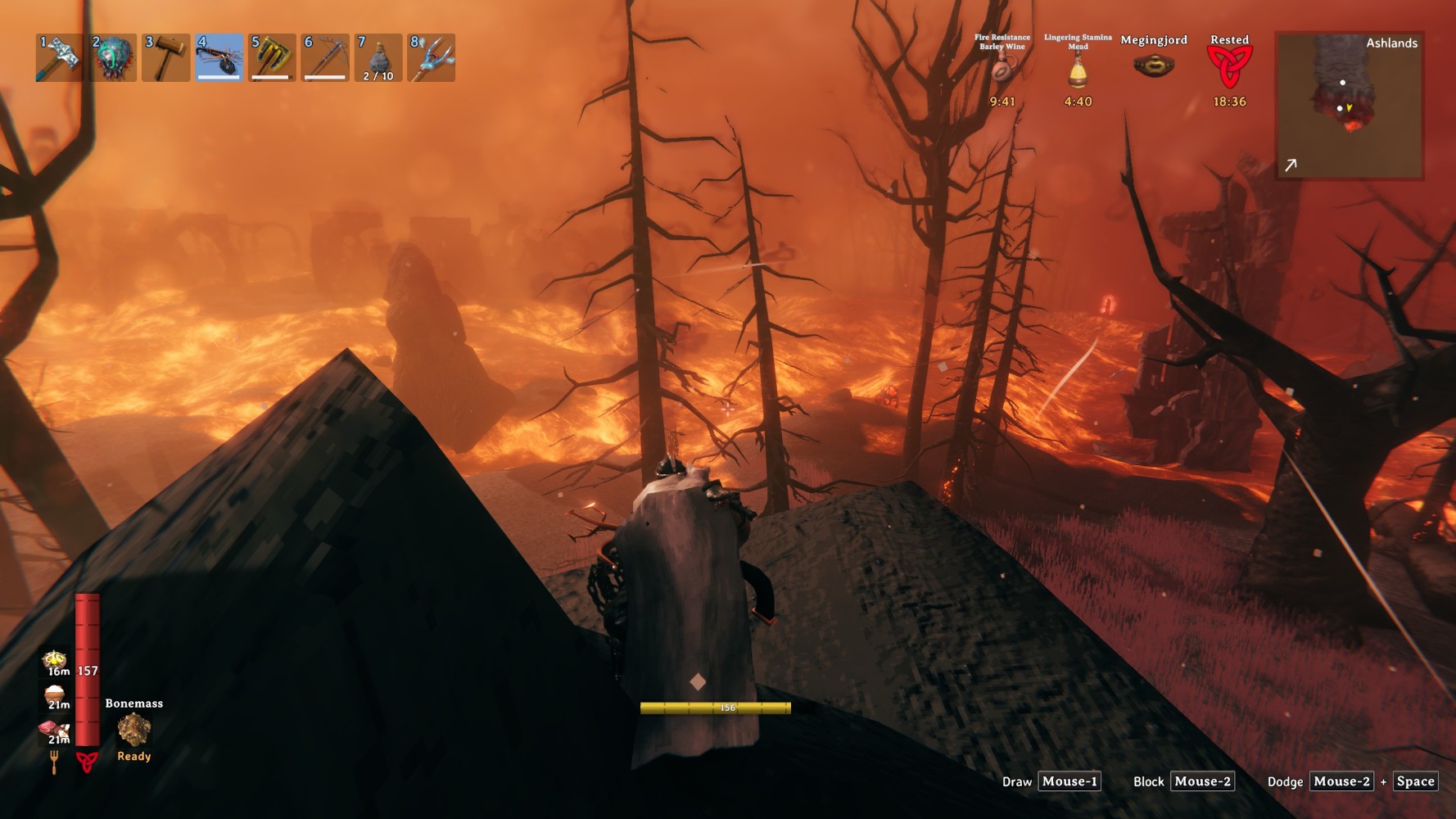
The Ashlands, as the Mistlands before it, was not nearly as bad as everything I heard about it. Which is because they subsequently nerfed it. Back in 2018 I wrote a post called The Internet is Forever… Wrong, and that remains relevant today. Whenever I go out and search for Valheim information on whether X weapon or Y staff is worth creating, nearly every search result or Youtube video is from 2 years ago and referring to stats or functions that have changed half a dozen times in the interim. There are filtering options available, yeah, but precious few search results afterwards.
That said, the Ashlands is definitely still hostile territory. The seas are boiling, all wildlife is hostile, stuff will catch fire randomly. And then there is the lava. Good lord, the lava. I actually appreciated the challenge of the lava at first. You can clearly see buildings suspended in the lava, so I tried to build pillars made of the same material. Nope, they crumble instantly. Then I tried to terraform the ground up. Nope, now there is a raised pillar of lava. It would have been rather silly if you could defeat the Ashlands with a hoe, but you never know with survival games.
By the next session though, the Ashlands was basically over. Trying to get the Flametal Ore from the spires in the center of lava fields is an engineering challenge. And it used to be harder, with the spires sinking after a few minutes! Just stealing entire chests full of the ore from forts with big green beacons highlighting their position? Much easier. Then it was just a matter of defeating the next iteration of the devs’ latest attempt to get you to quit the game from their bullshit boss design: Fader.
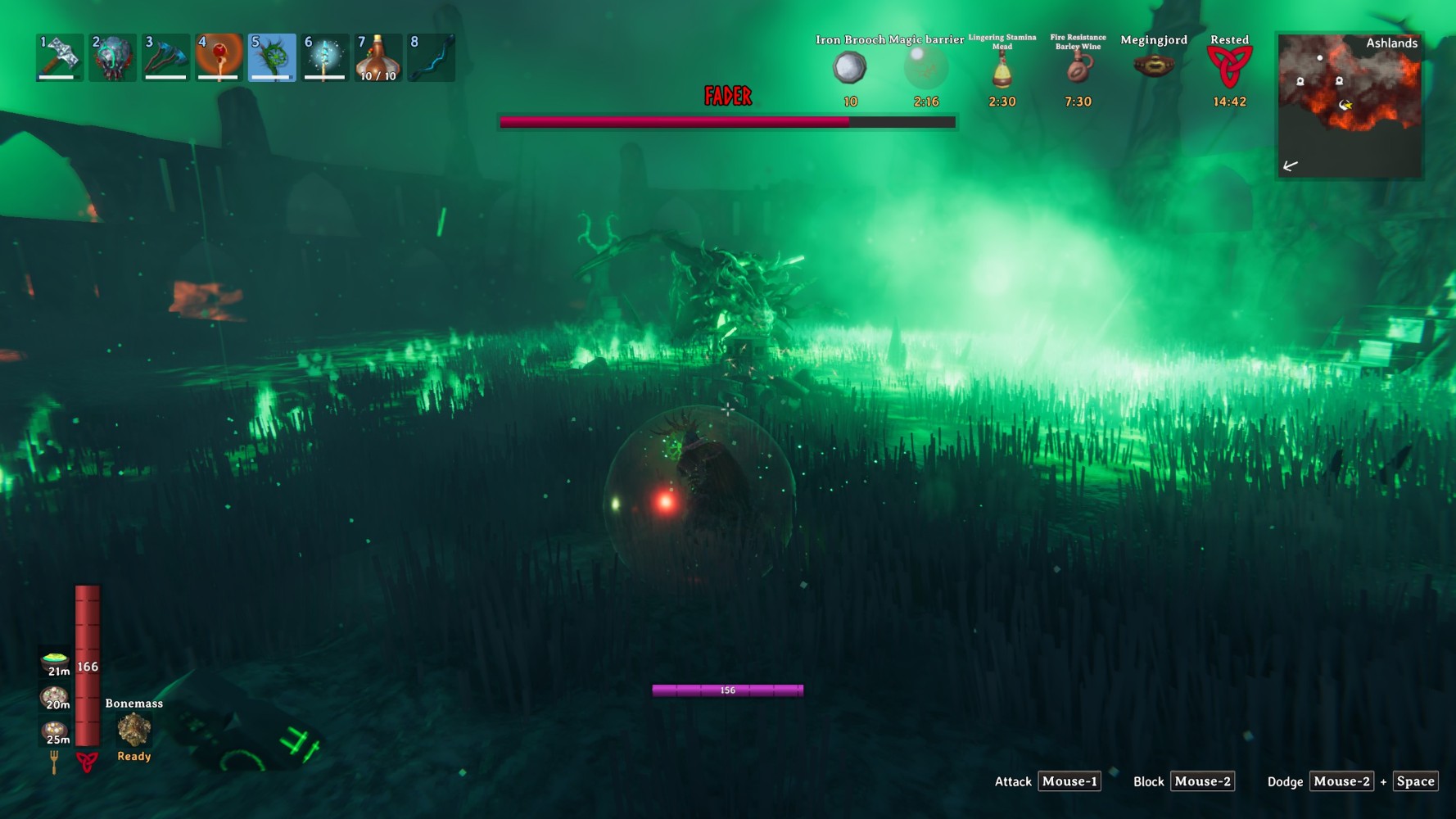
Fader is an exercise in deep boredom and frustration. Every 30 seconds, the boss creates multiple 11m zones of fire under your feet. If you are in melee range, the fire prevents from hitting the boss anymore, so you have to move out. Every 25 seconds, meteors rain down from the sky. Every 45 seconds, the boss calls adds, some of which are ranged bow users. There are more abilities, but those three themselves often meant the following loop:
- Hit the boss once
- Run out of the fire
- Dodge the meteors
- Kill the adds
- Start to run back to the boss
- Repeat
I eventually figured out that if I just kept running around at range, I could bait the fire to drop at range, and then maybe possibly get 3-4 melee hits in before some other bullshit happened. Bullshit being getting staggered by meteors, adds I didn’t kill, random other Ashland mobs who wandered into the boss area, getting launched into the lava by an Askvin, etc.
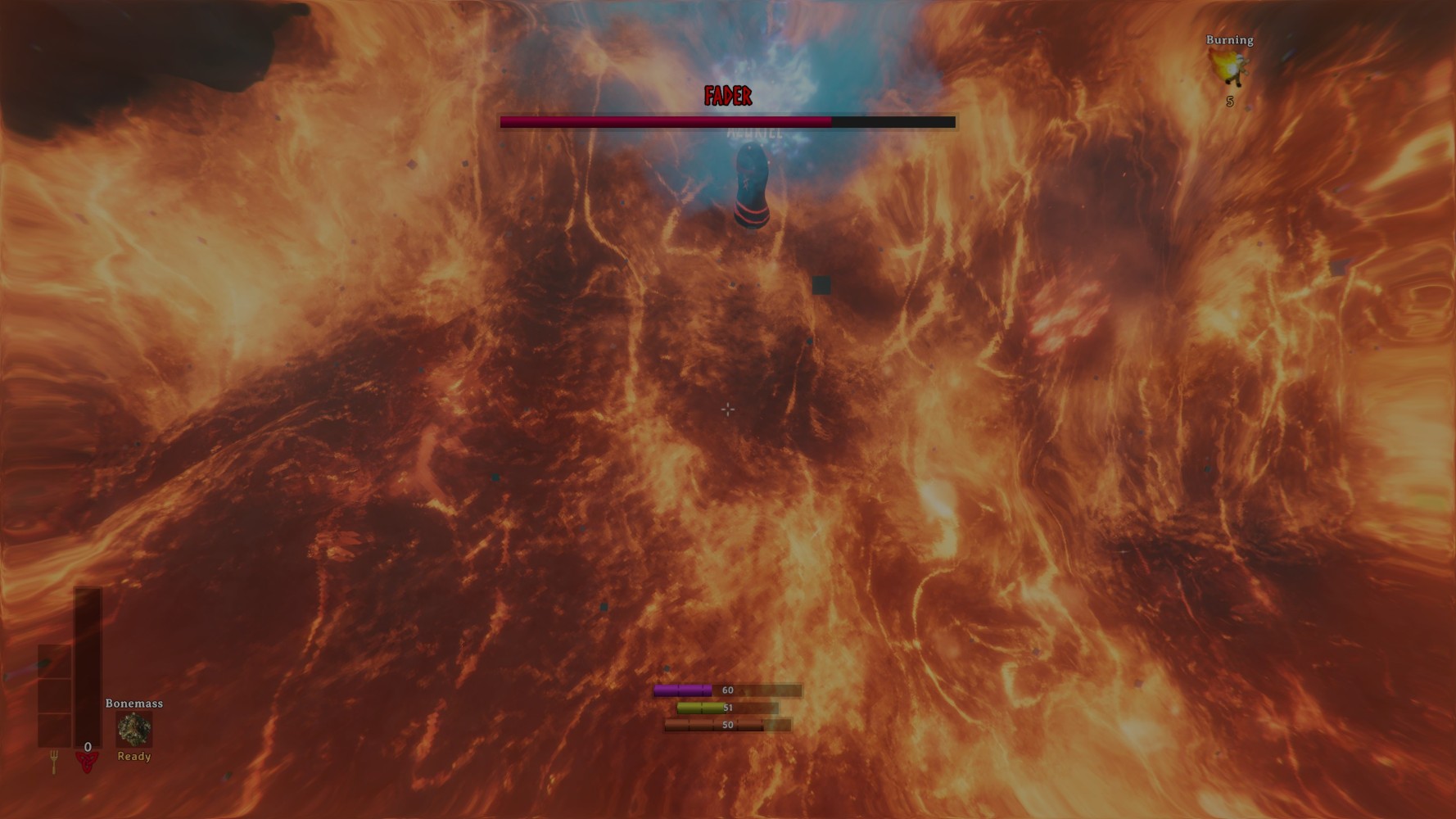
And props to the devs for making corpse retrieval as painful as physically (and emotionally) possible, even on the “easiest” difficulty. I’m not just talking about getting your corpse from the lava right next to a boss fight. I’m talking about how all these attacks create a lot of rock debris, which your character automatically picks up. So, when you run back to your corpse and try to hit “collect all”… you can’t do it. Or when it does work, you are overburdened and are desperately chucking things out of your inventory while under literal fire so you can move at normal speeds.
In any case, once my inventory and outside adds were taken care of, Fader eventually dies like the boring boss it is. Onward to the North!
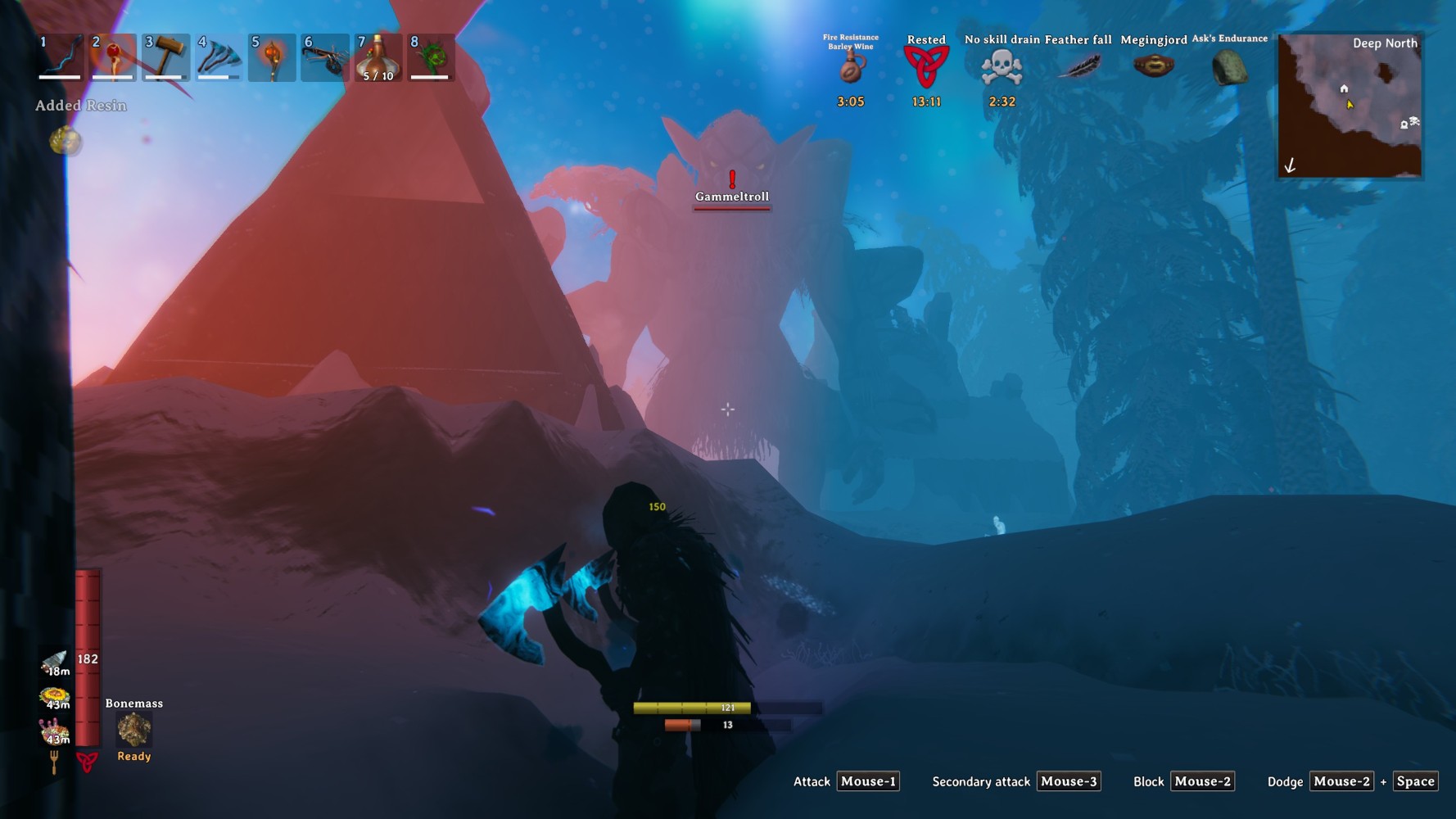
…in which I am fighting Greydwarves and skeletons again? The upgraded troll is indeed upgraded, but nothing there is remotely at the same level as what I just got through. Which is kinda weird, right?
Thinking about it though, I started to realize something that had been bothering me since Mistlands. Specifically, how disjointed the newer biomes have felt in comparison with the originals. The Mistlands felt like a feature-rich biome, with more things than average: new enemies, new ways to get older resources, an entirely new item type (Eiter-fueled), the Grappling Hook, neutral NPCs, and so on. Ashlands? Not so much. The Deep North is similar, with recycled enemies, and random schematic grinding for some reason. Want to get the Vanguard set? Buckle up and kill certain Jotun for your 3% chance of a random one dropping!
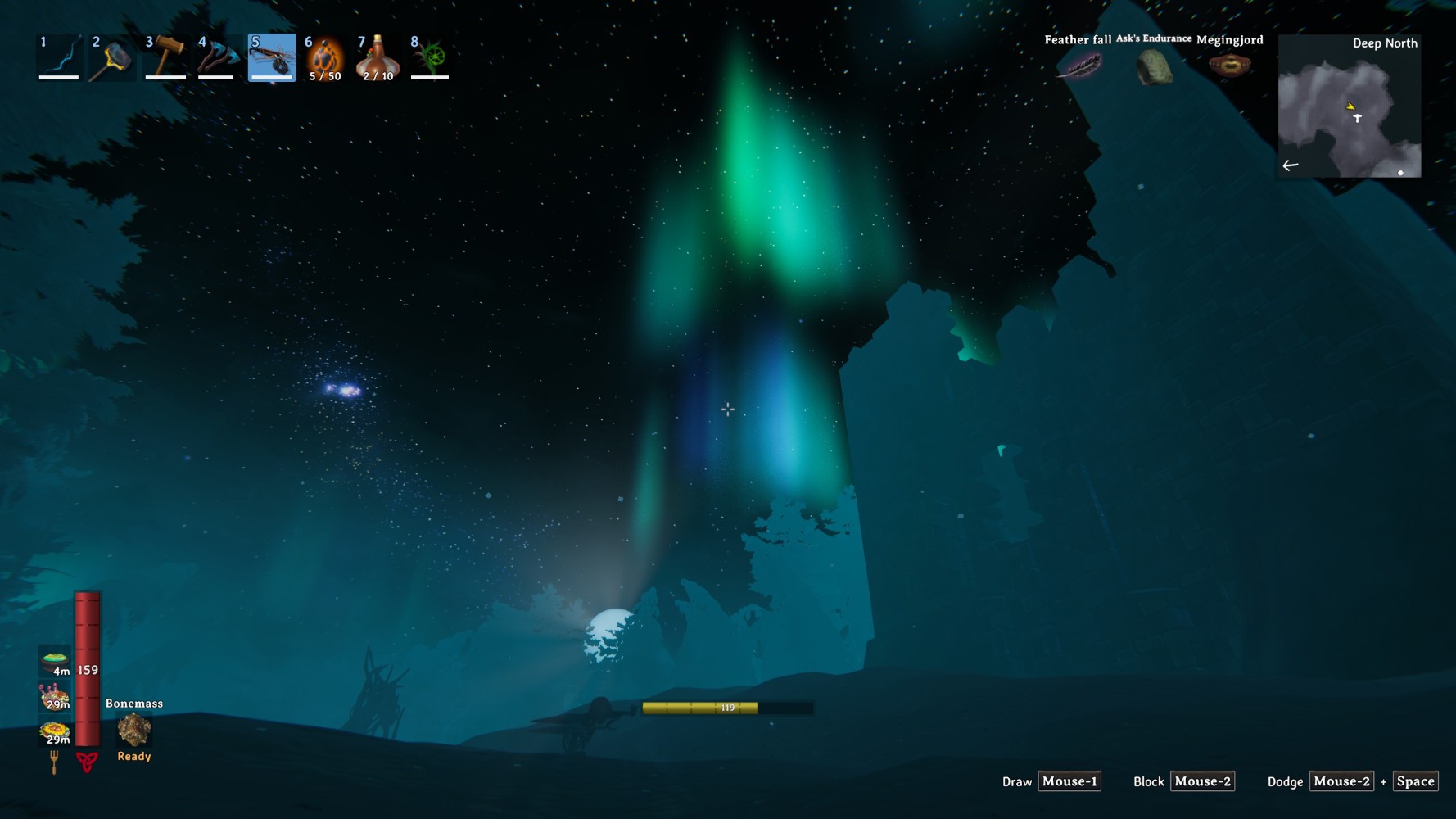
I dunno. Maybe it is just me being done with the game way before the game is done. I have one more McGuffin to grab before I can summon the final boss, and then however long that takes to defeat. I’ve crafted like two items from this final tier, being in no particular hurry to make more as the enemies are dying just fine. In the Plains and Mistlands, I was fighting for my life for every upgrade. Not so much in Ashlands and Deep North.
Onwards and upwards, I guess.
Disappearing Features
Tim Cain has a new video out titled “RPG Features That Are Disappearing” (link below).
To save you 12 minutes, Tim is largely talking about how RPGs 20+ years ago used to have a lot of hidden, unexplained, and/or missable content. The disappearing features are:
- Non-linear stories
- Unguided exploration
- Strong opening, middle, and ending acts
- Companions that can be missed
- “Dumb” dialog (e.g. low INT builds)
- Full character creation
- Focus on combat
- Undefined progress (don’t know how many acts remain, etc)
Towards the end, Tim says:
“I’m being told that those things I like, don’t increase sales. Or the things that do increase sales, like a fully voiced player protagonist, preclude the inclusion of things like dumb dialog or specialized dialog for certain [vampire] clans would be too expensive.”
There is a ongoing zeitgeist that gaming executives across the industry are, in fact, destroying the industry. Chasing trends, designing by committee, general enshittification, and so on. For a large part, I agree. How many subscription MMOs battle royales hero shooters extraction shooters do we really need in 2026 and beyond? How anyone with an MBA expects to be able to chase a trend with a product that takes six years to produce, I will never understand.
At the same time though… are the managers always wrong?
The original Fallout was made in 3.5 years and cost $3 million to develop. Even if we assume 1993 money, that’s still just $7 million after inflation. Fallout 2 was basically completed nine months later. How was that possible back then, and not today? Well, have you seen Fallout 1 & 2? Of course it is going to be easier to slap a few extra companions and unique endings when everything is a 2D sprite, a prerendered background, or some text.
Games are not really made that way anymore. Hell, Tim used Vampire: the Masquerade – Bloodlines as one of his examples of “dumb” (e.g. alternative) dialog features that are disappearing, specifically the Malkavian clan. If you never played Bloodlines, the vampire clan choice during character creation really can change the entire way you approach the game. Pick Malkavian and you will get all kinds of unique, crazy dialog through the entire game (because they’re crazy). Pick Nosferatu and all of a sudden you can’t interact with regular human NPCs. Having such radically different options is (conceptually) good!
Unfortunately, a conceptual good is no match for an objective bad, which was Bloodline’s commercial failure. The game was overbudget, underdeveloped, and its limited sales was the last nail in the, ahem, coffin for the entire studio, which shut down shortly afterwards. Would things have been different if the Malkavian and Nosferatu options did not exist or were watered down? Maybe, maybe not. It’s possible that Bloodlines was doomed at the start for using the prototype Source engine instead of something else… like 2D sprites and just text. Then again, the developers certainly spent a non-zero amount of time working on those clans, balancing them, and so on, all in an environment in which the game was already struggling to be completed on time.
My point is this: sometimes things disappear for a reason.
It would not take me more than 30 seconds to find someone who genuinely feels like Bethesda ruined the Fallout franchise by pivoting to 3D. Counterpoint: Fallout 3 sold 12.4 million copies. OK, yeah, well Fallout 4 was an immense dumbing down of every aspect of what made the franchise great, especially the dialog. Counterpoint: Fallout 4 sold 25 million copies. I am not saying there is a 1:1 causation between sanding down the design edges of a game, and it selling better. Nor do I want to imply that Candy Crush is the pinnacle of game design simply because it made billions of dollars. But… if not proof, there’s something in that pudding. And that sure beats empty pockets.
I do feel like gaming in general is on a bad trajectory. Regardless of causes, AAA games costing $300 million and taking an entire console generation worth of time to release is unsustainable. I can empathize with executives’ desire to water down everything in a desperate attempt to broaden the potential appeal of these all-in games; it’s not going to work, but I can see the logic. It’s also very possible (and likely) that if these auteur developers (like Tim) were left to their own old-school devices, the games would still fail. Failure, in this case, meaning that the game was unable to recoup its costs.
On the bright side, we do have the continued maturation of the indie scene/AA space, the occasional Baldur’s Gate 3, and the fact that all these old games still exist. You can go play them right now, if you want. Assuming you can bring yourself to do so. I don’t know about anyone else, but whatever part of me that was fine with spending my vanishingly small gaming time aimlessly wandering around to achieve intentionally (!) vague objectives died long ago.
Mistlands Complete
Just wanted to make a quick note here that I have completed the Mistlands in Valheim.
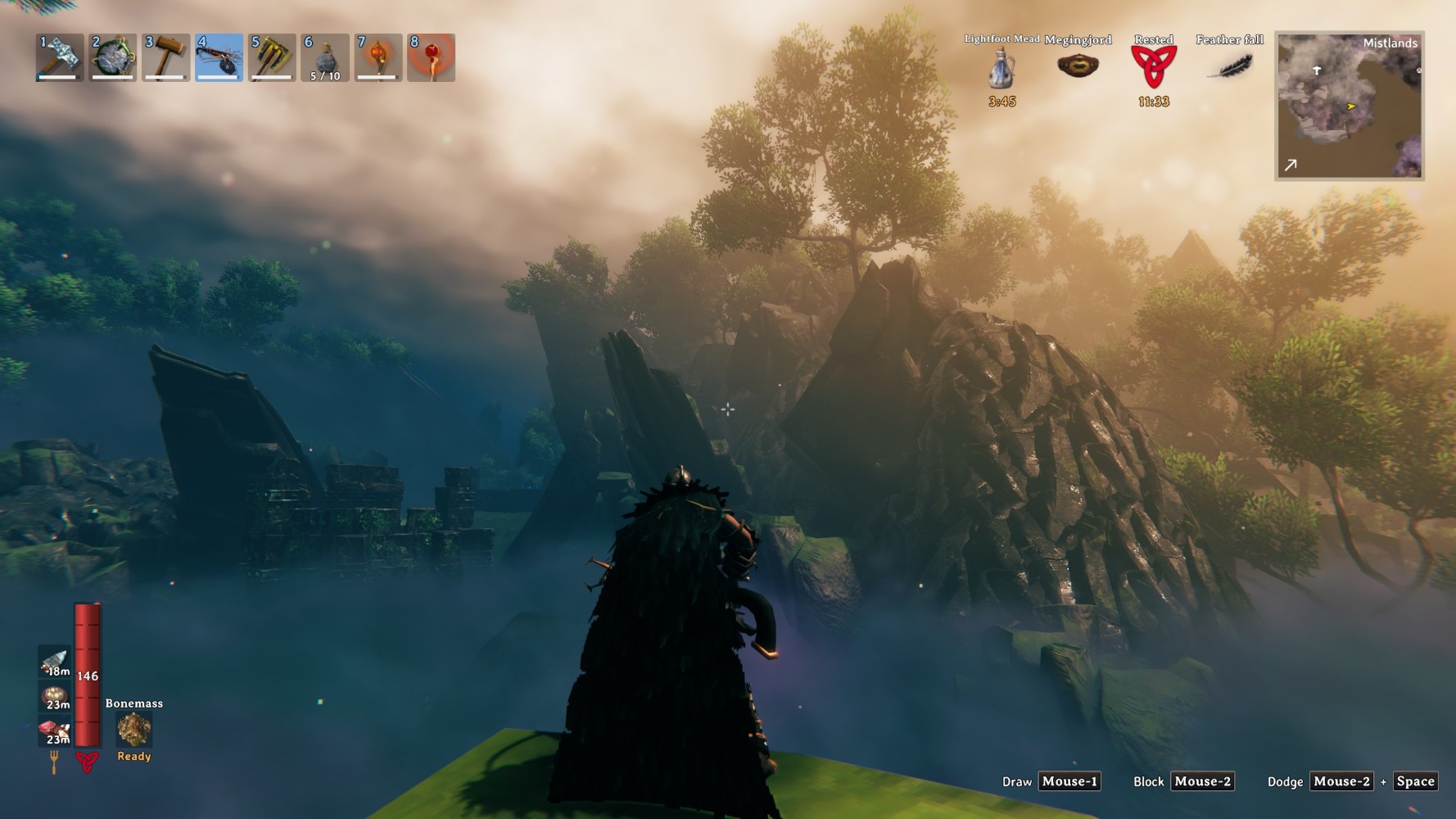
You know, for all the people complaining about the Mistlands, I found it surprisingly… fine.
As the name suggests, the entire region in shrouded in fog all the time. Your original access to the biome is soft-gated by your ability to craft an accessory that clears a 10m bubble around yourself to let you see where you’re going. After felling the first Yggdrasill sapling, you unlock a recipe for creating a sort of wisp-based standing torch that clears out a 20m bubble wherever it is dropped. Maybe this torch was buffed for the 1.0 release or something, but its existence – and my extensive experience playing Minecraft – meant the mists were simply a matter of spamming the torches everywhere. So, I did. And it was fine.
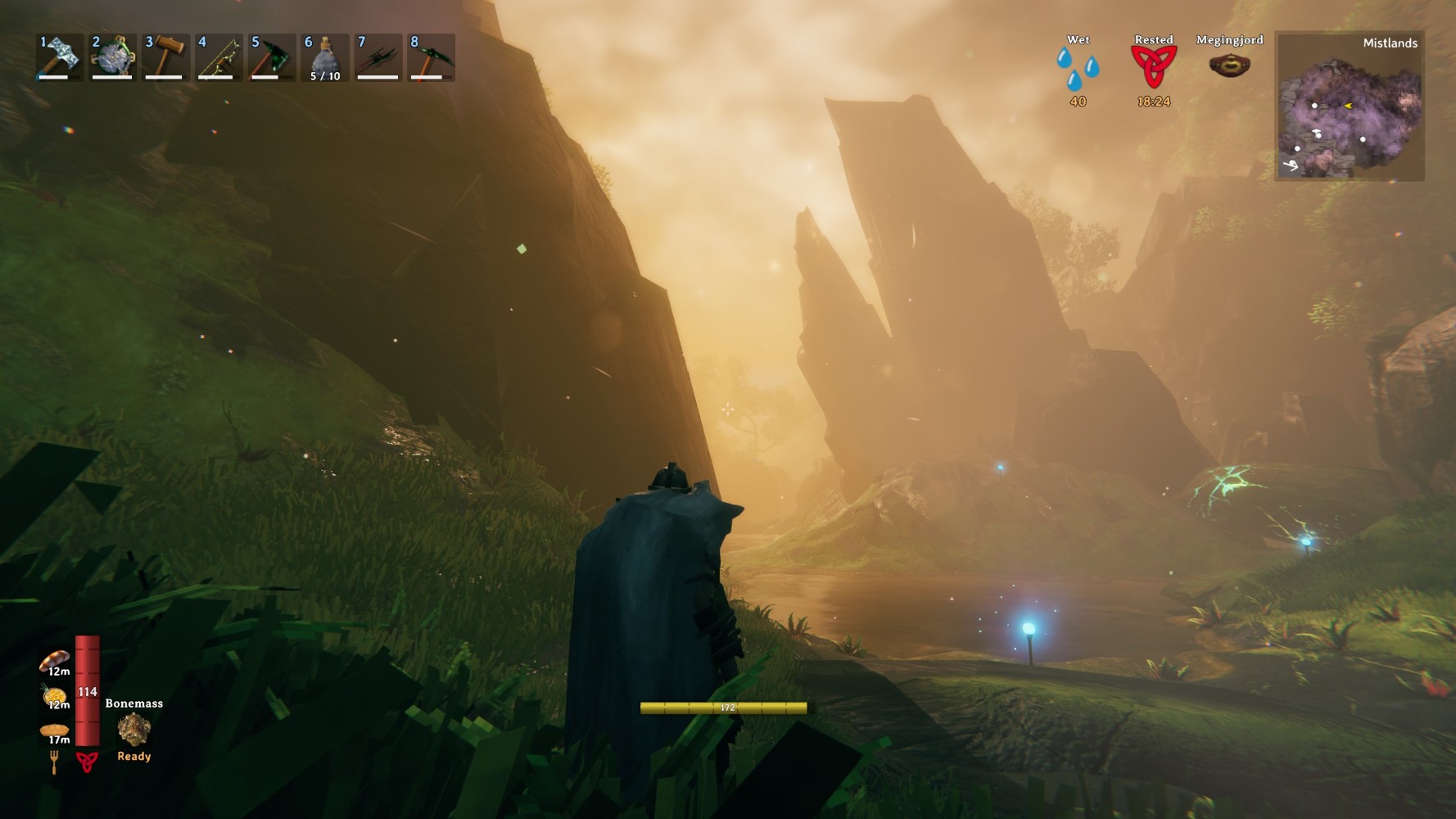
In fact, I would say it is more than fine: the Mistlands has been fantastic. It might even be my favorite biome thus far. You have obviously been able to see the giant roots of Yggdrarsill in the sky since Day 1 in the Meadows; in the Mistlands though, you can tap its very roots. You scavenge the petrified bones of ancient giants, cracking open their skulls to mine their Soft Tissue (i.e. brains) so you can feed it into a woodchipper-like machine to distill its essence to make magic gear. Their enormous helms and swords can be broken down for Copper and Iron too. The Gjall legit evoked a primal, Silent Hill-level of fear with its fog horn warning cry in the distance.
Look at those screenshots.
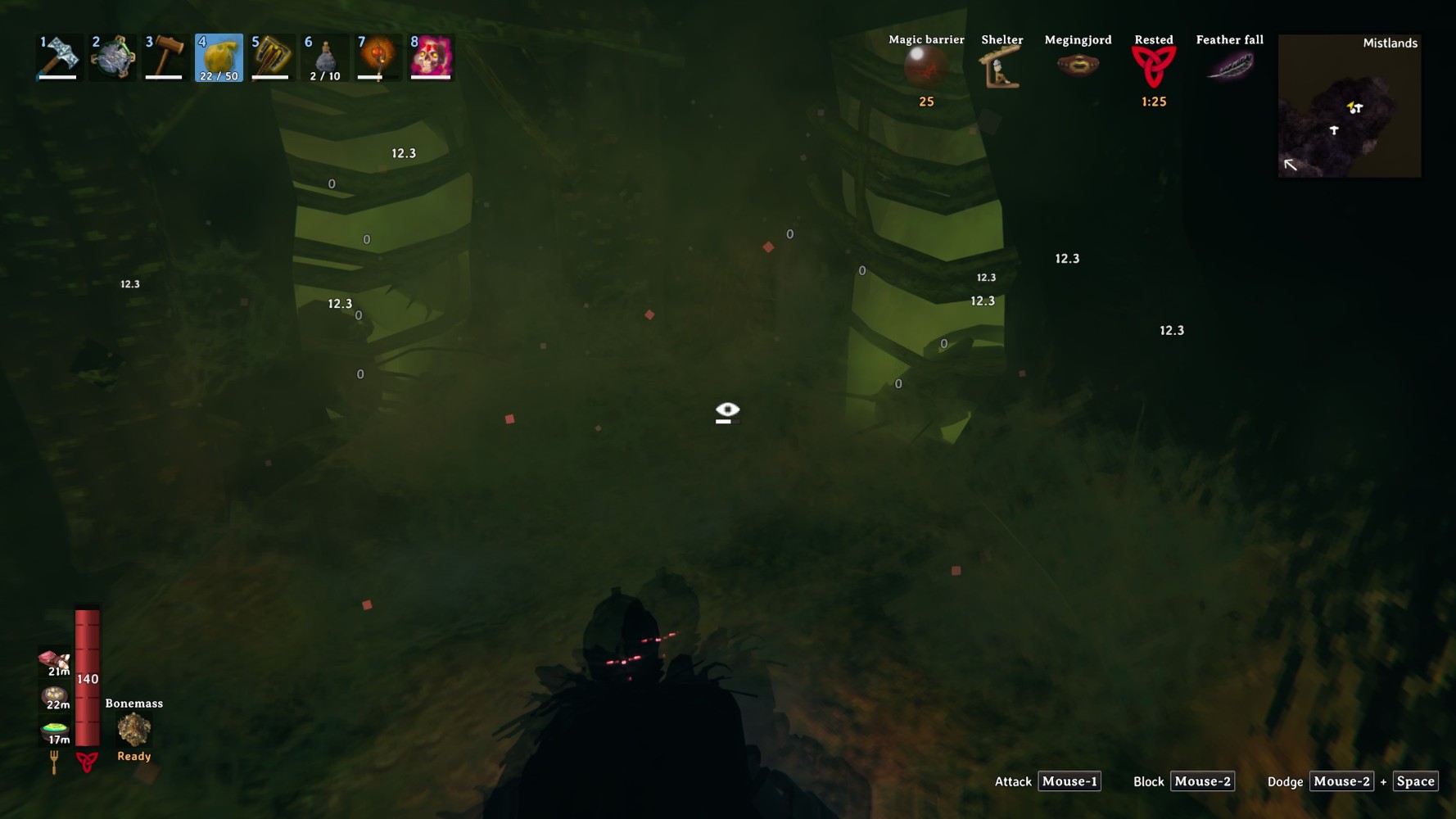
Anyway, I will say that the Queen fight was some outrageous bullshit. I have the death penalty set to the lowest level, which means I get to keep any equipped gear. Even then, it took like twelve deaths across five in-game days to make any meaningful progress. I can’t even imagine running around naked, chased by 30 bugs, trying to retrieve your corpse on the 3rd floor or whatever. Several times I got pushed into a corner with the spit attack, which then spawns a bunch of grubs, which prevented me from leaving said corner. Then I died. It is possible I should have been using the 2H hammer or whatever, but I literally had zero skill in the weapon, so I stuck with magic and 1H hammer + shield.
Anyway, I eventually won. And now onwards to the Ashlands.
Valheim “Exploration”
I’m going to come out and say it: Valheim’s “exploration” is shit.
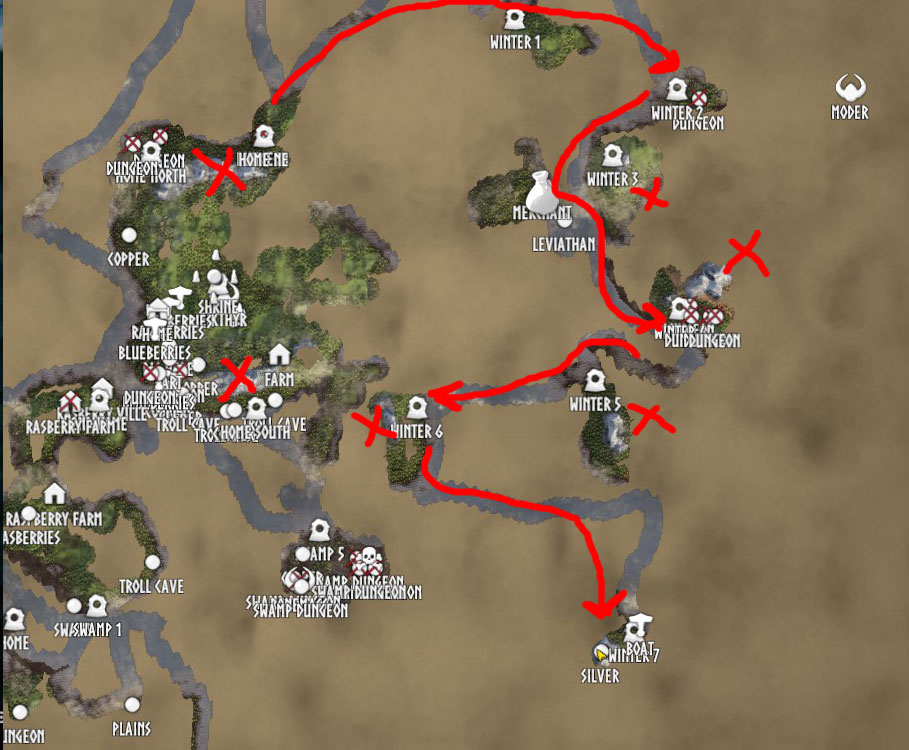
It may come as somewhat of a shock, but I am not an Explorer. Per se. I enjoy survival crafting games, and one of the biggest decisions you make in them is where you want to build your base. As such, I will happily traverse the world in search for the perfect location, and am always reevaluating the merits of better ones. Coming across rare resources, especially ones that regenerate, tickles my fancy. Nary a waterfall escapes examination for secret caves. I do pause for sunsets.
At the same time, rearranging a room with four objects doesn’t generate an infinite amount of novelty.
Valheim will procedurally generate a world for you with appropriate biomes scattered about, and then randomly populate those biomes with progression-required resources/POIs (points of interest). It is not enough to find just any Swamp, you must find a Swamp with a Sunken Crypt, before getting access to enough Scrap Iron to build better gear. This particular aspect is annoying, but not backbreaking.
What quickly becomes backbreaking is the additional layer of RNG: locating the randomly-assigned boss-locator tablet, which only appears in certain randomly-distributed POIs a percentage of the time. It is not enough to find an abandoned stone tower in the Mountains, you must find enough to get enough dice rolls to have one spawn the tablet.
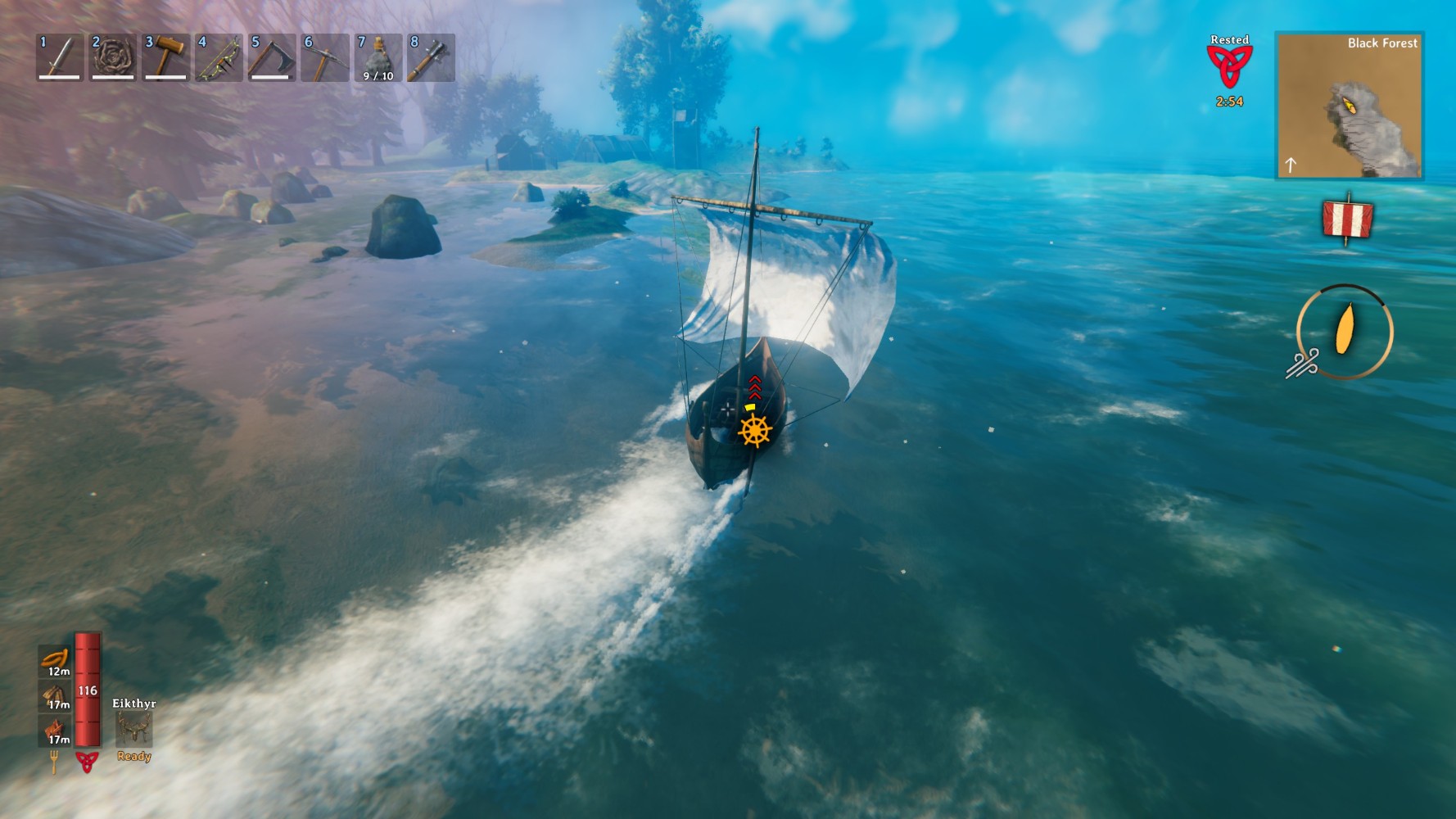
The variability is a problem, but not the biggest one. The problem is how you can be “done” with all the progression in a biome and yet still have to spend several real-life hours “exploring” for these POIs. Meanwhile, there is nothing new for you to encounter. Is the terrain different? Sure. But that’s it. Maybe you find a better location for reconstructing a Plains base or whatever, but are you really going to move everything right as you’re looking for the Plains boss so you can head to the next biome? Certain POIs will have treasure chests, but the contents of them are all standard resources. None of the hostile mobs you encounter will be any different than the ones you defeated hours ago with worse gear.
The initial foray in the unknown? Premium tier. Walking into a new biome for the first time is a terrifying experience. What should you be looking for? How deadly could a “Deathsquitto” really be (spoilers: very)? Progression feels good as you slowly upgrade your armor and weapons, making the dangers a little bit less so.
But then… there’s a gap. Sometimes a gulf, between you and even locating the boss you have prepared yourself to tackle. And Valheim nevertheless requires you to drudge around for… some reason. Ambiance? Hubris? Maybe they expect you to die and lose all your gear and then need to re-smelt all the ore and collect all the resources all over again somewhere else? It’s dumb.
I did not think it was possible to create an exploration system worse than Starfield, but the Valheim devs did it. Because at least in Starfield, it wasn’t required.
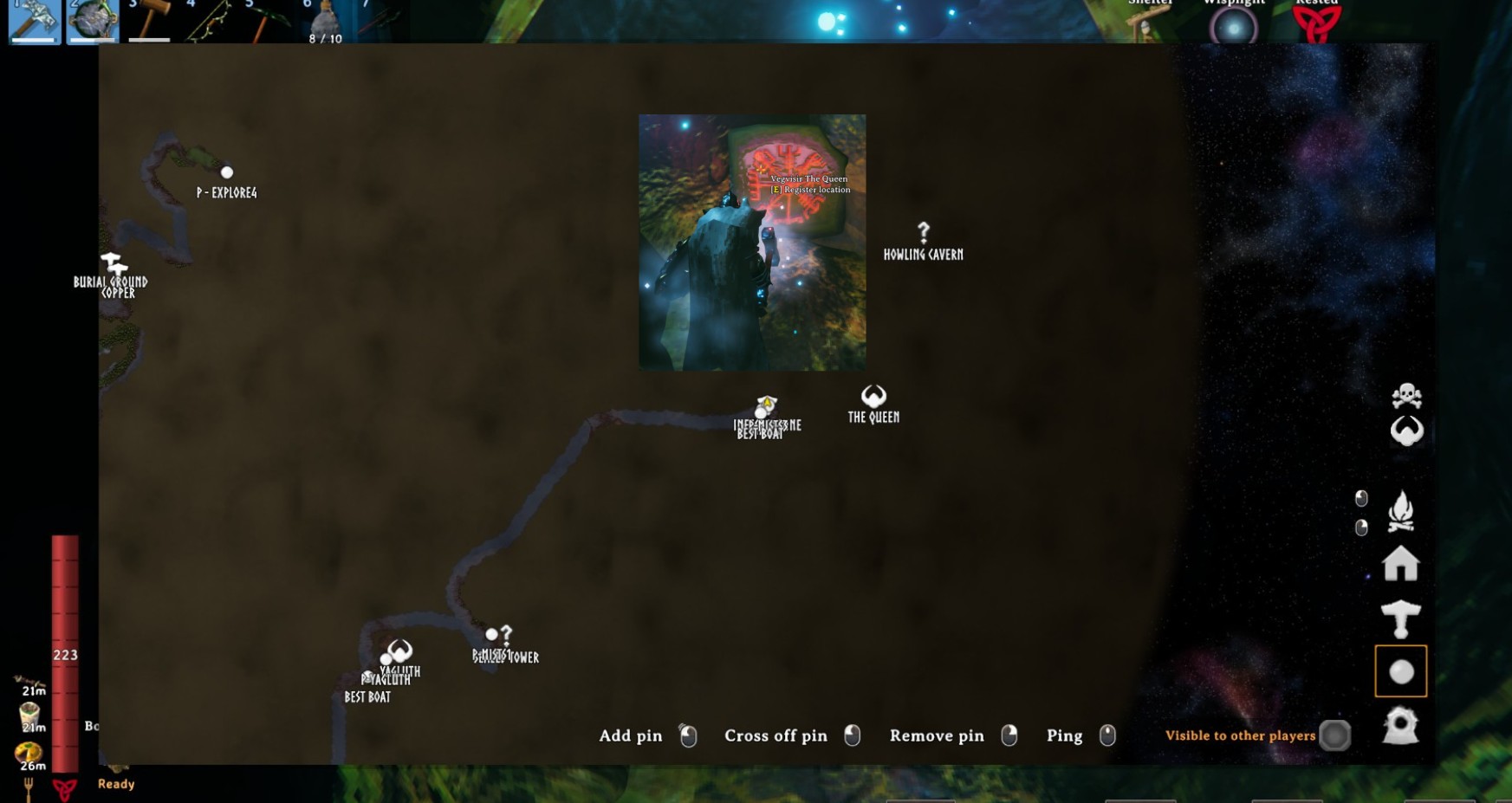
I’m currently in the Mistlands, and do you know how things have went thus far? The very first place I docked my boat had the POI that you need to raid for progression material. And inside that same POI was the tablet that showed me the boss location. Do you know what it didn’t have? Enough progression material to actually build the crafting tables to make the new weapons/armor/etc. Sounds like the reverse problem to what I had earlier, right? But this time I will be rewarded for my hunt for another POI with access to all kinds of new weapons and armor. Even if I have to go to a completely different Mistlands area, the carrot is still on the stick. In just about every other biome up to this point, the carrot was long gone, and it was just all stick. And that’s shit design, IMO.
I do (thus far) appreciate what the devs have been able to accomplish with Valheim given its spartan design. This does not feel like a game that only takes up 4.23 GB of space. Nevertheless, I do feel like they have hewn things a bit too much to the bone. If it goes against their design principles to have a sort of “pity timer” that will guarantee the boss tablet by the third POI or some way to spend a bunch of resources to divine the location yourself, it would be helpful to at least pepper some random useful shit across these biomes we slog through.
Valheim’s Subtle, Genius Design
I am going to complain about Valheim later, but before I do so, I wanted to get some words out in praise of some of its subtler elements of genius design. Specifically, there are two main elements: food and base-building. I’m going to talk about both as someone still in the Plains biome.
Counter-intuitively, in many survival-crafting games food is usually an afterthought. There might be a time period right at the beginning where you are scrounging for edibles anywhere you can, but thereafter hunger is just another meter you manage. Or more accurately, a meter you forget about completely until it is actively flashing at you. Certain “late-game” foods might provide specific buffs to damage or whatever, but it is clearly a bonus reward to encourage you to treat the design with more seriousness than it ever truly merits.
This is not at all the case with Valheim: your next meal is always top of mind at every stage of the game. And it achieves this, ironically, with no technical penalty for not eating. You will never starve to death in Valheim. Instead, you will… just have the default amount of HP and Stamina. Which is fine for a minute in the early game, but becomes a brutal setback nearly anywhere else.
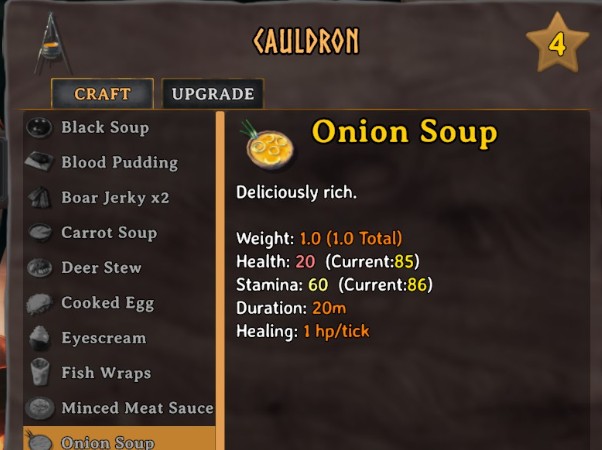
In Valheim, you have three “slots” for food. Each piece of food grants you some amount of extra HP, Stamina, and healing per interval. However, you can’t just eat the same thing three times, as the food slots are mutually exclusive. This automatically elevates the food/cooking system way past almost all traditional survival crafting games, into the realm of Green Hell and similar ones that track individual macros like Protein and Carbs. Unlike the super technical ones though, Valheim doesn’t care if you eat the same three (unique) dishes each day, nor does it bear the same burden of UI overhead. Food just gives the same three stats in varying amounts, for varying amounts of time. Want to subsist on just Turnips and Onions and Onion Soup? Go for it… but good luck not getting one-shot in the next biome.
As a sidebar, I also appreciate what Valheim does (thus far) when it comes to obsoletion of materials as you progress. After defeating a boss, you typically unlock something that allows you to process the next biome’s materials, which you need in order to take on the next boss. That’s pretty standard. What has been nice though, is that food/equipment still makes use of older ingredients in fairly rational ways. Some might find this grindy to have to head back into the Swamp for Iron or Blood Bags or whatever, but I appreciate the (usually) measured approach of some items requiring older mats.
Finally, I want to talk about the meat (ahem) of the genius design: the campfire.
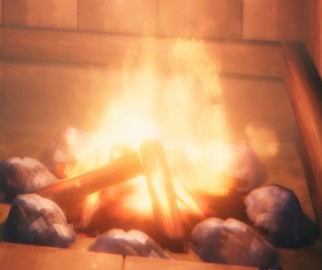
Real talk, Valheim slaughtered the sacred cow that almost every survival game raised without even knowing it, e.g. fires producing smoke. In almost every other game, you start by building a 2×2 box for a base, and throw everything inside… including the campfire. After all, rain will put a camp fire out, and you cannot fast-forward the night without being within a certain radius of a lit fire. In Valheim, however, unventilated fires also produce smoke, which creates a damaging debuff which can kill you.
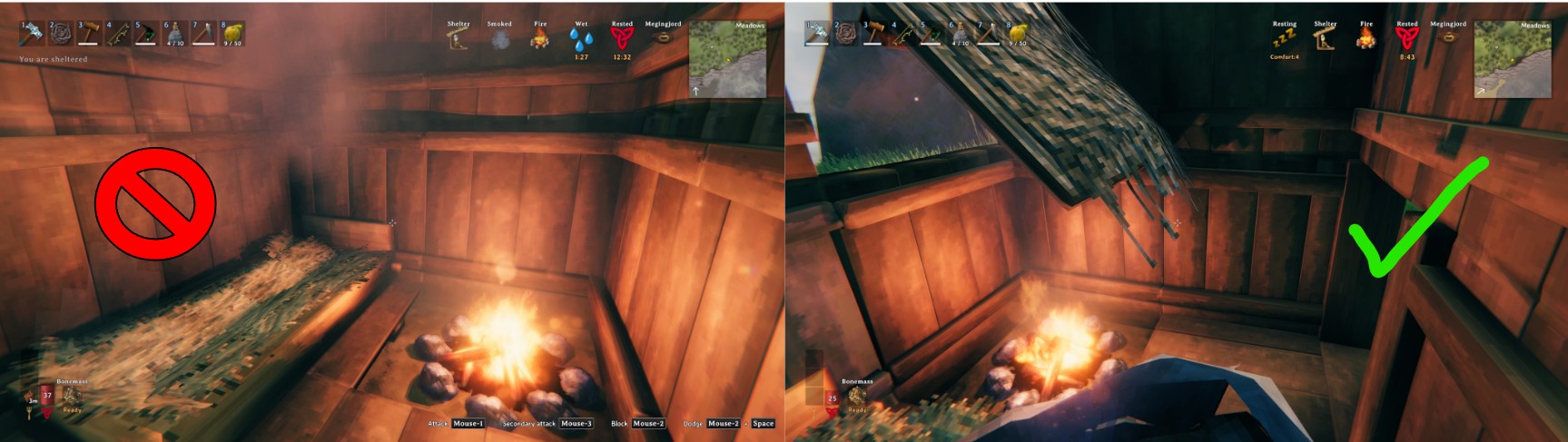
And that’s it. One simple change elevates the game beyond many of its peers in the genre. Not because it’s realistic (it is), but because of what it changes about how the player approaches base design. My own progression went something like this:
- Builds a 2×2 square box… ouch, getting smoked out
- Builds a 3×3 box with the center tile open… and it rained
- Get annoyed, place the campfire outside with a janky lean-to protecting it
- Get annoyed standing in the rain to cook my own food. Hmm.
- Put campfire back in the middle of 3×3 box, create a 1×1 elevated roof. It works!
- Get annoyed accidentally walking into campfire so many times
- Tear down wall in back corner, place campfire there, with a “range hood”. It works!
- ???
- Realize why (fantasy) Viking architecture all looks like the way it does
It may not seem revolutionary that a game with Viking-themed set pieces ends up encouraging players to build Viking-looking bases. But consider how the genre’s bar for successfully encouraging anything beyond a wooden survival cube is practically nonexistent. The closest I have felt to such an inspired synergy between mechanics and aesthetics was Nightingale, which wore its Valheim inspirations on its lanternpunk sleeve.
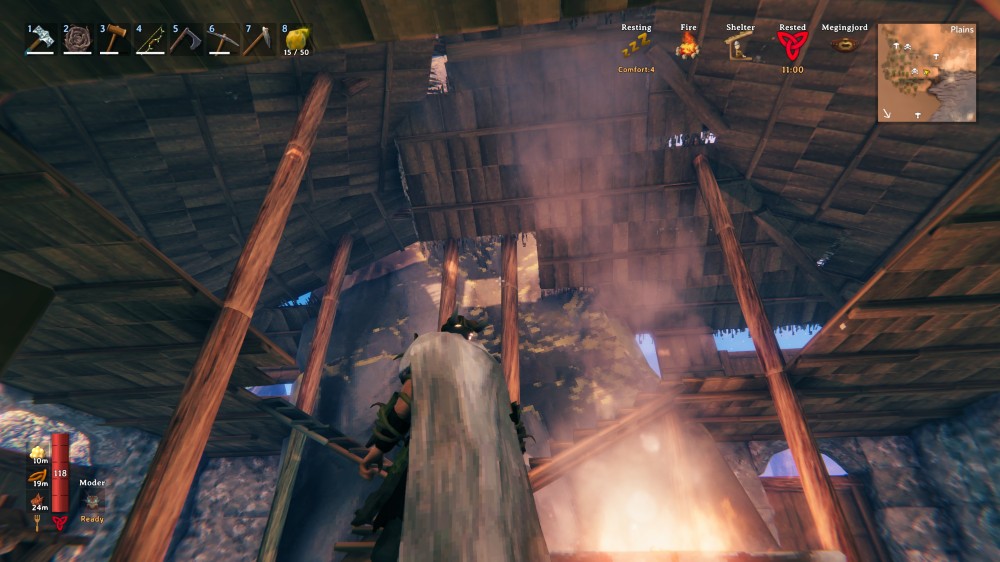
In any case, my compliments to the devs on these two, specific points.
Digital License Transfer
This is kind of a “summarize a Youtube video” post, but since I have talked about digital ownership in the past, I felt it prudent to mark the occasion.
Legendary Drops has a recent video talking about how Xbox is rolling out a new feature that allows players with physical discs to effectively “claim” a bonus digital license of that same game to use with Play Anywhere and cloud streaming. If you then sell the game disc to someone else, that new person can claim the game instead, thereby revoking your own license. You can watch the video below:
I didn’t actually think too much about the Xbox announcement until Legendary Drops spelled it out for me, and he is exactly correct: this is the beginnings of true digital ownership. Well, “ownership*.” You cannot directly sell the digital license to another person, and none of these benefits apply to someone who straight-up bought the game digitally. And it’s still possible that Xbox follows in Sony’s footsteps and says no physical discs will be made for the next-gen console. It’d be weird to do so right after an announcement like this, but it’s Microsoft, they’ve hurt themselves in confusion more than once.
But. BUT. They’re doing the thing. A transferrable digital license… tied to a physical disc… but still a transferrable digital license. Nobody can make the argument anymore that the infrastructure necessary to support transferrable licenses would be too complicated or onerous. Microsoft is starting this whole thing right now.
Who is next? Nintendo? God, I would love that. Maybe… Steam?!
Realistically, probably not. It may just end up being Microsoft flapping alone in the wind here, as they are certainly the most desperate and in need for any angle to get them back into (and selling) the game(s). Still, it’s something, and certainly more than we had two months ago.
Vacation Over
I have survived another vacation.
As part of the packing for the trip, I brought the Switch 2, the Retroid Pocket 6, the RG35XXSP, and of course our phones. A full week away from my PC and typical setup would be a perfect use-case scenario for all these retro machines, right? And I would have been very happy to report how much use they had gotten given how much money was spent on their purchases.
…if I they had gotten much use.
In reality, what happened during the copious amount of downtime was… playing games on my phone. Specifically, a game called Slice & Dice, which I reviewed four years ago . It’s basically a dice-rolling roguelike where you have a selection of party members facing a variety of enemies, you have a choice between a few random items or class upgrade after each fight, and yeah, that’s basically it. I had “beaten” most everything a few years ago, but apparently the devs had released some more content since then, so I spent some considerable hours going through it again.
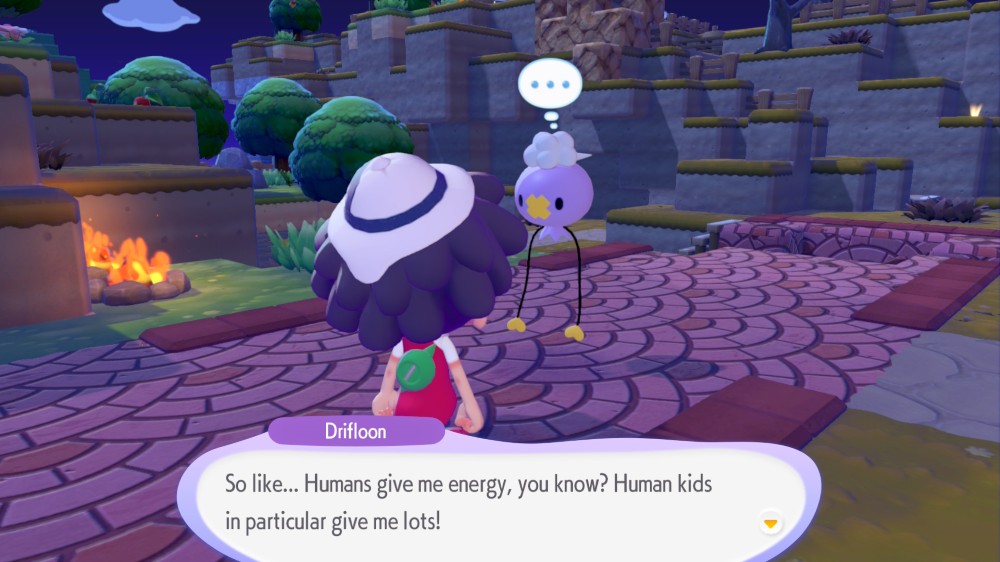
The other game I played the most of was actually Pokémon Pokopia on the Switch 2. This was purchased by my wife just prior to the trip, as she had a hankering for something similar to her Harvest Moon nostalgia of yore. To be clear, Pokopia is nothing like Harvest Moon, aside from the vibe. Anyway, I started up my own save – we have separate Switch profiles already – and played two longish sessions.
Pokopia a very weird game. You are actually a Ditto pokemon who becomes the image of the human you loved, in a sort of post-apocalyptic wasteland area devoid of both humans and pokemon, aside from a “professor”-looking one. Another pokemon appears in a near-death state (implied), you gain the ability to copy a sort of watering can-like ability to save them, and things start improving. As you heal the environment with the water, you can help start setting up specific pokemon habitats (four squares of tall grass, four squares of tall grass near a tree, etc) that will cause certain pokemon to spontaneously appear. The more pokemon, the more abilities you can copy, the more lively the world gets, the more building options open up, and so on and so forth.
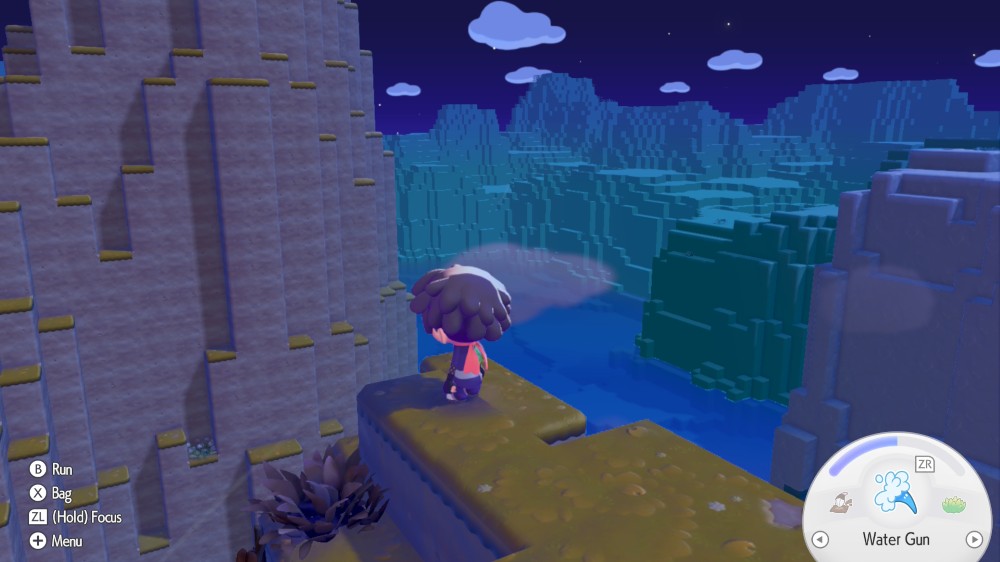
The whole setup sorta reminded me of My Time at Portia, wherein there was certainly a cataclysmic event in the past that resulted in widespread death and destruction, but the event itself is not the focus. You can see the effects, but no one is especially dwelling on what was lost. That is a surprisingly ripe narrative juxtaposition, and I’m for it.
With Pokopia though, the childlike angle makes it particularly grim, IMO. The professor pokemon asks you to help restore the environment and destroyed human houses because, as evidenced by the returning pokemon, maybe the humans will come back too if only you restore their “habitat.” Maybe this will be played straight, with the humans emerging from underground bunkers or whatever once the entire wasteland is green once more or whatever. I could also imagine it not being directly resolved at all in a sort of Hachikō situation, because Japanese devs sometimes like crushing melancholy.
We shall see.
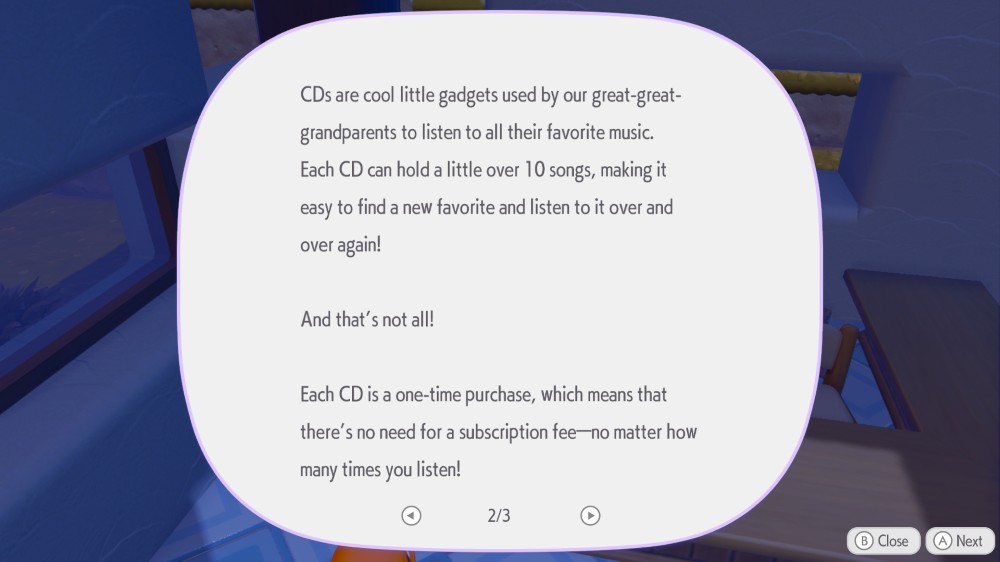
I did boot up the RP6 a few times, but only actually got into any games one time. I’ve talked about it before, but one of the problems with these retro machines is the fact that you have to be prepared to play them. In my case, that means headphones and the desire of solitude to put them on. For example, I got past the title screen of Final Fantasy Tactics and Chrono Trigger on two occasions, and turned them off because what is the point if you aren’t listening to the music too? It’s like eating without a sense of smell. Slice & Dice can easily be played without sound, turned off at a moment’s notice and easily gotten back into. These other games were never designed for quick, silent sessions.
Anyway, the two games on the RP6 I gave an honest college try with was Thomas Was Alone and Donut County. The former was utterly unplayable via GameNative despite being “compatible,” but the latter was perfectly fine. I got through some levels, which involves moving a hole around the map to swallow increasingly-large items, had some laughs at the dialog, and then turned it off. If shit really does hit the fan, I’ll be glad I can game on something that draws 6 watts instead of 600, but until then? Maybe not the most prudent purchases I have ever done.
I’m banking on Little Man eventually wanting his own console in his own room eventually, and maybe they’ll get a second (or first) life then.
In-Game Ads
I was doomscrolling today and came across this Youtube Short from Legendary Drops concerning in-game advertising being more fully explored by EA, Microsoft, and Sony, all practically at once:
I actually watch quite a bit of Legendary Drops, as he has some rather humorous (and compelling) takedowns of AAA studios and the nonsense they are engaging with these days. Which, apparently, includes feeling the temperature on including advertising within the games they are selling. The Short itself does not contain links to specific articles, so I had to do some digging around for the links.
- Introducing EA Advertising
- Beginning Ad-supported Game Streaming Test & Learn (Xbox)
- Sony is scaling up its Playstation advertising ambitions
As the Sony article points out, this is not everyone’s first rodeo:
This isn’t the first time Sony has tried to build an ads business around its video games division. It’s made three prior runs at monetizing PlayStation’s audience through advertising rather than hardware or subscriptions. In 2008, it launched dynamic in-game advertising on PS3. That same year, Sony opened PlayStation Home, a virtual world that doubled as branded real estate. Then in 2022, Bloomberg reported Sony had spent 18 months quietly developing a system to insert ads directly into PlayStation games, aiming to launch a private marketplace by the end of that year. None of them became a durable, scaled ads business.
It is 2026 and we are probably all well past this being a particular shock. F2P mobile games have had advertising since forever, including more pernicious gameplay-affecting ones. Indeed, one of my most-played mobile games is Tavern Rumble, a roguelite deck-builder that will give you the equivalent of +2 Strength, healing, etc, if you watch some ads after each fight. That’s… not OK. I ended up buying the “ad remover” for the game for $10 or whatever years ago, but even now, it’s hard to say whether the boosts are just extra, or whether the game was specifically balanced around them. For example, having played Candy Crush, you could not possibly convince me that some of the RNG in certain levels are beatable without power-ups, whether accrued for free over time or purchased directly.
And don’t forget the weird shit too, like Monster Energy drinks in Death Stranding:
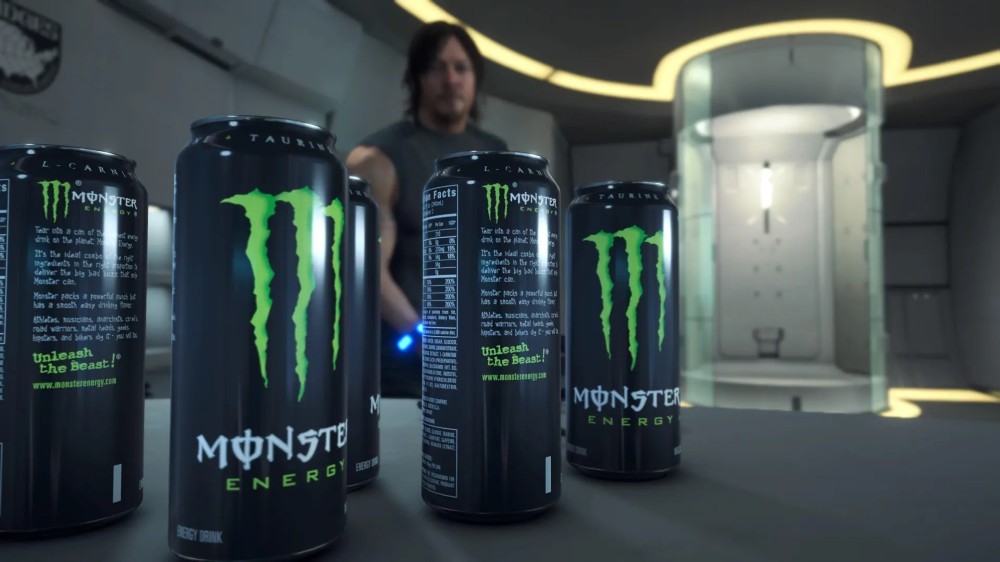
At the moment, it is not entirely clear the exact direction the enshittification is going. When looking at the EA page, they are talking about “dynamic, real-time placements, from stadium signage to custom in-game content.” Any sort of sports game would probably look uncanny without real-ish ads plastered about, considering that is what everyone sees IRL watching from home. Same with the hoods of racing cars, etc. With XBox, it sounds a lot more like a “free with ads” subscription tier rather than seeing a Microsoft Copilot banner in the Master Chief’s visor. With Sony… who even knows, to be honest. Sony has been losing so much money lately that it would not surprise me that they end up being the worst ad offenders eventually.
Steam sometimes gets touted as a bulwark of consumer protection… and it’s true, to a point. Steam does not run ads in the client, and specifically forbids games from having mobile-esque ads:
- Developers should not utilize paid advertising as a business model in their game, such as requiring players to watch or otherwise engage with advertising in order to play, or gating gameplay behind advertising. If your game’s business model relies on advertising on other platforms, you will need to remove those elements before shipping on Steam. Some options you could consider include switching to a single purchase “paid app,” or making your game free to play with optional upgrades sold via Microtransactions or Downloadable Content (DLC).
- Developers should not use advertising as a way to provide value to players, such as giving players a reward for watching or engaging with advertising in their game.
That same policy does allow “product placements,” which is largely reasonable. As jarring as seeing Monster Energy drinks in your videogame can be, it is difficult to draw a distinction between that and the fact that a very Norman Reedus is the one doing so. As long as you don’t have to drink a verification can, I guess it can slide. Christ, was that really 13 years ago?
In any case, as odious as advertising is generally and how annoying it is seeing it infiltrate yet another facet of our lives, I feel like it may end up working itself out. If a particular game is festooned with ads, and it breaks immersion, don’t buy that game. If there are ads in the storefront, well, yeah… stores often do. Just about the worse-case scenario might be forcing ads to display prior to playing a game, which sounds like what Microsoft is testing in the context of a “free streaming” offering. Which is a tradeoff you ostensively signed up for.
Ultimately though, the days for any kind of corporate shenanigans may be numbered. The entire business model around AAA gaming is on the verge of collapse, so I kinda doubt even the C-suite are going to gamble throwing ads into their next 6-year, $300+ million game and have that be the reason it failed. Sony can take their toys off Steam and go home, but hilariously, their ability to output said toys within their own console generation has the same upper limits as everyone else. Let them release a $1000+ PS6 with five exclusive games, a locked-down storefront, and sprinkle some intrusive ads for flavor and see what happens.
Switch to Switch 2
Longtime readers may recall that I was debating between the Switch vs Switch 2 last year, once Little Man came to a videogame awakening. I ended up purchasing a new Switch OLED bundle with Mario Kart 8 for $275 total last July. Plus, a kinda dumb amount of games… almost all of which got played! He’s not quite ready for Smash Bros yet. I am overall pleased with how that situation shook out.
Now, a year later and almost exactly to the day, I also bought (and since received) a Switch 2.
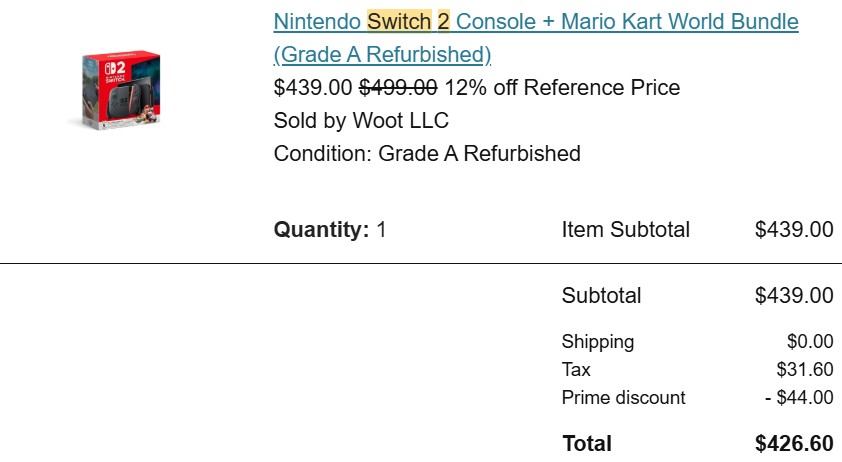
The Switch 2 bundle cost a total of $426.60, which is obviously much higher than the original Switch. Plus, you know, I still have the original Switch. What gives? Several kinda sorta related things.
- There is a pending $50 price hike for the console in September
- Zelda: Ocarina of Time Remake releasing in 2026
- I already own Zelda: Tears of the Kingdom plus have Nintendo expansion pass subscription, meaning I could get upgraded graphics/fps for when we start playing that
- Super Mario Sunshine is coming to the GameCube emulator (requires expansion pass)
- Missed the most recent Costco eShop gift card sale, e.g. $500 credit for $400 spent
- Donkey Kong Bananza is closest to Mario Odyssey, so Little Man may enjoy that
- Switch 2 version of Minecraft releasing in October
That, no doubt, sounds like a lot of explanation concerning a topic that should warrant none.
“Who you trying to convince?” Yes, me, myself. I routinely agonize over $15 game purchases, and whether 67% off is worth it considering the all-time-low was 70% three months ago. I once bought a game from an overseas storefront and ended up getting my bank account frozen “out of caution,” all trying to save $3 versus just buying it on Steam. I was not in any way depending on that $3, it was just the principle of the thing. I mean, hell, it was a Steam code in the first place!
Whatever. It’s done. The Switch 2 is fully functional – the refurbishment tag apparently referred to the box having beat-up corners – and has replaced the original Switch in all ways. I could sell the original for… looks like $160 on eBay at the moment, but my assumption is that it will stick around. Partly as a backup device, partly as an inheritable device, and partly because my wife mentioned she may want to play stuff on it. Theoretically, I could do local co-op with some games, but I have not yet done the research for which games require two copies and which can be shared.
It is kind of funny/sad looking at the list of games in the Nintendo eShop and realizing how many I already own on Steam, often for much less. Although, now that I’m looking, maybe not. For example, We Love Katamari REROLL is like $7.50 on Switch and the IsThereAnyDeal lowest was $5.77 two years ago. Donut County is $3.24 versus $2.43. I even bought that last one in a bundle deal like two months ago. Huh. For some reason I thought that something like Hollow Knight: Silksong retailed for more on Switch, but apparently the MSRP is the same.
I still prefer gaming on the PC, and Steam allows for me leverage my Retroid Pocket 6 if I need to go mobile, but this is starting to make me think about some things. Not for now, but perhaps in the future.


End of BioWare
Oct 22
Posted by Azuriel
EA is straight-up shutting down BioWare. From the farewell letter (source):
So, yeah, no more Mass Effect 4. Chances are that we never see entries in these franchises ever again.
There is a lot of blame to go around. The immediate villain is EA and their new private equity masters, as they were the ones to pull the trigger. At the same time, BioWare’s last three releases were Mass Effect: Andromeda, Anthem, and Dragon Age: Veilguard. How many studios could survive a string of three commercial failures in a row? If BioWare was independent, they would already be dead.
“It was EA’s focus on live-service and monetization that ruined BioWare.” That sort of thing doesn’t help, but have you read anything about how BioWare was “developing” these games? Andromeda had 4 years of wildly varying design direction where anyone struggled to find the fun, and then was crunched into its final form in 18 months. Anthem? Even worse. Veilguard? Wouldn’t you know it, crunched in 18 months. When I read these stories, it’s hard to blame EA at all. If anything, I came away with the thought that EA should have stepped earlier in with a firmer hand.
To be more fair to BioWare, in the post-mortem, everything may actually have been a slow death from Frostbite, e.g. the game engine EA mandated all its studios use. In every BioWare story, including the successful Dragon Age: Inquisition, design and iteration was constantly stymied by Frostbite bugs, lack of knowledge, and general inappropriateness as an engine. If you have to “hack together” an inventory or save system in your RPG, what are you even doing? It’s still possible that the game directors and executives in charge dither for years on the final design, but at least it may have been easier to bring the final vision to life with something else.
Alas.
Someone else did get it wrong.
Posted in Commentary
1 Comment
Tags: Anthem, Bioware, Capitalist Dystopian Hellscape, Dragon Age: the Veilguard, EA, Mass Effect: Andromeda