What’s In A Game?
Dragon Age: the Veilguard is coming out on October 31st. How I feel about it is… complicated. Veilguard’s first trailer received a lot of flak, but there have been a few subsequent ones that show a more a traditional Dragon Age vibe, as opposed to what felt sort of Fortnite/Borderlands-ish irreverence. Besides, what’s not to love about it being more Dragon Age, featuring a romanceable Scout Harding, and the fact that it’s a BioWare game.
…or is it?
I mean, yes, it’s a BioWare game. It’s also an EA game, proven by the fact that it has a deluxe edition, pre-order bonuses, and a $150 Collector’s Edition with a physical LED dagger and other items that hilariously doesn’t come with a copy of the game. You seriously can’t make this shit up.
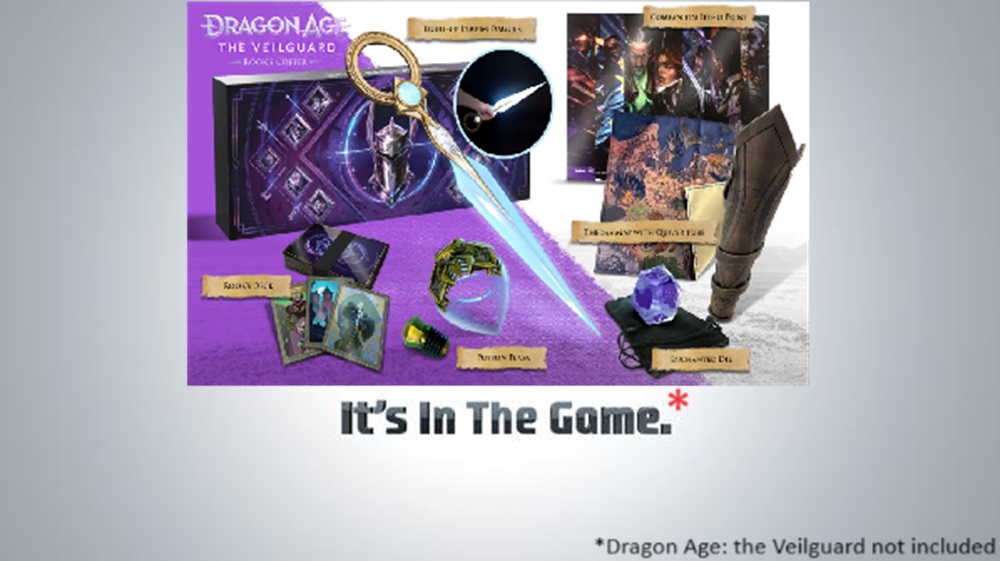
But what is a “BioWare game,” or any game for that matter? Not in an existential sense, but what is meant when we say these things? When I say BioWare game, emotionally I’m referring to a nebulous sort of companion-focused, squad-based RPGs with branching endings based on player dialog choices. Basically, the Mass Effect and Dragon Age series. Which I have historically enjoyed, including even (eventually) Mass Effect: Andromeda. It’s a type of game with a particular vibe to it.
Having said that, being a “BioWare Game” is really just branding and marketing. BioWare also released Anthem, which was a commercial failure; Andromeda wasn’t that hot either, considering how all DLC and follow-up expansions were canceled. Rationally, there should be no expectation that just because BioWare is releasing Veilguard, that it will be of the same quality of [insert favorite Dragon Age game here], especially after the franchise’s 10-year hiatus. But that touch of skepticism should still be the case even if Anthem and Andromeda were smash hits.
I have long cautioned against the sort of hero worship that game developers sometimes generate, especially when it comes to “rockstar” designers. There are people who fall to their knees at the altar of Fallout: New Vegas and Chris Avellone. To which I say: why? Even if New Vegas is your favorite game, there were a lot of cooks in that kitchen. In fact, you probably should be worshiping at the feet of John Gonzalez instead. Or, preferably, worshiping no one, including the companies themselves.
Game design is a collaborative endeavor – solo indie titles aside – and it’s a nigh-impossible task to nail down exactly who did what to make the game as compelling an experience as it was. Especially including the very staff who did it. Back in the day, there was an argument that Blizzard was sending in their B-Team for the Wrath of the Lich King expansion, and that is why subscriptions started to decline for the first time (notwithstanding the 12 million sub peak). As it turns out, that wasn’t the case – most everyone from vanilla and TBC ended up working on Wrath and subsequent expansions. Hell, the most controversial addition to the game (Looking for Dungeon tool) was something the original “rockstars” devs wanted to release in vanilla. It wasn’t the bean counters or the C-Suites or whatever design boogeyman you want to define; the calls were coming from inside the house.
There are times where it appears one very visible person seems to make a difference. Hideo Kojima immediately comes to mind. It is also difficult to argue against the apparent influence of, say, Yoshi-P when it comes to FF14. Or Hidetaka Miyazaki of FromSoftware fame. They could not build their games alone, of course, but leadership can and does set expectations and gives direction in these endeavors. There is a level of consistency – or consistent craziness in Kojima’s case – that is pretty rare in gaming.
By and large, though? Every game is a gumbo and no knows what went into it or why it tastes the way it does. That’s… a pretty strong nihilistic take, I admit, but riddle me this: if someone figured it all out, why is it so hard to bottle the lightning again? Boredom? Fear? Ever-changing audience mores? There are so many moving parts, between the game designers coming and going from the company, to the gaming zeitgeist of the time, to competing game releases, all of which can influence a title’s success. You can’t just say “Obsidian should just make New Vegas 2 and it will be a smash hit” because A) most everyone from the original team has left, B) none of the people who left appear to have taken the secret sauce with them, and C) New Vegas was massively outsold by Fallout 4 in any case.
So, am I still looking forward to Veilguard? Well, two words: Scout Harding.
Seriously though, I don’t want the takeaway to be that you shouldn’t look forward to anything. I have no idea what the plans are for Mass Effect 5, but I still want to find out. Just not on Day 1 (probably), and not with any sort of expectations that because Company A or Game Dev B made it that the end result will be C. If you’re going to base your hype on anything, base it on what the game is promising, not the people who made it. After all, the best games end up taking on a life of their own.
Posted on August 19, 2024, in Philosophy and tagged Bioware, Dragon Age: the Veilguard, Fallout: New Vegas, Game Design, Scout Harding, The Shyamalan Effect. Bookmark the permalink. 2 Comments.
 In An Age
Yeah, maybe Bioware is actually a good poster-child for that Shyamalan effect (which I still say cuts both ways, with retrospective rose-coloured glasses, nostalgia inflation, and consequent unreasonable expectations.)
Still, I think, like most nihilists, you’re setting the bar extraordinarily high. Bioware having a 70% chance of making “a Bioware game” or a not-quite-Bioware-game with enough “signature Bioware elements” to keep the fan of such things happy is still way better than random chance. And that’s before getting into whether the game is Good or Not Good in non-Bioware-specific ways.
Like, Jane Austen wrote six major novels, not counting the unfinisheds etc., right? No one would dispute that Pride and Prejudice is the smash hit, the gold standard, the yardstick. It’s the one where Jane let her hair down and shook it out to luxuriance. It’s launched fleets of visual adaptations. It’s still going. Persuasion: indisputably strong, from about the point of the move to Bath every turn of the page makes you more livid that Frederick (who’s a more impressive bloke than Darcy anyway) and Anne aren’t together yet. Emma: okay, things are getting too easy for the heroine, she’s well-off, the thing holding her back isn’t really social structure, it’s her own whimsical vow of singlehood, and you kind of realise that once she starts dabbling in match-making, she’ll sink into the quicksand of attraction in her own right. It’s a bit too smooth, but still very Jane. Sense and Sensibility: her shaky and far too timid debut, way too structural and overdesigned, the sister heroines suck, Brandon sucks, Willoughby sucks. Northanger Abbey is great fun, but flawed, a one-trick parody too anchored in its time, also weirdly unkind to Catherine, imho. Mansfield Park: Fanny Price is usually accused of being a pearl-clutching drip. While I’ll die on the hill of defending Fanny Price, Lizzie Bennet she ain’t. The play they’re staging is cruel, the whole thing is waspish and unpleasant, and the other characters are unlikable, manipulative caricatures struggling to carry forward a weak plot.
So, my question in reply is: why do you hate Jane Austen, Azuriel?
LikeLike
I have read zero Jane Austin novels. That said, authors would decidedly fall into the “solo indie dev” exception/camp wherein you can start to make reasonable inferences on how the next title will play out. Pick up something from Brandon Sanderson, Stephen King, or whomever, and you know what you’re in for.
But what about, say, Far Cry 7? The series has some pretty consistent features overall – there will likely be the equivalent of radio towers, enemy camps to take over, weapon unlocks, brutal melee takedowns, and so on. The quality though, especially in the story department, is all over the place. My two favorites, 2 and 3, couldn’t be more tonally different from each other, and 4, 5, and 6 all missed landing anywhere close in various ways.
Now that I think about it further, Ubisoft is perhaps one of the more consistent developers out there. People may not like “the Ubisoft formula,” but you at least know what to expect. Indeed, I don’t think I have even heard the names of particular devs at Ubisoft – they are just like a monolith of consistent franchise gameplay, which doesn’t ever quite get the respect it deserves, IMO.
I digress.
Ultimately, the nihilism isn’t about setting bars, it’s about managing expectations. More specifically, focusing on what is made and not who made it. The who shouldn’t matter. Obsidian made New Vegas but also The Outer Worlds. Bethesda made Fallout 3 & 4 and Skyrim but also Starfield. And we already talked about BioWare. Consistency is rare… which makes total sense with how collaborative development is, and how your own tastes can change over time too.
Be excited, but be so based on what you see in front of you not who was behind it.
Or do what you want. I’m not your dad.
LikeLike