The Hopes of the Game Industry
In short: they hope GTA 6 will cost $100 so they can raise their own prices.
As reported by VGC, Epyllion’s Matthew Ball just released a report focusing on the “State of Video Gaming in 2025”, which shares his thoughts on what might happen within the industry this year. Of course, a lot of that focus is out on GTA 6 which is primed to be one of the biggest game releases of all time, with some analysts predicting that it’ll make more than $1 billion in pre-orders alone.
Within the report, Ball claims that there is “hope” within the industry between publishers and developers that Take-Two will respond to all of the excitement and hype surrounding GTA 6 by raising the default price of the game to $100. Considering the fact that GTA 6 is going to sell well no matter how much it costs, the industry is reportedly hoping the price gets raised so that others can follow suit.
There is a ridiculous sort of myopia associated with seeing (and/or experiencing) high-profile commercial failures and escalating production costs, only to come to the conclusion everything would be better with higher unit prices. How about… *checks notes* … lower production costs? “But players demand AAAA-quality graphics!” Do they? I can appreciate the dilemma faced by developers, wherein the last game cost $400m and not wanting to gamble with a $350m (or lower) sequel. But if the acknowledgement is that the status quo of ever-increasing production costs is unsustainable, higher prices at best stems the bleed temporarily. At some point you need to address the root cause.
I was curious at this point as to what “the industry” actually thought about things, and if GTA 6 selling for $100 was all of it. So, the article I linked to above points to this VGC article, which then points to a 222-slide presentation by Matthew Ball, whom appears to be a “strategy advisor” to, presumably, the games industry (and others). If you have the time, I do very much encourage you to take a look yourself, as it is surprisingly straight-forward and facts-based. A summary:
- 2011-2021 saw the game industry grow at 150% annually
- However, in 2022 revenue fell -3.5% and remained flat in 2023-2024
- This mismatch in prior projections has dried up VC pipelines and investments
- The growth of the prior decade was due to multiple “innovations” that has since exhausted themselves
- Think microtransactions, mobile gaming, Battlepasses, etc
- Assumed new innovations are not bearing out (AR/VR, etc)
- Worse, rise of social video (TikTok) is actually eating into mobile leisure-time in a significant way
- PC and Steam growth appears to be bright spot… but all because of China
- Chinese game companies are exporting and directly (and successfully) competing with Western devs
- Game industry has unique struggles in variable pricing, and cannot easily pass on inflation
- Overall engagement is decreasing in gamers, including the hardcore ones
- Most of all gamers’ playtime is with existing titles – only 12% is spent on new games
- Network effects mean players stay playing the games their friends are playing
The final section of the presentation includes thoughts on potential new growth engines. And it does include GTA 6, but also several others.
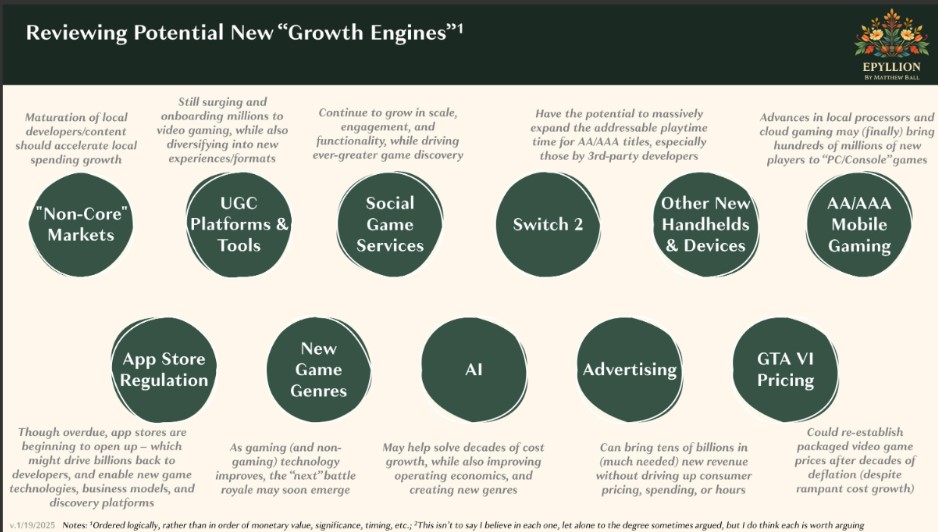
Again, I think it is worth looking at the presentation yourself, as each of the 11 bubbles there get multiple slides that introduce, justify, and even caution about the “solution.” Well, aside from GTA 6, which is noted would be the cheapest GTA ever (in real terms) if it comes out at $70. GTA 5 was released in 2013 at $60, which would be over $80 today, for example. Notwithstanding the billions of dollars GTA Online brought in, of course.
Overall, I did come away a bit more sympathetic to the plight of the games industry. Some of the headwinds I can personally attest to. For example, there have been multiple nights in which I found 2-3 hours of my “gaming time” consumed by Youtube Shorts scrolling. The network effect or “black hole” games are certainly a challenge as well, as anyone who has spent years playing MMOs can attest to. How do you compete against Fortnite, Minecraft, Roblox, and/or all the others?
“Raise prices,” of course!
Unfortunately, the actual solution is both pithy and hard to achieve: make fun games. Note how that solution did not include the words “spend 8 years painstakingly rendering every blade of grass.” Also note that I’m not saying that coming up with a fun game is easy either. But the industry seems stuck in this death loop of hiring more artists, programmers, marketers, and greenlighting enormously long development times… only for the game to fall flat because the fun wasn’t there. You can’t just hire more people to increase the fun quotient. And sometimes the fun that is achievable is only experienced by a narrow slice of the market, too small to be sustainable for the larger companies.
I don’t know the solution. If I did, I certainly wouldn’t be giving it out for free. But it might well be… decimation for the industry. I think a lot of publishers are just going to go bankrupt trying to spend their way out of the tailspin. AI could be a big disrupter, but disruption favors small indie shops, not the big guys. And while I do feel like longer development times is the obvious root issue for ballooning costs, I don’t see how the industry moves towards shorter development times and… then what? More releases? I mean, I wouldn’t be mad about a new Fallout every 2 years. If they keep the releases the same with a shorter development time though, that just means an implosion in the game jobs market. Not ideal.
…or maybe it is?
I dunno. I’m just a dude looking for fun games to play with my ever-decreasing amount of free time and eroding consumer surplus. When I look at my most-played games though, what I don’t see is full-priced titles with photo-realistic graphics and 8+ years in development. Well, I guess some Early Access titles were being worked on for that long, but it was like with three guys, not three hundred.
Anyway, Take Two can try and take $100 if they want and everyone raise prices as a result. Maybe it works, maybe it doesn’t. Nevertheless, my parsimony will abide.
Posted on January 20, 2025, in Commentary and tagged Consumer Surplus, Fun, GTA 6, State of the Industry, Unsustainable. Bookmark the permalink. 2 Comments.
 In An Age
It’s funny, because overall I feel we get fewer actually AAA games now (not AAA in terms of cost, but in how actually good the games are) than 10 years ago, but between older games that keep getting updated and more indie games that provide dozens of hours of fun gameplay, today I have more stuff I WANT to play then ever before.
Yet I’m spending less than ever before as well. Indie games you often can get for $10-$20, ‘AAA’ games you wait until they are on sale unless it’s that super rare event of said game actually holding its price (because, you know, it lives up to the hype and is worth spending more on).
Maybe it’s just me, but the core issue is most AAA today are worse than indie games, and just aren’t even close to worth the box price.
LikeLike
Yeah, it’s all a negative feedback loop. Nobody likes “design by committee” games, but you aren’t likely to secure funding for a $300m+ game that takes a bunch of risks, which leads the devs to chase trends, but since it takes 8+ years to release a game anymore, the trends have long since changed. Indie games can be much more nimble, or more likely to go their own way entirely and potentially start the trend themselves.
Luckily, my preferred genre is rife with indie coverage, mod coverage, or both. But this can’t be sustainable for the big players for much longer.
LikeLike