Blurry Lines
It occurs to me that in the last post, I brought up Larian Studios’ use of AI for “boring” work, but did not otherwise offer an opinion on the subject. Do they deserve to get the scarlet AI letter brand? Or perhaps will they received a reprieve, on account of not being Activision-Blizzard (etc)?
It helps to level-set. Here is more/most of the transcript from the Larian interview:
JS: Speaking of efficiency, you’ve spoken a little bit about generative AI. And I know that that’s been a point of discussion on the team, too. Do you feel like it can speed up production?
SV: In terms of generation, like white boxing, yes, there’s things, but I’m not 100% sure if you’re actually seeing speed-ups that much. You’re trying more stuff. Having tried stuff out, I don’t actually think it accelerates things. Because there’s a lot of hype out there. I haven’t really seen: oh this is really gonna replace things. I haven’t seen that yet. I’ve seen a lot of where you initially get excited, oh, this could be cool. And then you say, ah, you know, in the end it doesn’t really do the thing. Everything is human actors; we are writing everything ourselves. There’s no generated assets that you’re gonna see in the game. We are trying to use generated assets to accelerate white-boxing. But I mean to be fair, we’re talking about basic things to help the level designers.
JS: What about concept art?
SV: So that’s being used by concept artists. They use it the same like they would use photos. We have like 30 concept artistis at this point or something like that. So we bought a boutique concept art firm at the moment that everybody was using reducing them because they were going to AI, in our case it just went up. If there’s one thing that artists keep on asking for its more concept artists. But what they do is they use it for exploration.
[…]
SV: I think experimentation, white boxing, some broader white boxing, lots and lots of applications and retargeting and cleaning and editing. These are things that just really take a lot of time. So that allows you to do more. So there’s a lot of value there in terms of the creative process itself. It helps in doing things. But I haven’t seen the acceleration. So I’m really curious to see because there’s all studios that said, oh, this is gonna accelerate… If you look at the state of the art of video games today, these are still in their infancy. Will they eventually manage to do that at large scale? I don’t know how much data centers they’re gonna need to be able to do it.
So what I would say is that what Larian is doing is materially different than a company, say, using AI to generate random newspapers to place around a city. Or, you know, use AI to voice characters entirely. Copy & pasting AI-generated output directly into your game seems like a pretty clear line not to cross.
Personally though, there are other lines that are blurrier and on a slippery decline.
Take the concept artists. Larian hired a bunch at a time when many were getting replaced with AI. Good Guy Larian. Even if, perhaps, they may have been on a bit of a discount on account of, you know, AI pressure on their field of work. Whatever, humans good. We then learn that these same concept artists use generative AI for “exploration,” either instead of or, optimistically, in tandem with more traditional photos. That’s where things start to break down for me.
Suppose a concept artist wants to draw a lion. To do so, they would like to have a bunch of photos of lions for reference material. I understand the allure of saving time by simply getting ChatGPT or whatever to spit out 30 lion photos in various states of movement, rather than manually doing Google searches, going to zoo websites, and so on. The seduction of the follow-up prompt is right there though. “Lions roaring.” “Lions pouncing on antelope.” “Lion with raven wings attacking a paladin.”
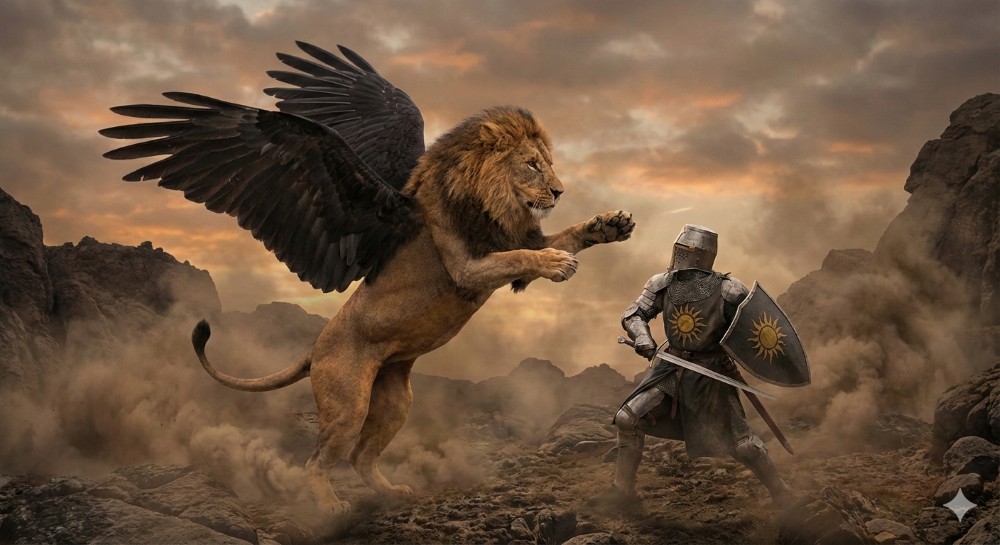
And yeah, that looks goofy as shit. The artists will redraw it in the style that fits the game and nobody will notice. But maybe the team likes the look of the dust and mountainous landscape. They incorporate that. Maybe they include an armor set that matches that style. Or the sun symbol. Over time, maybe the team takes what the people themselves came up with and start running it through the prompts “just in case” the AI spits out something similarly interesting. And so on and so forth.
“So what? What’s the harm?”
Well, how much time do you have? I’m going to focus exclusively on the videogame angle here, rather than environmental impacts, cognitive studies, and apocalypse risk from agentic, self-improving AI.
The first concern is becoming reliant upon it. Larian is apparently hiring concept artists today, but maybe in the not so distant future, they don’t. Anyone can type in a prompt box. Over time, the entire concept artist field could disappear. And what is replacing it? An AI model that is incentivized in giving you exactly what it thinks you want. This will lead to homogenization, the sort of “AI glow,” and even if you wanted to fight the current… who is still economically capable of producing the bespoke human work? And would they not just turn around and tweak AI output and call it a day (it’s happened before)?
Incidentally, the other part of AI reliance is the fact that you own none of it. Right now, these AI firms lose money any time people use it, but that is going to stop eventually. When it does, you are either going to be on the hook for tens of thousands of dollars a month for a license, or desperately trying to filter out ad placements from the output. Maybe open source LLMs (or corporate saboteurs) will save us from such a fate, but there won’t be a non-AI fallback option because the job doesn’t exist anymore.
The second concern is something that these companies definitely feel the effects of already, but apparently don’t give much thought about: we are very much in a crowded, attention economy. On one end you have short-form video eating into gamer time, and on the other you have legacy games continuing to dominate playtimes. For example, Steam’s year-end report showed that just 14% of gamer time was spent playing games released in 2025. Is that figure skewed by Steam exclusives like Counter-Strike 2? Maybe. Then again, Steam is the largest, most ubiquitous PC storefront in the world and had 1.5+ million concurrent players in Counter-Strike 2 yesterday. That’s a lot of people who could be playing anything other than a game from 2012.
Now imagine that all of the promises of AI have come true for videogame devs. Six year timelines become four years or even two. Great! Who is going to be playing your game with what time? Over 19,000 games came out on Steam in 2025. Are all of them AAA titles winning awards? Of course not. But what does AAA even mean in a flowers-and-rainbow AI scenario? Maybe $50-$100+ million still makes a big difference in quality, fine. But that certainly didn’t save Black Ops 7, Borderlands 4, Concord, the dead-on-eventual-arrival Highguard, and so on.
Now imagine what happens when there are… 190,000 games released in a year.
As a player, I suppose in this hypothetical we come out ahead; there are more games specifically tailored to our exact preferences. For the game makers though, well, most of them are going to fail. Or perhaps the hobbyist ones survive, assuming a lower AI license cost. I don’t see how AAA survives with the increased competition and a reduced competitive edge (mo-cap, CGI, etc); hell, they are struggling to survive already. To say nothing about the discoverability issues. Maybe AI will fix that too, yeah?
In summation, my thoughts on the matter:
- Copy & pasting literal AI assets in your game is bad
- Using AI for inspiration leads to being trapped in an AI ecosystem
- AI-shortened development times leads to no one making any money
Of course, the cat genie is out of the lamp bag and never going back into the toothpaste tube. Taking a hard stance on #1 – to include slapping AI labels on Steam pages and the like – is not going to prevent #2 and #3. Hell, everyone in the industry wants shortened development times. I just don’t think anyone fully appreciates what that sort of thing would look like, until after the monkey paw curls.
In the meantime, as a gamer… eh, do what you want. I personally don’t want any generative AI elements in the games I play, for all the reasons I already outlined above (plus the ones I intentionally skipped). At the same time, I don’t have the bandwidth to contemplate how much GitHub Copilot use by a random programmer constitutes too much for them to qualify for a GOTY award. And if you’re not turning off DLSS 3 or FSR out of principal, what are you even doing, amirite?
Posted on December 22, 2025, in Commentary, Philosophy and tagged AI, Attention Economy, Blurry Line, Careful What You Wish For, Larian. Bookmark the permalink. 3 Comments.


The first time I remember coming across the “it’ll all be gone and we’ll never get it back” argument was in the 1980s, when Margaret Thatcher was at war with the National Union of Miners and one of the arguments often used to support the miners was that if the pits were allowed to close that would be the end of coal mining in the UK forever because the lost pits would never re-open.
I wondered then, as I wonder now about the “if we let AI take these jobs, we’ll be totally screwed if we want to change our minds later” arguments, how it could have been that we got the pits in the first place. Someone dug them, presumably. Could someone not dig some more, if ever they were required? I realize the supply of coal is finite but surely the ability to dig holes to get to it isn’t?
Even more so with concept artists. If AI means no-one employs them any more or that they do but the employed artists themselves use AI, does that mean no-one will ever draw again? If the AI became sentient one day and decided creating endless images of dragons was beneath it, would no human be able to figure out how to do it for themselves?
About the worst that would happen, surely, would be a slight interruption in the pipeline before a return to the status quo ante. This isn’t to take a position on the ethical position of using AI for concept art. It’s just that I can’t see why changes like this are ever seen as permanent. It’s not even as though we’d have to go through the hundreds of years of the Rennaissance again before we discovered perspective. Everything goes a lot faster when you have a blueprint to work from.
As for the really quite extreme preference of gamers for older games they know over new ones they don’t, I often find myself wondering why we need any new games. Or books. Or music. Or movies. If all production of all of them ended today, wouldn’t we already have a surplus of supply to meet any reasonable future need? It’s nice to have new things but is it actually necessary?
LikeLike
The problem is that a coal mine is a lot more complicated than just “dig a hole”, the field evolved and people learned how to dig coal without getting killed in the process. When you lose this know-how, you have to rediscover it: it takes time (and sometimes lives), this is why some states subsidize local industries: to avoid losing the knowledge and becoming either dependent on a foreign nation, or having an entire industry disappear and waste years re-discovering things.
LikeLike
The question is never “could we possibly ever do it again,” but rather “is it ever economically viable to do it again?” The coal pits are closed forever because reopening would take enormous amounts of money – new buildings, new mining equipment, training, etc. Nobody would ever make that money back, even if coal prices spiked for a period of time.
Art, of course, doesn’t have the same capital expenditures. But the “slight interruption” in the pipeline is really the closure of art colleges, the removal of art majors, the firing of art professors, and a general instilling of the obsolescence of the field in the cultural imagination.
The people naturally talented at art may indeed continue drawing for fun, but will (correctly) see no viable path for it to become a career. So even when the humans-only developer comes looking for artists, the infrastructure necessary to match them together will not be there.
Could said infrastructure be rebuilt? Sure. With what money, though?
Edit:
Welcome to capitalism!
LikeLike