Half-Cocked
So the news out there is that both Avowed and The Outer Worlds 2 flopped. Or, technically, “failed to meet expectations.”
Last year the developer released three games—a rare and impressive achievement for a studio of its size—but two of them failed to meet sales forecasts set by Obsidian’s parent company, Microsoft Corp. “They’re not disasters,” Urquhart says. “I’m not going to say this was a kick in the teeth. It was more like: ‘That sucks. What are we learning?’”
While Grounded 2 was a big hit, the disappointing results from the other two have led Obsidian to “think a lot about how much we put into the games, how much we spend on them, how long they take,” Urquhart says. Both Avowed and The Outer Worlds 2 were in development for more than six years, inflating their production costs and the company’s financial expectations. One of Urquhart’s missions is to cut down development timelines to three or four years per title. (source)
The piling on in the Reddit comments is understandable, and I agree with most of it. Neither Avowed nor The Outer Worlds 2 feel like games that have had 6+ years in development. The equipment upgrade system in Avowed is both punishing and boring, and two of the classes have nothing interesting going on in the Skills department. For TOW2, Skills/Perks were half-assed at best and irrelevant at worst. What in the world were the designers spending all their time on?
During the negotiations with Microsoft, Obsidian’s executives assembled a slideshow presentation for the concept that would become Avowed, pitched as an ambitious cross between megahits The Elder Scrolls V: Skyrim and Destiny that would allow players to battle monsters together in a massive fantasy world. It was an impressive if unlikely proposition. “My thought when I first saw it was, ‘I don’t think there’s a team on the planet that could execute on this,’” says Josh Sawyer, Obsidian’s studio design director. Two years later, Obsidian stripped out the multiplayer feature, and a year after that it assigned a new director to the project. By the time Avowed came out, it had been in the works for nearly seven years.
Ah, well, there you go.
I’m not going to pretend to be an industry insider, or able to speak authoritatively on game design (or any topic, for that matter). But, respectively devs, what the fuck? We have heard for ages that development cycles are getting more expensive, and that is why game prices have to be $70, $80, and higher with macrotransactions. People just swallow the narrative that all the increases in technology and graphical fidelity make the process of making games cost more money. But peel back the layers and all of a sudden it certainly seems like the people in charge are just going off half-cocked.
Game design is an iterative process, yes. Inventing new forms of fun is hard. I can also understand that sometimes the fun only manifests itself once all the various interlocking systems are already in place. Again, though… what the fuck? “Skyrim meets Destiny in massive fantasy world” is not a game, it is barely a concept of a setting. Do these designers believe that the fun will simply manifest itself out of the aether? “If we build it, they will have fun”? Or do they assume that figuring out the fun is the easy part and can be added in later?
During recent breakfast meetings, Urquhart and his deputies discussed some things they could’ve done better with last year’s releases. Perhaps Avowed players needed the option to, say, commit crimes and get arrested to make the world feel more alive. Maybe The Outer Worlds 2 needed stronger virtual companions. It’s hard to imagine a game would sell more copies if it had pickpocketing, but Obsidian’s leaders say seemingly minor ingredients can make a big difference. “Our job, all of us here, is to go make games that people want to play and buy, and if we continue to do that, then we have a solid business,” Urquhart says.
“Minor ingredients,” oh my fucking god. They have no goddamn clue, do they?
Here you go, Obsidian, on the house. I’m not certain how pickpocketing would have worked in Avowed considering none of the NPCs move, but sure, it would be nice flavor. But I recommend starting with the fact that every part of the player progression experience is awful. You are punished for upgrading equipment since resources are finite and enemies don’t respawn, and are also punished for not upgrading equipment as enemies automatically deal 35% more damage if they exceed your tier. When you do upgrade though, you get a whole +4 to whatever stat, with nothing else interesting going on.
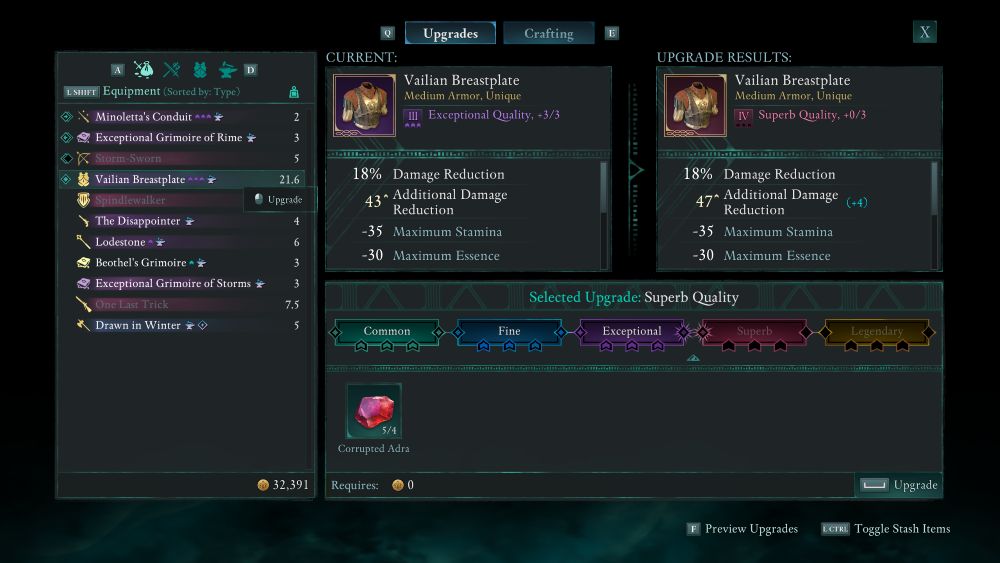
These sort of things are not “minor ingredients.” It’s the whole fucking game! You know, the thing that players do after purchasing your product? P-L-A-Y. Kudos to the people who designed the movement and vaulting inside the game world, but whoever came up with the fiddly bits needs some goddamn coaching. Would it have killed anyone to increase all the values by a few points when upgrading gear? Or playtested the Warrior/Ranger talents against all of the stuff the Wizard could do by default?
As for The Outer Worlds 2, same thing. Skills and Perks were deadass boring. How many of them meaningfully impacted combat at all? In what world should a player feel comfortable breezing through the entire last Act of game with 17 unallocated Skill Points and 5 Perk Points? Nothing I picked felt like it did anything other than add another percentage gain on otherwise extremely low base damage weapon. Hard to get excited about going from 490% increased damage to 520%.

It could be that I’m the one off-base. Maybe the entire problem with the games were one of marketing, or the story not being engaging enough, or the graphics being something-something. In one of the Reddit threads, someone commented how slowly people talked in Avowed being an issue. OK, sure. That said, it possibly couldn’t hurt to make character progression fun or exciting in any way whatsoever.
The hilarious and tragic thing are the lessons (un)learned.
Grounded 2 came together the quickest. Despite the popularity of the original, which the studio released during the pandemic gaming boom of 2020, Obsidian hadn’t planned on greenlighting a sequel until it got a pitch in early 2023 from Eidos Interactive, a studio in Montreal that was looking for outsourcing work. […]
Grounded 2 offers some lessons for a better way forward. Obsidian assigned a few senior staff to orchestrate the production in Montreal from 3,000 miles away, rather than develop the whole thing in-house. Chris Parker, an Obsidian co-founder who supervised development, says the distance was empowering because he could make hard calls more swiftly. One of the game’s vehicles—rideable insects called “buggies”—had originally been designed to be shared by multiple players until Parker and his crew realized the functionality wasn’t coming together, leading them to pivot. “I was like, ‘If this was one of our internal teams, we would work on this for another two or three months,’” Parker recalls. “We made this call because we could tell them what to do. It feels like we still run around with our kid gloves on internally.”
First of all… they hadn’t planned on greenlighting a Grounded sequel? I mean, yeah, not every game needs a sequel, people crave new experiences, sometimes devs want to move on, yadda yadda. Still, it feels bonkers to me that when a game company does strike gold on a fun game concept/design, it often just goes nowhere afterwards. Everyone sings Obsidian’s praises for Fallout: New Vegas, which cost $8 million and only two years to produce. How did that happen? It was basically a Fallout 3 mod. Which is probably why it was so fun in the first place, because it was built on an established foundation of fun.
We’ll have to see with Obsidian whether they take the lessons to heart. But I was also thinking about this other recent tidbit from Blizzard in a different article:
“[Warcraft is] a fantastic IP. In my humble opinion, it’s been underutilized and I just want to bring it to as many people as possible. And that means evolving what Warcraft means, what it is, and where it’s going. We want it to be approachable. Chris Metzen [executive creative director], is sometimes like, ‘I wish we hadn’t called it Warcraft. It sounds intimidating.’ But I’m like, nobody really thinks that about Warhammer. It’s an understood name.
“This idea of ‘third space’ in our online worlds, we can’t even define what that means exactly, but we’re working on figuring that out. We want people to come in, hang out and have birthdays, weddings, raids, grand adventures, play with their friends, meet new friends… all the things that World of Warcraft has been good at for over 20 years. (source)
The easy jokes are, you know, how Blizzard has a TCG, MOBA (abandoned), and Clash Royal-esque mobile app (dead) all within the same narrative universe. But remember, Blizzard had also been working on a fantasy survival game for many years before that got killed in development as well. Wonder what had happened there…
It was conceived to be similar to a more polished version of popular survival games such as Minecraft and Rust, containing “vast” maps supporting up to 100 players. Due to the ambitious map size, the game’s engine was switched from Unreal Engine, in which it was prototyped, to Synapse, an internally-developed engine created specifically for Odyssey and envisioned as something that would be shared by multiple projects. However, the switch led to significant problems – due to delays, Blizzard’s artists were forced to continue prototyping in Unreal, knowing their work would later be discarded. […]
At the time of the Microsoft acquisition, team members remained hopeful they would be allowed to switch back to Unreal Engine due to Microsoft’s stance on allowing game leads rather than executives choose the technology used. While the game was positively received by testers, however, there was estimated to be several years of development time remaining on the project, with even a 2026 release seeming overly optimistic. The news of the game’s cancellation was announced by Microsoft in a company-wide email in late January 2024.[2] Some of the former team members from Odyssey were moved to other projects in development,[2] though a significant portion were laid off.
Of fucking course. I especially liked the “allowing game leads rather than executives choose the technology used.” Seems like a good idea, maybe someone should try it occasionally.
You know, all this does is really highlight that nobody knows what they hell they are doing and it’s a miracle any fun games get built at all.
Posted on February 5, 2026, in Commentary, Philosophy and tagged Avowed, Blizzard, Failed to Meet Expectations, From Whence Fun?, Obsidian, The Outer Worlds 2. Bookmark the permalink. 3 Comments.
 In An Age
The more this stuff comes out, the more I’m convinced making a decent game isn’t that hard. After all, you are competing with the people above, and we know about them because at one point those people were ‘good’ at game design.
LikeLiked by 1 person
Again, though… what the fuck? “Skyrim meets Destiny in massive fantasy world” is not a game, it is barely a concept of a setting. Do these designers believe that the fun will simply manifest itself out of the aether? “If we build it, they will have fun”? Or do they assume that figuring out the fun is the easy part and can be added in later?
Sure reads like the unsanitised reaction of Josh Sawyer, Obsidian’s studio design director. Who, you know, got deep-sixed two years later.
The indictment of devs here is compelling enough, but it does elide the distinction between devs and suits, which has never been as significant to the outcome as it is nowadays. “Skyrim meets Destiny in fantasy world” sounds like something Urquhart wheezed while dangling in Phil Spencer’s force choke. “…and also like GTA V, but Fortnite, and plenty of MTX! MTX!…”
Said distinction does carve nature at the joints, because it certainly seems like the successful titles (culture war nonsense aside; I guess the chuds hated AssCreed because Yasuke and Concord because fat chicks? it’s becoming difficult to keep track) were the ones where the corporate culture is more dev-centric (BG3, Clair Obscur, Hades 2).
Or at least one layer removed from the head office, as with that story of Grounded. It’s striking that Eidos briefly ended up being to Obsidian what Obsidian once was to Bethesda.
LikeLike
Pingback: E33: How It’s Done | In An Age