Category Archives: MMO
Choosing to Miss the Point
The unofficial blogging theme of the week is Choice, and while I was not going to comment on it, the sheer force of a thousand bloggers missing the point simultaneously slowed the rotation of the Earth enough to make it necessary. So allow me to clear up a few things.
1) You cannot have “meaningful” narrative choice in MMOs. Nor would you want them.
In case you need a reminder, we are talking about Massively Multiplayer Online games here. Assuming “meaningful” choices existed, who is going to be making them? You? Or the ten thousand other players on your server? You cannot all be making meaningful choices pretty much by definition. Remember the Siege of Undercity? No you don’t. The Siege was completed by Arthasdklol hours before you logged on. If you solve the Arthasdklol situation by instancing everything out, at what point does A) the choices cease to remain meaningful, and B) the game ceases to be an MMO?
The lack of “meaningful” (narrative) choices in MMOs is not a bug, it’s an essential feature.
“What about MMOs like EVE?” I hear you cry. Obviously Sandbox content is a bit different than designer-created narrative content. But it is important to not get too pedantic with pitting player-generated stories against a coherent narrative, the latter of which is what everyone is talking about when they speak about choices anyway. If the headlined EVE scams and interstellar drama is put on a pedestal, why is WoW intra-guild drama not similarly enshrined? Heard that Dragonwrath legendary story yet? If EVE has “meaningful” choices due to nullsec shenanigans, then so does every social game. Which begs the question of whether these “meaningful” choices only exist in the context of social interaction. In other words, the game proper has nothing to do with it. Maybe Game A creates better incentives than Game B for social interaction, but just because you build it, does not mean the horses will drink. Or something.
2) You cannot have “true” failure in MMOs. Nor would you want them.
Raise your hand if you have ever failed an escort quest in an MMO. Now keep your hand raised if you think escort quests get any more interesting or fun if the person you are escorting permanently dies and you can never retake the quest again. If you still have your hand raised, lower it if the reason is because you hate escort quests with a passion and wish you could kill the dumbass you are escorting yourself, for running headlong into unnecessary mobs or how they move with the speed of a narcoleptic 3-toed Sloth that missed it’s insulin injection.
The people with their hands still raised should use it to slap themselves in the face for being a liar. Didn’t your mother raise you better?
The type of “failure” frequently enshrined by these bloggers is the sort of failure that results in a Game Over screen in single-player games. And the difference between reloading your last save after a Game Over and abandoning a failed quest and retaking it is… what? That’s right, there is not a damn single difference. Too Damn Epic asserts:
What happens, though, when your games are rigged so that you can’t lose? That’s the underlying problem in most MMOs. You can’t lose. They’re jury-rigged for success, and as Gandhi said, “Freedom is not worth having if it does not include the freedom to make mistakes.” Tweak that a bit for our purposes, and you get:
“Choices are not worth having if they do not include the option to make mistakes.”
[…] After all, in WOW, you can’t really make mistakes. You can undo talent trees. You can wipe on braindead PvE content to your heart’s content until you “win”. You don’t lose anything in PvP. In an effort to make games more accessible and retain subscribers, we’ve lost the capacity to fail – and in the process – lost the capacity to produce meaningful choices.
“You can wipe on braindead PvE content to your heart’s content until you ‘win.'” Err… so you are saying that you can fail until you succeed? Just like in any game ever made? Maybe there is a serious psychological difference between re-taking a quest and hitting F9 that I am not picking up on. Or perhaps the failure scale these individuals use have only two pegs: Faceroll and Battletoads. And as someone who actually played Battletoads on the NES back in the day, the game did not get more fun when you spent four hours memorizing all the walls in the racing level and the pitfalls in the tube level only to die in the snake level and have to redo everything all over again. That sort of designer bullshit has exactly one function: to turn a five-hour game into a 40 hour nightmare.
The bottom line here is that MMOs having a permanent failure state is actually a worse penalty than any single-player game, with the exception of Russian Roulette. Once you accept that a permanent failure is off the table, we are really quibbling over the length of player time to hold hostage. And honestly, I want to meet the Carebears who look at PvP and say nothing is lost when you get thoroughly owned by a Frost mage that is now teabagging your corpse. Somehow -1 Dignity and +1 Blood Pressure never evened out, in my experience.
3) What is “meaningful” choice anyway?
I have put “meaningful” in scare quotes every since I read SynCaine’s post on choices, and based on the example he used, I think everyone should as well:
A game like Dragon Age is full of ‘fake choice’, where every quest seems to have multiple solutions, but the end result is just different loot or some placeholder NPC switching up one line with another. Not that it really mattered in DA, the game was still fun and its story was good-enough to see it to the end. I’d just never put it anywhere near The Witcher in terms of moral choices and tough decisions.
Err… did we play the same Dragon Age? Assuming you beat DA and/or don’t mind 100% spoilers, just casually glance at the Epilogue Wiki page. Perhaps his point was that epilogue slides are just “switching up one line with another?” I have not played The Witcher myself although I own both 1 & 2 on Steam (SynCaine must have just missed the deal a few months ago), so I cannot compare the two. What I will do is make a wild assumption that what choices The Witcher does offer the player does not come in the form of mutually exclusive content, which appears to be the gold standard of “choice.” If the Witcher does have mutually exclusive content, it will be in the radical minority of games.
I am making a point of this not just because what is “meaningful” is subjective, but also because I think this usage of choice is dumb. Flavor choices are inexplicably dismissed as shallow or meaningless by bloggers, when they are absolutely critical in developing an identity, or affinity to your character or the narrative as a whole. Planescape: Torment is brought up a lot as the pinnacle of storytelling, for example, but how much “real choice” does Planescape actually have in comparison to, say, Dragon Age? Very little. The brilliance of Planescape came from the depth of the “meaningless flavor choices” (all 800,000 words of them) which otherwise pulls you into the narrative in the wholly unique way that only video games can.
Besides, if you believe flavor choices are meaningless or have no consequences and therefore are not choices, how do you explain the apparent success of the F2P cash shop model? Or the likely fact you have things hanging up on your wall right now that you paid for and yet have nothing to do with the structural integrity of your domicile?
Individual expression is, indeed, the most interesting choice you can make despite – or perhaps in spite of – the likely fact that no one else cares.
The Diminishing Returns of Fun
I was listening to an episode of The Instance (#242) today and was struck in a rather fundamental way by what they said in the Mailbag segment. So much so, that I went ahead and captured the 8 minute audio exchange and uploaded it to Youtube so it could be more easily accessed. The reader email question itself was rather asinine, but it elicited a (brief) discussion on how the playerbase of WoW has evolved over time. The evolution of the playerbase, or devolution as some say, has been a frequent whipping boy of forums posters and bloggers for ages – Blizzard dumbing down the game, catering to casuals, and so on.
The thing is, I firmly believe that the argument has always been backwards. Blizzard is not catering to casuals, they are desperately trying to retain that ever-sliding core of veterans. Blizzard is not shaping players, the players are shaping Blizzard. The rest is worth listening to, but I went ahead and transcribed the most important portion of that audio clip, spoken by Scott Johnson:
[Repeating content] is a distinct downside to MMOs in general, and it is why I really enjoy a cultivated experience like Diablo 3 – like the Elder Scrolls games, like I am expecting with Skyrim, like a lot of single-player RPGs – where the wonderment and the excitement and the newness is always present. Because, unless you are freak who plays games six times through for no reason, everything is new as you consume it. Whereas in World of Warcraft, and other MMOs like it, as much as Blizzard tries, and they do the best out there to make things SEEM as fresh as possible. After a while, like that Blood Beast fight… [snip]
But again, I’m kinda with him. This is why I don’t pug much. Because I find that so grindy and so not fun. What I want … if I’m going to do that stuff, I’ll do it with my friends because then THAT is the newness of the experience. Because we’re laughing, Manny said something funny, Pootinky made a fart noise, whatever. We’re having a ball in there. So THAT is fun for me. The actual pugging of the thing for the 5000th time is not fun for me at all in the least. It is just earning money, currency to go get something. And that’s fine, that’s working as a system. But I’m kinda with him that you lose that cultivated experience, you lose that wonderment of walking into a room for the first time, like walking into Ulduar and going “Holy crap! Look at where we have to go and how we have to get there.” And then after a while you are “Oh my gosh, Ulduar can suck it. I hate this fight.”
That is reason the “vanilla forever!” mindset never made sense to me, nor the appeal to nostalgia that was Cataclysm; as they say, you can never cross the same river twice. People like to imagine that if everything had stayed hard, they would not have gradually lost interest in the game. But think about your favorite games of all time. Are those games still fun for you today? Would they still be fun to you if you replayed them half a dozen times back-to-back? You can never recreate that original experience – the wonderment and newness is consumed in the act of experiencing it. And as much as I agree with Scott that Blizzard does a lot in trying to keep content fresh by constant iteration and new boss abilities (etc), at some point you understand on a fundamental level that the Ship of Theseus has sailed, so to speak.
The “catering” is not to casuals, but to the veterans who have reached the end of their original experience and who, through boredom or social ties, are looking for more things to do in-game to fill the time while they wait for schedules to align. But why would veterans actually want extremely fast leveling, faceroll dungeons, and so on? Some of that is actually trying to capture the 80-90% of players who never finish games, sure. But the things like Justice Points and LFD are firmly for the vets. Nils suggests that Blizzard uses “ease” as a weapon in the form of competitive advantage against other MMOs (or perhaps in response to others doing it). Or perhaps in reaction to player “entitlement.”¹ I would argue instead that fun in games has diminishing returns. Running across the entirety of Searing Gorge each time you wipe in BRD might have given you a healthy respect for safe pulling in your formative years, but I guarantee that you would be sick of it four or five years later if it was included everywhere. You learned that lesson, and reinforcing it constantly adds nothing of further value to your experience anymore than would repeating grade school as an adult.
Ultimately, I feel theme-park MMOs are their own worst enemy. Nils told me once that it was in my best interests for an MMO journey to last as long as possible. If I was purely fixated on the eradication of my free time, then sure. I played WoW for over 7000 hours as compared to Xenogears’ 80 hours. But I never once, for a single moment, felt that the magnitude of fun with the former came remotely close to matching the latter. In fact, as is the case with any novel or movie or TV series, the extreme danger is that efforts to elongate the experience instead poisons it². More becomes less. Instead of cultivating a complete experience with a beginning, middle, and end, the theme-park MMO model demands an open-endedness at odds with its progressive narrative.
Perhaps this is merely a sign that (theme-park) MMOs are not a genre meant for me. I do not think that is entirely true though. The genius of MMOs is that they appeal to and accommodate a huge variety of players with different interests – as vapid as questing seems to be to vets, it was actually an endearing experience the first (few) times. Instead, I think designers should embrace the end of their games, incorporating a more conclusive experience while leaving the door open for an encore. Or the after-party.
¹ Entitlement is a word so abused by bloggers and commenters that it has lost most of its meaning. Entitlement should not be synonymous with the expectation of a fair exchange of value. Nor should it denigrate legitimate instances of design criticism. It’s honestly getting to the point where you cannot say something is superfluous or inelegant without being accused of feeling “entitled” to, you know, better design.
² See: Lost, Rescue Me, every Terminator movie after T2, every Alien move after Alien 2, etc etc etc.
The F-Word
I was reading Stabs’ post about treasure hunting in Diablo 3, how the typical gold farmer strategies won’t work and so on, when I see Nils in the comments say:
While reading this something inside me cries out: “Why don’t you just try to have fun??”
You seem determined to optimize the fun out of it.
The first question that popped into my mind was “What if you find optimizing fun?” And Stabs replies:
@Nils Ah we’re getting back to the question, what is fun? All I can say is, for myself, I’m hyped that I’ll be able to play D3 for money, it was a game I’d have played heavily anyway, I’ve always loved theorycraft and numbercrunching, I have an encyclopedic knowledge of arcane D2 mechanics and I believe I’ll have an utter blast doing this.
I can’t really defend optimisation to someone who considers it not fun. I do suspect that you’re swimming against the tide.
If you listen to the PC Gamer podcast I linked you’ll hear them argue very persuasively that D3 is a game where everyone is a gold farmer but then go on to talk about how much fun it is to play. They’re not mutually exclusive.
I think the only fun I’ll intentionally sacrifice for optimisation is alting. I usually mess around with lots of different classes and builds when I get a new game. With this game I’ll be rushing to the end.
I have heard the phrase “optimize the fun out of it” from Nils and Tobold and others, and it was not until Stabs’ unapologetic response that I realized how asinine the phrase is to begin with. Optimization is fun. I am not going to hedge that with “can” or “to some people” because you have to fight stupid declarative statements with Objective (Self-) Truth. If you find optimization fun, then it is. Period. If you don’t like it tomorrow, then it is not fun, until such time that you change your mind again. If someone finds something different fun, they are wrong. Unless you agree with them. Is that not the implied premise in these fun discussions? Are we not justifying our favorite colors (red), flavors (peanut butter), or meals (taco salad)? I hate steak. Do I ask why people ruin their dinners with slabs of tough, bloody cow muscle? Of course not. And not just because I prefer taking a perfectly healthy salad and smothering it in greasy ground meat, nacho chips and sour cream.
I do not judge because I do not live in a solipsistic bizzaro-world where Fun is some objective Form straight out of the works of Plato. Have you read Gevlon at Greedy Goblin lately? He “refuses to nihilistically believe” that two people playing WoW can have different goals, motivations, desires. In a Battleground, he rages at the people fighting on the bridge instead of guarding a flag like he is; they are M&S (moron & slacker) for not winning in the most efficient manner. I was not aware winning was more important than having fun, but he covers that too by saying winning is the only way to have fun in the first place. I am not quite sure how he handles games like The Sims or Second Life – possibly you are M&S for not playing winnable games to begin with – but Nils, Gevlon, and Stabs all played WoW at some point in time so obviously someone was doing it wrong. Right?
The Dark Heart of the Matter
The underlying problem with “what is fun?” posts is not just because fun is a subjective thing. The underlying problem is that none of us can really be sure what fun even is to ourselves. That is, strictly speaking, an absurd statement. But the psychological fact of the matter is that human beings are damn near incapable of accurately predicting how they will feel in the future. Feel free to read along at home the article entitled The Futile Pursuit of Happiness. A choice excerpt:
Much of the work of Kahneman, Loewenstein, Gilbert and Wilson takes its cue from the concept of adaptation, a term psychologists have used since at least the 1950’s to refer to how we acclimate to changing circumstances. George Loewenstein sums up this human capacity as follows: ”Happiness is a signal that our brains use to motivate us to do certain things. And in the same way that our eye adapts to different levels of illumination, we’re designed to kind of go back to the happiness set point. Our brains are not trying to be happy. Our brains are trying to regulate us.” In this respect, the tendency toward adaptation suggests why the impact bias is so pervasive. As Tim Wilson says: ”We don’t realize how quickly we will adapt to a pleasurable event and make it the backdrop of our lives. When any event occurs to us, we make it ordinary. And through becoming ordinary, we lose our pleasure.”
It is easy to overlook something new and crucial in what Wilson is saying. Not that we invariably lose interest in bright and shiny things over time — this is a long-known trait — but that we’re generally unable to recognize that we adapt to new circumstances and therefore fail to incorporate this fact into our decisions. So, yes, we will adapt to the BMW and the plasma TV, since we adapt to virtually everything. But Wilson and Gilbert and others have shown that we seem unable to predict that we will adapt. Thus, when we find the pleasure derived from a thing diminishing, we move on to the next thing or event and almost certainly make another error of prediction, and then another, ad infinitum.
You can probably draw a line from that concept and connect it with Cognitive Dissonance, and especially the sub-set of that: Effort Justification. This is extremely relevant in MMO discussions about what is “fun” and what is not for what shall be readily apparent reasons:
Dissonance is aroused whenever individuals voluntarily engage in an unpleasant activity to achieve some desired goal. Dissonance can be reduced by exaggerating the desirability of the goal.
Oestrus from The Story of O and Nils from Nils’ MMO Blog both wrote about this dissonance in their (hopefully cynical) “What is fun?” articles. Both Nils and Oestreus argue (in effect) that fun is the resolving of the dissonance that is doing a long, arduous grind for an ultimately meaningless reward. After completion, you convince yourself that the journey was meaningful, and magically you retroactively have fun. Your brain does this because it refuses to believe that you could be so dumb to have spent all that time voluntarily being miserable, ergo the reward must have been worth it. And the sad thing is, this works. Nils even has a series of posts talking about how “great games enslave you,” not through riveting substance or fun activities (which is really salt that ruins the larger shit soup), but by pulling a Lucy and moving the football before you get to it, every goddamn time. I may be paraphrasing here.
In their defense, I do believe they are talking about great MMOs specifically, where “great” is defined as ones that keep you pressing levers for food pellets as long as humanly possible. It is the same definition of greatness, incidentally, that makes America’s Funniest Home Videos one of the greatest television shows of all time. Better than, you know, The Wire, The Sopranos, Dexter, etc etc.
On the Other Hand…
The good news is that your inevitable, happiness-based existential crisis may be unnecessary, and here is why: Think about your favorite games of all time. Now… were any of them MMOs? I am guessing no. For me, my favorite games are Xenogears, Final Fantasy 7, Final Fantasy Tactics, Chrono Trigger, Super Metroid, and so on. I quit playing WoW a few weeks ago after four years, and I have 7000+ hours logged; not only is that more time than I spent playing those listed games combined, it is probably more time than I played in the entire SNES era. And yet WoW will never occupy a place on my favorite game list. No doubt I had some memorial experiences, but the vast majority of those experiences were social ones that could have existed just as easily elsewhere, like in EQ, Rift, LotRO, Warhammer, etc etc. There was nothing specifically exclusive to WoW to merit associating the social triumphs with the quality of the game itself. Moreover, the very principals Nils attributes to “great” MMOs sours my memory of the WoW-specific moments of genius – Sunstrider Isle was an absolutely amazing starting experience, but it and other experiences are diluted by ~6920 hours of merely Okay gameplay. Just like a movie or book or blog post (like this one) can overstay its welcome via lack of editing and meandering structure, a game too can ruin itself by unnecessary extension.
It is for this reason that I believe the future of the MMO market is heading towards a more single-player Show & Tell experience. This was not possible when the payment model was pretty exclusively subscription-based, but now the stage is set through the legitimization of alternative payment models (F2P, but also Diablo 3 RMAH, etc) to allow developers to go back to crafting experiences with defined beginnings, middles, and ends. The end of the story is not always the end of gameplay, of course, which is where the Show & Tell comes into play. MMOs will be less about Lucy taking away the football at the last moment, and more about showing her how far it can fly.
The Single-Player MMO
Syncaine made a very interesting footnote in a recent post:
*It’s a multi-layered joke. One: Immersion is a long-running inside joke. Two: While I jokingly say that I’m looking forward to playing an MMO solo, the sad truth is many today hope for just that in their Massively Multiplayer games, and SW will make Cata look like a sandbox. Three: Barrens chat will look tame compared to SW general chat in the first month or two. Not only are SW nerds the worst nerds of all, but you just know every Huntard is going to take their unique brand of ‘gaming’ to SW and making the most (worst) of it.
I do think it is an open question about whether gamers actually want an MMO versus a single-player game with (optional) MMO components. Unlike Syncaine however, I do not think people playing MMOs as single-player games is “sad” at all – it is more indicative of the lengths gamers are having to go to find meaningful entertainment. In other words, I think it is a lack of quality games that have driven this segment into MMOs in the first place.
This is not to say there hasn’t been quality single-player games, but rather there are not enough being put out. Outside of the game-crippling bugs and sloppy design in several areas, Fallout: New Vegas was absolutely amazing and I spent 70 hours in there, loving every minute. I spent a similar amount of time in Dragon Age: Origins. Portal 1 & 2 both fantastic, both over in ~10 hours. So… that is 160 hours out of the 20 I play each week, or amusement enough for about two months. What about the other ten months?
 |
| I quit smoking when I bought WoW, joking I would trade one addiction for another. I have not smoked in 4 years. |
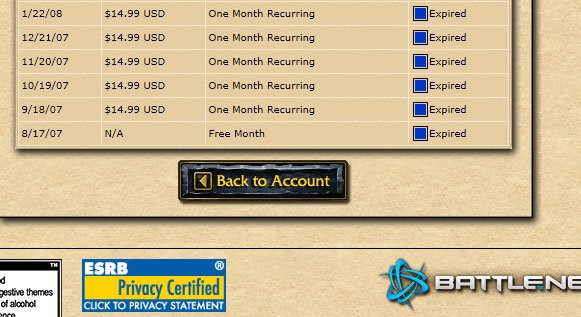
My 4-year WoW anniversary was last weekend, having started 8/17/07. Adding up all the days /played across my toons, I ended up around ~322 days, or 7,728 hours. Depressingly that averages out into 5 hours a day, every day, for four years. I played more when I was unemployed for a year, of course, but it is still shockingly bad. Then again, that also equals $0.087/hour as far as entertainment goes. Or imagine buying a $0.99 app and getting 11.38 hours of gameplay out of it. I find it unlikely that I would have done something (more) productive with my time had WoW not existed, so with that in mind perhaps I should be instead celebrating all the money I saved by switching to Geico playing the everliving hell out of WoW.
I have heard and agree with many people who suggest that WoW will be their first, last, and only MMO. Although I am a storied veteran of games that require other people to play with, e.g. pen & paper D&D, split-screen Goldeneye, Magic: the Gathering, etc, the common denominator was a group of people you enjoy hanging around with. In the absence of friends, WoW is a pretty shitty single-player experience once you reach the endgame. And while this problem can be “solved” by making new friends, actually shifting through all the bullshit is a lot of work* for the payout of challenging gameplay that comes in the form of hoping people that are not you do not screw up, e.g. raiding.
In this light, I do not particularly think the trend of companion AI or whatever is necessarily bad. Having played Minecraft for a while now, I have reached that plateau where you want nothing more than to show off the cool biodome tower you built or the Pit of Doom you dug or the cross-Atlantic powered railroad to someone, anyone else capable of appreciating the amount of effort/vision it took to do so. Of course, the thought of trying to do what I have done on a multiplayer server where anyone could wreck my house and steal my materials at any time is mortifying. I want a Show & Tell, not a group assignment. I want a single-player MMO.
And until then, WoW (with liberal playing of Steam games) will have to suffice.
*As outlined in this three year-old Cracked article, which is still pretty dead-on.

