Category Archives: RPG
[Baldur’s Gate 3] Too Late Now
One of the infographics from Larian regarding Baldur’s Gate 3 (BG3) is how over 93% of players created a custom character for themselves. I… did not. And it is very clearly a mistake. One that I cannot possibly “fix” now that I’m like 45 hours deep into Act 1.

Why did I not create a custom character? I thought that the game was going to be like Divinity: Original Sin 2 wherein there were very specific story beats that would be better with an Origin character. Although, to be fair, I am not exactly certain that was the case even in that game. But it seemed important enough to do there, so I did so here as well, picking Gale.
If you are one of the overwhelmingly vast majority of players who haven’t rolled an Origin character, let me explain why it is a mistake: your character doesn’t speak. Yes, custom characters don’t speak either, but I am assuming that Gale has a lot more to say about things beyond 1-2 quips at the conclusion of side quests. I have no clue how much of his background is normally explained by the end of Act 1 (around where I’m at), but I assume that it’s more than practically nothing. Beyond talking to a cat with wings about my mother – of whom I know nothing and have no reason to care about – all this “origin story” business appears to be about as deep as the blurb you read on the character select screen.
Maybe things open up in the later Acts? But what I’m worried about is how that plays out narratively. Are there exclusive scenes that you only see if you are playing as Gale? That would be the ideal, I imagine. But I’m also worried about how much any of that really matters in comparison to just doing his companion quests. For example, I was all down for smooching Shadowheart until the awkwardly direct Karlach literally stole the show. What about Gale though? What is his personality like? What kind of hilarious banter would he be getting into with my current party? I’ll never know, because I am him, and I don’t say shit, apparently.
Well, I choose all the dialog, but you know what I mean. It’s not the same.
Kinda makes me wonder if this is a uniquely Larian game problem. Most other RPGs don’t have “Origin” characters, right? Or they do, with no option for a custom character, so you’re not stuck in this dilemma. Which apparently is only impacting me and the other 7% suckers. Oh well.
[Baldur’s Gate 3] (Un)Intuitive
I continue to play a lot of Baldur’s Gate 3. Indeed, I’m at 40 hours and still in Act 1.
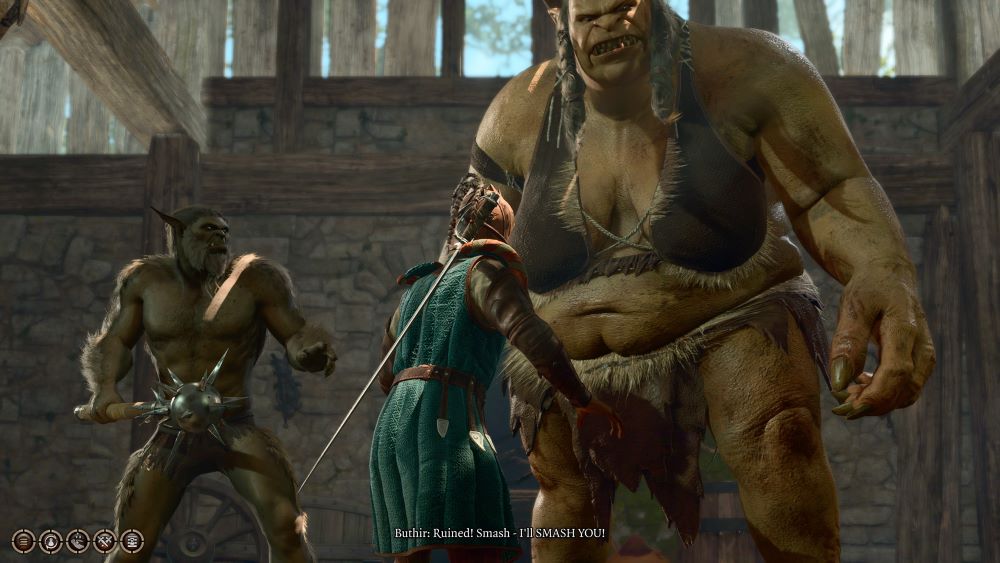
Some of the problems I have with the game are my own fault. I was super into 3.5e D&D way back in the day, and a lot of my “intuitive” understanding of such systems are still based on that clearly superior ruleset. Just kidding – stuff like Short/Long Rests and similar refinements over the years are definitely welcome. But it did come as a bit of a shock that, say, Rogues are only able to get one Sneak Attack per round in 5e (and BG3). Back in my day, the only way a Rogue could keep up with spellcaster DPS output was being able to poke someone three times in one round and get a pile of d6s each poke.
Okay, that’s clearly my bad. But then the line starts getting a little blurry.
For example: Mage Armor says to increase a target’s AC to 13 + DEX modifier, as long as the target isn’t wearing armor. This sounds like a great bonus for a Barbarian who is already encouraged to not wear armor… but it doesn’t “stack” with their own Unarmored Defense ability (Add CON and DEX modifier to AC when unarmored). Like, I get that it would probably be a bit overpowered, but I had to reread the text several times to understand why it didn’t work – Mage Armor specifically puts AC to “13 + DEX” instead of simply increasing the base AC of 10 to 13.
Of course, that’s just the classical Mage Armor gotcha, that apparently has been getting people for 8+ years. Worked in 3.5e, by the way, but clearly if you read page 14 of the 5e Player’s Handbook: “if you have multiple features that give you different ways to calculate your AC, you choose which one to use.” Okay, Rules As Written, got it. But riddle me this, Batman… what does the BG3 spell Warding Bond do?
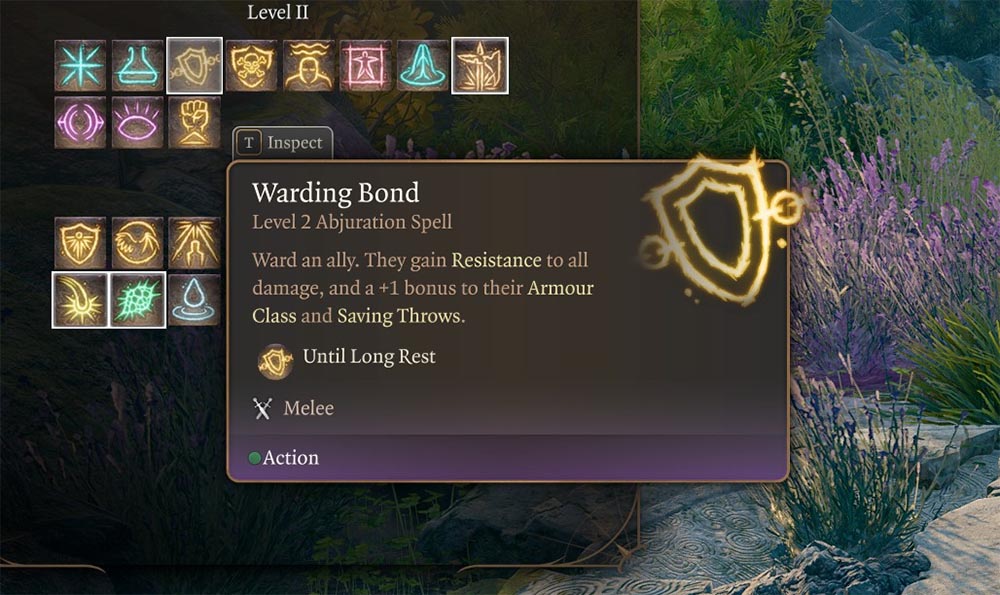
If you answered “create an unstoppable priesthood of clerics that only take half damage from everything,” you would obviously be wrong. Conspicuously absent from the BG3 description of Warding Bond is that the missing half of the damage you take can be found on the casting Cleric. Imagine my chagrin when I found that out, only after reading the “buff” that appeared on Shadowheart. But this is again a case of “just read the 5e Player Handbook to know how this 2023 CRPG works.”
Oh, hey, did you know that in BG3 prepared spells can actually be changed at any time outside combat? This is a big change from traditional (and 5e!) D&D rules that otherwise force you to, well, prepare which spells you can cast that day. What this means is that you can cast Mage Armor on yourself (which lasts until a Long Rest), and then drop it out of your list and put something else more useful in its place. You still use up one “casting” for the day, but now you get more options.
You can take things a bit further than that though, by having characters you’re not actively using cast things like Mage Armor while in camp. For example, you can have Gale cast Mage Armor on whomever, then swap Gale out for someone else. I had already been building my party in such a way that one person took utility spells and everyone else took offensive options, but knowing I could basically press the Camp button to essentially hotswap anyone at a moment’s notice took things to the next level. Now you can have your very own early-WoW era buffbot paladin, whose sole purpose is to stay at camp and buff your team.
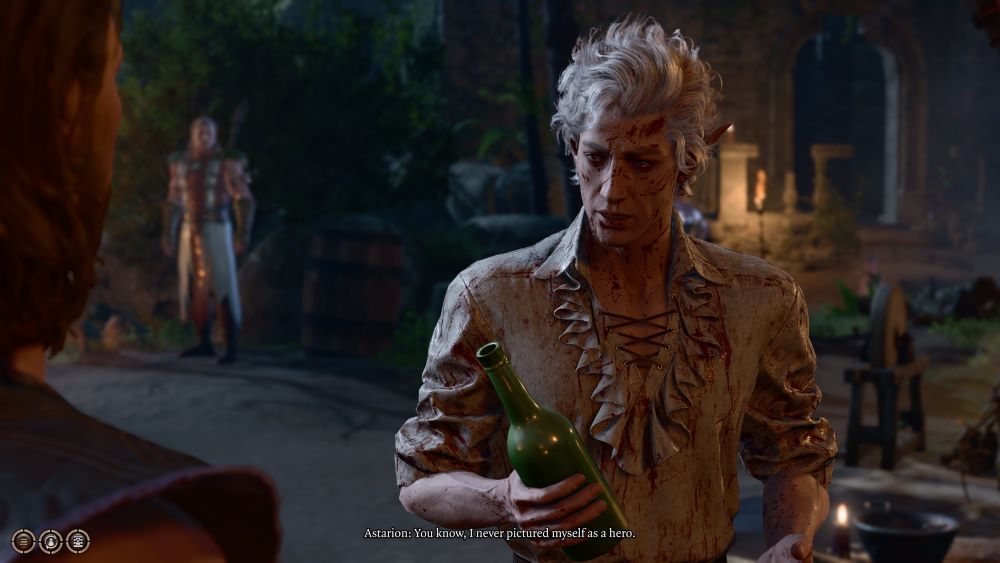
A lot of this highlights perhaps the biggest issue I have with BG3 at the moment: its inscrutability. A lot of the media praise thus far as been for the exact opposite, that the game is making 5e D&D or CRPGs in general more approachable. And that could certainly be technically accurate. But consider this: there’s no in-game way to determine what your characters will get at the next level up… until you level up. You can’t browse a list of magic spells. There’s a staff you pick up that gives you +1 to unarmed attacks and I have no idea how that works. Do staff attacks count as unarmed? Do you hold it in your off-hand and then make unarmed attacks with your on-hand? Does it only work with Flurry of Blows? I don’t even have a Monk character for which this would be relevant, but it vexes me.
And who knows, I might well turn Gale into a Monk next time I gain a level.
Perhaps the “average” player doesn’t care about any of this and will just take their character to level 12 just as they are. But that doesn’t mean Larian shouldn’t also include some kind of indexed in-game encyclopedia or something. If you have time for a Show Genitals button, surely you can have a Preview Level button. I would settle for a Wiki worth a single god damn, because the Fextralife one is near unusable and filled to the brim with outdated Early Access nonsense.
Anyway. Larian has indicated that they are working towards a Patch 1 with a “gigantic list of tweaks and changes.” Here’s to hoping that a little more clarity and intuitiveness is amongst them.
Review: Mass Effect 2
Game: Mass Effect 2
Recommended price: $25
Metacritic Score: 94
Completion Time: ~36 hours
Buy If You Like: Mass Effect, or cover-based 3rd person action-RPG shooters
It was with no small amount of trepidation that I booted up Mass Effect 2 (hereafter ME2) for the first time a few weeks ago. Having been so late to the Mass Effect party generally, the ongoing internet narratives surrounding ME2’s quality and “worthiness” as a sequel had already congealed into a crusty shell of opinion. I heard claims about “dumbing down,” that Bioware was losing its way and letting the RPG bits drift, abandoned in the dark places between stars. What would I find, coming from the original which so thoroughly and completely sucked me into a new universe?
What I found in ME2 was highly enjoyable, more… streamlined game.

Commander Badass reporting for duty.
A lot of my issues with the original Mass Effect came down to Bioware trying to shoehorn in RPG bits where they did not really fit. There were talents and upgrades and items without the underlying structure of, say, inventory management or character stat screens. In ME2, all of that has basically been removed. You can still find or purchase new weapons, but each weapon is not necessarily better than the ones you already have – it is more akin to alternate weapons in normal FPS games. There still is not a coherent stat screen, but the talent/power-choosing process has been truncated down to the point where it is not necessary.
While that is an improvement over the last game, I was left with the nagging feeling that it doesn’t really make sense to have levels and XP at all anymore; since you inevitably level up after each mission, why not just give players the talent points? Similarly, I was also left with the impression that there really was not much difference between Biotic and Tech-based powers. I could not tell you offhand what the mechanical difference between Tech and Biotic was in the original Mass Effect, but it seemed pretty clear that Biotics was supposed to be special and rare. Now it seems like more than half my crew was Biotic along with most of the organic enemies.
Although the nuts and bolts being streamlined could be viewed as good or bad depending on tastes, the combat itself feels much, much better in ME2. Taking cover feels a lot more fluid, firefights are longer and include more enemies, and with the radically shortened cooldown on Powers, you can do some pretty outrageously dynamic things. There may have been a lined crossed somewhere along the way – perhaps when I was warp-charging through cover every 6 seconds to punch heavily-armored bosses in the face – but I will take dynamic, exciting combat over rote realism any day. After all, how believable is it to have ample chest-high obstructions in every other room to begin with?
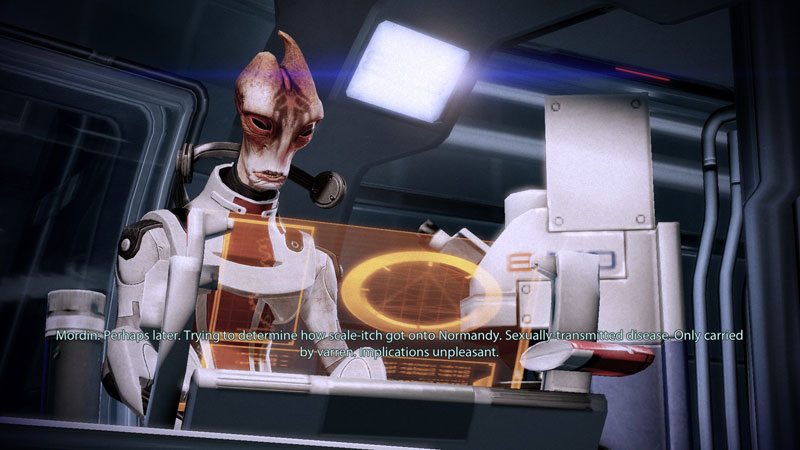
Best party member since Minsc.
My favorite aspect of the original Mass Effect was the integration of non-verbal dialog into the narrative, and the general narrative itself. In ME2, that is kicked up a notch^². Characters smile, nod, gesture, facepalm, wink, and otherwise emote in subtle, natural ways. Indeed, these little actions end up becoming part of the dialog, creating nuance and meaning that words themselves could not convey. Some scenes are punctuated with Quick Time Event-esque moves, such as interrupting a bad guy speech by just shooting him, or stopping someone from doing something they will later regret. While QTEs are normally cheap, annoying gimmicks to force players to pay attention, the ones in ME2 felt a natural part of the narrative… including when you went ahead and let a teammate squeeze off a round in the criminal’s kneecap. I have not played a proper RPG since starting up this Mass Effect experiment, and I am still nervous about whether I could ever go back to static character portraits, scrolling text, or (well-done) narrative QTEs again.
One other thing about the dialog that deserves special mention: this is one of the most goddamn hilarious games I have ever played. Sometimes ME2 crosses the line into absurdity – the cigar-smoking Elcor shopkeeper, anyone? – but most of it evoked more literal LOL moments than eyerolls. That is not to say there is not any drama or serious things going down. Rather, it is precisely these moments of sardonic levity that drive home stakes. You end up liking these characters, wanting to hear what quip they will bust out next, and then are suddenly confronted with the very real possibility they will die based on your actions.
What really ended up surprising me was when what originally appeared to be a simple “alien + personality quirk” party member, suddenly unfolded into a paper crane of origami complexity. I am specifically talking about Mordin, whom I felt practically stole the show aboard the Normandy. The transition between him being a “stereotypical” Salarian with a humorous ADHD staccato manner of speaking, to a weary doctor haunted by the ethical ghosts of his past is nothing short of brilliant. In fact, it is not even really a transition of his character, but a transition of your perception of his character; he didn’t become deeper, you merely discovered the depths. While the other characters are perhaps less complex in comparison, that is practically true of most characters in any RPG that I can recall.
Dialog and characterization aside, I am sympathetic to claims that ME2 streamlined the plot a bit too much. I wasn’t a huge fan of driving the Mako on every random planet, but when that option is replaced with a (decently fun) scanning minigame and combined with exploration mechanics that discourage exploration (we have fuel now?), it ends up making the universe seem a bit too small. Plus, I am not a huge fan of the Restart at Level One trope to begin with, or really how it was presented here. Instead of an epic, unified journey, ME2 really felt like 2-3 missions with about a dozen sidequests between you and the third. I want to stress though, again, this is a weakness with the story structure, rather than the story itself. Each of those episodic sidequests were worth experiencing on their own, but I do recognize how little effect they seemed to have on the overall plot.
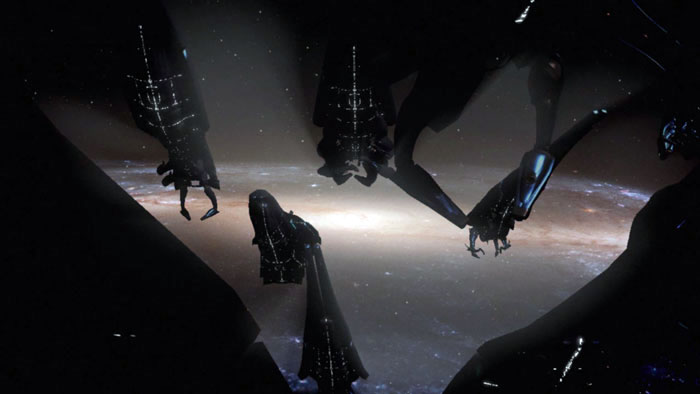
"You know, somehow, 'I told you so' just doesn't quite say it."
Is Mass Effect 2 as groundbreaking as the original? Of course not. The first game had the task of creating an entire universe filled with races and peoples, and had to go about getting you to care about learning more about them. In that respect it succeeded admirably. It is difficult to add something to an already completed picture though, and so I got the impression that Mass Effect 2 was concerning itself with making you care about Shepard. Not in the sense that Shepard is the most interesting man/woman in the galaxy, but rather in the sense that you genuinely care about the choices you will soon be forced to make in the coming war. Mass Effect was about world-building, and Mass Effect 2 about filling that world with individuals. As Mordin says:
No. Aware survival unlikely. Actually contacted him for personal connection.
Hard to imagine galaxy. Too many people. Faceless. Statistics. Easy to depersonalize. Good when doing unpleasant work.
For this fight, want personal connection. Can’t anthropomorphize galaxy. But can think of favorite nephew. Fighting for him.
Does Mass Effect 2 emulate the mechanics of RPGs as well as the first game? No. Did Mass Effect 2 capture the soul of RPGs, the essence of what makes them worth experiencing?
Absolutely.
Skyrim Design Nettles
Skyrim thus far has been as amazing an experience as everyone says. There is something to be said about how the fidelity of an experience engenders instant immersion in ways videogaming might not have achieved even five years ago. I already posted the screenshot of what I saw exiting the tutorial dungeon for the first time, and I was immediately struck by the same awe and infinite possibility I felt leaving the Vault in Fallout 3.
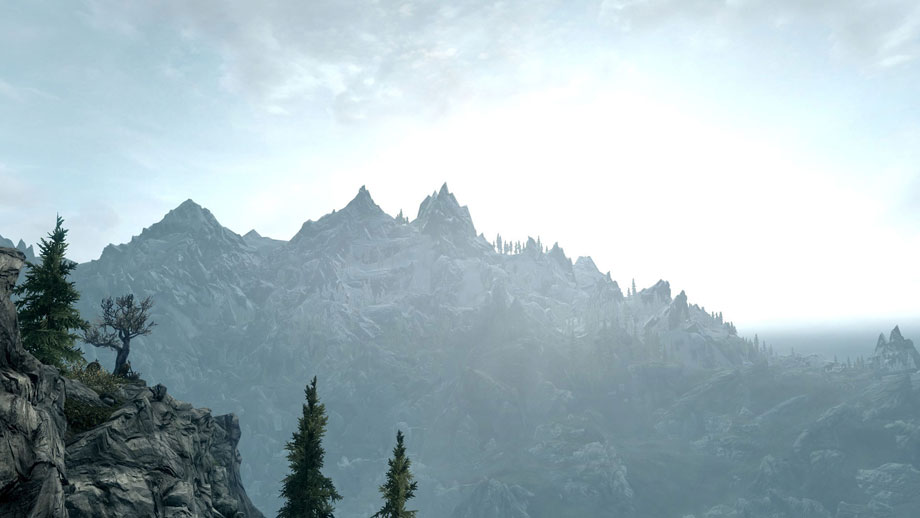
My current desktop background. Well, at +1000 resolution.
What I want to talk about today though, are the Design Nettles in Skyrim. These are the little things that take me out of the experience with their sting, no matter how much I try and ignore them. Every game has its idiosyncrasies, but what elevates these particular annoyances is either how out of place they seem within the context of a fidelitous experience, or how much they are artifacts of a bygone design era.
Imbalanced Skill Gains
Raising one’s Sneak level by auto-running into the wall for an hour has been a staple of Bethesda design since at least Morrowind. Why they choose not to fix that isn’t the problem. The problem is simply the imbalanced skill gains generally.
I gained two entire character levels in the first town from simply pickpocketing; going from level 6 to level 8 within the same house, in fact. Indeed, I gained 5 skill points for pickpocketing ONE ITEM, a magic ring from a sleeping guy. My pickpocketing skill is currently north of 70, I am level 21, and I haven’t even seen a 3rd city or a dragon yet. Meanwhile, I have probably picked 30 locks in the same time period and received ~4 skill ups. Same with Blacksmithing, Alchemy, Enchanting, Sneaking, Archery, and so on and so forth.
This is more of a problem in Skyrim than it was in Oblivion, because gaining any skill points increases one’s level, which in turn increases the level of all enemies in the game world. More insidiously, you can go hours (or specifically 18 hours in my case) before the problem even begins to manifest itself. I ran into some bandits on a bridge who were immune to my normal tactics which had hitherto worked in every encounter, and I only succeeded by “gaming” the system in rather ridiculous ways – playing Ring-Around-the-Cookpot and ladeling myself 16 servings of Apple Cabbage Stew in Matrix-esque bullet-time.
Enemies on Minimap
I can appreciate the design challenge that comes from choosing to have enemies appear on the minimap. Specifically, once you do that, you cede the ability to create tension via unknown enemy placement without resorting to dumb gimmicks. I like to call this the Silent Hill effect – unlike Resident Evil or other survival horror games where monsters can jump out at you at any moment, Silent Hill gives the player a radio that plays static whenever enemies are about. No static, no monsters.
Silent Hill as a series gets around this “limitation” by being fucking scary even when there aren’t enemies around (and by segmenting the game into rooms), but Fallout 3 and Fallout New Vegas fall into the trap of essentially lying to the player; “You can see enemies, and even raise stats to see them from farther away, unless we need to generate tension in which case your abilities will be useless.”
Skyrim attempts to have it both ways, while simultaneously stepping into one of my biggest pet peeves in “realistic” games.
In Skyrim, enemies that have aggro’d to your presence appear as red dots on the map-bar. You can even track the movement of these enemies through walls and barriers. Other than that, nothing appears on the map-bar other than locations. Which is… fine, right? Resident Evil, Half-Life, etc, don’t have minimaps with enemies on them either. My peeve though, relates to how high-fidelity games play out as if my highly skilled avatar is as clueless as me, the player.
Look. It’s clear the Skyrim designers decided not to put animals/people/etc on the minimap in order to increase realism. If I’m chasing butterflies to eat their delicious wings, it’s fair play that the tiger I wasn’t even looking for gets its turn too. But if I’m specifically hunting that tiger, or I’m sneaking up on the bandit camp, it simply feels dumb to be surprised due to lack of information. I can’t hear the guy in full plate walking around because the designers refused to give me that input; or if they did, they made audio-only to the point where I’d blow out my desktop speakers trying to hear it.
You can’t ask me to put myself in that field, and deny me access to my normal senses. And you can’t pretend that my normal senses are adequately represented in your arbitrary, game design way.
In other words, Christ, I want NPCs on that minimap. It obviously changed my behavior in the Fallout series knowing where people are even through walls and such, but removing it and pretending my character is as careless as I am playing the game is worse. Indoors? Yes, it works well to force people to be careful. Outdoors? Completely ruins any semblance of stealth-ish gameplay. At least, until I “beat the system” by Quick-Saving every 30 seconds and simply reloading if I stumble into a bandit camp without the opportunity to sneak attack someone.
Skyrim: Day 0
The ideal scenario, I believe, is to start playing popular (or notorious) games right when they come out. Not only is the potential for spoilers minimized, but there is also something to be said in exploring a brand new game as a virtual group, together. And the pageviews. Can’t forget about the pageviews.
Riding in on the backwash of the tidal wave of Skyrim blog posts does grant me the sort of perspective that First Day/Month players don’t start out with. Sometimes it’s good (“Don’t Sneak into a wall for two hours.”), sometimes it’s bad (“Infinite mana via Enchanting, yo.”), and sometimes… well, you start noticing things right away:
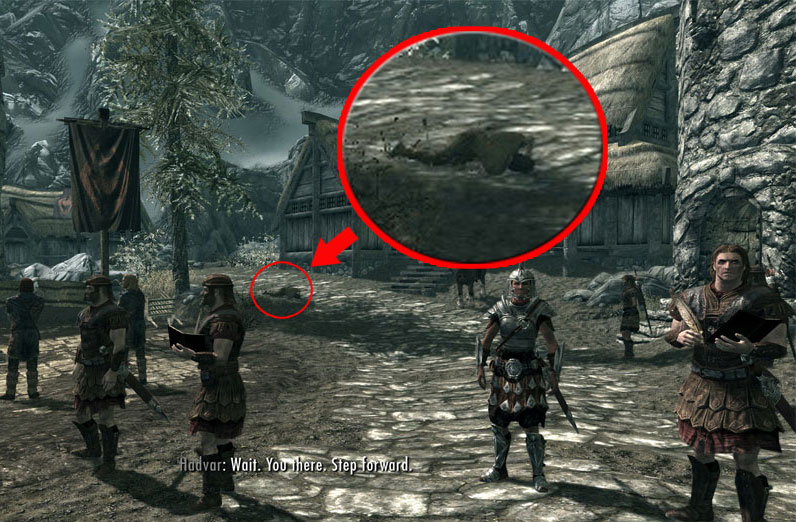
Wait a minute... did that arrow really hit him in the...
That aside, I wanted to kind of lay out the way I was approaching Skyrim before I get too far (12 hours and counting) into it to remember – indeed, I only stopped to write this because I had a C++ crash-to-desktop interrupting me.
- I strongly disliked Oblivion overall; in many ways, I considered it the anti-RPG. Here was a RPG that punished you for specializing in three skills that you actually use. Here was a RPG filled with quests that had no rewards, i.e. XP. Here was a RPG that discouraged exploration insofar that dungeons get stocked with crap treasure the earlier you reach it. Here was a RPG I broke in half after an hour of tinkering at the weapon enchanting workbench and 1000g (“Hey… -100 HP for 1 second costs practically nothing. And it can reduce them to zero? And it stacks if you cast it real fast?!”).
- If I’m honest, Oblivion’s true crime could simply have been that I played it after having spent 150+ hours in Fallout 3. Not only do I enjoy post-apocalypse settings better than fantasy, but it did everything else Oblivion seemed to be trying to do, but way better. Scaling enemies felt a lot more natural in Fallout 3, for example, while still allowing you the freedom to go practically anywhere starting at level 2 (something lost in Fallout: New Vegas, but that’s another post).
- I did finish Oblivion, albeit after starting a fresh character with 3 non-used specialized skills, a sword/bow that instantly killed everything below 100 HP, and a general disinterest in side-quests. There were some genuinely novel things going on, and I do remember a few of the quests. Like when you had to fish a ring out of a well, but the ring was enchanted to weight 200 lbs. It sounded (and felt) exactly like something out of my college buddy’s D&D campaign.
- The Shivering Isles expansion was loads of fun, and easily better than the entire normal game.
If the above sounds concerning in any way, allow me to alley those fears: I walked into Skyrim with a fundamentally different attitude. In the years since Oblivion, games like Minecraft (and, if I’m honest, other gaming blogs) taught me to enjoy more free-form, emergent gameplay.
I still prefer narrative-driven games, of course, but having an audience for Show & Tell purposes actually gives those random occurrences a narrative feeling – nobody cares about the crazy dream you had last night, but hey, look at this:
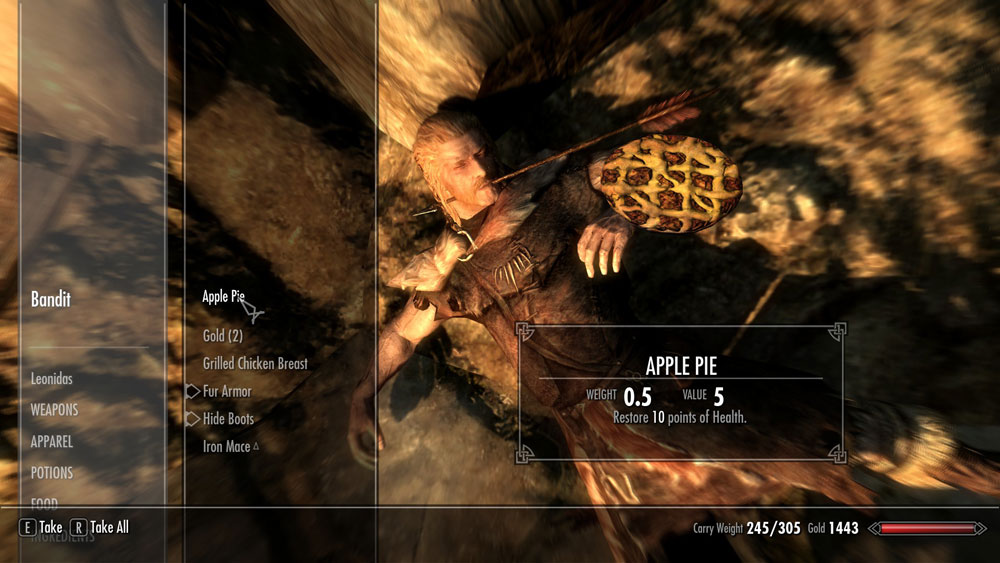
Horrific arrow wounds + delicious apple pie.
So, anyway, Skyrim is happening. Given the blogging saturation surrounding the game, I will attempt to keep “Christ, look at that mountain!” posts to a minimum. There is actually some topical problems I have with the game’s design, which I’ll get into a bit later. Interestingly, none of the problems are the interface.
Future of Gaming: We (May) Be Screwed
If you play games and had a pulse in the last fifteen years, you have undoubtedly bore witness to the meteoric rise of the Free To Play (F2P) model, which had been preceded by the Downloadable Content (DLC) model, which had been preceded by the “new Madden game every year” model, sandwiched inbetween the 8-hour single-player campaign and Skinner Box School of Character Advancement loafs. It is enough to make a grown man cynically quip “I told you so!” as he shuffles back into the 1990s when games were games, and boys dreamed of somehow getting credited as Writer in the next Squaresoft Final Fantasy epic.* You know, when gaming was cool because it was an ultra-niche hobby that catered solely to you and your demographic – back before the industry totally sold out** and before it was considered hip to pretend you were upset that something sold out.
Well my friends, it actually might be worse than you think.
 In An Age
Running Out the Clock
Aug 30
Posted by Azuriel
It is unlikely that I will end up finishing Baldur’s Gate 3 anytime soon. And I think I’m okay with that.
I am currently at 61 hours played and still in Act 1. To be clear, I’m probably 90% done with the Underdark path, so not too far from the beginning of Act 2. But also to be clear, I fully intend to march up to wherever the boundary is, turn around, and fully clear out the Mountain Pass path as well. As is tradition. That is… unnecessary and probably ill-advised. “Save it for a second playthrough!” When, do you imagine, that will occur? And if I am running a second playthrough – most likely on Tactician difficulty – why would I give up on an entire extra area of loot?
The reality is Starfield hits Game Pass in less than a week now. And three weeks after that, the expansion for Cyberpunk 2077. I think the Cyberpunk patch that radically transforms the base game (revamped talent trees, etc) will be released prior to the expansion too. Sea of Stars just came out on Game Pass a few days ago, by the way, and while it too was going to be somewhere on my list, I had not realized that Yasunori Mitsuda was involved. Truly an embarrassment of riches scenario right now.
What really sealed the BG3 deal though, was a recent Mass Effect 3-style ending acknowledgment:
As I said, I’m still in Act 1. However, I have consumed enough of the very thorough, very spoilery media posts to know that, for example, there were issues with Karlach. And had I plowed through the game as quickly as possible, I would probably be upset about this “optional” ending that nevertheless gives Karlach “what she deserves.” Which, from my partying experience with her in Act 1, is: all the nicest things in the world.
The talk about “first results” in terms of expanded epilogues foreshadows similarly corrected character developments. At which point the question is: why play this game right now at all? Collectively, I think we all kinda knew that someone playing BG3 Day 1 is going to have a vastly different experience than someone else picking up the Definitive Edition a year(s) later. But I’m not sure that a whole Mass Effect 3 ending situation was on the Bingo card.
Perhaps that comparison is premature. The fact that it is a possibility though… is making my dithering rather auspicious. The trick will be whether I come back to BG3 at all. My track record with “taking breaks” in CRPGs is not great. Didn’t work with Pillars of Eternity, Divinity: Original Sin 2, or Solasta.
Fourth time’s a charm, I hope.
Posted in Commentary, RPG
5 Comments
Tags: Baldur's Gate 3, Dithering, Embarrassment of Riches, Mass Effect 3, Starfield, Xbox Game Pass