Blog Archives
I May Be Ruined
I am about ~15 hours into Mass Effect 2.
Everything is going swimmingly, although I am beginning to suspect (all) other games have been ruined for me in two very specific ways.
First, I am not sure I can go back to text boxes in RPGs anymore. It is not just about BioWare’s penchant for fully-voiced stories, it is about the equally gripping body language. Everyone has heard about the whole “93% of communication is nonverbal,” right? We are now at a point in game design when at least one company is capable of delivering on that 93% and I do not know if I can go back.
It isn’t just about the smiles, the winks, the nods, or the scare quotes by characters with only three fingers either. It is about the more subtle touches that keep my eyeballs glued to the story exposition. For example:
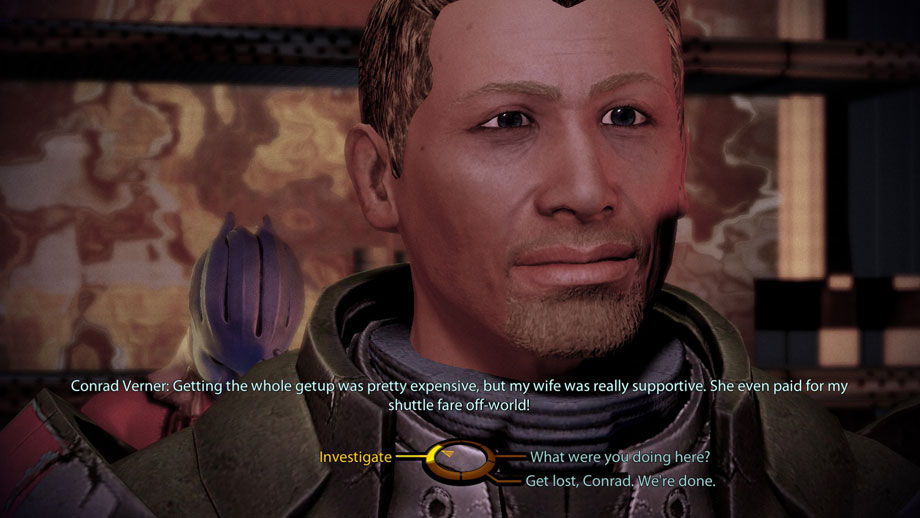
I should have shot him in the foot when I had the chance.
The asari bartender in the background facepalms when Conrad speaks the part about his wife buying the ticket. I actually had some difficulty taking that screenshot because the time between the background facepalm and the camera switching back to Shepard is less than a second – I had to redo that part of the conversation twice to get the shot.
Think about that for a moment. Someone actually went through the trouble of programming a facepalm into a (presumably) throwaway, non-required dialog option, with less than a second of screentime. Understated is an… er, understatement.
Going back to strict text and using my imagination to fill in the blanks? I am not quite sure it will feel the same knowing that the blanks are literal blanks; unless the developers clearly make up for it in other areas of the game, I suspect I will recognize the gaps as deficiencies rather than “imagination opportunities.”
The second way I have been ruined actually came via The Witcher, and is very clearly manifesting itself in Mass Effect 2. Specifically, I now believe I can and should be able to romance anyone and everyone, simultaneously.

Romance All the Things!
I first noticed this tendency when I was flirting with the ship psychiatrist – whom should really know better – and became nervous that things might get out of hand before the entire playing field became available, so to speak. This was not a problem in The Witcher; in fact, you typically only had a single opportunity for “romance” at any given time, so it was a series of all or nothing encounters.
To be honest, this probably has more to do with my methodical nature in gaming than anything else. The baseline assumption I operate on is that I will only ever play a game once – I am looking to maximize my fun, not fill time, and 2nd playthroughs almost always lose out to the dozens of other games available. Ironically, this leads to counter-intuitive game behavior wherein I suck the very marrow out of a game’s bones, completing every sidequest and bonus mission long after such things have ceased being fun and/or make sense to do. Exploring every planet in every system cluster in Mass Effect 1, running Miscellaneous quests in Skyrim as a level 54 character with 100k+ gold, and so on.
As you might suspect, mutually exclusive romance options present a certain difficulty to me.
I do have a residual desire to play ME1&2 again as FemShep, which I would have done originally if not for the availability of romance options at all (that’s another post). The ideal romance scenario would be the “Deus Ex ending” one, wherein you could save right before the critical choice and I could reload to see each outcome. I am getting the impression that this is not how things will shake out.
Youtube exists, but it is just not the same.
Review: Mass Effect
Game: Mass Effect
Recommended price: $15
Metacritic Score: 89
Completion Time: ~32 hours
Buy If You Like: 3rd-person pseudo-RPG shooters

Subtitles: On.
It is somewhat difficult trying to review a franchise-launching game like Mass Effect years after its initial release. Should it be compared to the standards of games of today, or of its time? Is it even realistic to believe the experience can be compartmentalized away from the knowledge $200 million MMOs are using its primary narrative mechanics 4 years later?
As I watched the ending credits this past weekend, it became clear in my mind that the concerns were largely moot. I loved this experience, I loved the narrative, I loved the setting where the writers were taking me. And I loved these things despite the weakness of the actual game bits of the game.
The combat system in Mass Effect is a cover-based 3rd-person shooter meets half-assed RPG elements. The shooting elements were decent on their own, even if the majority of the fights seemed to oscillate between completely trivial to instant death (at least towards the beginning). Your squad members are mostly competent in straight-up fights, although controlling them was sufficiently awkward that I was glad it mostly seemed irrelevant to the outcome.

Owned.
The “RPG elements” of the game though? I have mentioned this before, but there is really no point in having gear with stats – or talents that grant stats – if there is no way to actually look at your stats. Talent A gives me 3% more Hardening, but Talent B decreases the cooldown on my Throw ability by 5%. And yet I have no idea what my Hardening percent currently is (or, honestly, what it even does) or what my cooldown on Throw is currently sitting at. The first talent point in the weapon skills appears to boost damage and accuracy by crazy amounts (~10% vs 1-2% increments), but it is difficult to feel clever about making good choices when you never actually get to see numbers go up.
After the first area is cleared, the game map opens up most of the galaxy and gives you free reign to plow through dozens of side quests in a fairly non-linear fashion. The problem here is that it is all the same… literally. Each system has a landing planet where you are dropped off in a vehicle, drive around collecting junk, and cap off the experience in one of the two possible building layouts that are otherwise copy-pasted across the universe. Sure, the box maze is slightly different, but there are only so many times one can endure entrance corridor, large room, T-tunnel, two side rooms (or big room, small side room, stairs, small side room) before the very thought of landing on a planet becomes nauseating.
But then I asked myself why I was doing all these side quests to begin with. And the answer was that I loved it here. I didn’t want the game to end. I wanted to stick around in a game setting that people took the time to actually try and make intelligible. How is faster than light travel possible? Element Zero reduces mass, i.e. the Mass Effect. Why don’t we care about ammo? “Bullets” are just shavings off a brick of nondescript metal, accelerated at high speeds. Why can people take a bunch of bullets to the face? Kinetic shielding.
Mass Effect is Sci-Fi, but it doesn’t feel like the hand-waved or mystical Sci-Fi of settings with hyperspace or The Warp. Element Zero is fantastical, sure, but its interactions within the realms of physics largely makes sense. In other words, Mass Effect has more in common with Dune than Star Wars. And that is amazingly refreshing.

See you soon, space cowboy.
What is more than merely refreshing is the inclusion (and highlighting) of non-verbal dialog in an RPG. All dialog is fully voiced, which goes a long way in bringing otherwise disposable NPCs to life. But when they start winking at you, touching your character, raising an eyebrow… you realize how far the genre has come since Kefka’s 16-bit laugh of madness. Mass Effect might not break a lot of ground plot-wise, but it does break ground in the sense of being drawn into caring about the plot in ways most other RPGs can not achieve.
Overall, I was very, very impressed with my ~32 hours spent in this new universe, and eagerly look forward to spending some more in Mass Effect 2. And if they shore up some of the rough edges in the combat system, all the better.

