Blog Archives
Impressions: Stoneshard
I’ve played almost 40 hours of Stoneshard in the last two weeks. My opinions are… mixed, but hopeful.
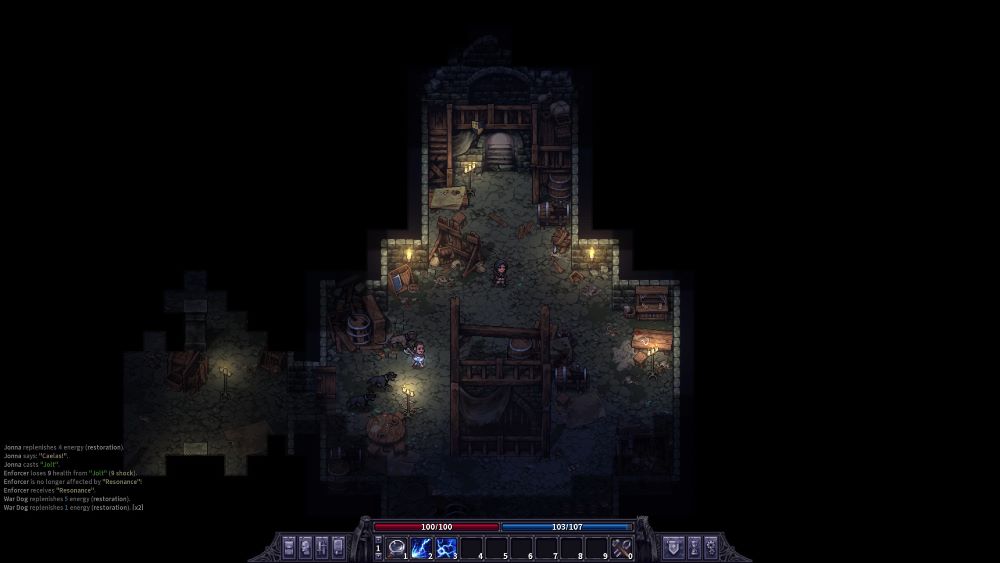
Stoneshard is a brutal, turn-based fantasy/mercenary game where death is always around the next corner. It’s one of those “you’re not the hero” kind of stories, although in practice that just means you can run into super high-level enemies early on if you aren’t careful. The general gameplay consists of taking contracts to do X inside dungeon Y within 3 days, and then returning for your reward. Eventually, the contracts dry up at your original location, so you have to trek to another town and start the process again, hitting harder and harder dungeons. The most recent update (0.9.1.0 – Rags to Riches) includes a caravan feature that makes moving through the world much easier.
The brutality of the game comes in two flavors: cascading failure, and time disrespect.
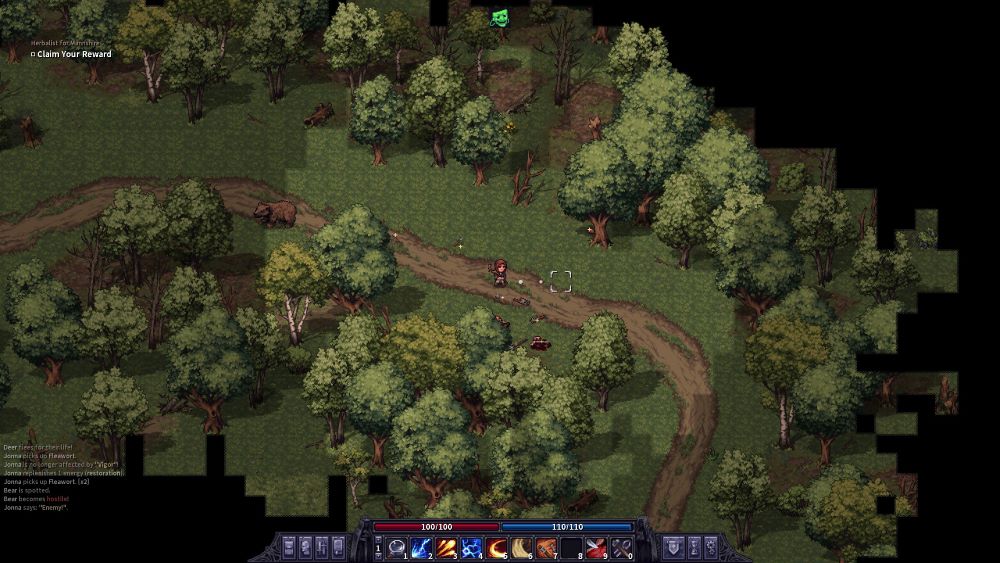
Let’s start with time disrespect first. The world is broken up into tiles that you move through, just the same as you would move through a dungeon. While you can click on a distant spot to have your character “hop” square to square quickly (outside of combat), the fact remains you still have to walk. If the dungeon is six tiles away, that’s six full screens you have to get through. There are a bunch of herbs, mushrooms, berry bushes and the like to occupy yourself with – you need to craft a lot of fodder to fuel your caravan – and there is always the risk of an ambush from bandits or hostile wildlife as well. So, it’s not always boring to travel long distances. Plus, sometimes it’s fun to kind of vibe with the very excellent music and ambient noises.
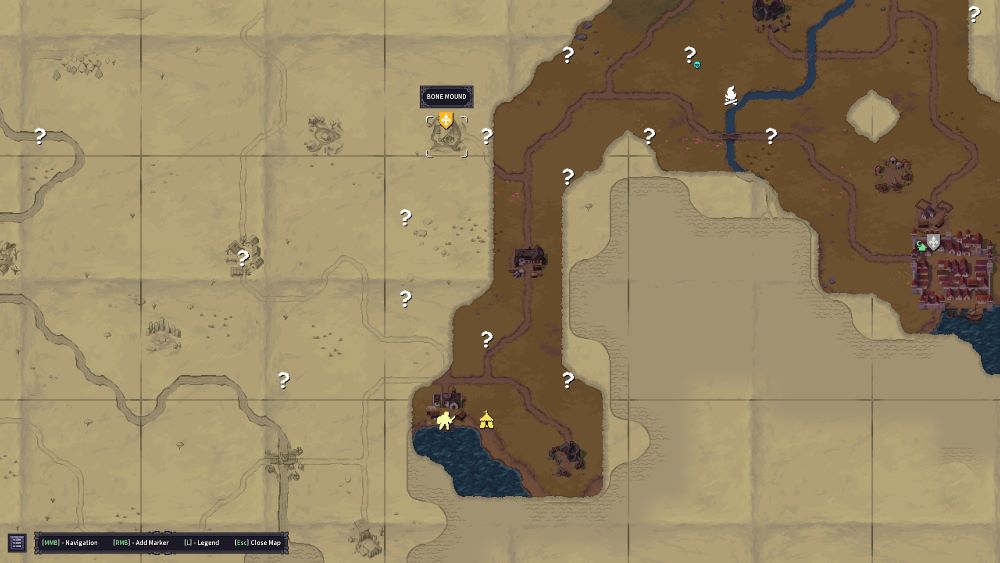
Here’s the thing though: you can only save the game when resting. If you travel for those six tiles, survive a few ambushes, clear an entire dungeon (including the boss), and then get bit by a hidden snake and die a tile away from town… you lose all progress since the last time you rested.
Technically, there are ways to mitigate this sort of disaster. You can buy/purchase bedrolls, which take an enormous amount of limited bag space, to create a one-time use resting spot outside of the dungeon. This will prevent you from having to re-walk to the dungeon, but of course do nothing about the dungeon itself or the walk back. Or perhaps you can bring two bedrolls, use one, stash the other outside the dungeon, and then use the second once you complete the dungeon. The latest update introduces the caravan, which you can technically park close to the dungeon and mitigate the worst of it, if you’re willing to burn a bunch of time (there’s a cooldown after parking the caravan). Of course, the existence of the caravan “workaround” calls into question why there’s no Quicksave, or a smaller Meditation Mat, or whatever.
[Note: there is a Save & Quit feature, allowing you to exit the game. This save is deleted after loading.]
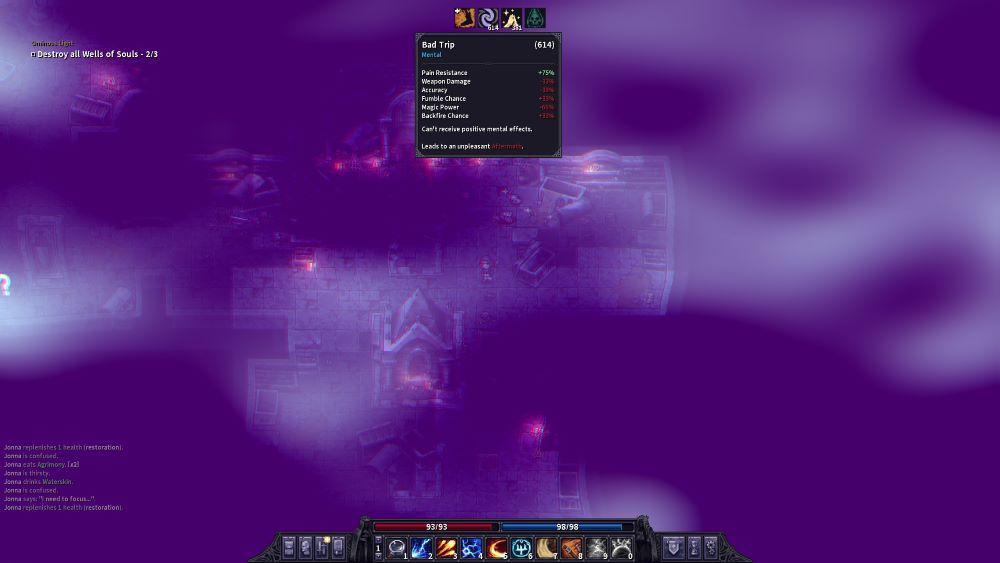
It’s important to know about this sort of thing because Stoneshard has a lot of cascading failure opportunities. You have Hunger and Thirst, which necessitates bringing a waterskin and snacks. When you are hit, damage is dealt to specific limbs, which can develop wounds or even Bleeds; make sure to pack Splints for the former and Bandages for the latter. Oh, and limbs have a Condition meter that reduces your maximum HP until they are healed, which is another consumable. Even if you heal the damage away, you have an overall Pain meter that accumulates unless reduced by beer/drugs. Enemy abilities can Stun, Stagger, Daze, Confuse, Immobilize, Ignite, and/or Poison you. Fatigue, Intoxication, Morale, and Sanity are also things. And all of these typically compound on one another, like how Pain gives you a debuff at certain thresholds that constantly drains Morale.
I am not actually opposed to all these “crunchy” systems. Choosing how many healing items to bring to the dungeon is a meaningful decision, and rewards the collection of crafting components and otherwise planning ahead. What I am opposed to is how often and how quickly these interlocking systems go from irrelevant to run-ending in a way you can do nothing about. Bleeding out at the end of a fight because you didn’t bring any/ran out of bandages? Fair play. Getting Dazed (turns off all your abilities for a few turns), then Immobilized, and then chopped in half within two turns? Okay then. The slow descent into insanity works in, say, Darkest Dungeon because damage is usually spread amongst a party and you get worn down. Here, you often just get hit a few times and die.
Ironically, that scenario doesn’t play out that often because you are always, 100% of the time trying to lure enemies out one at a time. Which is super effective! And sometimes boring. I play an Electromage with a few finishing moves via Staff. Electromancy is all about low cooldown spells that can Knockback or possibly Immobilize enemies. I just cleared out a 3-skull dungeon full of bandits and only got hit once, by an enemy that had a charge+attack move. So, perhaps my experience is a bit more skewed than if I were straight melee, sword & board with heavy armor; perhaps there’s more survivable damage.
Anyway, that’s Stoneshard. It’s still in Early Access, has been for years, and the updates themselves do not come quickly. That said, this is a game that has good “bones” and I can see it meaningfully improving with some tweaks and enhancements. The latest “Rags to Riches” release apparently changed the game’s compiler, which destroyed all existing mods – if/when that gets fixed, I could see mods coming to the rescue too. I’m certainly looking forward to being able to Quicksave anywhere.
[Dark Souls 2] Day…WTF
I started playing Dark Souls 2 a few days ago. And I have been in a near-constant state of aghast since.
See, the devs messed with the formula, but they did so in cruel and unusual ways. It started when I made it to the first formal Bonfire only to find no option to level up. I talked to the NPC nearby twice, but still didn’t know what was going on, so I thought maybe I had to unlock it further on. So I went forward down the only path that was visible: the one leading to Heide’s Tower of Flame. Needless to say, I was very confused as to how the armored knights were an appropriate challenge for new players who couldn’t even level up yet. Then again, this was Dark Souls.
So, spoiler alert, you have to talk to the NPC near the fire THREE times before it is revealed that she is the only way you can level up in the game. You can teleport between Bonfires right from the get-go, which I suppose is handy since you’ll be coming back to the starting area dozens of times.
After dying a bunch of times to the armored knights – which were not as obviously “you came to the wrong neighborhood” as the skeletons in the original Dark Souls – I then understood something fundamental: Dark Souls 2 features failure cascades.
As you may be aware, dying in a Dark Souls game means you drop all the Souls (upgrade currency) you had collected up to that point, you get sent back to the last Bonfire you rested at, and all enemies in the area respawn. If you manage to get back to your corpse you can collect all those dropped Souls, but if you die beforehand, those initially dropped Souls are gone forever. In terms of harsh death penalties in games, it’s the industry standard for pretty fucking rough.
In Dark Souls 2, dying ALSO reduces your maximum HP by 5%. Per death. Down to a limit of 50%. What in the ever-loving Christ is the point of that? The game still prominently includes “surprise, you’re dead!” traps and ambushes, which means you spend a lot of the game with less than max health, which then makes it easier for you to die again. There are Human Effigy items you can consume to reverse the HP reduction, but they are a limited resource (at first?) which only serves to excessively punish people learning the game. Did I mention you must be in Human form (no HP reductions) in order to summon friendly NPCs/players to assist you with boss fights?
Oh, and get this: regular enemies stop respawning in an area after 12-15 resets. One might assume that this would make things easier for struggling players… but think this through. If you’re dying a bunch, about the only thing that you can do outside of “git gud” is farming Souls so you can level up and gain higher stats. But now the enemies you farm no longer exist after a dozen resets. In my particular case, I got caught in a failure cascade on the way to re-attempt the Pursuer fight. Killed the enemies on the way, started the boss fight, desperately collected my dropped Souls, then died to the boss again. Repeat a bunch of times, and now the enemies on the way to the boss aren’t respawning, and realize that if I die before retrieving my dropped Souls, not just those accumulated Souls are gone, but so are any potential Souls on that path to the boss. Again, what the fuck?
In the game’s defense, there are technically ways of getting enemies to respawn. First is the Bonfire Ascetic, which is a consumable that can be used to essentially “upgrade” an area to the New Game+ version. This, of course, means all of the enemies that respawn are the NG+ versions of themselves, which might not be an appropriate solution for someone trying to farm Souls to overcome regular enemies. The second option is joining a specific Covenant that unlocked infinite spawns… in return for a massive increase in enemy attack and defense, and a decrease in damage you deal for as long as you stay in the Covenant. So, yeah, not a great solution either.
I honestly don’t understand what the devs were going for with these changes. Did they just not like players farming Souls and experiencing incremental progression that way? Were they trying to save players from themselves? Did they intend to double-punish people who weren’t able to retrieve their corpse? The Bonfire Ascetic mechanic is a cool addition, but everything else they “added” to the formula feels like hot garbage and I really want to know why/how they thought it was a good idea.
 In An Age