Blog Archives
[Baldur’s Gate 3] (Un)Intuitive
I continue to play a lot of Baldur’s Gate 3. Indeed, I’m at 40 hours and still in Act 1.
Some of the problems I have with the game are my own fault. I was super into 3.5e D&D way back in the day, and a lot of my “intuitive” understanding of such systems are still based on that clearly superior ruleset. Just kidding – stuff like Short/Long Rests and similar refinements over the years are definitely welcome. But it did come as a bit of a shock that, say, Rogues are only able to get one Sneak Attack per round in 5e (and BG3). Back in my day, the only way a Rogue could keep up with spellcaster DPS output was being able to poke someone three times in one round and get a pile of d6s each poke.
Okay, that’s clearly my bad. But then the line starts getting a little blurry.
For example: Mage Armor says to increase a target’s AC to 13 + DEX modifier, as long as the target isn’t wearing armor. This sounds like a great bonus for a Barbarian who is already encouraged to not wear armor… but it doesn’t “stack” with their own Unarmored Defense ability (Add CON and DEX modifier to AC when unarmored). Like, I get that it would probably be a bit overpowered, but I had to reread the text several times to understand why it didn’t work – Mage Armor specifically puts AC to “13 + DEX” instead of simply increasing the base AC of 10 to 13.
Of course, that’s just the classical Mage Armor gotcha, that apparently has been getting people for 8+ years. Worked in 3.5e, by the way, but clearly if you read page 14 of the 5e Player’s Handbook: “if you have multiple features that give you different ways to calculate your AC, you choose which one to use.” Okay, Rules As Written, got it. But riddle me this, Batman… what does the BG3 spell Warding Bond do?
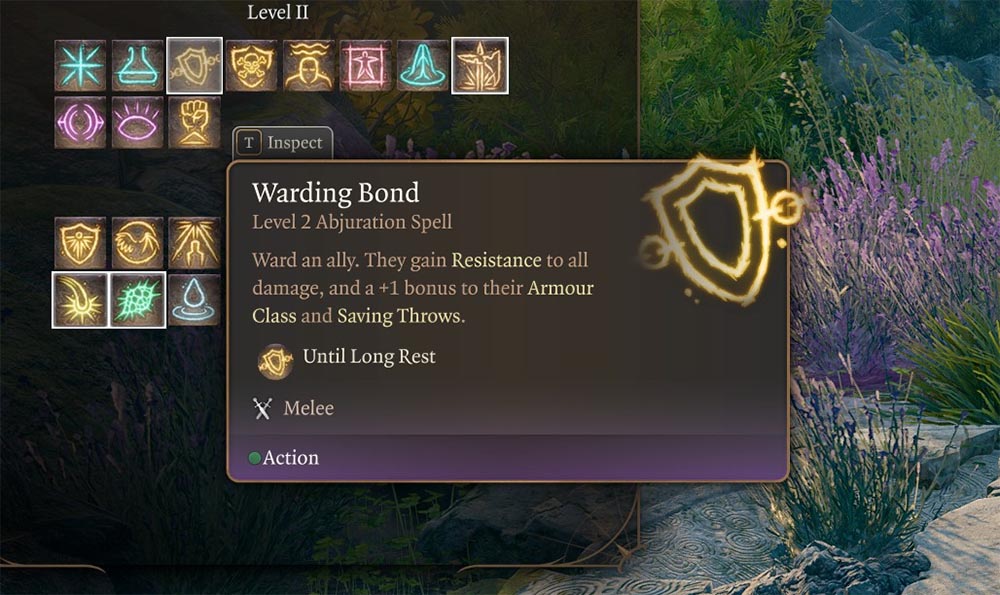
If you answered “create an unstoppable priesthood of clerics that only take half damage from everything,” you would obviously be wrong. Conspicuously absent from the BG3 description of Warding Bond is that the missing half of the damage you take can be found on the casting Cleric. Imagine my chagrin when I found that out, only after reading the “buff” that appeared on Shadowheart. But this is again a case of “just read the 5e Player Handbook to know how this 2023 CRPG works.”
Oh, hey, did you know that in BG3 prepared spells can actually be changed at any time outside combat? This is a big change from traditional (and 5e!) D&D rules that otherwise force you to, well, prepare which spells you can cast that day. What this means is that you can cast Mage Armor on yourself (which lasts until a Long Rest), and then drop it out of your list and put something else more useful in its place. You still use up one “casting” for the day, but now you get more options.
You can take things a bit further than that though, by having characters you’re not actively using cast things like Mage Armor while in camp. For example, you can have Gale cast Mage Armor on whomever, then swap Gale out for someone else. I had already been building my party in such a way that one person took utility spells and everyone else took offensive options, but knowing I could basically press the Camp button to essentially hotswap anyone at a moment’s notice took things to the next level. Now you can have your very own early-WoW era buffbot paladin, whose sole purpose is to stay at camp and buff your team.
A lot of this highlights perhaps the biggest issue I have with BG3 at the moment: its inscrutability. A lot of the media praise thus far as been for the exact opposite, that the game is making 5e D&D or CRPGs in general more approachable. And that could certainly be technically accurate. But consider this: there’s no in-game way to determine what your characters will get at the next level up… until you level up. You can’t browse a list of magic spells. There’s a staff you pick up that gives you +1 to unarmed attacks and I have no idea how that works. Do staff attacks count as unarmed? Do you hold it in your off-hand and then make unarmed attacks with your on-hand? Does it only work with Flurry of Blows? I don’t even have a Monk character for which this would be relevant, but it vexes me.
And who knows, I might well turn Gale into a Monk next time I gain a level.
Perhaps the “average” player doesn’t care about any of this and will just take their character to level 12 just as they are. But that doesn’t mean Larian shouldn’t also include some kind of indexed in-game encyclopedia or something. If you have time for a Show Genitals button, surely you can have a Preview Level button. I would settle for a Wiki worth a single god damn, because the Fextralife one is near unusable and filled to the brim with outdated Early Access nonsense.
Anyway. Larian has indicated that they are working towards a Patch 1 with a “gigantic list of tweaks and changes.” Here’s to hoping that a little more clarity and intuitiveness is amongst them.
Fuzzy Rules
I have been play a bit of Divinity: Original Sin and continue to enjoy it. Mostly.
One thing that I strongly dislike in games though, are fuzzy rules. By “fuzzy” I mean that the parameters of the rules are either not consistent or not entirely clear within the game itself. Divinity has tons of them that were at first amusing, but now are a bit grating.
For example, sometimes when you attack a target, they bleed on the ground. Fine, right? Well… environment effects are super important in Divinity. There is a talent that actually heals you when standing in blood, for example. Blood puddles also apparently conduct electricity, as I discovered when two of my melee team members got stunned after a third one shot a Lightning Bolt.
Things get real dumb though when you fight zombies. See, zombies are healed by poison effects. Guess what zombies bleed? Poison. So… yeah, hit zombies enough and they will bleed poison on the ground, which then heals them. I can kinda sorta maybe see the logic, if the designers were using this self-regeneration mechanic as an explanation for zombie resilience. But it’s far more likely that this is just sloppy game mechanics. Especially when you set zombies on fire, then the fire makes the poison explode, which ends up dealing fire and poison damage simultaneously, which sometimes cancels out the fire damage entirely.
Are there benefits to fuzzy rules? Sometimes. The real world is full of strange situations, so carrying over some of that uncertainty can make virtual worlds more realistic. Plus, fuzzy rules are a de facto increase in difficulty – if you’re not certain something is going to work, you have to be more cautious. Weird situations also make for good stories.
That said, I don’t like unclear rules very much. It’s tough to determine whether vague interactions are intentionally designed, or just designer incompetence. And when you end up failing because of said interactions, it’s difficult to know what you should have done differently. Did you lose to a dice roll? Strategic blunder? Not leveling up enough?
Growth requires not just knowing what went wrong, but what can be done to avoid it in the future. If the answer is “nothing,” there really isn’t any growth at all.
 In An Age