Blog Archives
Review: Mass Effect
Game: Mass Effect
Recommended price: $15
Metacritic Score: 89
Completion Time: ~32 hours
Buy If You Like: 3rd-person pseudo-RPG shooters

Subtitles: On.
It is somewhat difficult trying to review a franchise-launching game like Mass Effect years after its initial release. Should it be compared to the standards of games of today, or of its time? Is it even realistic to believe the experience can be compartmentalized away from the knowledge $200 million MMOs are using its primary narrative mechanics 4 years later?
As I watched the ending credits this past weekend, it became clear in my mind that the concerns were largely moot. I loved this experience, I loved the narrative, I loved the setting where the writers were taking me. And I loved these things despite the weakness of the actual game bits of the game.
The combat system in Mass Effect is a cover-based 3rd-person shooter meets half-assed RPG elements. The shooting elements were decent on their own, even if the majority of the fights seemed to oscillate between completely trivial to instant death (at least towards the beginning). Your squad members are mostly competent in straight-up fights, although controlling them was sufficiently awkward that I was glad it mostly seemed irrelevant to the outcome.

Owned.
The “RPG elements” of the game though? I have mentioned this before, but there is really no point in having gear with stats – or talents that grant stats – if there is no way to actually look at your stats. Talent A gives me 3% more Hardening, but Talent B decreases the cooldown on my Throw ability by 5%. And yet I have no idea what my Hardening percent currently is (or, honestly, what it even does) or what my cooldown on Throw is currently sitting at. The first talent point in the weapon skills appears to boost damage and accuracy by crazy amounts (~10% vs 1-2% increments), but it is difficult to feel clever about making good choices when you never actually get to see numbers go up.
After the first area is cleared, the game map opens up most of the galaxy and gives you free reign to plow through dozens of side quests in a fairly non-linear fashion. The problem here is that it is all the same… literally. Each system has a landing planet where you are dropped off in a vehicle, drive around collecting junk, and cap off the experience in one of the two possible building layouts that are otherwise copy-pasted across the universe. Sure, the box maze is slightly different, but there are only so many times one can endure entrance corridor, large room, T-tunnel, two side rooms (or big room, small side room, stairs, small side room) before the very thought of landing on a planet becomes nauseating.
But then I asked myself why I was doing all these side quests to begin with. And the answer was that I loved it here. I didn’t want the game to end. I wanted to stick around in a game setting that people took the time to actually try and make intelligible. How is faster than light travel possible? Element Zero reduces mass, i.e. the Mass Effect. Why don’t we care about ammo? “Bullets” are just shavings off a brick of nondescript metal, accelerated at high speeds. Why can people take a bunch of bullets to the face? Kinetic shielding.
Mass Effect is Sci-Fi, but it doesn’t feel like the hand-waved or mystical Sci-Fi of settings with hyperspace or The Warp. Element Zero is fantastical, sure, but its interactions within the realms of physics largely makes sense. In other words, Mass Effect has more in common with Dune than Star Wars. And that is amazingly refreshing.

See you soon, space cowboy.
What is more than merely refreshing is the inclusion (and highlighting) of non-verbal dialog in an RPG. All dialog is fully voiced, which goes a long way in bringing otherwise disposable NPCs to life. But when they start winking at you, touching your character, raising an eyebrow… you realize how far the genre has come since Kefka’s 16-bit laugh of madness. Mass Effect might not break a lot of ground plot-wise, but it does break ground in the sense of being drawn into caring about the plot in ways most other RPGs can not achieve.
Overall, I was very, very impressed with my ~32 hours spent in this new universe, and eagerly look forward to spending some more in Mass Effect 2. And if they shore up some of the rough edges in the combat system, all the better.
Massive Effect
Having completed Torchlight, I decided to move onward to Mass Effect. Why not Skyrim, which is literally burning a hole through my Steam library? As Liam O’Brian might say, the status of my preparations is in doubt. I prefer one meaty title with a helping of indie garnish along the side – with something like Skyrim, I’m getting the impression that I’ll still be eating turkey sandwiches for months later.
About 5 hours into Mass Effect, all I can say is holy shit.
One of the most groundbreaking things occurred in the city after the first “dungeon.” In talking with a receptionist to the Consort, she winked at me.
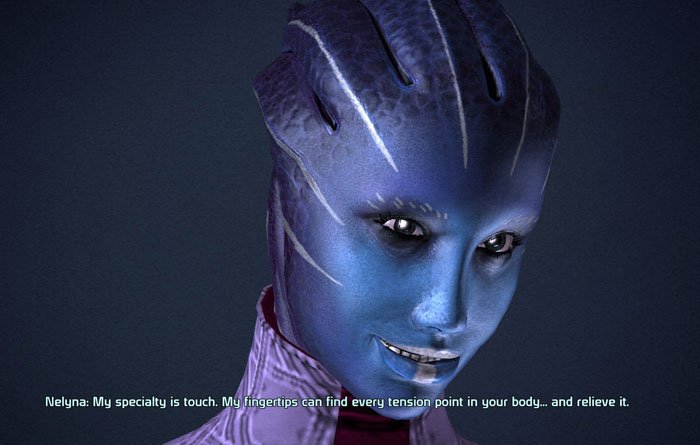
She also said that, but nevermind.
My incredulity may sound facetious, but I am actually very, very impressed.
See, I have been thinking about the problems with storytelling in videogames for quite some time. How is one supposed to convey subtle nuance in a game? In purely written works, it is somewhat easy to evoke the emotion you want to get across, provided you massage the language a bit. For example, consider the following:
‘Look, I can explain,’ he said.
Lord Vetinari lifted an eyebrow with the care of one who, having found a piece of caterpillar in his salad, raises the rest of the lettuce.
How could someone ever translate that in game form? Nevermind Vetinari’s specific sentiment here, think generally: there is an entire genus of expression that the format is preventing designers from expressing.
Games have some pretty unique qualities that cannot be replicated by other mediums too – Far Cry 2’s plot wouldn’t work without player interaction – but many times it feels as though designers simply give up. Game narratives are written in the language of action because of these restrictions on expression. Why are we always killing 10 [%local_wildlife]? Or killing everything, period? Well, how else are you supposed to convey conflict when reduced to crude avatars with clubs? Even though all games have access to written dialog, at some level we do expect everything to be translated into the language of action. And until the last few years, it was functionally impossible to express more than a rudimentary emotional gesture anyway.
There are pitfalls too, of course. Blink during the wink, and you’ll have missed it. Or, hell, focus on the subtitles and miss it too. It is also arguable about whether games should try and be more like the other mediums, instead of focusing on its own unique strengths.
To that last charge, I say “Watch that scene in FF7 again.” Pay close attention at 1:19. More than the murder itself, it was Sephiroth’s smirk that drove home how irredeemably evil the man was. Without the CG movie we would never have saw it; calling attention to smirk in-game via text would have ruined its subtle gravity. While story can certainly be a crutch to prop up forgettable gameplay, story can also be a pole that vaults a game into the classics.
So, Mass Effect, you have my full attention. I just hope you do a little more winking a little less of this:
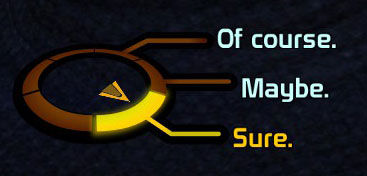
Decisions, decisions.
 In An Age