Blog Archives
Laika: Aged in Blood
About a month ago, I was hesitant to pick up Laika: Aged in Blood (Laika) because I was not certain whether I already had it as part of a random bundle. After a while, I decided to just go for it. And what I discovered is a extremely brutal and brutally difficult metroidvania with impressive artwork and a ridiculously great soundtrack.
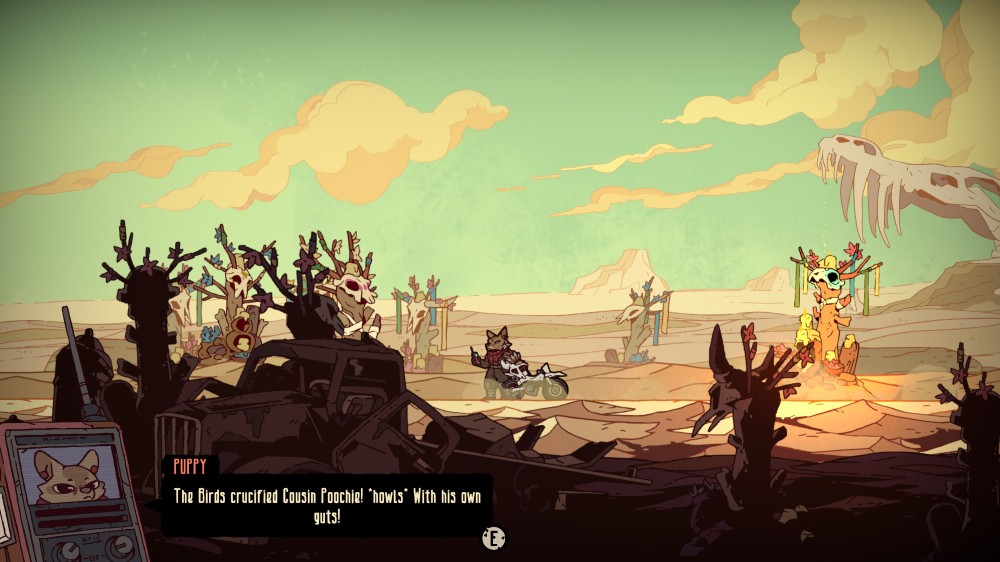
In Laika, you control the eponymous anthropomorphized coyote as she rides around the 2D post-apocalypse wasteland on a motorcycle. The game’s marketing really struck home with the “motorvania” tag, but it’s accurate. On a keyboard, W makes you drive forward, A & D will tilt you forwards or backwards, Spacebar will turn you around, and you use the mouse to aim in any direction and fire. If that sounds clunky… it is. Playing this game will require you to rewire your brain a bit. Especially considering you can only reload your guns by doing a backflip (!!). Yes, every time.
That is only the half of it though. Laika does not have a health bar because every bullet is fatal. Landing upside down is fatal. Hitting your head on a ledge is fatal. If you forget how the controls work, just pressing D for more than 2 seconds is fatal as you flip your bike over, even at a dead stop. Luckily, Laika takes a sort of Super Meat Boy/Hotline Miami approach where you respawn almost instantly… back at whatever checkpoint totem you last activated. Unfortunately, it also takes a halfway Dark Souls approach where you drop 50% of your upgrade currency in a bag at the location of your death.
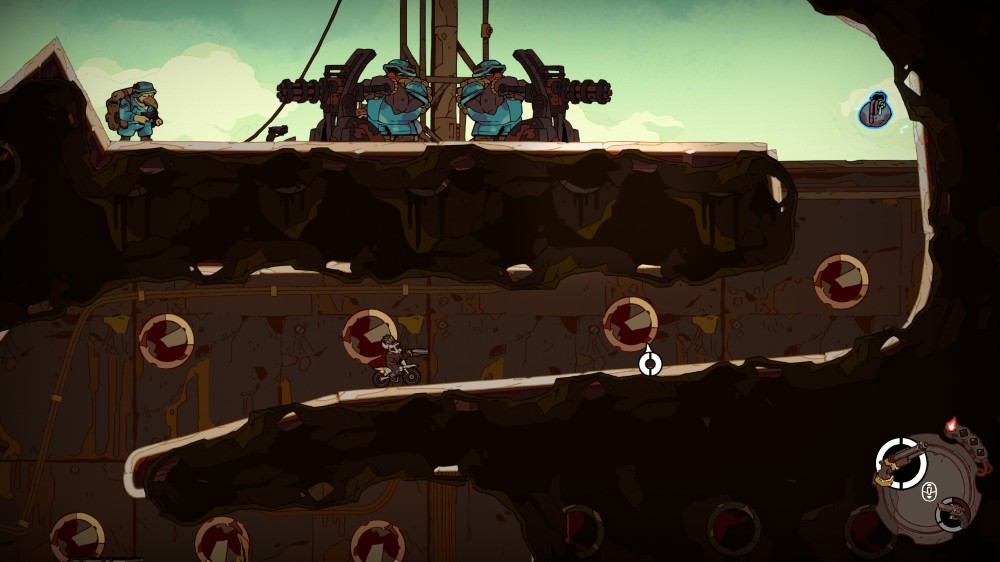
With the exception of a few boss fights, I eventually just vibed with the (death) experience. Your bike will protect you from incoming shots from the bottom and there’s an extremely generous bullet-time feature. It was quite satisfying seeing myself go from timidly seeking out obvious ramps to reload my pistol after every encounter, to trying to backflip from every bump in the road, to eventually just driving into encounters with only one in the chamber knowing I would be spinning around in the air deflecting bullets and reloading automatically anyway. I would still die to dumb shit all the time, of course, but my reaction was mostly on the “haha, oh man!” side rather than frustration. Considering I died 336 times (per Steam achievements), you kinda have to.
As for the rest of the game, it’s equal parts bleak, ultra-violence and touching melancholy. Indeed, the opening sequence has Laika discovering the horrific torture and crucifixion (with his own guts) of her young daughter’s friend at the hands of Birds. And yes, you do see Poochie hanging there. Considering the rest of the game is not nearly as gory and violent – guns and blood and bodies notwithstanding – I assume the devs wanted something extra brutal at the beginning to justify Laika killing all the Birds. Which was not all that needed, IMO, as the Birds were clearly a continued menace to everyone.
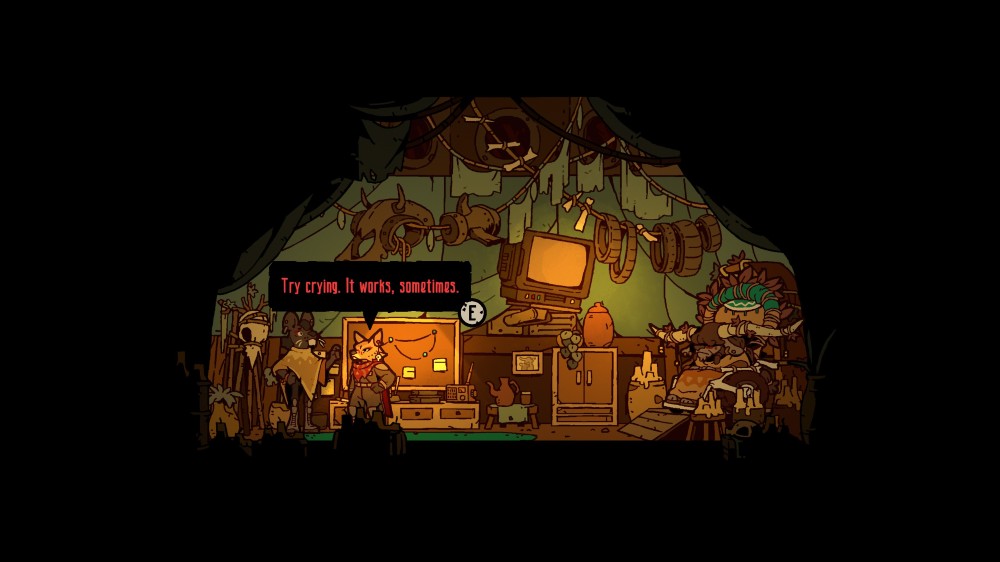
The final aspect I wanted to highlight is the soundtrack. Good Christ is the soundtrack fantastic. It is a lo-fi jazz-bar Western experience that perfectly fits the feeling of the game, or perhaps defines it. Even if you have no desire to play the rest of the game, I highly recommend browsing the soundtrack. The only negative is how some of these songs are collected or purchased from vendors in-game, which means after 18 hours of playing, you might be tired of the ones you heard more than others. Although I never seem to tire of The Whisper, or My Destiny, or even Bloody Sunset. There are technically “normal” non-voiced songs too, but they are more limited to certain locations, boss fights, and such.
So, yeah, that is Laika: Aged in Blood. It’s not a great game, and certainly not something I would play over again. But it joins that gnostic pantheon of games like LISA or Undertale where I am equal parts glad to have experienced it and glad it is over. Sometimes you just need the pathos.
Citizen Sleeper
I appreciate a game that hits from an unexpected angle, and that’s why I appreciate Citizen Sleeper.
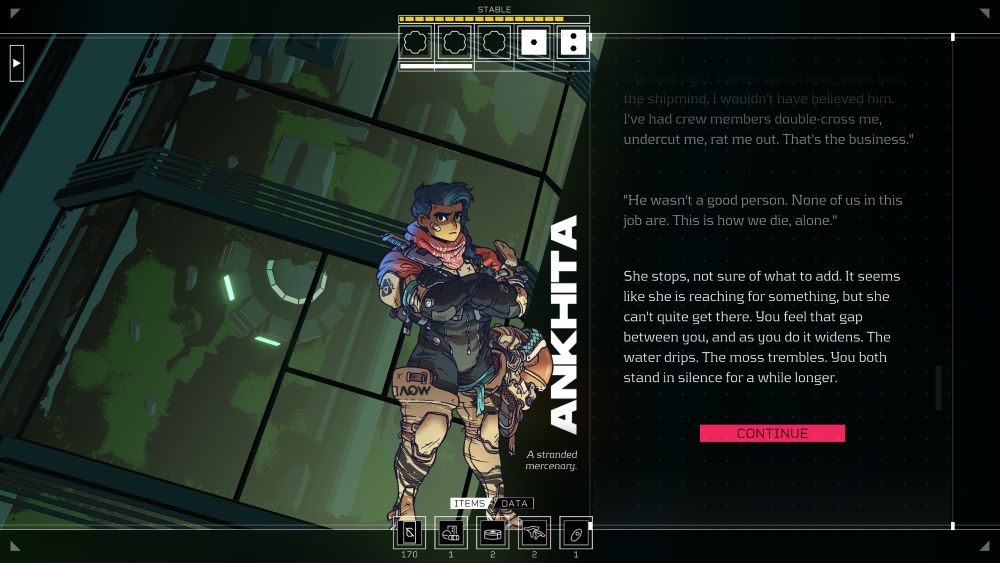
In Citizen Sleeper, you play as a “Sleeper”: an emulated mind in a biomechanical body, desperately fleeing the corporation that owns your total being. You awake in a shipping container, near broken, starving, and alone. Well… not quite alone. The scrapper who found you is hesitant, but allows you to work with him for some meager pay and sleep in the shipping container. From there, you attempt to build what little life you can from whatever you can cobble together.
For the most part, the game is essentially a visual novel with some “diceplay” bolted on. Each morning, you roll up to five dice depending on the condition of your body, and then choose what actions to spend those die on. The numbers on the dice you spend correspond to RNG outcomes associated with the actions – a 6 is always a 100% positive outcome, whereas lower numbers can be as poor as 50% neutral/50% negative. In this way, you have some measure of control over actions, even though things are random. However, since your condition dictates how many dice you have in the first place, this is definitely a “rich get richer” slash failure cascade mechanic. Especially considering how you must earn money to purchase food (starving results in condition damage), earn money to purchase the drugs that repairs condition damage (you decay each day), and negative results can sometimes lead directly to condition damage.
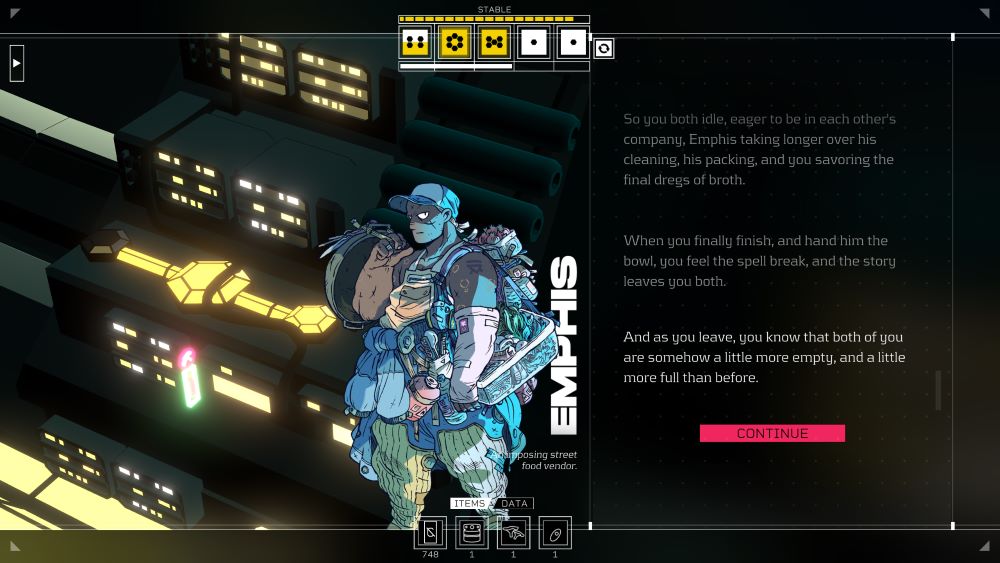
If that sounds stressful… that is kind of the point. Probably.
Once you manage to get a toehold somewhere though, the ramshackle space station begins to open up. You can start spending dice on things other than immediate needs. Start socializing at the neighborhood bar. Chat up the noodle vendor. Start helping the mercenary stuck in the docks. Maybe utilize your quasi-AI mind to dive into the abandoned corners of station. Each encounter adds a splash of color to the otherwise bleak setting, both emphasizing how alone everyone is and yet how much a helping hand can change one’s trajectory.
The unexpected hit I got from Citizen Sleeper was the understated poignancy of the many offramp endings. There are quite a few different endings you can focus towards, but the nature of the game sometimes passively (dice rolls) and actively (wait periods) prevents you from just mainlining them. Which leads you to perhaps explore some of the other stories and meet other kindred spirits. And so there I ended up at the precipice of one such ending, a simple Yes away from escaping my fate on the station… and realizing that in so doing I would be abandoning everyone I met. That particular ending was not Good or Bad – you are not a Chosen One, you have no preexisting connection or responsibility to anyone, and the station and its inhabitants would have just grinded on without you.
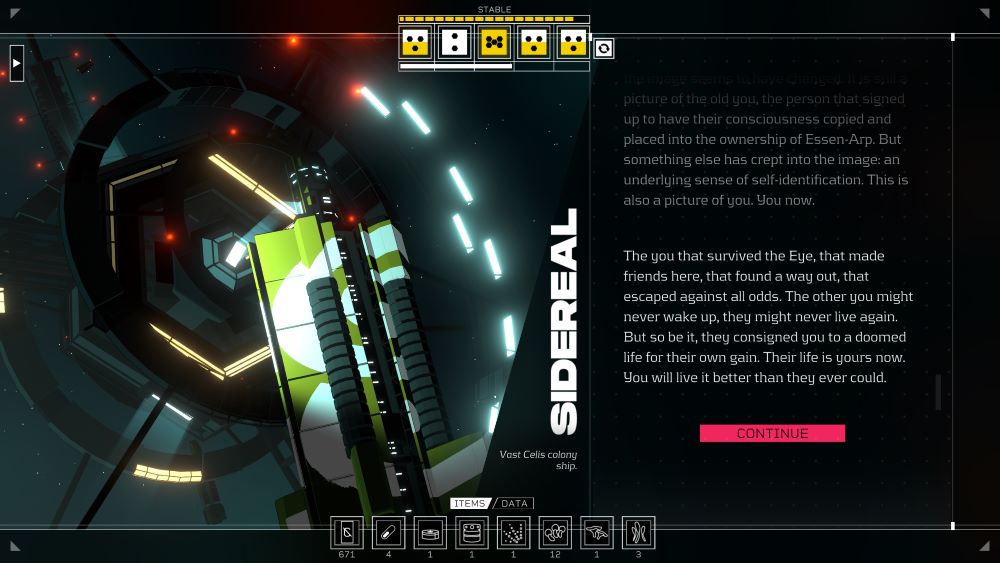
But I was there. I was making a difference for people I could touch. And so I chose to continue doing so.
Now, granted, I also was interested in getting all the various storylines fully maxed out before choosing a preferred ending. Yeah, I optimize even visual novels. HOWEVER! I did actually get a pang of melancholy there, despite the fact that I had copied the save file to a separate location so that I could choose other endings without having the play the game all over again. I never did though. I completed all the storylines and chose to stay behind, until it was time to go with the family I made over the course of the game.
Overall, I recommend giving Citizen Sleeper a try on GamePass.
 In An Age