Blog Archives
Impressions: Stalker 2
Stalker 2 is leaving Game Pass in a few days. Which means I should probably play a bit of it, eh?

As the picture above shows, I did not get very far. I believe there was originally a 15-day warning message about the game leaving Game Pass, and so it was technically possible for me to plow through the 50ish hours needed to complete the game. However… it just didn’t grip me. Plus, I was trying to play some other games (Outer Worlds 2) at the time, so being “forced” into playing something else didn’t exactly leave me in the best headspace.
I have not talked about them much directly, but I have played all of the original games 10+ years ago:
- Stalker: Shadow of Chernobyl (22 hours)
- Stalker: Clear Skies (5.2 hours)
- Stalker: Call of Pripyat (22.7 hours)

For those that have never played the series, Stalker is some quintessential eurojank. The premise (I think) is that after the Chernobyl nuclear disaster, the area is not just radiated, but a bunch of anomalies and mutants show up. The anomalies are extremely deadly environmental hazards that one must navigate carefully, but allow intrepid “stalkers” to claim nearby artifacts with varying powers. These are quite valuable scientific specimens, as you can imagine, leading many different factions fighting to control the best locations within the Exclusion Zone. There is also a loose plot that navigates you closer and closer towards the source of the anomalies.
One of the Stalker series’ biggest claims to fame is the “A-Life” mechanic. Essentially, A-Life was an attempt at making the Zone feel like a living, breathing world. We hear a lot about that sort of thing these days, usually with “innovations” like NPCs having a work schedule and going home at night, etc. Meanwhile, Stalker devs originally built NPCs capable of beating the game themselves back in like 2008. While things were reigned in a bit, the point is that a lot of very innovative stuff went on to make the original game world(s) feel like you were the least interesting thing in it… until you weren’t.
What does this all have to do with Stalker 2? Well, it originally launched without anything resembling A-Life. Instead, you got what every open-world game has: “dynamic” events that spawn randomly within rendering distance of you. Hearing gun shots in the distance while walking around can feel haunting; less so when it happens like clockwork. The more up-to-date articles I’m finding is saying that Stalker 2 eventually did get A-Life working, but some of the magic still feels gone.
Honestly though, that really just sort of sums it up: the magic is gone for me.

Graphics? Phenomenal. In the moment, things look a bit gritty and muddled. Then I realized that, hey, it kind of looks like I’m viewing this game through a body camera. That’s low-key crazy good.
The mutants are hit-or-miss. The dogs have insanely good AI, with all the juking and serpentine movement that causes immediate panic as you empty your magazine into the dirt and end up dying to what would otherwise be level 1 enemies in other games. Other mutants? Deadly… but rote. How nice of the invisible bloodsuckers to attack me, then run off long enough for me to use a healing injector and reload before attacking again.
My problem is that the series is just not that mechanically interesting to me anymore. Granted, maybe a whole lot of things change after hour 7, I dunno. Fundamentally though, there doesn’t seem to be a lot going on. For example, there are a lot of random abandoned houses dotting the landscape. You can go into just about every one of them. But… there’s nothing to interact with inside. While that “makes sense” from an immersion standpoint, it fails on a gameplay standpoint. Even when there are things to pick up, they’re just the same bullets, broken guns, canned meat, bandages, etc, as everywhere else. That leads you naturally to just going from map icon to map icon, collecting crap to sell to a vendor to hopefully afford something that the game is likely to just give you for free in another hour.

Seriously though, you start the game with a vest armor that provides about as much protection as, well, a regular-ass vest would. Then you talk with an NPC that can upgrade your vest with like chainmail for cash. Not two missions later though, you pick up a way better armor right at the start to an area, and then find an even better piece 30 minutes later. Gotta love these designer gotcha moments, right? Or hate them with an undying passion.
Meanwhile, the whole time I was playing, I was trying to remember what even happened in the first games. I thought I remembered there being a cool twist/choice at the end, then I realized I was thinking of Metro 2033’s ending instead. And by the way, Metro actually rewarded exploration because those extra bullets you found doubled as currency. To say nothing about Fallout 3, which came out at a similar time; even when not finding those little post-apoc vignettes, you were always looking for additional aluminum cans or duct tape.
Some of these criticism are, in a sense, unfair. Presuming that the A-Life situation is actually resolved, I would say that Stalker 2 is definitely a Stalker game. If you played the others, you’ll probably like it. There are some little things that add to the charm, like seeing a group of stalkers coming in an sitting around a campfire while someone plays the guitar. Or how after a firefight, the survivors actually loot the bodies of their comrades, just like you were about it. The first time that happened, I was like “Hey!” And then I was like, “fair play.”
So, if you’re in for a bleak, immersive mil-sim with some mutants and anomalies for flavor, then yeah. Stalker 2. (Un)Fortunately, I’ve been spoiled by Metro and Fallout in the intervening years, and it turns out I like what they bring more than what this series does. It’s a time and a place that’s passed for me.
Exodus Complete
I beat Metro: Exodus a few days after my prior post.
Overall, it was a decently entertaining game. There are many FPS games out there that have stealth tactics just thrown in that aren’t actually viable, but Exodus comes through just like its predecessors. Going from cramped subway tunnels to near-open world initially felt like a big drift away from the “core” Metro experience, but there were plenty creepy/FEAR-y/Metro-esque locations towards the end. And visually, the game is an absolute treat.
My only major annoyances with the game were mechanical. For example, the devs somehow made taking screenshots impossible – not even PrintScreen worked. That is in spite of the fact that there is an in-game Photo Mode. It might be minor, but it also takes forever to load into the game. Once you’re in, there aren’t many loading screens, but its literal minutes to get in even with an SSD.
I completed the entire game via the Xbox Game Pass and do consider Exodus one of the primary drivers towards me subscribing to the service.
Impression: Metro: Exodus
Despite the country being on lockdown and me working from home, my time has actually decreased from before. Figure that one out. Hint: baby.
What I have been doing in extremely limited bursts though, is playing though Metro: Exodus. My overall impression is… better than expected.
The Metro series has been an interesting experience. I reviewed the first game way back in 2012, and the key takeaway was that it was one of the best “authentic” gaming simulations at the time. Features that might otherwise be annoying actually felt right, such as having to pump up your flashlight battery as you explore subway tunnels. The second title was similar, although I seem to recall a truly ridiculous number of “knock you unconscious so we can show exposition” sections. Like, serious traumatic brain injury levels of blackouts.
Exodus starts out in the tunnels and I was not really feeling it. You kinda have to be in a mood to enjoy jump scares and such, right? When the game opened up into an almost Far Cry 3+ way though, it almost felt like too much. You have a map (Far Cry 2-style) and markers, but was it really a Metro experience to just… walk around wherever?
It is, and I like it. Or maybe I’m just getting Fallout vibes and liking that.
Indeed, in addition to pumping up the flashlight, you now have to scavenge for materials to create bullets and repair your gear. There is some minimum level of crafting you can do anywhere, and there are workbenches scattered about to complete bigger tasks like making grenades. Some human enemies drop weapon mods you can otherwise permanently learn, with others being tucked away in remote areas of the world.
There is definitely a tension with exploring though. As usual for the series, the mutants you kill drop nothing. Which itself is a surprisingly uncommon game design mechanism, if you think about it. The result is that sneaking and avoiding enemies is encouraged, which heightens the tension considering how much simpler it’d be to stealth kill them instead. The difficulty I’m on (Normal) doesn’t make avoiding fights necessary, but I do find myself tackling most missions during the daytime, which increases the amount of human enemies, who do drop gear and are easier to take out anyway. Aside from that, the other tension is the lack of fast travel. Exploring is fun and all, until you get to a point where you have to traverse the map in the opposite direction a few times.
I’m not sure how far along in the game I am, but it’s going well. We shall see if Metro: Exodus loses steam or pushes through to the end.
Reviews: Metro 2033, Blocks That Matter, Far Cry, Atom Zombie Smasher, VVVVVV
Game: Metro 2033
Recommended price: $15
Metacritic Score: 81
Completion Time: ~12 hours
Buy If You Like: Half-Life meets STALKER meets FEAR
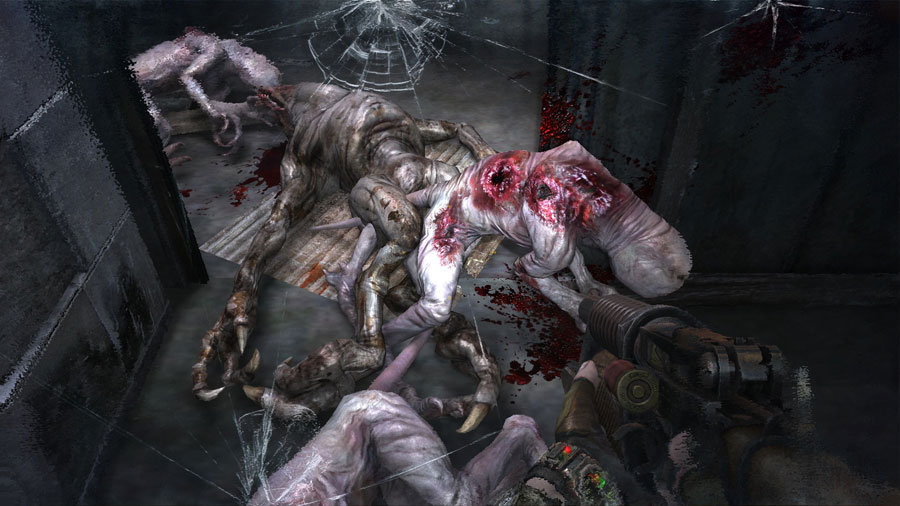
Notice the lack of an interface. You don't need one.
Metro 2033 is one of the most surprisingly authentic post-apocalyptic FPS games I have ever played. A game’s “realistic simulation” aspect is never something I particular care about, as all too often it is used as an excuse for bad gameplay mechanics. In the case of Metro 2033 however, all of the simulation bits impact the game in nothing but positive ways. For example, you start off with a flashlight with a fairly weak default luminosity that can be juiced with a handheld Universal Charger. To do so, you put your gun away, bring out this scrappy-looking device, and then pump the mechanism by clicking the mouse over and over while watching the smudged dial slowly increase with each pump. Although you will be performing this ritual hundreds of times over the course of the game, there was something so… correct about the activity that I actually looked forward to those moments. There are several weapons that require similar attention – an air-pump speargun, an electric railgun-esque weapon that shoots ball bearings – and the fidelity they engender as you huddle against a wall in the darkness or behind your increasingly fogged/damaged gas mask is wholly unique experience in videogaming.
Beyond those brilliant touches, the rest of the game itself is similarly well-designed. Although most of the game occurs in subway tunnels, the environments are surprisingly varied; you frequently are required to head to the toxic surface, which ironically feels more oppressive than the tunnels by its hostile nature, or exploring abandoned military complexes. There is a good mix of fighting mutants and humans, exploration is rewarded with pre-war ammunition (which brilliantly doubles as the game’s currency), stealth mechanics are actually supported, and the difficulty curve is relatively smooth while still escalating throughout the game. At one point there is a section where you carry a child on your back through this mutant-infested area, and the child’s weight impacts your ability to turn and aim at the monsters he is warning you about.
This is the kind of game Metro 2033 is, and I would not have it any other way.
Game: Blocks That Matter
Recommended price: $3
Metacritic Score: 79
Completion Time: ~5 hours
Buy If You Like: Indie puzzle games with robust player-generated map support
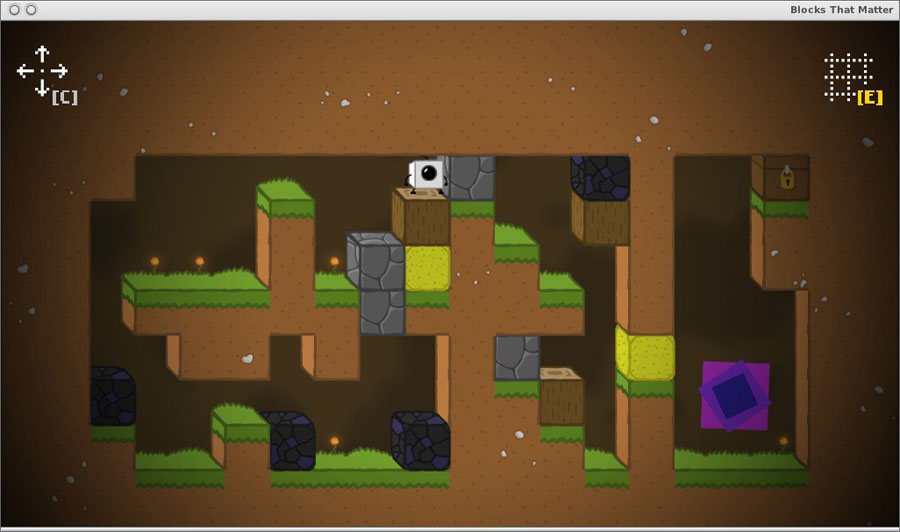
Not as easy as it looks.
Blocks That Matter is one of those “pure” puzzle games that starts with an unique, arbitrary premise and goes on to demonstrate how deep the gameplay can go. With the, ahem, building blocks of a 2D platformer, the “schtick” is that you collect blocks either by breaking them Mario-style or drilling them horizontally, but you can only place them in connected groups of four (at least one block has to be attached to a surface as well). Getting to the exit portal is usually straight-forward, but the real mind-melting begins when you decide to go after the treasure chests on the various levels. Later on, the characteristics of each block begins to matter (sand falls down if not supported, wood burns, etc) and when layered upon the sometimes extreme platforming aspects of later levels, it can definitely lead to frustration if you aren’t prepared for it.
One of the best aspects of Blocks That Matter though, are the hundreds of player-generated maps available for free download via the interface. While I only tried a handful, each one was rather brilliant in its own way and definitely complementary to the ~40 in the normal game. These maps can be sorted by highest-ranked as well, so you are sure to come across additional hours of entertainment if you enjoyed what came before.
Game: Far Cry
Recommended price: $5
Metacritic Score: 89
Completion Time: ~13 hours
Buy If You Like: Being kicked in the balls by a FPS
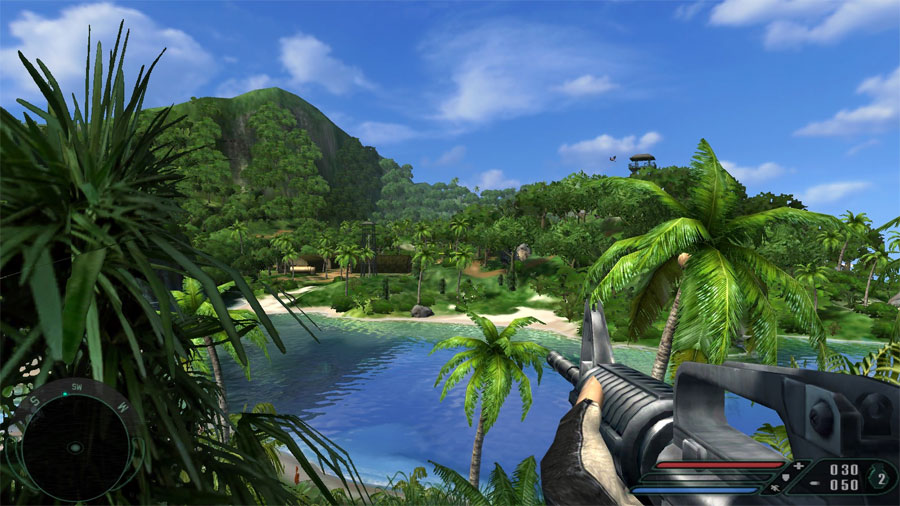
There are about 20 ways to die on the other side, and you will experience all of them.
Far Cry is hands-down the hardest, most frustrating FPS I have ever played. Setting Metro 2033 to Ranger Hardcore mode might take the cake, but you would actually have to make it through the chef cock-slapping you through the kitchen normal-mode that Far Cry offers before you could even think of baking said cake. I seriously uninstalled Far Cry twice, before achieving that head-smashing zen state necessary for slogging through the game to the bitter, bloody end.
Typically, frustrating difficulty is due to bad game design and isn’t something I suffer gladly. In Far Cry’s case, the insane difficulty actually stems from a coherent nod towards realism that says getting shot in the face or eaten by a Grue kills you. Which is fine, whatever. The frustration that settles in is how Far Cry operates entirely on a Checkpoint Save system wherein you can systematically kill 40 enemies without taking any damage, achieve 2/3 of the objectives, and then die to a rocket that was launched from a mile away, slip off the side of a mountain, stand too close to an exploding barrel, or any manner of “oops!” deaths and be forced to start all over again. There are checkpoints within levels, but you never know where they are or when they will kick in, sometimes leaving you stranded with 30 health a door away from a massive firefight you have zero chance of exiting alive. At one point in the game, I was making my way across the deck of a ship and had to learn via trial-and-error, e.g. dying, the location of the nine guys who killed me in their opening salvos. On the 10th checkpoint reload, I killed them all losing only 80% of my HP, only to be shot by a tenth guy at the end of the stern.
Aside from masochism, one of the things that kept bringing me back though was the compelling nature of the enemy AI and open-endedness of the game itself. You are being pitted against a mercenary force that reacts to noises, fans out in search of intruders, engages in pincer maneuvers, investigates dead bodies, and otherwise works together in a completely non-scripted way. Sure, a lot of the time they can magically spot you in the bushes from 100 yards away. Sure, sometimes their incidental gunfire leads you certain doom while you desperately search for a medkit. But this was the first FPS I have played in which I actually felt hunted, or at least surrounded by an intelligent enemy that fostered a sort of manic paranoia.
Like a particularly difficult bowel movement though, I am glad Far Cry is finally over and I am not looking forward to similar experiences again. At least, not ones lacking quicksaves.
Game: Atom Zombie Smasher
Recommended price: $5
Metacritic Score: 75
Completion Time: ~8 hours
Buy If You Like: Compelling indie strategy games
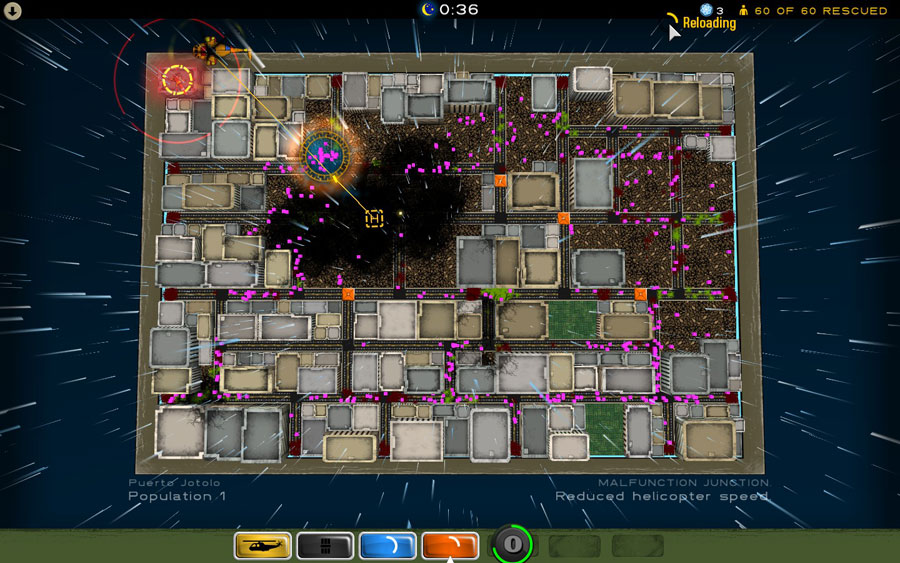
Evacuation complete.
I basically already reviewed Atom Zombie Smasher in a post entitled Population: 1. This is one of those indie games which justify the existence of indie games, and the continued need to ensure that more such works of brilliance are supported and nurtured.
What I will add though, is that I hope the game continues to go through some additional iterations. The city gameplay is excellent, and between the random selection of troops each month (“What? Only barricades, landmines, and TNT?!”) and the random buff/debuffs, even the same city layouts can feel like entirely new games each time you load it up. The map gameplay that nests the city gameplay, however, needs some work. It is ridiculously easy to fall behind and essentially make winning impossible. Similarly, a few early wins can make the rest of the game largely a joke. So while I am glad that developer chose to focus on the city gameplay as opposed to the map gameplay, the unfortunate side-effect is that the replay value suffers for it, at least to me. If they can tighten up the map, it may actually give me reason to keep playing.
Game: VVVVVV
Recommended price: bundle
Metacritic Score: 81
Completion Time: ~2 hours
Buy If You Like: Innovative retro 2D platformers
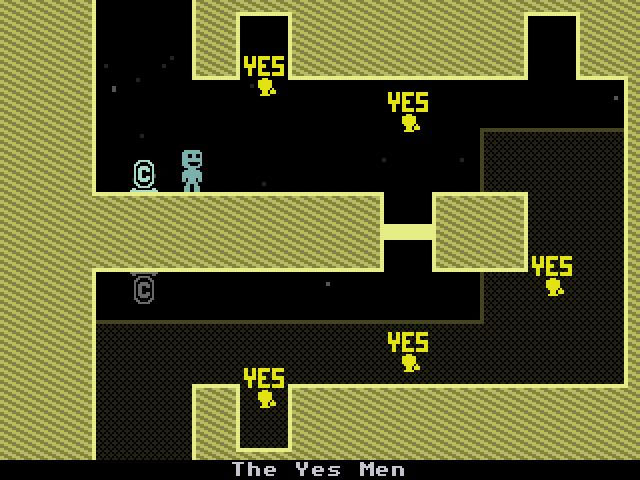
Err... what else is there to say, really?
VVVVVV is a retro indie game that takes the traditional elements of platforming and stands them on their head.
…that pun was lame, even for me.
Essentially, instead of a jump button, VVVVVV simply flips the gravity of your character around such that you end up walking on the ceiling. Since you cannot change direction in mid-air, this leads to some pretty fiendishly novel puzzle-platforming situations in which you have to make full use of ceiling and floor. Gameplay is pretty brisk, and the frequent use of checkpoints and a focus on single-room platforming (with some exceptions) means it is all action, all the time. Which, of course, means you end up beating the game pretty quickly as well. The game gets pretty difficult towards the end, and I ended up dying in a single room 50+ times, but overall the experience was pleasant.
For the length of gameplay though, the retail price of $5 is a bit much; it makes for a perfect indie bundle though, if you find one with VVVVVV in it.
 In An Age