Blog Archives
Crestfall
So everyone seems to be talking about Crestfall Crowfall, the latest unreleased Jesus game from veteran Jesus game developers. Included amongst them is the perennial nostalgia favorite, Raph Koster, bringing up the consultant rear. Or as I like to call him, the M. Night Shamamamalan of video game design. I mean, I’m looking at his Wikipedia and I’m seeing a huge blank starting from around 2006 onwards. I’m not a game designer, of course, but if I were, I would like to think that the people who deserve recognition are, you know, actually making games people are buying. Maybe even in the last five years!
In any case, I’m not exactly sure why we’re supposed to care about Crowfall right now. I suppose there’s a deep, philosophical difference between straight, corporate PR advertisements (e.g. Guild Wars 2 manifestos) and… Kickstarter campaigns, right? It used to be that these companies paid hundreds of thousands of dollars in advertising into the face of a skeptical audience, but now the script has been fully flipped:
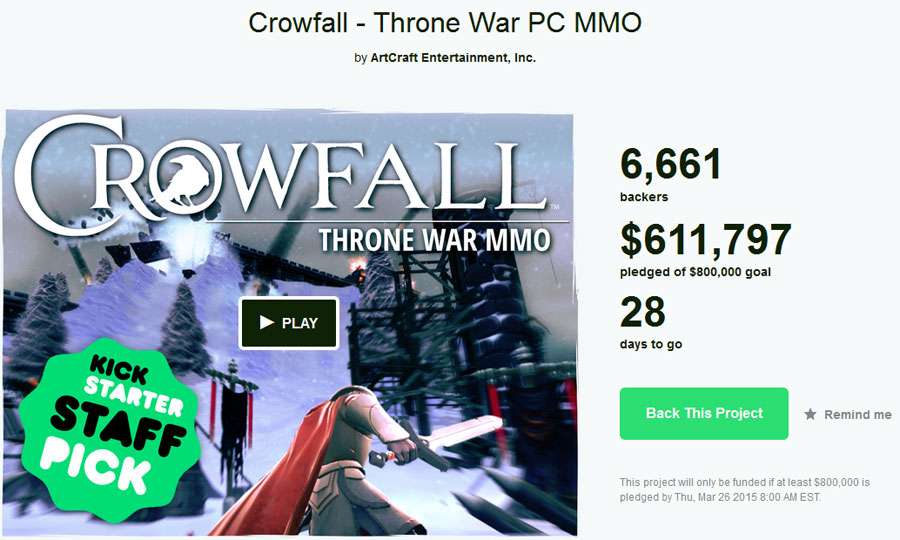
As of 10pm EST, 2/25/15.
That is an average of almost $92 per backer, by the way.
What I will give Crowfall some much deserved credit for is its very evocative premise:
We are Immortal. The Gods choose the best of us to be Champions. They send us to the Dying Worlds to fight, to collect the souls of Damned. The Mortals fear us. They see us as Executioners and Scavengers. They call us Crows…
That has a lot of juice. It neatly solves the conceptual problems of “why do worlds reset” and “why does my character respawn” and even “why am I doing this?” You can almost immediately hear the fanfiction being written – perhaps you’re not a champion, but a slave forced to collect food for a parasite god. Or you’re condemned to your own Sisyphean torment. And were these worlds “dying” before a bunch of hungry godlings showed up? This description greases the wheels even further: “The Shadow Worlds lie closer to the Hunger, where even the Gods dare not tread.” What do the gods fear from the Hunger that you yourself don’t? Mmmm.
But that is where this whole Crowfall hype thing both begins and ends with me. I mean, how many “genre-saving MMOs” are we up to now? Who is still playing ArchAge or Wildstar or whatever? There is jaded cynicism on the one hand, sure, but irrational exuberance (at best) is the other. Maybe everyone is just happy it’s not another endgame raiding MMO, I dunno. I do think we would all be better off pumping the brakes a bit so we can actually see what Jesus features make it off the cross of development.
Talk is cheap. Actually delivering a product that anyone still cares about when released is more difficult.
Star Citizen and “Realism”
I have not really been following the development of Star Citizen beyond knowing that it had a pretty successful Kickstarter campaign. I mean, I know the premise and everything, but the name Chris Roberts holds about as much cachet with me as Raph Koster – both supposedly important dudes who made games I never played. Have they done anything lately? No? Okay then.
One thing that did catch my eye the other day though, was a short Massively article talking about Star Citizen’s “realistic” health and wound system. Feel free to read the source material itself. The basic idea is that the designers wanted to further the immersion by making a “fun” limb-based damage system. Take a lot of damage to an arm, and your arm gets blown off and/or ruined. There are a total of 10 specific areas to damage, with eight of them being arms or legs. The “Damaged” state is between 50% and 1% health, and… let me just quote it:
Damaged – Damaged limbs are useless and the player cannot use them unless they get them patched up in the field or taken to a mobile trauma system (see: Healing). This is the state right after the hurt phase, where the pain is so severe to the player, that no matter what limb is damaged, they will have a hard time being mobile. If one of their legs are damaged, they fall to the ground and crawl.
Now, there is something to be said about how the CoD/Battlefield-style run-and-gun regenerating health paradigm removes a lot of the weight of battle.¹ Take some damage, hide behind a wall, and ~15 seconds later you are good to go. Or perhaps rush into that occupied room with a shotgun and hope you get lucky, knowing you’ll get back to the fight faster than any of the other guys.
On the hand… Jesus Christ, can you imagine the grief potential? Enormous. I don’t care under what circumstances we have come to blows, I’m telling you now: I’m shooting your legs. I’m shooting your legs and then, whether or not I survive, you are spending the remaining time crawling pathetically across the floor to get anywhere. I am doing that because it is the most annoying thing I can possibly imagine. Screw headshots, if you want to invade my ship, you will spend the next 15 minutes crawling your way to the command chair over my dead body.
If you want to find me, I’ll be flying the most handicap inaccessible ship I can find. One with stairs!
That post about limb damage mentioned permadeath, which was the first I heard about it in Star Citizen, so I read that article too. The short version is that permadeath exists for lore reasons, but doesn’t actually matter. Taking a cue from Rogue Legacy, any time your character permanently dies, you simply start playing as whomever you marked as your next-of-kin. Since there are no RPG elements apparently (i.e. Skill Points), the most you lose is some reputation standing and whatever emotional attachment you’ve developed for a character in a permadeath-enabled game. Considering that the limb-damage system specifically talks about how difficult it will be to instantly die – a Ruined head might be jaw or eye damage instead of missing skull – it sounds like this might not be entirely relevant anyway.
I do not want to give the impression that I am not looking forward to Star Citizen, at least as much as anyone can about a game that could radically change at any moment. Space sims are not a genre I spend a lot of time thinking about, but I absolutely loved them in the past. I played Colony Wars for the PS1 way back in the day for an inordinate amount of time. The Zone of Enders series might not technically count as a space sim, but it is the first thing I think about whenever I see videos of Star Citizen dogfighting. I would seriously consider buying EVE: Valkyrie on Day 1, even though I’m not particularly impressed with CCP’s other spinoffs.
But if/when I do pick up Star Citizen, it will be in spite of mechanics such as limb-based damage and permadeath. I do not actually see such things adding anything of value to the game that would not have otherwise already been there. Instead, I foresee a future in which there will be a lot of people crawling around on the floor, hoping that Chris Roberts included a method to commit suicide and still wake up back at their spawn point.
¹ I don’t actually believe that much, if any, weight is removed in these games (or at least in Battlefield). Dying is already a miserable experience even with instant respawns, let alone in the context of not being able to capture an objective or prevent the capturing of your own. Attempts to penalize them further just makes the game harder, but not in a particularly fun way. Otherwise death penalties would all be “invalidate your CD key and force you to repurchase the game.”
Raph Koster Says Immersion is Dead
More or less (emphasis not added):
Things that we once considered essential to games drift in and out of fashion. And I think immersion is one of those.
Immersion does not make a lot of sense in a mobile, interruptible world. It comes from spending hours at something. An the fact is that as games go mainstream, they are played in small bites far more often than they are played in long solo sessions. The market adapts — this reaches more people, so the budgets divert, the publishers’ attention diverts, the developers’ creative attention diverts.
As I watch my son and daughter play games or participate in role play sessions, I find myself reluctantly admitting to myself that it is a personality type that ends up immersed in this way, and were it not in games it would be in something else. Immersion isn’t a mass market activity in that sense, because most people are comfortable being who they are and where they are. It’s us crazy dreamers who are unmoored, and who always seek out secondary worlds.
It’s just that games aren’t just for crazy dreamers anymore.
The part that struck me in particular was later on when he said:
But stuff changes. Immersion is not a core game virtue. It was a style, one that has had an amazing run, and may continue to pop up from time to time the way that we still hear swing music in the occasional pop hit. It’ll be available for us, the dreamers, as a niche product, perhaps higher priced, or in specialty shops. We’ll understand how those crotchety old war gamers felt, finally.
There are immediate, topical parallels to be drawn, of course. Difficult MMOs, for instance. And then, if immersion can go out of style, what does that say about sandboxes in general?
…actually, considering the widespread success of Skyrim, Minecraft, and the stubborn persistence of EVE, I am not entirely sure what he is talking about. Did he honestly believe the opposite, that immersion was something more than a niche genre? That there is a true Form of gaming that always included it? I enjoyed my years of table-top D&D, especially the world-building aspects of a six-year stint of being a Dungeon Master, but I was perfectly fine coming back home and doing some Battlefield 2, building M:tG decks, or playing some Super Smash Bros.
I am not too concerned about it though, because the name Raph Koster means nothing to me, regardless of how often he is quoted as being an “authority” on game design. Similar to Will Wright, the moment you stop making successful videogames or your ideas stop creating them, is the moment you cease to be an authority on the subject. Simcity 2000 ranks up as one of the best games I ever played (and it’s highly, highly underrated Streets of Simcity “expansion”) but come on, Willy. Get back on the horse, we need you.
And it might be juvenile schadenfreude, but I couldn’t help but giggle when Raph Koster talked about how his own children apparently disproved his life’s work. This Demotivational poster came to mind:

 In An Age
Stars’ Rug-Pull
Feb 25
Posted by Azuriel
Stars Reach is the Raph Koster moonshot that, as far as I can tell, has immediately shot itself in the head. The official Kickstarter will be active at the time of this post, but some of the pertinent details have become clear in a fireside chat with Koster (emphasis added):
Let’s review for a second. Stars Reach is a game about exploration, gathering resources, fighting mobs, all with an entirely player-based economy. It is being billed on the official website as a “massively multiplayer sandbox RPG” meant to “immersing yourself into an alternative world of adventure.” And it will be Free-to-Play!
…unless perhaps you want live anywhere you will be playing. That will cost you a $10/month subscription.
But it potentially get worse! I was taking it as a given that players would have some base-level ability to set up crafting stations inside a spaceship or whatever, even if you weren’t paying space-rent. You know, like in Starbound or No Man’s Sky. But according to the preview on homesteading:
Combine that with this other Reddit AMA thread:
Neither of which indicates to me that the space hobo way of life is especially supported. By which I mean any F2P player. Because what are you going to be able to do on a foundational level? All items decay and have to be replaced with player-produced ones. Lugging around resources is apparently going to be painful. I’m taking it as a given that players will be able to craft basic items without needing a homestead, but who even fucking knows at this point? There’s a flowchart on the “Stars Reach Tour” that I have helpfully annotated with the latest information regarding the property pass:
It truly boggles the mind. Or would, if these “industry veterans” were not a font of dumbass ideas.
I have less than zero interest in Stars Reach at this point. It was already conceptually hostile to solo players, but I still had it in the back of my mind as a sort of “challenge” to engage with down the road. But paywalling the one aspect of the game that is remotely sticky enough to get players to stay? No thank you. It’s almost as bad as the devs from Forever Winter with their real-time water mechanic.
Posted in Commentary
2 Comments
Tags: Paywall, Raph Koster, Space Rent, Stars Reach, Subscription, What Could Possibly Go Wrong?