Blog Archives
Review: Syndicate
Game: Syndicate
Recommended price: $5
Metacritic Score: 69
Completion Time: ~6 hours
Buy If You Like: Amoral cyberpunk FPS bastardizations
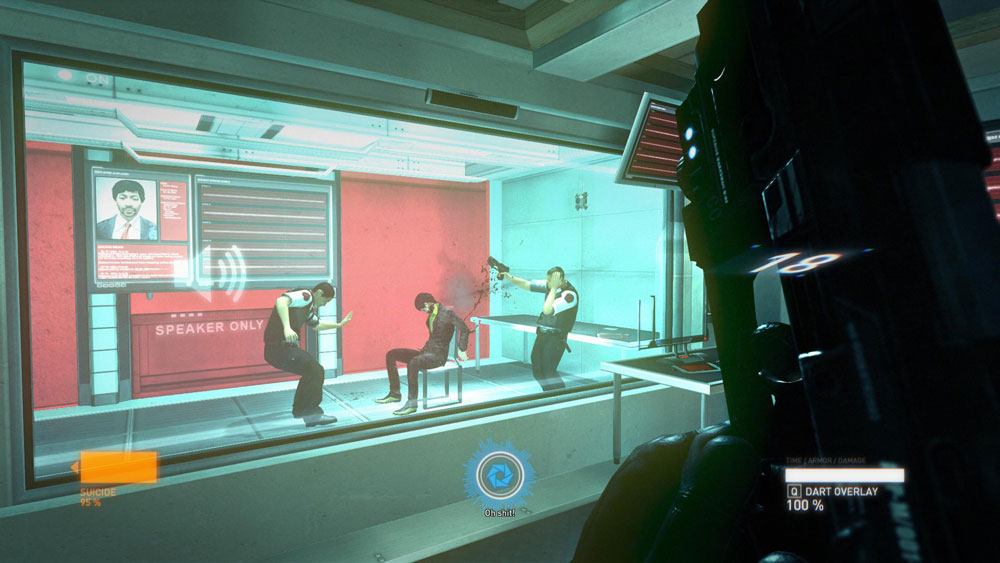
Style over substance ^ 100
Syndicate is a FPS reboot of the 90’s series of the same name. As someone who never played the original series, I became interested after watching the trailer and was drawn towards the dystopian cyberpunk setting as a means of getting through my Deus Ex withdraw. Indeed, at first glance Syndicate has a lot in common with Deus Ex on a thematic level, although Syndicate never really goes any farther than reestablishing the rather brilliant lore of prior games. There are no deeper ramifications to your actions, or introspection on the nature of humanity, or much beyond entertaining gunplay, so… not really like Deus Ex at all.
The premise of the game is that you are Kilo, an Agent of a syndicate named Eurocorp, who just developed a highly-advanced neural implant that grants access to various powers. In this future, industrial sabotage takes on an incredibly literal meaning, with Agents of rival syndicates tasked with infiltrating R&D departments and basically killing/stealing ALL the things. During a mission to do exactly that, a conspiracy is uncovered, reinforcements arrive, boom boom, explosions, lens flare, boss fights, the end.
That sounds facetious, but plot is not at all Syndicate’s strong point.
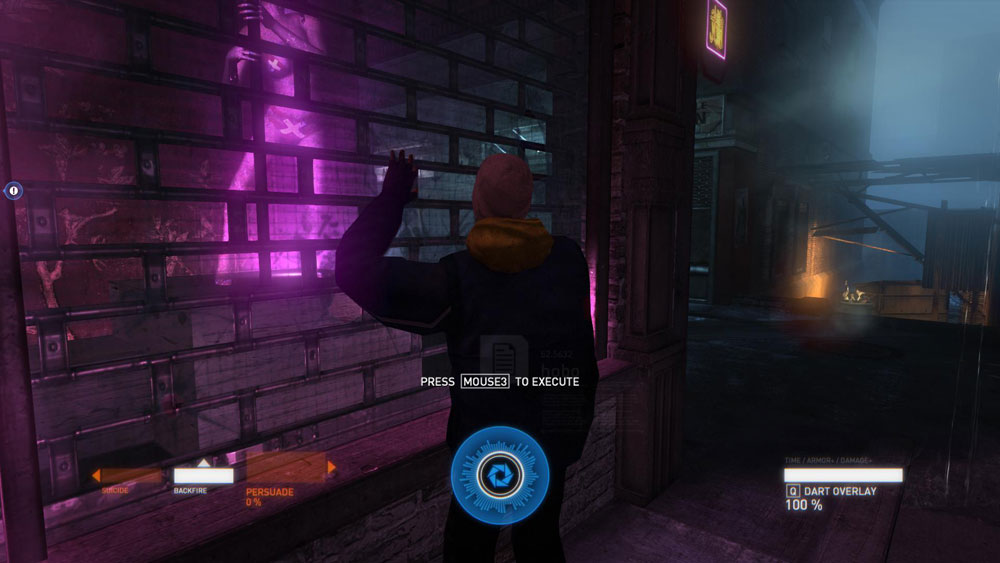
Not much room for deep thinking when you get an Execute prompt for hobos watching bad VR porn.
What is particular strong however, is the gunplay. Syndicate does a great job of making you feel like you are running and gunning in a Matrix-esque movie, including having access to overpowered abilities without making you feel immortal. As the plot develops, you eventually gain access to three main “Breaches”: Suicide, Backfire, and Persuade. Suicide makes the targeted enemy shoot themselves in the head or pop a grenade if they are near others. Backfire causes enemies to fall down (possibly out of cover) and take additional damage for X seconds. Persuade makes an enemy fight on your side for X seconds, before shooting themselves at the end of the timer. Each of these abilities recharge only when you kill enemies, ensuring that you don’t just hide in cover until your cooldown comes back up.
What does recharge is the sort of bullet-time mode that you can use in a more traditional Max Payne/FEAR sense to dispatch foes. In fact, this bullet-time is incredibly important because you frequently face massive waves of enemies who are more than capable of mowing you down in seconds. As you progress, the enemies get smarter, tougher, and many start becoming immune to your Breaches altogether. Along the way, you will face rival Agents as proper boss fights, including extra-long HP bar and various gimmicks. While such boss fights were really out of place in a game like Deus Ex, for some reason they felt alright in Syndicate.
In any case, if you are like me and care more about whether it’s worth $9.99 or whatever than about how much the reboot ruins the spirit of the original games, I would say it entirely depends on how much enjoy cyberpunk settings. Syndicate looks great, it has a solid five hours of mindless fun, and you can almost pretend that there is an in-depth existential plot you are just Spacebaring through the whole time. Indeed, Syndicate has a lot more in common with Hard Reset than Deus Ex in that regard. Times aren’t what they used to be though, and whereas I would recommend Hard Reset at $10, I have a tough time recommending Syndicate at any anything higher than $5… and even then, only if you really dig cyberpunk games.
Review: Dishonored
Game: Dishonored
Recommended price: $20
Metacritic Score: 91
Completion Time: 18-20 hours
Buy If You Like: First-person Tenchu or Assassin’s Creed, sneaky Bioshock
Style over substance.
I have been hearing Metacritic, er, criticism for years now without really understanding what all the fuss was about. It is a useful tool, and I include it in my game reviews as a sort of “by they way, this is what other people are saying” disclaimer. But now? I understand why people complain. I have no idea how Dishonored got a 91 Metacritic score. It is a good game and probably worth your time depending on purchase price. But is it better than (or even comparable to) Fallout: New Vegas (84), F.E.A.R. (88), Deus Ex (90), or Fallout 3 (90)? Lord no.
Before getting into what Dishonored is not, let us begin with what it is.
Dishonored is a first-person stealth action game set in the highly stylized, steampunk (or whale-oil-punk) city of Dunwall. You play as Corvo, a counter-assassin of sorts, as he struggles with being framed for the murder of the Empress he swore to protect. Through the course of gameplay, Corvo is granted supernatural powers like the ability to teleport short distances, stop time, or possess animals/people. The game is roughly divided into “missions,” which can consist of multiple areas and be completed/traversed in several ways. Within each area, there is usually a side-quest or two that can be completed for additional rewards, along with a smattering of extra upgrade components hidden around the map.
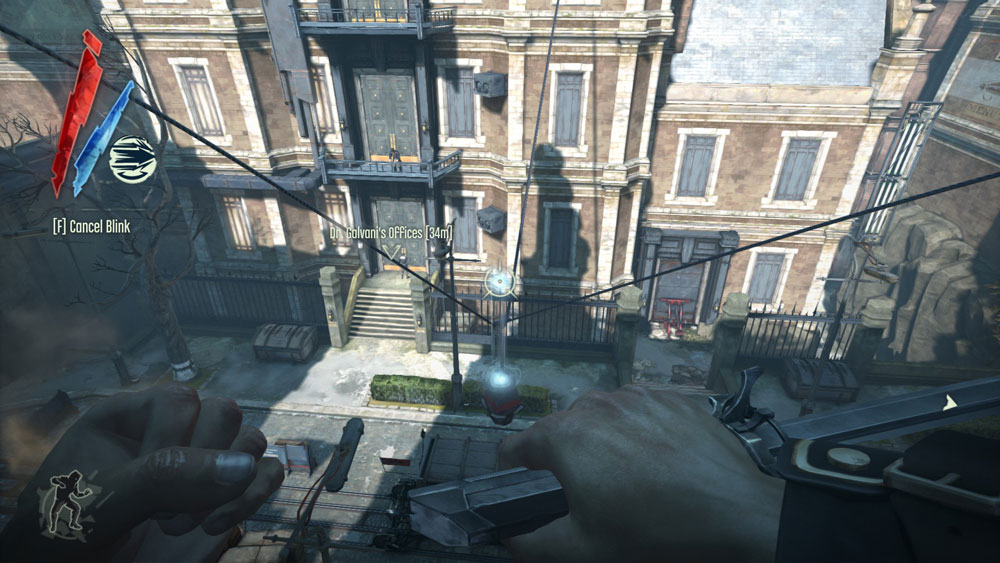
Blink onto hanging speaker, Sleep Dart guard on balcony, Blink over and enter via 2nd floor.
One of the most vaunted and critically acclaimed features of Dishonored is the ability to overcome challenges multiple ways. This is, for the most part, accurate. The mission goal may be to assassinate a certain individual, and the game will overlay the location of said individual on your UI, and… that’s it. If you want to stroll in the front door with a blood trail, tripping every alarm along the way, you can do that. If you want to Blink your way from rooftop to rooftop, hop in through a window, and switch the target’s wine glass with one that he poisoned (or mix them to poison both), you can do that. If you want to body-hop your way inside by possessing rats, fish, and guards, all so that you can render the target unconscious and remove them from power in a nonlethal manner, you can do that too. Or whatever combination you choose.
The problem I have with the extraordinary hyping of this gameplay feature is twofold. First, the game is incredibly easy. Almost trivially so. After the first 2-3 hours, I decided that I needed to restart on the highest difficulty setting. So I did… and further decided on a 100% nonlethal route for my first playthrough. Less than twenty hours later, Mission Accomplished.
People have different skill levels, of course, but most of the supernatural powers you get (all six of them) are pretty ridiculous. The default power is Blink, a short-range teleport that effectively has unlimited uses provided you wait 4-5 seconds between them. Blink is definitely a lot of fun to use, but once you upgrade it to level 2 (increasing it’s range) the game is basically over – there are no “puzzles” that cannot be solved by simply finding higher ground, going through windows, etc. Indeed, on more than one occasion I accidentally bypassed damn near the entire level and all of the security inbetween by Blinking between buildings.
The very next power that the game strongly suggests you unlock is Dark Vision, which allows you to not only see enemies through walls, but also their cone of vision; like Blink, Dark Vision is a super-cheap spell that you can effectively chain infinitely. Other stealth games, if they offer this sort power at all, make it expensive or difficult to use precisely because of how difficulty-destroying it is. Dishonored lets you peek through keyholes or lean around corners while remaining hidden… but it’s moot considering you can see everyone all the time with a touch of a button. Perhaps the worst part of Dark Vision though, is how it destroys the visuals and ambiance of a very stylish game with its sepia-tone washout effect and dark whispers; once upgraded, it even highlights cash and other items, meaning you can go through an entire level with it on and miss nothing… except all of the artwork and nuance. Dishonored without Dark Vision is a 100% better game, but you shouldn’t feel like you need to handicap yourself by not taking it to have fun.
Between Blink, Dark Vision, and how absurdly easy it is to kill/incapacitate guards, I only used Bend Time or Possession out of a sense of guilt for having “skipped” the rest of the game.
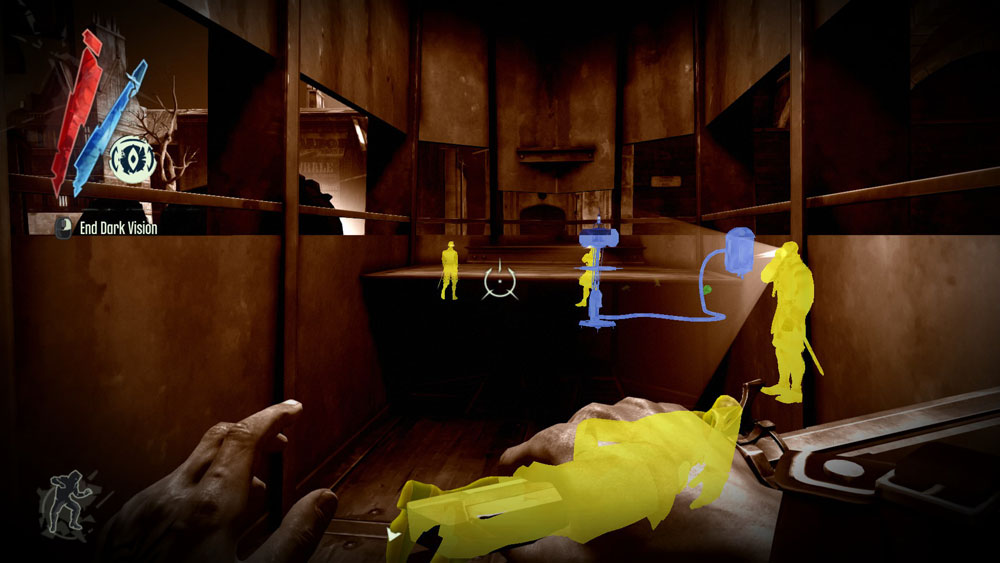
Around 90% of the time, your screen will look like this.
The second reason I do not understand the hype is how most games do this sort of thing anyway. If I am playing Metal Gear Solid, the game asks me to get to a certain location and then sets me loose. Whether I get there by avoiding all the guards, or shooting all the guards via sniper rifle, or going through the vents, or using a cardboard box, or whatever, is irrelevant. Dishonored is really no different. It doesn’t matter whether you got into the building through the window or by possessing a rat, just like it doesn’t matter in MGS, or Deus Ex, or Tenchu, or any of the other hundred games released since 1998 that feature more than one path. This sort of thing is par of the course. If the critics are referring to your ability to take out “bosses” in a nonlethal manner as being groundbreaking… um, again, 1998 called and just filed an injunction.
All of this is not to say that I did not have a good time in Dishonored. The story is fairly predictable, the setting is bit all over the place, but the game is good at pulling you in two different directions when it comes to whether you should simply murder your target or show “mercy” (where mercy sometimes ends up as fates worse than death). And again, I had a fun time in the game sneaking around and feeling like the biggest badass in the place. I just do not have any notion that Dishonored, mechanically, was the one delivering that fun experience versus me reliving the joys of MGS, Tenchu, and Deus Ex.
Maybe that distinction is immaterial to you. Maybe it is enough that an off-brand experience is so similar to one you enjoyed in the past. In which case, by all means, have fun. I just do not see how Dishonored deserves a 91 for emulating actually groundbreaking games wholesale, minus their difficulty and nuance. I’m thinking it is an 81 at most. Which is still great!
Review: FTL: Faster Than Light
Game: FTL: Faster Than Light
Recommended price: $9.99 (full) / Bundle
Metacritic Score: 83
Completion Time: ~2.5 (or 25) hours
Buy If You Like: Harsh roguelikes, micromanaging space ships, indie games
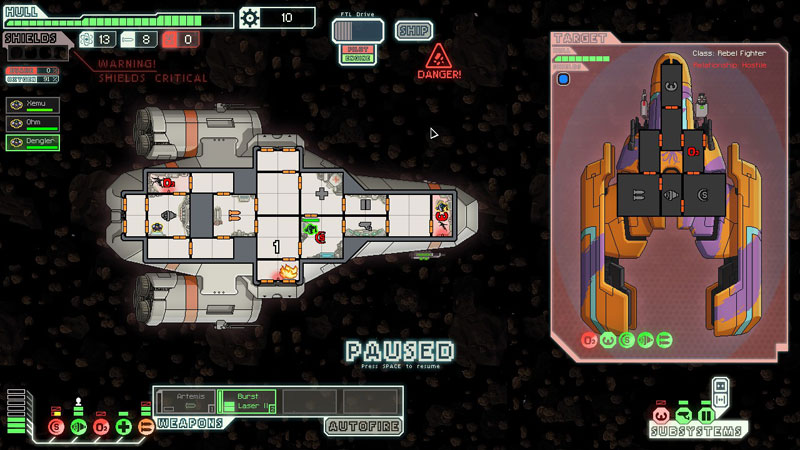
This happened during the FIRST BATTLE in one of my playthroughs.
FTL is absolutely one of those games which, had I not forced myself to dig beneath the brutal, unforgiving crust, I would have written off as awful after the first four hours of playing. While this may have been par for the course for roguelikes, I had hitherto been spoiled by The Binding of Isaac, which not only had a more generous feeling of incremental progression, but a more direct correlation between skill and outcome. With Isaac, awesome twitch-skills is nearly enough by itself to propel you to success. With FTL, success is largely determined by how many coin-flips you win early on.
At least, it seemed that way at first.
…actually, no, coin-flips are still pretty important.
The basic premise is that you are a Federation ship with secret knowledge trying to outrun the advancing Rebel army. Each “turn” you move to an unknown point on the star map and either encounter an enemy ship, a text scenario of some sort, a Store, or possibly nothing at all. Combat takes place in real-time, although you can pause as much as you like. When attacking, you can choose specific ship systems like Weapons or Shields to disable them, or perhaps continually attack their O2 rooms to suffocate the enemy crew. Meanwhile, the enemy is doing their best to repair your damage and blow you up in turn. Some encounters can take place with environment hazards like asteroid fields, solar flares, or ion storms. Defeating enemies randomly gains you Fuel, Missiles, Drones, Scrap, or even ship components. While combat is pretty nuanced and skill-heavy, the text scenarios are the coin-flips where you either win needed materials, or lose big, without much room inbetween.
Once I realized that the game is meant to be played on Easy instead of Normal though, FTL blossomed like an origami flower. Getting more Scrap (upgrade currency) and less ridiculously-armed enemy ships granted the breathing room necessary to learn about juggling power supply, the importance of simultaneous weapon fire to pierce shields, which weapons can snatch victory from the jaws of defeat, and so on.
I also was able to get a handle on which events were riskier than others, and how many of them can be mitigated with certain ship upgrades or items. Since failing (i.e. losing the coin flip) events typically results in losing a crew member, I began to understand that outside the beginning few levels (where restarting is less painful), it just wasn’t worth the risk. But it was that precise lesson in risk management that eventually started turning every Easy run into a full clear, and then doing the same in Normal.
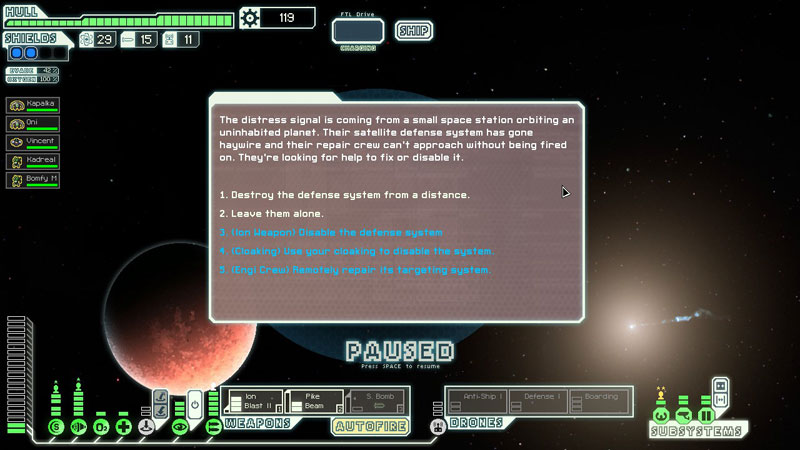
Blue options are always better.
At the time of this writing, I have 45 hours logged in FTL. Part of what keeps me coming back is the cohesion of the overall package, from the 16-bit graphics to 16-bit sound. A bigger part is the very randomness I despised originally. When you start the game, you have access to just a single ship. Getting 2 out of 3 ship-specific achievements will unlock a different configuration of that ship type; these alternate ships not only have different room layouts, but also different starting crew races and weapon loadouts. Entirely new ship types, each with their own alternate layouts, are further unlocked via gameplay. There are a total of 9 different ships, which means 18 different configurations.
What all of this combines into is an extremely slick, subconscious form of progression. Your games with the Engi’s drone-focused ship are going to be much different than your Rockmen’s missile-focused ship. While most ships are going to look basically the same upgrade-wise by the time you get to the final encounter – the ridiculousness of the flagship sees to that – the getting there becomes a game unto itself.
That is sort of the whole point of roguelikes, of course.
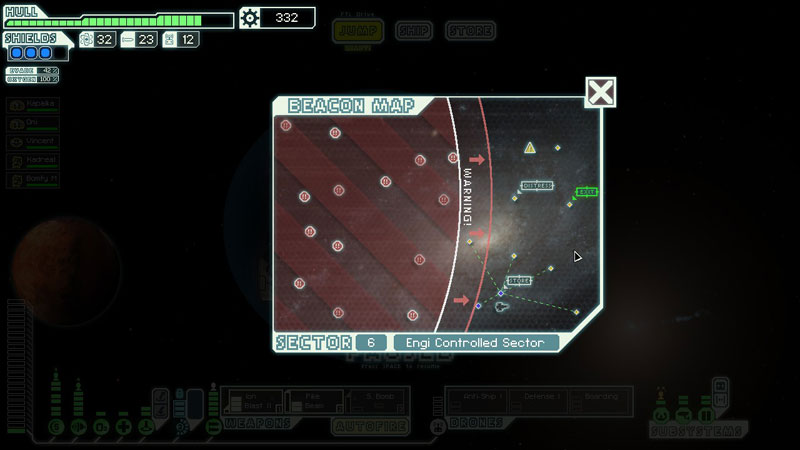
Will I make it? Spoiler Alert: Yes, because I’m awesome like that.
Ultimately, I am recommending this game at full price or Bundle price because it comes down to how much early frustration you are able to handle before giving up. You have no idea how close I was to uninstalling after I died in the screenshot at the top of the review, for example. If scenarios like that make you leery, I suggest waiting for FTL to hit Humble Bundle or Indie Royale as it inevitably will.
If, however, you are the type of person willing and able to muscle through rough first impressions to get at the delicious marrow in the bones of your enemies, buy FTL right now. Not only will you be getting a pretty ridiculous hour-per-dollar gameplay ratio (get 240 hours from a $60 game lately?), but you will be supporting one of the first indie game Kickstarter successes.
Review: Mass Effect 3
Game: Mass Effect 3 + Multiplayer + DLC
Recommended price: $40
Metacritic Score: 89
Completion Time: ~32 hours
Buy If You Like: Mass Effect; story-driven, cover-based sci-fi shooter RPGs.
By far, Mass Effect 3 (hereafter ME3) is the hardest review I have ever tried to write.
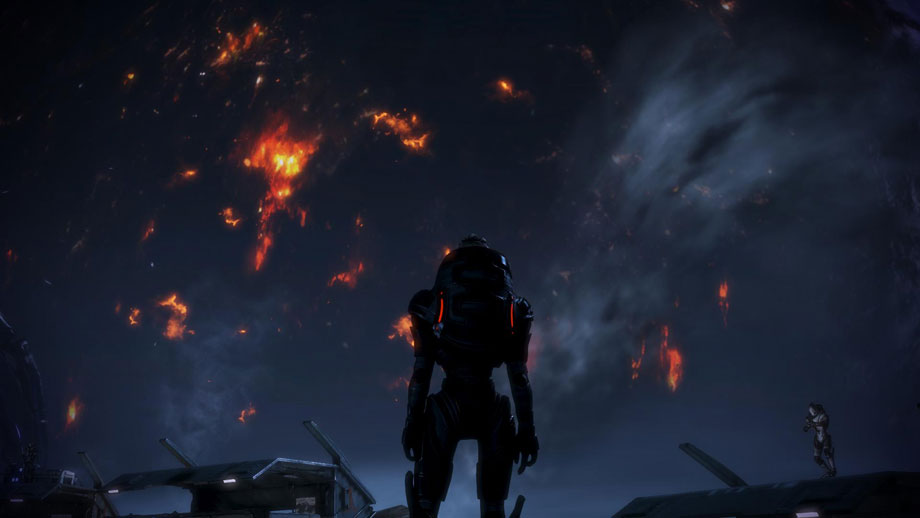
Cue the Stages of Grief
There are three entirely different prisms through which this game can be judged. The first is as the 5-year culmination of arguably the most important sci-fi videogame story of our time. The second is as a comparison between the individual components of the trilogy, as in how it stacks up compared to the first two titles. The third is as an independent game, divorced from the accumulated emotional detritus and hype of the series.
The distinctions are important precisely because no matter how grating certain features or design decisions are in isolation, I have found myself literally incapable of escaping the rose hue of the first prism. This is not to say I did not notice the deficiencies, but rather they seemed to matter less in the final analysis. Your mileage may vary.
For example, things feel off from the very start. The Reaper invasion – the nightmare scenario that formed the impetus to action in the first two games – has finally arrived. Earth is under attack. And… I feel nothing. Outside of a Lunar sidequest in Mass Effect 1, this is the first time Earth has ever actually appeared in the series in any real way. My Paragon Commander Shepard has never been fighting for Earth, or even humans specifically, but for the right of all sentient life in the galaxy to exist. Indeed, humanity has almost represented a background bumbling bureaucratic force, a one-dimensional foil to Shepard’s actions throughout the trilogy that lacks the novelty of the alien scenarios.
It does not help that throughout the Earth invasion, throughout your leaping from burning building to burning building, throughout the panning of cameras to the monstrous Reaper capital ships landing among the skyscrapers… there is nothing but an eerie, empty silence. Where is the stirring music? I spent the first twenty minutes of Mass Effect 3 wondering if my game had glitched, perhaps setting the music volume slider at 0%. There are plenty of amazing songs in the rest of the game – the absolutely haunting “Leaving Earth” comes to mind, or the stirring “The Fleets Arrive” – so the lack has to be some inexplicable design choice.
Certainly, it won’t be the last such inexplicable choice.
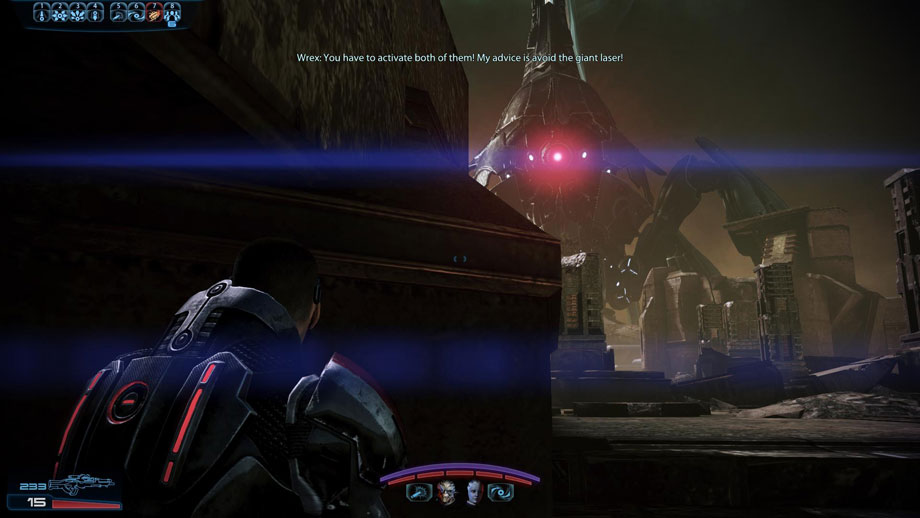
Wrex: the Krogan Sun Tzu
Once Commander Shepard is back aboard the Normandy though, the game once again feels like Mass Effect. And it really was not until ME3 that I could point out what that even meant. The brilliance of the series, in my mind, is the notion that one ship and one crew can make a difference, in a relatively believable manner – the sort of “right place, right time” effect. At no point did I feel like Shepard was a god amongst men, even as I was performing miracles and uniting species after centuries of war. Flying around the galaxy in a desperate attempt to cobble together a coalition for a final stand against the Reapers… yes, this is Mass Effect.
One thing that deserves special attention is the combat system. Simply put, it’s rather brilliant. For the most part, combat in ME3 is the same as ME2 aside from some subtle, key differences. The first is the inclusion of Carrying Capacity, which I will admit to having a strong negative reaction to at first. Shepard and crew can carry all five types of weapons if they wish, but the lower the percentage of Carrying Capacity utilized, the greater rate at which Biotic/Tech abilities recharge. In other words, if Shepard takes an assault rifle, shotgun, and sniper rifle into battle, he/she may get a -150% modifier on cooldown times. Alternatively, if Shepard only takes a sniper rifle and pistol, he/she may have a +50% modifier. Given the radically increased power of Biotic/Tech abilities this time around, choosing a loadout actually becomes a choice, especially since some guns are balanced around their weight.
On a related note, the gunplay in the missions themselves has never felt more fun and exciting. You will still spend 80% of the game crouching behind chest-high walls, but the obstructions are less obviously arbitrary, and the environment/graphics look amazing. More importantly, the enemies are radically more varied, have a deeply cunning AI that will flank you or flush you out of cover with grenades, and otherwise keep you in the moment and on your toes.
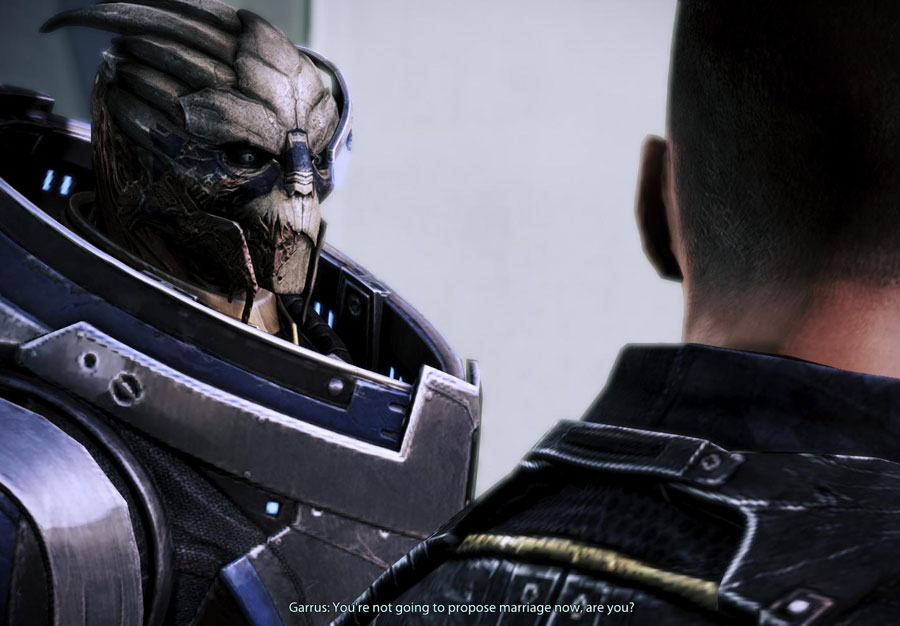
Damn, Garrus. Way to shoot me down.
Any review of ME3 would be remiss to not mention what has become, if not the most, at least one of the most controversial endings in gaming history. Without getting into spoilers, the thing to understand about why it is as big a deal as it has been in the gaming media comes down to this: catharsis. Simply put, there was not any. And with as much passion as the franchise has generated, I do not find it surprising in the least that so many people have taken the pent-up energy to the forums and blogs (as I myself have done). As of the time of this writing, Bioware has taken the rather extraordinary step (if you think about it) to begin development of a free, epilogue DLC to be released this summer. If said epilogue is able to honor the choices players have made in this franchise, if it is capable of giving me the catharsis I hunger for months after the fact, then Mass Effect could very well unseat the sacred cows of Chrono Trigger, Final Fantasy 7, and perhaps even Xenogears in my Top 3 games of all time.
As it stands, there is really no question that you should play Mass Effect 3 if you have at all enjoyed the first two titles in any capacity. Objectively, I think Mass Effect 2 as an independent experience (insofar as that is possible) edges out Mass Effect 3, but… well. To quote Fight Club: “You know how they say you only hurt the ones you love? Well, it works both ways.” Without a doubt, Mass Effect 3 has wounded me in ways no other game has ever done, and that in itself is a remarkable triumph.
“I think we ought to read only the kind of books that wound and stab us… We need the books that affect us like a disaster, that grieve us deeply, like the death of someone we loved more than ourselves, like being banished into forests far from everyone, like a suicide. A book must be the axe for the frozen sea inside us.”
–Franz Kafka
Multiplayer
The multiplayer that comes with Mass Effect 3 deserves its own special section, because in many ways it is almost a second, complete game. Indeed, its development started originally as a first-person shooter spinoff before it was enfolded into ME3 proper.
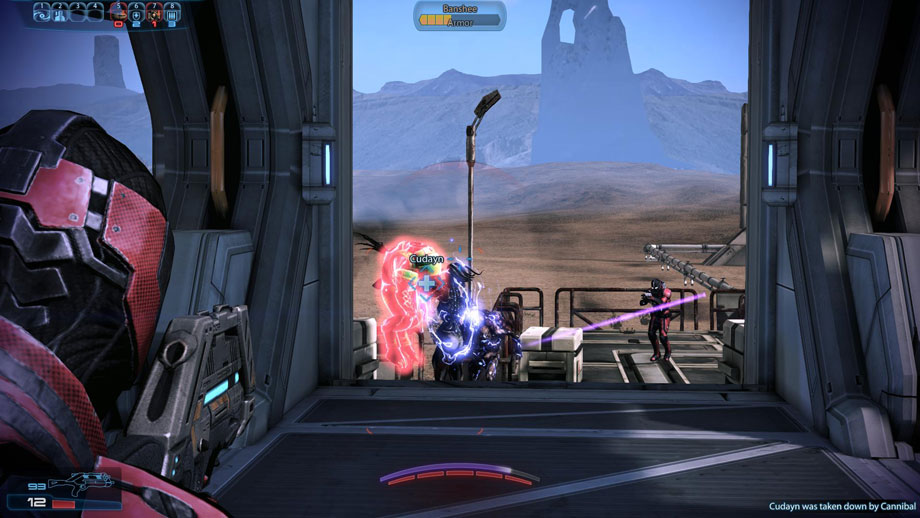
You're going to need a LOT of Medigel for that one, buddy.
In effect, multiplayer is a stand-alone, four-person co-op survival mode. Although winning multiplayer matches increases the Galactic Readiness Rating in the single-player game (essentially allowing you to skip sidequests and still achieve your goals), there is otherwise zero overlap. You pick one of the six classes, one of the five races, a weapon loadout, a difficulty level, and then head into one of the six maps to face one of the three enemy factions. Each map has 11 waves, three of which will consist of special objectives that will be a King-of-the-Hill, activating four beacons, or assassinating four specific enemies amongst the others. Successfully completed maps will take around ~30 minutes, you will gain XP for the class you chose (with a level cap of 20), and Credits.
The replay factor, aside from the entertaining gunplay, comes from the unlocking of packs. Starting out, you have access only to the five most basic weapons and human versions of the six classes. As you earn Credits, you can purchase different levels of packs – Recruit, Veteran, and Spectre – which unlocks new weapons, weapon mods, races, character customization options, and one-use items or buffs to give you an edge. Obviously this can lead to frustration at times, especially if you opt to buy packs via Bioware Points (i.e. microtransactions) instead of Credits, but it does give you an incentive to try and make weapons or classes you would not typically pick, work.
The sort of bottom line is this: if you had fun with Mass Effect’s combat system, you will have a ton of fun with the multiplayer. I have already spent more time playing multiplayer than I have playing Mass Effect 3 itself. And at the time of this writing, there is a free multiplayer DLC (Mass Effect 3: Resurgence Pack) coming to introduce two new maps, new race combinations (including Geth and Batarian), and new weapons. Given that packs can be purchased with real money via Bioware Points, it is entirely possible all future multiplayer DLC may be free.
DLC: From Ashes ($9.99)
From Ashes is the poster-child for everything evil about Day 1 DLC: it is hideously overpriced, lacking in content, and has fundamentally shifted my perspective about the nature of the Mass Effect plot. What you are purchasing is one throwaway stand-alone mission, a Prothean squad-mate (Javik), a new weapon (a particle rifle with regenerating ammo), and a bunch of new dialog between Javik and the other party members (especially with Liara).
The problem is that without the DLC, the Protheans were always this unknown, almost magical race who fell to the Reapers in the last cycle and whose artifacts you spend a lot of time collecting. Interacting with Javik, however, reveals the Protheans as a belligerent, almost xenophobic race that would have enslaved or destroyed the races we have come to love in the Mass Effect franchise. In other words, by the end of the game I honestly felt that the Reapers did us a big favor by wiping out the Protheans.
So while From Ashes is not in any way essential to the plot of Mass Effect 3, I personally believe that its absence radically limits the scope of the narrative. In other words, I consider it both required and overpriced. Then again, honestly, you could probably just read the Mass Effect Wiki and watch the Youtube videos for the same effect, saving yourself $10.
Review: Far Cry 2
Game: Far Cry 2
Recommended price: $5-$10
Metacritic Score: 85
Completion Time: 19 hours
Buy If You Like: Novel, immersive FPS games with bad pacing and one-dimensional missions.
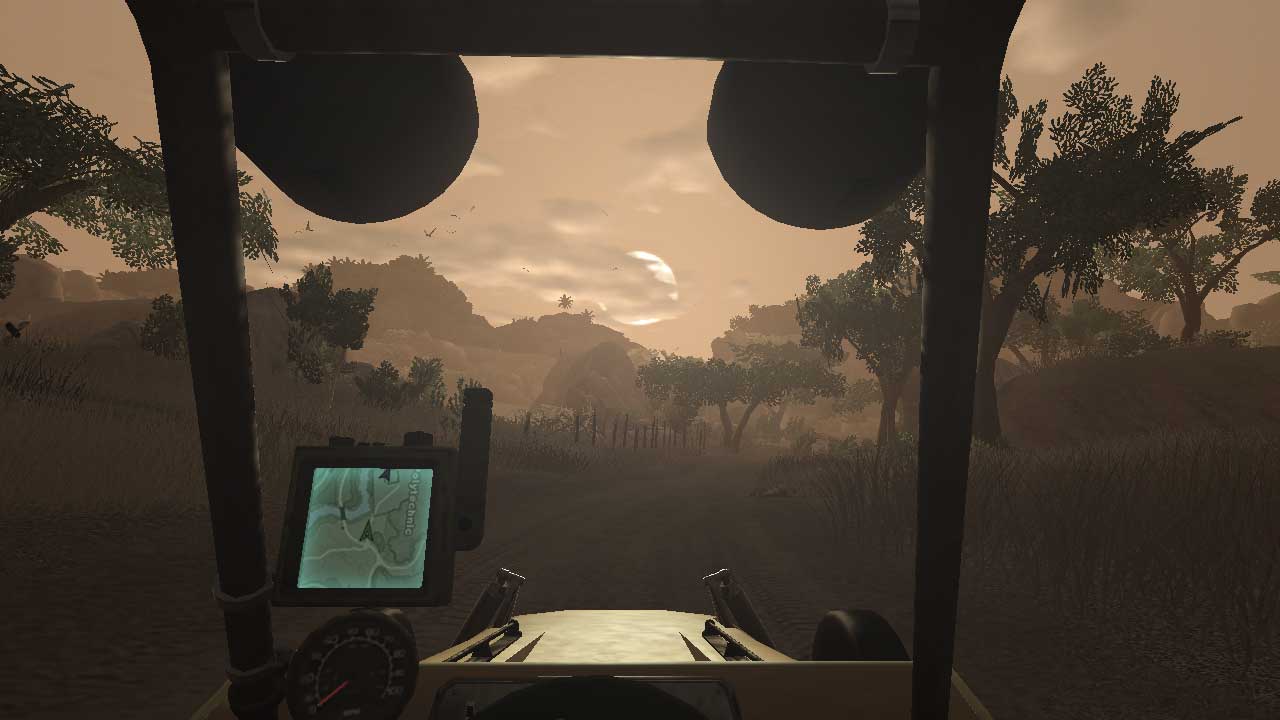
Get used to this. In a... bad way! Er...
Grand Theft Africa
The very first thing to understand about Far Cry 2 is that the designer intent is for you to be immersed in the story and setting. Unlike most games that also want this to occur, Far Cry 2 is unapologetic about its meta-story approach. Every single mission involves either killing a guy, or blowing something up and then killing a guy. These missions are not meant to be interesting, nor are the reasons you are given for doing them. Rather, the idea is for you to muse on what it means for you to be doing them, and why every mission is repetitive nonsense but you do it anyway.
Of course, the danger is always that too much is being read into what is objectively a beautiful, immersive if badly-paced game. I am giving the designers the benefit of the doubt though.
The premise of Far Cry 2 is that you are a bounty hunter or assassin or whatever, flying into a chaotic African nation to kill The Jackal, an arms dealer who sold weapons to both sides and arguably made the conflict possible. After an extended driving sequence reminiscent of Half-Life’s opening tram ride, you arrive at the hotel and collapse from malaria fevers. The Jackal shows up in your hotel room, taunts you a bit, and leaves just as a civil war erupts outside your window. You stumble around in your fever haze, before collapsing just outside of town. As far as intros go, it is refreshingly novel. I do wish the designers saw fit to show you being bitten by the mosquito in-game, but malaria’s quickest incubation period is 7-10 days, so I suppose that is a point in favor of Far Cry 2’s realism.
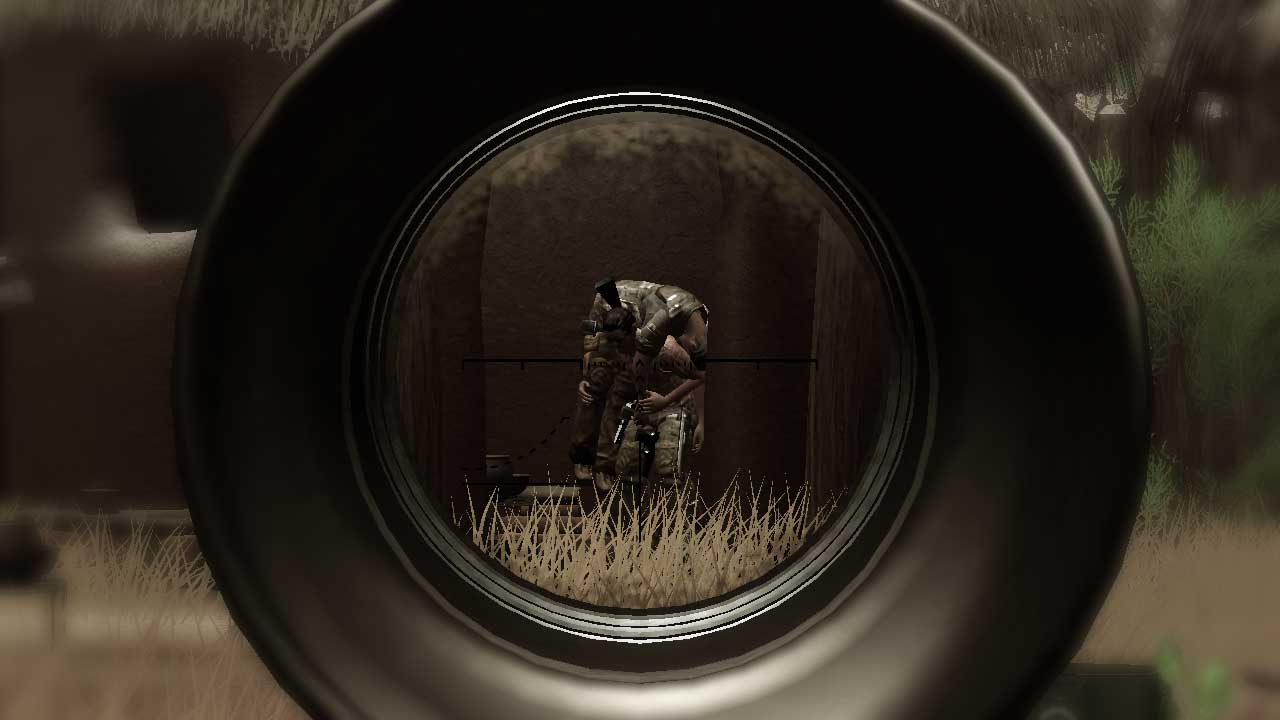
How convenient! I barely have to aim.
Once in the game proper, you are given a few “this is your ass, this is a hole in the ground” tutorial missions before suddenly Africa opens up as your gasoline-soaked, civil war-tincted oyster. To move the plot forward, you get episodic missions from both forces of this civil war, oscillating between the two factions with apparently zero regard for tact and subterfuge. Both sides see you as their “secret weapon,” and send you unsupported to deal damage to the other side, in the form of assassination and blowing things up. The problem is that “unsupported” means that the soldiers of whichever faction you are working for will shoot to kill, which is fine, but more troubling is that these faction leaders never once suggest that you should, you know, not shoot their own soldiers. At the height of Far Cry 2’s absurdity, one of the faction leaders straight up tells you that he knows you are doing missions for the other side… and then carries on like nothing happened. There is no identity between the two factions, no choice in doing missions for one over the other, no real choice in declining missions (at one point you have to blow up experimental malaria vaccines), and since everyone shoots at you, no real difference between anything whatsoever.
But again, given the meta-story that becomes more clear in the game’s final hours, it may be less bug and more feature.
Measured in raw game hours, Far Cry 2 is more of a driving game than a FPS. The game takes place in two Acts, each with their own 25 square kilometer game maps featuring realistically shitty African roads winding all over the place. There happens to be instant transportation in the form of Buses, but most of these are at the far corners of the map and generally shave off only ~20% of the driving distance at best. Given the nature of these maps, there are rarely opportunities to avoid the frequent guard checkpoints – which I suppose is a primary feature of good guard checkpoints, so another point for realism – which inevitably results in firefights every 3-4 minutes. While your enemies are decent shots out in the bush, their bullets transform into auto-tracking, Jeep Wrangler-seeking projectiles when you try to speed past them. It was originally satisfying creeping into these checkpoints, killing everyone, and being awarded (achievement-wise) for “scouting” the bases, but it has zero long-term impact on the game. No matter how many checkpoints you wipe out, it will always be fully staffed and stocked by the time you return.
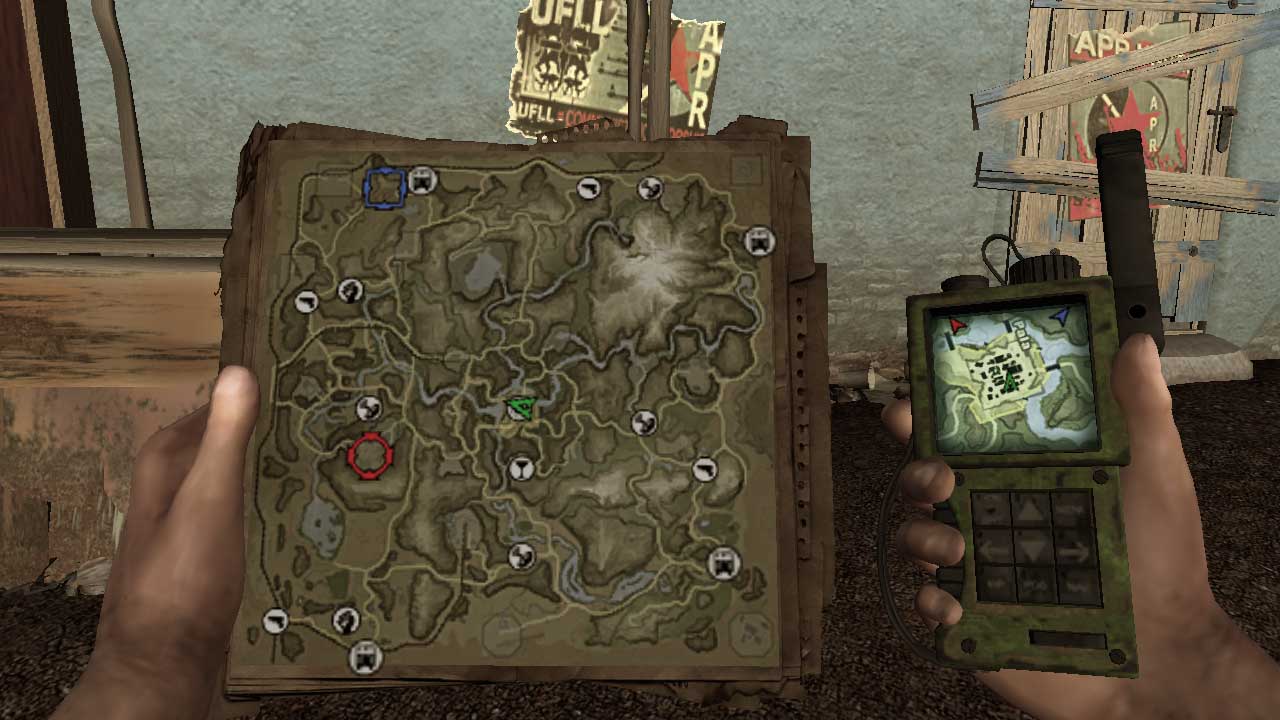
Optional blue objective is (thankfully) optional.
One of the more ballsy moves on the designers’ parts was having crosshairs disabled by default. In fact, generally speaking, there is no HUD at all until you reload or take damage. This definitely gives Far Cry 2 a more primal feel as opposed to arcade shooter, even though you look down iron sights most of the time. Reinforcing this primacy are little touches like how “health kits” are morphine ampules injected into your wrist veins. Indeed, if you are close to death, “healing” becomes pulling bullets out of your arm with needle-nose pliers, yanking your wrist/elbow/shoulder back into their sockets, cutting shrapnel out of your leg with a knife or extracting pieces of rebar out of your thigh. If you recruit a combat buddy, they can even swoop in when your health reaches zero to save you from a hard Game Over, in an extended sequence of dragging your semi-conscious form to cover before stabilizing you. All this happens wherever you are, not some stock footage, and that combat buddy will still be there helping shoot the enemies that (almost) took you out. If they go down, you have the option of returning the favor by stabilizing them, or putting them out of their misery with a coup de grace.
Ultimately, it is difficult to recommend Far Cry 2 as a game game when it plays out more like an interactive, philosophical art piece. The FPS elements are solid, but you only utilize them sporadically as you drive around. The sandbox feel of the maps and interface immerse you into the setting, but all roads lead to Rome. And the story… well, the story is disjointed and awful, but Far Cry 2 successfully transported me into the mind of the protagonist by the end. To me, that sort of experience is worth something… in the neighborhood of $5-$10.
 In An Age