Blog Archives
Impressions: Sun Haven
I’m currently at around 30 hours played with Sun Haven. I bought it six days ago.
‘Nuff said, yeah?

Sun Haven is a pixel fantasy farming/life sim game in the same vein as Stardew Valley. Like, literally in the same vein. Protagonist arrives in a town, meets a bunch of people, can choose a life of toil via farming, crafting, ranching, fishing, mining, and so on. There is a daily community quest board, a calendar of birthdays and festivals, a pile of romance options. Deja vu, yeah?
The thing is, Sun Haven has a lot of very interesting innovations even within the farm/life sim genre.
For example, Sun Haven has no energy meter. That’s right, you can perform actions for as many minutes there are in the day (and you can make those longer too in the Options menu). It almost feels like cheating, for veterans of this genre. And guess what other sacred cow got slaughtered? The game auto-saves constantly, which means you can safely stop playing at any time, e.g. not just when going to sleep. What the what?! If you thought “one more day” was addicting, wait until you play this.
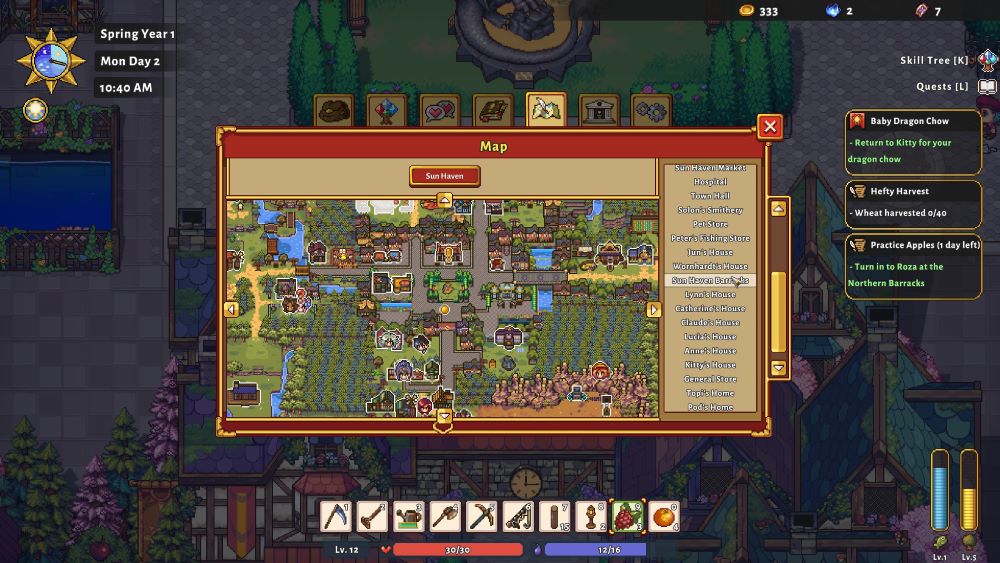
As mentioned before, the setting is fantasy. Your main character can be human… or elf, or angel, devil, and so on. You can also select a starting background, which affects if you arrive in town with some seeds or a fruit tree or farm animals. Magic also features somewhat prominently, with you learning a fireball spell very early on to assist with combat. As you gain XP in Farming, you can eventually get spells that will automatically till a big square via an earthquake, or summon a rain cloud to water your crops in an area.
Another thing that keeps things fresh is the fact that there is a surprisingly large number of Skills you can pick across the Exploration, Farming, Combat, Mining, and Fishing trees. Each one accumulates XP separately, and while the Skills offered generally affects the specific category, sometimes there is synergistic overlap. Also, these are Skill “trees” only insofar as you need to assign 5 Skill points to unlock the next tier of Skills – you are not actually forced to go down one set path.
There is a plot within the game that is unveiled over time via fairly simple questing. I cannot comment much about it at this point, as I have not really seen enough of it to tell what’s going on. What I can say is that additional towns are unlocked (including different farms!) as you progress. I just got to the Elf town and none of the traditional plants you are used to grow there. Indeed, the Elf town doesn’t even use gold as currency, so you can’t just make bank in Sun Haven and waddle your way over to clear out the vendors. I’m guessing that maintaining two or more farms simultaneously will not go over well, but it will be interesting to see if you can effectively abandon your old life and simply start over elsewhere.
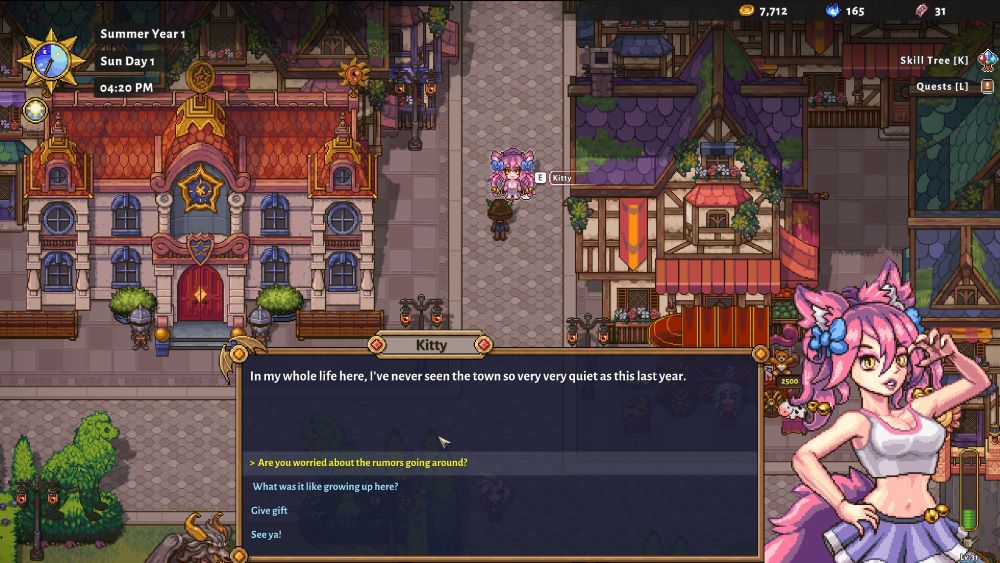
One last piece that I thought was insanely clever was the fact that most foods grant permanent bonuses when eaten, subject to a cap. This encourages you to plant a large variety of crops even after you used Excel to determine the most profitable ones, since each point of extra Mana will save you X amount of seconds by summoning rain clouds instead of using a watering can like a pleb. The bonuses are typically small, like +1 HP and then go down to +0.75 HP for the second serving, but across the dozens or so recipes it all adds up. This can affect HP, MP, Attack, and even movement speed.
My only real criticism so far is that the game is so well-made that I started expecting more out of it. For example, combat is extremely simplistic. Enemy will aggro and try to melee you. You can unlock a Fireball spell early, or you can rely on Crossbows or Sword swings to defeat them. None of this is all that different from other games in the genre. And yet I kept thinking that Sun Haven needed more spells, or enemies with a more interesting attack pattern or something. Exploration feels really good, with a whole pile of useful things to collect off the ground, and yet enemies being so simplistic sort of diminished that somehow. I will say though, that I encountered one boss out in the world that made me flee, and that made things exciting again. Just wish there were more of that in normal enemies.
Overall? Sun Haven gets top marks from me. The genre innovations – mostly in the form of sacred cow slaughters – is a breath of fresh air, and the sense of progression is top-notch. I’m excited to see what the rest of the game has in store for me, even though I’ve already clocked in more than my money’s worth just in the first third of the game.
Review: Per Aspera
Per Aspera is one of those games you can become obsessed with far beyond its actual quality.

In short, the game is about terraforming Mars – a surprisingly crowded field these days. You are an experimental AI in charge of turning the red planet green, and must plan out a series of resource mines, factories, and resolve supply chain issues on your way. While you go through this process, you (the AI) will reflect on some of the philosophical ideas surrounding artificial consciousness, your role in terraforming Mars, and some political intrigue as major players swap out.
One of the reasons I don’t actually like the game is because it’s poorly paced. When you first start your journey, you have a single hub building providing minimal electricity, one worker rover, and some basic building materials. Your primary goal is to create a 2nd worker while acknowledging the existential threat of not having a Maintenance Facility, which is a building that’s required to keep everything else from decaying in the Martian atmosphere. One carrot, one stick. Okay. So what’s the path?
- Worker Factory = Parts + Electronics + Glass + Aluminum (and Steel to construct)
- Parts Factory = Steel + Aluminum
- Electronics Factory = Silicon + Aluminum
- Steel Factory = Iron + Carbon
- Glass Kiln = Silicon
- Aluminum Mine = Steel
- Silicon Mine = Steel + Aluminum
- Iron Mine = Aluminum + Silicon
- Carbon Mine = Aluminum + Iron
- Maintenance Facility = Polymer + Electronics (and Aluminum and Steel to construct)
- Polymer Factory = Chemicals + Carbon
- Chemical Plant = Aluminum + Steel
- Solar Farm = Aluminum + Electronics + Glass
Basically, every fucking thing.
So you’ll start by building an Aluminum and Silicon Mine, then a Glass Kiln. This will get you far enough to place a Solar Farm or two, as your original landing hub won’t have enough juice to power many more mines/factories. Then you can get started on Iron and Carbon Mines to fuel a Steel Factory. And so on.
This entire time though, you have one single worker rover, which means it carries a single resource at a time to a location. Does something take six total resources to craft a particular building? That’s six trips. The game offers a speed boost up to 16x, which pretty much tells you everything you need to know.
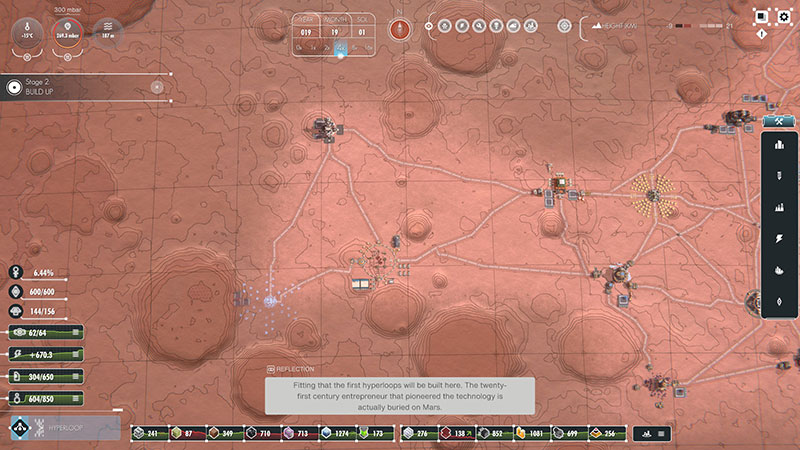
To say that the game is a slow burn is an understatement.
Having said that, I did start feeling the coals after a while. As soon as you get that second worker, things accelerate significantly. The 3rd/4th/Nth workers pop out as soon as you build the corresponding Worker Hubs, and you can get busy planning your expansion across the Martian surface. Your growth is kept in check by building limits, which is tied to Tech trees, which is tied to Research Points, which is tied to hosting human colonist and keeping them alive with Ice and Food. A lot of things to keep you busy planning and expanding.
Of course, it all grinds to a halt again in the mid-game when you slowly realize that “choices” aren’t really choices. Goal: increase temperature at Martian polar ice caps to release frozen CO2. Looking at the tech tree, you see things like “Construct Satellite Mirrors” and “Aerobrake Comets” and “Import Greenhouse Gases from Earth,” along with some lesser stuff like Greenhouse Gas Factory. What isn’t immediately obvious is that the comet is a one-time deal, and the Mirror project only heats things up by about 20% of the total. You’re back to doing all of the things, this time limited by how many Spaceports you build rather than Worker rovers.
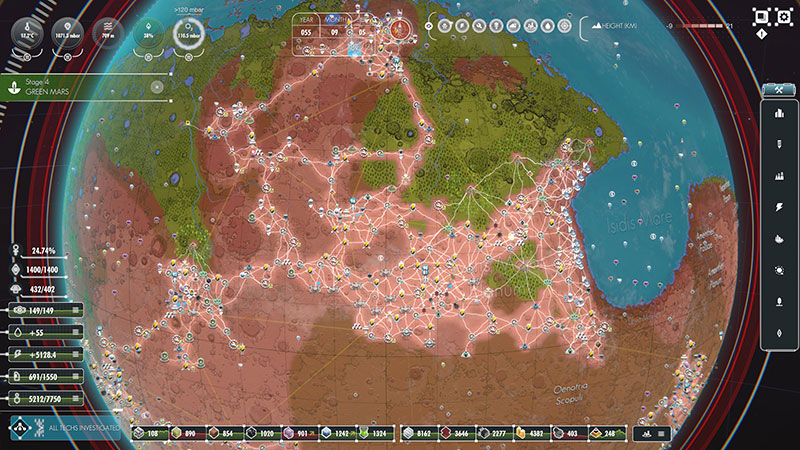
And spoiler alert: there’s a third grind at the endgame, notwithstanding however long it takes to get a breathable atmosphere. The last two hours of my “playtime” consisted of me having the game run at 16x while I dicked around on my phone.
Ultimately though, I did stick around to the bitter end. Why? It’s hard to say. The existential musings were a bit basic compared with other titles, but they seasoned the stew. And this was a very, very long-burning stew. But perhaps in a cognitive dissonance sort of way, I began to really enjoy myself once I saw Mars starting to change. Once water appears, the game just feels different. You start needing to place Water Treatment Plants near the water, but take care that they won’t get flooded should you continue to pump up the water table. Some unique buildings require you to use craters rather than just placing willy-nilly, and that changes up how you approach base design and/or expansion.
I haven’t played many other sims like this, so I cannot really speak for whether Per Aspera is more worth your time than Surviving Mars or whatever else is out there. Hell, I’m conflicted as to whether it was worth my time to play Per Aspera at all. But I did play it for just shy of 30 hours in less than two weeks, so that’s worth something.
Impression: Metro: Exodus
Despite the country being on lockdown and me working from home, my time has actually decreased from before. Figure that one out. Hint: baby.
What I have been doing in extremely limited bursts though, is playing though Metro: Exodus. My overall impression is… better than expected.
The Metro series has been an interesting experience. I reviewed the first game way back in 2012, and the key takeaway was that it was one of the best “authentic” gaming simulations at the time. Features that might otherwise be annoying actually felt right, such as having to pump up your flashlight battery as you explore subway tunnels. The second title was similar, although I seem to recall a truly ridiculous number of “knock you unconscious so we can show exposition” sections. Like, serious traumatic brain injury levels of blackouts.
Exodus starts out in the tunnels and I was not really feeling it. You kinda have to be in a mood to enjoy jump scares and such, right? When the game opened up into an almost Far Cry 3+ way though, it almost felt like too much. You have a map (Far Cry 2-style) and markers, but was it really a Metro experience to just… walk around wherever?
It is, and I like it. Or maybe I’m just getting Fallout vibes and liking that.
Indeed, in addition to pumping up the flashlight, you now have to scavenge for materials to create bullets and repair your gear. There is some minimum level of crafting you can do anywhere, and there are workbenches scattered about to complete bigger tasks like making grenades. Some human enemies drop weapon mods you can otherwise permanently learn, with others being tucked away in remote areas of the world.
There is definitely a tension with exploring though. As usual for the series, the mutants you kill drop nothing. Which itself is a surprisingly uncommon game design mechanism, if you think about it. The result is that sneaking and avoiding enemies is encouraged, which heightens the tension considering how much simpler it’d be to stealth kill them instead. The difficulty I’m on (Normal) doesn’t make avoiding fights necessary, but I do find myself tackling most missions during the daytime, which increases the amount of human enemies, who do drop gear and are easier to take out anyway. Aside from that, the other tension is the lack of fast travel. Exploring is fun and all, until you get to a point where you have to traverse the map in the opposite direction a few times.
I’m not sure how far along in the game I am, but it’s going well. We shall see if Metro: Exodus loses steam or pushes through to the end.
 In An Age