Blog Archives
Impressions: Stoneshard
I’ve played almost 40 hours of Stoneshard in the last two weeks. My opinions are… mixed, but hopeful.
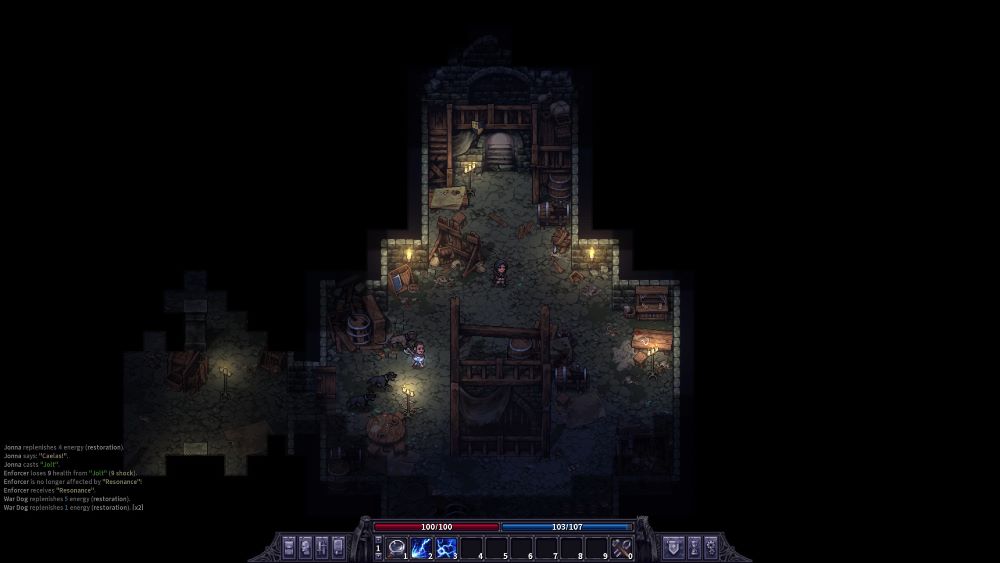
Stoneshard is a brutal, turn-based fantasy/mercenary game where death is always around the next corner. It’s one of those “you’re not the hero” kind of stories, although in practice that just means you can run into super high-level enemies early on if you aren’t careful. The general gameplay consists of taking contracts to do X inside dungeon Y within 3 days, and then returning for your reward. Eventually, the contracts dry up at your original location, so you have to trek to another town and start the process again, hitting harder and harder dungeons. The most recent update (0.9.1.0 – Rags to Riches) includes a caravan feature that makes moving through the world much easier.
The brutality of the game comes in two flavors: cascading failure, and time disrespect.
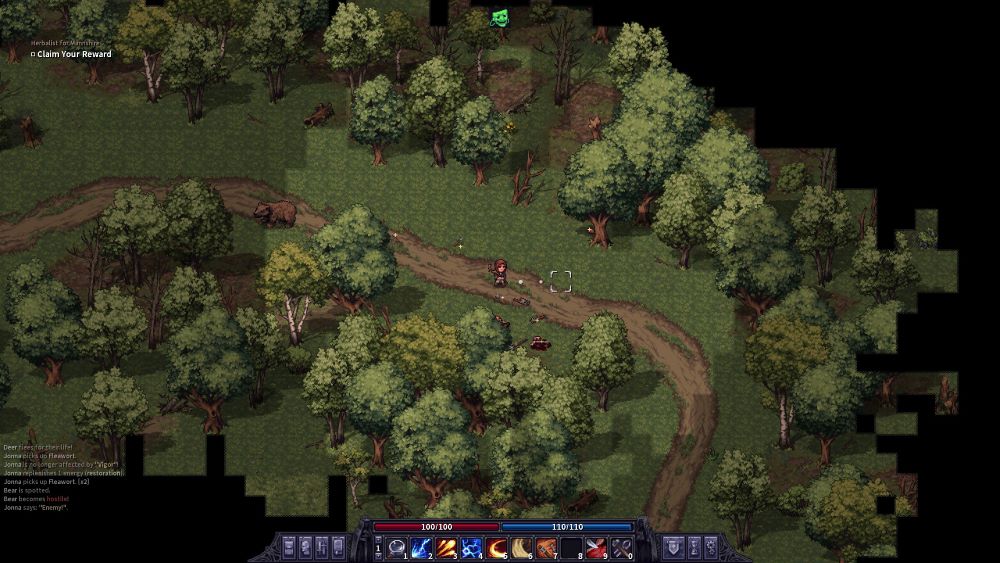
Let’s start with time disrespect first. The world is broken up into tiles that you move through, just the same as you would move through a dungeon. While you can click on a distant spot to have your character “hop” square to square quickly (outside of combat), the fact remains you still have to walk. If the dungeon is six tiles away, that’s six full screens you have to get through. There are a bunch of herbs, mushrooms, berry bushes and the like to occupy yourself with – you need to craft a lot of fodder to fuel your caravan – and there is always the risk of an ambush from bandits or hostile wildlife as well. So, it’s not always boring to travel long distances. Plus, sometimes it’s fun to kind of vibe with the very excellent music and ambient noises.
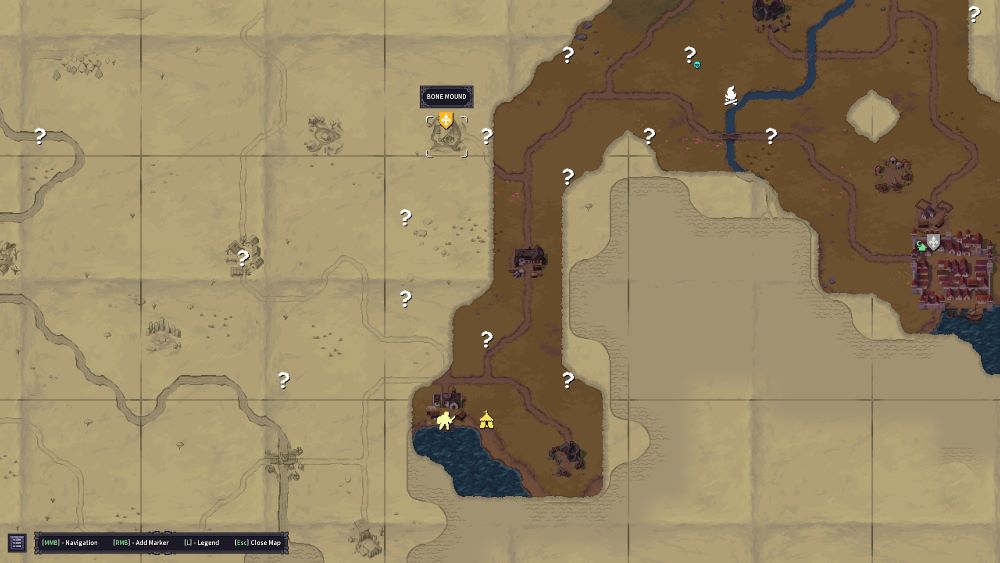
Here’s the thing though: you can only save the game when resting. If you travel for those six tiles, survive a few ambushes, clear an entire dungeon (including the boss), and then get bit by a hidden snake and die a tile away from town… you lose all progress since the last time you rested.
Technically, there are ways to mitigate this sort of disaster. You can buy/purchase bedrolls, which take an enormous amount of limited bag space, to create a one-time use resting spot outside of the dungeon. This will prevent you from having to re-walk to the dungeon, but of course do nothing about the dungeon itself or the walk back. Or perhaps you can bring two bedrolls, use one, stash the other outside the dungeon, and then use the second once you complete the dungeon. The latest update introduces the caravan, which you can technically park close to the dungeon and mitigate the worst of it, if you’re willing to burn a bunch of time (there’s a cooldown after parking the caravan). Of course, the existence of the caravan “workaround” calls into question why there’s no Quicksave, or a smaller Meditation Mat, or whatever.
[Note: there is a Save & Quit feature, allowing you to exit the game. This save is deleted after loading.]
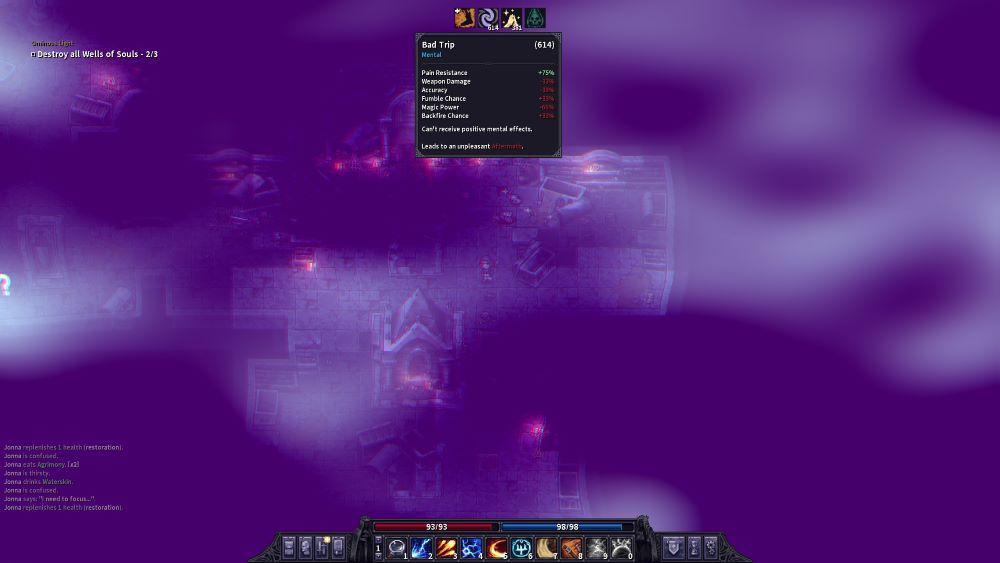
It’s important to know about this sort of thing because Stoneshard has a lot of cascading failure opportunities. You have Hunger and Thirst, which necessitates bringing a waterskin and snacks. When you are hit, damage is dealt to specific limbs, which can develop wounds or even Bleeds; make sure to pack Splints for the former and Bandages for the latter. Oh, and limbs have a Condition meter that reduces your maximum HP until they are healed, which is another consumable. Even if you heal the damage away, you have an overall Pain meter that accumulates unless reduced by beer/drugs. Enemy abilities can Stun, Stagger, Daze, Confuse, Immobilize, Ignite, and/or Poison you. Fatigue, Intoxication, Morale, and Sanity are also things. And all of these typically compound on one another, like how Pain gives you a debuff at certain thresholds that constantly drains Morale.
I am not actually opposed to all these “crunchy” systems. Choosing how many healing items to bring to the dungeon is a meaningful decision, and rewards the collection of crafting components and otherwise planning ahead. What I am opposed to is how often and how quickly these interlocking systems go from irrelevant to run-ending in a way you can do nothing about. Bleeding out at the end of a fight because you didn’t bring any/ran out of bandages? Fair play. Getting Dazed (turns off all your abilities for a few turns), then Immobilized, and then chopped in half within two turns? Okay then. The slow descent into insanity works in, say, Darkest Dungeon because damage is usually spread amongst a party and you get worn down. Here, you often just get hit a few times and die.
Ironically, that scenario doesn’t play out that often because you are always, 100% of the time trying to lure enemies out one at a time. Which is super effective! And sometimes boring. I play an Electromage with a few finishing moves via Staff. Electromancy is all about low cooldown spells that can Knockback or possibly Immobilize enemies. I just cleared out a 3-skull dungeon full of bandits and only got hit once, by an enemy that had a charge+attack move. So, perhaps my experience is a bit more skewed than if I were straight melee, sword & board with heavy armor; perhaps there’s more survivable damage.
Anyway, that’s Stoneshard. It’s still in Early Access, has been for years, and the updates themselves do not come quickly. That said, this is a game that has good “bones” and I can see it meaningfully improving with some tweaks and enhancements. The latest “Rags to Riches” release apparently changed the game’s compiler, which destroyed all existing mods – if/when that gets fixed, I could see mods coming to the rescue too. I’m certainly looking forward to being able to Quicksave anywhere.
Warhammer 40K: Mechanicus
I have read descriptions of Warhammer 40K: Mechanicus (Mechanicus) as being a cross between Warhammer 40K and XCOM. The short version? Sure, close enough. The long version? Not at all.
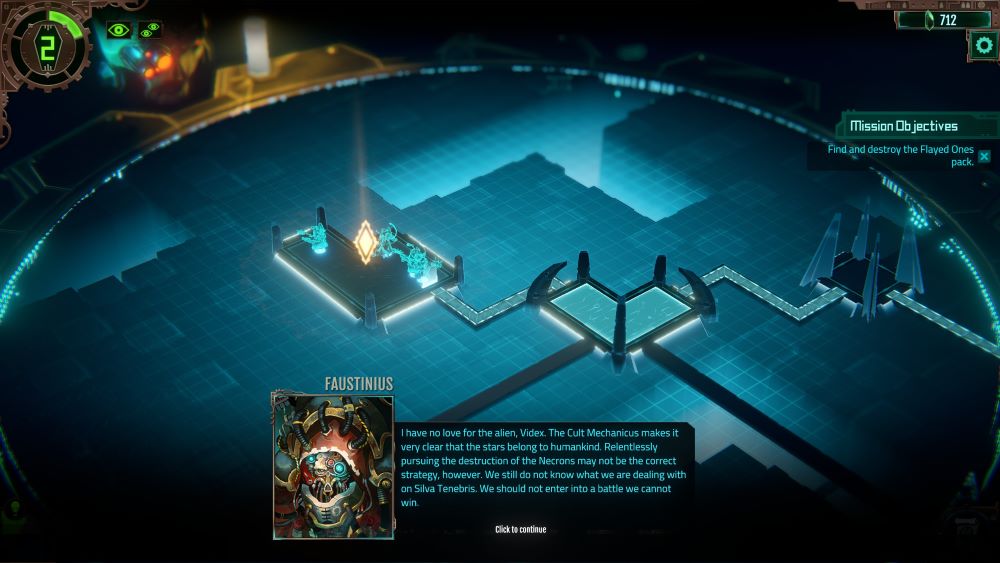
At the base level, Mechanicus is a unit-turn-based RPG set in the Warhammer 40K universe following the Adeptus Mechanicus branch of the Imperium of Mankind. This already sets it apart from the dozens of its licensed peers, who typically follow the overdone Space Marines. I am a general fan of the Warhammer 40K setting, so the implicit lore taking place (and overwrought dialog) were pure bonuses. If you are not similarly inclined, or find the glorification of Imperium problematic, then you may want to sit this one out.
The reason I say this is because the gameplay is rather simplistic. When I think XCOM, I think about cover and missing 95% accuracy shots seven times in a row. In Mechanicus, there is no cover and no accuracy – if you are within range and have Line of Sight, you hit your target. The combat wrinkle is Cognition (Cog): a persistent, spendable team-wide resource needed to fire larger guns and utilize abilities. In the beginning, your primary source of Cog is from the expendable Servitor redshirts you bring along with you to soak up enemy fire. Deploying Servitors costs 1 Cog, but they grant 1 Cog each time they take damage. Enemies that are downed also grant 1 Cog if a Tech-Priest is nearby to extract it. Aside from that, there are usually several structures around the battlefield that grant 1-3 Cog per turn if a Tech-Priest walks nearby, or if they send their Servo-Skulls (drones on a cooldown) to go collect it.
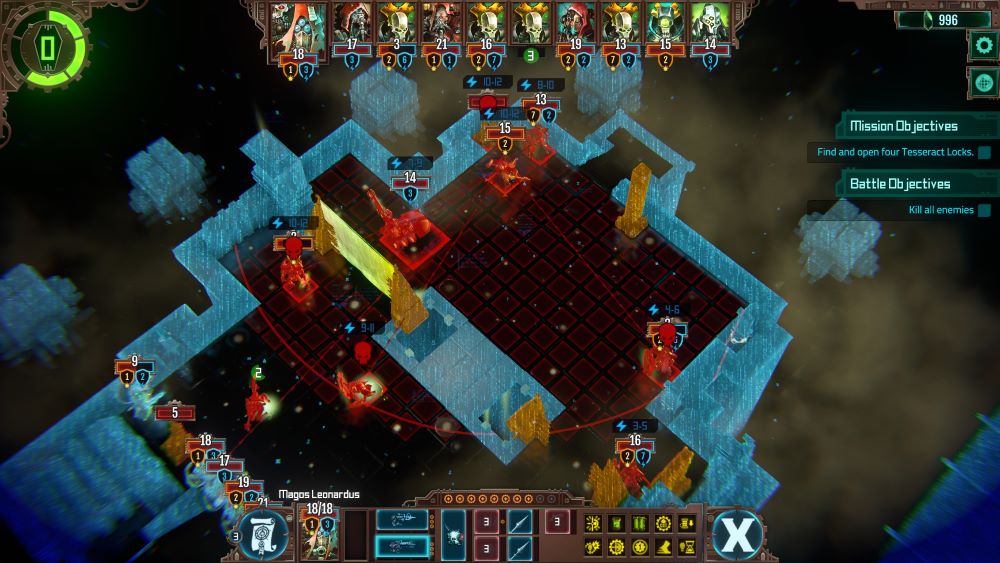
There are technically other tactical considerations. Ranged weapons cannot be used when in melee range, and there is an Attack of Opportunity when you move out of a threatened square. Units can block each others’ Line of Sight. Necron units will come back to life after a few turns unless you spend time attacking their downed forms. There is an Armor system of sorts that reduces the damage from either Physical or Energy attacks by a flat amount. Necron unit HP/Armor is unknown unless they are scanned by Servo-Skulls or attacked with specific weapons that indicate that said info is captured. Spending time to Scan computer consoles will award you more “Blackstone,” which is an upgrade currency for your Tech-Priests.
But honestly? Heading into the mid-game none of that really matters. Once you have figured out a combination of abilities to keep your team loaded with Cog, you can just blast every enemy out of existence with relative impunity. Indeed, it gets amusing once a character or two unlocks the “Immune to Attacks of Opportunity” skill, as it allows you to freely traverse the map. See, your units can move X spaces normally, but they can spend 1 Cog to extend that range another X spaces. And another, and another, as long as you have Cog to spare. Which means one Tech-Priest can run around the map collecting all the Cog from structures as he goes, scanning all the consoles, and then end up where he started with a full Cog gauge, depending on abilities.
One such ability? Fill your entire Cognition gauge, on a 5-turn cooldown.

Outside of combat, you are basically playing a Visual Novel with a series of frustratingly Blind Choices. Decide which icon room to enter next, decide which of three choices to pick, and then act surprised when they are terrible outcomes. Within each mission there is an Awakening Meter that increases for each room you enter, increases per turn of combat, and also depending on the Blind Choices you make. As the meter fills, more Necrons join the fight and otherwise things go more badly for you. Once you successfully complete a mission, the Awakening Meter gets added to your overall Awakening Meter (e.g. 3 Awakening = +3%), which leads to a Game Over at 100% if you haven’t unlocked the final boss yet. There are usually a few ways to reduce the Awakening Meter within a mission, but it’s otherwise a race against time and actively discourages you from exploration. Which is necessary, because your units get god-like pretty quickly if left to their own devices.
Overall, I did have a good time to the tune of 20 hours. Then I played another 8 hours in order to finish the game, which was pure slog. If you picked up Mechanicus as part of a bundle and you can tolerate the Warhammer 40K setting even a little bit, it is worth installing and giving it a whirl. But if your interest starts to wane, go ahead and drop it within guilt. The game stays exactly the same the whole way through, and nothing about the final battle or ending moves the needle.
Impression: Fell Seal: Arbiter’s Mark
Oh, how sweet is that feeling of consumption. Well, not that consumption… the other one, when you have had gaming ennui and then you boot something up and it consumes your entire mindspace.
Fell Seal: Arbiter’s Mark (FSAM) is a rather unapologetic Final Fantasy Tactics clone. From the bottom of the Steam description:
Strongly influenced by games such as Final Fantasy Tactics (original and Advance versions) and Tactics Ogre, this tactical RPG stands on its own as a worthy successor of those classics, bringing a slew of improvements and additions to the tactics genre.
Which is fine. We all need some more FFT in our lives.
For the most part, FSAM is pressing all the right buttons. Your characters start out knowing just a few jobs classes like Mercenary or Scoundrel or Mender. As you complete battles, each participating unit will earn AP which can be spent buying abilities in that class in a very limited “tree.” Each purchased ability raises the level of the class, which can unlock new classes. For example, raising Mender to Rank 2 unlock the Wizard class, which then is necessary to unlock other classes, etc.
What really gets the juices flowing is the customization of skillsets. Each character can have a primary class (Abilities + Passives) and a sub-class (Abilities only). So, maybe you want a Knight that also can heal like a Mender. There are two additional Passive slots and a Counter slot you can fill with skills from any class you have purchased though. So instead of being stuck with the Mender’s Passives, you can maybe choose the Ranger’s Evasion Up (13% dodge chance) and the Templar’s Defense Expert (scaling +Defense). And then, instead of something boring like Counterattack, you can choose Evade Magic from the Fellblade class, so you are immune to spells. So, yeah, super tanky Knight in heavy armor with a high dodge rate and immune to spells and can heal themselves or others. Just one combo of a whole raft of similar possibilities.
Another thing I appreciate is the Item system. Basically, Items like Potions and such have per-encounter uses that automatically replenish after combat. Collecting crafting material will allow you to upgrade the potency and unlock additional uses in the future. No more need to hoard X-Potions or the like for a time that may never come.
There are elements where the game falls a bit short. The penalty for death during battle is an “Injury” which is a -10% stat debuff until the unit sits out a battle (or more if multiple injuries). While it’s encouraged to have a larger army of rotating characters so you can sub one out, it’s easier to just travel to an early encounter node and get into a random battle with level 3 enemies, crush them, and then your injured guy is ready for the next story mission. I really just preferred the whole “you have 5 turns to revive your guy” that FFT had. This system is compounded by the sometimes wildly vacillating difficulty, wherein specific units can get piled on if you are not extremely careful, but meanwhile it’s more difficult for your team to alpha strike enemies all in one go.
I am not quite sure about the equipment system and related buff/debuff system yet. Right now I am being offered a raft of generic elemental-themed items (yawn) and a few choice weapons that apply Bleed or Blind (interesting). Debuffs in this game are just as powerful as they are in any turn-based game – battles go bad very quick if anyone on your team gets hit with Berserk/Charm/Sleep/etc, as it consumes your healer’s turn even if you fix it right away. At the same time, characters can equip 2-3 accessories so blanket immunity to many effects are possible. On top of that, enemies will often have these items equipped, so I have found my Fellblade (has a lot of debuff attacks) a little useless when 90% of enemies are immune to Poison/Bleed/Blind.
Overall though, I am having a lot of fun. It’s definitely knockoff FFT quality – there are no Line-of-Sight restrictions, presumably because that’s too difficult to code for an indie team – but for a lot of things in life, a knockoff of something great is still pretty good. Especially when you have apparently been unknowingly craving that thing this whole time.
 In An Age