Monthly Archives: July 2024
Impressions: Icarus
TL;DR: Empty wildlife murder simulator.
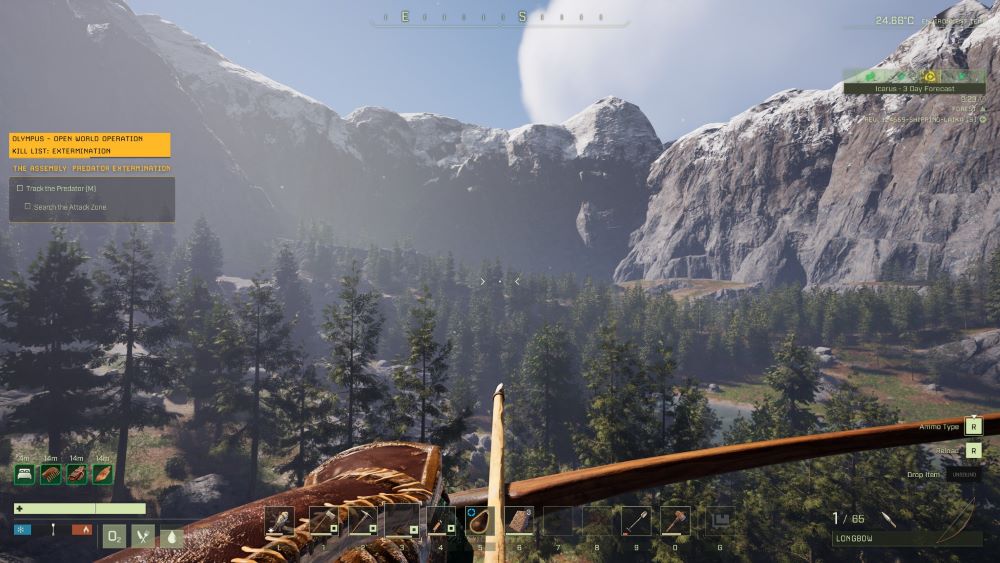
To understand what Icarus is all about, you need to know what it was about. At release, Icarus was intended to be a sort of survival roguelike, where you are dropped off at a location, fulfill a mission before the timer expired, and then bailed on the world (including anything you built) within a few days. In fact, it was originally so hardcore that if the timer expired before you left – and it counted down even with the game turned off! – your character would straight-up be deleted. Successful missions granted you a currency that could be used to both research and then later buy items that you could then bring with you planetside in the future. For example, instead of starting at zero every time, you could start with an upgraded spacesuit, a backpack with bonuses, weapons, etc.
As you may imagine, that novel approach didn’t sit well with many people. Indeed, it’s difficult to imagine a worse genre mashup… although I suppose 7 Days to Die somewhat pulls it off (e.g. eventually enemies get too tough). But generally, the beginning stages of punching trees is the least interesting part of survival games, and losing progress is the worst. Icarus had both. The developers suddenly had to pivot, and so they eventually released a more traditional open-world survival mode.
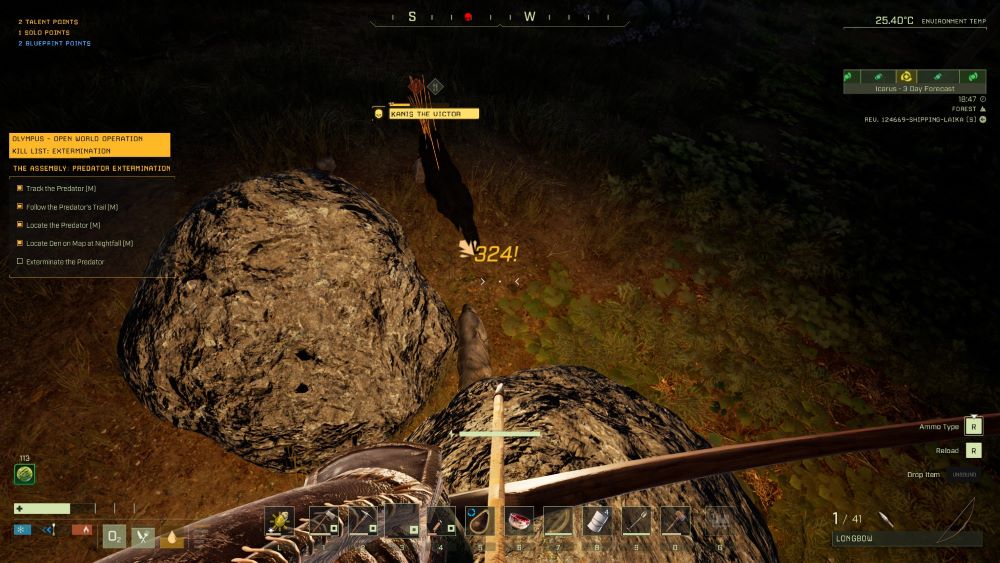
The pivot has taken some time, although the developers have sustained a weekly update schedule for over two years now, which is impressive. Or would be, if the game was fun or interesting at all.
The fundamental issue with Icarus is that there isn’t much going on. There is a relatively solid survival crafting framework in place, with XP and levels and recipe unlocks and talent points and such. The world is gorgeous and thick with trees, bushes, rocks. There is even a semi-voxel thing going, with fallen trees being satisfyingly split into logs, and ore/rock nodes deforming exactly where you are hitting them. All of which will sustain genre fans for a few hours past the refund window.
But after a while, you start to realize what you have in Icarus is basically the window dressing of other games. A forest with deer, rabbits, wolves, goats, moas, bears? A desert with hyenas and scorpions? Snow biome with polar bears and mammoths? Other titles like 7 Days to Die, The Forest, ARK, etc, have those things… aaaaand the rest of the game game. Without the parameters (and timers) of Missions, the Open World aspect falls flat. Technically, you can craft a radio that opens up both short and longer-form Missions even in the Open World, but you still run into the issue of “why.”
“Why do anything at all in any game, eh?” Because shooting zombies and looting things is fun? Because delving into caves and uncovering mysteries while running from mutants is (supposedly) fun? Because dinosaurs are fun? With Icarus, what you see is literally what you get. Kill thousands of animals to farm XP and unlock more crafting benches so you can kill more animals efficiently. Or build a quaint little abode in the woods. Which is fine for the people that want to do that, but you can also do that in (cheaper!) games that have more meat than potatoes.
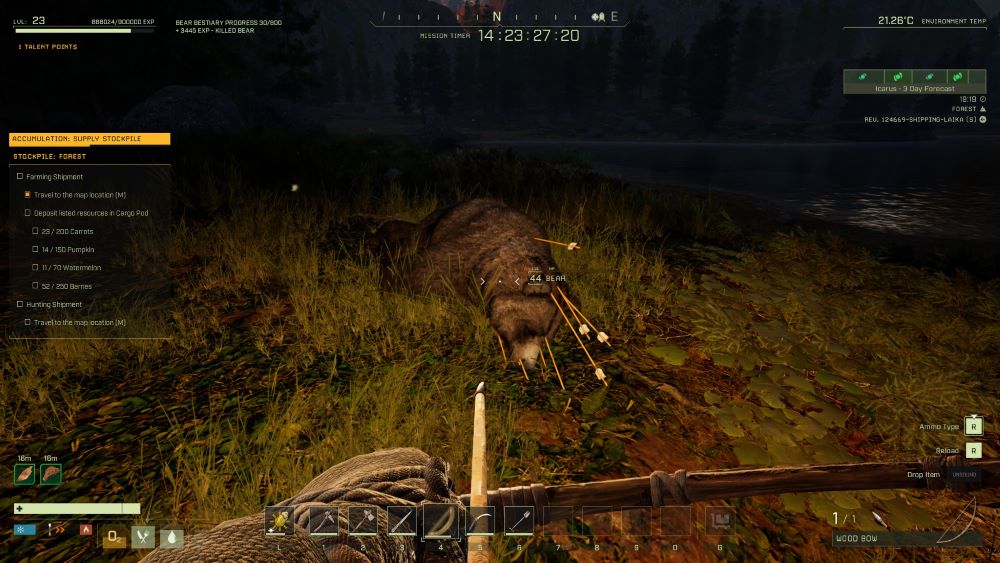
In an effort to be totally fair, I did go ahead and run a few Missions, e.g. the way the game was designed to be played, once the open-world lost its luster. And… it was pretty much as bad as it seemed. After the tutorial one, the next Mission was to collect up meat and vegetables into two different drop pods. Cool. What they neglected to mention was the fact it was going to be like 150 Pumpkins, 200 Carrots, and so on. The only possible way of gathering that much was going to be setting up a farm, and then hanging out for a while. Which I did. Next was the meat, which was something absurd like 300 meat, 400 hide, and 300 fur or whatever. I got about halfway through murdering literally every single mammal that moved before the tedium overtook me and I uninstalled.
Having said all that… is there anything good going on in Icarus? Sure. Although it is a limiting factor, the existence of oxygen as a necessary meter to watch gave texture to the survival experience. It helps that Oxite Ore is in most places, so you aren’t as constrained as in, say, Breathedge. The storms in Icarus are also interesting. Staying outside in one fills up an Exposure meter that begins hurting you when full, and the storms themselves do damage to most buildings. Now, you usually just spend the storm inside your base running around and smack-repairing things with a hammer, but it elevated “weather” from a pure, ambiance detail in most games to one that you must account for. And you do have to account for it: your walls will collapse if they take too much damage from the weather or anything else.
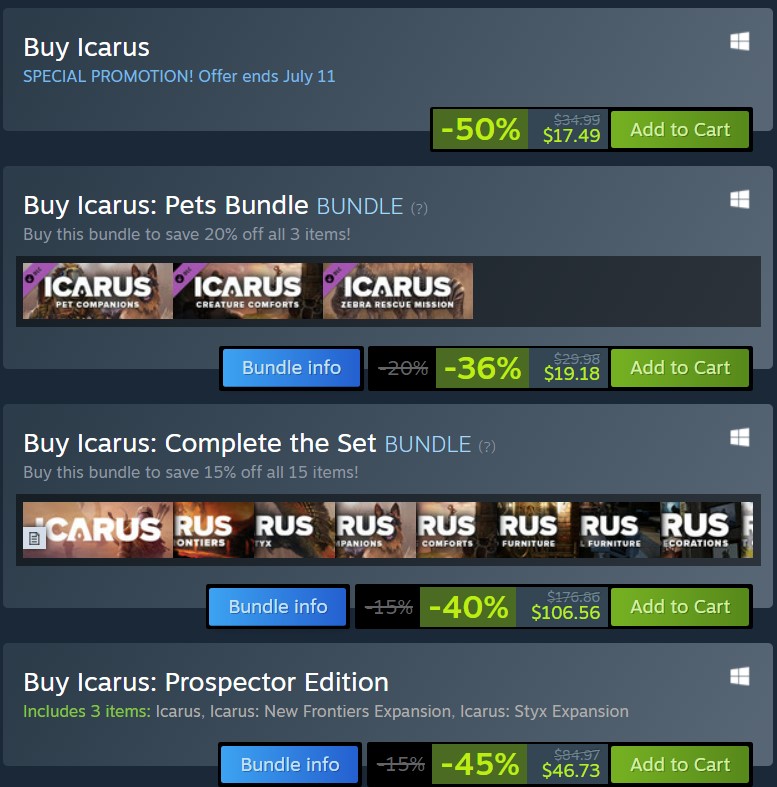
That’s about it, though. Part of me feels bad for the devs since they likely had to scrap a lot of their post-release plans when they pivoted to a more traditional open-world structure. But then I look at how much they are charging for the game + DLCs in its current state and those feeling go away.
Boardgate: Hearthstone Edition
Hearthstone is releasing a new expansion next week called Perils in Paradise, but they aren’t releasing a new board along with it. And this is heralding the beginning of the end. Possibly.
As with most things, it’s not about the game boards themselves, but what they represent. Every Hearthstone expansion has had a new game board – there are 30+ of them – so the absence of one is notable, especially given this year will be the 10th (!!) year anniversary. Of course, this is the same year that Blizzard discontinued the Duels mode and enacted some boneheaded changes to the quest system in an apparent attempt to inflate engagement metrics.
It doesn’t help when the official Blizzard response plays right into everyone’s fears:
We hear your questions on what’s changing and why, including why there is no new board for Perils in Paradise.
Hang tight, as we’ll be sharing an update next week on that, along with what the team is focusing on for the future.
Why not just, you know, address it this week? Because the $50/$80 preorder bundles are still going until next week. There may be a less cynical argument that discussion over future Hearthstone changes is more appropriate in an flashy expansion release post. On the other hand, there have been plenty of those teaser-esque posts in the weeks leading up to the expansion, and Blizzard community managers have been bobbing and weaving the “where board?” questions for just as long. All the delays accomplish is elevating the doomsaying ahead of what should otherwise have been talk about the expansion itself.
Incidentally, when Blizzard removed Duels it was spun this way:
As we think about the future of Hearthstone and where the team can best focus their efforts, we’ve made the difficult decision to discontinue support for the Duels Mode. […] This change will allow us to shift our resources to where we feel they will have the most impact, including Traditional Hearthstone, Battlegrounds, and more.
Looking at the current state of Hearthstone more generally, it’s difficult to identify what “focusing efforts” has accomplished. Game balance in Standard mode is amongst the worst it has ever been; power is no longer creepin’, it be runnin’. Battlegrounds has re-introduced Buddies (presumably for a limited time), which is worst of the three types of historic meta-shakeup mechanics. Battlegrounds Duos is a mode no one asked for, is rife with trolling, and basically a content-creator dead-end. What could the devs possibly be focusing on, aside from updating their resumes?
I suppose we will see more next week. My guess is that they will start offering Premium Boards in the shop as another channel of monetization. Which, whatever. That, at least, would be less problematic than them coming out and saying “we’re only making one new board per year so we can focus on other things” and then those other things never materialize because it was shareholder value all along.
Impressions: Once Human
Once Human is an open-world survival crafting MMO whose Beta details I mostly received filtered through the amusing lens of Bhagpuss. Based on those posts, I wishlisted the game and promptly forgot all about it. Then Tuesday came along and now its officially released. I played for almost six hours straight on that first evening, and not because it was, as my 5-year old terms it, a “stay day.”
Nor, incidentally, because the game necessarily deserves it.

Let’s start with the Pros, I guess. First, the game is free to play and not obnoxious about it. By that I mean I did not seem to get prompted to buy the Battle Pass every time I opened a menu, or had a red exclamation mark on my UI until I opened the shop, or the myriad of similar design disasters. Indeed, there is a Wish lottery mechanic (for cosmetics) somewhere in the game, but I was not actually able to find it. Maybe it unlocks later? I found a few vendors who require obscure currencies for vague items, but near as I can tell, none of them were extra bag slots, carrying capacity, or the like.
Second, Once Human does seem to support a rather robust survival crafting experience. You are encouraged to build a base immediately once out of the tutorial, and you can do so almost anywhere not already occupied by other players and/or the pre-existing set pieces. I also really appreciated the ability to go into “flight” mode when building, rather than having to awkwardly maneuver your character every which way. Collecting resources from trees/ore nodes is not too onerous at this early point, and you are overall encouraged to revisit points of interest to collect junk items that you then break down into smaller components to craft new items.
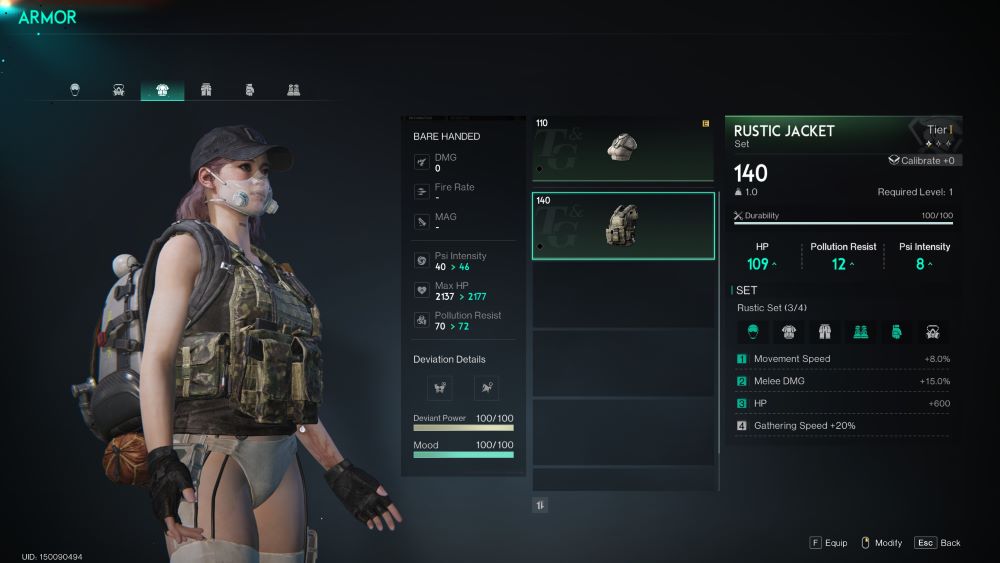
Then it struck me: Once Human is basically Asian Fallout 76.
Viewed from that lens, the veneer started to peel. Is the base-building better than Fallout 76? Absolutely not. Crafting? No. Quests? Nope. Environmental storytelling? Nonexistent thus far. The feeling of collecting and hoarding resources? Not even close. Both are post-apocalyptic, both have cryptids, and Sanity is basically Radiation – both reduce your maximum HP until healed and, hilariously, grant you special abilities if you accumulate too much (Whim vs Mutation).
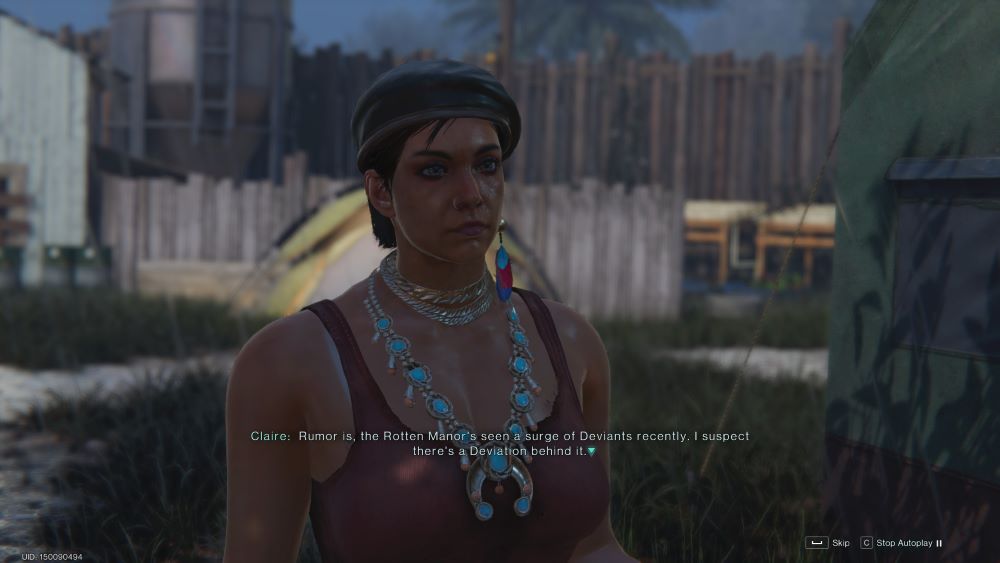
I originally didn’t want to complain about the Once Human combat system in these early stages – tutorials going to tutorial – but it’s… trivial. Every creature died to 2-3 hits with a torch, and having access to guns makes it even more ridiculous. Presumably mobs will sponge more bullets later on, and there is a dodge-roll button, but the fact that Once Human will be releasing on mobile phones in two months does not inspire confidence. The boss (or mini-boss?) fights were more interesting, and seem to be where the devs spent most of their imagination capital. Not saying that Fallout 76’s combat system is groundbreaking or anything, but it nevertheless has a heft to it even early on that is definitely lacking in Once Human.
Again, it’s possible this is all a bit unfair this early in the experience. The map looks huge, they give you a motorcycle within the first few quests, the Deviation (pet-ish) mechanic seems akin to Pals from Palworld, which could be interesting. The notion of Seasonal world resets and ever-changing “scenarios” is fairly unique in the survival space, and could go a long way in keeping the experience fresh. Time will tell.
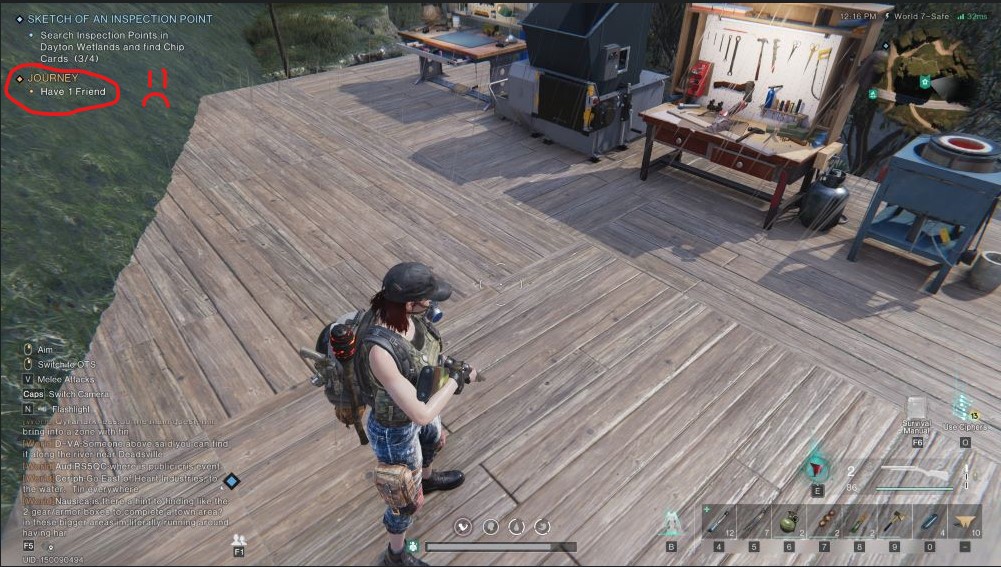
Time will also tell if I don’t just end up reinstalling Fallout 76 and playing that instead.
Impressions: Keplerth
Not going to lie, the name “Keplerth” was both intriguing and ultimately accurate.
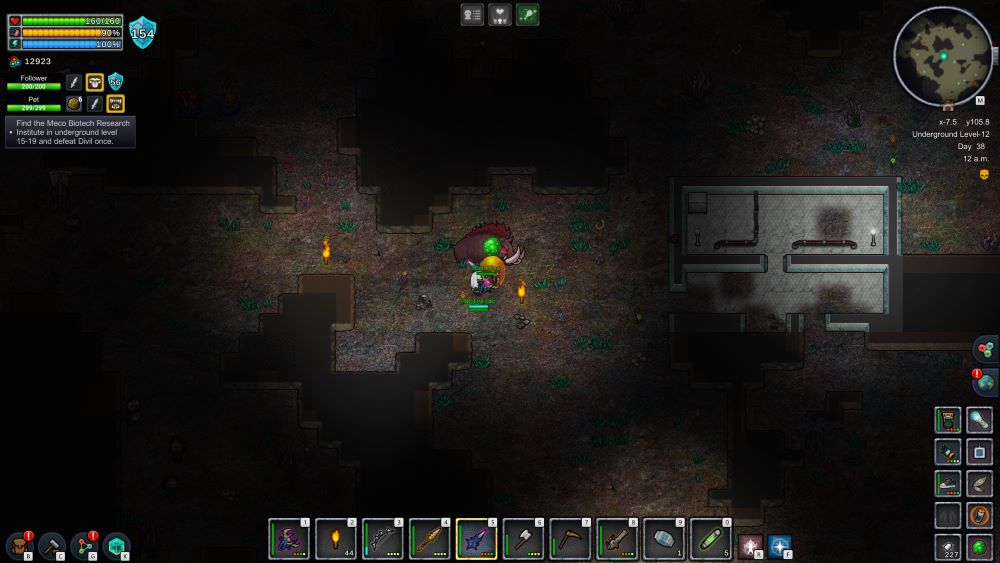
Keplerth is a top-down survival crafting game reminiscent of Terraria, with art assets straight stolen from RimWorld. Other reviews mention this as being a post-apocalypse knock-off of Necesse, if you know of that one. You will punch trees, create crafting benches, craft gear, and then tackle bosses to unlock the next tier of equipment, resources, and mobs. Rinse and repeat.
There are some interesting innovations to the formula though. For example, there is no XP here. Instead, you unlock new genes based on special resources that drop from basically everything in the game, e.g. plants, mobs, minerals, etc. The genes start simple, with stuff like +5% Evasion or +10% Attack Speed. Towards the beginning of the game, you have plenty of room to “equip” every gene you unlock; later on, you have to choose amongst them and their potential synergies.
I also appreciated how equipment bonuses work. Essentially, each piece of gear has a random set bonus and a random set bonus score (+0 through +3). So, the leg armor you craft might have bonuses to +Defense or +Pet Attack instead of the +Melee you were looking for. And even if it does have +Melee, the final set bonus may only trigger when you have 7/7 equipped and the piece you rolled grants +0. While random can be frustrating sometimes, many survival games are kind of rote in that Iron armor is Iron armor, and thus you only need 22 Iron ingots total to kit yourself out on that tier. This at least means you need to collect a buffer amount of resources. Later on, you get the ability to spend other resources to “reroll” the tier bonuses, so it is not too frustrating for long.
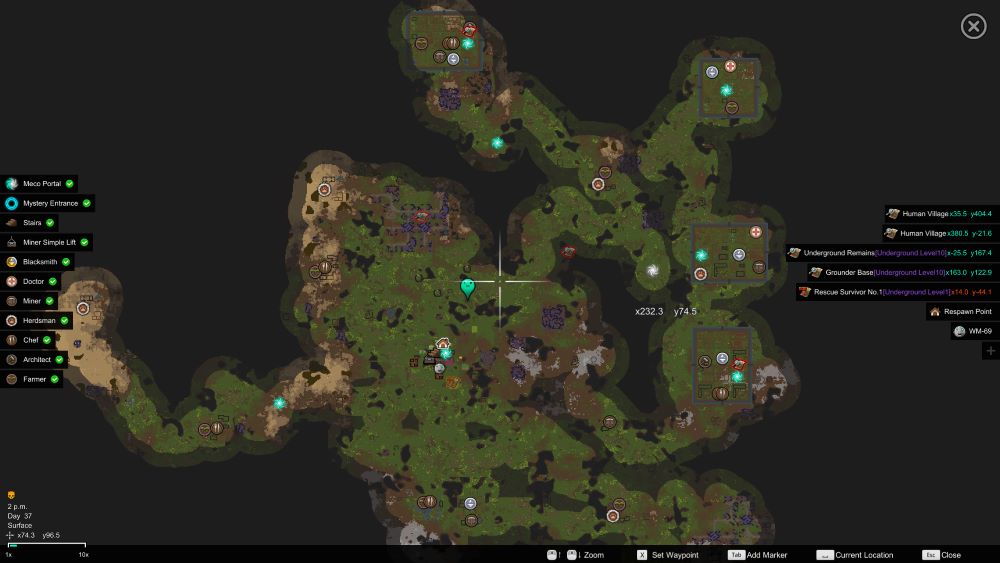
Where Keplerth struggles is… kinda everywhere else.
A lot of the mechanics feel half-baked. One of the early tutorial quests involves you attracting other survivors to your base with a communications tower. What the game doesn’t tell you is that the survivors… don’t really do anything. There is an entire elaborate construction station to create fancy furniture, but ultimately the survivors need 1 (one) recreation item (hot tub) and their heart meter will eventually fill and you click on them for money. That’s it. They do not defend your base, work the fields, or anything. You can also have farm animals like cows, chicken, horses, etc, and they will reproduce asexually as soon as their food meter hits 100%. Cooked food does require a variety of meat and plants for pretty useful buffs, so there is a point to all this, but it doesn’t always make that much sense. Like why have Horse Meat in the game when eggs are really the limiting factor for advanced food?
The special material mechanic I praised earlier is also a bit uneven. A lot of it felt natural at the time, as you just pick up all the things and new stuff seemed to unlock every 5 minutes or so. Eventually though, once your gene grid fills up and you start needing to examine what’s left, you start to realize that 5-6 of the missing genes require Thorns or Apples or some early-game stuff. Luckily the grind isn’t too bad since you can chop most everything down and replant it near your base to more quickly get additional chances when harvesting it – as opposed to having to wander around for more natural-occurring spawns – but the amount of things tagged to Thorns specifically is a bit odd.

What kind of broke the game for me though was one of the mid-tier boss drop weapons. Up to that point, you may have some melee weapons, bow and arrows, some early guns, and so on. Even with guns, there were some trade-offs with damage versus shooting speed. Then you get a 100% drop of an energy beam gun that deals constant damage with zero ammo. While it technically is out-classed in DPS later on, the utility of being able to trigger knockback, certain genes (“each hit adds X effect”), and the lack of ammo makes everything else feel dumb to use in comparison.
Later bosses also get into SHMUP/bullet-hell territory, which forces you to turtle up with your genes and equipment, which makes the fight last ages because you are no longer specced for damage.
Having said all that, I did end up playing the game for ~25 hours or so, somewhat obsessively. Keplerth definitely hit a stride for me after about the 2nd boss, once you unlocked the ability to tame battle pets, get some better weapons, better genes, and start finding other human settlements to spend money at. It is unfortunate how that petered out in the endgame, but what else can you do?
Play something else, I guess.
 In An Age