Review: The Outer Worlds 2
As mentioned, I recently completed The Outer Worlds 2 (TOW2) after about 70 hours of playing. There is a lot of like about TOW2, especially in comparison to the original game, but there is an equal (or greater) amount of terrible game design. Moreover, for all the news articles extolling Obsidian’s return to Fallout: New Vegas form with this title, I see regression at best. And, seriously guys, it’s been 15 years.
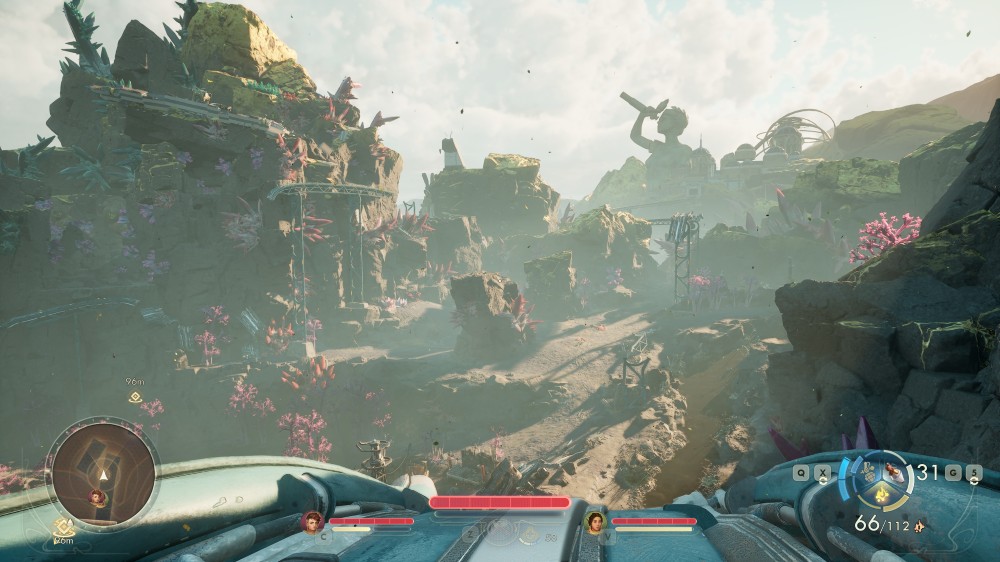
First, the good stuff. The game is gorgeous, maps are large, the skyboxes interesting. One of my criticisms from the first game was that interior spaces felt generic and cut & paste in the “let’s pretend it was on purpose because modular sci-fi habitats” kind of way. Thankfully, TOW2 feels much more diverse and detailed. There is still a definite lack of something that the aging Bethesda Gameybro Engine is able to evoke, but it is worlds better than before. Also, the act of traversing the landscape itself feels great, with double-jumping and auto-vaulting on par or better than with Avowed.
Gunplay and collecting bits and bobs out in the world is also much improved. There are baseball-esque cards sprinkled around everywhere that grant you +1% critical hit chance (etc), which makes exploration more exciting. The world is populated with many junk items that can be broken down into crafting components and then turned into ammo or mods. The original game featured a punishing repair/tinker system that drained you of resources; this one lets you use whatever guns or armor you want (for the most part) straight into the endgame.
Where the game falls apart for me is with the Skill Checks, and a broader fetishization of “choices matter” when they really do not.

Before I begin, there is one aspect of Skills I do want to give Obsidian credit for: they solved the combat vs social skills dilemma. In almost every RPG I have played, allocating a limited amount of points into something like Speech meant you were radically weaker than someone who put them in Guns. Broadly speaking, that is not the case in TOW2. Each point is Speech gives you a +10% damage bonus against Human targets. There is further a Perk called Space Ranger that gives you a 2.5% damage bonus against all targets for every level of Speech you have. While that is not as good as an unconditional 10% per Guns level, it no longer feels as though you need to gimp your character in order to talk to characters in an RPG.
But, see… that’s just the thing. This is a game of “choices” which is governed almost exclusively by Skill checks. In the original game, you could respec, wear gear with Skill bonuses, or even take certain companions with you to achieve certain Skill thresholds. Not anymore. You are hard-capped at level 30, meaning you can have three Skills at 20 with maybe two points elsewhere; two Skills at 20 with a few more at scattered about; or a single 20 Skill and a more even distribution across a few interesting ones. Obsidian devs have said they wanted players’ “choices to matter” and for players to commit to mistakes. Choices made… where? On the character page, prior to knowing anything about the rest of the game? Something like the very meaningful choice between Lockpicking 5 and Lockpicking 6?
The end result is this nonsense:

I spent the last third of the game with 17 unallocated Skill points, and 5 unchosen Perks. This is an epic game design fail on all sorts of levels. For a start, it illustrates how easily I was able to forgo 170% extra gun damage and still breeze through the game (on Normal). Indeed, my “build” was capable of one-shotting every non-boss enemy in the game from stealth… with zero points in Sneak. Second, it makes a mockery of “commitment and/or consequence” seeing as how I was easily able to pop into the character menu and become an expert of any relevant Skill as needed. Finally, it demonstrates how boring the capstone Perks (ones requiring 20 points in X) were, that I was completely unmoved to commit the Skills points needed to get there. As a matter of fact, almost none of the Perks were especially relevant or impactful, which is crazy considering there are 90 of them.
Now, as pointed out in my Tips post, you don’t actually have to max out Skills to avail yourself of all the most meaningful options. You wouldn’t know that while playing the game though, which is part of the problem. A lack of meaningful information precludes a meaningful choice. Would you still choose to get to Speech 20 if you knew Speech 9 was good enough for the kumbaya ending? Or, honestly, Speech 5 considering how odious one of the factions ends up being. And if Speech 5 is good enough, why do we need Speech to be the determining factor in the decisions our character makes at all?
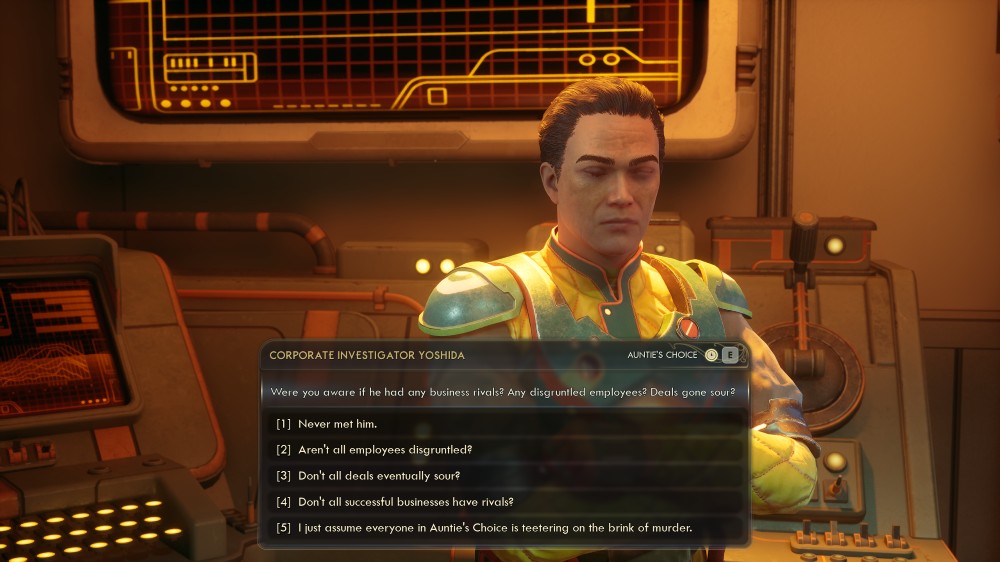
“It’s an RPG.” So are Mass Effect and Dragon Age: Origins. Is a game only an RPG if you have to put points in a Speech skill in order to make decisions? That sounds more like a Roll-playing game, amirite.
Having said all that, a lot of this is moot because the overall narrative of TOW2 is weak. The game starts off fairly strong with a much more consistent tone than the original. You learn about Auntie’s Choice, the ultra-capitalistic caricature of corporations from the first game, and then interact with the Protectorate, the ultra-authoritarian, brainwashing, jobs-assigned-at-birth and report-your-family-members bad guys. Later, you meet the Order, who represent scientists who use math and probability to predict the future. But then the Protectorate becomes generic antagonists and you just have Auntie’s Choice and the Order to play off one another and I could not be less interested. The vaunted, hard-hitting choices from the makers of Fallout: New Vegas boil down to who you want to attack you on sight for not taking them to prom. With a high enough Speech skill, you can take them both. Whee.
Maybe that is reductionist. All I know is that I played through all the faction quests and did not once feel a spec of moral gravity. Compare that to interacting with Caesar’s Legion, NCR, House, or going it alone in New Vegas. The companion quests in TOW2 did fare better than the main story, but it is one of those situations in which you sort of question why the writers are hiding the light under the bushel of characters you technically don’t even have to recruit. Maybe that’s what they mean by choice? Then again, that’s sort of like saying you’re making meaningful choices by not playing the game.
…which I may ultimately recommend.
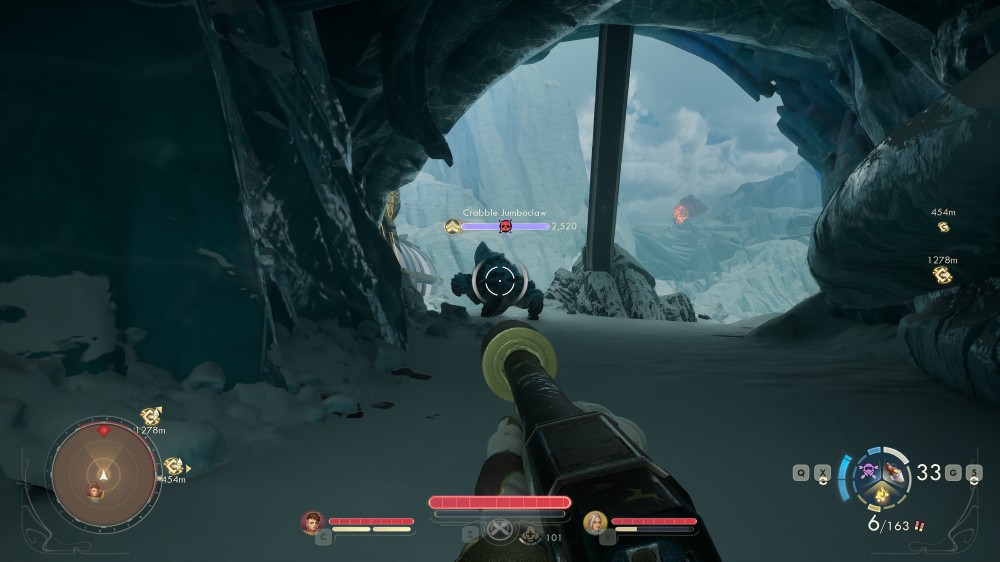
In the final analysis, I did end up playing The Outer Worlds 2 to conclusion after 70 hours, so there’s something there. By the end of the utter slog that is the third act though – especially when Obsidian goes full Starfield with forcing you to fast travel across planets via 10 loading screens to talk to NPCs – all I could really think about is how much better Avowed was in comparison.
And I didn’t really like Avowed. At least it had respecs though.
Posted on January 12, 2026, in Review and tagged Avowed, Fallout: New Vegas, Meaningful Choices, Obsidian, The Outer Worlds 2, Xbox Game Pass. Bookmark the permalink. 4 Comments.
 In An Age
I try not to comment too often on posts about game mechanics that (purportedly, arguably, etc.) support roleplaying. Our respective views on this are so firmly opposed that I’d rather not come off as shrilly one-note at best and trolling the host at worst.
But I do mean it in good faith when I say this thesis puzzles me:
A lack of meaningful information precludes a meaningful choice.
I don’t think this is true, unless I’m misunderstanding ‘meaningful’. Decisions made under a fog of war, with limited information, are still interesting. Maybe more so. I like chess too, but some games are poker or Diplomacy.
An RPG, at its most basic, involves making a character or a party according to little more than vague heuristics about the kind of gameplay one wants, throwing them at a largely unknown scenario, and navigating that scenario as best one can given their strengths and weaknesses. Ideally, the scenario teaches the player enough about itself as it unfolds to enable better subsequent decisions; I’m not disputing that OW2 may have failed at that. Maybe these kinds of stat checks are a shoddy way of expressing said strengths and weaknesses (though they must be some good if so many RPGs insist on using them), but for the basic scheme to hold, there has to be a way.
Would you still choose to get to Speech 20 if you knew Speech 9 was good enough for the kumbaya ending?
Of course not, and it’s a shame if some stat levels are simply overkill; one of the more epic moments in Fallout:NV was being able to ‘solve’ the finale with words, but that did require Speech 100. What does that prove, though? That one could have made more efficient choices with perfect hindsight? This is trivially true for most… everything.
Perhaps the disagreement comes down to what content is, exactly, in these kinds of games. The actual point of the beat-by-beat experience. Is it the specific hit of pleasure from opening some locked chest with a cool weapon in it? Or obtaining whatever material advantage cashes out of a particular dialogue line? Stringing together as many of these wins as possible? Or does all of that have to feel earned with trade-offs to even be content instead of just empty, confusing calories?
No content without context. Fits on a placard.
LikeLike
I always appreciate your pushback on these matters, as it keeps me honest.
To whom? Someone who guesses correctly at the character select screen?
I understand that there are some people out there that enjoy coming into games with a pre-built archetype in mind. “I want to play a smooth-talking space smuggler.” “Stealth archer again for me.” To an extent, every game forces us to make some fundamental decisions – such as a class, etc – before knowing how the designers intended to honor (or not) that commitment.
Not every game forces you to continue playing in a gimped state for an additional 70+ hours with no offramp though. It’s like a pebble in your shoe at the onset of a hike, and yet you are never able to sit down and correct the issue.
To give another concrete example from TOW2, there are many doors that are stuck and require Engineering X to open… or have the Brawny trait. If you chose the Brawny trait at the start and end up putting any points into Engineering, you have effectively wasted a trait; technically the combat portion of Brawny still works, but it’s only relevant in melee. That is a designer Gotcha! moment to me, and something that reduces my enjoyment of the game continuously and cumulatively. Because every Skill Check thereafter is a reminder that I would have had Y additional points available to put somewhere else more useful.
Or designer hubris.
For the record, I am not opposed to making mutually exclusive choices. Indeed, the Mass Effect series is one of my favorite experiences in gaming. While the ultimate endings came down to three cupcakes, I agonized over some of the decisions along the way. That was great gaming!
Now, imagine a Mass Effect where you only get the option to cure the Krogan genophage if your chosen class was Adept, or you put all your points in Biotics. Does that make Mass Effect better? Does it make the choices more meaningful?
There are some gray areas. Mass Effect had Paragon vs Renegade meters, and it did have an impact on some choices/outcomes. I also recognize that things can go “too far” in the other direction. For example, in Deus Ex: Human Revolution, doing any basic exploration will reveal like 5 different ways to bypass a locked door; all of the options existing simultaneously did diminish my sense of cleverness at solving the issue in any particular way, e.g. using Strength to move a vending machine. If any key opens every door, what’s the point of locks?
Ultimately though, in the case of RPGs, the entire genre revolves around talking to NPCs and making decisions. As such, there is never a situation in which a Speech skill that dictates choices exists optionally to me. Ergo, it just ends up as a pointless designer tax.
Imagine Fallout: New Vegas where a Speech skill did not exist. Do any of the decisions you make in that game matter less because of it? If not, why is it there?
LikeLike
Sure, to someone who guesses correctly at the character-select screen, and then continues branching out correctly at the level dings or whatever. And by correctly I mean making the most out of the archetype one is building, not maximising combat and area-access power in absolute terms. One man’s gimped is another man’s optimising under an additional set of constraints. That medic/talker isn’t suddenly going to become a samurai.
Or maybe he is. It probably says something about me that my initial reaction to the no-respecs stance from Obsidian was a ‘damn, respect’ rather than the cold loathing you must have felt. Conversely, it kind of bothers me that you can bank the skill points for later.
While many of the perks are doubtless bland and dumb, I don’t think it’s exactly a bait-and-switch when a trait called Brawny lends itself best to a melee build. It’s tooltipped rather fairly, too. The fact that you have the whole negative vs. positive trait trade-off at character creation is also something of a giveaway as to the kind of game it’s going to be. If you pick one of your two precious initial positives solely with the manipulation of doors in mind, well… you’d best team up pronto with a fateful child capable of warging and foresight.
The argument I do find very strong is the one you make about ME2 and stat-less direct ethical choices. (Those posts were from the early 2010s, what a trip…) I agree that such choices are often, maybe usually, more satisfying and better written around than simple skill checks. They also lead more reliably to diverging narratives, or at least interesting side-routes to the same conclusion. I’m also glad the record now reflects that you’re willing to find yourself locked out of entire swathes of content by making them. (I kid. Mostly.)
I think the main problem there is that they elide the distinction between player and character. Such choices are more strictly my choices, not filtered through my guy, and I think RPGs make more sense when narrated in a kind of free indirect discourse.
(Maybe this isn’t true at all for Shepard because of the galactic scale of the good commander’s decisions and the availability of a starship full of allies and advisors, who do have every possible kind of expertise. I can’t speculate because I’ve never played ME except for loads of ME3 coop multiplayer.)
The answer to the Fallout: NV Speech question is yes, though. It would be different. Quite possibly leading to different choices altogether. We both know that mine, Esteban’s, Speech is somewhere in the 30s, good enough to pry out of Jack that he’s got the hots for Janet, or to pull off whatever the lie was to get into Helios One. My poor tongue-tied brute of a Courier isn’t as good as I am, though, which may sometimes feel tragic given the stakes. On the flip side, he can bench a Volkswagen and I can’t. I like to be occasionally reminded of the differences between us.
I could theatre-of-the-mind all this, of course, and refuse to pick the smooth-talking options even if I could, etc. But at that point we’re merely arguing over who has to be inconvenienced, and what parts of RPG gameplay should or should not be kept track of by codified game systems.
LikeLike
You know… ironically, I might have been more OK with TOW2 if Obsidian indeed forced you to commit all Skill Points and Perks immediately. I would have had all the same grumblings as before – e.g. what’s the point of Lockpick 20 if Lockpick 17 is the highest check – but at least the baby would have been whole instead of split in twain. Whenever you “unlock” a Flaw, for example, it takes over the entire screen and you cannot do anything else until you either approve or reject it. During my playthrough, I ended up choosing the Flaw that gives you 100% extra Sneak Attack damage but -25% HP or whatever, and felt fine with the tradeoff at that point.
Perhaps I would have thought differently if my Sneak Attacks didn’t end up one-shotting every mob for the rest of the game though. Hmm.
This is a broader topic, but I am (generally) fine with being locked out of content based on meaningful choices. Sacrificing a crew member in the original Mass Effect reverberates through the entire trilogy. That kind of thing is incredibly rare in gaming, and also the sort of thing that is only really possible in this medium. The other example I always think about is the old PS1 game Tactics Ogre. Early on, you either follow orders and massacre a town or flee and eventually join the rebellion. That choice doesn’t result in a simple pallet swap, but entirely different maps, bosses, and subsequent plot choices.
That said, I don’t consider putting points into Speech to be a meaningful choice, be it New Vegas or any other game, even if it results in multiple endings or whatever. I will never not take Speech in a RPG, because designers are too dumb or stubborn to understand it is not a real choice. Can you still shoot guns without putting points into the Guns skill? Yes. Can you convince two sides to work together without putting points into the Speech skill? No. One is a gradient of combat damage that is easily substituted with player skill and ingenuity, and the other is… binary. Where is the meaningful choice?
Every single game with Skills, I feel forced to pick Speech, Lockpicking, and Hacking (or equivalent). And they all have to be maxed out, because the difference between Speech 99 and Speech 100 isn’t just +5% whatever, it’s the difference between changing the entire plot or not. Not that I prefer the BG3/D&D percentage-based approach much better, honestly, but at least it’s something.
Hopefully the distinctions make sense.
LikeLike