In-Game Ads
I was doomscrolling today and came across this Youtube Short from Legendary Drops concerning in-game advertising being more fully explored by EA, Microsoft, and Sony, all practically at once:
I actually watch quite a bit of Legendary Drops, as he has some rather humorous (and compelling) takedowns of AAA studios and the nonsense they are engaging with these days. Which, apparently, includes feeling the temperature on including advertising within the games they are selling. The Short itself does not contain links to specific articles, so I had to do some digging around for the links.
- Introducing EA Advertising
- Beginning Ad-supported Game Streaming Test & Learn (Xbox)
- Sony is scaling up its Playstation advertising ambitions
As the Sony article points out, this is not everyone’s first rodeo:
This isn’t the first time Sony has tried to build an ads business around its video games division. It’s made three prior runs at monetizing PlayStation’s audience through advertising rather than hardware or subscriptions. In 2008, it launched dynamic in-game advertising on PS3. That same year, Sony opened PlayStation Home, a virtual world that doubled as branded real estate. Then in 2022, Bloomberg reported Sony had spent 18 months quietly developing a system to insert ads directly into PlayStation games, aiming to launch a private marketplace by the end of that year. None of them became a durable, scaled ads business.
It is 2026 and we are probably all well past this being a particular shock. F2P mobile games have had advertising since forever, including more pernicious gameplay-affecting ones. Indeed, one of my most-played mobile games is Tavern Rumble, a roguelite deck-builder that will give you the equivalent of +2 Strength, healing, etc, if you watch some ads after each fight. That’s… not OK. I ended up buying the “ad remover” for the game for $10 or whatever years ago, but even now, it’s hard to say whether the boosts are just extra, or whether the game was specifically balanced around them. For example, having played Candy Crush, you could not possibly convince me that some of the RNG in certain levels are beatable without power-ups, whether accrued for free over time or purchased directly.
And don’t forget the weird shit too, like Monster Energy drinks in Death Stranding:
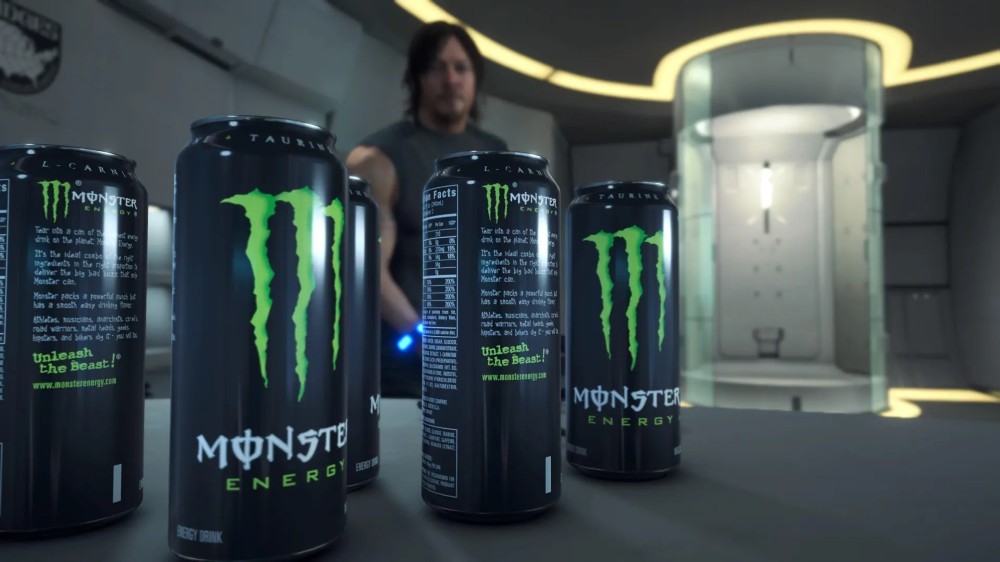
At the moment, it is not entirely clear the exact direction the enshittification is going. When looking at the EA page, they are talking about “dynamic, real-time placements, from stadium signage to custom in-game content.” Any sort of sports game would probably look uncanny without real-ish ads plastered about, considering that is what everyone sees IRL watching from home. Same with the hoods of racing cars, etc. With XBox, it sounds a lot more like a “free with ads” subscription tier rather than seeing a Microsoft Copilot banner in the Master Chief’s visor. With Sony… who even knows, to be honest. Sony has been losing so much money lately that it would not surprise me that they end up being the worst ad offenders eventually.
Steam sometimes gets touted as a bulwark of consumer protection… and it’s true, to a point. Steam does not run ads in the client, and specifically forbids games from having mobile-esque ads:
- Developers should not utilize paid advertising as a business model in their game, such as requiring players to watch or otherwise engage with advertising in order to play, or gating gameplay behind advertising. If your game’s business model relies on advertising on other platforms, you will need to remove those elements before shipping on Steam. Some options you could consider include switching to a single purchase “paid app,” or making your game free to play with optional upgrades sold via Microtransactions or Downloadable Content (DLC).
- Developers should not use advertising as a way to provide value to players, such as giving players a reward for watching or engaging with advertising in their game.
That same policy does allow “product placements,” which is largely reasonable. As jarring as seeing Monster Energy drinks in your videogame can be, it is difficult to draw a distinction between that and the fact that a very Norman Reedus is the one doing so. As long as you don’t have to drink a verification can, I guess it can slide. Christ, was that really 13 years ago?
In any case, as odious as advertising is generally and how annoying it is seeing it infiltrate yet another facet of our lives, I feel like it may end up working itself out. If a particular game is festooned with ads, and it breaks immersion, don’t buy that game. If there are ads in the storefront, well, yeah… stores often do. Just about the worse-case scenario might be forcing ads to display prior to playing a game, which sounds like what Microsoft is testing in the context of a “free streaming” offering. Which is a tradeoff you ostensively signed up for.
Ultimately though, the days for any kind of corporate shenanigans may be numbered. The entire business model around AAA gaming is on the verge of collapse, so I kinda doubt even the C-suite are going to gamble throwing ads into their next 6-year, $300+ million game and have that be the reason it failed. Sony can take their toys off Steam and go home, but hilariously, their ability to output said toys within their own console generation has the same upper limits as everyone else. Let them release a $1000+ PS6 with five exclusive games, a locked-down storefront, and sprinkle some intrusive ads for flavor and see what happens.
Posted on August 15, 2026, in Commentary and tagged Enshittification, In-Game Advertising, Legendary Drops, Sony, Verification Can. Bookmark the permalink. 5 Comments.


Advertising mystifies me. Hardly anything on the web would even be there if ad money wasn’t paying for it. Imagine if all the ad money stopped tomorrow. How many online services and platforms would carry on and how much would we have to pay to use them even if they did?
And yet everyone, apparently hates advertising and the smart people block it so they don’t even have to see it so how it makes its stake money back for the businesses using it has always confused me, let alone how it could actually make them any money. I have spent a lot of hours researching it and I’ve looked at the statistics, which generally support the idea that advertising does, somehow, improve turnover or market share, if not profitability. The best I can figure it, it’s a kind of cold war situation, where no-one dares not keep spending so long as the competition is doing it.
Even then, though, how we get from there to advertising being pretty much the driver for everything not only on the internet but in all forms of media beats me. I don’t mean advertising the product you’re selling, obviously. I get why you want to tell people about that. I mean where you fund your own service or product by using it to tell your customers about someone else’s. You’d think a business model where you just charged your own customers a sufficient amount to cover your costs and give you a profit would be a lot easier to manage but then that would need customers to be willing to pay the real costs plus a reasonable amount extra on top, wouldn’t it?
LikeLike
I don’t mind advertising, but for me it’s the fact that some platforms (YouTube, for the most egregious example) are completely tone deaf in terms of when their ads appear. At least US broadcast television has commercials at specific breaks in the show you’re watching, but YouTube appears to say “Okay, 10 minutes are up, time for an ad break!” and cutting the video off no matter what is happening. (There’s also the matter of commercials being significantly louder than whatever it is you’re watching, but I digress.)
There’s also the problem of just what ads (or pop-ups) are appearing on your screens. If you’re watching shows that little eyes would be seeing, why are you putting up political ads? Or for things that are distinctly adult in nature? Or maybe another way of looking at the ads/pop-ups are “Do they have malware/spyware associated with them? And why doesn’t the site with these ads/pop-ups care about that?” Google in particular certainly seems to want to push against the best practices that anybody using the internet should be doing –namely installing AV software and ad blockers– and they simply don’t care if malware infects your system because of what they allow.
On the flip side, much of advertisement for the internet is driven by clicks to various websites. Once LLMs become the dominant method of answering queries from the internet all those clicks will vanish, and the advertising model will collapse along with it. I don’t think Google or Facebook or any of these other major sites have figured out what an alternative ought to look like beyond having us pay for the use of LLMs.
LikeLike
The sad thing is that the advertising model doesn’t collapse, it consolidates. AI search will steal the clicks until the sites with actual information are driven out of business. At that point, advertisers will pay for ad placement in the AI output itself, perfectly tailored in real time to the individual engaging with the LLM.
I used to wonder what the AI companies imagined they would train their LLMs on after they starve the content sites out of existence. “Is this just a case of them saying ‘not my problem’ or ‘that’s something for next quarter?” Nowadays, I believe they are straight-up embracing complete nihilism. All non-AI sites are competition to them. When there is nothing left standing, AI will have complete monopoly on content. Then the thumbscrews come out.
LikeLike
I believe that before all that’s left is AI happens, the open source model that China is producing will end up dominating the market. Why pay OpenAI or even Google when you can obtain your own open source AI and train it on your own local data?
This is where the closed model of AI development is at its weakest, and those companies know it. Their solution is to try to keep the open source model out of their market, but as any student of history will tell you, that never holds for long.
LikeLike
Pingback: Lameazoid.com - Weekly Wrap Up (2016.08.16)