Blog Archives
Impressions: Keplerth
Not going to lie, the name “Keplerth” was both intriguing and ultimately accurate.
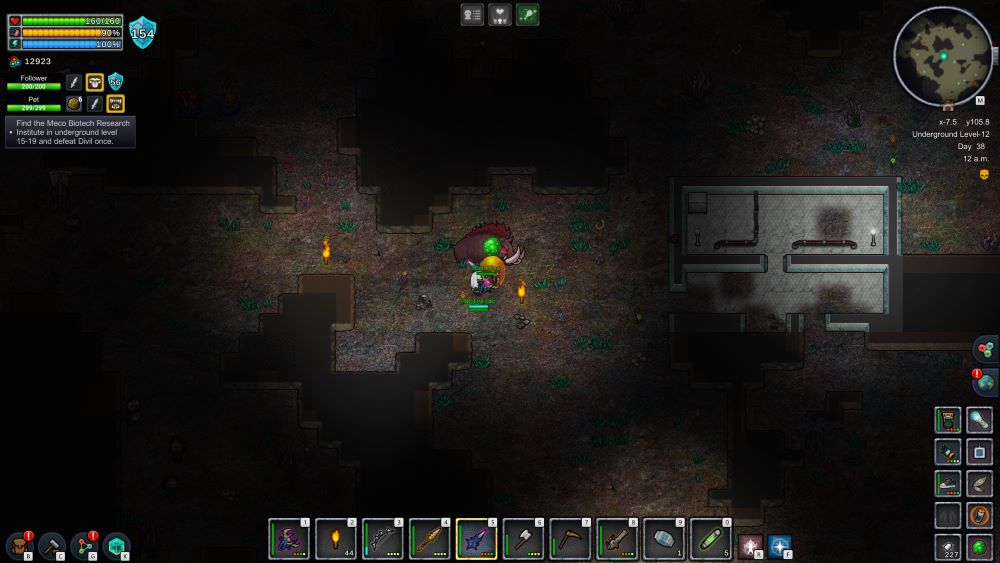
Keplerth is a top-down survival crafting game reminiscent of Terraria, with art assets straight stolen from RimWorld. Other reviews mention this as being a post-apocalypse knock-off of Necesse, if you know of that one. You will punch trees, create crafting benches, craft gear, and then tackle bosses to unlock the next tier of equipment, resources, and mobs. Rinse and repeat.
There are some interesting innovations to the formula though. For example, there is no XP here. Instead, you unlock new genes based on special resources that drop from basically everything in the game, e.g. plants, mobs, minerals, etc. The genes start simple, with stuff like +5% Evasion or +10% Attack Speed. Towards the beginning of the game, you have plenty of room to “equip” every gene you unlock; later on, you have to choose amongst them and their potential synergies.
I also appreciated how equipment bonuses work. Essentially, each piece of gear has a random set bonus and a random set bonus score (+0 through +3). So, the leg armor you craft might have bonuses to +Defense or +Pet Attack instead of the +Melee you were looking for. And even if it does have +Melee, the final set bonus may only trigger when you have 7/7 equipped and the piece you rolled grants +0. While random can be frustrating sometimes, many survival games are kind of rote in that Iron armor is Iron armor, and thus you only need 22 Iron ingots total to kit yourself out on that tier. This at least means you need to collect a buffer amount of resources. Later on, you get the ability to spend other resources to “reroll” the tier bonuses, so it is not too frustrating for long.
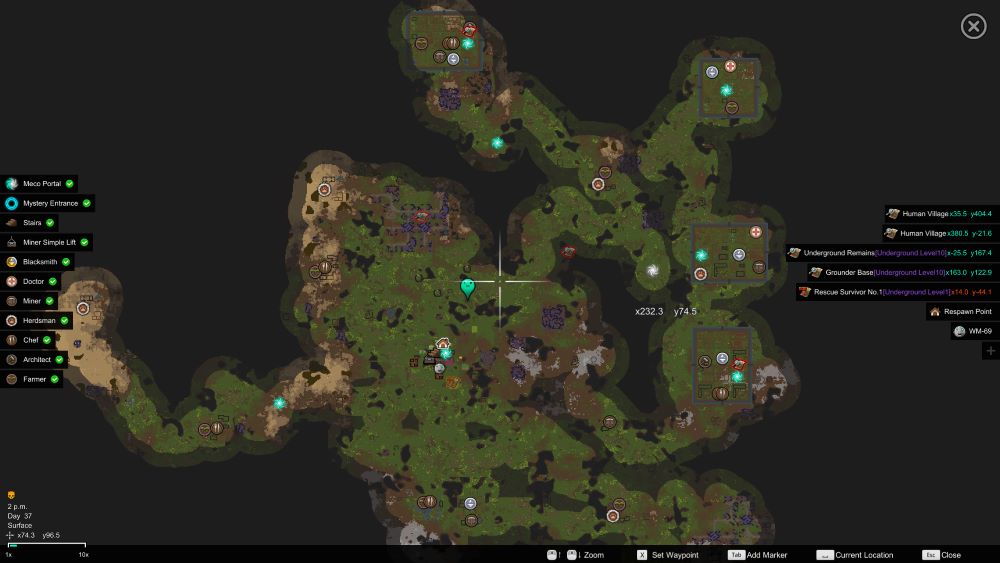
Where Keplerth struggles is… kinda everywhere else.
A lot of the mechanics feel half-baked. One of the early tutorial quests involves you attracting other survivors to your base with a communications tower. What the game doesn’t tell you is that the survivors… don’t really do anything. There is an entire elaborate construction station to create fancy furniture, but ultimately the survivors need 1 (one) recreation item (hot tub) and their heart meter will eventually fill and you click on them for money. That’s it. They do not defend your base, work the fields, or anything. You can also have farm animals like cows, chicken, horses, etc, and they will reproduce asexually as soon as their food meter hits 100%. Cooked food does require a variety of meat and plants for pretty useful buffs, so there is a point to all this, but it doesn’t always make that much sense. Like why have Horse Meat in the game when eggs are really the limiting factor for advanced food?
The special material mechanic I praised earlier is also a bit uneven. A lot of it felt natural at the time, as you just pick up all the things and new stuff seemed to unlock every 5 minutes or so. Eventually though, once your gene grid fills up and you start needing to examine what’s left, you start to realize that 5-6 of the missing genes require Thorns or Apples or some early-game stuff. Luckily the grind isn’t too bad since you can chop most everything down and replant it near your base to more quickly get additional chances when harvesting it – as opposed to having to wander around for more natural-occurring spawns – but the amount of things tagged to Thorns specifically is a bit odd.

What kind of broke the game for me though was one of the mid-tier boss drop weapons. Up to that point, you may have some melee weapons, bow and arrows, some early guns, and so on. Even with guns, there were some trade-offs with damage versus shooting speed. Then you get a 100% drop of an energy beam gun that deals constant damage with zero ammo. While it technically is out-classed in DPS later on, the utility of being able to trigger knockback, certain genes (“each hit adds X effect”), and the lack of ammo makes everything else feel dumb to use in comparison.
Later bosses also get into SHMUP/bullet-hell territory, which forces you to turtle up with your genes and equipment, which makes the fight last ages because you are no longer specced for damage.
Having said all that, I did end up playing the game for ~25 hours or so, somewhat obsessively. Keplerth definitely hit a stride for me after about the 2nd boss, once you unlocked the ability to tame battle pets, get some better weapons, better genes, and start finding other human settlements to spend money at. It is unfortunate how that petered out in the endgame, but what else can you do?
Play something else, I guess.
Undertale, Overrated
Yeah, I said it.
Undertale is a cult favorite and Kickstarter darling from 2015 featuring meme-ready characters, NES graphics, and unique game mechanics. Your character has fallen down a hole into the underworld and now must contend with anxious monsters who need your soul to escape their otherwise eternal confinement. Will you leave a traditional trail of bodies and tears on your way to the exit, or will you embrace the spirit of determination and the power of friendship to spare all that you meet?
The very ending(s) depend on it!
It’s possible that I played Undertale too late. The retro graphics did nothing for me, nor did the retro graphics + modern game twists, as I played LISA back in 2015 already. While I did not know exact plot details, I also knew Undertale had a True Pacifist route that led to the best ending – knowledge which prejudges one’s own behavior in the game. Finally, I had already played games that also shifted in narrative tone and 4th-wall breaking, like Nier: Automata. If Undertale was my first experience with any of these things, maybe I would have been more impressed.
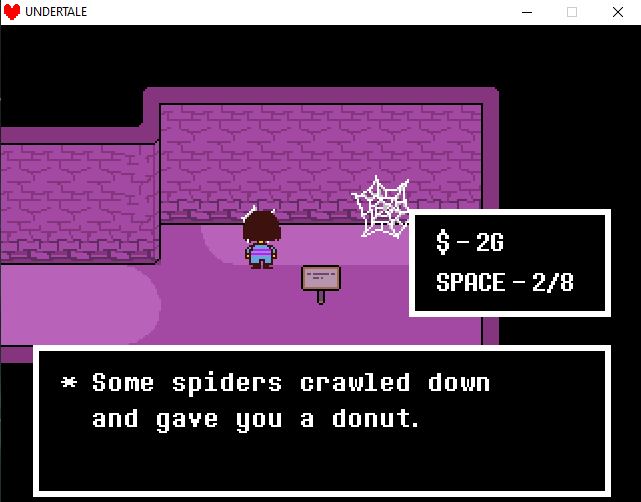
My major issue with Undertale though is that it is… not fun. When fighting enemies, they attack you via 5-6 seconds of Bullet Hell in which you move a red heart around a predefined box. It’s an extremely novel concept, and the things Undertale is able to convey through this mechanism is commendable. But at no point is it fun to do. Doing a True Pacifist run means you must talk to enemies instead of attacking them, which consumes several “turns” which results in you doing multiple Bullet Hell levels for each randomly-encountered enemy. True Pacifist also means you never level up or get more HP, so the game just gets progressively harder. Finally, if you get dangerously low on HP, you have to spend your turn using a healing item instead of talking, which delays the end of the fight and can mean you catch more damage than you healed and otherwise wasted your time.
Did I mention that you need to purchase healing items, using money that you receive from successfully navigating monster neuroses, thus potentially trapping yourself into a losing battle of attrition? Indeed, the only way I was able to complete the game at all was from looking up the solution to a puzzle that gave me an item that sometimes gave me free healing items. Supposedly there is also some armor you can buy to trivialize fights if you die enough times too.
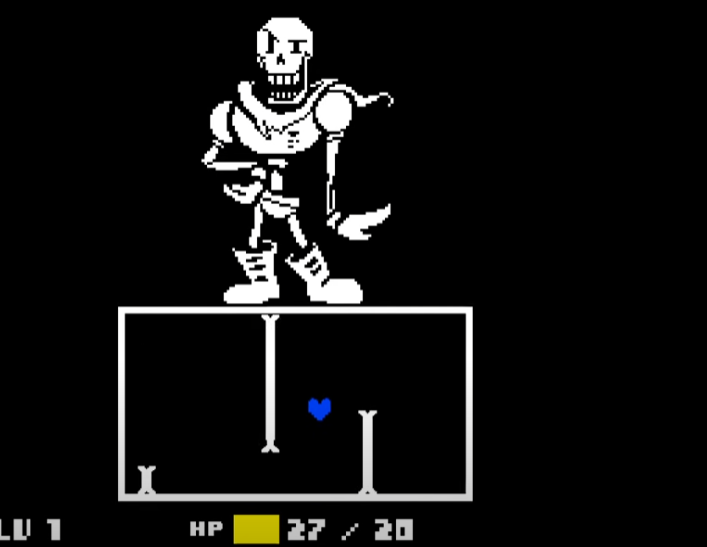
In any case, the Venn Diagram of people who enjoy the plot of Undertale and those who like Bullet Hell games are likely two circles on opposite ends of the Earth.
There were some genuinely funny moments in the game, don’t get me wrong. But all I could really think about while playing was that Undertale did not respect my time. Which seems strange considering the game is like 9 hours long. Or perhaps that is expected when you know that every random encounter represents a possible permanent loss of player power (e.g. healing items or money to purchase more) instead of, you know, your character growing stronger over time. Technically you do find better equipment along the way, but that is really a bare minimum to keep parity with ever-stronger foes when you are stuck with 20 HP and losing a quarter of it each time you touch something.
Ultimately, I am glad I finished Undertale’s True Pacifist route. I understand that there are a myriad of alternative endings, including one which requires you murdering everyone you meet, but I don’t see the point. I sure as shit ain’t spending another 5+ hours on the endeavor when I already disliked combat.
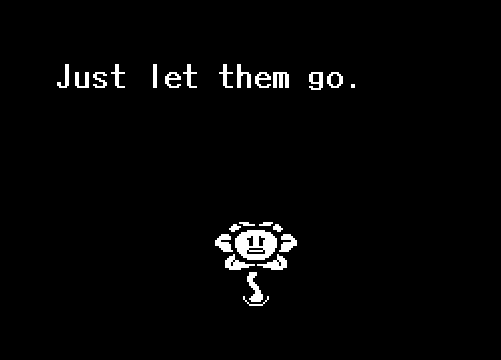
Will do, Flowey. Will do. In fact, it’s already done.
How Hardcore Will Wildstar Actually Be?
Keen brought up an interesting perspective last week in regards to Wildstar:
I keep hearing/reading that WildStar is going to be such a hardcore game not for the casual, console, [insert something with a core not hard enough] audience. Yes, there are inaccessible 40-man raids. You’re delusional if you think that WildStar is now or will ever be hardcore. Even compared to Vanilla WoW (like WildStar often is) it’s ridiculously accessible and easy to level. People were hitting 40+ in 3-4 days or less.
All it will take is a few exit surveys for NCSoft to step in and force accessibility. “We’re losing subscribers because they can’t experience the content they want to play.” It will never, ever, be more inaccessible than WoW.
It’s an interesting perspective to me because I was (and still am) prepared to take Carbine and the Wildstar devs on face value. There was another Reddit AMA last week that sort of doubled-down on the hardcoreness. You can read a much cleaner, more condensed version here. This rather epic deconstruction sums up a lot of miscellaneous things:
Q: When it becomes apparent in the next year that hardcore 40 man’s aren’t going to work because it’s not what people like to do anymore, what other ideas are you going to try?
CRB_Gaffer: This is a “gotcha” question, but I’ll answer it anyways since some variant of it comes up reasonably often.
Little aside here: Why is this “gotcha”? Well, let’s examine possible answers:
1) Say “yes, 40 mans won’t work in a year, we’ll roll to another system” – well obviously we don’t believe that, or we wouldn’t have done them. And if early testing were pointing that way, we would have already converted them.
2) Say “no, they’ll never change, even if no one plays them!” – well, obviously, we’d be idiots to not respond to player feedback; it’s what we do. They’re fun enough that they’ll get played, we’re confident.
3) Say “it’s entirely up to player feedback!” – that’s hardly giving a strong direction, and we know this one will be contentious – there’s not likely to be a consensus. Every interesting game design decision is a mix of having a vision and being willing to intelligently and rationally assess when to swerve from it if reality and vision collide.
4) If we say that contingently we’ll push other fallback ideas, then of course the player base will potentially rapidly become divided to say “DO THAT NOW!!!” or assume that our plan all along is to go that route, when in practice, anything we do in terms of long-term planning is to an extent contingency based. We’ll be MUCH more knowledgeable about the health of the systems in the long terms six months post-launch.
So, that’s kinda the definition of a gotcha question – there’s no simple answer that actually addresses the question.
There’s another issue; the phrasing “when it becomes apparent” that implies that you’re asking the question to people you think aren’t that smart to begin with.
One assumes that’s intentional; it creates the added issue that responding to the question potentially Pavlovian conditions folks asking us questions to be snarky, when generally we try to focus answers on intelligent, well-phrased questions (even contentious ones) to make sure we’re doing our best to improve the quality of dialogue. No offense intended if that phrasing was just unintentional and through poor communication skills! Anyways, a good policy in TL;DR form: “Don’t feed the trolls”
But what the heck! To answer concisely after the extended parenthetical:
If it turns out that gamers are no longer capable of enjoying large-scale raiding, at that time our cross-discipline group of folks will have a series of debates on what works, what doesn’t work, base it on the data we’ve pulled from the systems and talking with our fans, and either double down on the parts of the systems that work well, or innovate some new directions to move forward in.
But early feedback is that that’s a pretty hypothetical situation.  Cause, hell, they’re pretty fun, and we think the added fun of the deeper gameplay we get out of those fights outweighs the social overhead of maintaining large groups. But folks will prove us wrong or not.
There are enough Ins and Outs in that response to construct a burger franchise, but there you go. Vague PR bullshit or nuanced game design? While I find myself more inclined to wait and see, I must confess that the following responses seems a bit contradictory:
Q: Are you committed to keeping a natural progression of content? […] Do you plan on adding shortcuts to previous tiers of raids when new ones come out? Removal of attunements, nerfing fights, adding equivalent gear from casual and easy to obtain sources (see WoW patch 2.4)?
CRB_TimeTravel: This is a great question for four months from now. Our post-launch balancing plans will depend heavily upon the speed with which players consume the content and the # of players doing the consuming.
However, we definitely don’t want to simply invalidate our previous content when we release new stuff.
Q: I know this is far into the future, but I’m hoping you guys keep old content relevant. I think it would be a great way to get the more casual players to raid in older/easier raid instances and have the new raids maintain the benchmark for hardcore players.
CRB_TimeTravel: We definitely don’t want to make our older content irrelevant, so will be looking for ways to have an intelligent progression forward with gear and ability as the game matures post-launch.
Q: What are your plans for longterm raid progression in terms of gear? Will you be taking the WoW model of trivializing the oldest raid instances when new ones are released? or the EverQuest model of a strict progression system, or somewhere in between?
CRB_TimeTravel: Somewhere in between.
We do not want to trivialize our content, nor force players to do all of it before seeing anything new.
What “middle way” is there between “not invalidate older content” and “not force players to do all of it”? You can either skip tiers or you can’t. The fact that the last boss of any given raid tier is always harder than the first (few) boss(es) of the next tier is one of the reasons I have always considered things like attunements and the justifications for them to be asinine. “Linear progression” is never linear progression, at least not for the first half of the next instance. If the hardcore raiders get a handful of gimmie bosses, why not everyone else? What good is preserved by putting a hard, game-ending limit to a given guild’s progression when you’ve specifically crafted new bosses that that guild could defeat if you but got out of the way?
Ugh. I think “attunements” and “linear progression” are trigger words for me.
That being said, I am not entirely sure whether I share Keen’s “optimism” regarding raiding in Wildstar becoming more accessible. As mentioned, there is enough wiggle-room in the posts by Carbine devs to allow them to nerf the content based on low participation. More problematic is how exactly they plan on nerfing it. Many of the gameplay videos I have seen paint most of the bosses as “bullet hell” dances, even in the 5m dungeons. In a world in which something as simple as the Heigan Dance threatened to break guilds apart, I’m skeptical these devs will be able to thread that needle. Maybe the attacks will 3-shot you instead of 1-shot? Maybe there will be less “bullets?” As any PUG raid leader can tell you though, moving out of the fire and dodging the fire are two entirely different things.
In any case, I suppose we’ll see how things shake out a few weeks from now.
 In An Age