Blog Archives
Coastal Wizards Indict Cryptic Hex
In a move that should not have been so surprising in retrospect, Wizards of the Coast – makers of Magic: the Gathering – are suing Cryptozoic‘s Hex for copyright and patent infringement. Browsing through the actual complaint is actually fairly eye-opening. For example, if you turn to page 14, paragraph 30, lines 18-21:
Other users in the gaming community were confused because of the near identicality of the two games. On Cryptozoic’s own forum a registered user, on December 1, 2013, stated, “I have played a lot of CCGs [Collectible Card Games], and for the most part, CCGs are very similar to each other. However, I’ve never seen a CCG that is as similar to another as Hex is to Magic.”
Think about that for a second. Some random comment of yours on a forum from a year ago could be cited in a copyright/patent lawsuit used to bankrupt a multimillion dollar company.
Going back over my Hex posts, I just realized that I practically wrote the complaint myself a year ago (bolded for prophesy):
I have some concerns with Hex. First, while I am frankly excited about the unique opportunities involved with an all-digital TCG – cards that buff your creatures do so for the rest of the match, you can put tokens on cards that get shuffled into your library, and all sorts of crazy nonsense that physical card games couldn’t pull off – this game skews so heavily towards Magic Online that I’m surprised Wizards of the Coast hasn’t issued a takedown notice.
Seriously, look at this video.
I’m not talking about Apple’s “rounded corners” copyright bullshit, I’m talking about Grand Theft Mechanics. Creatures have summoning sickness, there is First Strike, Haste, seven cards in the opening hand, 20 life per player, four copy limit on individual cards, 60 cards per deck, land cards, instants, discrete turn phases (Draw phase, main phase, declaring attackers/blockers/combat damage, end step), and even the goddamn Stack.
Indeed, Wizards has a table outlining all those same similarities and more starting on page 16, paragraph 34. What ultimately got me the most though, were the excessively blatant clonings. “Flying” vs “Flight” is like, you know, whatever. Coming across the following card comparisons though?
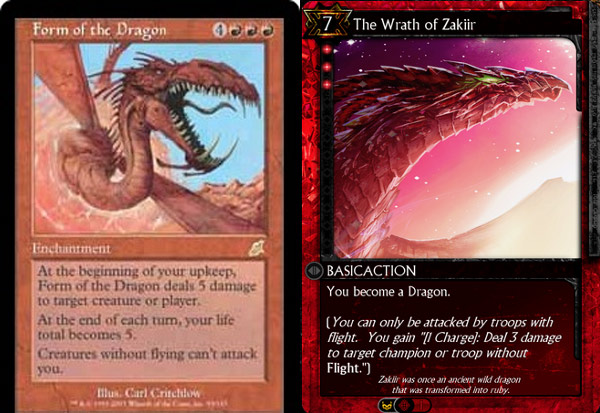
Err… totally an homage, guys.
Okay, maybe you can overlook the 7-mana casting cost, the fact that you become a dragon, can only be attacked by flying creatures, and so on. Maybe the Hex version doesn’t put you at 5 HP. Also, one is an Enchantment that can be removed, whereas the other is a spell that’s otherwise permanent. I can see giving this a pass. But then…
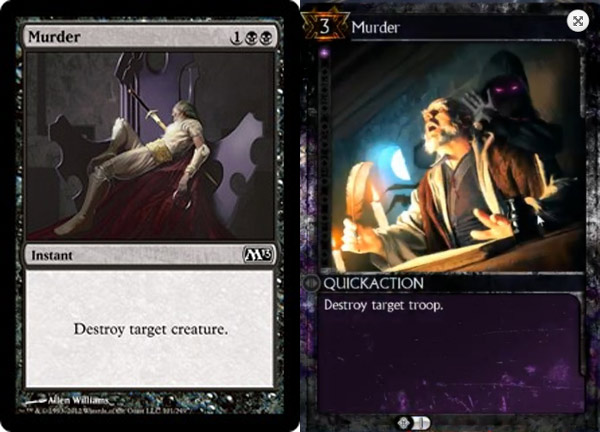
Uh oh.
It’s like they weren’t even trying. There are literally dozens of these sorts of cards floating around.
If you’re interested, I came across a Magic-playing lawyer’s blog post examining the lawsuit in plain language. In short, Wizards is bullshitting in some respects, reaching in others, but likely has a pretty solid case overall. Also, Richard Garfield’s patent on tapping cards, e.g. turning them sideways, expires in June 2014. That seems almost like someone patenting gaining XP and leveling up, but hey, someone had to invent intermittent windshield wipers; sometimes there is no more elegant a solution to a problem than the first one.
In any case, I might spend some time this weekend reinstalling the Hex beta and playing around a bit while I still can. Given how I wasted $85 paid $85 for an expensive lesson on the wisdom of Kickstarting pre-alpha projects, it’s the least I can do. Or I could watch other people play Hearthstone on Twitch, which I am sadly starting to find more entertaining than Hearthstone itself, at least in this metagame.
Hope Springs Eternal
(This is followup to my In Defense of Used Games post.)
I believe that eventually we will see the resell of game licenses. Given how our present trajectory is clearly in favor of restrictive limited licenses, games-as-services, and exclusive accounts everywhere, from whence does this optimism spring? Basically, it springs from what I imagine to be an inevitable reconciliation between what is legal and what consumers see as reasonable and/or how they play games in the real world.
I am going to divide this model into roughly two parts: the Practical and the Legal.
The Practical Disconnect
There is an incredible disconnect between what companies write in their ToS/EULAs and how people actually use the products in question. In fact, even the question of what amounts to game piracy is not as clear-cut as you might think. If you download the Tomb Raider reboot off of Pirate Bay, that is clearly piracy, sure. But suppose you let your little brother play the copy that you legally purchased. Is that piracy? Instead of it being a family member, suppose you let a friend come over and play it. Is that (still) piracy? What if you let a complete stranger play your copy of the game?
Now suppose this copy of Tomb Raider in question was purchased on Steam. Does that change anything at the family/friend/stranger level? It does:
“When you complete Steam’s registration process, you create a Steam account (“Account”). Your Account may also include billing information you provide to Valve for the purchase of Subscriptions. You are solely responsible for all activity on your Account and for the security of your computer system. You may not reveal, share or otherwise allow others to use your password or Account. You agree that you are personally responsible for the use of your password and Account and for all of the communication and activity on Steam that results from use of your login name and password. You may not sell or charge others for the right to use your Account, or otherwise transfer your Account, nor may you sell, charge others for the right to use, or transfer any Subscriptions other than if and as expressly permitted by this Agreement (including any Subscription Terms or Rules of Use).”
In our all-digital future, everything is tied to accounts. Ostensively, account-sharing is a bannable offense. In fact, if Valve suspects you shared or sold a given Steam account, it will ban all accounts in your possession, even if nothing untoward was happening in the others. And yet the problem with account-sharing is that it shouldn’t actually be any company’s business who is sitting in the chair, behind the keyboard/controller. I mean, it is technically their business – because they say it is – but it shouldn’t be.
I am not playing WoW right now, despite having multiple level-capped characters and a large sum of gold doing no good to anyone. If I resubscribed and started playing again, Blizzard would be happy. If I resubscribed and let a friend play my character, Blizzard would still be happy… up until the moment they realized what I was doing. But provided we did not alternate log-ins from multiple IP addresses or whatever, there is really no way for Blizzard to tell the difference between us. And yet that is “illegal.” Why? Because presumably the threat of account closure is supposed to induce the friend to purchase their own account/expansions/etc and work their way from scratch.
If letting friends and family members play your games does not count as piracy, neither should letting them log onto your account(s). Indeed, the only way the company would be able to ascertain a difference between users is with intrusive biometric privacy measures like… an always-on IR camera powerful enough to measure your heart rate via body heat to ensure only the True Owner ™ utilizes the account. Otherwise, these measures simply fail unless you attempt to log in from two places simultaneously. These companies are writing rules and contractual terms they have no means of enforcing outside the most heinous of nightmare scenarios. Or, I guess the Honor System.
Perhaps you do believe that your little brother playing your copy of Tomb Raider counts as piracy. In which case I have two questions: 1) why haven’t you turned yourself in, and 2) how far does that really go? Is it piracy for him to watch you play? Or is the crime committed only when he touches the controller? What if it is a strategy game in which he tells you what moves to make, and you simply act as his inputs? Still probably worth a $150,000 fine, wouldn’t you agree?
If companies could go this far, they would. That is the copyright endgame: the limitation of the experience to a single, paying mind. Thankfully, they lack the ability to dictate what happens in the privacy of our homes. Except, you know, for all the times that they can.
The Legal Aspect
In his rebuttal to me, Tobold linked an article in regards to US courts ruling against First Sale doctrine applying to digital goods. The article includes the following passage:
“Notably, the ReDigi case turned in large part on the same phrase at issue in Kirtsaeng—whether the copies at issue were “lawfully made” under [the Copyright Act]. In ReDigi, the court held they were not. “The first sale doctrine does not protect ReDigi’s distribution of Capitol’s copyrighted works,” Sullivan held, because the files at issue are “unlawful reproductions” and therefore not “lawfully made.” And, also like Kirtsaeng, the court said the proper venue to decide the core issue—whether buyers of digital products can resell them—is Congress.
“ReDigi effectively requests that the Court amend the [the Copyright Act] to achieve ReDigi’s broader policy goals—goals that happen to advance ReDigi’s economic interests,” Sullivan observed, adding that “amendment of the Copyright Act in line with ReDigi’s proposal is a legislative prerogative that courts are unauthorized and ill-suited to attempt.”
If you haven’t been following the ReDigi case, you really should take a look. Spoiler alert though: ReDigi lost back in April, but is appealing.
The hinge of the case was that even though ReDigi’s process involved removing the music file from the original computer, technically ReDigi was still “creating” a copy on their own servers by virtue of the transfer process. That was the entire hang-up, or more accurately, the technicality. Even Google tried to get involved in the case by coming to the defense of ReDigi, arguing a judgment against ReDigi “would put the entire cloud computing industry, worth an estimated 41 billion dollars, at risk.”
Incidentally, as pointed out in the concluding paragraphs of the same article:
To make his point, Sullivan stressed that the first sale doctrine does still protect the ability to resell digital music—you can still sell your “computer hard disk, iPod, or other memory device” onto which the file was originally downloaded, he wrote. While conceding that practice might prove to be “onerous,” he suggested there may also be reasons why such “physical limitations” are desirable. “It is left to Congress, and not this Court,” he concluded “to deem them outmoded.”
In other words, you can resell your digital music, as long as you originally downloaded them onto, I dunno, say a $6 MicroSD card. Or a $2-$5 USB stick (which are 1gb in size… Jesus, time flies). Preferably we could cut the bullshit and just print the CD/DVDs ourselves, but I imagine there is no direct-to-CD argument that can be made, else they would have made it.
The salient point here is that the current system is, at best, untenable. As more and more aspects of our lives migrate more fully into the digital realm, Congress will revisit this subject again. Honestly, they really should not have to – it would be better for everyone involved if companies came to this voluntarily. Hell, I have been shitting on the Xbox One pretty often, but Microsoft is apparently putting in a “used digital game” framework, in some murky form or another. It would be the height of irony if Microsoft ended up starting a revolution in the same way that Steam made digital games mainstream. Both Apple and Amazon have patented second-hand digital marketplaces, by the way, but have yet to actually do anything with them.
Some people get the impression that I am anti-IP, or that I am antagonistic to copyright. That is not really the case, although I do believe “life of author + 70 years” is absurd welfare for corporate rent-seekers rather than to the actual benefit of society, e.g. the entire original purpose of copyright. I mean, are there really artists out there that would look at something like Life + 5 years and go “fuck it, I’m not going to bother”? Give me a break.
Anyway, what I desire is for the designers to partner with consumers, for all of us to cooperate for the common good. I don’t like GameStop any more than game designers do – they really are just parasitic middleman – but only one of those two parties actually make efforts to improve consumer surplus, even if it’s just by accident. And if there was any enduring message that came out of the wild internet heyday, it is that you Can’t Stop the Signal. Revenue models are going to have to change, whether you like it or not. If game designers want a piece of the the new paradigm, they have every opportunity to get aboard the train.
Wait, When Did THIS Happen?
European Courts have ruled that it is legal to resale digital software licenses:
Buying and reselling any form of digital software is perfectly legal, the Court of Justice of the European Union has ruled. Software authors – or in the gaming world, publishers – can not stop customers from reselling their games, even if the publisher attaches an End User License Agreement prohibiting resale.
“The exclusive right of distribution of a copy of a computer program covered by such a license is exhausted on its first sale,” the court has found.
This ruling covers customers in European Union member states, and games bought through services such as Steam or Origin. […]
Okay, so I do know when it happened: July 3rd, 2012. But… who… when… huh? That is damn near a year ago. Has anything gone forward since then?
I mean, the absolute latest news was April 2nd, when a US District Court stated that reselling iTunes songs violated copyright laws. Conversely, buying textbooks from Thailand and selling them in the US for profit is legal, according to the US Supreme Court. As is streaming TV service Aereo, for that matter.
Looking at that European ruling again, I would actually say there wouldn’t be any contradiction in reselling a license. You aren’t copying any files, you are merely removing your own rights to a digital good and granting them to another… and they’re the ones downloading it. Hell, in an always-online-esque DRM scheme, such a transfer would arguably be the safest for the publisher considering the seller literally cannot access the game anymore (as opposed to the honor system when it comes to reselling music CDs).
Obviously every publisher everywhere would fight tooth and nail against this breaking of their digital monopoly, just as companies like Microsoft (and Sony for a while) contemplate ways to smother the used game market. But the question of licenses has yet to be settled, and I am inclined to show uncharacteristic optimism in this regard. Most people would not look at playing Halo at a friend’s house as piracy or consider yard sales as theft, and yet that is what these companies would want you to believe.
Personally, I think it is only a matter of time until logic and common sense forever strip the asinine “you don’t own a videogame!” argument from corporate apologists everywhere. Physical game or license, you nevertheless (should) have the right to sell it. Nothing less makes sense.
 In An Age
Nintenwon’t Sue
Feb 13
Posted by Azuriel
The meteoric rise of Palworld is a song for the ages. Two weeks ago, it was sitting in 5th place for all-time concurrent Steam numbers. Today, the throne is forever etched with it sitting at #2. Or #1 if you add the 3 million concurrent Xbox/Game Pass players to the Steam total. Overall, there have been 19 million players shooting adorable animals in the face and/or enslaving them in little balls.
Unfortunately, Palworld may have finally gotten to close to the sun. Or has it?
It always seemed a question of “when” rather than “if” Nintendo would sue Palworld over copyright infringement for what the media (and everyone) describes as “Pokemon with Guns.” In the latest Nintendo investor call, someone brought up Palworld and this is what the Nintendo president, Shuntaro Furukawa, said:
Let’s just take a moment and appreciate the craftmanship of that sentence. It says so much without saying anything at all, which in turn says so much.
Nintendo has never been shy about suing anyone and anything into oblivion for copyright infringement, so the fact that Palworld made it into Early Access at all is indicative that any hypothetical lawsuit was risky. That it continued to make headlines and break records unimpeded further indicates hesitation. And this legalese statement essentially confirms that if Nintendo ever does get around to business, the lawsuit will be from an oblique angle, at best.
The Palworld devs aren’t worried. As they noted back in January:
Is it hubris? Actually, probably not.
We can say “Palworld is a rip-off of Pokemon,” but that is A) not all that accurate, and B) at best a moral statement. Game mechanics cannot be copyrighted. Attacking cute animals in tall grass and then capturing them with spheres is not protected expression. And three cheers for that! Can you imagine if Hit Points, Experience Points, talents, aiming down sights, side-scrolling, or any of the myriad of common mechanics were the exclusive domain of whomever first came up with them?
What about patents though? You may have heard about how Richard Garfield and Wizards of the Coast patented the “tapping” mechanic in Magic: the Gathering back in 1995, e.g. turning a card sideways to indicate its use. And over the intervening years, WotC has successfully sued at least two companies – ironically the Pokemon Company, but also the makers of Hex – into at least settling out of court. When it came to Hex though, they deserved it.
However, there is every indication that WotC’s gambit would not be successful anymore. This article touches on it, but basically a Supreme Court ruling in 2014 (Alice v CLS Bank) and subsequent 2018 Federal Court ruling all but closed the door on abstract game rules being patentable. Nevermind that the patent expired years ago anyway. Tap to your heart’s content! (This is not legal advice)
So, yeah. The Palworld mod that literally put Pokemon into the game? DMCA’d. Regular ole’ Palworld? Completely fine. And, honestly, kind of a perfect example of why none of this sort of thing should be locked down as the exclusive right of one corporation. Are the individual mechanics completely unique? Nope. But rather than the copy & paste shovelware you see in app stores, Pocket Pair is at least trying to take all the fun stuff from the games they like and mash it together and see if the result is just as fun. As armchair devs, we all like to say “I wish I could play X with the mechanic from Y.” Well, here is someone doing exactly that and it’s working. I saw that energy in Craftopia and I see that here in Palworld. We could do with more of that, not less, IMO.
Posted in Commentary
Comments Off on Nintenwon’t Sue
Tags: Copyright, Hex, Lawsuit, Nintendo, Palworld, Pokemon, Whistle Past the Graveyard