Blog Archives
Review: Tomb Raider
Game: Tomb Raider
Recommended price: $10
Metacritic Score: 86
Completion Time: ~14 hours
Buy If You Like: 3D puzzle platformers, slick Deus Ex-like visuals
When it finally came time to play Tomb Raider, the reboot of a 1997 game, it had been sitting in my Steam library untouched for over a year. I delayed playing this version because I felt as though I might get more out of the experience if I played through some of the original games; I think I got as far as the underwater portion of the very first one, back in the day. Once it became clear that that was not likely to ever happen, I sat down and booted up Tomb Raider.
Holy shit, you guys. This game is slick.
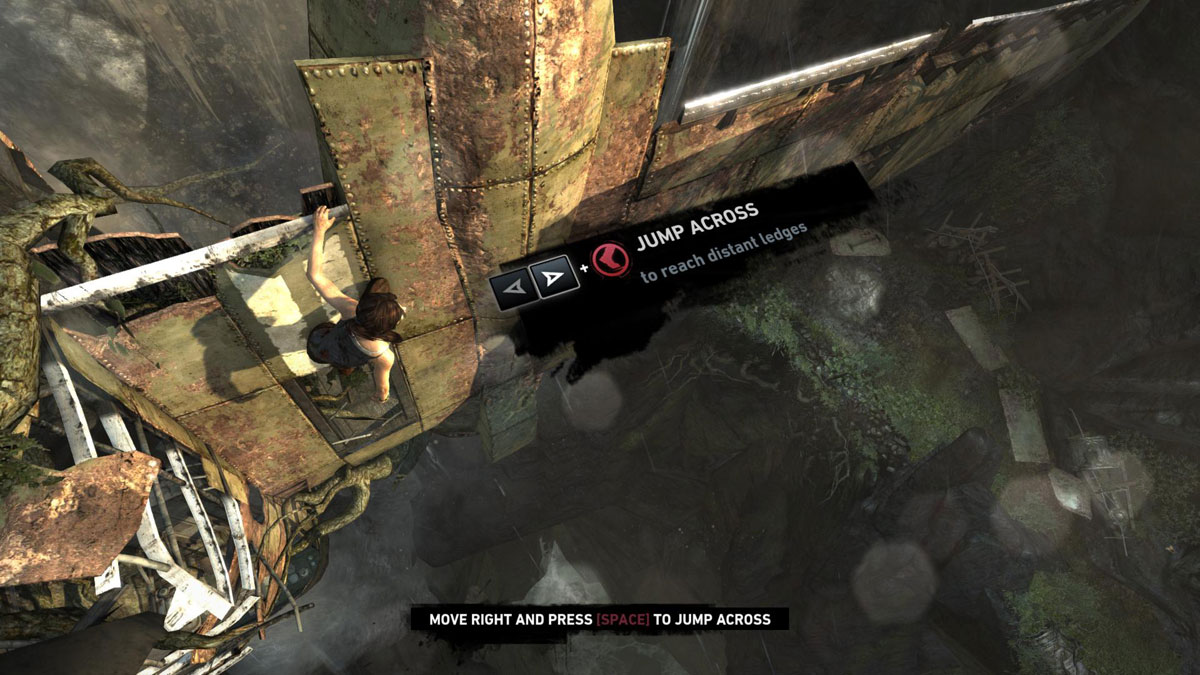
See how even the tutorial message box is inside the screen? Awesome.
Although the Eidos Montreal team seems to have only worked on the multiplayer portion, the very first thing I thought of while playing Tomb Raider was “this feels like Deus Ex: Human Revolution.” My gaming rig is starting to get long in the tooth (GTX 560ti), but this is easily the best-looking computer game to ever grace my screen. The whole thing may as well have been an extended cutscene for how good it looks. And not just visually, but conceptually as well – even the UI when camping seems downright cinematic.
After some early exposition, you take control of an inexperienced Lara Croft who very quickly faces some life-and-death situations. While there were some early news articles alleging the game is torture-porn, I felt it did a rather brilliant job at portraying a more “realistic” sense of action. Lara is not the invincible action hero she eventually becomes in the older games – she gets smacked around, thrown by explosions, impaled by rebar, covered in cuts, dirt, and blood. “I hate tombs,” she quips in an early section of the game. While some later scenes clearly get pretty fantastical, I nevertheless remained fully immersed by the utterly reasonable way Lara walked around, hid behind waist-high obstructions, and later became the hardered tomb raider of destiny.
I will say though, that the brutality of failing the numerous quick-time events almost makes you want to fail them on purpose just to see how awful a death the designers scripted in. Spoiler: they’re harsh.

Yeah… ouch.
In terms of what you actually do while playing, the game is essentially a 3D puzzle platformer with some extended shooting sequences. The game is divided into discrete areas to explore and solve, but the edges are pretty seamlessly integrated into the whole. Indeed, it wasn’t until about the 5th or so cave before I realized that Lara squeezing through a narrow gap and slowing walking with a torch outstretched was basically a playable loading screen. Sure beats all those elevators in Mass Effect. In any case, the puzzles themselves aren’t particularly difficult and Lara will generally talk her way through them the longer you stay stumped in the same area.
It is sort of difficult to coming up with more words to describe what the experience of playing this game is like. I suppose it is exactly that: an experience. Tomb Raider is a 15-hour movie that could have easily been a satisfying 7 or 10 hour one, but goes that little extra mile and I am glad for it. You will not likely be blown away by the dialog or particularly innovative gameplay experience, but you will be having too much fun looking around and doing things to care.
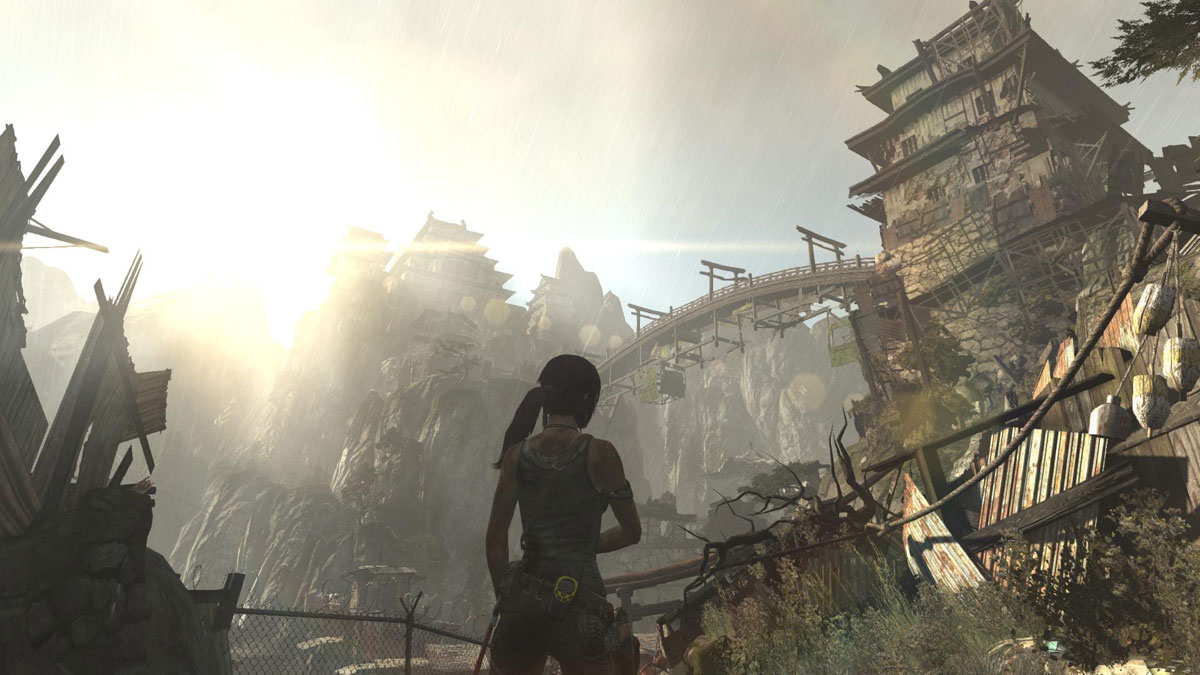
Seriously, guys, it’s like this all the time.
I definitely recommend playing Tomb Raider if you get the chance.
Badass
I have been playing Borderlands 2 quite a bit lately.
At one point, I had a mission to rescue a dude at the top of this dam. I fought my way through several rooms, saw some interesting stuff, solved some pseudo-puzzles, killed all the things. As I bust out of the final door onto the dam proper, everything goes to hell: the orbiting space station starts launching artillery shells, armed robots start landing, bullets start flying everywhere in this now-three-way battle royale. I take down a few more enemies with my corrosive sniper rifle, and then crouch behind some cover while I reload.
Then this music started playing.
I emerge from cover while tossing a holographic decoy out, stealthing to the first robot and meleeing it in the goddamn face. As robotic limbs fly everywhere, I switch to a ridiculously large shotgun, aim, and fire at a second robot. The shotgun shoots 17 pellets that each individually explode on contact, and firing it sounds like God slamming a car door shut.
Whump. Chik-Chik. Whump. Chik-Chik.
As I stroll down the middle of the ramparts like I own the place (and I do), I am suffused with a feeling of Badass. This whole sequence is staged, minus the explosive shotgun; the designers specifically put this music, with these enemies, in this order. It is the definition of themepark content, as single-player games are wont to be. But that doesn’t matter. I had been having fun before, but this was on its own elevated level. And after the sequence is over and I move on to the next (decidedly less cool) quest it occurs to me to ask: when was the last time I felt this way while playing a game?
I had to go back, waaaay back to my guild’s first Mimiron kill¹ in WoW. Like I said, I have had fun in plenty of games in the past three years. I have done some crazy moves in Deus Ex, there are some epic moments in the Mass Effect trilogy, and double-dagger Elementalist in GW2 was great fun originally. But the specific feeling I had owning faces up on Bloodshot Ramparts? Very fleeting, very rare, but much appreciated.
If you guys have experienced something similar in a game lately, feel free to share below.
¹ Please excuse the editing and the decidedly non-epic music accompaniment. 2009 was a long time ago.
Reviews: Sequence, DE:HR – Missing Link DLC, Dawn of War II – Retribution
Game: Sequence
Recommended price: $2.50
Metacritic Score: 70
Completion Time: ~11 hours
Buy If You Like: Playing DDR on your keyboard… with RPG elements
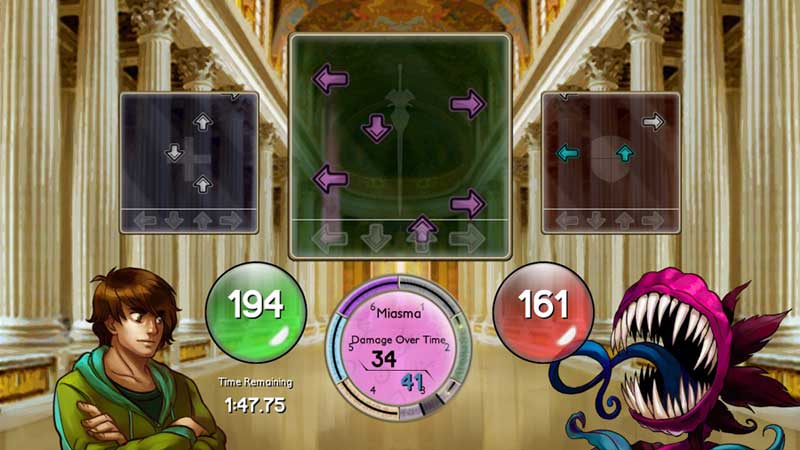
It’s actually a bit more fun than it looks.
Sequence is definitely one of those “out there” indie games in which the initial concept sounds unappealing, and yet the game is mostly redeemable fun. The premise is that the main character is abducted into the bottom level of a tower, and he must fight his way to the top by crafting keys from the dropped loot of monsters killed by three-panel DDR rhythm battles. The three panels correspond to Spells which you cast to heal/buff yourself, or damage/debuff the monster; a Mana panel which just constantly flows with arrows, with each successful arrow refunding 2 MP for use with Spells; and an Attack panel which represents arrows you need to match, or suffer damage. You lose the battle by either running out of HP before killing your opponent, or if you run out of time. Successful battles gives you XP and item drops, the latter of which can either be equipped right away or combined via “Synthing” into usable items, new spells, or the keys to unlock new floors.
I had a healthy level of skepticism coming in as to how a rhythm game would feel being played on a keyboard, but I can tell you now that Sequence handles itself rather well. I used WASD for the arrows, Q/E to rotate the three different panels, and 1-6 as the Spell buttons. Just like any good rhythm game, there is a decent variety of songs with differing tempos and general arrow densities. The RPG elements of the game also do a decent enough job at making sure you aren’t bored out of your mind in fighting the same enemies over and over again (only 3 different monster types per floor). There is definitely some possible frustration though, insofar as the item drops you need might have a 20% chance and then you end up grinding the same monster 11 times in a row. Also, learning some of the later Spells requires you to achieve a 95% accuracy in a 5 minute song or get 120-note combos (e.g. no mistakes), with failure resulting in losing a ton of XP (since you spend XP to get a chance to learn a new Spell).
Overall though, I had a decent enough time with a fairly unique indie game. I have heard some other reviewers complain about the irreverent storyline filled with pop-culture references, but I enjoyed it. And while my recommended price is $2.50 (which I bought it at during a sale), the default Steam price is just $5. Sequence isn’t necessarily a must-play game at $5, but it definitely will add value to whatever indie bundle it ends up getting attached to in the future.
_____________
Game: Deus Ex: Human Revolution – Missing Link (DLC)
Recommended price: <$5
Metacritic Score: 73
Completion Time: ~4 hours
Buy If You Like: Four extra hours of DE:HR
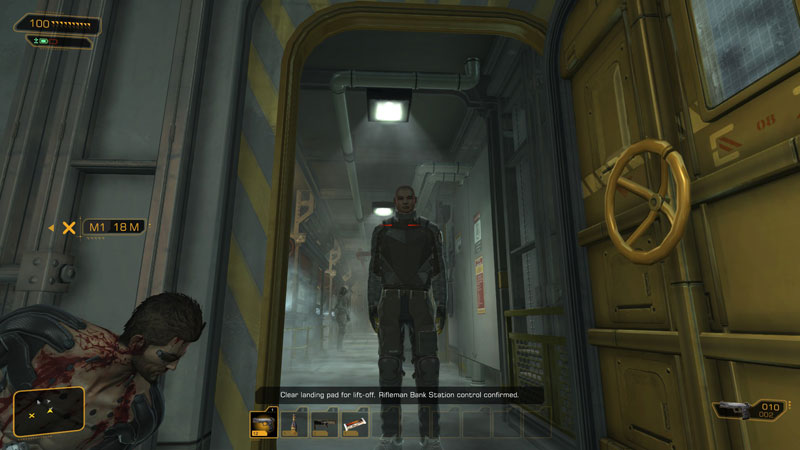
Oh, how I missed this.
To be honest, the Missing Link DLC to Deus Ex: Human Revolution was one of the first DLCs I have ever played which felt like a legitimate “deleted scene” from the main game. This is both a good and bad thing. Good in that it feels like a relatively seamless addition despite being on its own 2gb installer and featuring the vastly overused (gaming) trope of the hero losing all of his/her powers. Bad in that, well, most deleted scenes are deleted for a reason.
Taking place in the midst of a fade-to-black scene change in the middle of the original game, Missing Link does not add anything of plot value to the game proper aside from, well, around four more hours of gameplay. While you end up getting access to most of the weapons/augments from the main game, I definitely experienced a mental disconnect between the choices I was making, knowing that none of it mattered since no data was going to be transferred. Want to explore every nook and cranny? Okay… but why? No data, no XP, no weapons, no credits, nothing will endure past the final encounter.
Which, incidentally, takes the form of how all the boss battles in Human Revolution should have played out. I was actually kind of surprised when I discovered that I had inadvertently killed the last boss, thinking it was just another dude shooting at me.
Aside from that, and a frustrating amount of pointless backtracking past a 20-30 second in-game “loading screen,” Missing Link is a good enough dessert to the main course that was the original game. Provided, of course, you can snag it for less than the outrageous $15 retail price. Less than $5 or included in a Game of the Year edition would be ideal.
_____________
Game: Warhammer 40k: Dawn of War II – Retribution
Recommended price: $0/bundle
Metacritic Score: 80
Completion Time: ~11 hours+
Buy If You Like: Dawn of War II, RTS games minus the resources/base management
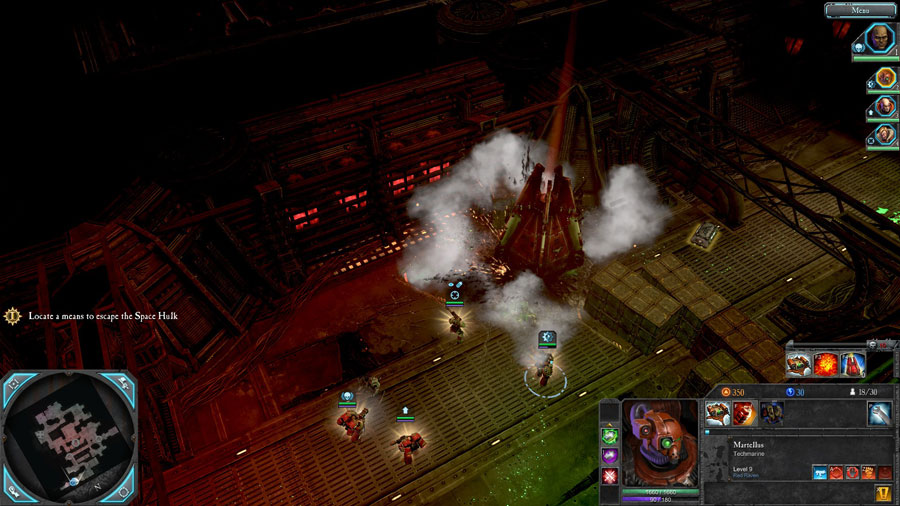
Drop pods while inside another ship probably makes more sense than the rest of the game.
In the interest of fairness, I absolutely despise the direction the Dawn of War series took when it dropped the base-building and resource management arms of the RTS genre into Dawn of War II. The original Dawn of War was a groundbreaking work of beauty – to this day, almost all other RTS games feature infantry units as little squads, so they can be shown to be killed individually by vehicle units. I played DoW: Dark Crusade for something ridiculous like 200+ hours. Dawn of War II was fine on its own, and DoWII: Chaos Rising was alright. But as I headed into this particular installment, I began to tire of the 4-5 squad “tactical” gameplay that ends up feeling like a WoWVille iPhone app.
As I understand it, there are six “campaigns” in Retribution, but after completing the Space Marines, it appeared as though every other race uses the exact same scripted maps in the same exact order with perhaps a slight difference in the faction you are fighting. For example, at the end of the first map as Imperial Guard you fight a Tyranid hero; at the end of the map as Tyranid, you fight an Imperial Guard hero. While each race has access to different units and general fighting styles, the heavy emphasis on terrain “tricks” (shoot these barrels, take cover here, approach the turrets from behind, etc) means each map plays out identically no matter what you play as. Technically the same could be said about, say, Dark Crusade, but the difference is that a resource/base-focused RTS at least can play out much differently each time.
While many people dismiss the importance of story in Warhammer 40k’s grimdark setting, I genuinely enjoy that sort of thing. And here again, unfortunately, Retribution fails to deliver. While it wraps up the Blood Raven arc (hopefully for good), it lacks any of the subtlety of even Chaos Rising, let alone Dawn of War II. I can only imagine it was so truncated specifically because they felt it necessary to shoehorn all six races into the same story on the same maps in the same order. Even if there are redeeming plot points in the final chapters of the other races’ stories (which I doubt), I am thoroughly unable to bring myself to slog through the game again to reach them.
I just hope against hope that Dawn of War 3 is more like 1 and not 2.
Unfortunate Obsolescence
It occurs to me that we – or more specifically, I – have well and truly crossed the barrier beyond which old, amazing games go to die, unplayed and forgotten.
For example, today you can buy Star Wars: Jedi Knight: Dark Forces II on Steam for $1.24. I have heard many, many great things about this game over the years (and it indeed has a 91 Metacritic score), but I never got around to experiencing it. And so when I saw it up for 75% off, I decided to take a look at the game’s page. What I saw was this:

This probably looked amazing to my 14-year old self.
I just couldn’t do it. Whatever it was that this game could have added to my life experience is gone forever.
Of course, this is not just Dark Force II’s problem. Have you tried booting up Planescape: Torment lately? I wrote an awful, awful review of the game back during the height of my JRPG fandom phase a decade ago, and have always wanted to return to give the game its proper dues. But that is unlikely to ever happen. I tried, I seriously tried. Planescape always had a super zoomed-in camera compared to the Baldur’s Gate titles, and combined with the 640×480 max resolution was simply too much. I could not bring myself to get out of the morgue, the technical/compatibility issues notwithstanding.
To bastardize a phrase: the flesh is willing, but the spirit is weak.
Who though, in all honesty, is going to go back and play Fallout 1 & 2 after being introduced to the franchise via 3 or New Vegas? There are hundreds of classic games like this. Certain ones, like Chrono Trigger and the like, can survive rerelease after rerelease without changes. But these others? Not going to happen. I talked about the haunting legacy of Deus Ex in regards to its modern-day prequel, but who is going to play the original if they have not already? I understand there are mods that do amazing things to the visuals, but that presupposes a desire to go through the trouble to begin with.
Indeed, I feel the entire gaming industry is entering a bizarre new landscape with the advent of the App/Indie/F2P Age. I wrote over 60 RPG reviews back in the day, and every single one of them had a Replayability score. Now? Who cares about replayability? Story choice is fantastic, but the typical likelihood of my actually going back through New Game+ or its equivalent is somewhere between zero and no way in hell. I’m not looking for something to kill my time anymore – time is the one precious thing I ain’t got anymore. Any game that wants another roll in the hay is competing against an entire library of unplayed Steam titles, indie or no.
And that, sadly, also goes for older titles regardless of their presumed timelessness. So when I see people complain about, say, Syndicate looking like this instead of this, well… that latter game is dead and gone. I just went through an Eeyore routine with Deus Ex: Human Revolution, sure, but I would rather some remnant exist in a modern form than nothing at all.
Review: Deus Ex: Human Revolution
Game: Deus Ex: Human Revolution + DLC
Recommended price: $25
Metacritic Score: 89
Completion Time: ~38 hours
Buy If You Like: A (more) cyberpunk Metal Gear Solid
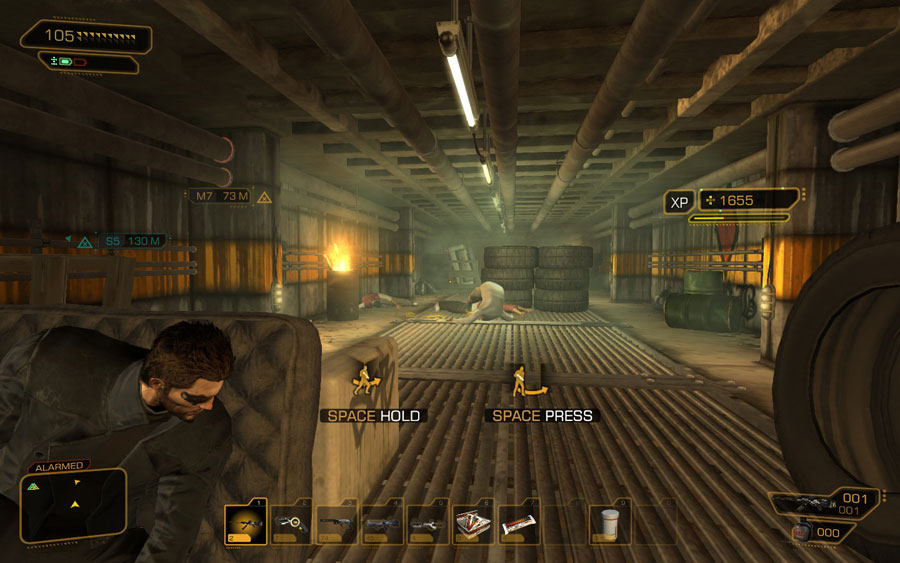
I would be “Alarmed” too.
The thing to understand right from the start is that Deus Ex: Human Revolution (hereafter DX:HR) is three separate things. The first is a prequel to the original groundbreaking Deus Ex released in 2000. The second is a genre showcase of cyberpunk sensibilities. And the last? The actual game.
The distinction between the three is extremely important because it is easy for someone to write off the entire game because it does not live up to the Deus Ex heritage. Or for someone else to watch trailers like these and fall so deep in love of the cyberpunk spirit of the game that the actual mechanics becomes irrelevant. Or in my specific case, struggle within the dichotomy of loving the setting so much that it (almost) washes away all the sins of not being Deus Ex: New and Improved, while the game bits themselves simply show up to work and get the job done.
One of the defining characteristics of the original Deus Ex was the multiple ways in which the player could progress through the game. Want to treat the game like a normal FPS? You could do that. Want to sneak through the air vents, hack into the computer systems, and bypass all security measures without firing a shot? You could do that too. DX:HR does its best to live up to that open-choice legacy, without really understanding how the original maintained a level of coherency: limited, metered choices. In DX:HR, 100% of the augmentations are available to the player right at the beginning of the game; the choice simply comes down to which ones you want to unlock in which order. What this means in gameplay terms is that since all of the choices are available, the designers included ways in which all of the choices are useful.
For example, about a third of the way through the game you will be tasked to get past a locked lab door. Your options include:
- Kill the guards (personally or via hacked security bots), loot the key.
- Hack the lab door.
- Grab an extra pass in the security room, present to guard.
- Sneak through ventilation.
- Use the Strength augment to move a vending machine, climb on top and jump to 2nd floor balcony.
While it felt liberating to know there were so many different ways to progress at first, it also meant that none of the ways you did progress felt particularly clever. The natural inclination to explore all the rooms to make sure you didn’t leave behind valuable items (despite none ever really existing), quickly reveals how many paths lead to the same outcome. Considering all 5 of the different paths occur within 30 feet of each other, you begin to question whether the choices actually matter. And that answer is, unfortunately, “No.”
But that is the rub. Had this been any other other FPS title, I would have been praising it for its Deus Ex-qualities instead of damning it for the same. Compared to the generic FPS flair of games like Singularity, DX:HR blows them out of the water. Indeed, DX:HR feels more coherent than even open-world titles like the STALKER and Far Cry series, insofar as the latter games mostly present “options” in the form of exploiting AI than necessarily discreet choices.
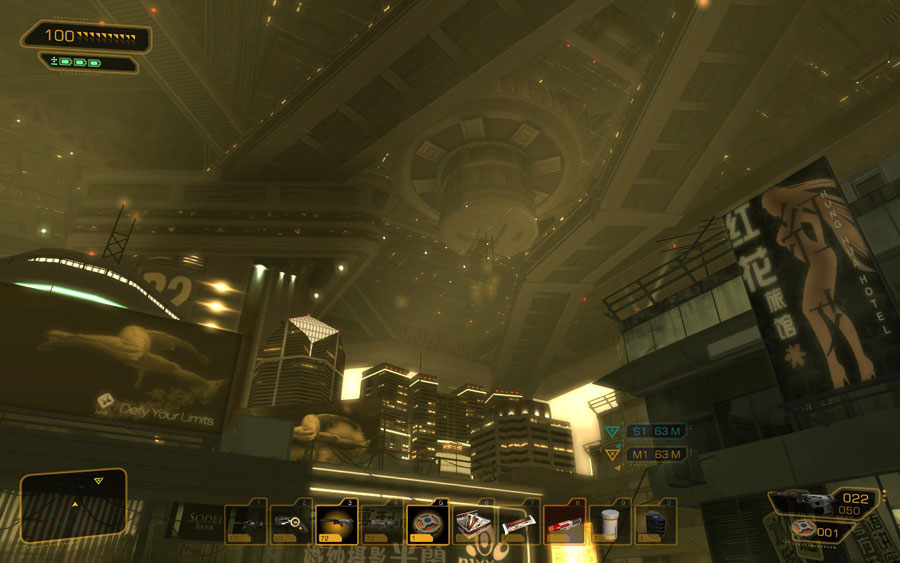
This Midgar-looking city makes me want a FF7 remake soooooo bad.
Legacy issues aside, DX:HR as a game within itself is a rather brilliant experience. Someone looking for a challenging run-n-gun cover-based shooter will find DX-HR an acceptable challenge. The stealth mechanics do not feel tacked on like so many other FPS titles (Far Cry, etc). While the augmentation choices might not matter in a metagame sense, they are useful in making you better at whatever playstyle you are accustomed. The oft-maligned boss battles do indeed feel a bit out of place, although I would be more disappointed if they were handled entirely in cut scenes or if I, say, was able to one-shot them in a takedown move or whatever. The visuals and vistas are top-notch, and the soundtrack is one of the best I have ever heard.
As a final note, I would be remiss if I did not mention the horrible, horrible technical issues I had with the game. With a four-month old game being played on a $1300 gaming rig bought a month ago, I experienced complete Crashes-To-Desktop (C2D) roughly every ~20 minutes for the entire 38 hours I played. Sometimes it would C2D within 3 minutes, sometimes I would actually go a full, uninterrupted hour. Two of the big plot-twisting cinematics were completely unwatchable in that it would C2D at a certain point 100% of the time, and I was never able to watch any of the various ending cinematics in their entirety; in all such cases, I skipped them in-game and Alt-Tabbed to watch them on Youtube in order to proceed. While it could be entirely Nvidia’s fault, or user-error for that matter, it is something to keep in mind.
And honestly, the fact that I endured hundreds of C2Ds over the span of 38 hours to reach the game’s conclusion is perhaps the highest endorsement I can give. Whether it was because of the zeitgeist of the cyberpunk setting, or the ghosts of Deus Ex past, or if it came down to the gameplay itself, all I know for sure is how I felt at the very end:
“Please, sir, I want some more.”
Human Revolution DLC Review:
Missing Link ($14.99) – To be honest, the Missing Link DLC to Deus Ex: Human Revolution was one of the first DLCs I have ever played which felt like a legitimate “deleted scene” from the main game. This is both a good and bad thing. Good in that it feels like a relatively seamless addition despite being on its own 2gb installer and featuring the vastly overused (gaming) trope of the hero losing all of his/her powers. Bad in that, well, most deleted scenes are deleted for a reason.
Taking place in the middle of a fade-to-black scene change in the middle of the original game, Missing Link does not add anything of plot value to the game proper aside from, well, around four more hours of gameplay. While you end up getting access to most of the weapons/augments from the main game, I definitely experienced a mental disconnect between the choices I was making, knowing that none of it mattered since no data was going to be transferred. Want to explore every nook and cranny? Okay… but why? No data, no XP, no weapons, no credits, nothing will endure past the final encounter. Which, incidentally, takes the form of how all the boss battles in Human Revolution should have played out.
Aside from that, and a frustrating amount of pointless backtracking past a 20-30 second in-game “loading screen,” Missing Link is a good enough dessert to the main course that was the original game. Provided, of course, you can snag it for less than the outrageous $15 retail price. Less than $5 or included in a Game of the Year edition would be ideal.
Insert Coin
Random!
- Beat Deus Ex: Human Revolution a few days ago; the more formal review will be forthcoming. Short version is: game was goo… *crash to desktop*
- Steam holiday sales annoy me to an extent. You see, what is the point of having entire catalogs on sale from 33-50% off, when they routinely turn around and toss up seemingly random selections from those same catalogs for 75% off? The only purpose I can ascertain is to piss people off.
- For example, Space Marine was 33% off for the pass week, now is 50%. Torchlight was 50% off for the past week, now is 75%. I learned my lesson when I was burned in this way a year ago, but it still boggles my mind they pull the same shit year after year. All it encourages me to do is to wait until the very last moment to buy anything lest it go on sale a day later, and thereby potentially miss the deadline entirely and not buy anything.
- I generally avoid the stupid Steam contests that involve you having to (re-)download multiple 10 gb games you already purchased but haven’t played yet in order to unlock achievements that result in lumps of coal. I did however do so on a whim with the Orcs Must Die! one. I have been playing the game every since.
- Sometimes I hate buying shit off the internet. There are two monitors on Amazon, both Viewsonic 24″ widescreen LEDs: the VX2450WM (originally $368, now $179.99) and the VX2453MH (originally $270, now $189.99). For the life of me, I can’t seem to understand the difference. The latter has 30 million: 1 contrast as opposed to 20 million:1, is “ultra thin,” can be turned into a picture-frame looking thing for god knows what reason, and weighs 0.9 lbs less. The former can be mounted on a stand or something, and has roughly three times as many reviews (both are 4.5/5 stars).
- My first instinct, I shit you not, was the former simply because “You Save: $188.01 (51%)” vs “You Save: $80.24 (30%).” With logic like that, I’m surprised I haven’t already ruined the Monster cables hooked up to my Alienware by spilling Grey Poupon all over them. Good thing I’m still covered under my Black Tie GeekSquad 5-year Best Buy warranty, ya?
- Grey Poupon. Poupon. Poupon.
- You now have an angry French guy in your head. You’re welcome.
Have a happy whatever you celebrate or not celebrate, as the case may be.
Boxed In
I have been having more fun with boxes than strictly necessary in DE: HR.
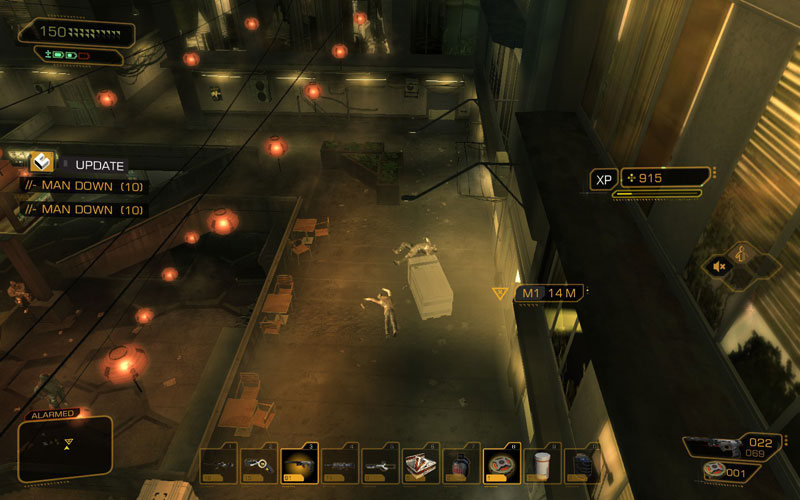
Two birds, one industrial crate.
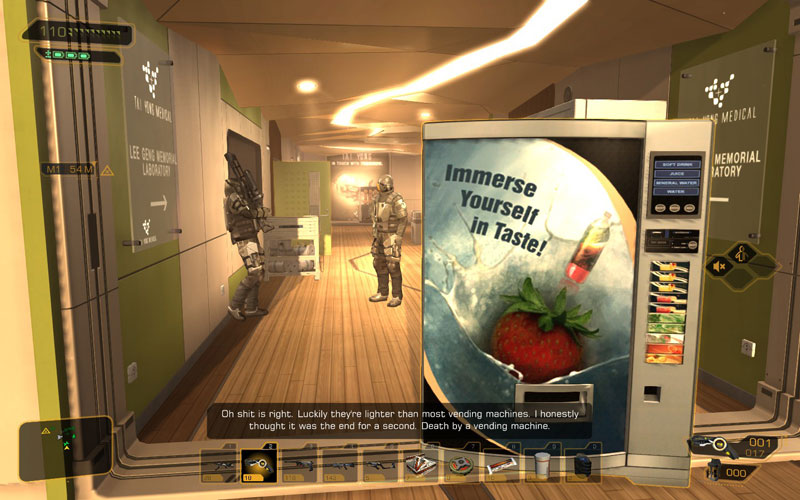
Things Not to Say to A Guy Randomly Carrying Around a Vending Machine #467
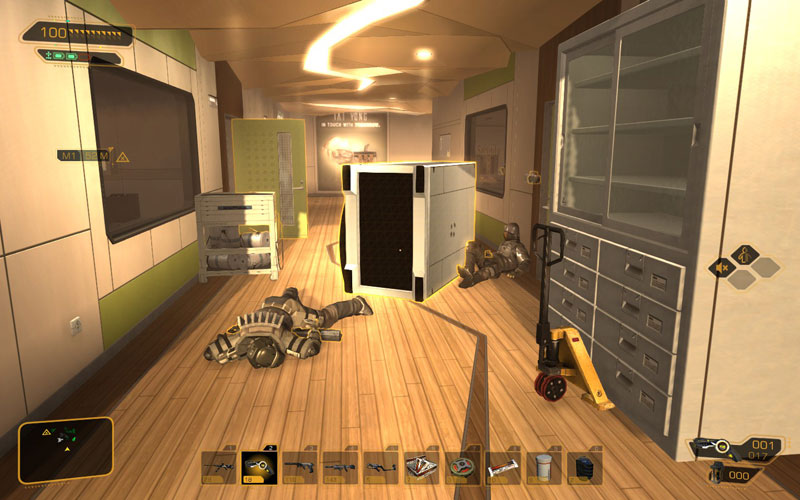
With that kind of setup, I was surprised by the lack of an achievement.
What has been less fun are the frequent Crash-To-Desktop (C2D). By “frequent,” I mean between every 5 to 50 minutes with a trend towards the former. It boggles my mind that legitimate pieces of software are able to be released in this sort of broken state. Googling results in the same, unhelpful article posted a hundred different places. The Steam forums basically tells you to turn off DirectX11 (it’s off), and then tells you that it’s not really a Steam issue anyway. The Edios website tells you to, no joke, create a non-administrative user account in Windows, then play the game from there (tried it, didn’t work). Oh, and by the way, technically it’s not an Edios problem, but a Square-Enix problem. And there is no useful support forum for Square-Enix.
Finally, there was always the “turn everything down” proposed solution. I have yet to try this “solution,” mainly because A) I didn’t purchase a goddamn $1200 computer to play games on settings my laptop could have done, and B) the C2Ds, while supremely annoying, do not make the game unplayable.
I would like to believe that, ultimately, reviews should reflect the game as it should be, or is for the majority of players, reflected through the prism of of the reviewer’s worldview. For example, it would be asinine to complain about DE: HR’s graphics looking terrible in 640×480 resolution with the lowest settings. Similarlly, should a game be “punished” if it launched with bugs that later players never experience?
On the other hand, this situation frustrates me so much precisely because I love everything else going on. If it was a terrible game, like say Frozen Synapse, I would have dropped it like a rock (something I typically do not do). I want to be able to say that I’m never buying another game from Edios/Square-Enix based on their shitty QA process, but just like with Bethesda, I can’t say that either. If they released another Deus Ex, I’d be on that like white on rice microfiber weave carbon nanotubes on a super-conducting ceramic polymer.
When In Doubt, Update Drivers
As I mentioned in the last post, I was extremely nervous about my computer “investment” considering the choppy performance in Deus Ex: Human Revolution thus far. When I re-downloaded Fraps, I finally saw the full scope of the depravity: ~15 fps standing still in the outdoor environments, single digits walking around. Keep in mind, that was with the lowest texture settings, AA set to one notch above “none,” and a 1440×900 resolution. As is often the case in these things, Google was fairly useless other than letting me know that people with lesser machines were miraculously getting better performance.
Then, in my darkest… half-hour, I fell back on my most basic of training: when in doubt, update drivers.
The Nvidia driver update did not actually solve anything. But in the process of updating it, I noticed a Virtu Control Panel button in the System Tray. Screwing around with the settings there did nothing. That was when I chose the “check for updates button,” navigating to their website for the latest driver. Which said:
New games added
- Battlefield 3
- Shogun2
- Crysis 2
- DiRT3
- Deus EX Human Revolution
From what I gather, the Virtu program basically creates a virtual GPU that combines the power of your processors + your normal graphics card. Or, in my case, prevent my computer from using the goddamn graphics card. No, seriously. Once the driver was updated, I loaded up Deus Ex and had a maximum settings, 105 fps orgasm. We’re talking Perpetual Motion Machine lubricant smooth. This feels like an entirely different game than I was playing for the last 15 hours. I almost feel like starting the game over entirely.
So, when in doubt, update drivers. Including the drivers for shit you didn’t even know was installed on the machine.
 In An Age
Incentivizing Morality
Oct 5
Posted by Azuriel
In the comments of my last post, Kring had this to say:
In the vast majority of games, “the good path” is incentivized by default. This usually manifests in terms of a game’s ending, which sees the hero and his/her scrappy teammates surviving and defeating the antagonist when enough altruistic flags are raised. Conversely, being selfish and/or evil typically results in a bad ending where the hero possibly dies, or becomes just as corrupt as the original antagonist, and most of the party members have abandoned you (or been killed). It’s almost a tautology that way – the good path is good, the bad path is bad.
Game designers usually layer on addition incentives for moral play though. The classical trope is when the hero saves the poor village and then refuses to accept the reward… only to be given a greater reward later (or sometimes immediately). I have often imagined a hypothetical game in which the good path is not only unrewarding, but actively punished. How betrayed do you think players would feel if doing good deeds resulted in the bad guy winning and all your efforts come to naught? It would probably be as unsatisfying in such a game as it is IRL.
Incentives are powerful things that guide player behavior. And sometimes these incentives can go awry.
Bioshock is an example of almost archetypal game morality. As you progress through the game, you are given the choice of rescuing Little Sisters or harvesting them to consume their power. While that may seem like an active tradeoff, the reality is that you end up getting goodies after rescuing three Little Sisters, putting you about on par with where you would have been had you harvested them. By the end of the game, the difference in total power (ADAM resource) is literally about 8%. Meanwhile, if you harvest even one (or 2?) Little Sister, you are locked into the bad ending.
An example of contrary incentives comes from Deus Ex: Human Revolution. In this one, you are given the freedom of choosing several different ways to overcome challenges. For example, you can run in guns blazing, sneak through ventilation shafts, and/or hack computers. The problem is the “and/or.” When you perform a non-lethal takedown, for example, you get some XP. You also get XP for straight-up killing enemies. But what if you kill someone you already rendered unconscious with a non-lethal takedown? Believe it or not, extra XP. Even worse, the hacking minigame allows you to earn XP and resources whereas acquiring the password to unlock the device gives nothing. The end result is that the player is incentivized to knock out enemies, then kill them, search everywhere for loot but ignore passwords/keys so you can hack things instead, and otherwise be the most schizophrenic spy ever.
Does DE:HR force you to play that way? Not directly. Indeed, it has a Pacifist achievement as a reward for sticking just to non-lethal takedowns. But forgoing the extra XP means you have less gameplay options for infiltrating enemy bases for a longer amount of time, which can result in you pigeonholing yourself into a less fun experience. How else could you discover the joy that is throwing vending machines around with your
bareaugmented hands without having a few spare upgrades?Speaking of less fun experiences, consider Dishonored. This is another freeform stealth game where you are given special powers and let loose to accomplish your objective as you choose. However, if you so happen to choose lethal takedowns too many times, the environment becomes infested with more hostile vermin and you end up with the bad ending. I don’t necessarily have an issue with the enforced morality system, but limiting oneself to non-lethal takedowns means the majority of weapons (and some abilities) in the game are straight-up useless. This leads you to tackle missions in the exact same way every time, with no hope of getting any more interesting abilities, tools, or even situations.
I bring all this up to answer Kring’s original question: why choose to be the murder hobo in Starfield? Because that’s what the game designers incentivized, unintentionally or not. Bethesda crafted a gameplay loop that:
Does this mean you have to steal neutral NPCs’ spaceships right from under them and pawn it lightyears away? Or pickpocket every named NPC you encounter? No, you don’t. Indeed, some people would suggest that playing that way is “optimizing the fun out of the game.”
But here’s the thing: you will end up feeling punished for most of the game, because of the designer-based incentives not aligning with your playstyle. In every combat encounter – which will be the primary source of all credits and XP in the game regardless of how you play1 – you will be acutely aware of how little ammo you have left, switching to guns that you don’t like and also take longer to kill enemies with, being stuck with smaller spaceships that perform worse in the frequent space battles, and don’t offer quality of life features you will enjoy having. Sinking points into the Persuasion system will make those infrequent opportunities more successful, but those very same points mean you have less combat or economic bonuses which, again, will leave you miserable in the rest of the game.
Can you play any way you want in Starfield in spite of that? Sure. Well… not as a pacifist. Or someone who sneaks past enemies. Or talks their way out of every combat encounter. But yes, you can avoid being a total murder hobo. You can also turn down the graphical settings to their lowest level and change the resolution to 800×600 to roleplay someone with vision problems. Totally possible.
My point is that gameplay incentives matter. Game designers don’t need to create strict moral imperatives – in fact, I would prefer they didn’t considering how Dishonored felt to play – but they should take care to avoid unnecessary friction. Imagine if Deus Ex: Human Revolution did not award extra XP for killing unconscious NPCs, and using found passwords automatically gave you all the bonus XP/resources that the hacking game offers. Would the game get worse or more prescriptive? No! If anything, it expands the roleplaying opportunities because you are no longer fighting the dissonance the system inadvertently (or sloppily) creates.
In Starfield’s case, I’m a murder hobo because the game doesn’t feel good to play any other way. But at the root of that feeling, there lies a stupidly simple solution:
That’s it. Problem solved – I’d hang up my bloody hobo hat tomorrow.
Right now the outpost system is a completely pointless, tacked-on feature. If you could craft your own ammo though, suddenly everyone wants a good outpost setup, which means players are flying around and exploring planets to find these resources. Once players have secured a source of ammo, credits become less critical. This removes the incentives for looting every single gun from every single dead pirate, which means less time spent fighting the awful inventory and UI. With that, being a murder hobo is more of a lifestyle choice rather than a dissonance you have to constantly struggle against.
That’s a lot of words to essentially land on leveraging the Invisible Hand to guide player behavior. And I know that there will be those that argue that incentives are irrelevant or unnecessary, because players always have the choice to play a certain way even if it is “suboptimal.” But I would say to you: why play that game? Unless you are specifically a masochist, there are much better games to roleplay as the good guys in than Starfield. You can do it, and there are good guy choices to make, but even Bethesda’s other games are infinitely better. And that’s sad. Let’s hope that they (or mods, as always) turn it around.
Posted in Commentary, Philosophy
4 Comments
Tags: Deus Ex: Human Revolution, Incentives, Moral Choices, Murder Hobo, Optimization, Starfield