Blog Archives
Torghast: Fun?
I have spent about 15 hours total in Torghast thus far, and I can’t quite tell if I’m having fun. Which probably means I’m not.
The design of this endgame activity is weird, which may be a result of Blizzard’s whiplash direction. It was originally very challenging for a solo player, then it was made to be harder presumably to not surprise players at reaching an unkillable (to them) final boss, and then made much easier across the board. Which is fine, because this is the primary source of Soul Ash, which is necessary to craft Legendary armor this expansion. And everyone is absolutely expected to have one. The recently-released Twisting Corridors with its cosmetic rewards is a better place for challenge.
But even that aside, it doesn’t feel great. Each run takes me 40-60 minutes and it is a commitment. If you don’t kill the last boss, you get nothing. If your gameplay gets interrupted by something, you get nothing. If you die too many times to random things even before the last boss, you get nothing. So, given the risk, you are highly incentivized to kill every mob pack and scour every crevice for Anima Cells to gain more power. If you skip things on the early floors to try and finish more quickly, but end up not having enough juice to kill the boss, well, you get nothing.
Oh, and don’t forget that the elites and bosses all get a rapidly-stacking 10% damage buff every dozen seconds or so. Berserk timers would have been one thing, but really? Why is that necessary at all?
When you first unlock Torghast, you just have access to Layer 1. Beating a Layer gives you Soul Ash and unlocks the next Layer. Each Layer gives you a decreasing amount of Soul Ash – it goes 120, 100, 85, 70, 60, and so on. The good news is that Layers stay unlocked, so that next week you can instantly go to Layer 5, beat it, and gain all the Soul Ash from that and the lower Layers automatically (435 total in this case). Plus, by virtue of having beaten Layer 5, you can do Layer 6 next week. Or this week, if you want to put in another hour or so for 50 Soul Ash.
The bad news is that unlocking 5-6 Layers right away on a toon is exhausting and will burn you out quickly. All of your alts start at Layer 1 just like your main, and Legendaries are gated behind Torghast, so it is not as though you can readily ignore it, even if you only PvP. You could “take it easy” and only run one Layer at a time, but that’s going to delay your Legendary by weeks.
Finally, the Anima Powers you have available are really hit or miss. There are sometimes fun combos to unlock, like when my Guardian Druid got to auto-cast Roots on enemies that stuck me when Barkskin is up, and when Roots breaks it deals 4000 damage to nearby enemies. Oh, and Barkskin was all but permanent with duration boosts. That combo let me charge into multiple mob packs, do a few Swipes, and then the Roots breaking for 6+ mobs simultaneously dealt 24k damage to everything.
When you roll in with an Affliction Warlock though, you get runs where your Seed of Corruption gets buffed five times. Which is fine for trash, but doesn’t do anything for the boss.
Torghast is probably one of the most interesting design decisions Blizzard has implemented since Scenarios. Reminds me of Dungeon Runs in Hearthstone. But is it fun? Eh, it can be. Sometimes. It’s also exhausting, kinda formulaic, and also required. If Blizzard leaned more into the overpowered abilities angle, or if each floor guardian gave a little Soul Ash, then I could see it being better.
From Whence Fun?
The other day I was playing Words with Friends (aka Scrabble app) with my SO. She is not much of a gamer – although she did play WoW back in vanilla – but she enjoys board games, and word games the most. I play along with the word games mainly because it’s something we can do together, but… I don’t really enjoy it. Word games are not my forte, and it does not help that she is way better at words than I am. I have actually legit won on occasion, primarily on the back of a few critical plays when the tiles line up just right. For the most part though, she kicks my ass on the daily.
For those who don’t know, there are an abundance of Words with Friends “cheat” apps out there. What those will do is analyze your seven tiles and the board, and then list out the best possible scoring combinations via brute-force analysis. I have never played with any such apps, but I find the idea amusing simply because that is exactly what I try to do a lot in-game.
See, Words with Friends will only allow valid plays. So, if you don’t know whether something is a word, you can drop tiles and get instant feedback. I have gotten a lot of points before basically dropping random tiles in key locations and making a word I had never heard of.
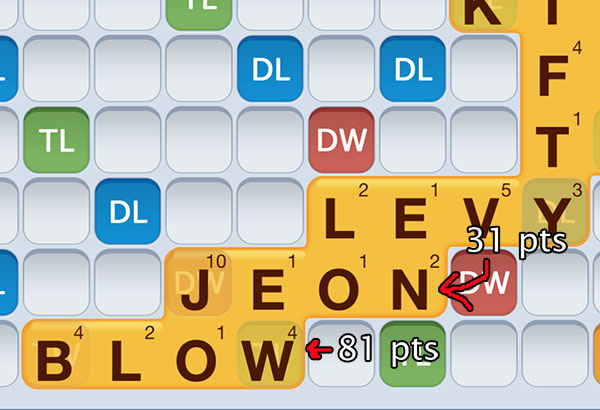
I don’t even know what “Jeon” is, but I regretted playing it immediately.
The difference between my method and using an app to do it for me is… something.
I suppose it becomes less of a contest between two players’ knowledge when automation is involved, cheapening the experience. On the other hand, my SO plays word games a lot – she runs several concurrent games at a time, in fact – so she has memorized all the different Q words that don’t need a U, and so on, which is a pretty big advantage. And like I mentioned, I can do everything the cheat apps would do, if I was patient enough to do it myself. So, at some point, her overwhelming knowledge versus my very basic brute-force tactics becomes analogous to one or both of us facing two different kinds of bots.
That thought led me to another: what if we both used cheat apps? At that point, the game would probably come down to the random nature of tile distribution, and perhaps a few scenarios in which we had to choose between two same-point plays. Regardless, it doesn’t sound particularly fun, right? If we have automated things that far, we may as well automate the selection of the answer, and just have two bots play against each other forever.
So… from whence did the fun originate?
I think it is safe to say that certainty reduces fun in games. While I do not necessarily mean that randomness needs to exist in order for fun to occur, I do mean that the outcome needs to be unknown, or at least in contention. If one person has the cheating app and the other does not, it’s not likely to be a fun game. Even if no cheating was involved, one player having an overwhelming advantage – either knowledge or skill – and the outcome is probably the same.
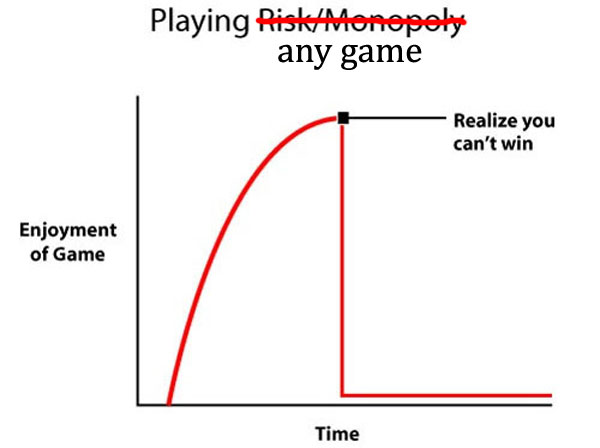
But what does that really say about our games, and the way we play them? The better we are at a game, the less fun we likely will have. Having a little advantage is nice, and the process by which we get better (experimenting, practice, etc) is a lot of fun too. At a certain level though, it tapers off. What’s fun after that? Direct competition? Maybe. Part of that fun is likely tied into the whole “unknown level of skill from opponent” thing though. Because if we knew he/she was using a cheat program, that fun would evaporate pretty quickly.
Now, there is a sort of exception here: it can be fun to totally dominate your opponent(s). Be it ganking in MMOs, or aimbots in FPS games, the reason a person would do such a thing is precisely to “collect tears” by specifically ruining other peoples’ experience. At that point though, the medium is kinda immaterial; the bully is just using whatever is convenient and less personally risky.
In any case, I went ahead and shared my thoughts above with my SO and her response was interesting. For her, the “game” within Words with Friends is actually just challenging herself in finding the highest-scoring move each turn – she does not necessarily care about the ultimate outcome of the game. Which, to me, sounds like she should be playing against bots, but nevermind. And I actually understand that sentiment: whenever I was playing BGs in WoW, my goal is not necessarily to win at all costs (e.g. sitting on a flag 100% of the time), but to amuse myself on a micro level, even if I was grinding Honor.
Still, I suspect my SO will eventually tire of the wordplay over time, once her skills plateau. Or… maybe she won’t. After all, I somehow find it infinitely interesting to collect resources in Survival games despite having achieved maximum efficiency usually by clicking the button once. Which leads me back to my original question: from whence fun?
 In An Age
Half-Cocked
Feb 5
Posted by Azuriel
So the news out there is that both Avowed and The Outer Worlds 2 flopped. Or, technically, “failed to meet expectations.”
The piling on in the Reddit comments is understandable, and I agree with most of it. Neither Avowed nor The Outer Worlds 2 feel like games that have had 6+ years in development. The equipment upgrade system in Avowed is both punishing and boring, and two of the classes have nothing interesting going on in the Skills department. For TOW2, Skills/Perks were half-assed at best and irrelevant at worst. What in the world were the designers spending all their time on?
Ah, well, there you go.
I’m not going to pretend to be an industry insider, or able to speak authoritatively on game design (or any topic, for that matter). But, respectively devs, what the fuck? We have heard for ages that development cycles are getting more expensive, and that is why game prices have to be $70, $80, and higher with macrotransactions. People just swallow the narrative that all the increases in technology and graphical fidelity make the process of making games cost more money. But peel back the layers and all of a sudden it certainly seems like the people in charge are just going off half-cocked.
Game design is an iterative process, yes. Inventing new forms of fun is hard. I can also understand that sometimes the fun only manifests itself once all the various interlocking systems are already in place. Again, though… what the fuck? “Skyrim meets Destiny in massive fantasy world” is not a game, it is barely a concept of a setting. Do these designers believe that the fun will simply manifest itself out of the aether? “If we build it, they will have fun”? Or do they assume that figuring out the fun is the easy part and can be added in later?
“Minor ingredients,” oh my fucking god. They have no goddamn clue, do they?
Here you go, Obsidian, on the house. I’m not certain how pickpocketing would have worked in Avowed considering none of the NPCs move, but sure, it would be nice flavor. But I recommend starting with the fact that every part of the player progression experience is awful. You are punished for upgrading equipment since resources are finite and enemies don’t respawn, and are also punished for not upgrading equipment as enemies automatically deal 35% more damage if they exceed your tier. When you do upgrade though, you get a whole +4 to whatever stat, with nothing else interesting going on.
These sort of things are not “minor ingredients.” It’s the whole fucking game! You know, the thing that players do after purchasing your product? P-L-A-Y. Kudos to the people who designed the movement and vaulting inside the game world, but whoever came up with the fiddly bits needs some goddamn coaching. Would it have killed anyone to increase all the values by a few points when upgrading gear? Or playtested the Warrior/Ranger talents against all of the stuff the Wizard could do by default?
As for The Outer Worlds 2, same thing. Skills and Perks were deadass boring. How many of them meaningfully impacted combat at all? In what world should a player feel comfortable breezing through the entire last Act of game with 17 unallocated Skill Points and 5 Perk Points? Nothing I picked felt like it did anything other than add another percentage gain on otherwise extremely low base damage weapon. Hard to get excited about going from 490% increased damage to 520%.
It could be that I’m the one off-base. Maybe the entire problem with the games were one of marketing, or the story not being engaging enough, or the graphics being something-something. In one of the Reddit threads, someone commented how slowly people talked in Avowed being an issue. OK, sure. That said, it possibly couldn’t hurt to make character progression fun or exciting in any way whatsoever.
The hilarious and tragic thing are the lessons (un)learned.
First of all… they hadn’t planned on greenlighting a Grounded sequel? I mean, yeah, not every game needs a sequel, people crave new experiences, sometimes devs want to move on, yadda yadda. Still, it feels bonkers to me that when a game company does strike gold on a fun game concept/design, it often just goes nowhere afterwards. Everyone sings Obsidian’s praises for Fallout: New Vegas, which cost $8 million and only two years to produce. How did that happen? It was basically a Fallout 3 mod. Which is probably why it was so fun in the first place, because it was built on an established foundation of fun.
We’ll have to see with Obsidian whether they take the lessons to heart. But I was also thinking about this other recent tidbit from Blizzard in a different article:
The easy jokes are, you know, how Blizzard has a TCG, MOBA (abandoned), and Clash Royal-esque mobile app (dead) all within the same narrative universe. But remember, Blizzard had also been working on a fantasy survival game for many years before that got killed in development as well. Wonder what had happened there…
Of fucking course. I especially liked the “allowing game leads rather than executives choose the technology used.” Seems like a good idea, maybe someone should try it occasionally.
You know, all this does is really highlight that nobody knows what they hell they are doing and it’s a miracle any fun games get built at all.
Posted in Commentary, Philosophy
3 Comments
Tags: Avowed, Blizzard, Failed to Meet Expectations, From Whence Fun?, Obsidian, The Outer Worlds 2