Blog Archives
Reviews: Recettear: An Item Shop’s Tale; Deadlight
Game: Recettear: An Item Shop’s Tale
Recommended price: $5
Metacritic Score: 82
Completion Time: ~16 hours
Buy If You Like: Japanese indie games with funny localizations

Seriously, even a Lost joke?!
Recettear: An Item Shop’s Tale is a Japanese indie game localized in the Working Designs (RIP) tradition, wherein you take control of Recette as she turns her lonely house into an item shop to pay off her missing adventurer father’s defaulted debt. With the aid of the loan shark fairy Tear, you can either buy weapons, armor, and other goods at wholesale prices from the markets to sell at a premium, or hire out adventurers to go clear dungeons and sell those drops in your store. Time is limited however, and you must make each week’s increasingly crazy payment lest your home get repossessed.
I found the general gameplay and underlying mechanical tension surprisingly fun. Each day in Recettear is divided into four slices, which you can use to run your shop, spend going out shopping, or use two at a time to go through dungeons. I frequently found myself in interesting dilemmas: with the 80,000 payment due tomorrow, should I spend all four time slices to peddle my dwindling wares? Should I gamble that a dungeon run will net be some expensive “free” items, and that I still have time to sell them? Or should I actually spend money at the market in the hopes that I can recoup with profit before tomorrow?
These dilemmas even extend to the actual selling of items too, as you must decide what markup percent your customers are willing to accept. Shoot for the guaranteed 110%… or stretch to 130%? Finally, at random intervals the market for weapons/consumables/etc will either crash or spike, which can force you to sell at half price or lets you double your profits respectively.
Overall, I enjoyed the game while it lasted, or at least the first 8-10 hours. Defaulting on the loan actually leads to a Game Over screen, but you can start again at Week 1 with your full inventory, same adventurer levels/equipment, and same Merchant Level and other unlocks. While this makes beating the game an inevitability, you are likely to understand the underlying systems well enough to make beating the game a forgone conclusion before the end of Loop 2. For those who find themselves obsessed, Recettear does offer a quite a selection of post-game activities, including New Game+, Endless mode, and even Survival Hell mode where you have to keep making six-figure loan payments until you finally default.
If you want a unique, quirky indie game with an amusing localization, Recettear has you covered.
_____________
Game: Deadlight
Recommended price: Bundle
Metacritic Score: 78
Completion Time: ~3 hours
Buy If You Like: A less artistic LIMBO, or short side-scrolling puzzle games
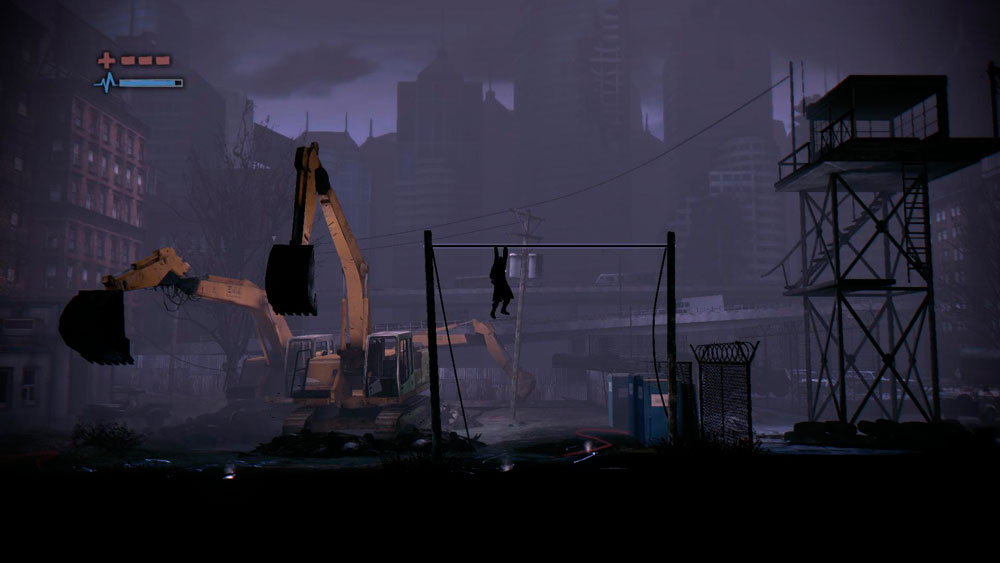
Dude… couldn’t you just walk 10ft into the background?
Deadlight is a side-scrolling puzzle platformer in the tradition of Out of This World or LIMBO, to use a more recent example. You control Randall Wayne has he navigates his way through a 1980s version of a Seattle zombie apocalypse on a mission to find his family. Amidst the frankly ridiculous jumping scenarios that Randall solves with Assassin’s Creed-levels of aplomb, you will frequently be harassed by zombies (or “Shadows” as they are termed here), which creates an extra level of tension and danger to the side-scrolling navigation.
It is worth noting that this game is stunningly beautiful; clocking in at 4.1 gigs, I suspect that the characters and environments are actually rendered in full 3D, with the camera merely forcing a 2D perspective. Aside from the graphics though, my comparison with LIMBO remains apt: Deadlight is an incredibly short game whose merits largely reside on the artistic side of the spectrum, rather than gameplay. Whereas LIMBO’s style accentuated the gameplay though, Deadlight’s more realistic bent strains credulity and breaks immersion in a few places. An example is in the screenshot above, where Randall had to leap from a building onto a series of cranes, then jump down to wire before launching himself over a barbwire fence. While platformers require a healthy degree of suspension of disbelief in general, I had a hard time getting over the fact that there is clearly a perfectly safe pathway not 10 feet in the background of that very screenshot.
Despite the immersion breaks, Deadlight isn’t a bad game – it is simply something I would not recommend picking up outside of a bundle. Even if you pick it up on a $5 sale as I did, the dollar-per-hour of entertainment is not particularly impressive.
Great Timing
When I originally saw the MMO-Champion post about free SWTOR beta keys, I was excited. And, hey, I actually got a key! Oh… what? It’s a key to enter the drawing for a chance at downloading and playing a 20+ gig client for more than a day 1.5 weeks from now? Wow. I am still trying to imagine a scenario in which downloading a 20 gig game to play for 24 hours or less is not a thinly-veiled “fuck you.” I do not suffer under bandwidth caps, but there is absolutely a cap on my attention span and tolerance for bullshit.
That was a week ago. Last night at 3:23 am, I get the email talking about how I was magically selected for the upcoming weekend beta. I quickly click the link in the email, because apparently the speed at which you click determines the duration of the cock-tease. Fantastic, there is an error. Apparently SWTOR wants everyone who registered before a certain date to reset their passwords. I press the password reset button and wait for the email. And wait. And wait. It arrives at 4:29 am, having taken the equivalent of Pony Express speeds through the Internet tubes, about fifteen minutes after I went to sleep.
Today, I finally reset the password, and attempt to log on to redeem my weekend beta code.

Couldn't they spend, say, $5 million of that $300 million making a goddamn website that works?
Gee whiz, guys. With how concerned EA/Bioware is with a smooth launch, one would assume their goddamn website would be able to handle the traffic generated by the miserly metering of beta codes a week ago.
But you know what? I’m over it. If you notice down at the lower right of the screenshot, there is a Steam notification that Aquaira finished downloading. Aquaria and Crayon Physics Delux and Darwinia and other indie titles for $3.53 care of the latest Humble Bundle that went up today. Not to mention the next Indie Royale bundle will be going up on Friday, along with the inevitable Steam sales over Thanksgiving.
When I quit WoW, I was somewhat concerned about what I would do with all the time freed up by no longer doing daily quests, running heroics, playing the AH and so on. After all, when you averaged the ~7700 hours out it was in the neighborhood of 5 hours a day (albeit most of that encompassed when I was unemployed). What I discovered is that time gets filled up no matter what I do – there is never a time when I am bored for lack of games to play, blogs to read, or things to do. And so I am wondering if I will even have the time or inclination to fit in mediocre MMO gameplay propped up by social strings and glue anymore. Having friends is great; making friends is an awkward pain in the ass.
And unless/until SWTOR starts impressing me a lot more than it currently is, I may stick to the vastly cheaper, and amusingly better quality indie gameplay.
Reviews: Eufloria, Kane & Lynch 1 and 2, Osmos, Trine
Game: Eufloria
Recommended price: Bundle
Metacritic Score: 63
Completion Time: 16 hours
Buy If You Like: Ambient indie quasi-puzzle games
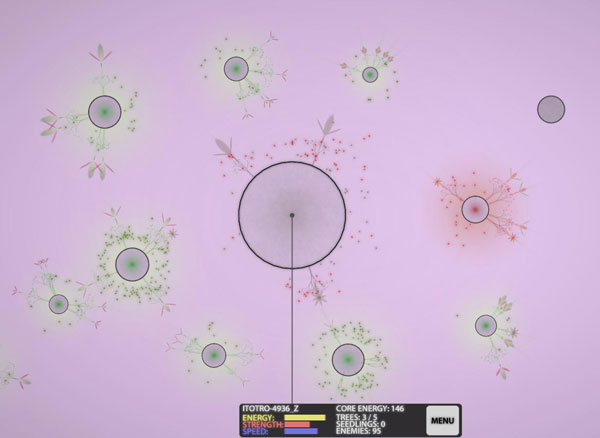
You have no chance to survive, make your time
Eufloria is an ambient indie strategy/puzzle game that blurs the line between strategic depth and shallowness. Your goal is to colonize all the asteroids in the playing field using your fleet of organic plant ships called Seedlings. Each asteroid has three characteristics – Strength, Speed, and Energy – and their varying levels determines the qualities of the resulting Seedlings that are grown from the Dyson trees. You see, to control of an uninhabited asteroid, you essentially sacrifice 10 of your Seedlings to grow a Dyson tree, which makes more Seedlings indefinitely. If said asteroid is inhabited by the enemy, your forces must attack any enemy Seedlings there, blow up one of their Dyson trees, and then kamikaze themselves through the root system to sap the core. Once the core is sapped, the asteroid is yours and any surviving Dyson trees are automatically converted to your side.
While all of this undoubtedly sounds strategic and exciting, the actual core gameplay can best be summed up by sitting around until you zerg the ever-living hell out of the enemy. There are actually additional strategic elements involved such as Defensive trees, tree-boosting flowers, and Death Star-esque multi-laser flower ships… but, again, all of them are problems that can be solved with the hammer of the zerg swarm.
The interface is clean, the ambient music relaxing, and the overall experience is somewhat refreshing in a distilled water sort of way. The last group of missions actually does require some strategic elements, but even then the issue ultimately comes down to surviving against the swarm long enough for your swarm to outnumber their swarm. Ultimately, I believe Eufloria to be one of those games that would unequivocally be better suited to the iPad or the Touch rather than computer proper.
Game: Kane & Lynch: Dead Men
Recommended price: $5
Metacritic Score: 67
Completion Time: ~4 hours
Buy If You Like: Controlling a dark, over-the-top revenge movie
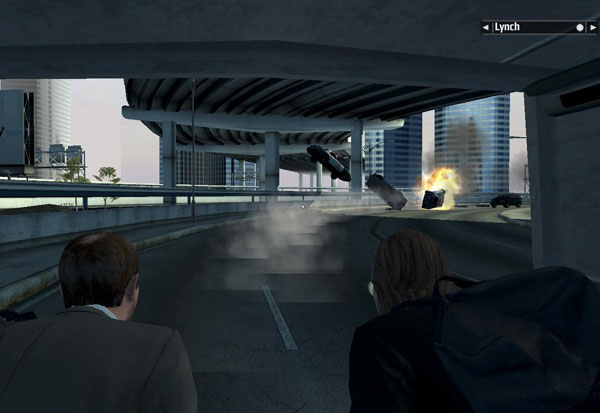
One grenade, half a dozen crimes against humanity.
I actually played Kane & Lynch 2 before the original, so my experience with the series is somewhat disjointed. This game follows Kane, an ex-mercenary in prison on his way to being executed. Along the way, he is “rescued” by Lynch along with the surviving members of The7, a mysterious organization that Kane betrayed in the past presumably because he believed them to have been killed in a botched mission. Actually, the whole convoluted backstory remains largely unexplained to the extent that it feels like you walked into a movie halfway over.
The game itself is an over-the-shoulder shooting spree as you navigate Kane through areas of cover and increasingly ridiculous scenarios. The7 has kidnapped your wife and daughter, and to get them back you rob a bank, escape by murdering half the police force in the western United States, fly (!) to Tokyo, fly (!!) back to the US, kill some more people, fly (!!!) back to Tokyo, and fly (!!?!) back to the US and other locales, as if there is no such thing as a no-fly list in the year two thousand and goddamn seven.
Despite the over-the-top ridiculousness of the entire scenario, despite the somewhat clumsy game mechanics, and despite everything else that I should objectively dislike about the game… the Kane & Lynch series is one that I actually enjoyed. For $5, but still. Both Kane and Lynch are completely unlikable characters, until you start finding their chemistry (if nothing else) rubbing off on you. To that end the voice acting is excellent to the point that you really do feel like you are playing a movie. Perhaps a bad movie, but by the end you want it so much to be a good one that you meet it halfway.
Game: Kane & Lynch 2: Dog Days
Recommended price: $5
Metacritic Score: 66
Completion Time: ~4 hours
Buy If You Like: Controlling a dark, over-the-top handycam revenge movie
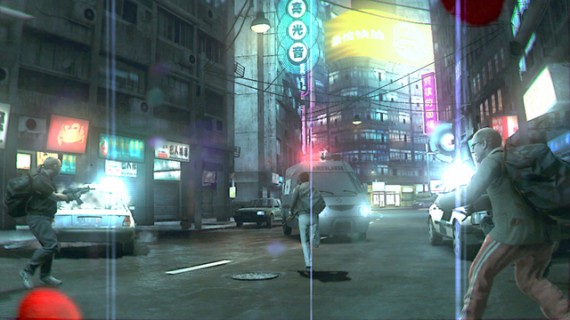
Now with 100% more lens flare.
Much like the original, Kane & Lynch 2 is an over-the-shoulder cover shooting spree that sees you playing as Lynch, the self-medicated psychopath, rather than the ex-mercenary Kane. One of the notorious aspects of the game is the camera system, which was definitely designed to give the impression that a drunk guy with a handycam is the one filming yet another outlandish slaughter by this dastardly duo.
Although this game actually has a lower Metacritic score than its predecessor, it is actually far superior than the original in many key ways. For one thing, Kane & Lynch 2 has a much more reasonable escalation of violence. Starting out with a botched mission in Shanghai, you move through the Chinese underground being chased by the gang you wronged, followed by who they were working for, then eventually the police and military. Compare that with the original in which you kill American police officers and hostages in the opening acts and freely take international flights multiple times later on. So from a narrative perspective, one of series’ strong points, the sequel out-shines the original quite nicely. Plus, in how many other games are the main characters brutally tortured only to escape and run around shooting people while completely naked and covered in box-cutter scars?
This is not to say that, strictly speaking, Kane & Lynch is a good game. You are not likely to play the game again, and you may have trouble even completing a single play-through if the first 5-10 minutes does not grab you (as that represents pretty much what you’ll be doing the entire time). Personally, I enjoyed myself quite a bit even though I developed a headache from the rather punishing lack of lulls in the action. Ultimately, I am glad that games like Kane & Lynch exist, because they definitely explored directions that few (if any) other games have ever dared. Even if those dank, dark corners of interactive fiction proved ultimately fruitless, at least we finally explored them.
Game: Osmos
Recommended price: $5 / Bundle
Metacritic Score: 80
Completion Time: ~5 hours
Buy If You Like: Elegant, ambient indie puzzle games

You are the blue orb, red orbs will kill you, good luck.
Osmos is a deceptively simple, intuitive puzzle game that turns out to be extraordinarily complex in many ways. The premise is that you control a blue orb, and you are tasked with absorbing those orbs smaller than you while avoiding being absorbed yourself. Movement is accomplished by ejecting small bits of yourself, which causes your orb to not only shrink, but also causes other orbs to grow if they end up absorbing the launched matter. You are aware at all times which orbs are smaller than you (e.g. capable of being safely absorbed) by their color: blue is safe, while red is not. Indeed, this elegant “scoring” has been one of the most psychologically satisfying mechanisms I have ever seen in a game – there is nothing quite analogous to finally absorbing a target orb and watching the rest of the playing field suddenly turn blue.
Honestly, “elegant” is simply the best way to describe the game period. The background, the ambient soundtrack, the visuals, the gameplay… everything about the game simply fits.
Once you complete the starting missions, the game branches out in three “gametypes” which you can complete in any order. One branch is Sentient, where all the levels feature, well, sentient orbs that will move around and attempt to absorb you. Sentient levels becomes somewhat a race against time as your opponents gobble up orbs and each other while you try and do the same. The second branch is Ambient, where all the levels feature massive amounts of stationary orbs all over the level. In these, you typically start out completely surrounded by orbs that will kill you if you bump them, and the idea is to push them into each other without letting one get too big to absorb yourself once you clear a path. The last branch is Force, in which the levels literally revolve around a sort of “star” with a gravitational pull. The later Force missions are simply diabolical, and require a level of patience and skill that I simply was not able to possess.
Overall, if you are able to simply let go of those levels/branches that you do not enjoy, Osmos is a mentally stimulating game that happens to also be deeply relaxing as well. When I think of indie games that push the genre/medium in general forward and have no AAA analogy, Osmos ranks towards the top of that list.
Game: Trine
Recommended price: $10
Metacritic Score: 80
Completion Time: ~6 hours
Buy If You Like: Gorgeous indie physics puzzle-platformers
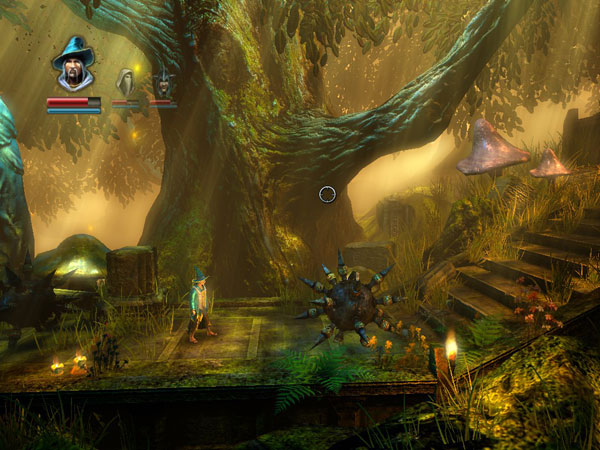
God this game is gorgeous.
Trine is one of those rare games that you forget isn’t some AAA title in the midst of playing it; an indie game that pushes the genre and medium as a whole forward when so many big studios are cashing in on derivative sequels.
The premise of the game is that a mage, a thief, and a knight walk into a bar end up touching the Trine, a plot object that explains why you can instantly swap out one character for another one at the touch of a button. The mage is able to conjure into being steampunk-esque cubes, planks, and eventually floating triangular platforms, in addition to being able to manipulate said objects (and others) by moving them around telekinetically. The thief is extremely agile, shoots arrows, is able to perform a limited wall-jump, and has a grappling hook that allows her to swing around. Finally, the knight has a sword and shield, can lift heavy objects, and can break barriers down with a giant hammer.
The plot itself is fairly generic fantasy storybook fair, but the lack of its depth is easily compensated by the puzzle platformer aspect of the rest of the game. See, you’ll come across “puzzles” like a pit with a bunch of spikes in it that is too far to jump over. You can “solve” it as the mage by conjuring cubes to drop onto the spikes, conjuring planks to lay over the spikes/across the cubes, build a cube tower to give you enough height to jump across, and so on. Alternatively, you can use the thief’s grappling hook to grab onto any overhanging wooden branches and swing across. Or you can have the mage conjure a floating platform, and then have the thief grapple the platform to swing across. Or just have the mage conjure multiple floating platforms. Or… you get the idea.
I put “puzzles” in scare quotes because they are never really presented as puzzles per se. Some are, sure, but many are not. What’s great about the system is that each of your three characters level up and get to choose where to spend “talent” points, for lack of a better term. For example, I may decide that I want the mage to be able to conjure three cubes instead of just two (at the expense of two planks, or upgrading the floating platform to be wooden, so the thief can grapple onto it). That choice has a profound impact on how you end up getting past certain areas, as you can imagine.
Even though the characters do not end up being terribly balanced against one another – the thief can generally complete 99% of the game by herself, if you have quick enough reflexes – the game as a whole is delightful, absolutely gorgeous, and ends far, far too quickly. I would have easily been entertained for another 20 hours had there been that many more levels.
Review: And Yet It Moves
Game: And Yet It Moves
Recommended price: $1 / Steam deal
Metacritic Score: 75
Completion Time: ~2 hours
Buy If You Like: Proof of concept physics-based indie puzzle platformers
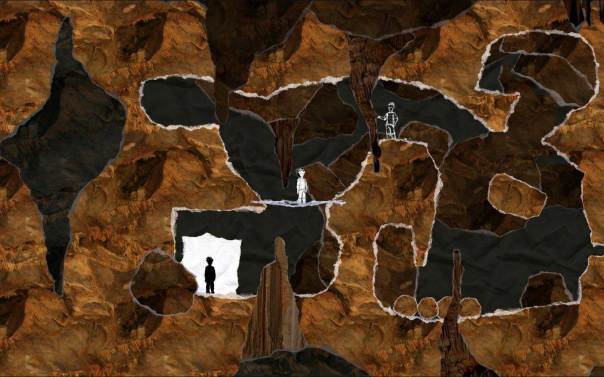
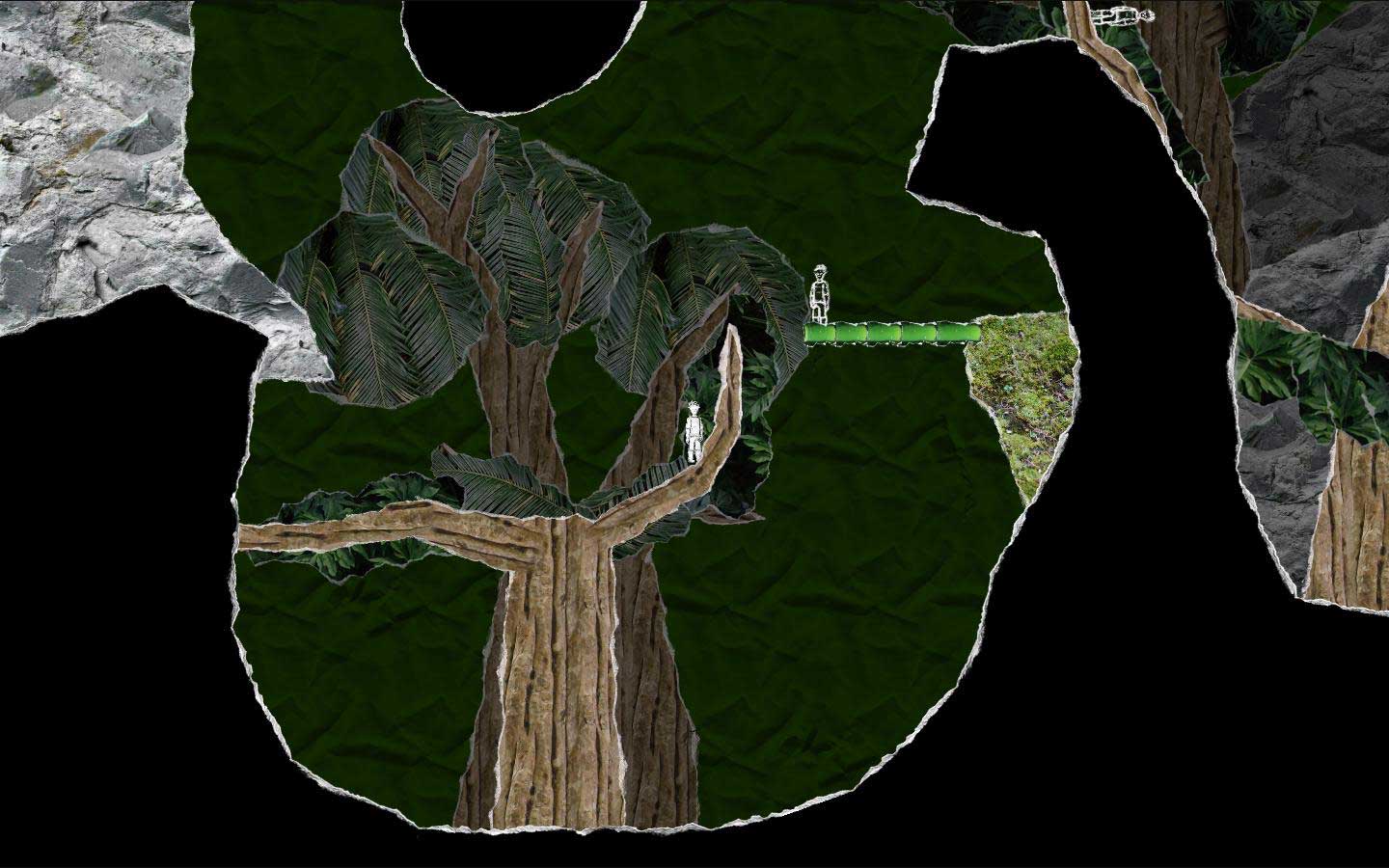
- Get those balls from A to B without hurting yourself. Always harder than it looks.
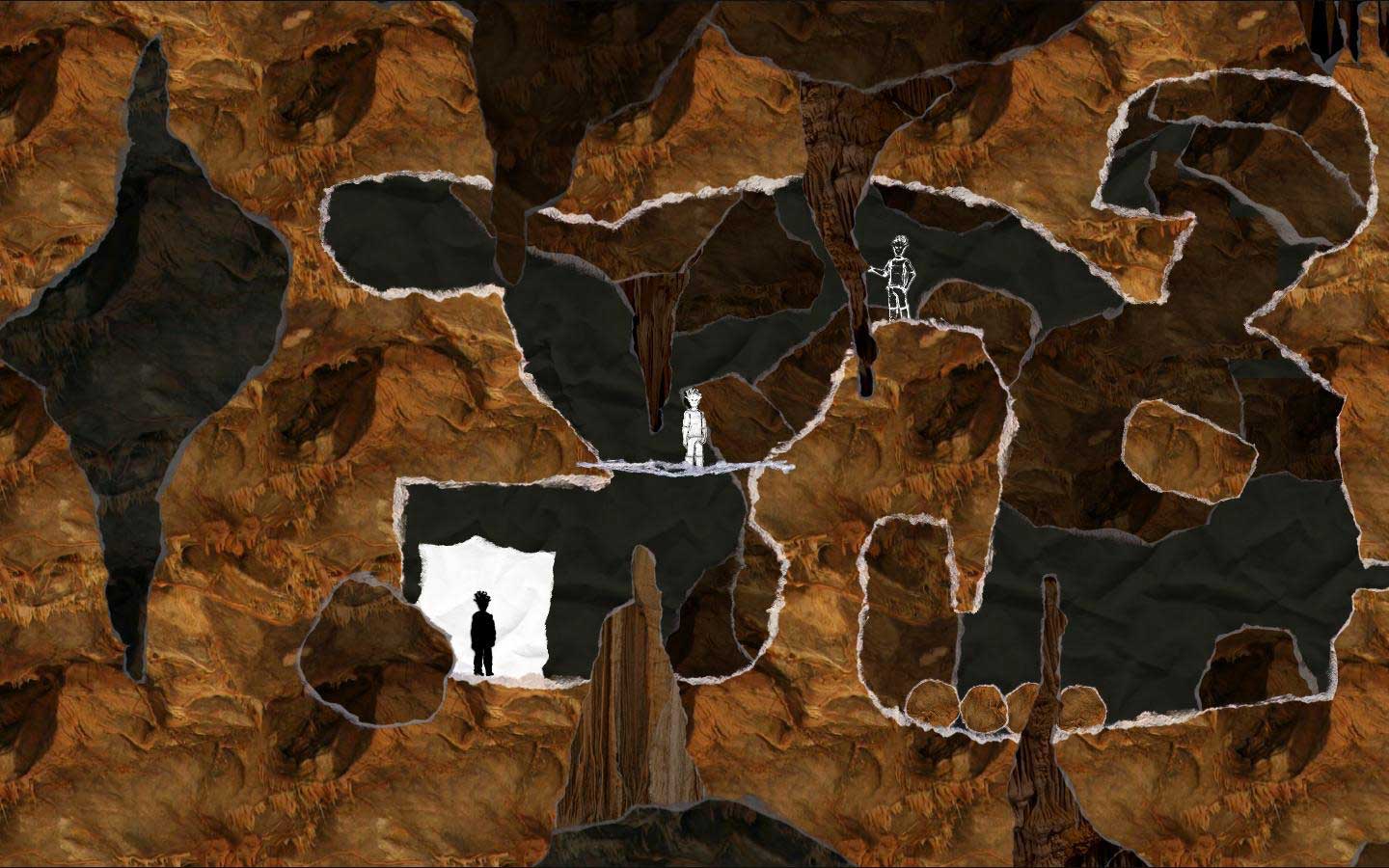
The great thing about the indie game phenomenon is how moving beyond the necessity of fully-realized 3D graphics not only allows smaller companies to compete with commercialized behemoths, but also exposes us to visual styles that are equal parts game and art. Quite apart from anything else, one of the best points about And Yet It Moves is how well the paper mache slash magazine cutout slash last minutes of Rejected Cartoons comes across. The visuals along with the “death” animation along with the ambient soundtrack and sound effects all mesh into an unified narrative, so to speak, that simply works.
The game itself works too… as a proof of concept goes. You move the avatar left and right and can jump, but the lion’s share of gameplay takes place by the ability to rotate the entire game-world in 90 degrees increments (with a quick 180 option as well). The physics puzzles primarily have to do with the short distances your avatar can fall before he explodes into paper confetti – momentum is conserved during the rotations, which can quickly result in terminal (for you) velocity. These physics also apply to various paper boulders and other debris that may be nearby, so care has to be maintained lest you blithely turn a floor into a wall and get crushed by the scenery.
Overall, the game is fairly addictive between its charming indie qualities and excellent pacing, but there is simply not enough of it to go around. Frequent checkpoints thankfully save you from having to redo each major puzzle element of the level should you die afterwards (you will), though this does scoot the player to the credits in less time than most movies. At a default price of $9.99, that is fairly ridiculous. If you see And Yet It Moves as part of some Steam or indie game pack deal, you can rest easy in the knowledge that this game’s inclusion does add value to the purchase. Just not enough to justify the full MSRP.
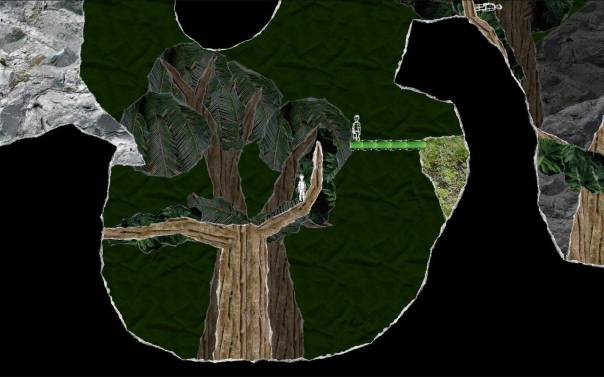
- You quickly lose all sense for up and down, without the pesky disorientation.
 In An Age
Minecraft Beats CoD
Oct 29
Posted by Azuriel
As reported by Kotaku:
And, of course, one of the very first comments is “One overrated game tops another.”
I have not booted up Minecraft since the beta ended – not out of hipster snobbery, but due to having gotten my 100+ hour fill already – so I cannot really speak to the game as it exists currently. But let me just say: good goddamn job. Although there have undoubtedly been indie game successes before this one, I think the gaming historians of the future will look back and catalog indie games as being BM (Before Minecraft) and AM (After Minecraft).
Going from 1-2 programmers to knocking Call of fucking Duty out of the number one slot on Xbox Live is a success story for the ages.
Kinda makes me wonder whether this topical (MMO) sandbox debate has some traction. Is Minecraft just an Angry Birds, e.g. hugely popular in a self-contained way with few derivatives? Or is it more of an iPad phenomenon, e.g indicative of consumers being introduced to something they did not realize they wanted (like tablet computers)?
Start your betting here.
Posted in Commentary
1 Comment
Tags: Call of Duty, Indie, Minecraft, Xbox Live