Blog Archives
Impressions: The Outer Worlds 2
When it comes to The Outer Worlds 2 (TOW2), when compared to the original game, there have been some marked improvements in some areas, and some continued nonsense in others. What follows are my initial impressions after about 12 hours of gameplay, still on the first planet.

One of my gripes from the first game came from what I considered stunted exploration:
Outside of combat, things are so formulaic that I don’t even know why Obsidian bothered with exploration elements at all. There are three ammo types for all guns (light, heavy, energy); there are multiple damage types (physical, corrosive, etc) but they map 1:1 in a cookie-cutter resistance way; 99% of everything you find is either currency, unnecessary food, and more copies of generic guns/armor to break down for generic parts to repair the guns you chosen to use; mods for guns/armor sound important but are again generic nonsense (your melee weapon deals plasma damage now!) that just ticks the customization 101 box. Even the Perks are boring.
I am pleased to report there are now 10 (!) ammunition types! But seriously, there is a much bigger emphasis picking up random pieces of junk to break down into useful materials and then crafting them into other items. I cannot exactly recall if the prior game already had a similar system or not beyond repairing/upgrading, but it certainly feels much better in TOW2. Additionally, there have been several unique “playing cards” sprinkled about that grant permanent buffs when picked up. Overall, it is not on the same level as Fallout whereby you shout in excitement at discovering an Aluminum can amongst a bunch of Tin ones, but it does make general exploration more worth it, with a knock-on effect of making navigating the game world more engaging. The Avowed-style vaulting certainly helps too.
Sadly, one of the things making the world considerably less engaging is the Skill/Perk system.
Not sure if this qualifies as a hot take, but I despise Skills checks in games. “It encourages roleplaying and specialization.” No, it does not. There is nothing more nakedly mechanical and abstract than a Skill check. What is the difference between Speech 3 and Speech 5, from a “roleplaying” perspective?

To me, roleplaying is all about choices you make. When you defeat the bandits, do you forgive them or do you execute them? Do you accept the quest from the shady merchant, or do you turn them in? Or do you complete the quest, keep the item, then kill the merchant yourself while pinning the death on an innocent bystander? Those are meaningful roleplaying choices. Imagine not even having the option to turn the merchant over to the authorities because you put one too many points into Lockpicking last time you leveled up.
To Obsidian’s credit, TOW2 is not entirely binary in the Skills checks thus far. A stuck door can be opened with Engineering 3 or the Brawny Trait. Special medicine can be synthesized via Medical 4 or just winging it via the Lucky Trait. Sometimes just finding incriminating evidence is enough to trigger additional dialog choices. But there are absolutely single Skill checks in quests or conversations and you either have the number, or you have the deficiency rubbed in your face. Which means if you want to roleplay “someone in an RPG who can talk to people,” you need to hyperfocus on maxing out Speech. That’s 20 points, accrued at two points per level. Since there is a level cap of 30, that means you can max out just 3 total skills (out of 12) with everything else being zero, or perhaps max two with some scattered levels in other things for flavor.
To state the obvious, this is not a fun way to play the game. “Yay, level up and… another 2 points into Speech.” Or, in actuality, just leveling up and not choosing any Skills at all because I don’t feel that I have enough information to even make a meaningful choice. Is Speech 4 good enough for this area of the game? Can I afford to raise Sneak to 2 in order to get past this skill check and break into the building in front of me? Or am I going to immediately regret it the next time an NPC starts talking to me?

This is a real scenario I encountered: exploring the map, find a befuddled man in front of a locked house. Don’t have Medical 2, so I fruitlessly exhaust the dialog choices with him. I can see items in the house through the window, but there is no way inside as none of the doors are powered. Up the road is a power sub-station that is malfunctioning, presumably the cause of the locked house. The sub-station repair kit is inside a locked building, and you need Sneak 2 or the Nimble trait to squeeze through the vent. On the roof of the building is the malfunctioning panel, which requires Engineering 3 or the Innovative trait or the repair kit mentioned earlier. If you don’t have any of those… fuck you, I guess.
So, anyway, I’m still running around with 2 loose skill points and about to level up again for a total of 4. Could I put two points in Sneak and solve the area? Sure. How many more Sneak checks will I encounter though? This was literally the first one. Conversely, Engineering has come up quite a lot, so I’m more inclined to put points there instead. But I also have to acknowledge that since I know there will be Speech 20 checks in the game, I only get one other max skill (because I put a point into Guns and Observation), and that was originally going to be Hacking and/or Lockpicking.
This is all very fun, I’m having so much fun, can you tell? So much fun I’m seriously considering deleting 10 hours of progress so I can pick different traits – why did I think Witty was going to be useful if I’m not trying to kill everyone I meet? – and bypass some of these dilemmas. Unless, of course, there will be some future dilemmas with different Skills rendering everything moot.

By the way, I understand that there are indeed real people out there who either don’t care about being locked out of content, or who appreciate the “enforced roleplaying” aspect. I want you to know that I see you… and I don’t understand you. In fact, I may actively hate you. For one thing, the “enforcement” mechanism of discrete Skill checks could have stayed inside your roleplaying mind; you can still commit to your Chaotic Neutral space pirate fantasy without Speech 10 checks sprinkled about. Just, you know, pick those dialog choices, shoot empire guards on sight, or whatever. Hell, I’m more fine with a morality bar governing choices, because at least that is based on prior actions made inside the game world rather than the UI. Where is the fun picking answers before you even get to the questions?
Ultimately, if you have designed your game such that players would rather run around with unspent Skill/Perk points lest they miss out, you have failed IMO. Either by not making them exciting enough to want to pick straight away, or by gating too much content behind them.
Other than, well, all that? The Outer Worlds 2 is pretty good thus far. Time will tell how annoying it will continue getting with Skill checks as we get further into the game. My guess is “loads more annoying.”
Role Playing
One of the most meaningful quests I have ever completed in World of Warcraft actually occurred in Cataclysm. It was called “A Bird in Hand.” Ostensively, it was just another boring, linear quest in a string of half-hearted attempts to spice up the killing of X mobs. Then came this part:
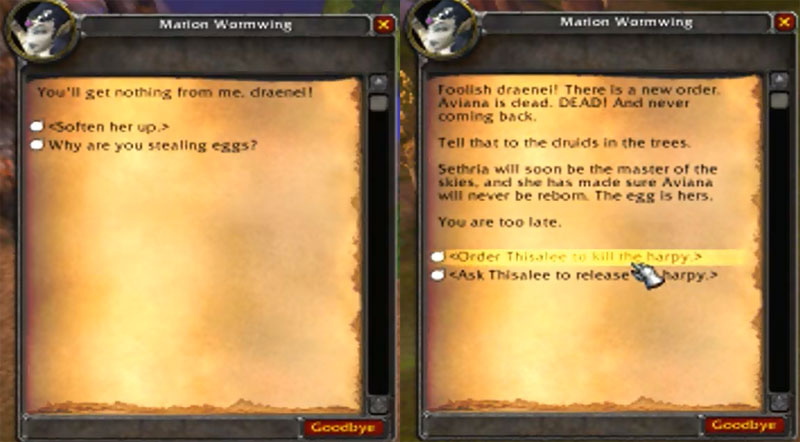
Originally, I pummeled her repeatedly for the sheer novelty of it.
For those unfamiliar, the quest asks you to choose between roughing up the harpy or simply yelling at her. You can mix and match a bit, or you can continue to pummel the harpy until she eventually tells you everything she knows. At the end of this dialog “tree,” you have the option of either letting the harpy go, or having the NPC slit the harpy’s throat. Which options you pick is entirely irrelevant to the game. No future NPC references your actions in any way, the rewards are the same, each option takes an equal amount of effort.
And it was, in all seriousness, one of the best moments in WoW questing.
Because it was not until that moment that Azuriel the draenei paladin was anything other than a mere user interface element. The quest forced me, as a player, to step back and ask myself a question that was never hitherto asked: is your avatar you? What would Azuriel do? And what I found in answering that question was a hidden depth to the game, an unburied black monolith that was full of stars.
Of course, then the quest is over, the fever-dream passed.
So allow me to disagree with anyone who has suggested that the choices in SWTOR are dumb, meaningless, a waste of time. The fact that every Trooper has the same general story as any other Trooper is irrelevant. The biggest success of SWTOR – regardless of what happens in the future – is NOT necessarily voices and deeper narratives, it is that the game represents one of the biggest moves into mainstreaming the RP in the MMORPG that I have seen in years, perhaps ever.
When I played through Deus Ex, or Fallout, or any typical single-player game, the main character was a stand-in for me. What would I do, as a cybernetic super-solider? How did I feel about letting bandits go? What would I say in the ridiculous, impossible situation so far removed from my own life? I don’t know whether it is the first-person perspective of those games or their overall structure, but I do feel different when it comes to MMOs, and my time with the SWTOR beta specifically.
It is one thing to get someone to put themselves into a game, and quite another to get them to bring a character to life and imagine what this entity separate from themselves would do. Mainstreaming the mechanics of empathy, making it fun? That is some Nobel Peace Prize shit going on. And I am only half-joking.
“Our character is what we do when we think no one is looking.”
-Jackson Browne
Having our game decisions result in discrete consequences makes for a better simulation, yes. Then again, in the real world the decisions we make when the consequences are irrelevant or unknowable is a definitive aspect of one’s character. If you helped an old lady cross the street, and she got hit by a car a block later, was your original decision truly meaningless? Are consequences the only arbiter of morality? Is intention irrelevant? You tell me.
All I know is on that soot-filled day in the burning mountains of Hyjal, skin caked with sweat and the still-warm blood of ten harpies, the paladin Azuriel beat Marion Wormring to within an inch of her life. To an inch… and no farther. For in that one, singular moment did Azuriel have a choice: the choice to walk away. And so… she did.
 In An Age