
This gallery contains 3 photos.
Skyrim, of course, is not intended to be an MMO.
That said, as I sailed past 100 hours played and started finally running out of the “named quests,” I started thinking back to when a lot of bloggers were musing on a hypothetical Skyrim Online and how great that would be. As it turns out, there is not much imagination necessary: Skyrim really already emulates a lot of the standard sort of MMO tropes. And, perhaps ironically, some of Skyrim’s other qualities sort of demonstrate why such mechanics generally do not really work in MMOs.
Quests range from “Talk to this guy,” to “Collect 20 Nirnroot,” to “Kill the Bandit Leader in a nation with an inexplicable 10,000:1 bandit to honest citizen ratio.” While there are no exclamation points over peoples’ heads, each city is so densely packed with quest-givers that your minimap – if such thing existed – would be lit up like a Christmas tree. And just like with every quest in an MMO, you never get a sense that you are actually solving anything. Give the Blacksmith 10 Fire Salts to reheat his forge? He may greet you a little differently, but his “secret technique” results in no higher quality merchandise, no larger gold cap, no discounts.
Sidequests are sidequests, though, right? Well, to an extent. The problem is when there are more sidequests than main quests, or when the main quest is boring. At some point, you give the player enough freedom to hang themselves… and they do.
See, I have completely lost the Skyrim narrative. “What am I doing? Why do I care?” Helping a dude steal a horse is supposed to enrich the game world’s verisimilitude, I guess? If that is the case, it failed. The quests are so disjointed and arbitrary that I end up feeling like a dyslexic, ADD-addled coke-fiend with Tourettes, sputtering along countryside with an ever-increasing laundry list of chores. The situation really makes me appreciate all those otherwise lame zones in WoW, insofar as the quests actually lead somewhere or enriched the background of the zone.
I have heard a lot of people lament the state of player crafting in MMOs, but again, Skyrim is a good case-in-point about where strong player crafting can lead to. Basically, I have not upgraded a single piece of gear in the last 40 hours of gameplay. Considering there is no such thing as quest XP, and I have more gold than I could ever possibly spend, the lack of possible gear upgrades essentially boils questing down to its base narrative components. Some hold up, most do not.
Short of the sandbox-esque nuclear option of destroying gear and/or permanent durability loss, I do not see a worthy payout for the costs of strong player crafting. I just completed a long questline to reconstruct a 1,000+ year old amulet whose power started a war and led to it being split into three parts and sealed away; the names of amulet keepers were to be forgotten under the pain of death. After finally reforging it, I held it in my hands and… oh, +30 to Health/Mana/Stamina? I created an amulet with +67 to Health and +40% extra Bow damage nearly 50 hours ago.
/vendor
While some of this can be mitigated in MMOs by making recipes rare, requiring special crafting materials from higher-level content (which is different than normal loot… how?), and so on, strong player crafting still seems to boil down to reducing or eliminating much of the incentive to quest. Perhaps that is indeed the entire point, eh? Moving away from designer quests and into “Spam Trade chat for an hour” player quests? That is fine to do, with the assumption that the game itself is either going full quest-less, or the quests that do exist are so ridiculously fun and exciting that they are intrinsically worth doing.
Although this is not a formal review, if I had to sum up all of my problems with Skyrim in a single word, it would be “pacing.” There simply isn’t any. Even if the game revolves around doing what you want, pacing is important. I am level 51 and I can 2-shot dragons with my bow from stealth – the game is essentially over for me. And yet the main questline is not remotely near complete, nevermind the handful of other quests remaining. Yes, “I did this to myself.” If EVE gave every new player a Titan for completing the tutorial, those players would also be “doing it to themselves” for (ab)using it too.
Point being, it is the designers’ jobs to craft a well-paced game. I don’t care how sandbox your design is, I shouldn’t be allowed to break the game for myself. One of the great strengths of the themepark experience is exactly the derided “on rails” component: it will take you X days of Y quests to get Z gear. The bosses you face tomorrow will be stronger than the ones faced today. There will be a quantifiable reason to collect 10 bear asses.
After 100 hours of gameplay, clearly Skyrim is doing some things right. I have never taken more screenshots in my entire life, for example. Despite my character being completely broken, I still treat the world seriously (sneaking around when I could simply kill things straight-up) because it projects seriousness in most every scenario. But instead of making me pine for Skyrim Online, it does the opposite. I miss the strong narratives of Fallout 3 and New Vegas. I hated having to level through Burning Crusade content in WoW, but I hate tracking down 20 Nirnroots more.
Pacing is something to keep in mind when constructing your hypothetical sandbox or Impossible MMO. More options, more things to do, can actually result in less meaningful gameplay. Skyrim deserves its accolades, but it makes for a pretty bad MMO. And the changes necessary for Skyrim to be ported into the MMO world would, in fact, make it resemble nothing like its present state.
Skyrim thus far has been as amazing an experience as everyone says. There is something to be said about how the fidelity of an experience engenders instant immersion in ways videogaming might not have achieved even five years ago. I already posted the screenshot of what I saw exiting the tutorial dungeon for the first time, and I was immediately struck by the same awe and infinite possibility I felt leaving the Vault in Fallout 3.
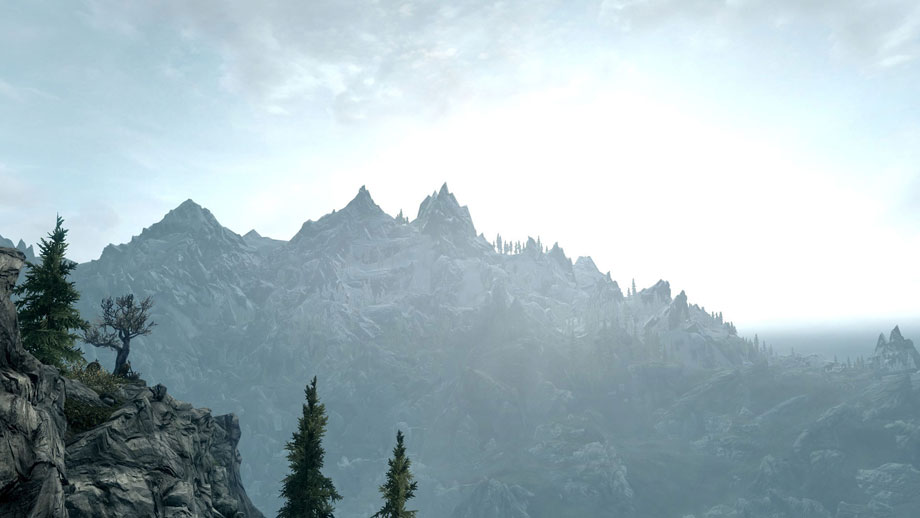
My current desktop background. Well, at +1000 resolution.
What I want to talk about today though, are the Design Nettles in Skyrim. These are the little things that take me out of the experience with their sting, no matter how much I try and ignore them. Every game has its idiosyncrasies, but what elevates these particular annoyances is either how out of place they seem within the context of a fidelitous experience, or how much they are artifacts of a bygone design era.
Raising one’s Sneak level by auto-running into the wall for an hour has been a staple of Bethesda design since at least Morrowind. Why they choose not to fix that isn’t the problem. The problem is simply the imbalanced skill gains generally.
I gained two entire character levels in the first town from simply pickpocketing; going from level 6 to level 8 within the same house, in fact. Indeed, I gained 5 skill points for pickpocketing ONE ITEM, a magic ring from a sleeping guy. My pickpocketing skill is currently north of 70, I am level 21, and I haven’t even seen a 3rd city or a dragon yet. Meanwhile, I have probably picked 30 locks in the same time period and received ~4 skill ups. Same with Blacksmithing, Alchemy, Enchanting, Sneaking, Archery, and so on and so forth.
This is more of a problem in Skyrim than it was in Oblivion, because gaining any skill points increases one’s level, which in turn increases the level of all enemies in the game world. More insidiously, you can go hours (or specifically 18 hours in my case) before the problem even begins to manifest itself. I ran into some bandits on a bridge who were immune to my normal tactics which had hitherto worked in every encounter, and I only succeeded by “gaming” the system in rather ridiculous ways – playing Ring-Around-the-Cookpot and ladeling myself 16 servings of Apple Cabbage Stew in Matrix-esque bullet-time.
I can appreciate the design challenge that comes from choosing to have enemies appear on the minimap. Specifically, once you do that, you cede the ability to create tension via unknown enemy placement without resorting to dumb gimmicks. I like to call this the Silent Hill effect – unlike Resident Evil or other survival horror games where monsters can jump out at you at any moment, Silent Hill gives the player a radio that plays static whenever enemies are about. No static, no monsters.
Silent Hill as a series gets around this “limitation” by being fucking scary even when there aren’t enemies around (and by segmenting the game into rooms), but Fallout 3 and Fallout New Vegas fall into the trap of essentially lying to the player; “You can see enemies, and even raise stats to see them from farther away, unless we need to generate tension in which case your abilities will be useless.”
Skyrim attempts to have it both ways, while simultaneously stepping into one of my biggest pet peeves in “realistic” games.
In Skyrim, enemies that have aggro’d to your presence appear as red dots on the map-bar. You can even track the movement of these enemies through walls and barriers. Other than that, nothing appears on the map-bar other than locations. Which is… fine, right? Resident Evil, Half-Life, etc, don’t have minimaps with enemies on them either. My peeve though, relates to how high-fidelity games play out as if my highly skilled avatar is as clueless as me, the player.
Look. It’s clear the Skyrim designers decided not to put animals/people/etc on the minimap in order to increase realism. If I’m chasing butterflies to eat their delicious wings, it’s fair play that the tiger I wasn’t even looking for gets its turn too. But if I’m specifically hunting that tiger, or I’m sneaking up on the bandit camp, it simply feels dumb to be surprised due to lack of information. I can’t hear the guy in full plate walking around because the designers refused to give me that input; or if they did, they made audio-only to the point where I’d blow out my desktop speakers trying to hear it.
You can’t ask me to put myself in that field, and deny me access to my normal senses. And you can’t pretend that my normal senses are adequately represented in your arbitrary, game design way.
In other words, Christ, I want NPCs on that minimap. It obviously changed my behavior in the Fallout series knowing where people are even through walls and such, but removing it and pretending my character is as careless as I am playing the game is worse. Indoors? Yes, it works well to force people to be careful. Outdoors? Completely ruins any semblance of stealth-ish gameplay. At least, until I “beat the system” by Quick-Saving every 30 seconds and simply reloading if I stumble into a bandit camp without the opportunity to sneak attack someone.
The ideal scenario, I believe, is to start playing popular (or notorious) games right when they come out. Not only is the potential for spoilers minimized, but there is also something to be said in exploring a brand new game as a virtual group, together. And the pageviews. Can’t forget about the pageviews.
Riding in on the backwash of the tidal wave of Skyrim blog posts does grant me the sort of perspective that First Day/Month players don’t start out with. Sometimes it’s good (“Don’t Sneak into a wall for two hours.”), sometimes it’s bad (“Infinite mana via Enchanting, yo.”), and sometimes… well, you start noticing things right away:
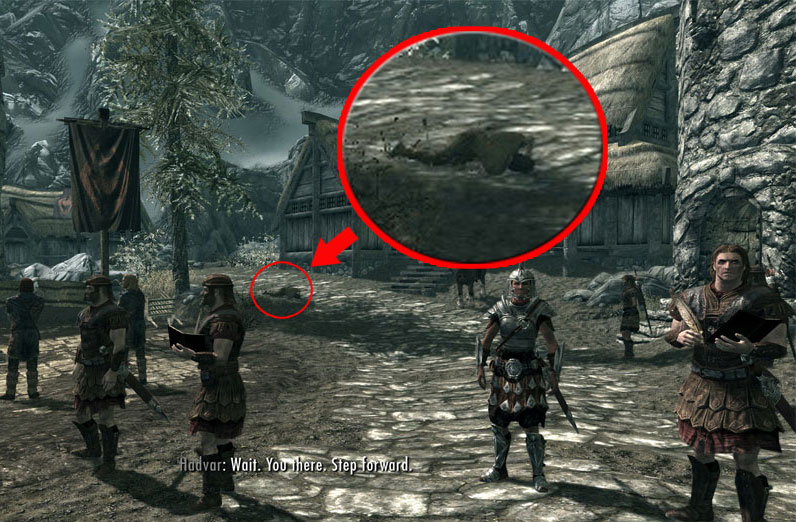
Wait a minute... did that arrow really hit him in the...
That aside, I wanted to kind of lay out the way I was approaching Skyrim before I get too far (12 hours and counting) into it to remember – indeed, I only stopped to write this because I had a C++ crash-to-desktop interrupting me.
If the above sounds concerning in any way, allow me to alley those fears: I walked into Skyrim with a fundamentally different attitude. In the years since Oblivion, games like Minecraft (and, if I’m honest, other gaming blogs) taught me to enjoy more free-form, emergent gameplay.
I still prefer narrative-driven games, of course, but having an audience for Show & Tell purposes actually gives those random occurrences a narrative feeling – nobody cares about the crazy dream you had last night, but hey, look at this:
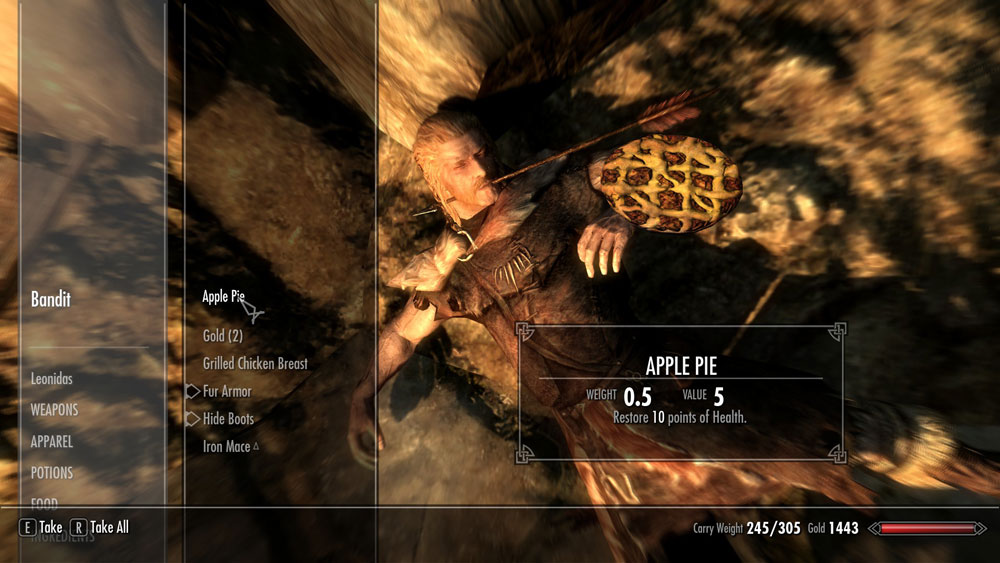
Horrific arrow wounds + delicious apple pie.
So, anyway, Skyrim is happening. Given the blogging saturation surrounding the game, I will attempt to keep “Christ, look at that mountain!” posts to a minimum. There is actually some topical problems I have with the game’s design, which I’ll get into a bit later. Interestingly, none of the problems are the interface.
Finished Mass Effect over the weekend.
As I was browsing my Steam game list looking for, you know, a shorty, breezy title to cleanse the palate, I came across a game I hadn’t heard much about in the blog scene. Not quite sure what it’s all about yet – it has something to do with dragons and getting lost in the woods and collecting brooms, I think. Since there doesn’t seem to be much written about it, I’ll keep poking around and let you know if I find anything interesting.

I just got a new computer about two years ago. Everything runs completely fine!* What would I even do with the old computer? You know those people who buy a brand new car every other year, and how much you hate them? Don’t be that guy.
Besides, you have plenty of indie games and MMOs to keep you busy practically for years to come. Who cares that everyone is talking about Skyrim?
Why do developers do this shit?!
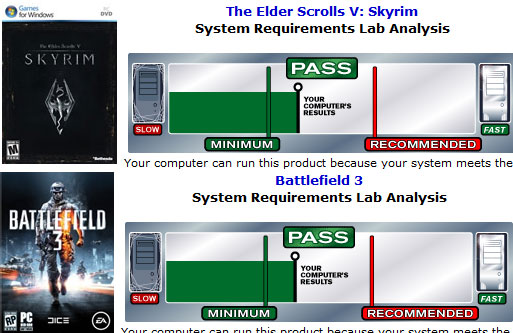
I paid something stupid like $1400 on a computer two years ago and already I’m being priced out of videogames? I could have spent that money on a PS3 and XBox 360 on launch day and been good for the next seven years! This is why there will always be a market for consoles; what kind of insane person buys the equivalent of $700 videogames?
And when did the computer component world pass me by? “Sandy bridge” my ass.
You know, I had a real handle on graphics card models back in the day. I could explain that a NVidia 8700 was more powerful than a 9500 – the trick was that the first number was a model number, and only the last three digits meant anything important. Nowadays, the NVidia guys are telling me that their goddamn GTX 295 outperforms their GTX 560. Sounds sorta like the old system, right? But wait! The GTX 480 spanks them both. You can’t explain that!
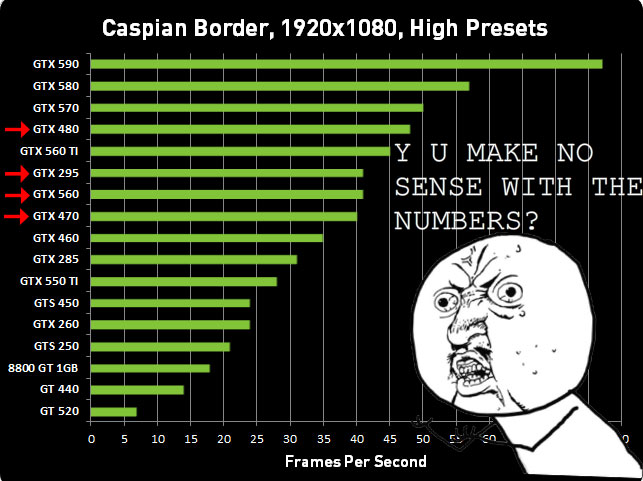
Okay, you win. I spend probably close to 90% of my free time using the computer, and two years is like a decade in internet years anyway. If I just cave and buy a console, I’ll miss out on all those ridiculous Steam deals; the money I’ll save probably makes the price a wash. Nevermind that my computer monitor is larger than any TV in the house… and I really, really want to play Battlefield 3/Skyrim/etc.
I don’t need the bleeding edge stuff. Maybe something that, you know, is done bleeding but still warm. For about $1000.
I have no idea WTF I am doing. NVidia helpfully says I can buy everything off of Newegg for ~$700 and then build it myself. That’s great… until I start reading shit like this:
Static electricity is the biggest danger to the expensive parts you are about to assemble, even a tiny shock, much too small for you to feel, can damage or ruin the delicate electronic traces, many times smaller than a human hair, that make up your CPU, RAM and other chips. It’s important to use your anti-static wrist strap to prevent damage to these components. Once you have the power supply installed in the case, clip the end of the wrist strap to the outside of the power supply. (Never plug your computer in while you are connected to it by a wrist strap.)
[…]
Installing the CPU, and the CPU’s heat-sink and fan, are by far the most difficult steps you’ll have to complete during your build. Here, more than anywhere else, it will pay to read the instructions carefully, look at the parts, study the diagrams that came with your CPU and/or third party cooling solution, and make sure you thoroughly understand what you are going to do before you try to do it.
There is no getting over the sense of impending doom that is knowing it is possible to destroy a CPU with static I won’t even feel, and can probably launch just by looking at it funny. Christ, I cannot even look at a Micro SD chip without getting an insane urge to put it in my mouth.
There is no way this is going to work.
Surely though, with components at $700 I could find some place willing to build it for me for like $300, right? Everyone tells me its easy, so that should be an easy $300. Except… not so much. Oh wait, this computer looks pretty cool. Hmm, let me check out the comments.
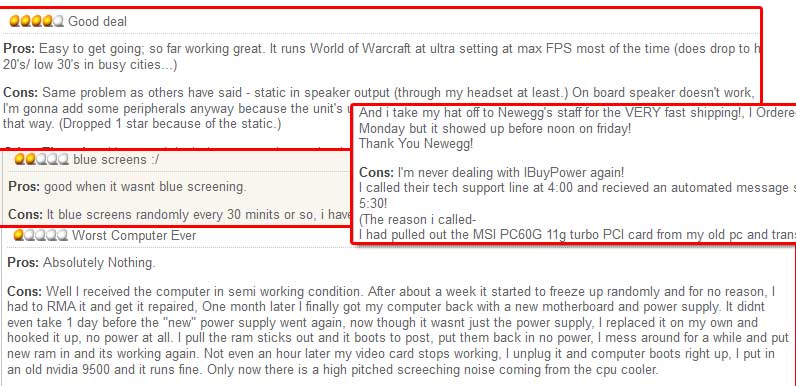
Negative Newegg.com comments make me mistrust all technology, everywhere.
I don’t know what to do anymore. Maybe I shouldn’t scrimp on a computer. My current computer was like $1400 at the time, so maybe I should look at the higher end machines and just go for it.
Wow… look at this $1600 machine. Liquid cooling is badass. Alright, having the liquid cooling leak all over the inside of the computer during shipping sounds less cool in the comments. I suppose I could at least look at the Youtube video they provided.
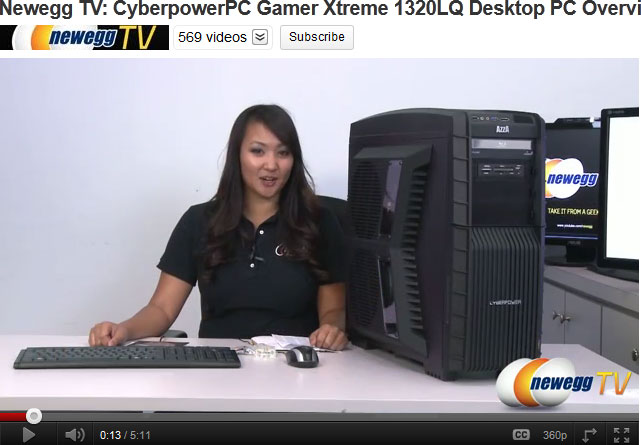
Holy mother of Christ, is that Asian chick just tiny or is that case really the size of a goddamn diesel generator?
You know what? I can’t do it. I just can’t. That thing costs about 1/4th of what I spent on my car, and is about 1/4th the size of the car to boot – at this point, I would be shopping for a new desk just to have somewhere to place a computer, a new chair to fit the desk, and renting a crane to lower the case through a recently installed skylight. All the while praying to any god that would listen so that some component I cannot begin to touch without frying it did not come loose in shipping.
I can troubleshoot software no problem. But I know just enough about hardware to know I will A) screw it up building it myself, B) get screwed buying pre-built machines on the cheap, or C) get screwed buying expensive pre-built machines only 1% better than the half-priced prior generation machines.
Until I break down and buy something from Best Buy simply because it offers the safety of having a physical location to direct my ire. Not that any of them ever have an idea of what they’re talking about, aside from sending the computer off to Asscrack, Alaska for the next eight weeks.
But hey, the devil you know…
*For given amounts of fine. For example, my audio-out only delivers sound from the left speaker. Headphones work fine, but I have bought 3 different sets of external speakers over the years, and all of them had the same problem. Of course, none of the audio cables fit in all the way, but I’m tired of spending $20 a pop guessing.
 In An Age
Designer Responsibility
Nov 18
Posted by Azuriel
How responsible are game designers in the balancing of their (single-player) game?
Syncaine swerves to the right:
One theme I’m seeing is the debate about what is OP [in Skyrim], and how easy it is to min/max the game. I find this… odd. As Nil’s himself pointed out, you can turn godmode on if you want, and be as ‘maxed out’ as you can possibly get. Hearing that people are ‘exploiting’ the game by running into a wall for hours while hidden to max out stealth makes no sense to me. Why waste all that time, just go into the character file and put stealth to 100. […]
“Am I to blame?”
Yes.
Luckily the solution is easy; remove one or more of the enchanted pieces, or up the difficulty, or RP a reason why you no longer require mana to cast spells.
I’d rather you do that then Bethesda spend time hardcoding a solution over adding yet-another-quest, or whatever other content they could do in that time. Or have the hardcoded solution prevent me from play “how I want”.
If this was an MMO, 100% valid point. If it was a multiplayer game like Dungeon Defenders, still 100% valid. An sRPG that is far more about the journey than the end-goal? Naw, non-issue IMO.
Nils has a more center-oriented approach:
I agree that it is partly in the player’s responsibility to not optimize the fun out of his game. An example would be sneaking against a wall until you have maxed out stealth in Skyrim.
On the other hand, I just uploaded a video to youtube that shows how I enchanted four items and now can cast destruction and restoration spells witout any mana cost. This is a game changer, as the mana constraint was important in the game – until then. Many of my perks in the talent trees are suddenly useless. The game becomes worse. Playing it is less fun if I can just spam a single spell without looking at mana.
I optimized the fun out of Skyrim. Am I to blame?
The problem is that I ended up enchanting my equipment this way not by sneaking against a wall. I simply skilled enchanting and then used reasonable enchantments on my equipment.
My point is this: A game cannot use the cartot, that character power progression (CPP) is, to increase the player’s engagement with the game, and at the same time allow him to optimize the fun out by hunting the carrot in a reasonable way.
My own left-leaning approach is the same as I outlined in the Culpability of Questionable Design, the very first post I made under the In An Age banner. Essentially, it is (almost) always the designer’s fault.
Don’t Hate the Player, Hate the Game
As I commented on Syncaine’s post, I find it bizarrely apologetic to state that it is a player’s responsibility to not ruin the game for themselves. The specific situation in Skyrim Nils had brought up was the ability to eliminate all mana/stamina costs of spells and abilities via Enchanting. Nils had gotten his Enchanting skill up “legitimately,” as opposed to, say, getting 100 Sneak by auto-sneaking into a corner for a several hours. For the record, I see zero difference between those two activities – both are simply examples of incredibly
poor designridiculous failures of imagination.In Oblivion there existed a Magic College where you could invent your own spells and magic items, within certain constraints. Making a Fireball spell that dealt 100 damage was expensive, whereas a 50 damage Fireball cost less. Similarly, a buff/debuff that lasted an hour was more expensive than one that lasted for only 1 second. After about an hour of playing with the various sliders, I left the College with a ranged spell that decreased the HP of the creature it touched by 100 for 1 second. The practical effect was that it instantly killed everything in the game, at least until I gained many more levels – even then, if I fired it quickly, the second hit would kill anything with less than 200 HP since it stacked with itself. I called this spell Finger of Death, and later added it to a sword along with the Soul-draining property so that as the sword instantly killed who it touched, it refueled itself.
I did not set out to break Oblivion, nor did Nils set out to break Skyrim; the both of us were simply using the tools the designers gave us and taking them to their logical conclusions. It is the responsibility of the designers to ensure that incredibly obvious things (at least in retrospect) like “-25% mana usage” does not stack with itself, that temporary decreases in HP scale the same as damage abilities when their effects are indistinguishable, and so on, are balanced. Arguing to the contrary is to admit that WoW leveling is not too quick since the player can manually shut off XP, that facerolling mobs and instances is a player failure as said player could play with just one hand, play with a gamepad, play with Resurrection Sickness, or any number of entirely arbitrary self-imposed restrictions. It is to abdicate, wholly and completely, any responsibility of the designers to present a balanced, well-paced experience.
Syncaine is right about these games being about the journey, not necessarily getting to the end as quickly as possible. And yet I derive deep satisfaction in the execution of strategies, figuring out how rules/objects work, and finding more efficient ways of doing tasks; those things constitute the journey to me. Turning on god-mode in the console may have the same end result, but it skips all the fun, thinking bits inbetween, just like skipping to the last chapter of a book. In other words: optimization is fun.
And so I believe it is – and has to be – the designer’s responsibility to ensure that if a game can be optimized, that it still continues to be fun and challenging when it inevitably is. Anything less is laziness, incompetence, or both.
Posted in Commentary, Philosophy
13 Comments
Tags: Game Design, Nils, Oblivion, Optimization, Skyrim, SynCaine