Blog Archives
Impressions: Starfield
TL;DR: Consider me… whelmed. Not overwhelmed, not underwhelmed. Just whelmed.
The initial few hours of Starfield are incredibly weak. Like, insultingly bad for a Bethesda game. I had no sense of grounding in the game world like with Skyrim, Fallout 4, Fallout 3, or even Oblivion. After an hour or so, you get dumped into New Atlantis, which is the Starfield equivalent of Dragon Age: Inquisition’s Hinterlands. There is plenty of things to do in the city, all of which you absolutely should not be doing. Not to say the quests are bad per se, but I felt myself burning out of the game after sessions 2 and 3 were all just questing in the city with zero combat.
I decided to break away from New Atlantis and things began to improve. Following the main quest, I get to Mars. Instead of going to the bar where the quest wants me to go, I instead strike out towards an unknown marker. Looks like some kind of rocket structure. I see a spaceship just sitting nearby… so I steal it. The devs have a heavy thumb on the economic scale in this game, so while you can certainly steal a better ship than you have, it costs like 90% of the sell price of a ship to register it, which you need to pay before you can sell it (or customize it). My profit is like 1700 credits, which is the equivalent of selling four guns from dead pirates.
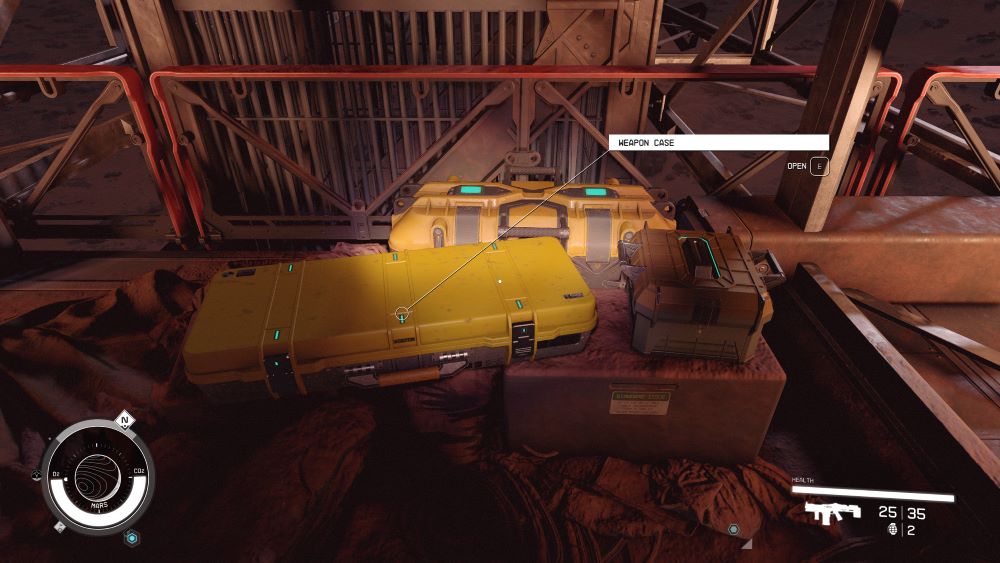
I fast travel back to the rocket pad, climb all the way to the top, which it seems like the devs intended. At the very tippy-top, I see three chests up there containing common gun drops and ammo. Yay.
That is when it hits me. “Exploration” only happens in instanced content in Starfield. Had this been a Fallout title, there would have been a skeleton up there or some other environmental storytelling (audio log, etc). Had this been Elder Scrolls, there may have been some Daedric portal or a unique item or something. The rocket pad is a Point of Interest, yes, but I will no doubt be seeing similar rocket pads across the 1000s of planets in the game, and they all need to have a chest at the tippy-top.
Or maybe I am wrong, and the launch pad on Mars was specifically hand-crafted. In which case… yikes.
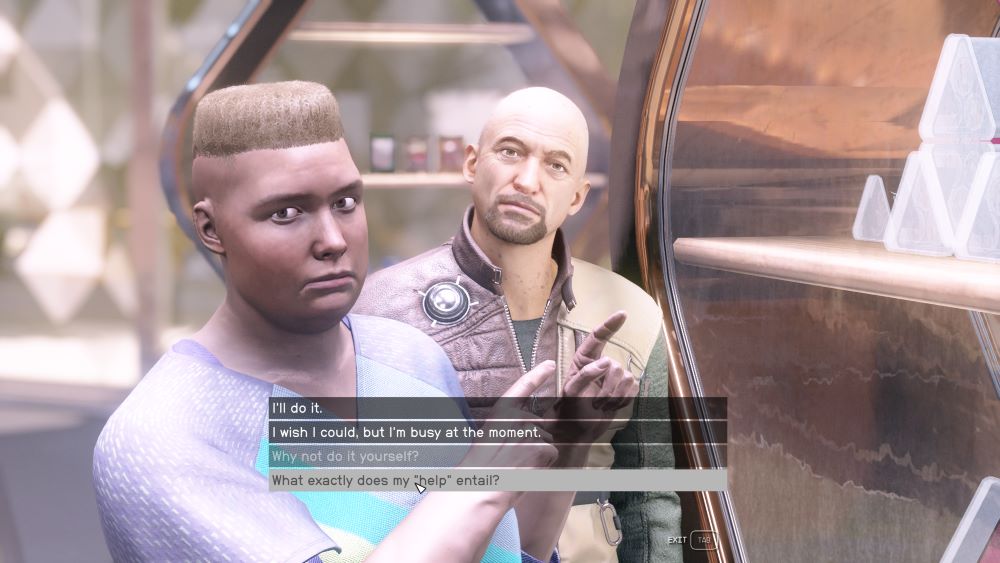
On my next play session, I go into the bar as intended. Along the way, I overhear a conversation about how some miners are being turned away by the mining supervisor. I talk with him, and he asked me to mine some Iron “off the books” so that it looks like his team exceeded quota and thus will get approval to some badly-needed upgraded equipment. I do that, and now he’s asking me to become an executive assistant to “help” the Fiscal manager to sign the paperwork. No doubt there will be further shenanigans in the space station as I try to get the request approved.
The above is the type of thing I’m actually impressed with while playing the game: mundane-sounding side-quests end up becoming more involved and interesting. There are a tons of these and you can do them or not do them at your leisure. It makes the game world feel a bit more alive and interconnected. As opposed to the literal game world, which is dead and fragmented by loading screens.
Having said all that, I am becoming increasingly okay with it. In Buddhism, “unfulfilled expectations” are the root of all suffering. In a recent Starfield play session, I cleared out a random den of Spacers on Mars, went outside, fast traveled to New Atlantis and off-loaded my loot to vendors, then fast traveled back to the Martian surface to continue looting the building. Is that, strictly speaking, dumb game design? Yes. Is it all that different than fast traveling to vendors in any other Bethesda game? Er… no. It only feels dumb because I have some unfulfilled expectations that this is a good game space games are necessarily immersive sims that play out more like No Man’s Sky.
I dunno. I typically do not mod games on a first playthrough, but I’m feeling like maybe giving myself 1000 more carry weight might actually make the game more immersive than leaving it as-is.
Impression: Outer Wilds
I started playing Outer Wilds this week.
So far, I’m only 22 minutes in.
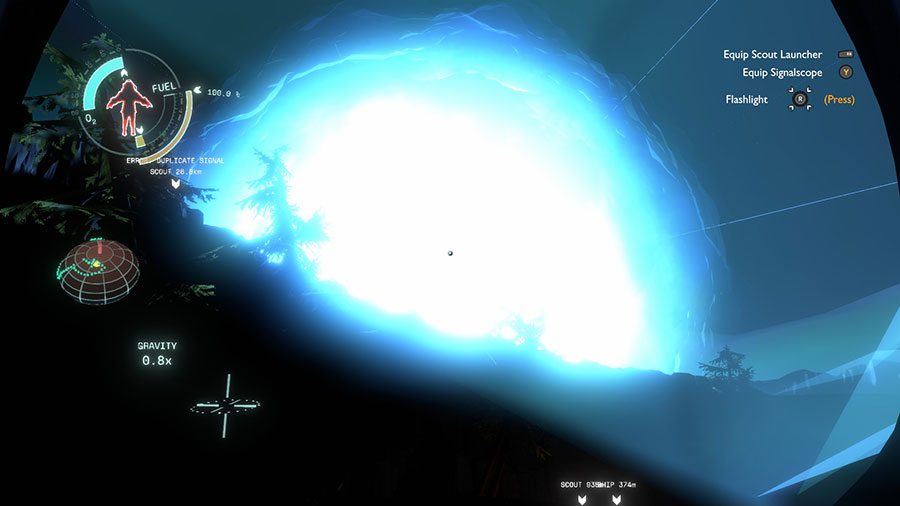
…five or six times. You know, because the solar system explodes and time loops back around.
I don’t think I’ll be talking much about the experience of Outer Wilds as I go along, because a lot of people have gone to great lengths to not “spoil” anything. Not that I have encountered anything in-game that might constitute a spoiler yet. Supposedly the game can be completed in 20 minutes if you know the right place to go, but… of course it can. The sun explodes every 22 minutes of game time, so by definition it has to be solvable within 22 minutes.
What I will say though, is that Outer Wilds has not thus far been anything approaching peaceful or idyllic or an explorer’s dream or anything of the sort. That seemed to have been the impression I gleaned from reading other posts about it.
In my first foray in space, I brought my spaceship over to some interesting orbiting debris, took a space walk to explore, and when I turned around I realized that my ship had floated away. Or rather, was in a rapidly decaying orbit around the goddamn sun. So I chased after it, damn near skimmed the surface of said sun, and then was slingshotted out into the abyss of space where I eventually suffocated in the darkness, alone.
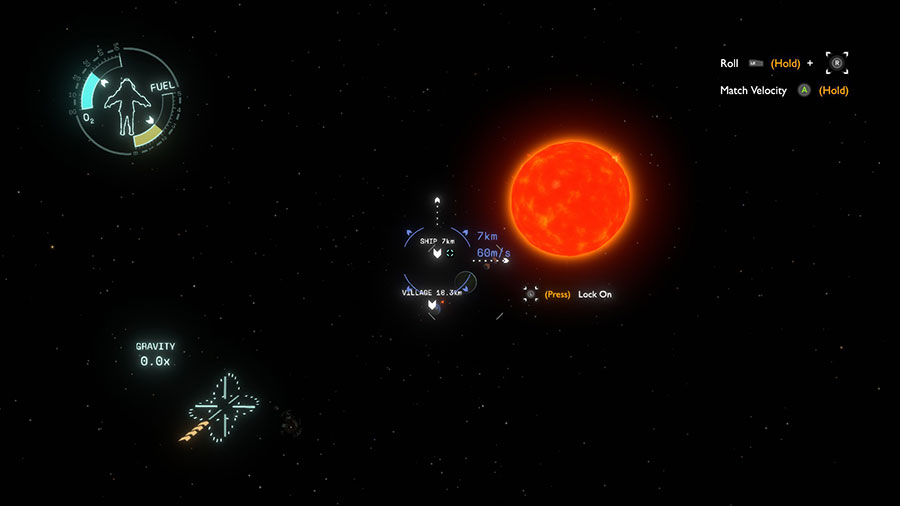
That was the “first death” too, so I had to watch it play out in its entirety. Kind of fitting, I guess. On all subsequent screw-ups, you can use the menu to manually reset the time loop at will. But that kind of starter experience really sets a tone.
After that, I started exploring an ocean planet with constant, horrific tornadoes that are so strong that they LAUNCH THE ISLANDS YOU WALK ON INTO SPACE. That was a fun second experience. After surviving re-entry somehow, I died walking off a cliff, not having realized a jetpack at full thrust was unable to overcome the planet’s 2.0x gravity. The next few deaths were “only” due to sun explosion as I tried exploring some other ruins. Fun times.
So, yeah. Outer Wilds. Fun in the way I imagine Alien Isolation or the Chemical Plant level in Sonic 2 can be considered fun. But I’m getting the hang of things, and hopefully the experience will improve as time goes on. And loops again. You know what I mean.
Review: FTL: Faster Than Light
Game: FTL: Faster Than Light
Recommended price: $9.99 (full) / Bundle
Metacritic Score: 83
Completion Time: ~2.5 (or 25) hours
Buy If You Like: Harsh roguelikes, micromanaging space ships, indie games
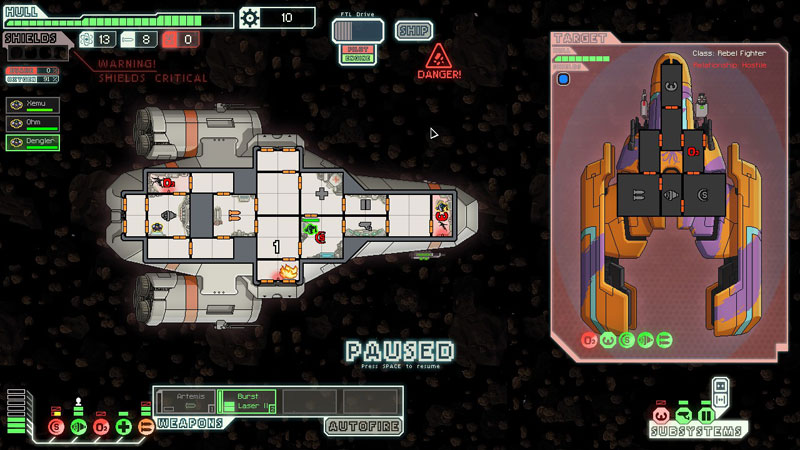
This happened during the FIRST BATTLE in one of my playthroughs.
FTL is absolutely one of those games which, had I not forced myself to dig beneath the brutal, unforgiving crust, I would have written off as awful after the first four hours of playing. While this may have been par for the course for roguelikes, I had hitherto been spoiled by The Binding of Isaac, which not only had a more generous feeling of incremental progression, but a more direct correlation between skill and outcome. With Isaac, awesome twitch-skills is nearly enough by itself to propel you to success. With FTL, success is largely determined by how many coin-flips you win early on.
At least, it seemed that way at first.
…actually, no, coin-flips are still pretty important.
The basic premise is that you are a Federation ship with secret knowledge trying to outrun the advancing Rebel army. Each “turn” you move to an unknown point on the star map and either encounter an enemy ship, a text scenario of some sort, a Store, or possibly nothing at all. Combat takes place in real-time, although you can pause as much as you like. When attacking, you can choose specific ship systems like Weapons or Shields to disable them, or perhaps continually attack their O2 rooms to suffocate the enemy crew. Meanwhile, the enemy is doing their best to repair your damage and blow you up in turn. Some encounters can take place with environment hazards like asteroid fields, solar flares, or ion storms. Defeating enemies randomly gains you Fuel, Missiles, Drones, Scrap, or even ship components. While combat is pretty nuanced and skill-heavy, the text scenarios are the coin-flips where you either win needed materials, or lose big, without much room inbetween.
Once I realized that the game is meant to be played on Easy instead of Normal though, FTL blossomed like an origami flower. Getting more Scrap (upgrade currency) and less ridiculously-armed enemy ships granted the breathing room necessary to learn about juggling power supply, the importance of simultaneous weapon fire to pierce shields, which weapons can snatch victory from the jaws of defeat, and so on.
I also was able to get a handle on which events were riskier than others, and how many of them can be mitigated with certain ship upgrades or items. Since failing (i.e. losing the coin flip) events typically results in losing a crew member, I began to understand that outside the beginning few levels (where restarting is less painful), it just wasn’t worth the risk. But it was that precise lesson in risk management that eventually started turning every Easy run into a full clear, and then doing the same in Normal.
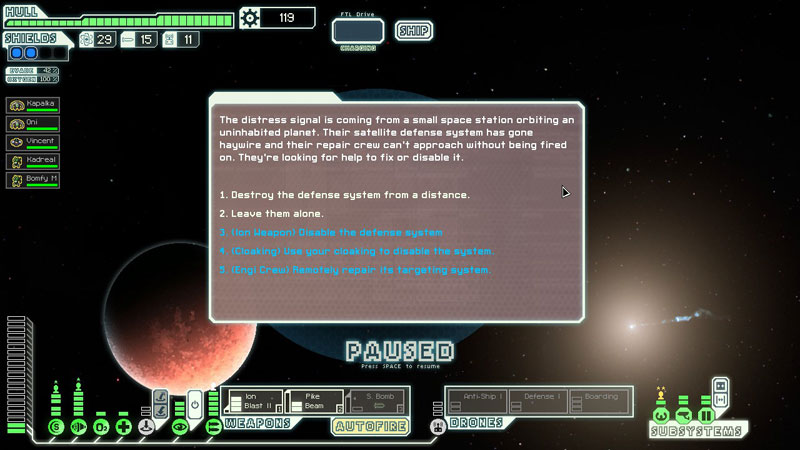
Blue options are always better.
At the time of this writing, I have 45 hours logged in FTL. Part of what keeps me coming back is the cohesion of the overall package, from the 16-bit graphics to 16-bit sound. A bigger part is the very randomness I despised originally. When you start the game, you have access to just a single ship. Getting 2 out of 3 ship-specific achievements will unlock a different configuration of that ship type; these alternate ships not only have different room layouts, but also different starting crew races and weapon loadouts. Entirely new ship types, each with their own alternate layouts, are further unlocked via gameplay. There are a total of 9 different ships, which means 18 different configurations.
What all of this combines into is an extremely slick, subconscious form of progression. Your games with the Engi’s drone-focused ship are going to be much different than your Rockmen’s missile-focused ship. While most ships are going to look basically the same upgrade-wise by the time you get to the final encounter – the ridiculousness of the flagship sees to that – the getting there becomes a game unto itself.
That is sort of the whole point of roguelikes, of course.
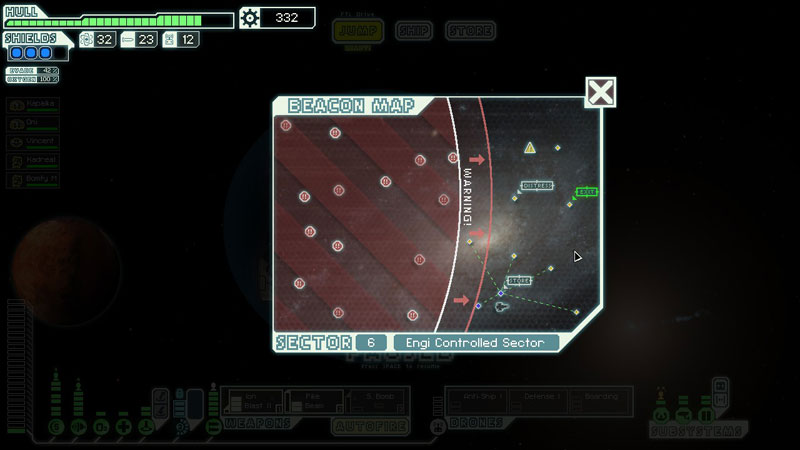
Will I make it? Spoiler Alert: Yes, because I’m awesome like that.
Ultimately, I am recommending this game at full price or Bundle price because it comes down to how much early frustration you are able to handle before giving up. You have no idea how close I was to uninstalling after I died in the screenshot at the top of the review, for example. If scenarios like that make you leery, I suggest waiting for FTL to hit Humble Bundle or Indie Royale as it inevitably will.
If, however, you are the type of person willing and able to muscle through rough first impressions to get at the delicious marrow in the bones of your enemies, buy FTL right now. Not only will you be getting a pretty ridiculous hour-per-dollar gameplay ratio (get 240 hours from a $60 game lately?), but you will be supporting one of the first indie game Kickstarter successes.
 In An Age
The Early Starfield Reviews Are In
Sep 1
Posted by Azuriel
To be clear, I have not played Starfield – the Game Pass version is not out yet. However, there is a Reddit megathread with many of the top review sites linked. Verdict? Mostly good. Ish. A fewer big outlets like GameSpot, PC Gamer, and IGN have given it 7/10 scores though.
One common complaint about the game is the disjointedness of fast travel. There are 1,000 planets to land on in the game, but the actual landing bit is a cut-scene and/or menu prompt.
At first, this seemed like a silly complaint to me, especially when people compared it to No Man’s Sky. Yes, there is an element of fidelity to the simulation in NMS when you fly towards a planet, break through the atmosphere, and then choose to land literally wherever. But that is something they have to incorporate because the fundamental gameplay is so repetitive and shallow. If you could just instantly warp to a Point of Interest, you would “consume” everything it had to offer within 30 seconds and then be done with all the, e.g. language unlocks in an afternoon. Heading back out into space feels good, yes, but its function is padding.
The criticism harder to shake off is when the reviewers point out how segmented exploration gets vis-a-vis fast travel. You may have seen this Skyrim meme before:
That is absolutely something that happened to me while playing Skyrim. Or the times you are just wandering around and stumble across a faction fight, or bandit camp, or whatever else. There are bandit camps in Starfield, and (presumably) faction fights, and other similar events. But the nature of the game would appear to make these things less organic. They just appear on the planet menu. And so I can see how that could become an issue with some people, and possibly myself.
That said… we’ll see. I have always been a proponent of flying in MMOs despite that encouraging the exact behavior I was describing, e.g. drop in and drop out gameplay. I don’t necessarily feel the need for the NMS flying around if the destinations and Points of Interest are themselves are a worthy goal. And if planet exploration is just the equivalent of driving around with the Mako in Mass Effect, we can… just not do that.
Again, time will tell. I have been looking forward to Starfield for a long time and I love sci-fi as a setting and Bethesda games in general. I’m not quite sure why they felt the need to add 1000 planets though.
Posted in Commentary
4 Comments
Tags: Bethesda, No Man's Sky, Sci-Fi, Skyrim, Space, Starfield