Blog Archives
Stardew Valley Revisited
For the past few days, I have been playing Stardew Valley again.

The reasoning was due to a recent 1.6 update, plus hearing good things about the “Stardew Valley Expanded” mod (which was recently updated to be compatible), which I never saw when I was playing back in 2018. Also, despite spending 50 hours playing the first time, I never actually made it all the way through a full year, dropping the game during Winter.
Well… they’re right. You can’t go home again.
When Stardew Valley first released, it was a pivotable indie phenomenon almost right away. It obviously did not invent the farming/RPG life-sim – Stardew Valley itself being an homage to Harvest Moon – but the genre itself saw a renewal and resurgence of interest due to its surprising success. Slay the Spire did the same thing with roguelike deckbuilders; not the first, but certainly a wild success that created space in which alternatives to flourish.
But that is precisely my problem with Stardew Valley: alternatives exist. Dare I say… better ones too. Or, perhaps, some amalgamation thereof.

In the years since 2018, I have played My Time at Portia, Sun Haven, Coral Island, and My Time at Sandrock. The first thing I noticed coming back to Stardew? All the Quality of Life “regressions.” For one thing, you have zero control over the length of the day. For another, in a shocking throwback, the game only saves when you sleep. That has always been dumb design with zero redeeming features, and is especially banal considering the mobile version of Stardew does allow you to quicksave. Other games have also realized that a map showing location of NPCs and important buildings is kind of important. That one can be remedied with mods, but it just makes you wonder why. As in, why play Stardew Valley instead of one of these other games?
And that really is the rub, ain’t it? Why play this over that?
I don’t have a good answer at the moment. Many of Stardew’s NPC stories/events have been lauded as being more realistic and/or nuanced than the genre average, but it’s hard to tell if that is even accurate. Sun Haven and the My Time at [X] series certainly have deeper combat and character skills. Coral Island definitely wins the graphics award, along with some very attractive character art. All of them have fishing, farming, Community Center-esque activities, and so on. I don’t particularly have any nostalgia for Stardew either. So… why this one?
For the moment, I will continue to investigate. I’m at that pivotal optimization stage where there are some interesting decisions going on – do I spend money upgrading my pickaxe, saving for a barn, upgrading the house, etc – but I already see an “endgame” of sorts taking shape. Like, I’ll be done with most of the Community bundles by the end of this first year, I already have a horse, and I just hit the bottom of the mines. From here, there doesn’t seem to be a whole lot of new stuff to look forward to other than more passive ways of getting money, to buy something or other. Then again, I never actually got to any endgame the first time around, so perhaps there is more to be seen (and was added in the past 6 years). Plus, you know, there’s probably something expanded in the Expanded mod.
We shall see.
Impressions: Sun Haven
I’m currently at around 30 hours played with Sun Haven. I bought it six days ago.
‘Nuff said, yeah?

Sun Haven is a pixel fantasy farming/life sim game in the same vein as Stardew Valley. Like, literally in the same vein. Protagonist arrives in a town, meets a bunch of people, can choose a life of toil via farming, crafting, ranching, fishing, mining, and so on. There is a daily community quest board, a calendar of birthdays and festivals, a pile of romance options. Deja vu, yeah?
The thing is, Sun Haven has a lot of very interesting innovations even within the farm/life sim genre.
For example, Sun Haven has no energy meter. That’s right, you can perform actions for as many minutes there are in the day (and you can make those longer too in the Options menu). It almost feels like cheating, for veterans of this genre. And guess what other sacred cow got slaughtered? The game auto-saves constantly, which means you can safely stop playing at any time, e.g. not just when going to sleep. What the what?! If you thought “one more day” was addicting, wait until you play this.
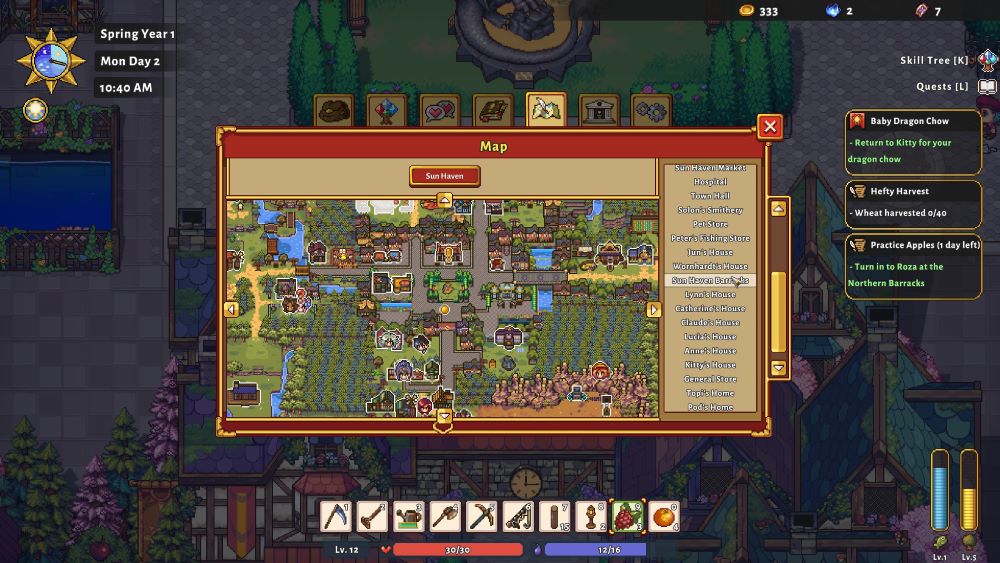
As mentioned before, the setting is fantasy. Your main character can be human… or elf, or angel, devil, and so on. You can also select a starting background, which affects if you arrive in town with some seeds or a fruit tree or farm animals. Magic also features somewhat prominently, with you learning a fireball spell very early on to assist with combat. As you gain XP in Farming, you can eventually get spells that will automatically till a big square via an earthquake, or summon a rain cloud to water your crops in an area.
Another thing that keeps things fresh is the fact that there is a surprisingly large number of Skills you can pick across the Exploration, Farming, Combat, Mining, and Fishing trees. Each one accumulates XP separately, and while the Skills offered generally affects the specific category, sometimes there is synergistic overlap. Also, these are Skill “trees” only insofar as you need to assign 5 Skill points to unlock the next tier of Skills – you are not actually forced to go down one set path.
There is a plot within the game that is unveiled over time via fairly simple questing. I cannot comment much about it at this point, as I have not really seen enough of it to tell what’s going on. What I can say is that additional towns are unlocked (including different farms!) as you progress. I just got to the Elf town and none of the traditional plants you are used to grow there. Indeed, the Elf town doesn’t even use gold as currency, so you can’t just make bank in Sun Haven and waddle your way over to clear out the vendors. I’m guessing that maintaining two or more farms simultaneously will not go over well, but it will be interesting to see if you can effectively abandon your old life and simply start over elsewhere.
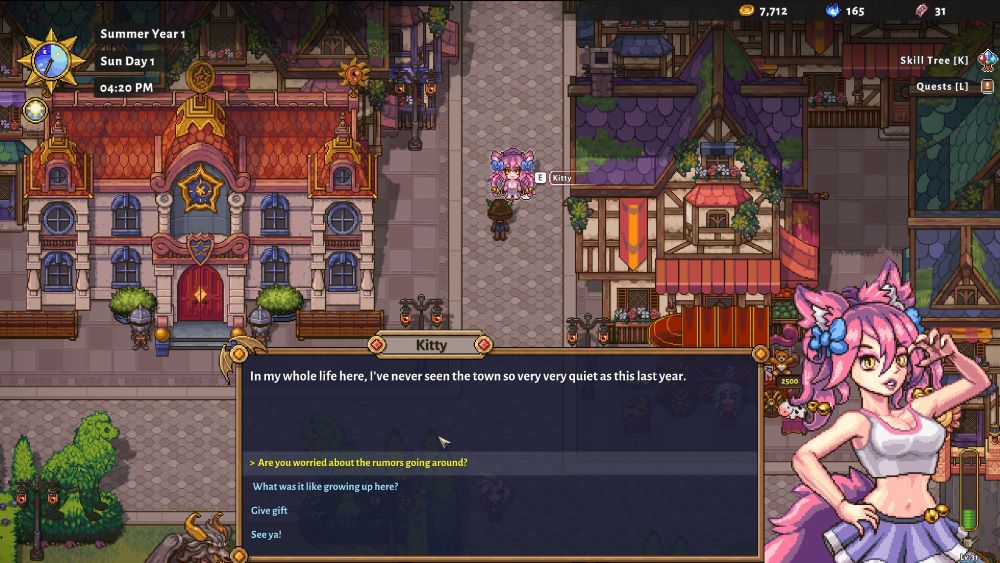
One last piece that I thought was insanely clever was the fact that most foods grant permanent bonuses when eaten, subject to a cap. This encourages you to plant a large variety of crops even after you used Excel to determine the most profitable ones, since each point of extra Mana will save you X amount of seconds by summoning rain clouds instead of using a watering can like a pleb. The bonuses are typically small, like +1 HP and then go down to +0.75 HP for the second serving, but across the dozens or so recipes it all adds up. This can affect HP, MP, Attack, and even movement speed.
My only real criticism so far is that the game is so well-made that I started expecting more out of it. For example, combat is extremely simplistic. Enemy will aggro and try to melee you. You can unlock a Fireball spell early, or you can rely on Crossbows or Sword swings to defeat them. None of this is all that different from other games in the genre. And yet I kept thinking that Sun Haven needed more spells, or enemies with a more interesting attack pattern or something. Exploration feels really good, with a whole pile of useful things to collect off the ground, and yet enemies being so simplistic sort of diminished that somehow. I will say though, that I encountered one boss out in the world that made me flee, and that made things exciting again. Just wish there were more of that in normal enemies.
Overall? Sun Haven gets top marks from me. The genre innovations – mostly in the form of sacred cow slaughters – is a breath of fresh air, and the sense of progression is top-notch. I’m excited to see what the rest of the game has in store for me, even though I’ve already clocked in more than my money’s worth just in the first third of the game.
 In An Age
Farm-Sim Annoyances
Apr 8
Posted by Azuriel
Although I am continuing to play Stardew Valley, this experience is reminding me of design annoyances frustratingly common to the genre at large. Non-exhaustive list:
Challenge/Interesting Decisions are Front-Loaded
When you first begin any farm-sim, you have a mountain of dilemmas to resolve. Which seeds do you buy first? Do you focus on fast-growing crops to maintain cash flow or do you invest in long-term payoffs? Should you spend time clearing the farm, foraging for extra crops, mining for ore, or fishing? Do you spend your first wave of cash on building a Chicken Coop or buying more seeds? Do you focus on trying to complete the Community Center (or equivalent) in Year 1, or save that for later?
As time passes however, an inflection point is reached and things only ever get easier. Early investments in more passive income streams (Beekeeping, Animal Husbandry, etc) and Sprinklers free up all your time to do… nothing much. I mean, you could spend more time foraging/fishing/mining, but those activities were typically required to get you to this point in the first place, so they themselves may not be relevant anymore. While there may be endgame goals that require substantial amounts of cash, its achievement ends up largely a function of pressing the Sleep button over and over.
Robust (but Pointless) Cooking System Locked Behind Midgame+
It boggles my mind how consistently farm-sim games lock Cooking behind expensive home upgrades. Then comes the double-whammy of most recipes being a net-loss of income compared to just selling the ingredients – nevermind the opportunity cost of the home upgrade itself! Even worse, by the time you unlock the ability to cook, have the proper ingredients, and learned the recipes, the buffs (if they even have any) and Energy gained by consuming a cooked meal are largely irrelevant due to farm automation and/or character progression. In the Summer, I would frequently leave my farm with 50% Energy or less from watering crops. By Fall, I would leave with 100% Energy and have nothing to do to meaningfully “spend” it even outside the farm.
My assumption is that these game designers are afraid that making Cooking profitable will turn the farm-sim into basically a cooking-sim. Or perhaps Cooking itself is only intended to be another “Community Center”-esque achievement grind and/or money-sink. Nevertheless, it always just feels bad to be generating hundreds of crops and just throwing them in a bin because there is no reason to, you know, combine resources together.
Intentionally Limited Inventory Space
Managing inventory space is a key activity in several genres, but none feel so much like a punishment than in farm-sims. The primary problem is that you are typically restricted to a small amount backpack space and then given a dozen or more different crops that can have 3-4+ different quality outputs on top of tools, forage items, etc. There might be an argument that this leads to “interesting decisions” in whether to trash one item over another, but considering that this issue often appears even when on the farm, all it amounts to is an incredible annoyance of running back and forth.
Non-Trivial Amount of Trivial Combat
One of my deep-rooted disappointments in the genre is usually how little care is given to the combat side of the game. Now, yes, this is a farm-sim and not an Action RPG. And yet almost all of them feature monsters you must defeat in the Mines while you dig for ore. Presumably this aspect is included to make digging for ore more stimulating, but you know what would be even more stimulating? Supporting what ends up being 40% or more of the gameplay with some character progression.
Maybe getting random gear drops with different stats and abilities would feel a bit out of place in something like Stardew Valley – running around in plate armor isn’t quite the vibe it’s going for. Then again, there are a bunch of different weapons with stats, including weapon speed, crit chance, crit power, defense, rings with powers, and so on. Sophisticated gear systems aren’t necessary in every farm-sim, but if you are going to ask the player to engage in combat for 30+ hours, please make it a bit more meaningful than pressing left-click with the same weapon the entire time.
Tool Upgrade Timeout
The amount of necessary planning that goes into tool upgrades is quite absurd. Like, I’m never excited about upgrading my Watering Can or Axe. Instead, I’m meticulously scanning the calendar and weather report to gauge when I can safely forgo the tool for two days. And, inevitably, the next morning I realize that I needed some extra Hardwood or dig a patch of ground or whatever, and then become sad.
“No big deal. Upgrade the Watering Can the day before rain, go mine while your axe is in the shop, etc.”
Yeah, I get it. But… why have the mechanic in the first place? The verisimilitude of upgrading is too important to compromise, despite the fact that you can otherwise craft complex machinery instantly next to a wood chest? Perhaps it is to engender a sense of anticipation for how much more of the world the upgrade will unlock? I can see that… for the first upgrade tier. After that, the Watering Can becomes useless as you craft Sprinklers all over your farm, and the minute energy-per-swing savings from Axe/Pick upgrades is moot as your increased energy maximum (and ability to actually cook food) makes time-in-day the limiting factor.
I had some more annoyances written out, but I realized that many of them have become mercifully moot over the past few years. Sun Haven, in particular, slaughtered a lot of the sacred cows like only being able to Save the game when the day is over. The My Time at [X] games features a more robust combat system with more incremental gear drops. And so on. I remember reading a few days ago about another farm-sim game (whose name escapes me now) that would allow you to borrow a basic replacement tool while yours is being upgraded in the shop. Brilliant, if true!
There is a case to be made that the player friction created by some of these design decisions are integral to the fun. For example, if you could cook your first wave of crops into tasty Energy food, the entire “Energy economy” is liable to go away. Which it already does in the midgame due to Sprinklers and unlocking the Kitchen, mind you – nevermind how Sun Haven gets by just fine with no Energy bar (!!!) at all. Or how limited inventory space means you have to be more thoughtful about forays into town and/or the mines and develop a system of organizing the 37 different chests on your farm.
If this sort of friction is indeed integral, what does that imply when it all goes away in the midgame?
It could be the case that I’m playing these farm-sims more like survival/automation games than intended. If you just want to relax and farm shit with your bros and hoe, none of this really matters. “Oops, forgot to grow any Melons for the Community Center gift, maybe next year then.” I can’t imagine playing that way myself, but I have heard the same things said about my predilection towards optimization. In any case, I do hope that as the genre continues to evolve (or just iterate) one version will release that maintains the same density of interesting decisions from beginning to end.
Or maybe I should just go farm in Valheim instead.
Posted in Commentary
5 Comments
Tags: Decisions, Farming, Game Design, Life Sim, Stardew Valley, Sun Haven