Blog Archives
What’s In A Game?
Dragon Age: the Veilguard is coming out on October 31st. How I feel about it is… complicated. Veilguard’s first trailer received a lot of flak, but there have been a few subsequent ones that show a more a traditional Dragon Age vibe, as opposed to what felt sort of Fortnite/Borderlands-ish irreverence. Besides, what’s not to love about it being more Dragon Age, featuring a romanceable Scout Harding, and the fact that it’s a BioWare game.
…or is it?
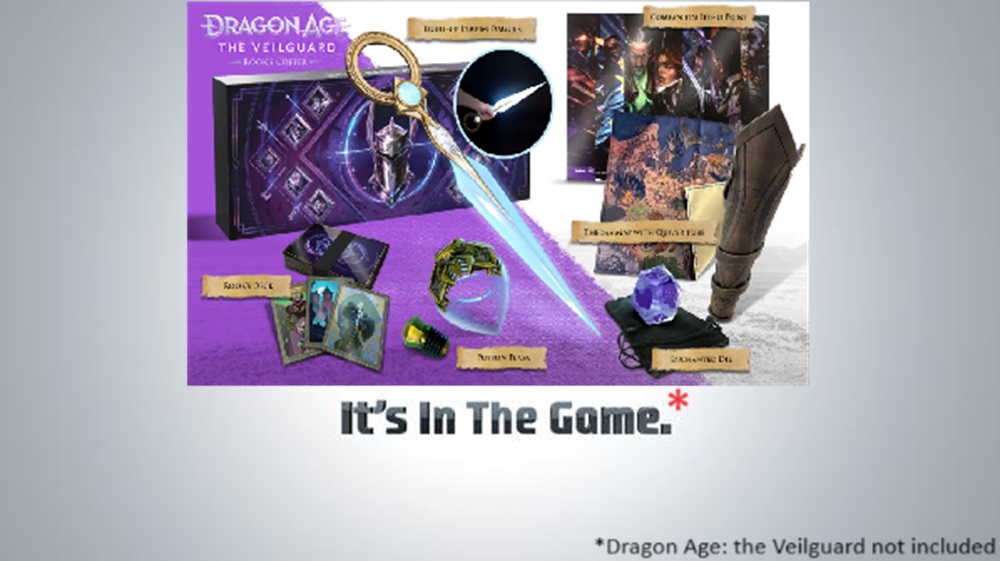
I mean, yes, it’s a BioWare game. It’s also an EA game, proven by the fact that it has a deluxe edition, pre-order bonuses, and a $150 Collector’s Edition with a physical LED dagger and other items that hilariously doesn’t come with a copy of the game. You seriously can’t make this shit up.
But what is a “BioWare game,” or any game for that matter? Not in an existential sense, but what is meant when we say these things? When I say BioWare game, emotionally I’m referring to a nebulous sort of companion-focused, squad-based RPGs with branching endings based on player dialog choices. Basically, the Mass Effect and Dragon Age series. Which I have historically enjoyed, including even (eventually) Mass Effect: Andromeda. It’s a type of game with a particular vibe to it.
Having said that, being a “BioWare Game” is really just branding and marketing. BioWare also released Anthem, which was a commercial failure; Andromeda wasn’t that hot either, considering how all DLC and follow-up expansions were canceled. Rationally, there should be no expectation that just because BioWare is releasing Veilguard, that it will be of the same quality of [insert favorite Dragon Age game here], especially after the franchise’s 10-year hiatus. But that touch of skepticism should still be the case even if Anthem and Andromeda were smash hits.
I have long cautioned against the sort of hero worship that game developers sometimes generate, especially when it comes to “rockstar” designers. There are people who fall to their knees at the altar of Fallout: New Vegas and Chris Avellone. To which I say: why? Even if New Vegas is your favorite game, there were a lot of cooks in that kitchen. In fact, you probably should be worshiping at the feet of John Gonzalez instead. Or, preferably, worshiping no one, including the companies themselves.
Game design is a collaborative endeavor – solo indie titles aside – and it’s a nigh-impossible task to nail down exactly who did what to make the game as compelling an experience as it was. Especially including the very staff who did it. Back in the day, there was an argument that Blizzard was sending in their B-Team for the Wrath of the Lich King expansion, and that is why subscriptions started to decline for the first time (notwithstanding the 12 million sub peak). As it turns out, that wasn’t the case – most everyone from vanilla and TBC ended up working on Wrath and subsequent expansions. Hell, the most controversial addition to the game (Looking for Dungeon tool) was something the original “rockstars” devs wanted to release in vanilla. It wasn’t the bean counters or the C-Suites or whatever design boogeyman you want to define; the calls were coming from inside the house.
There are times where it appears one very visible person seems to make a difference. Hideo Kojima immediately comes to mind. It is also difficult to argue against the apparent influence of, say, Yoshi-P when it comes to FF14. Or Hidetaka Miyazaki of FromSoftware fame. They could not build their games alone, of course, but leadership can and does set expectations and gives direction in these endeavors. There is a level of consistency – or consistent craziness in Kojima’s case – that is pretty rare in gaming.
By and large, though? Every game is a gumbo and no knows what went into it or why it tastes the way it does. That’s… a pretty strong nihilistic take, I admit, but riddle me this: if someone figured it all out, why is it so hard to bottle the lightning again? Boredom? Fear? Ever-changing audience mores? There are so many moving parts, between the game designers coming and going from the company, to the gaming zeitgeist of the time, to competing game releases, all of which can influence a title’s success. You can’t just say “Obsidian should just make New Vegas 2 and it will be a smash hit” because A) most everyone from the original team has left, B) none of the people who left appear to have taken the secret sauce with them, and C) New Vegas was massively outsold by Fallout 4 in any case.
So, am I still looking forward to Veilguard? Well, two words: Scout Harding.
Seriously though, I don’t want the takeaway to be that you shouldn’t look forward to anything. I have no idea what the plans are for Mass Effect 5, but I still want to find out. Just not on Day 1 (probably), and not with any sort of expectations that because Company A or Game Dev B made it that the end result will be C. If you’re going to base your hype on anything, base it on what the game is promising, not the people who made it. After all, the best games end up taking on a life of their own.
No Country for Old Blizzard
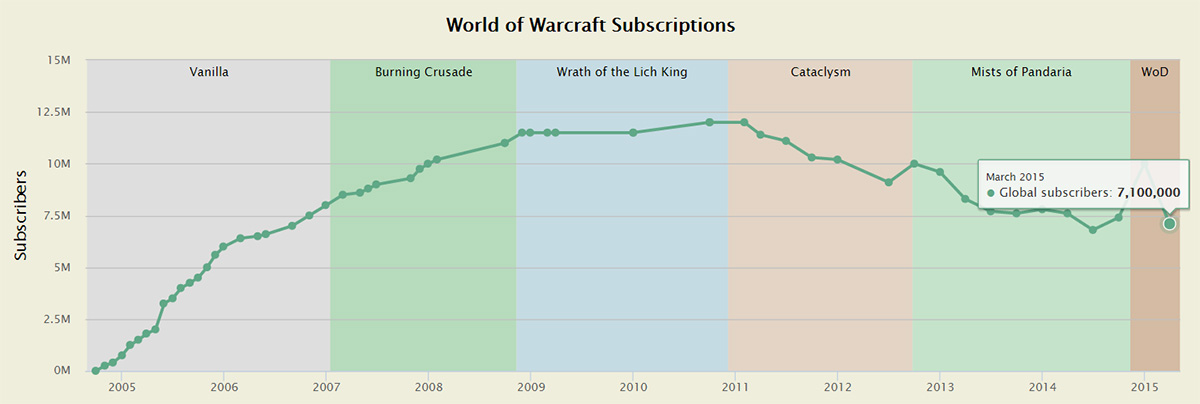
One of the more… persuasive talking points when it comes to World of Warcraft is that there is an Old Blizzard and a New Blizzard. The Old Blizzard are the people responsible for the most successful MMO ever created, and the New Blizzard is everyone that is sailing the ship into icebergs. The evidence for such a dichotomy seems almost, well, self-evident:
Whiplash.
Syncaine, who is much a fan of the two phrases, likes to point out that the breaking point between the Old and the New came in Wrath of the Lich King. From the graph, that is when WoW stopped growing. There are also a few philosophy changes that occurred during that expansion, such as the introduction of the fully automated LFD system, a full embrace of the Badge system, “bring the player, not the class,” and similar things.
Personally, I think Cataclysm marks a much more sensible breaking point, but nevermind.
As I said before, the Old Blizzard vs New Blizzard narrative is pretty persuasive. Which is rather unfortunate considering how it is factually incorrect: Old Blizzard never left. Below are the Credits screens from vanilla WoW and all the expansions, focusing on Lead Designers or Game Designers. I’m formatting it this way because it’s better than a table that won’t fit on the page:

Apologies for the formatting.
The source is the Credits screen accessed from within the WoW client (Character Select screen // Menu // Credits), which appears to be the only way to access the names. Luckily, you do not need a subscription to the game to access it. I typed it all by hand after taking screenshots, so feel free to check my work¹. Alternatively, just look at this Google Docs spreadsheet.
Notice anything? Like maybe all the duplicate names? In the spreadsheet, I highlighted anyone credited as a Designer in vanilla or TBC and who went on to be a Designer in any other expansion². Of particular note is the fact that of the 20 Designers of TBC, 15 of them went on to be Designers in Wrath. In other words, 68% of the design team of Wrath came from TBC. This includes Tom Chilton and Jeffrey Kaplan, both of whom were credited as Lead Designers in both expansions (and Designers of vanilla WoW besides).
Now, you may be thinking to yourself, “Rob Pardo is the missing link!” He was, after all, the Lead Designer of vanilla WoW and TBC before seemingly falling off the design map. Well, allow me the distinct pleasure of destroying your revisionist narrative dreams once and for all. See, Rob Pardo gave a rather sweeping interview back in 2009, almost at the midpoint of Wrath. The link points to the 1st page of that interview because it’s still that good, but money shots are on the 3rd page:
We had all these suppositions, and as the years went on and we had more and more experience living with WoW as a live game, we realized that they weren’t just truths. They might affect a hardcore minority, but the people we saw weren’t really as hardcore as we thought they were. If we reduced raids from 40 to 25, we saw, it makes it more fun. You might have some hardcore players who get upset, but keeping people out of content isn’t right for the game overall. We mellowed sometimes, and realized we were wrong.
The other piece is that the WoW playerbase is becoming more casual over time. People who were hardcore into MMOs, they joined us first, but the people we’re acquiring over the years are casual. They heard about the game from a friend of a friend, and maybe it’s their first MMO – maybe it’s their first game. The game has to evolve to match the current player.
And what did Rob Pardo think about the much maligned LFD system?
That segues in nicely to this question: Cross-server gameplay. It’s convenient, but do you think that it runs the risk of destroying server communities?
To be completely honest, [the Looking For Group tool] is a feature I wanted in the game when we launched the game. I was really unhappy when we didn’t have it when we first shipped, so it’s been 5 years coming. Maybe it wasn’t the number one thing I wanted in, but it’s definitely one of the top 5 things that I wanted in the game. It’s actually our third try at a proper LFG tool, and this one gets it right. With the Meeting Stones, we didn’t put enough attention into it, we just tried to jam it in, and people didn’t use it. The second tool, it ended up being compromised feature – we tried to cater to too many different audiences.
As for the community question, I used to … I think that 5 years ago, I would have answered this question differently than I would today. I was all about preserving the small realm communities, but already… Well, look at Battlegrounds, it’s a good case in point, because it doesn’t diminish social relationships that matter on a realm. Sure, everyone can bring up “that one guy” that they know, the ninja looter who stole his stuff. But I think your real community isn’t the whole realm, but it’s your guild and the friends you group with, and the cross-server LFG won’t undermine that at all. The Dungeon Finder – by the way, I think we just renamed it the Dungeon Finder last night – We designed it in such a way that it serves the need for guilds and groups and friends. You don’t have to always [join a Pick-Up Group]. If there are four guildies in a group who just need a fifth, they can do that. You can also use it if even you have a full five-person party.
Or, you can do it if you’re on your own and just want to run something, so I don’t think it diminishes it at all.
*mic drop*
…
*picks mic back up*
The argument I’m making is not necessarily that there hasn’t been a decline in quality WoW game design over the years. The argument I’m making is that there isn’t an Old Blizzard vs New Blizzard dichotomy. Tom Chilton has been at the head table every expansion. Jeff Kaplan was still Lead Designer for Wrath, and while he was absent after that, it was because he became the Game Director for Overwatch. Rob Pardo didn’t stick around for Wrath… as a designer. Instead, Rob Pardo became Executive Vice President of Game Design for Wrath and Cataclysm. And, don’t tell Syncaine, but Pardo is also Chief Creative Officer and Executive Producer of Hearthstone.
So who exactly is Old Blizzard again?
The alternative title I was going to use for this post was “the M. Night. Shyamalan Effect.” For those that might not know, he was the Director and Screenwriter to an enormously successful and critically acclaimed film called Sixth Sense – it is a cultural touchstone film still used in comparisons today. His follow-ups included Signs and Unbreakable… followed by 13 years of utter garbage. If you choose to believe in a narrative of WoW’s decline from quality, it is this comparison that fits. We would not say “Old Shyamalan vs New Shyamalan,” and we shouldn’t do the same with Blizzard.
¹ The one conspicuously missing name is Greg Street, aka Ghostcrawler. Greg Street is listed as Lead Systems Designer in Wrath, Cata, and Mists, and that role undoubtedly has something to do with design. However, the position doesn’t exist in vanilla, TBC, or Warlords, and there is another “Additional Designers” category I didn’t include either, simply because I can’t be sure what they do. In any case, they always say design is a collaborative process, so even if Greg Street is the cause of it all, that doesn’t get “Old Blizzard” off the hook.
² I have since color-coded all the designers who had carryover between expansions, and the results are interesting. For example, all but one of the designers from Wrath came over into Cataclysm, making up 91% of the final total. This is both baffling and makes perfect sense, assuming The Shyamalan Effect.
 In An Age