Yearly Archives: 2011
Unfortunate Obsolescence
It occurs to me that we – or more specifically, I – have well and truly crossed the barrier beyond which old, amazing games go to die, unplayed and forgotten.
For example, today you can buy Star Wars: Jedi Knight: Dark Forces II on Steam for $1.24. I have heard many, many great things about this game over the years (and it indeed has a 91 Metacritic score), but I never got around to experiencing it. And so when I saw it up for 75% off, I decided to take a look at the game’s page. What I saw was this:

This probably looked amazing to my 14-year old self.
I just couldn’t do it. Whatever it was that this game could have added to my life experience is gone forever.
Of course, this is not just Dark Force II’s problem. Have you tried booting up Planescape: Torment lately? I wrote an awful, awful review of the game back during the height of my JRPG fandom phase a decade ago, and have always wanted to return to give the game its proper dues. But that is unlikely to ever happen. I tried, I seriously tried. Planescape always had a super zoomed-in camera compared to the Baldur’s Gate titles, and combined with the 640×480 max resolution was simply too much. I could not bring myself to get out of the morgue, the technical/compatibility issues notwithstanding.
To bastardize a phrase: the flesh is willing, but the spirit is weak.
Who though, in all honesty, is going to go back and play Fallout 1 & 2 after being introduced to the franchise via 3 or New Vegas? There are hundreds of classic games like this. Certain ones, like Chrono Trigger and the like, can survive rerelease after rerelease without changes. But these others? Not going to happen. I talked about the haunting legacy of Deus Ex in regards to its modern-day prequel, but who is going to play the original if they have not already? I understand there are mods that do amazing things to the visuals, but that presupposes a desire to go through the trouble to begin with.
Indeed, I feel the entire gaming industry is entering a bizarre new landscape with the advent of the App/Indie/F2P Age. I wrote over 60 RPG reviews back in the day, and every single one of them had a Replayability score. Now? Who cares about replayability? Story choice is fantastic, but the typical likelihood of my actually going back through New Game+ or its equivalent is somewhere between zero and no way in hell. I’m not looking for something to kill my time anymore – time is the one precious thing I ain’t got anymore. Any game that wants another roll in the hay is competing against an entire library of unplayed Steam titles, indie or no.
And that, sadly, also goes for older titles regardless of their presumed timelessness. So when I see people complain about, say, Syndicate looking like this instead of this, well… that latter game is dead and gone. I just went through an Eeyore routine with Deus Ex: Human Revolution, sure, but I would rather some remnant exist in a modern form than nothing at all.
Review: Deus Ex: Human Revolution
Game: Deus Ex: Human Revolution + DLC
Recommended price: $25
Metacritic Score: 89
Completion Time: ~38 hours
Buy If You Like: A (more) cyberpunk Metal Gear Solid
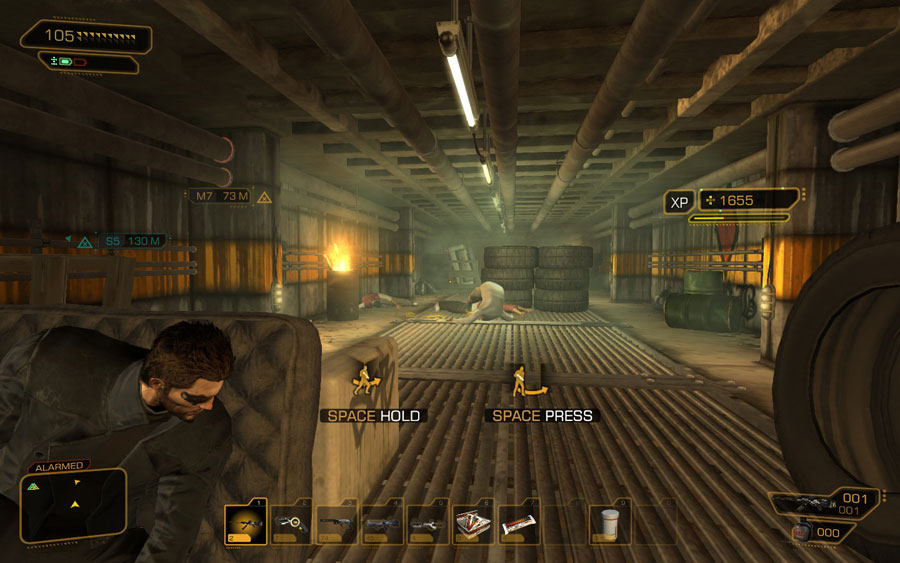
I would be “Alarmed” too.
The thing to understand right from the start is that Deus Ex: Human Revolution (hereafter DX:HR) is three separate things. The first is a prequel to the original groundbreaking Deus Ex released in 2000. The second is a genre showcase of cyberpunk sensibilities. And the last? The actual game.
The distinction between the three is extremely important because it is easy for someone to write off the entire game because it does not live up to the Deus Ex heritage. Or for someone else to watch trailers like these and fall so deep in love of the cyberpunk spirit of the game that the actual mechanics becomes irrelevant. Or in my specific case, struggle within the dichotomy of loving the setting so much that it (almost) washes away all the sins of not being Deus Ex: New and Improved, while the game bits themselves simply show up to work and get the job done.
One of the defining characteristics of the original Deus Ex was the multiple ways in which the player could progress through the game. Want to treat the game like a normal FPS? You could do that. Want to sneak through the air vents, hack into the computer systems, and bypass all security measures without firing a shot? You could do that too. DX:HR does its best to live up to that open-choice legacy, without really understanding how the original maintained a level of coherency: limited, metered choices. In DX:HR, 100% of the augmentations are available to the player right at the beginning of the game; the choice simply comes down to which ones you want to unlock in which order. What this means in gameplay terms is that since all of the choices are available, the designers included ways in which all of the choices are useful.
For example, about a third of the way through the game you will be tasked to get past a locked lab door. Your options include:
- Kill the guards (personally or via hacked security bots), loot the key.
- Hack the lab door.
- Grab an extra pass in the security room, present to guard.
- Sneak through ventilation.
- Use the Strength augment to move a vending machine, climb on top and jump to 2nd floor balcony.
While it felt liberating to know there were so many different ways to progress at first, it also meant that none of the ways you did progress felt particularly clever. The natural inclination to explore all the rooms to make sure you didn’t leave behind valuable items (despite none ever really existing), quickly reveals how many paths lead to the same outcome. Considering all 5 of the different paths occur within 30 feet of each other, you begin to question whether the choices actually matter. And that answer is, unfortunately, “No.”
But that is the rub. Had this been any other other FPS title, I would have been praising it for its Deus Ex-qualities instead of damning it for the same. Compared to the generic FPS flair of games like Singularity, DX:HR blows them out of the water. Indeed, DX:HR feels more coherent than even open-world titles like the STALKER and Far Cry series, insofar as the latter games mostly present “options” in the form of exploiting AI than necessarily discreet choices.
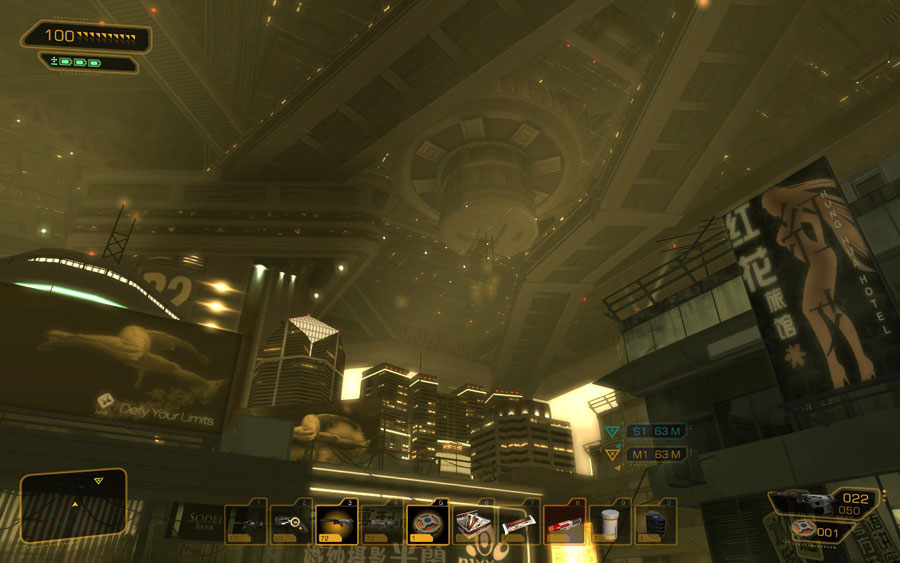
This Midgar-looking city makes me want a FF7 remake soooooo bad.
Legacy issues aside, DX:HR as a game within itself is a rather brilliant experience. Someone looking for a challenging run-n-gun cover-based shooter will find DX-HR an acceptable challenge. The stealth mechanics do not feel tacked on like so many other FPS titles (Far Cry, etc). While the augmentation choices might not matter in a metagame sense, they are useful in making you better at whatever playstyle you are accustomed. The oft-maligned boss battles do indeed feel a bit out of place, although I would be more disappointed if they were handled entirely in cut scenes or if I, say, was able to one-shot them in a takedown move or whatever. The visuals and vistas are top-notch, and the soundtrack is one of the best I have ever heard.
As a final note, I would be remiss if I did not mention the horrible, horrible technical issues I had with the game. With a four-month old game being played on a $1300 gaming rig bought a month ago, I experienced complete Crashes-To-Desktop (C2D) roughly every ~20 minutes for the entire 38 hours I played. Sometimes it would C2D within 3 minutes, sometimes I would actually go a full, uninterrupted hour. Two of the big plot-twisting cinematics were completely unwatchable in that it would C2D at a certain point 100% of the time, and I was never able to watch any of the various ending cinematics in their entirety; in all such cases, I skipped them in-game and Alt-Tabbed to watch them on Youtube in order to proceed. While it could be entirely Nvidia’s fault, or user-error for that matter, it is something to keep in mind.
And honestly, the fact that I endured hundreds of C2Ds over the span of 38 hours to reach the game’s conclusion is perhaps the highest endorsement I can give. Whether it was because of the zeitgeist of the cyberpunk setting, or the ghosts of Deus Ex past, or if it came down to the gameplay itself, all I know for sure is how I felt at the very end:
“Please, sir, I want some more.”
Human Revolution DLC Review:
Missing Link ($14.99) – To be honest, the Missing Link DLC to Deus Ex: Human Revolution was one of the first DLCs I have ever played which felt like a legitimate “deleted scene” from the main game. This is both a good and bad thing. Good in that it feels like a relatively seamless addition despite being on its own 2gb installer and featuring the vastly overused (gaming) trope of the hero losing all of his/her powers. Bad in that, well, most deleted scenes are deleted for a reason.
Taking place in the middle of a fade-to-black scene change in the middle of the original game, Missing Link does not add anything of plot value to the game proper aside from, well, around four more hours of gameplay. While you end up getting access to most of the weapons/augments from the main game, I definitely experienced a mental disconnect between the choices I was making, knowing that none of it mattered since no data was going to be transferred. Want to explore every nook and cranny? Okay… but why? No data, no XP, no weapons, no credits, nothing will endure past the final encounter. Which, incidentally, takes the form of how all the boss battles in Human Revolution should have played out.
Aside from that, and a frustrating amount of pointless backtracking past a 20-30 second in-game “loading screen,” Missing Link is a good enough dessert to the main course that was the original game. Provided, of course, you can snag it for less than the outrageous $15 retail price. Less than $5 or included in a Game of the Year edition would be ideal.
Insert Coin
Random!
- Beat Deus Ex: Human Revolution a few days ago; the more formal review will be forthcoming. Short version is: game was goo… *crash to desktop*
- Steam holiday sales annoy me to an extent. You see, what is the point of having entire catalogs on sale from 33-50% off, when they routinely turn around and toss up seemingly random selections from those same catalogs for 75% off? The only purpose I can ascertain is to piss people off.
- For example, Space Marine was 33% off for the pass week, now is 50%. Torchlight was 50% off for the past week, now is 75%. I learned my lesson when I was burned in this way a year ago, but it still boggles my mind they pull the same shit year after year. All it encourages me to do is to wait until the very last moment to buy anything lest it go on sale a day later, and thereby potentially miss the deadline entirely and not buy anything.
- I generally avoid the stupid Steam contests that involve you having to (re-)download multiple 10 gb games you already purchased but haven’t played yet in order to unlock achievements that result in lumps of coal. I did however do so on a whim with the Orcs Must Die! one. I have been playing the game every since.
- Sometimes I hate buying shit off the internet. There are two monitors on Amazon, both Viewsonic 24″ widescreen LEDs: the VX2450WM (originally $368, now $179.99) and the VX2453MH (originally $270, now $189.99). For the life of me, I can’t seem to understand the difference. The latter has 30 million: 1 contrast as opposed to 20 million:1, is “ultra thin,” can be turned into a picture-frame looking thing for god knows what reason, and weighs 0.9 lbs less. The former can be mounted on a stand or something, and has roughly three times as many reviews (both are 4.5/5 stars).
- My first instinct, I shit you not, was the former simply because “You Save: $188.01 (51%)” vs “You Save: $80.24 (30%).” With logic like that, I’m surprised I haven’t already ruined the Monster cables hooked up to my Alienware by spilling Grey Poupon all over them. Good thing I’m still covered under my Black Tie GeekSquad 5-year Best Buy warranty, ya?
- Grey Poupon. Poupon. Poupon.
- You now have an angry French guy in your head. You’re welcome.
Have a happy whatever you celebrate or not celebrate, as the case may be.
Chilton and Audiences
From a NYTimes article:
“What we’re trying to do now is figure out what our current audience wants,” Tom Chilton, World of Warcraft’s game director, told me by phone last week. “It became clear that it wasn’t realistic to try to get the audience back to being more hard core, as it had been in the past.”
As someone returning to World of Warcraft after a long absence, I find the current direction of the game eminently engaging. As Mr. Chilton said, “We hear from a lot people who used to play a lot that they’re just not at that point in their life anymore, and they want to play, and they want to see the content. But they can’t make the same time commitment they used to.”
What is interesting to me is how they felt that it was realistic in the first place. And the use of “current” audience, with the implication that a prior audience existed but no longer does today. The debate over whether the “more hardcore prior audience” hollowing out was due to lack of attention or was inevitable seems almost academic at this point.
The same MMO with a new community is a different MMO, period.
Sexism: Point Taken
This should be my last post on the sexism topic for a while, as the items below essentially obsoleted a 1500-word post on the subject I had scheduled to go up.
Item 1: The Comic
False Equivalence from Shortpacked.com:

Although I would still argue the finer points of what physical features are power fantasies to whom… well, point taken.
Item 2: The Paradigm-Shifting Article
Why Strong Female Characters Are Bad for Women. An excerpt from the thesis bit:
I think the major problem here is that women were clamoring for “strong female characters,” and male writers misunderstood. They thought the feminists meant [Strong Female] Characters. The feminists meant [Strong Characters], Female.
So the feminists shouldn’t have said “we want more strong female characters.” They should have said “we want more WEAK female characters.” Not “weak” meaning “Damsel in Distress.” “Weak” meaning “flawed.”
Good characters, male or female, have goals, and they have flaws. Any character without flaws will be a cardboard cutout. Perhaps a sexy cardboard cutout, but two-dimensional nonetheless. And no, “Always goes for douchebags instead of the Nice Guy” (the flaw of Megan Fox’s character in Transformers) is not a real flaw. Men think women have that flaw, but most women avoid “Nice Guys” because they just aren’t that nice. So that doesn’t count.
This article, much like the two videos I posted previously, came from such an unexpected direction that it shifted the entire way I looked at the issue itself. Even the nagging objection I had in the back of my mind – “Is attractiveness in these female characters harmful, then?” – is addressed towards the latter end of the article.
Item 3: The Pithy Video
Why Men and Women Can’t be Friends.
While the previous two items changed the scope of the debate for me, this video summarizes the problems I have with the article Nerds and Male Privilege, the one that made me /facepalm so hard I developed an epidural hematoma and set me to writing a 1500-word post. At one point in the aforementioned article, “Dr. Nerdlove” writes: “Y’see, nobody’s saying that women don’t receive different treatment from guys… I’m saying that being treated differently is the problem.” While the examples of sexism he goes on to use are legitimately bad (assuming a woman is a quota hire or got to where she is by sexual favors, etc), there is an implicit underpinning to the article that if nerds just treated women equally, all this would go away.
Except… it can’t. The harassment and stereotypes can and should be diminished, absolutely. But as the video succinctly demonstrates, there will always be a difference, even under gender equality.
A Few Unresolved Issues
First, there is the question of whether characters like Samus, Chell, FemShep, etc, are actually strong female characters if they could be replaced by male characters without a loss in narrative integrity. The Rule 63 Dilemma, if you will. I’m inclined to say that any non-fanservice female is a win by default, but I can acknowledge how that may amount to the soft bigotry of low expectations.
Second, I am beginning to question whether a call should go out for more weak male characters (see Item 2). While some would point to, say, Batman as an example of a flawed male character with depth, my point is that male protagonists inevitably succeed at “being a man.” Chiseled men kicking ass may be a male power fantasy (see Item 1), but I consider it just as pernicious a fantasy as Objectified female sex objects. When I was out of work for 14 months, I felt a crippling sense of shame for not “being a man,” because men provide, men aren’t weak, men aren’t emotional, and so on. While there is obviously a power difference between being conditioned to be aggressive versus demure/passive/accommodating, it is still harmful conditioning.
Third, while the debate on Syl’s blog has wound down, one of the main issues we have “agreed to disagree” on was why Tifa/Sylvanas were drawn sexy. Syl asked “Why?” I asked “Why not?” They both are written as strong characters, so it should not matter in the scheme of things to also dial up the visually appealing meter while we’re there. Syl asked: “what’s the message there exactly and why will their male equivalents not come with equal, sexual innuendo?” My counter-question would be, if I were still permitted to post there, “What would you like to see, innuendo-wise, from males?” From my (limited) understanding on the subject, what women find visually appealing or sexual varies wildly from woman to woman. In contrast, pretty much all men are visually attracted to boobs and butts. If the Batman from Item 1 is only appealing to 20% of the female audience, is that a win or a loss considering the traditional Batman model is 100% appealing to men for power fantasy purposes (and presumably X% of women)?
I understand that it’s more fair if the audience breakdown for games is 50/50 to draw as visually appealing characters as possible without alienating one side (i.e. women) with panty shots or barely-there clothing. I suppose the question is: what’s the impact when one gender is more predisposed to visuals than the other? Is equal still fair? Or can we agree with the article in Item 2 insofar that the problem isn’t the sexiness of female characters at all, but rather when the whole depth of their character concept is visual sexiness?
In closing, I want to mention again the importance of tailoring one’s argument away from Goal-oriented methods towards more Results-oriented ones. The articles and arguments that shifted my attitude on this subject were NOT the confrontational ones that attempted to guilt me into accepting their conclusions wholesale. Even though the comic in Item 1 began that way, the unique perspective of what a woman actually found attractive in comparison to the standard fantasy male was intriguing; not to mention the idea that Batman’s chiseled abs were drawn for men. That, along with the notion that sexy poses were actually demeaning and patronizing to men too, were game-changers. How could you argue against that? There is no defense. Appealing to self-interest may not be as noble, but at some point the question arises as to whether you’d rather be noble, or actually accomplish what you set out to change.
Strong Female Characters
I was not going to write a follow-up to yesterday’s post, but I came across another Kotaku post today titled “It’s Time for a Lady Hero in Grand Theft Auto.” I agree with the article, in that such a thing would be awesome, assuming they find a way to make it work. And by “work” I mean actually make the main character being a woman matter, as opposed to merely swapping gender models in a story written for a man (or gender neutral, which so often defaults to man anyway).
But then I got to thinking… is that not what typically occurs anyway, even with strong female characters?
In the comment section of that article, the following was posted:
Oh shit a female character? How am I supposed to relate to that?
BRB PLAYING METROID AND PORTAL.
The comment is obviously sarcastic, referring to the strong female characters of Samus Aran in Metroid and Chell in the Portal series. And yet, at what point does it matter in any meaningful sense that the protagonists are women? Don’t get me wrong, I love that they are. As I mentioned in the comments on Syl’s post:
I love strong women. I love the rich, dramatic narrative possibilities of balancing strength with femininity; “being a man” is almost always one-dimensional (i.e. strength == man) in contrast. It is why I almost always roll female toons in MMOs.
A woman slaughtering a bandit camp or slaying a dragon is automatically more interesting to me than a man doing the same. But if I am honest, it’s that way because I’m imagining more complex inner struggles into those events from the female side. I expect a man to slaughter a bandit camp or slay a dragon, because that is the cliche. To not do so would be a renunciation of “being a man.” Which, incidentally, is something I consider far more pernicious than any Objectification that goes on with scantily-clad women, but I may be biased. But when a woman slaughters a bandit camp, I envision a struggle against conformity, against despair, against a nature inclined to nurture, and so on. The Bene Gesserit of Dune and Aes Sedai of The Wheel of Time are more interesting groups of people because they are women; a mystical cabal of controlling men is almost too cliche to commit to paper.
Going back to the Metroid and Portal examples though, did it really matter in a narrative sense that they were female? I would say no. Samus and Chell could have been dudes and the game would have played out in the same way. If strong female characters can be replaced with males with zero narrative loss, are they really strong female characters? As I mentioned, them being dudes would have certainly diminished something from my play experience, but I’m struggling with the intellectual notion that the gender of the character model really makes that big a difference to me. Or is the fact that they could be replaced by men without a loss of narrative integrity actually a win? Gender equality and all that.
Perhaps silent protagonists are not the best examples. Final Fantasy 7 is my second favorite game of all time, and I consider Tifa one of the deepest characters in any RPG I have ever played, despite (and perhaps in spite of) some of her more obvious fanservice qualities. Tifa is strong, capable, independent and yet distinctly feminine at the same time. That being said, outside of taking care of Cloud during the whole Mako poisoning bit, and the pseudo love triangle thing, I could not really give examples of what I mean by “distinctly feminine” that does not have something to do with the way she looks or otherwise read like a laundry list of cliches. Maybe that’s okay, and those prior distinctions are enough?
So, good luck Rockstar. I cannot wait to see what they would do with a female lead in GTA.
P.S. While “researching” this post, I came across two excellent examples of What To Do when talking sexism in games, both in video format. The first is The Big Picture: Gender Games, and the second is Game Overthinker: Bayonetta. The former is rather brilliant with it’s “pose” argument, which is both intuitive and unassailable. The latter doesn’t focus on sexism explicitly, which makes its implicit argument all the more compelling when you realize what just happened by the end, i.e. you agreed with everything.
If you want to affect real change, you do it that way.
Internet Sexism, Global Warming, and the War on Terror
Through a confluence of events – namely Syl’s war on panties and a Kotaku article that points towards an abysmally counter-productive blog post – I want to talk about internet sexism for a moment. Namely, how not to do it. For example, taken from aforementioned counter-productive blog post:
So first up, is this a problem at all? Yes. Yes, this is a problem. The gaming community contains an incredible number of idiots. Go here and read this article about Saint’s Row 3 by Emma Boyes. It’s a good article, well reasoned and the complete opposite of anything aggressive or hectoring or provocative. It defends a game that has been attacked for sexism. It’s a great piece.Then read the comments and it’s just a roll-call of complete fucking bullshit. Angry, shouty, stupid, illogical, emotional, insecure ranting, brought forth from the depths of the internet’s prick cabinet. If that exact same article had been written by a man, not a single one of those comments would have been written. That’s because they have absolutely nothing to do with anything that’s said in the article and, more importantly, because men don’t get handed this shit.
This is not how you should approach the problem of sexism over the internet. To be honest, even approaching the problem of sexism over the internet is probably dumb. Not because sexism is a cause unworthy of one’s concern, but because it is an unnecessarily Sisyphean struggle based on how you are outlining the issue.
The United States is currently “at war” with Terror, even after Drugs won the Drug War. If you set your objective as eliminating the Platonic Form that is Terror – and exclude the Terror you inflict on other nations – you set yourself up for failure. All terrorists have to do is succeed once; you must succeed 100% of the time, forever. Similarly, eliminating internet sexism can never succeed considering that the closer you reach the endpoint, the more effective a sexist troll becomes.
Is such thinking defeatist? No. To be defeatist is to set oneself up for defeat, i.e. unrealistic goals. Your goals should be informed by what you want to accomplish, not the other way around.
When Nils wrote about Global Warming, I knew how the comments would unfold before I even read the post. Why? Because the way the Green movement approaches the subject is dumb. We should not be talking about the earth warming, sea levels rising, and so on. It is entirely possible (no matter how unlikely) that mankind has nothing to do with the earth warming; every minute you spend trying to convince someone the Green movement isn’t an anti-business communist conspiracy is a minute farther away from what you want to accomplish. Instead, Green should be focusing on the power plants very obviously spewing toxic material in the air. Green should focus on more fuel-efficient cars for energy independence and because, hey, efficiency. And in the process of focusing on concrete, unassailable accomplishments, Green also achieves their Global Warming goals.
Incidentally, the above is why this nonsense:
@olly – If you believe what you just said and act accordingly then you are enabling those assholes. These people will always exist but it is still your personal job to tell them they are being assholes when they are being assholes.
We don’t stop trying to catch murderers just because there will always be murderers.
You are making excuses. Stop it.
…is worse than doing nothing, it’s counter-productive. Calling trolls assholes is exactly what they want. The more white knights that show up on internet message boards, the more embarrassing their (otherwise noble) behavior appears to everyone else, and the less likely anyone actually does stick up for women (etc) when it counts. And by the way, if you tell someone who gives to charity that they don’t give enough, you are liable to make them stop giving at all.
If you want to combat internet sexism, demand these companies moderate their own goddamn comment sections. Do you see? A well-moderated forum is just as free from (trolling) sexism as an utopian gender-equal society. Moreover, the actual issue was never sexism per se, but trolling itself. “Solving” sexism and racism and other -isms is fairly meaningless if everyone ends up trolling about how fat, stupid, or ugly someone is instead.
Sexism in the real world is a lot more difficult to solve, of course. But just like with everything above, the key is to leave ideology at the door, fix the plumbing, and then the owner will invite ideology in on their own. And even if they don’t, well, at least the plumbing got fixed.
Boxed In
I have been having more fun with boxes than strictly necessary in DE: HR.
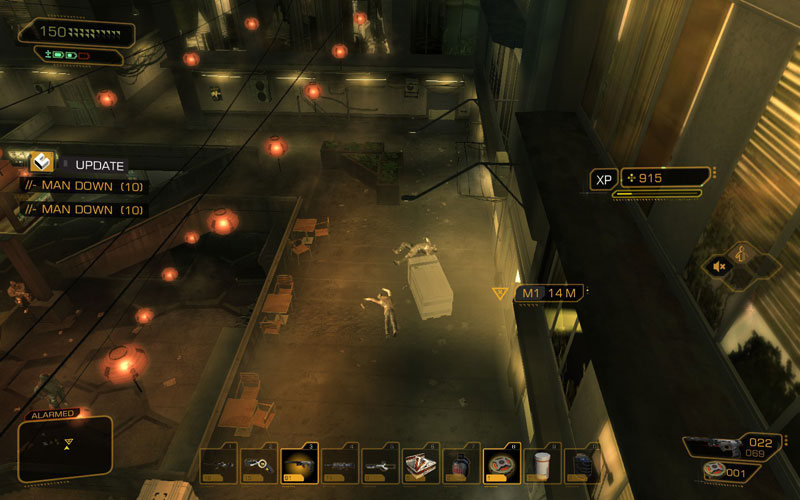
Two birds, one industrial crate.
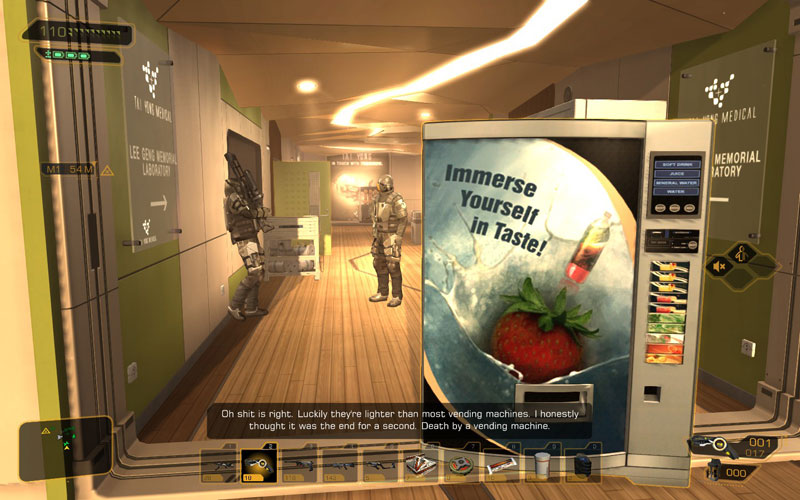
Things Not to Say to A Guy Randomly Carrying Around a Vending Machine #467
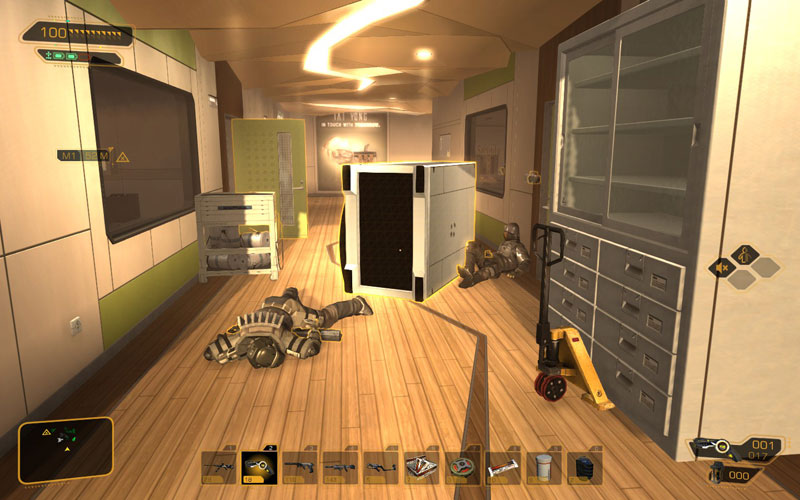
With that kind of setup, I was surprised by the lack of an achievement.
What has been less fun are the frequent Crash-To-Desktop (C2D). By “frequent,” I mean between every 5 to 50 minutes with a trend towards the former. It boggles my mind that legitimate pieces of software are able to be released in this sort of broken state. Googling results in the same, unhelpful article posted a hundred different places. The Steam forums basically tells you to turn off DirectX11 (it’s off), and then tells you that it’s not really a Steam issue anyway. The Edios website tells you to, no joke, create a non-administrative user account in Windows, then play the game from there (tried it, didn’t work). Oh, and by the way, technically it’s not an Edios problem, but a Square-Enix problem. And there is no useful support forum for Square-Enix.
Finally, there was always the “turn everything down” proposed solution. I have yet to try this “solution,” mainly because A) I didn’t purchase a goddamn $1200 computer to play games on settings my laptop could have done, and B) the C2Ds, while supremely annoying, do not make the game unplayable.
I would like to believe that, ultimately, reviews should reflect the game as it should be, or is for the majority of players, reflected through the prism of of the reviewer’s worldview. For example, it would be asinine to complain about DE: HR’s graphics looking terrible in 640×480 resolution with the lowest settings. Similarlly, should a game be “punished” if it launched with bugs that later players never experience?
On the other hand, this situation frustrates me so much precisely because I love everything else going on. If it was a terrible game, like say Frozen Synapse, I would have dropped it like a rock (something I typically do not do). I want to be able to say that I’m never buying another game from Edios/Square-Enix based on their shitty QA process, but just like with Bethesda, I can’t say that either. If they released another Deus Ex, I’d be on that like white on rice microfiber weave carbon nanotubes on a super-conducting ceramic polymer.
 In An Age
SWTOR Retention Predictions
Dec 30
Posted by Azuriel
Discussing retention in an MMO without accounting for social ensnarement is like discussing weight loss without accounting for calories. It is something so fundamental that I have to imagine that the only reason it is not brought up is because it is taken as a given. And yet I have now read multiple blogs talking about SWTOR’s lack of retentive capacity based on story, story, or even god forbid, gameplay with completely straight faces. Here is Gordon from We Fly Spitfires:
To get this out of the way, WoW’s combat definitely does have a more visceral cadence to it than my experience with the SWTOR beta. At least, it does once you pass certain level thresholds with a given class. Rogues before Cheapshot are hideous. Paladins were garbage for years until multiple class revamps later. And so on.
Having said that… really? Are we seriously to the point at which we are holding WoW up as an example of compelling gameplay as if Cataclysm never happened? Even if we agree that there are two (or more) different definitions of gameplay taking place – the moment-to-moment, and say, the minute-to-minute – I am here to argue that while they are helpful, they are ultimately secondary at best.
Retention in MMOs come down to the people. Daily quests are not compelling gameplay. Heroics are not compelling gameplay. Grinding mobs is not compelling gameplay. What is compelling is that you are doing things either with or for other people. These otherwise asinine activities are utter tripe on their own, divorced from the Show & Tell aspects. When I did 20+ days of daily quests to unlock the exalted Tol Barad trinket on an alt, it did indeed feel good to work towards something tangible. But what made the trinket tangible? The PEOPLE. The knowledge that my geared alt would be useful in a guild raid situation, that some random person could appreciated the amount of investment that went into earning it, that it was useful in the context of other people.
So tell me, exactly, what it is about SWTOR that prevents such meaning from possibly existing in whatever arbitrary trinket they have at the ass-end of a huge endgame grind. We have all endured unfun things in WoW either for the promise of fun later, or because friends make it fun to do unfun things together. What is the difference here? And perhaps more pointedly, if compelling gameplay is the defining factor for retention, why aren’t we still playing WoW? I did not quit WoW because the gameplay changed, I quit because the game ceased to be fun. Great gameplay is not enough for long-term retention. Nor would I even say it’s required. It helps, no doubt, just like voice-acting and emphasis on stories helped get feet stuck in doors of people whom would have never gave yet another MMO a chance. Whereas moment-to-moment gameplay has to compete against every new game released, your social circle is a lot less replaceable.
SWTOR could very well end up flopping due to lack of retention. But if it does, I’m betting the traction loss comes not from lukewarm gameplay or limited instances, but lack of guild infrastructure, social incentives, RPing opportunities, and the other touchy-feely aspects of the game. In any case, considering SWTOR needs 350k-500k subs to operate in the black (even counting the Lucas cut), predictions of its eventual demise are a little ridiculous unless you believe it will be less successful than Rift (currently at ~475k).
Posted in Commentary
11 Comments
Tags: Retention, Show & Tell, Social, Star Wars