Monthly Archives: April 2017
Inventory Junk
Sometimes it takes a game to start doing something mundane before you appreciate how every other game doesn’t bother you with that crap. Case in point: Divinity: Original Sin doesn’t automatically remove anything from your inventory.
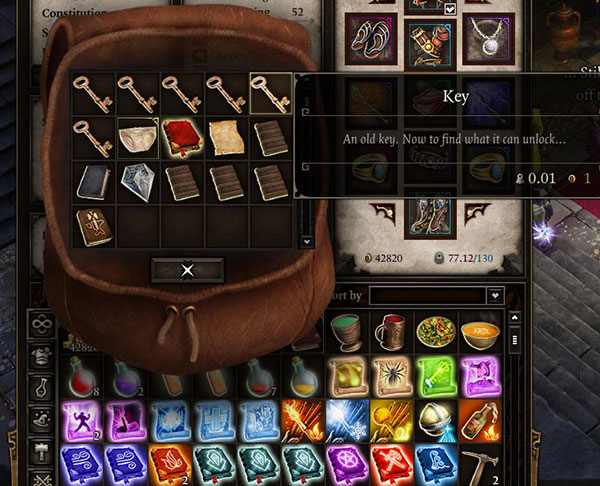
Nothing. The answer is nothing.
In pretty much any other RPG ever made, introducing lock to key causes the key itself to disappear. It is not as though the key will work on any other lock, so why keep it around? “Why not?” muses the D:OS designers. “Because it’s dumb,” says I. My inventory is filled with keys (which you can’t sell), books that no longer serve a quest or skill gain purpose, and other kitchen drawer debris. There isn’t any special glowing inventory effects either, so sometimes it gets difficult to realize that you actually have picked up something worth clicking on.
Can I manually go through my whole inventory? Of course. But why exactly do I need to? What is the underlying gameplay purpose? As far as I can tell… well, I can’t. I don’t actually know if this is a “old-school” throwback, as I don’t remember if Baldur’s Gate had anything similar. Probably not.
In any case, I’m glad most modern games have moved on. Because ain’t nobody got time for that.
Funslope
I have been musing a lot about Hearthstone and Clash Royale lately.
In Hearthstone, I bought around 22 packs of the latest expansion with accumulated gold and… things didn’t feel particular satisfying. A lot of duplicate commons, and only one Legendary (the hunter quest). I kinda screwed myself over inadvertently though, as I opened a pack reward from the Tavern Brawl, which ended up being Carine, a duplicate Legendary of mine, thus removing my pity timer.
According to Reddit, the latest expansion will cost you about $400 to get all the cards. Let that sink in a moment. $50 will get you 40 packs, and I opened about half that and got hot garbage. Spending enough money to buy a AAA videogame on release will likely not even get you remotely competitive in a F2P game.
This sort of begs the question though: how much should it cost to be competitive in a(ny) game?
On the one hand, I think cost analyses for an entire expansion are a bit ridiculous. Out of the 135 cards available, how many are actually any good? Cutting out the terrible Legendaries will reduce Dust cost by 1600 apiece, for example. Then there is the consideration of whether you really need all the cards on Day 1. There are going to be weeks and weeks of Un’goro, during which you can accumulate more packs naturally. Granted, if you are still buying Un’Goro packs a month before the next expansion’s release, you won’t have any buffer there.
On the other hand… well, it’s all terrible. A bunch of cards just rotated out, so if you aren’t rolling in the latest expansion cards you may as well just give up. Or go play Pirate Warrior and hope the other guy doesn’t have one of a thousand new taunts.
Clash Royale is a different F2P game, but I am encountering similar breakpoints. Specifically, I had a deck that I focused all my in-game resources on, the meta shifted, and now my deck gets hard-countered very easily. You can switch your cards out, but leveling cards takes increasing amounts of gold, and thus I can only field under-leveled cards against people with focused decks.
How easy should it be to max out your stuff though?
Personally, I feel that answer should be “immediately” for competitive PvP games. What is the point of a ladder in these games if you can buy your way to the top? It honestly reminds me of the gacha games, which have “VIP Levels” that unlock as you spend more money buying diamond currency. Well, except these gacha VIP levels are permanent and don’t reset each time new cards come out.
Alas, this is not the case.
What is worse is the simple fact that these games also do not have logical endpoints. They are fun. Then, gradually, they are less so. At what point on the Fun Gradient can you draw a line? I suppose games like Hearthstone are little more cut-and-dry since expansions are released, cycle out, and otherwise contain clear demarcations on the calendar. Clash Royale, meanwhile, does not. I am having less fun than I did a few months ago, but still more fun than either nothing or another game. So I continue to play, with internal injuries accumulating from the dissonance.
And just to be clear: these games are engineered this way. Payslopes? More like Funslopes. And at the bottom of this slope is just a money-pit that you fill with cash to try and make a softer landing.
Fuzzy Rules
I have been play a bit of Divinity: Original Sin and continue to enjoy it. Mostly.
One thing that I strongly dislike in games though, are fuzzy rules. By “fuzzy” I mean that the parameters of the rules are either not consistent or not entirely clear within the game itself. Divinity has tons of them that were at first amusing, but now are a bit grating.
For example, sometimes when you attack a target, they bleed on the ground. Fine, right? Well… environment effects are super important in Divinity. There is a talent that actually heals you when standing in blood, for example. Blood puddles also apparently conduct electricity, as I discovered when two of my melee team members got stunned after a third one shot a Lightning Bolt.
Things get real dumb though when you fight zombies. See, zombies are healed by poison effects. Guess what zombies bleed? Poison. So… yeah, hit zombies enough and they will bleed poison on the ground, which then heals them. I can kinda sorta maybe see the logic, if the designers were using this self-regeneration mechanic as an explanation for zombie resilience. But it’s far more likely that this is just sloppy game mechanics. Especially when you set zombies on fire, then the fire makes the poison explode, which ends up dealing fire and poison damage simultaneously, which sometimes cancels out the fire damage entirely.
Are there benefits to fuzzy rules? Sometimes. The real world is full of strange situations, so carrying over some of that uncertainty can make virtual worlds more realistic. Plus, fuzzy rules are a de facto increase in difficulty – if you’re not certain something is going to work, you have to be more cautious. Weird situations also make for good stories.
That said, I don’t like unclear rules very much. It’s tough to determine whether vague interactions are intentionally designed, or just designer incompetence. And when you end up failing because of said interactions, it’s difficult to know what you should have done differently. Did you lose to a dice roll? Strategic blunder? Not leveling up enough?
Growth requires not just knowing what went wrong, but what can be done to avoid it in the future. If the answer is “nothing,” there really isn’t any growth at all.
Relative Value of Money
Gaming has gotten pretty complicated for me these days.
The annoying part of this situation is that the complication is all by design. Clash Royale recently celebrated its 1-year anniversary, for example, which means I have been playing this mobile game off-and-on for about a year. Just the other day they teased a “one time sale” that included 100,000g and a Magical Chest for roughly $25. At the stage of development I’m at in the game, that amount of gold would effectively allow me to upgrade two units. Two. For $25.
And I was seriously considering it.
The only real thing that stopped me was that the deal wasn’t as good as the prior deals I did take advantage of. The $25 thing was only a “x4 value” whereas I dropped $25 on a different package several months ago that was a x10 value. At the time, it offered a rather significant boost of power, and allowed me to finally snag an Ice Wizard, which I have used in every deck to this day. Conversely, it is not entirely clear that upgrading two units for 100,000g would see similar returns.
In addition to Clash, I am playing three separate gacha-esque games with similar payment models. Four, technically, if you include Fire Emblem: Heroes in there. I haven’t spent near as much in those as I have in Clash, but I do boot them up every single day for the feeling of incremental progression. And all of them are offering “amazing” deals for $10, $25, even $99.
Then look what happened with WoW. There is currently a “sale” on character services, which means it “only” costs $18.75 for server transfers. Since I had over $180 in Blizzard Bux from cashing in WoW Tokens, I decided to use some of those funds to move the survivors of Auchindoun-US over to Sargeras-US. Moved about four toons thus far, and thinking of a fifth. That’s $75 already. Not $75 from my bank account per se, but I could have nearly bought StarCraft 2: Legacy of the Void and 50 packs of Hearthstone’s latest expansion with that same amount of funds.
All of this is why I take a somewhat adversarial stance with game designers. If these were all B2P games, we would not be having this discussion; instead I would be lamenting about how there aren’t enough hours in the day to play all these great games. Instead I’m talking about services within a game, or progression boosters, any of which are more expensive than actual, other games. I just bought Mass Effect: Andromeda from GMG for $41 and some change. That’s roughly two character transfers in WoW, or a few unit upgrades in Clash Royal.
Now, there’s the argument that there aren’t that many games you could even play for a whole year and not tire of. Doesn’t Clash Royal deserve my money for how much amusement it has generated? Isn’t plopping down some cash on these games technically cheaper than paying full price for new releases every few weeks/months anyway?
I think those are the wrong questions, and intentionally engineered to take advantage of cognitive dissonance. Because we aren’t asking those questions up front – we are asking them after having “invested” dozens (or hundreds) of hours into the game. If you told me at the beginning that it took 50,000g to upgrade units in Clash Royal, I would have balked. But having stewed in a pot of nearly boiling water for a year, it all seems reasonable. “Of course it makes sense that I used to get upgrades every three days, and now only get one a month.” Not really, no.
(Especially not when they end up nerfing units a month later. No refunds here.)
The value of money is mostly relative. Going from making $20k to $30k is life-changing, whereas going from $100k to $110k is likely not. However, money is also fungible. Dropping $10 or $25 here and there might make sense in the context of whatever game you are currently playing long-term, but those same dollars could buy anything else.
It is important, IMO, to consider the full picture of what your gaming dollars may or may not be purchasing. A server transfer in an MMO that will save your waning interest may seem a bargain. Hell, it might actually be a bargain in the final analysis. Just be cognizant that the decision should not be “do I spend money or not,” but rather “do I give up X or not.” I decided that two unit upgrades in Clash Royal isn’t worth half a Mass Effect. Framing it this way helps me resist all the fallacies (Sunk Cost, Gambler’s, etc) working on the decision to make it seem reasonable (when it is not), and gives me an answer I can live with.
Maybe your gaming budget is such that you don’t mind dropping hundreds of dollars a month into whatever. In which case, feel free to Paypal some my way, chief. Otherwise, we all have to look out for each other a bit, because the game designers and the in-house psychoanalysts on their payroll certainly are not.
Hearthicide
One of the interesting quotes going around the block this weekend:
“Hearthstone is killing itself” – Superdata
–GamesIndustry.Biz
The short version of the situation was summed up by GameRant:
In a February report about the worldwide digital games market, SuperData spelled out a not so positive picture for the Blizzard card game. It says that in February, Hearthstone revenues on iOS and Android hit the “lowest” since those versions of the game launched and is “down significantly year-over-year and month-over-month.” The desktop version of the game has also experienced declining revenue but they have been less severe, likely due to the support from more “hardcore” fans.
SuperData blames this fall on recent “unpopular” gameplay changes to the game, which have resulted in a “sharp decrease in conversion on mobile.” Although Blizzard has attempted to fix problems with the game, such as addressing problems with arena drafts and nerfing certain OP (over-powered) cards, this hasn’t been enough. Several professional players have also ditched the game recently, citing the game’s reliance on randomness (rather than actual strategy), as a reason for them to look elsewhere.
I would kinda like to read the Superdata report itself to see if they provided more context, but the paywall is kinda significant.

Think I’ll pass, thanks.
The dire portents are somewhat interesting, because as recently as January the reports were all glowing about Hearthstone had cleared $394.6 million in 2016. Then again, perhaps that was just your sort of standard end-of-year update, and this February news showing a more concerning trend.
The question I always have: is it really randomness that’s the issue here? Certainly for Lifecoach it was an express reason. And perhaps for the pros at the top where the delta between player skill is so razor thin, randomness effectively makes up a disproportionate amount of the outcome.
But, honestly? As I mentioned a month ago, the problem is Team 5’s fucking ass-backwards balance philosophy. Back on January 13th, the devs officially stated that they were “looking into” the Pirate disaster they introduced in Mean Streets of Gadgetzan. You know, the expansion that came out on December 1st? The nerfs themselves did not occur until the very end of February. So we got 1.5 months to acknowledge a problem, then another 1.5 months to move on a solution. Then, even after the nerf, 14 of the 16 players in the HCT Winter Championships brought Pirate Warrior.
Were the nerfed cards absent? Yes. Does Pirate Warrior still consistently kill you on turn 5? Also yes.
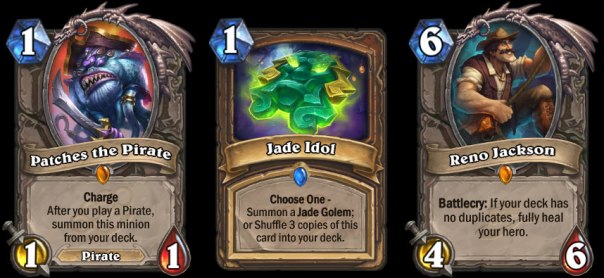
Triple threat.
That is the problem. You have pretty much 100% of aggro decks (and some midrange) running a Pirate package. If you aren’t facing Pirates, you are facing Jade Druid, which completely murders Control decks in two different ways (endless threats + zero fatigue). And if you happen to get lucky and aren’t facing Pirates or Jade Druid, you are facing Renolock, which is a match best described as a JRPG boss fight – get them to low HP, they heal to full, get them low again, and then they transform into Jaraxxus. If you aren’t playing one of those three decks, you are blood for the blood god.
Journey to Un’goro is coming out soon, and I am finding it difficult to imagine the meta shifting that much. Pirate Warrior loses Sir Finley, which is a one-drop Legendary that allows the Warrior to switch his hero power into something else. That is a bigger deal than it sounds, but not something that derails a turn 5 win with decent draws. Jade Druid loses a few cute moves with Brann, but is similarly otherwise unscathed. Reno Jackson himself is leaving, which is a big deal to Renolock, of course. Then again, Handlock did fine for years before Mr. “We’re going to be rich.”
You can see the entire new set yourself. What jumped out at me were the vast increase in Taunt cards, which is good. Taunt Warrior with the Rag hero power Quest is probably going to be a thing. Shaman elementals seem pretty powerful as well. I like the Druid cards, for the most part. But again, all that being said, will whatever new decks emerge actually be better in practice than Pirates or Jade?
I have my doubts.
And we haven’t really even gotten to the other parts of Hearthicide, which is doing practically nothing in the face of competitors like Shadowverse throwing out 10 free packs for their latest expansion. We’re getting some free stuff each day for logging in, I guess, but it’s hard to tell. In any case, Team 5 has got to get off their ass and at least put on the appearance of doing something, or Hearthstone is going to be competing with Heroes of the Storm soon. For last place.
 In An Age
CraftCraft
Apr 27
Posted by Azuriel
A few weeks ago, Gevlon had an interesting post on how crafting in MMOs is fundamentally broken:
Basically, crafting is broken because all other options available to get in-game currency take keyboard effort (gathering, grinding mobs) whereas crafting does not. And, having reflected on that, it is 100% true. Just as in real life, the people making bank aren’t those doing the work, but the ones working the bank.
Gevlon concedes that there really isn’t a solution to this problem, mainly because “active crafting” would essentially be a grindy minigame. Well, he says the solution is to make it so that everyone can craft everything, thereby hopefully making the crafter-class irrelevant. I’m not so sure, considering how much gold people already make from selling vendor mats in WoW. Any knowledge gap is enough space for the Bourgeoisie to pop up like mushrooms.
Would a minigame really be that bad though?
Maybe. I remember getting pretty frustrated with Wildstar’s crafting system, which was essentially a lot of RNG and wasted mats. I did not spend a whole lot of time in FF14, but I recall a similar minigame there that required button presses for optimum results. Based on the comments on Gevlon’s blog post, it seems there might be other, older MMO examples as well.
Still, I’m thinking that that pretty much has to be the “solution.” This is assuming that you believe there is a problem to begin with. But crafting has felt divorced from the general MMO gameplay experience for ages. Even Fishing in WoW feels more interactive than the normal sort of insane grind (or extreme automation via addons) that is, say, prospecting stacks of ore and/or creating Glyphs. Running around Herbing on a toon feels fun. Smelting ore and transmuting it does not. And yet one of those is much, much more lucrative than the other.
A more active crafting overhaul would require a fundamental rebalancing of the sort of boilerplate crafting experience though. Most crafting systems are predicated on you crafting hundreds of redundant items, for example. Skill-ups – assuming they still exist – would perhaps need to come from successful strikes on the anvil, rather than just one for the finished product. Or perhaps simply an offline system ala EVE.
In any case, I do feel like active crafting is the way forward. There would still be a goblin-esque master class, as I find it unlikely A) even an active system would be slower at gold generation than grinding mobs, and B) a good 80% of the player population is too lazy to craft their own gear. Maybe the right system hasn’t been found yet. Or perhaps the right system is trapped on an older MMO?
Posted in Commentary
5 Comments
Tags: Crafting, Game Design, Gevlon, Minigame