Category Archives: Commentary
eBooks
I’m not much of a reader. I actually enjoy books quite a bit and have read a lot of them, but I have found that it takes a specific set of circumstances for it to occur. Back when I was stuck in an office doing menial data entry tasks 15 years ago? Conducive. If I’m sitting in my gaming chair in front of my $2500 gaming PC setup? Not conducive. I’m also allergic to cluttering up my house further with physical one-and-done objects; the subtle guilt that arises from even thinking of disposing of books is also something I can live without. So, the rise of eBooks and eReaders has helped the situation somewhat.
…aside from the friction that comes from buying a PDF of words. Who does that?
I have heard a lot of good things about the Three-Body Problem series. I’m a fan of sci-fi and philosophical musings – I really enjoyed the entire Foundation series, Ender’s Game series, and so on. If you’ve followed this blog for any length of time though, you understand the problem: parsimony as fuck. So, it looks like the trilogy is $28.78 at basically every online vendor, including Amazon. However, Amazon is selling the first book for $11.99 and the 2nd and 3rd for $5.99 apiece. Shit like that really starts to make you question the subjective value of particular arrangement of words.
So, I then start looking up local libraries in my area. As it turns out, a lot of libraries will loan you eBooks for free, and you can even sign up for a library card without stepping foot in the physical space. Top-tier Millennial innovations, let me tell you. Of course, predictably, this means that the two electronic versions of the books are already checked out and behind a 200+ waitlist of people who probably subsequently went directly to Pirate Bay.
That actually was my Go-To move in past, but I’ve been out of the skull-and-crossbones game too long and the scene moved on without me. I mean, I can figure out VPNs and Plex servers and Usenet groups… but I just don’t want to. No longer do I have near-infinite time with near-zero responsibility. Clearly, all that time is better spent doing an absurd amount of shopping to save a number dollars no longer enough to purchase lunch.
The end result was this: nothing. I gave up and read nothing.
Great story, right? If you could Paypal me $11.99, I’ll be right on my way.
Actually, what will probably occur is that I go to Google Play and spend the $10ish and change I have earned doing random surveys to purchase the first book, then buy the two $6 sequels from Amazon, and then hope they all work on my Kindle Paperwhite. Where they will likely stay dormant until/unless I find myself away from the house and any parental or driving responsibility for a substantial amount of time. Then, I might actually get to reading something again.
It’s a tough life I lead, I know, full of adversity.
[Fake Edit] Don’t worry, after browsing some older folders, I apparently already “acquired” the Three-Body Problem series back in 2021. Now, to read them. Some day.
The Haul
I purchased a number of games over the holiday break:
- My Time at Sandrock
- Dave the Diver
- Tiny Tina’s Wonderlands: Chaotic Edition
- Alan Wake 2
- Dead Island 2: Gold Edition
The (potentially) interesting thing is how four of them were from the Epic store and only one from Steam. As it turns out, throwing an additional 33% discount on top of the holiday sale discount is enough to get me to switch storefronts. Well, “switch storefronts,” with air-quotes. And, shit, I would’ve done it for like a $5 discount; I’m a cheap date. I do fully anticipate Epic to eventually stop with the free games and outrageous deals because they’re just hemorrhaging money, but for now I’ll soak up as much as I can and just assume them going bankrupt won’t lose my library.
I started writing about why I chose the five games above and not any of the other ones on my wishlist(s), but it started to feel a bit weird. Which has hardly ever stopped me before, mind you.
I dunno. My inclination to drop a game when it becomes less fun than something else I could be playing, is starting to run into guilt of a veritable landfill of half-chewed titles. I shouldn’t care – there is no one keeping score at home – but I’m also thinking about how silly it gets when talking about games to other human beings. “Oh, yeah, Baldur’s Gate 3 is amazing. I got 61 hours into Act 1 and then… stopped playing. Since August.” “Yep, 120+ hours in Cyberpunk 2077. Never finished.” “Elden Ring was beautiful, I agree. About 30 hours in, but haven’t touched it in 6 months.” WTF, mate?
Don’t get me wrong, there are still titles I’m very interested in that will be releasing in 2024. But at some point I hit a critical mass of straw such that my cognitive back can no longer sustain the dissonance. I need to get my shit together. Or abandoned shit. It’s getting a little ridiculous.
Welcome to 2024.
End of Year: 2023 Edition
Tangentially related to 2022, with n+1.
Workwise, I ended up receiving a significant “market adjustment” raise on top of higher-than-normal raise at the beginning of the year. Both were sort of defensive moves intended to stem the bleeding/poaching of staff, and it largely seemed to have worked. I certainly stopped looking for other positions… for the time being. Truth be told, I’m a bit of a big fish in a small pond. With golden handcuffs. On the, er, fins. Excellent health coverage, 99.99% work from home, substantial pension, the job is both intellectually fulfilling and easy, and I don’t actively hate anyone I work with. It would take a lot of money to make me roll the dice on something else.
Family continues to do great as well. Kiddo will be in kindergarten (!) next year.
For this look-back, I’m going to list out the new (to me) games I played along with the hours logged.
Steam (425h)
- Dark Souls [62.9h]
- Baldur’s Gate 3 [61h]
- Dark Souls 2 [44.5h]
- Across the Obelisk [44.1h]
- Against the Storm [40.8h]
- Sun Haven [36.2h]
- Warhammer 40K: Mechanicus [28.3h]
- Elden Ring [28h]
- Green Hell [15.7h]
- Arcanium [15h]
- Craftopia [9h]
- Cult of the Lamb [8.3h]
- Days Gone [6.7h]
- Wildermyth [5.3h]
- Rune Factory 4 Special [4.9h]
- Littlewood [3.7h]
- Necesse [3.1h]
- Tunguska: the Visitation [2.7h]
- God of Weapons [1h 37m]
- Cryptark [1h 34m]
- Her Story [1h 25m]
- Barony [1h 17m]
- Blasphemous [1h]
- Paint the Town Red [41m]
- Survivalist: Invisible Strain [35m]
- The Planet Crafter [34m]
- Dead Estate [25m]
- Die in the Dungeon: Origins [17m]
Looking up the /played time and putting them in order really puts things in perspective. As ordering things tend to do. Hadn’t quite realized how much time I spent with Dark Souls 1 & 2, for example.
I have every expectation on returning to Baldur’s Gate 3… someday. Originally, I was slowing down because of what I heard about Act 3 being buggy. But the reality is probably closer to what happened with me in Divinity: Original Sin 2: being too thorough. It’s how I could still be in the Underdark after 61 hours (!). Also, knowing that I would immediately turn around at the Act 2 prompt and go explore the Mountain Pass alternate route was a bit too much me. I mean, if you aren’t uncovering the fog on every square inch of isometric CRPGs, are you really playing them?
Epic Game Store (106h)
- Cyberpunk 2077 (Phantom Liberty) [62h]
- My Time at Sandrock [38.5h]
- Disco Elysium [4h]
- Surviving the Aftermath [1.5h]
Once again, can I just say how idiotic the Epic launcher is when it comes to gathering meaningful information from your games? I sort by “Recently Played” and it sorts by Recently Installed which is obviously not the same thing! And there’s no way to sort by install size. In any case, Epic has been doing better in the price department and will result in a few more purchases before the Winter sale is done. Still, not a whole lot of games played in comparison to Steam.
As you may have heard in the gaming press, Cyberpunk is indeed in the No Man’s Sky redemption club between the expansion release and the more-important 2.0 Skill rework. I actually started a brand new character to play through the expansion, and enjoyed myself thoroughly (as evident from the /played time). Still haven’t gotten around to finishing the game’s main plot though. The situation reminds me of Witcher 3 wherein the primary plot device is the least interesting thing going on.
Xbox Game Pass (302h):
- Wartales [76h 28m]
- Starfield [64h 54m]
- Coral Island [46h 18m]
- Far Cry 6 [20h]
- Everspace 2 [17h 47m]
- Potion Craft [12h 23m]
- Ori and the Will of the Wisps [11h 34m]
- Weird West [11h 33m]
- Farworld Pioneers [9h 20m]
- Common’hood [7h]
- Chained Echoes [4h 25m]
- Skul: the Hero Slayer [3h 41m]
- Atomic Heart [3h 38m]
- Redfall [2h 58m]
- Eiyuden Chronical: Rising [2h 51m]
- Remnant 2 [2h 3m]
- High on Life [1h 56m]
- Disney Dreamlight Valley [1h 32m]
- Homestead Arcana [1h 12m]
- Cocoon [52m]
- Death’s Door [45m]
- Dungeons 4 [30m]
- Eastern Exorcist [22m]
- Techtonica [??]
I, uh, really liked Wartales, huh? Hearthstone probably absorbed more time overall, but Wartales very clearly exceeds the total game time of any other item on the list. But guess what? If you said “I bet you didn’t finish the game” then you would be correct! It’s starting (ending?) to be a problem.
As for Starfield… man. What a disappointment. Bethesda was teasing some updates with “new ways to travel,” which is kind of a funny way of saying “new loading screens.” But seriously, what’s the point? Even if they added some kind of rover or fun new traversal mechanic, all that will do is get you over the nondescript terrain and into the copy/pasted POIs faster. Are they adding new Abandoned Mines, or is it the same one I saw on 13 different planets and our own goddamn Moon? It boggles my mind how these designers could experience the wild successes of the Elder Scrolls and Fallout series and then completely forget why those games are any good. “What if we took our dense environmental storytelling and, like, divided it into loading screens lightyears apart?” What a waste.
On a different note, Game Pass itself provided 302 hours of gameplay for me over the course of the year, at an approximate cost of $120. That’s a pretty decent >2.5:1 ratio for entertainment by itself. In September though, I snagged three 3-month membership cards for $22.56 apiece, each one granting me a bonus month when I redeemed them. So, $67.78 for as much Game Pass as I can stand through most of 2024. Not sure if the “trick” will still work for others, but it certainly beat buying Starfield or Redfall for full (or any) price.
What’s Next
Playing more games, of course. Just not the correct ones, or finishing anything.
For real though, I am actually running out of space on my 2TB game drive and thus have an external motivation to complete (or delete) these games. Specifically, in 2024 I’d like to finish:
- Cyberpunk 2077 (for real)
- Baldur’s Gate 3
- Death Stranding
- Red Dead Redemption 2
- Starfield (sigh)
I’ve already picked up a few other games during the Winter sale (not listed), so there will be some competition to my clearly limited attention span. Or maybe its just a healthy reaction to something in my life no longer sparking joy. After all, I did officially become Old™️ this year. Well, middle-aged, anyway. Which certainly feels pretty damn old (apologies to those bloggers with 20+ years on me).
Here’s to hoping we all get older in 2024.
Winter Epic Sale – 2023 Edition
It’s that time of year again: contributing to the financial instability of the Epic Game Store. And this time around, Sweeny is extra committed to going deeper into the red with an endless 33%-off coupon that stacks with existing sales + 10% “cash back” that you get unlocked 10 days later. While the 33%-off only applies to purchases $14.99 and above, you can get the discount by adding more than one cheap game together in the same cart.
I’m being a bit flippant here, but I’m actually pretty surprised at the deals at hand. Here is what is on my wishlist (prices do not include the 10% cash back):
- Untitled Goose Game – $6.69
Assassins Creed Odyssey: Standard Edition – $8.09(Game Pass)- Assassins Creed Valhalla: Standard Edition – $10.04
- Lord of the Rings: Return to Moria – $13.39
- Tiny Tina’s Wonderlands: Chaotic Edition – $13.39
- God of War – $16.74
- Far Cry 6: Gold Edition – $16.74
- My Time at Sandrock – $21.46
- Dying Light 2: Winter Tales Edition – $24.11
- Alan Wake 2 – $26.79
- Dead Island 2: Gold Edition – $32.15
Steam’s Winter Sale will not be kicking off for another week, but I would be very surprised if it beat any of these prices. For example, I don’t anticipate that My Time at Sandrock will go from 20% off at Thanksgiving to 50% during Christmas. And even if it did for some reason, that will basically just achieve price parity.
In any case, I’m not about to just purchase everything on that list. At a certain point, it’s less about Patient Gamer and/or Wait Until Game Pass and more about not setting oneself up for failure. I like the Assassins Creed games, but I haven’t played the last five or them, and it’s doubtful I would jump in and plow through the ones that take 100 hours to complete or whatever. Same with God of War. I played the first two way back in the day, and nothing since. Would I enjoy my time? Sure. But I still haven’t gotten around to Red Dead Redemption 2 after a year and a half.
Of course, none of that really matters. What matters is: what do I want to play right now. Sometimes it is bullshit farming sims to mindlessly pass the time, and other times it is Serious Business Games. More so the former than the latter these days, honestly.
The Waiting Place: December 2023
A non-exhaustive list of things I am waiting on for one reason or another.
Waiting on Sales
- My Time at Sandrock
- Dave the Diver
- Zero Sievert
- Vintage Story
- Dead Island 2
- Dying Light 2
I’ve really been kicking myself over passing on Sandrock during the Thanksgiving sales. I was busy playing other games at the time, but I got the itch really bad after playing Coral Island and now anything else I play feels like, well, that I’m trying to distract myself from itching. Aside from that, Dead Island 2 was almost good enough of a deal during Thanksgiving, but there was some kind of fuckery going on with the base game versus game + DLCs or something that made me pause.
Waiting on Updates/1.0 Releases
- Stardew Valley – v1.6 with major changes
- Kynseed – Out now, but needs updates/fixes
- Sons of the Forest – February 2024
- Smalland: Survive the Wilds – Q1 2024
- Once Human – Q3 2024
- The Planet Crafter – sometime 2024?
- Core Keeper – Summer 2024
- Valheim – sometime 2025?
I thought about booting up Stardew Valley again with some of the expanded mods to give that a whirl, but the looming 1.6 release gave me pause. Updates that big will probably impact the mods too, so that will take some time to sort out. I’ve had an eye on Kynseed for a while, and there is some developer drama I’m not keen on, but the lack of sales (and needed updates) make that easier to wait for. Just looked at the roadmap for Valheim and they are expecting 2 more years in Early Access so… yeah. Already been 2 years, what’s 2 more? There will be plenty of other games releasing into Early Access (and possibly out of) in the meantime.
Early Access Launches
- Enshrouded – January 2024
- Palworld – January 2024
- Nightingale – February 2024
- Light No Fire – TBD
- Rooted – TBD
- Under a Rock – TBD
I’m pretty excited about all of these, honestly. The release date trailer for Enshrouded was pretty great, and I’ve watched enough of the “demo” streams to feel pretty confident it will have an enjoyable Early Access experience. Palworld is Palworld. Nightingale is one where I’m worried about how the idea of it might end up better than the finished project. We shall see.
Light Some Fires
There were some interesting reveals coming out of the recent Games Awards, but Light No Fire was one that immediately piqued my interest. Here is the release trailer:
In case it was not obvious by the trailer style or esoteric title or the logo with a mysterious red thing in the middle, this is Hello Games studio’s upcoming follow-up release to No Man’s Sky. Sean Murray was back onstage to give a sort of intro to the reveal, and history sort of repeated itself with some amazing claims. “[We’ve been working on] something very different, something maybe more ambitious.” Something more ambitious… than a goddamn procedurally-generated galaxy? Even the host chimed in with a “Ha, here we go.”
Indeed, the jokes started coming in from all corners afterwards:
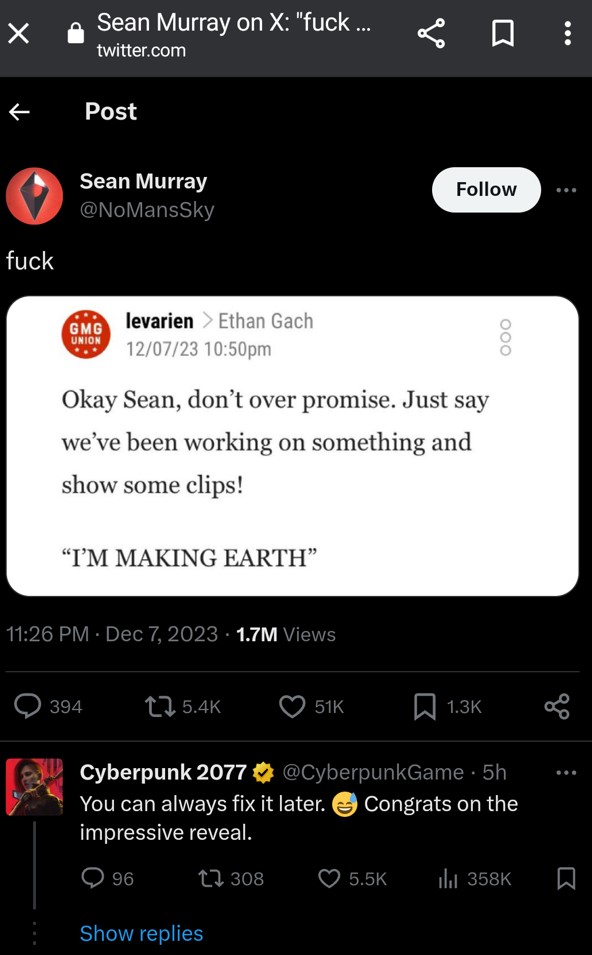
Now, you can certainly take some umbrage with how both the Cyberpunk and Hello Games devs are making light of releasing broken games that took multiple years (or longer) to fix. You are well within your rights to be screaming from the rooftops about Sean Murray in general, and warn about the dangers of hype. Hell, we don’t even have a release timeframe or hints that it will come out this decade.
But. But!
…I’m excited for Light No Fire. For two reasons.
First, it’s a survival-crafting sandbox. You might think there are dozens of these sort of games on the market already, and you would be correct. And I played them. Pretty much most of them, actually. So, I’m excited that another one is coming out from a team that I trust*.
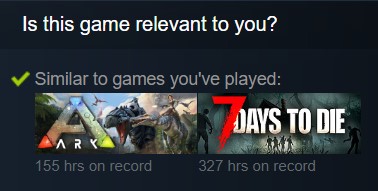
That leads me to the second reason: trust. Do I trust that Hello Games will deliver everything Sean Murray said at the Game Awards? No. Do I trust all the things written on the Steam page? No. But what I do trust is the No Man’s Sky that exists already. And when I saw that Light No Fire trailer, what I saw was mostly stuff that you can already do in No Man’s Sky.
Climb mountains? Check. Go underwater? Check. Build stuff? Check. Fly around? Check. Ride creatures? Check. Survival elements, collect rare resources, care about environmental dangers, build persistent buildings, explore things with friends, fight big monsters? Check ^ 6. About the only thing you can see in this trailer that you don’t already see in NMS are trees swaying in the breeze and a world with more than one biome. We can imagine them stitching together a bunch of planets onto one larger planet, and that is solved straight away.
The “danger” is getting hyped on what a game could be. Will there be dungeons, will there be raid bosses, will there be a “reason” to go to the tallest mountain, will there be PvP? I suppose there is also danger in assuming that when they say “one world” that it will actually be one, non-instanced world. I actually hope there isn’t one world because, if ARK has taught us nothing, it’s that prime gameplay for many people includes obstructing all available real-estate with pillars and/or phalluses. I don’t care if the world is larger than our own 197 million square miles – if you build it, people will come take a shit on it, if possible. If there are no building limitations, I give it six months, max.
Anyway, that’s Light No Fire. I will be closely following this one.
Fallout TV
A new teaser trailer was released for the upcoming Amazon-funded Fallout TV show, and it looks… good? Possibly amazing?
Show is starting April 14th, 2024.
To be fair, I have watched pretty much zero TV adaptions. Not Halo, not Wheel of Time, not The Last of Us, not Twisted Metal (?!). I guess I did watch two seasons of The Witcher and thought it was pretty good. Yeah, yeah, and I guess Game of Thrones.
Anyway, what I like about the Fallout trailer is that it hits on the irreverence of the game. Cool scene of the Brotherhood of Steel flying away in vertibirds… and it ends with the goofy bobbly head of a Power Armor suit. You’re left wondering if the armor is supposed to be impressive or obviously impractical or what. (Answer: Yes) Then you got some shots of the ultra-violence, some comedic timing, older music playing over nuclear explosions. That’s Fallout.
Can’t wait.
Dust to Dust
Over 10 years ago, CCP released an EVE-based FPS called Dust 514. An exclusive to the PS3, I was nevertheless intrigued enough to download and play it. The results were… less than ideal. The bones of something were there, but between the decision to be PS3-exclusive and the rather insane competitive environment in which it was released, it had no chance to breathe. Dust 514 was shut down in 2016.
Cue my surprise in 2023 to then receive this email:
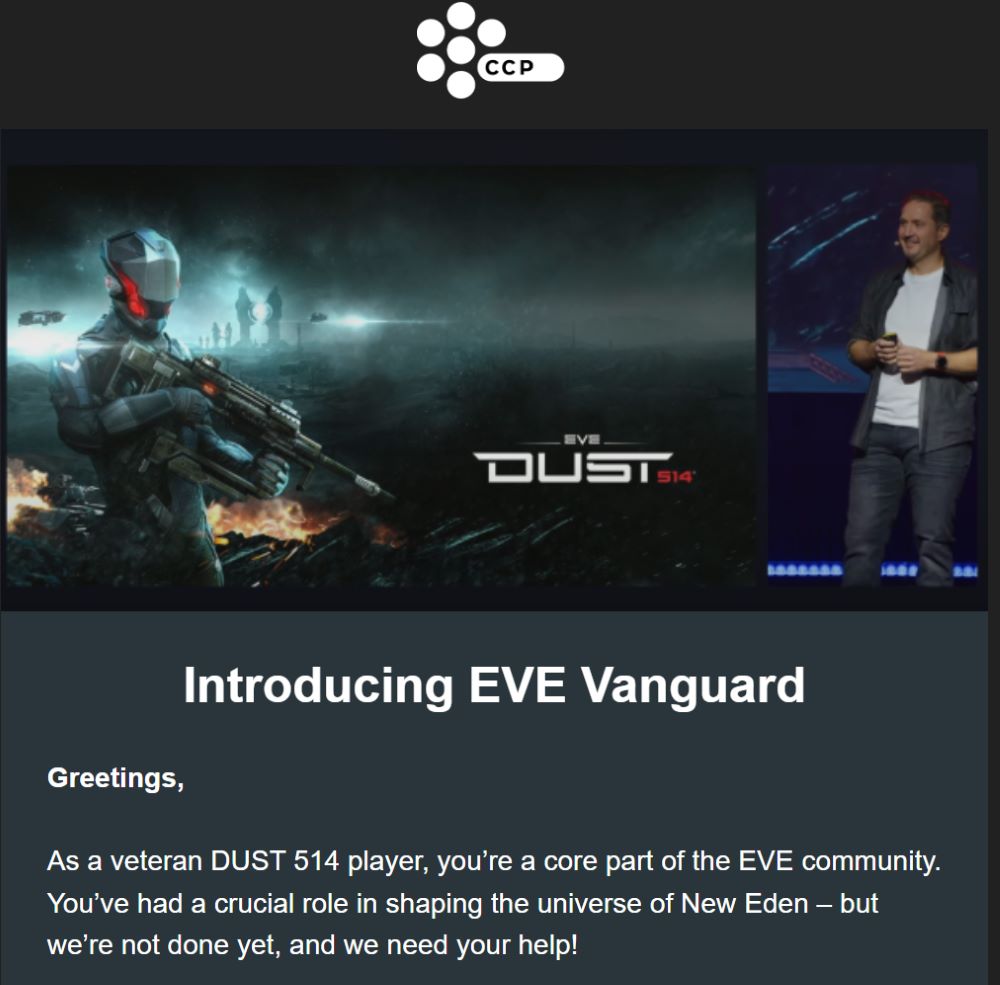
I guess technically it should not have been a surprise that the ghost of FPS past has returned. It was not even a year after Dust 514’s original 2013 release that it was potentially getting “rebooted” on PC. Then again, CCP says a lot of things, and its only nine years later that they appear to be on the verge of delivering them. Maybe.
Let me just say, from my perspective, it’s actually a great time to be releasing a FPS. Back in 2013, the competition was at the top of its game: PlanetSide 2, Battlefield 3 & 4, Warframe, Call of Duty: something or other, Borderlands 2, Far Cry 3, Titanfall, and more. A decade later and… I dunno. PlanetSide 2 is still around, but it’s not the same. Battlefield 2042 is a flop and Battlefield V wasn’t good either. Call of Duty still sells millions of copies, but there’s controversy. Look, there are tons of arena-based shooters and Fortnite and whatever, but what I’m saying is that now is probably the best time to try to penetrate the market with something new.
So, CCP, I have subscribed to your newsletter. Just, please don’t immediately slam your dick in a car door agai…
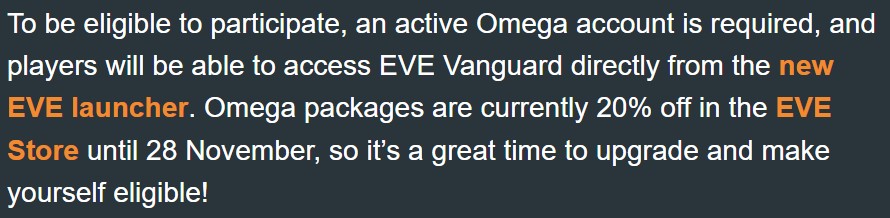
Goddammit, CCP! I mean, OK, maybe that makes sense for early access. Then you pivot, right? Right?
With the model Vanguard is proposing, simply using EVE Online’s existing subscription for access frees up the dev team to focus less on monetization and more on creating the most compelling game possible. […] EVE Online’s creative director Bergur “CCP Burger” Finnbogason called it a “relief” when the team realized the monetization model could be baked into EVE Online’s existing subscription.
While the initial monetization is coming from EVE Online Omega subs, that’s not going to be the end goal for Vanguard. Of course, there will need to be more monetization on top of the sub to keep the development afloat long-term. […]
MMORPG.com
What the literal shit. What the actual fuck. A subscription-based FPS?
I mean, congratulations, I think that might be a first. There are battlepasses galore in this space, but I don’t think anyone had the chutzpah to outright charge $19.99/month to play their FPS. If this was any other company, I would think it silly to assume this monetization strategy would persist outside of Early Access. Leveraging your existing customer base to playtest your new title is Marketing 101.
But this idea is stupid enough that I think CCP will go for it. In which case, I would ask: what was the fucking point? The goal is either to make the EVE tent bigger or extract more dollars from your existing playbase. This accomplishes neither! Maybe there is an angle where you lure the Alpha (F2P) portion of players to pony up money for the real subscription, but that seems really weak.
For now, this is all just prognostication. Maybe upon release, CCP will do the sensible thing and either sell a box or go F2P again with an optional Omega subscription granting battlepass-level benefits. In which case, I will try out Vanguard like I did Dust 514 before it. God knows I’m starving for a more modernized PlanetSide 2 or Battlefield analog that doesn’t suck.
But I’m certainly not going to be subscribing to one.
P.S. NoizyGamer has a good write-up from the EVE side of things.
Past is Prologue
Starfield has been a wild success. Like, objectively: it was the best-selling game in September and has since become the 7th best-selling game for the year. And those stats are based on actual sale figures, unmuddied by Xbox Game Pass numbers. Which is astounding to think about.
[Fake Edit] A success… except in the Game of the Year department. Yikes. It’s at least nominated for Best RPG, along with (checks notes) Lies of P? No more sunlight between RPG-elements and RPG anymore, I guess. Doesn’t matter though, Baldur’s Gate 3 is going to continue drinking that milkshake.
Starfield having so many procedurally-generated planets though, is still a mistake. And its a mistake that Mass Effect: Andromeda took on the chin for all of gamedom a decade ago.
Remember Andromeda? The eagerly-anticipated BioWare follow-up to their cultural phenomenon trilogy? It ended up being a commercial flop, best remembered for terrible facial animations and effectively killing the golden goose. What happened? Procedurally-generated planets. Andromeda didn’t have them, but the (multiple) directors wanted them so badly that they wasted months and years fruitlessly chasing them until there was basically just 18 months left to pump out a game.
You can read the Jason Schreier retrospective (from 2017) for the rest of the story. And in total fairness, the majority of the production issues stemmed from EA forcing BioWare to use the Frostbite engine to create their game. But it is a fact that they spent a lot of time chasing the exploration “dream.”
Another of Lehiany’s ideas was that there should be hundreds of explorable planets. BioWare would use algorithms to procedurally generate each world in the game, allowing for near-infinite possibilities, No Man’s Sky style. (No Man’s Sky had not yet been announced—BioWare came up with this concept separately.)
[…] It was an ambitious idea that excited many people on the Mass Effect: Andromeda team. “The concept sounds awesome,” said a person who worked on the game. “No Man’s Sky with BioWare graphics and story, that sounds amazing.”
That’s how it begins. Granted, we wouldn’t see how No Man’s Sky shook out gameplay wise until 2016.
The irony though, is that BioWare started to see it themselves:
The Mass Effect: Andromeda team was also having trouble executing the ideas they’d found so exciting just a year ago. Combat was shaping up nicely, as were the prototypes BioWare had developed for the Nomad ground vehicle, which already felt way better to drive than Mass Effect 1’s crusty old Mako. But spaceflight and procedurally generated planets were causing some problems. “They were creating planets and they were able to drive around it, and the mechanics of it were there,” said a person who worked on the game. “I think what they were struggling with was that it was never fun. They were never able to do it in a way that’s compelling, where like, ‘OK, now imagine doing this a hundred more times or a thousand more times.’”
And there it is: “it was never fun.” It never is.
I have logged 137 hours in No Man’s Sky, so perhaps it is unfair of me to suggest procedural exploration is never fun. But I would argue that the compelling bits of games like NMS are not the exploration elements – it’s stuff like resource-gathering. Or in games like Starbound, it’s finding a good skybox for your base. No one is walking around these planets wondering what’s over the next hill in the same way one does in Skyrim or Fallout. We know what’s over there: nothing. Or rather, one of six Points of Interest seeded by an algorithm to always be within 2km walking distance of where you land.
Exploring a procedurally generated world is like reading a novel authored by ChatGPT. Yeah, there are words on a page in the correct order, but what’s the point?
Getting back to Starfield though, the arc of its design followed almost the reverse of Andromeda. In this sprawling interview with Bruce Nesmith (lead designer of Skyrim and Bethesda veteran), he talked about how the original scope was limited to the Settled Systems. But then Todd Howard basically pulled “100 star systems” out of thin air and they went with it. And I get it. If you are already committed to using procedural generation on 12 star systems, what’s another 88? A clear waste of time, obviously.
And that’s not just an idle thought. According to this article, as of the end of October, just over 3% of Xbox players have the “Boots on the Ground” achievement that you receive for landing on 100 planets. Just thinking about how many loading screens that would take exhausts me. Undoubtedly, that percentage will creep up over time, but at some point you have to ask yourself what’s the cost. Near-zero if you already have the procedural generation engine tuned, of course. But taking that design path itself excludes things like environmental storytelling and a richer, more tailored gaming experience.
Perhaps the biggest casualty is one more felt than seen: ludonarrative. I talked about this before with Starfield, but one of the main premises of the game is exploring the great unknown. Except everything is already known. To my knowledge, there is not a single planet on any system which doesn’t have Abandoned Mines or some other randomly-placed human settlement somewhere on it. So what are we “exploring” exactly? And why would anyone describe this game as “NASApunk” when it is populated with millions of pirates literally everywhere? Of course, pirates are there so you don’t get too bored exploring the boring the planets, which are only boring because they exist.
Like I said at the top, Starfield has been wildly successful in spite of its procedural nonsense. But I do sincerely hope that, at some point, these AAA studios known for storytelling and/or exploration stop trying to make procedural generation work and just stay in their goddamn lane. Who out here is going “I really liked Baldur’s Gate 3, so I hope Larian’s next game is a roguelike card-battler”? Whatever, I guess Todd Howard gets a pass to make his “dream game” after 25 years. But as we sleepwalk into the AI era, I think it behooves these designers to focus on the things that they are supposedly better at (for now).
We learn from our mistakes eventually, right? Right?
 In An Age
Blizzard Decimation
Jan 26
Posted by Azuriel
It’s been rough going in the game development world, and it’s getting rougher: Microsoft has laid off 1,900 Activision Blizzard staff. Layoffs are an expected reality after corporate mergers, and certainly the industry trend is towards cutting staff this past year. But this… also cuts a bit deeper.
There’s some irony in Blizzard’s abandonment of the survival game project just as Palworld is eating the genre’s lunch – copying existing games and making them slightly better was Blizzard’s whole M.O! No doubt the layoffs were planned months ago, but part of me wonders whether the calculus would have changed had they known of Palworld’s viral success. Then again, if Blizzard released something to less acclaim, then that would be pretty embarrassing.
I’m actually low-key devastated that we won’t see Blizzard’s take on the genre. It may seem like there are a lot of options available – and there are – but it’s quite rare to see AAA development in this space. Right now, it’s like… Fallout 76 and maybe Grounded. No Man’s Sky might count? Just imagine your character running around with the detail of Overwatch rigs. Blizzard already has experience building giant, seamless worlds too. Although… hmm. If you squint hard and ignore the questing, I guess WoW itself really might feel like a survival game already. Maybe that slight overlap was the problem.
In any case, another unfortunate outcome of the axed survival game is the fact that the devs working on it were pulled from other areas months ago, only to be laid off. From a Hearthstone Reddit thread:
On second thought: oof. Book of Mercenaries was not good content, Twist has been an epic disappointment, and Caverns of Time was an insane cash-grab that’s especially egregious considering they “paused” Twist for months. Meanwhile, Duels
iswas… cut from the same cloth, let’s say. I don’t want to kick anyone while they’re down or anything, but I’m starting to wonder if Blizzard was really assembling an A-Team for the survival project. Maybe these devs were the ones most willing to take risks to see what works. And perhaps the monetization strategy wasn’t their idea. Who knows?Oh well. Pour one out for the game that was not to be.
Posted in Commentary
1 Comment
Tags: Activision Blizzard, Hearthstone, Layoffs, Microsoft, Survival