Category Archives: Philosophy
I May Be Ruined
I am about ~15 hours into Mass Effect 2.
Everything is going swimmingly, although I am beginning to suspect (all) other games have been ruined for me in two very specific ways.
First, I am not sure I can go back to text boxes in RPGs anymore. It is not just about BioWare’s penchant for fully-voiced stories, it is about the equally gripping body language. Everyone has heard about the whole “93% of communication is nonverbal,” right? We are now at a point in game design when at least one company is capable of delivering on that 93% and I do not know if I can go back.
It isn’t just about the smiles, the winks, the nods, or the scare quotes by characters with only three fingers either. It is about the more subtle touches that keep my eyeballs glued to the story exposition. For example:
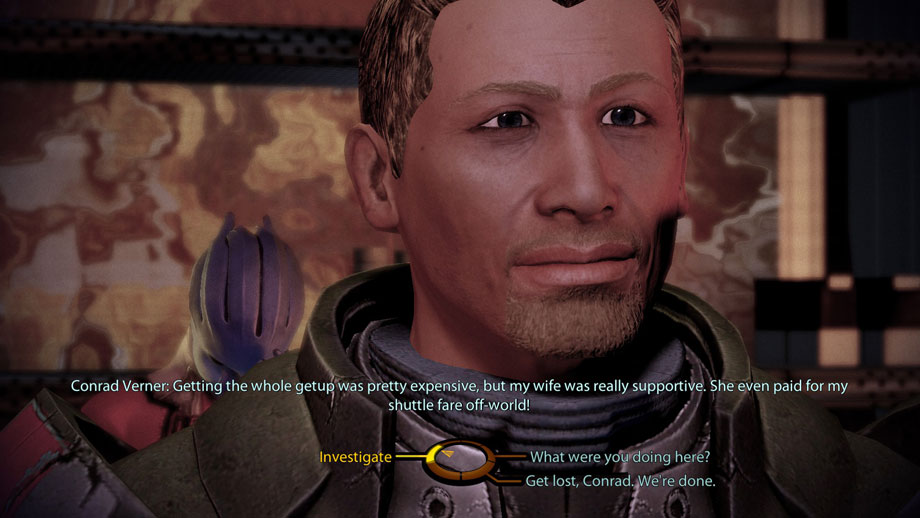
I should have shot him in the foot when I had the chance.
The asari bartender in the background facepalms when Conrad speaks the part about his wife buying the ticket. I actually had some difficulty taking that screenshot because the time between the background facepalm and the camera switching back to Shepard is less than a second – I had to redo that part of the conversation twice to get the shot.
Think about that for a moment. Someone actually went through the trouble of programming a facepalm into a (presumably) throwaway, non-required dialog option, with less than a second of screentime. Understated is an… er, understatement.
Going back to strict text and using my imagination to fill in the blanks? I am not quite sure it will feel the same knowing that the blanks are literal blanks; unless the developers clearly make up for it in other areas of the game, I suspect I will recognize the gaps as deficiencies rather than “imagination opportunities.”
The second way I have been ruined actually came via The Witcher, and is very clearly manifesting itself in Mass Effect 2. Specifically, I now believe I can and should be able to romance anyone and everyone, simultaneously.

Romance All the Things!
I first noticed this tendency when I was flirting with the ship psychiatrist – whom should really know better – and became nervous that things might get out of hand before the entire playing field became available, so to speak. This was not a problem in The Witcher; in fact, you typically only had a single opportunity for “romance” at any given time, so it was a series of all or nothing encounters.
To be honest, this probably has more to do with my methodical nature in gaming than anything else. The baseline assumption I operate on is that I will only ever play a game once – I am looking to maximize my fun, not fill time, and 2nd playthroughs almost always lose out to the dozens of other games available. Ironically, this leads to counter-intuitive game behavior wherein I suck the very marrow out of a game’s bones, completing every sidequest and bonus mission long after such things have ceased being fun and/or make sense to do. Exploring every planet in every system cluster in Mass Effect 1, running Miscellaneous quests in Skyrim as a level 54 character with 100k+ gold, and so on.
As you might suspect, mutually exclusive romance options present a certain difficulty to me.
I do have a residual desire to play ME1&2 again as FemShep, which I would have done originally if not for the availability of romance options at all (that’s another post). The ideal romance scenario would be the “Deus Ex ending” one, wherein you could save right before the critical choice and I could reload to see each outcome. I am getting the impression that this is not how things will shake out.
Youtube exists, but it is just not the same.
Skyrim is a Bad MMO
Skyrim, of course, is not intended to be an MMO.
That said, as I sailed past 100 hours played and started finally running out of the “named quests,” I started thinking back to when a lot of bloggers were musing on a hypothetical Skyrim Online and how great that would be. As it turns out, there is not much imagination necessary: Skyrim really already emulates a lot of the standard sort of MMO tropes. And, perhaps ironically, some of Skyrim’s other qualities sort of demonstrate why such mechanics generally do not really work in MMOs.
Questing
Quests range from “Talk to this guy,” to “Collect 20 Nirnroot,” to “Kill the Bandit Leader in a nation with an inexplicable 10,000:1 bandit to honest citizen ratio.” While there are no exclamation points over peoples’ heads, each city is so densely packed with quest-givers that your minimap – if such thing existed – would be lit up like a Christmas tree. And just like with every quest in an MMO, you never get a sense that you are actually solving anything. Give the Blacksmith 10 Fire Salts to reheat his forge? He may greet you a little differently, but his “secret technique” results in no higher quality merchandise, no larger gold cap, no discounts.
Sidequests are sidequests, though, right? Well, to an extent. The problem is when there are more sidequests than main quests, or when the main quest is boring. At some point, you give the player enough freedom to hang themselves… and they do.
See, I have completely lost the Skyrim narrative. “What am I doing? Why do I care?” Helping a dude steal a horse is supposed to enrich the game world’s verisimilitude, I guess? If that is the case, it failed. The quests are so disjointed and arbitrary that I end up feeling like a dyslexic, ADD-addled coke-fiend with Tourettes, sputtering along countryside with an ever-increasing laundry list of chores. The situation really makes me appreciate all those otherwise lame zones in WoW, insofar as the quests actually lead somewhere or enriched the background of the zone.
Crafting
I have heard a lot of people lament the state of player crafting in MMOs, but again, Skyrim is a good case-in-point about where strong player crafting can lead to. Basically, I have not upgraded a single piece of gear in the last 40 hours of gameplay. Considering there is no such thing as quest XP, and I have more gold than I could ever possibly spend, the lack of possible gear upgrades essentially boils questing down to its base narrative components. Some hold up, most do not.
Short of the sandbox-esque nuclear option of destroying gear and/or permanent durability loss, I do not see a worthy payout for the costs of strong player crafting. I just completed a long questline to reconstruct a 1,000+ year old amulet whose power started a war and led to it being split into three parts and sealed away; the names of amulet keepers were to be forgotten under the pain of death. After finally reforging it, I held it in my hands and… oh, +30 to Health/Mana/Stamina? I created an amulet with +67 to Health and +40% extra Bow damage nearly 50 hours ago.
/vendor
While some of this can be mitigated in MMOs by making recipes rare, requiring special crafting materials from higher-level content (which is different than normal loot… how?), and so on, strong player crafting still seems to boil down to reducing or eliminating much of the incentive to quest. Perhaps that is indeed the entire point, eh? Moving away from designer quests and into “Spam Trade chat for an hour” player quests? That is fine to do, with the assumption that the game itself is either going full quest-less, or the quests that do exist are so ridiculously fun and exciting that they are intrinsically worth doing.
Pacing
Although this is not a formal review, if I had to sum up all of my problems with Skyrim in a single word, it would be “pacing.” There simply isn’t any. Even if the game revolves around doing what you want, pacing is important. I am level 51 and I can 2-shot dragons with my bow from stealth – the game is essentially over for me. And yet the main questline is not remotely near complete, nevermind the handful of other quests remaining. Yes, “I did this to myself.” If EVE gave every new player a Titan for completing the tutorial, those players would also be “doing it to themselves” for (ab)using it too.
Point being, it is the designers’ jobs to craft a well-paced game. I don’t care how sandbox your design is, I shouldn’t be allowed to break the game for myself. One of the great strengths of the themepark experience is exactly the derided “on rails” component: it will take you X days of Y quests to get Z gear. The bosses you face tomorrow will be stronger than the ones faced today. There will be a quantifiable reason to collect 10 bear asses.
After 100 hours of gameplay, clearly Skyrim is doing some things right. I have never taken more screenshots in my entire life, for example. Despite my character being completely broken, I still treat the world seriously (sneaking around when I could simply kill things straight-up) because it projects seriousness in most every scenario. But instead of making me pine for Skyrim Online, it does the opposite. I miss the strong narratives of Fallout 3 and New Vegas. I hated having to level through Burning Crusade content in WoW, but I hate tracking down 20 Nirnroots more.
Pacing is something to keep in mind when constructing your hypothetical sandbox or Impossible MMO. More options, more things to do, can actually result in less meaningful gameplay. Skyrim deserves its accolades, but it makes for a pretty bad MMO. And the changes necessary for Skyrim to be ported into the MMO world would, in fact, make it resemble nothing like its present state.
Role Playing
One of the most meaningful quests I have ever completed in World of Warcraft actually occurred in Cataclysm. It was called “A Bird in Hand.” Ostensively, it was just another boring, linear quest in a string of half-hearted attempts to spice up the killing of X mobs. Then came this part:
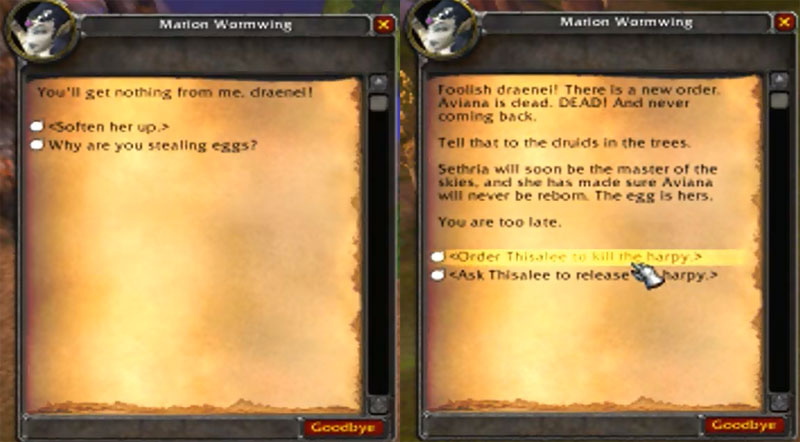
Originally, I pummeled her repeatedly for the sheer novelty of it.
For those unfamiliar, the quest asks you to choose between roughing up the harpy or simply yelling at her. You can mix and match a bit, or you can continue to pummel the harpy until she eventually tells you everything she knows. At the end of this dialog “tree,” you have the option of either letting the harpy go, or having the NPC slit the harpy’s throat. Which options you pick is entirely irrelevant to the game. No future NPC references your actions in any way, the rewards are the same, each option takes an equal amount of effort.
And it was, in all seriousness, one of the best moments in WoW questing.
Because it was not until that moment that Azuriel the draenei paladin was anything other than a mere user interface element. The quest forced me, as a player, to step back and ask myself a question that was never hitherto asked: is your avatar you? What would Azuriel do? And what I found in answering that question was a hidden depth to the game, an unburied black monolith that was full of stars.
Of course, then the quest is over, the fever-dream passed.
So allow me to disagree with anyone who has suggested that the choices in SWTOR are dumb, meaningless, a waste of time. The fact that every Trooper has the same general story as any other Trooper is irrelevant. The biggest success of SWTOR – regardless of what happens in the future – is NOT necessarily voices and deeper narratives, it is that the game represents one of the biggest moves into mainstreaming the RP in the MMORPG that I have seen in years, perhaps ever.
When I played through Deus Ex, or Fallout, or any typical single-player game, the main character was a stand-in for me. What would I do, as a cybernetic super-solider? How did I feel about letting bandits go? What would I say in the ridiculous, impossible situation so far removed from my own life? I don’t know whether it is the first-person perspective of those games or their overall structure, but I do feel different when it comes to MMOs, and my time with the SWTOR beta specifically.
It is one thing to get someone to put themselves into a game, and quite another to get them to bring a character to life and imagine what this entity separate from themselves would do. Mainstreaming the mechanics of empathy, making it fun? That is some Nobel Peace Prize shit going on. And I am only half-joking.
“Our character is what we do when we think no one is looking.”
-Jackson Browne
Having our game decisions result in discrete consequences makes for a better simulation, yes. Then again, in the real world the decisions we make when the consequences are irrelevant or unknowable is a definitive aspect of one’s character. If you helped an old lady cross the street, and she got hit by a car a block later, was your original decision truly meaningless? Are consequences the only arbiter of morality? Is intention irrelevant? You tell me.
All I know is on that soot-filled day in the burning mountains of Hyjal, skin caked with sweat and the still-warm blood of ten harpies, the paladin Azuriel beat Marion Wormring to within an inch of her life. To an inch… and no farther. For in that one, singular moment did Azuriel have a choice: the choice to walk away. And so… she did.
Kingdoms of Amalur, Used Game Sales
As you may or may not be aware, there was a minor kerfuffle surrounding Kingdoms of Amalur: Reckoning. The gist is that Amalur is an EA-published single-player RPG with an Online Pass that unlocks Day 1 DLC, which is like a triple-word score on the Scrabble board of controversy. The thread on the forums ballooned to 48 pages of indignation, Curt Schilling (CEO and some baseball guy) responded in an eminently reasonable manner, and now the thread is about three times as big.
The irony in all of this is that this particular incident is not that big a deal. However, it touches on so many things that ARE a big deal, that it becomes something that should be a big deal. Specifically, the demonization of used game sales, which has came up before in an unfortunate Penny Arcade post back in August 2010. Later on in the Amalur thread, Curt Schilling laid out the issue:
Herein is the dilema no one wants to talk about right? We CANNOT in ANY WAY cater to people that buy used games exclusively right? We see ZERO revenue. Now as a consumer you may care nothing about that, and that is absolutely your right and we respect that.
However we are a business, we have 400 people, every single one of them is awesome, but I just can’t get them to work for free, so we need to make money to pay them, to make more awesome games.
Now the issue is the straddler, there are people like me, never ever bought a used game in my life, or pirated one, and never will, and people that ONLY buy used because they don’t have the means to buy new or whatever, but they have their reasons, agree with them or not it’s not relevent.
The straddler does both, he buys new and used, he turns in used to buy new, and that new game could be ours right? How do we handle that? How does the industry handle that? Industry? That’s the huge challenge.
I want to talk to the executives out at EA and other game companies for a moment. Are you guys listening? Get ready to write this down:
Fuck you.
A used game sale is a guaranteed new game sale at a lower price point.
Don’t you see? These people are ready and willing to give you money, and YOU ARE NOT LETTING THEM. No one is buying used games because used is better; used games are universally worse, with possibly scratched disks, missing manuals, missing cases, and so on.¹ No one is buying used games to specifically deny money to the developers; otherwise they would simply pirate it. People buy used games because they are otherwise being priced out of the market (which includes people who don’t feel a game is worth full MSRP).
I understand it’s EA or whoever’s right to set their merchandize at whatever price point they like. I have doubts that $59.99 is the precise intersection of Demand and Supply, but whatever. My point here is that used game sales is literal demand that is being filled by other people expressly because you refuse to accept any less than an arbitrary amount. The idea of Online Passes is to get something back from the secondary market, right? Instead of selling $10 Online Passes, how about, I dunno, dropping the price of the game by $10?
Maybe the Online Pass thing makes them more money. If a game is resold ten times, that is potentially $100, right? But if that game was resold for $40 ten times, that means EA could have sold TEN NEW COPIES AT $40. Gamestop could sell used copies at $35, sure, and maybe no game company one wants to get into such a race to the bottom. But at that point, I would hope that EA and friends would get on the right side of incentives instead of the wrong.
Because here’s the thing: this is all about the continual erosion of Consumer Surplus. When you buy a brand new game for $59.99, the ability for you to sell that game to Gamestop for $20 when you are done with it is Consumer Surplus. It is value, whether you explicitly exercise it or not. We can imagine a world where used games somehow don’t exist in any form.² In such a world, you have LOST $20 worth of value and have likely received NOTHING in return – probably LESS than nothing, if the mechanism that prevented used games inconveniences legitimate customers the same way DRM harms actual customers. This is the reason DLC (especially Day 1 DLC) is troubling, the reason Cash Shops are troubling, the reason being forced to go online and register offline, single-player RPGs is troubling: all of these things are signs of Consumer Surplus extraction.
Remember back, say, 20 years ago? When a game company only received greater profit by ensuring they put out quality products? Those days are long gone. It is no longer about generating more sales, but from extracting more dollars from the sales that ARE made. Whoever came up with the phrase “value-added services” is a goddamn Doublespeak genius. Instead of simply getting those extra costume options, we pay for them. Instead of getting free map packs, we pay for them. Instead of being able to earn Sparkleponies and Disco Lions, we pay for them. This incentivizes game designers to have us pay more for less, instead of pay less for more.
The Kingdoms of Amalur controversy is not that big a deal in the scheme of things. Indeed, when you put it in the context of pre-order bonuses and Collector’s Edition items, it’s hard to see 38 Studios “giving away” DLC as particularly nefarious. Lesser evil is still evil though, and I can’t help but wonder whether in a different age those seven quests would have been included in the game, or in a free patch later on. Or as a poster in the Amalur thread said:
Is it just me or does that PR statement just admit that they develope DLC at the same one as the game, or in non moron speak, the game you’re paying 60 bucks for is having parts removed so you could buy then later.
AHow incredibly fucking nice of them to give Us the entire game up front, oh wait, they just admired to holding that back.. What else did they pull out? What other content did they strip from the title to bilk us for later?
Looks like $20-30 GOTY edition it is.why would I pay full price when I can’t trust or believe I’ll actually get the full….Fucking…. Game?
¹ Remember when games came with cloth maps and game posters? I still have the two game posters that came packaged in the FF6 box. Those sure as hell didn’t show up with your used game copy.
² Just look at Steam: no used game sales. Of course, you should also look at Steam because they are on the right side of consumer incentives. In return for DRM and no resale of games, we get hassle-free DRM, truly ludicrous sales (consumer surplus!), automatic game updates, amazingly fast downloads, integrated community, and the ability to manage a library of titles without worrying about CDs or CD keys. Compare that to the typical ham-fisted Ubisoft or EA implementation of DRM.
Massive Effect
Having completed Torchlight, I decided to move onward to Mass Effect. Why not Skyrim, which is literally burning a hole through my Steam library? As Liam O’Brian might say, the status of my preparations is in doubt. I prefer one meaty title with a helping of indie garnish along the side – with something like Skyrim, I’m getting the impression that I’ll still be eating turkey sandwiches for months later.
About 5 hours into Mass Effect, all I can say is holy shit.
One of the most groundbreaking things occurred in the city after the first “dungeon.” In talking with a receptionist to the Consort, she winked at me.
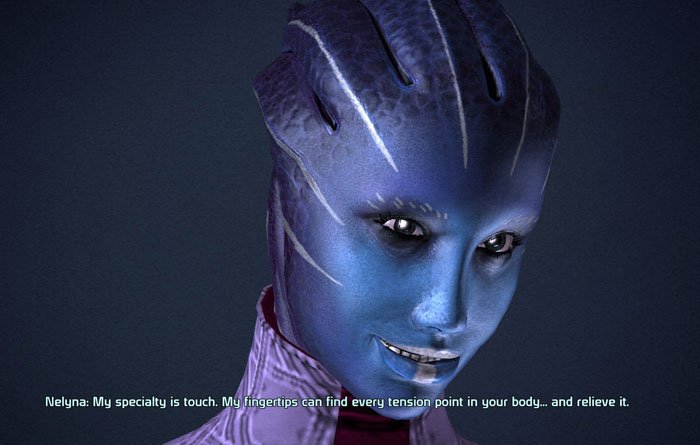
She also said that, but nevermind.
My incredulity may sound facetious, but I am actually very, very impressed.
See, I have been thinking about the problems with storytelling in videogames for quite some time. How is one supposed to convey subtle nuance in a game? In purely written works, it is somewhat easy to evoke the emotion you want to get across, provided you massage the language a bit. For example, consider the following:
‘Look, I can explain,’ he said.
Lord Vetinari lifted an eyebrow with the care of one who, having found a piece of caterpillar in his salad, raises the rest of the lettuce.
How could someone ever translate that in game form? Nevermind Vetinari’s specific sentiment here, think generally: there is an entire genus of expression that the format is preventing designers from expressing.
Games have some pretty unique qualities that cannot be replicated by other mediums too – Far Cry 2’s plot wouldn’t work without player interaction – but many times it feels as though designers simply give up. Game narratives are written in the language of action because of these restrictions on expression. Why are we always killing 10 [%local_wildlife]? Or killing everything, period? Well, how else are you supposed to convey conflict when reduced to crude avatars with clubs? Even though all games have access to written dialog, at some level we do expect everything to be translated into the language of action. And until the last few years, it was functionally impossible to express more than a rudimentary emotional gesture anyway.
There are pitfalls too, of course. Blink during the wink, and you’ll have missed it. Or, hell, focus on the subtitles and miss it too. It is also arguable about whether games should try and be more like the other mediums, instead of focusing on its own unique strengths.
To that last charge, I say “Watch that scene in FF7 again.” Pay close attention at 1:19. More than the murder itself, it was Sephiroth’s smirk that drove home how irredeemably evil the man was. Without the CG movie we would never have saw it; calling attention to smirk in-game via text would have ruined its subtle gravity. While story can certainly be a crutch to prop up forgettable gameplay, story can also be a pole that vaults a game into the classics.
So, Mass Effect, you have my full attention. I just hope you do a little more winking a little less of this:
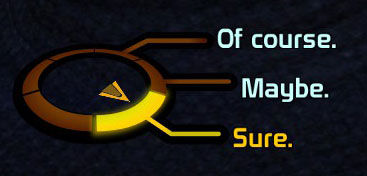
Decisions, decisions.
Unfortunate Obsolescence
It occurs to me that we – or more specifically, I – have well and truly crossed the barrier beyond which old, amazing games go to die, unplayed and forgotten.
For example, today you can buy Star Wars: Jedi Knight: Dark Forces II on Steam for $1.24. I have heard many, many great things about this game over the years (and it indeed has a 91 Metacritic score), but I never got around to experiencing it. And so when I saw it up for 75% off, I decided to take a look at the game’s page. What I saw was this:

This probably looked amazing to my 14-year old self.
I just couldn’t do it. Whatever it was that this game could have added to my life experience is gone forever.
Of course, this is not just Dark Force II’s problem. Have you tried booting up Planescape: Torment lately? I wrote an awful, awful review of the game back during the height of my JRPG fandom phase a decade ago, and have always wanted to return to give the game its proper dues. But that is unlikely to ever happen. I tried, I seriously tried. Planescape always had a super zoomed-in camera compared to the Baldur’s Gate titles, and combined with the 640×480 max resolution was simply too much. I could not bring myself to get out of the morgue, the technical/compatibility issues notwithstanding.
To bastardize a phrase: the flesh is willing, but the spirit is weak.
Who though, in all honesty, is going to go back and play Fallout 1 & 2 after being introduced to the franchise via 3 or New Vegas? There are hundreds of classic games like this. Certain ones, like Chrono Trigger and the like, can survive rerelease after rerelease without changes. But these others? Not going to happen. I talked about the haunting legacy of Deus Ex in regards to its modern-day prequel, but who is going to play the original if they have not already? I understand there are mods that do amazing things to the visuals, but that presupposes a desire to go through the trouble to begin with.
Indeed, I feel the entire gaming industry is entering a bizarre new landscape with the advent of the App/Indie/F2P Age. I wrote over 60 RPG reviews back in the day, and every single one of them had a Replayability score. Now? Who cares about replayability? Story choice is fantastic, but the typical likelihood of my actually going back through New Game+ or its equivalent is somewhere between zero and no way in hell. I’m not looking for something to kill my time anymore – time is the one precious thing I ain’t got anymore. Any game that wants another roll in the hay is competing against an entire library of unplayed Steam titles, indie or no.
And that, sadly, also goes for older titles regardless of their presumed timelessness. So when I see people complain about, say, Syndicate looking like this instead of this, well… that latter game is dead and gone. I just went through an Eeyore routine with Deus Ex: Human Revolution, sure, but I would rather some remnant exist in a modern form than nothing at all.
Sexism: Point Taken
This should be my last post on the sexism topic for a while, as the items below essentially obsoleted a 1500-word post on the subject I had scheduled to go up.
Item 1: The Comic
False Equivalence from Shortpacked.com:

Although I would still argue the finer points of what physical features are power fantasies to whom… well, point taken.
Item 2: The Paradigm-Shifting Article
Why Strong Female Characters Are Bad for Women. An excerpt from the thesis bit:
I think the major problem here is that women were clamoring for “strong female characters,” and male writers misunderstood. They thought the feminists meant [Strong Female] Characters. The feminists meant [Strong Characters], Female.
So the feminists shouldn’t have said “we want more strong female characters.” They should have said “we want more WEAK female characters.” Not “weak” meaning “Damsel in Distress.” “Weak” meaning “flawed.”
Good characters, male or female, have goals, and they have flaws. Any character without flaws will be a cardboard cutout. Perhaps a sexy cardboard cutout, but two-dimensional nonetheless. And no, “Always goes for douchebags instead of the Nice Guy” (the flaw of Megan Fox’s character in Transformers) is not a real flaw. Men think women have that flaw, but most women avoid “Nice Guys” because they just aren’t that nice. So that doesn’t count.
This article, much like the two videos I posted previously, came from such an unexpected direction that it shifted the entire way I looked at the issue itself. Even the nagging objection I had in the back of my mind – “Is attractiveness in these female characters harmful, then?” – is addressed towards the latter end of the article.
Item 3: The Pithy Video
Why Men and Women Can’t be Friends.
While the previous two items changed the scope of the debate for me, this video summarizes the problems I have with the article Nerds and Male Privilege, the one that made me /facepalm so hard I developed an epidural hematoma and set me to writing a 1500-word post. At one point in the aforementioned article, “Dr. Nerdlove” writes: “Y’see, nobody’s saying that women don’t receive different treatment from guys… I’m saying that being treated differently is the problem.” While the examples of sexism he goes on to use are legitimately bad (assuming a woman is a quota hire or got to where she is by sexual favors, etc), there is an implicit underpinning to the article that if nerds just treated women equally, all this would go away.
Except… it can’t. The harassment and stereotypes can and should be diminished, absolutely. But as the video succinctly demonstrates, there will always be a difference, even under gender equality.
A Few Unresolved Issues
First, there is the question of whether characters like Samus, Chell, FemShep, etc, are actually strong female characters if they could be replaced by male characters without a loss in narrative integrity. The Rule 63 Dilemma, if you will. I’m inclined to say that any non-fanservice female is a win by default, but I can acknowledge how that may amount to the soft bigotry of low expectations.
Second, I am beginning to question whether a call should go out for more weak male characters (see Item 2). While some would point to, say, Batman as an example of a flawed male character with depth, my point is that male protagonists inevitably succeed at “being a man.” Chiseled men kicking ass may be a male power fantasy (see Item 1), but I consider it just as pernicious a fantasy as Objectified female sex objects. When I was out of work for 14 months, I felt a crippling sense of shame for not “being a man,” because men provide, men aren’t weak, men aren’t emotional, and so on. While there is obviously a power difference between being conditioned to be aggressive versus demure/passive/accommodating, it is still harmful conditioning.
Third, while the debate on Syl’s blog has wound down, one of the main issues we have “agreed to disagree” on was why Tifa/Sylvanas were drawn sexy. Syl asked “Why?” I asked “Why not?” They both are written as strong characters, so it should not matter in the scheme of things to also dial up the visually appealing meter while we’re there. Syl asked: “what’s the message there exactly and why will their male equivalents not come with equal, sexual innuendo?” My counter-question would be, if I were still permitted to post there, “What would you like to see, innuendo-wise, from males?” From my (limited) understanding on the subject, what women find visually appealing or sexual varies wildly from woman to woman. In contrast, pretty much all men are visually attracted to boobs and butts. If the Batman from Item 1 is only appealing to 20% of the female audience, is that a win or a loss considering the traditional Batman model is 100% appealing to men for power fantasy purposes (and presumably X% of women)?
I understand that it’s more fair if the audience breakdown for games is 50/50 to draw as visually appealing characters as possible without alienating one side (i.e. women) with panty shots or barely-there clothing. I suppose the question is: what’s the impact when one gender is more predisposed to visuals than the other? Is equal still fair? Or can we agree with the article in Item 2 insofar that the problem isn’t the sexiness of female characters at all, but rather when the whole depth of their character concept is visual sexiness?
In closing, I want to mention again the importance of tailoring one’s argument away from Goal-oriented methods towards more Results-oriented ones. The articles and arguments that shifted my attitude on this subject were NOT the confrontational ones that attempted to guilt me into accepting their conclusions wholesale. Even though the comic in Item 1 began that way, the unique perspective of what a woman actually found attractive in comparison to the standard fantasy male was intriguing; not to mention the idea that Batman’s chiseled abs were drawn for men. That, along with the notion that sexy poses were actually demeaning and patronizing to men too, were game-changers. How could you argue against that? There is no defense. Appealing to self-interest may not be as noble, but at some point the question arises as to whether you’d rather be noble, or actually accomplish what you set out to change.
Strong Female Characters
I was not going to write a follow-up to yesterday’s post, but I came across another Kotaku post today titled “It’s Time for a Lady Hero in Grand Theft Auto.” I agree with the article, in that such a thing would be awesome, assuming they find a way to make it work. And by “work” I mean actually make the main character being a woman matter, as opposed to merely swapping gender models in a story written for a man (or gender neutral, which so often defaults to man anyway).
But then I got to thinking… is that not what typically occurs anyway, even with strong female characters?
In the comment section of that article, the following was posted:
Oh shit a female character? How am I supposed to relate to that?
BRB PLAYING METROID AND PORTAL.
The comment is obviously sarcastic, referring to the strong female characters of Samus Aran in Metroid and Chell in the Portal series. And yet, at what point does it matter in any meaningful sense that the protagonists are women? Don’t get me wrong, I love that they are. As I mentioned in the comments on Syl’s post:
I love strong women. I love the rich, dramatic narrative possibilities of balancing strength with femininity; “being a man” is almost always one-dimensional (i.e. strength == man) in contrast. It is why I almost always roll female toons in MMOs.
A woman slaughtering a bandit camp or slaying a dragon is automatically more interesting to me than a man doing the same. But if I am honest, it’s that way because I’m imagining more complex inner struggles into those events from the female side. I expect a man to slaughter a bandit camp or slay a dragon, because that is the cliche. To not do so would be a renunciation of “being a man.” Which, incidentally, is something I consider far more pernicious than any Objectification that goes on with scantily-clad women, but I may be biased. But when a woman slaughters a bandit camp, I envision a struggle against conformity, against despair, against a nature inclined to nurture, and so on. The Bene Gesserit of Dune and Aes Sedai of The Wheel of Time are more interesting groups of people because they are women; a mystical cabal of controlling men is almost too cliche to commit to paper.
Going back to the Metroid and Portal examples though, did it really matter in a narrative sense that they were female? I would say no. Samus and Chell could have been dudes and the game would have played out in the same way. If strong female characters can be replaced with males with zero narrative loss, are they really strong female characters? As I mentioned, them being dudes would have certainly diminished something from my play experience, but I’m struggling with the intellectual notion that the gender of the character model really makes that big a difference to me. Or is the fact that they could be replaced by men without a loss of narrative integrity actually a win? Gender equality and all that.
Perhaps silent protagonists are not the best examples. Final Fantasy 7 is my second favorite game of all time, and I consider Tifa one of the deepest characters in any RPG I have ever played, despite (and perhaps in spite of) some of her more obvious fanservice qualities. Tifa is strong, capable, independent and yet distinctly feminine at the same time. That being said, outside of taking care of Cloud during the whole Mako poisoning bit, and the pseudo love triangle thing, I could not really give examples of what I mean by “distinctly feminine” that does not have something to do with the way she looks or otherwise read like a laundry list of cliches. Maybe that’s okay, and those prior distinctions are enough?
So, good luck Rockstar. I cannot wait to see what they would do with a female lead in GTA.
P.S. While “researching” this post, I came across two excellent examples of What To Do when talking sexism in games, both in video format. The first is The Big Picture: Gender Games, and the second is Game Overthinker: Bayonetta. The former is rather brilliant with it’s “pose” argument, which is both intuitive and unassailable. The latter doesn’t focus on sexism explicitly, which makes its implicit argument all the more compelling when you realize what just happened by the end, i.e. you agreed with everything.
If you want to affect real change, you do it that way.
Internet Sexism, Global Warming, and the War on Terror
Through a confluence of events – namely Syl’s war on panties and a Kotaku article that points towards an abysmally counter-productive blog post – I want to talk about internet sexism for a moment. Namely, how not to do it. For example, taken from aforementioned counter-productive blog post:
So first up, is this a problem at all? Yes. Yes, this is a problem. The gaming community contains an incredible number of idiots. Go here and read this article about Saint’s Row 3 by Emma Boyes. It’s a good article, well reasoned and the complete opposite of anything aggressive or hectoring or provocative. It defends a game that has been attacked for sexism. It’s a great piece.Then read the comments and it’s just a roll-call of complete fucking bullshit. Angry, shouty, stupid, illogical, emotional, insecure ranting, brought forth from the depths of the internet’s prick cabinet. If that exact same article had been written by a man, not a single one of those comments would have been written. That’s because they have absolutely nothing to do with anything that’s said in the article and, more importantly, because men don’t get handed this shit.
This is not how you should approach the problem of sexism over the internet. To be honest, even approaching the problem of sexism over the internet is probably dumb. Not because sexism is a cause unworthy of one’s concern, but because it is an unnecessarily Sisyphean struggle based on how you are outlining the issue.
The United States is currently “at war” with Terror, even after Drugs won the Drug War. If you set your objective as eliminating the Platonic Form that is Terror – and exclude the Terror you inflict on other nations – you set yourself up for failure. All terrorists have to do is succeed once; you must succeed 100% of the time, forever. Similarly, eliminating internet sexism can never succeed considering that the closer you reach the endpoint, the more effective a sexist troll becomes.
Is such thinking defeatist? No. To be defeatist is to set oneself up for defeat, i.e. unrealistic goals. Your goals should be informed by what you want to accomplish, not the other way around.
When Nils wrote about Global Warming, I knew how the comments would unfold before I even read the post. Why? Because the way the Green movement approaches the subject is dumb. We should not be talking about the earth warming, sea levels rising, and so on. It is entirely possible (no matter how unlikely) that mankind has nothing to do with the earth warming; every minute you spend trying to convince someone the Green movement isn’t an anti-business communist conspiracy is a minute farther away from what you want to accomplish. Instead, Green should be focusing on the power plants very obviously spewing toxic material in the air. Green should focus on more fuel-efficient cars for energy independence and because, hey, efficiency. And in the process of focusing on concrete, unassailable accomplishments, Green also achieves their Global Warming goals.
Incidentally, the above is why this nonsense:
@olly – If you believe what you just said and act accordingly then you are enabling those assholes. These people will always exist but it is still your personal job to tell them they are being assholes when they are being assholes.
We don’t stop trying to catch murderers just because there will always be murderers.
You are making excuses. Stop it.
…is worse than doing nothing, it’s counter-productive. Calling trolls assholes is exactly what they want. The more white knights that show up on internet message boards, the more embarrassing their (otherwise noble) behavior appears to everyone else, and the less likely anyone actually does stick up for women (etc) when it counts. And by the way, if you tell someone who gives to charity that they don’t give enough, you are liable to make them stop giving at all.
If you want to combat internet sexism, demand these companies moderate their own goddamn comment sections. Do you see? A well-moderated forum is just as free from (trolling) sexism as an utopian gender-equal society. Moreover, the actual issue was never sexism per se, but trolling itself. “Solving” sexism and racism and other -isms is fairly meaningless if everyone ends up trolling about how fat, stupid, or ugly someone is instead.
Sexism in the real world is a lot more difficult to solve, of course. But just like with everything above, the key is to leave ideology at the door, fix the plumbing, and then the owner will invite ideology in on their own. And even if they don’t, well, at least the plumbing got fixed.


Designer Responsibility
Nov 18
Posted by Azuriel
How responsible are game designers in the balancing of their (single-player) game?
Syncaine swerves to the right:
One theme I’m seeing is the debate about what is OP [in Skyrim], and how easy it is to min/max the game. I find this… odd. As Nil’s himself pointed out, you can turn godmode on if you want, and be as ‘maxed out’ as you can possibly get. Hearing that people are ‘exploiting’ the game by running into a wall for hours while hidden to max out stealth makes no sense to me. Why waste all that time, just go into the character file and put stealth to 100. […]
“Am I to blame?”
Yes.
Luckily the solution is easy; remove one or more of the enchanted pieces, or up the difficulty, or RP a reason why you no longer require mana to cast spells.
I’d rather you do that then Bethesda spend time hardcoding a solution over adding yet-another-quest, or whatever other content they could do in that time. Or have the hardcoded solution prevent me from play “how I want”.
If this was an MMO, 100% valid point. If it was a multiplayer game like Dungeon Defenders, still 100% valid. An sRPG that is far more about the journey than the end-goal? Naw, non-issue IMO.
Nils has a more center-oriented approach:
I agree that it is partly in the player’s responsibility to not optimize the fun out of his game. An example would be sneaking against a wall until you have maxed out stealth in Skyrim.
On the other hand, I just uploaded a video to youtube that shows how I enchanted four items and now can cast destruction and restoration spells witout any mana cost. This is a game changer, as the mana constraint was important in the game – until then. Many of my perks in the talent trees are suddenly useless. The game becomes worse. Playing it is less fun if I can just spam a single spell without looking at mana.
I optimized the fun out of Skyrim. Am I to blame?
The problem is that I ended up enchanting my equipment this way not by sneaking against a wall. I simply skilled enchanting and then used reasonable enchantments on my equipment.
My point is this: A game cannot use the cartot, that character power progression (CPP) is, to increase the player’s engagement with the game, and at the same time allow him to optimize the fun out by hunting the carrot in a reasonable way.
My own left-leaning approach is the same as I outlined in the Culpability of Questionable Design, the very first post I made under the In An Age banner. Essentially, it is (almost) always the designer’s fault.
Don’t Hate the Player, Hate the Game
As I commented on Syncaine’s post, I find it bizarrely apologetic to state that it is a player’s responsibility to not ruin the game for themselves. The specific situation in Skyrim Nils had brought up was the ability to eliminate all mana/stamina costs of spells and abilities via Enchanting. Nils had gotten his Enchanting skill up “legitimately,” as opposed to, say, getting 100 Sneak by auto-sneaking into a corner for a several hours. For the record, I see zero difference between those two activities – both are simply examples of incredibly
poor designridiculous failures of imagination.In Oblivion there existed a Magic College where you could invent your own spells and magic items, within certain constraints. Making a Fireball spell that dealt 100 damage was expensive, whereas a 50 damage Fireball cost less. Similarly, a buff/debuff that lasted an hour was more expensive than one that lasted for only 1 second. After about an hour of playing with the various sliders, I left the College with a ranged spell that decreased the HP of the creature it touched by 100 for 1 second. The practical effect was that it instantly killed everything in the game, at least until I gained many more levels – even then, if I fired it quickly, the second hit would kill anything with less than 200 HP since it stacked with itself. I called this spell Finger of Death, and later added it to a sword along with the Soul-draining property so that as the sword instantly killed who it touched, it refueled itself.
I did not set out to break Oblivion, nor did Nils set out to break Skyrim; the both of us were simply using the tools the designers gave us and taking them to their logical conclusions. It is the responsibility of the designers to ensure that incredibly obvious things (at least in retrospect) like “-25% mana usage” does not stack with itself, that temporary decreases in HP scale the same as damage abilities when their effects are indistinguishable, and so on, are balanced. Arguing to the contrary is to admit that WoW leveling is not too quick since the player can manually shut off XP, that facerolling mobs and instances is a player failure as said player could play with just one hand, play with a gamepad, play with Resurrection Sickness, or any number of entirely arbitrary self-imposed restrictions. It is to abdicate, wholly and completely, any responsibility of the designers to present a balanced, well-paced experience.
Syncaine is right about these games being about the journey, not necessarily getting to the end as quickly as possible. And yet I derive deep satisfaction in the execution of strategies, figuring out how rules/objects work, and finding more efficient ways of doing tasks; those things constitute the journey to me. Turning on god-mode in the console may have the same end result, but it skips all the fun, thinking bits inbetween, just like skipping to the last chapter of a book. In other words: optimization is fun.
And so I believe it is – and has to be – the designer’s responsibility to ensure that if a game can be optimized, that it still continues to be fun and challenging when it inevitably is. Anything less is laziness, incompetence, or both.
Posted in Commentary, Philosophy
13 Comments
Tags: Game Design, Nils, Oblivion, Optimization, Skyrim, SynCaine