Category Archives: Review
Reviews: Sequence, DE:HR – Missing Link DLC, Dawn of War II – Retribution
Game: Sequence
Recommended price: $2.50
Metacritic Score: 70
Completion Time: ~11 hours
Buy If You Like: Playing DDR on your keyboard… with RPG elements
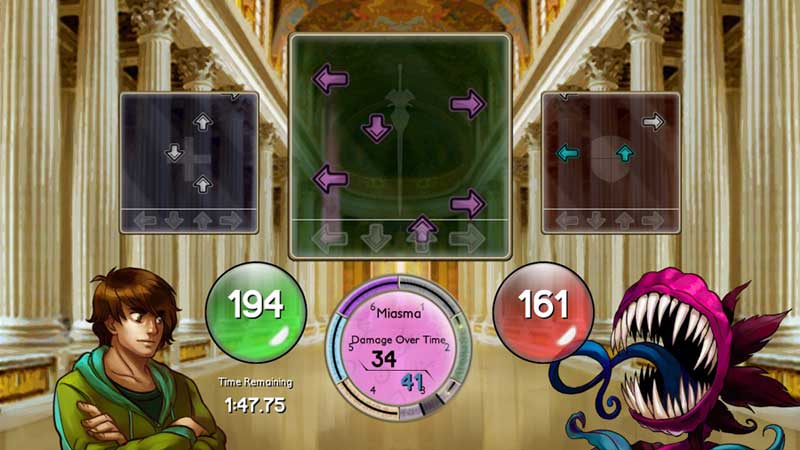
It’s actually a bit more fun than it looks.
Sequence is definitely one of those “out there” indie games in which the initial concept sounds unappealing, and yet the game is mostly redeemable fun. The premise is that the main character is abducted into the bottom level of a tower, and he must fight his way to the top by crafting keys from the dropped loot of monsters killed by three-panel DDR rhythm battles. The three panels correspond to Spells which you cast to heal/buff yourself, or damage/debuff the monster; a Mana panel which just constantly flows with arrows, with each successful arrow refunding 2 MP for use with Spells; and an Attack panel which represents arrows you need to match, or suffer damage. You lose the battle by either running out of HP before killing your opponent, or if you run out of time. Successful battles gives you XP and item drops, the latter of which can either be equipped right away or combined via “Synthing” into usable items, new spells, or the keys to unlock new floors.
I had a healthy level of skepticism coming in as to how a rhythm game would feel being played on a keyboard, but I can tell you now that Sequence handles itself rather well. I used WASD for the arrows, Q/E to rotate the three different panels, and 1-6 as the Spell buttons. Just like any good rhythm game, there is a decent variety of songs with differing tempos and general arrow densities. The RPG elements of the game also do a decent enough job at making sure you aren’t bored out of your mind in fighting the same enemies over and over again (only 3 different monster types per floor). There is definitely some possible frustration though, insofar as the item drops you need might have a 20% chance and then you end up grinding the same monster 11 times in a row. Also, learning some of the later Spells requires you to achieve a 95% accuracy in a 5 minute song or get 120-note combos (e.g. no mistakes), with failure resulting in losing a ton of XP (since you spend XP to get a chance to learn a new Spell).
Overall though, I had a decent enough time with a fairly unique indie game. I have heard some other reviewers complain about the irreverent storyline filled with pop-culture references, but I enjoyed it. And while my recommended price is $2.50 (which I bought it at during a sale), the default Steam price is just $5. Sequence isn’t necessarily a must-play game at $5, but it definitely will add value to whatever indie bundle it ends up getting attached to in the future.
_____________
Game: Deus Ex: Human Revolution – Missing Link (DLC)
Recommended price: <$5
Metacritic Score: 73
Completion Time: ~4 hours
Buy If You Like: Four extra hours of DE:HR
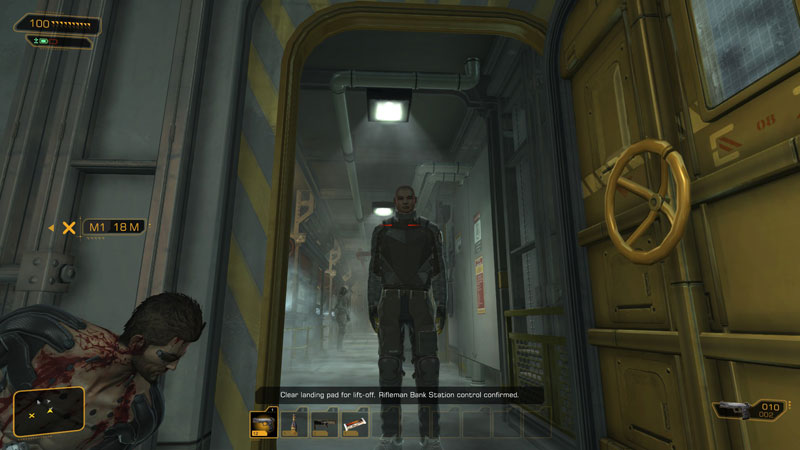
Oh, how I missed this.
To be honest, the Missing Link DLC to Deus Ex: Human Revolution was one of the first DLCs I have ever played which felt like a legitimate “deleted scene” from the main game. This is both a good and bad thing. Good in that it feels like a relatively seamless addition despite being on its own 2gb installer and featuring the vastly overused (gaming) trope of the hero losing all of his/her powers. Bad in that, well, most deleted scenes are deleted for a reason.
Taking place in the midst of a fade-to-black scene change in the middle of the original game, Missing Link does not add anything of plot value to the game proper aside from, well, around four more hours of gameplay. While you end up getting access to most of the weapons/augments from the main game, I definitely experienced a mental disconnect between the choices I was making, knowing that none of it mattered since no data was going to be transferred. Want to explore every nook and cranny? Okay… but why? No data, no XP, no weapons, no credits, nothing will endure past the final encounter.
Which, incidentally, takes the form of how all the boss battles in Human Revolution should have played out. I was actually kind of surprised when I discovered that I had inadvertently killed the last boss, thinking it was just another dude shooting at me.
Aside from that, and a frustrating amount of pointless backtracking past a 20-30 second in-game “loading screen,” Missing Link is a good enough dessert to the main course that was the original game. Provided, of course, you can snag it for less than the outrageous $15 retail price. Less than $5 or included in a Game of the Year edition would be ideal.
_____________
Game: Warhammer 40k: Dawn of War II – Retribution
Recommended price: $0/bundle
Metacritic Score: 80
Completion Time: ~11 hours+
Buy If You Like: Dawn of War II, RTS games minus the resources/base management
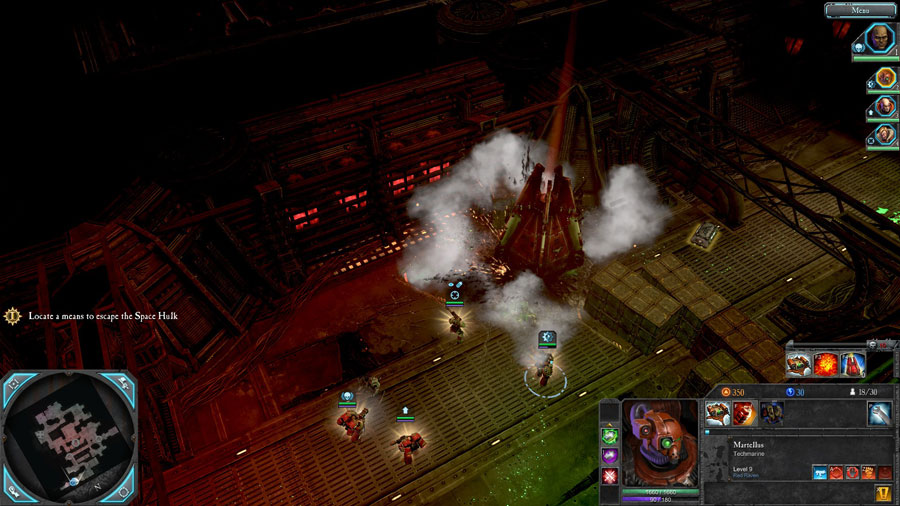
Drop pods while inside another ship probably makes more sense than the rest of the game.
In the interest of fairness, I absolutely despise the direction the Dawn of War series took when it dropped the base-building and resource management arms of the RTS genre into Dawn of War II. The original Dawn of War was a groundbreaking work of beauty – to this day, almost all other RTS games feature infantry units as little squads, so they can be shown to be killed individually by vehicle units. I played DoW: Dark Crusade for something ridiculous like 200+ hours. Dawn of War II was fine on its own, and DoWII: Chaos Rising was alright. But as I headed into this particular installment, I began to tire of the 4-5 squad “tactical” gameplay that ends up feeling like a WoWVille iPhone app.
As I understand it, there are six “campaigns” in Retribution, but after completing the Space Marines, it appeared as though every other race uses the exact same scripted maps in the same exact order with perhaps a slight difference in the faction you are fighting. For example, at the end of the first map as Imperial Guard you fight a Tyranid hero; at the end of the map as Tyranid, you fight an Imperial Guard hero. While each race has access to different units and general fighting styles, the heavy emphasis on terrain “tricks” (shoot these barrels, take cover here, approach the turrets from behind, etc) means each map plays out identically no matter what you play as. Technically the same could be said about, say, Dark Crusade, but the difference is that a resource/base-focused RTS at least can play out much differently each time.
While many people dismiss the importance of story in Warhammer 40k’s grimdark setting, I genuinely enjoy that sort of thing. And here again, unfortunately, Retribution fails to deliver. While it wraps up the Blood Raven arc (hopefully for good), it lacks any of the subtlety of even Chaos Rising, let alone Dawn of War II. I can only imagine it was so truncated specifically because they felt it necessary to shoehorn all six races into the same story on the same maps in the same order. Even if there are redeeming plot points in the final chapters of the other races’ stories (which I doubt), I am thoroughly unable to bring myself to slog through the game again to reach them.
I just hope against hope that Dawn of War 3 is more like 1 and not 2.
Reviews: Mirror’s Edge, SPAZ
Game: Mirror’s Edge
Recommended price: $5
Metacritic Score: 81
Completion Time: ~5 hours
Buy If You Like: First-person platforming, parkour, novel videogames
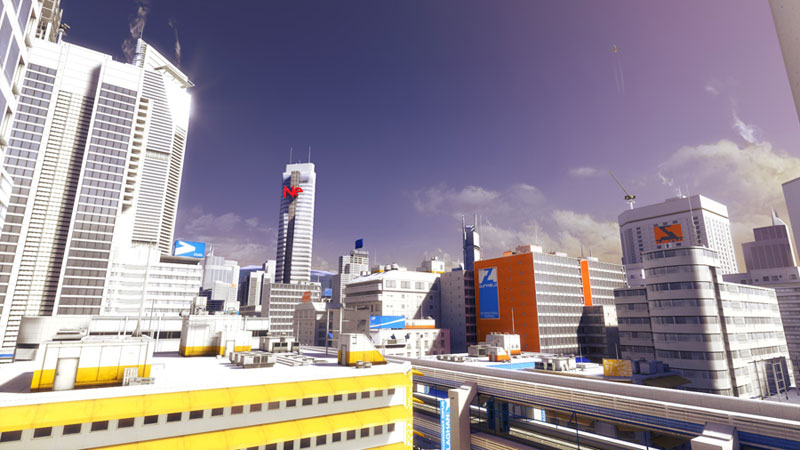
More of this, please
I had somehow missed most of the other reviews out there regarding Mirror’s Edge, so when I booted the game up I was a blank canvas upon which the designers could paint a visually-striking first-person platformer that worked (far better than others, anyway). And while I have seen those other reviews in the time after having completed this game, their legitimate criticisms does not change my mind regarding badly wanting Mirror’s Edge 2.
It is difficult to say much more than “first-person platformer” because that pretty much sums up Mirror’s gameplay. You control a Runner named Faith, as she delivers packages and unravels a conspiracy in the unnamed City sometime in the (not so distant?) future. Most of your time is leaping from rooftop to rooftop, vaulting over AC units, scrambling over fences, busting down doors, shimmying up or down pipes, and basically making a circuitous path from Red Point A to Red Point B. Pretty soon, helicopter gunships and trigger-happy police officers are firing on you as you maintain an addicting sort of manic momentum and leaps of faith. Perhaps ironically, I felt more like a ninja in Mirror’s Edge than I ever did in Assassin’s Creed, despite this game being more realistic in terms of your ability to take falls and so on.
Unfortunately, the reviews are correct in criticizing the game’s split personality when it comes to combat. While you have the choice early on to simply run around the police you encounter, by mid-game you are frequently required to take on armed guards with your relatively ineffectual unarmed attacks. There is a disarming method that will take out a guard in a single button press, but the timing is so ludicrously short – even with your recharging slow-mo ability – that most times you are better off flailing at the guards until you or they go down. Once the first guy drops, you can pick up his gun and take out the others with however many bullets are left in the clip.
Ultimately though, when Mirror’s Edge is good, it’s great. Much like Portal 2, you will end up surprising yourself with the solution of “how the hell am I going to get over there?” – and managing to get a few stages correct the first time left me with a metaphorical runner’s high. Other times you will get stuck, shot, or take a flying leap off a building only to realize that wasn’t what the game wanted you to do. If you can accept the (minor) frustrations as the price of admission though, I highly recommend checking out the show.
Game: Space Pirates And Zombies (SPAZ)
Recommended price: $5
Metacritic Score: 74
Completion Time: ~38 hours
Buy If You Like: Overhead view spaceship pseudo-RPG action games
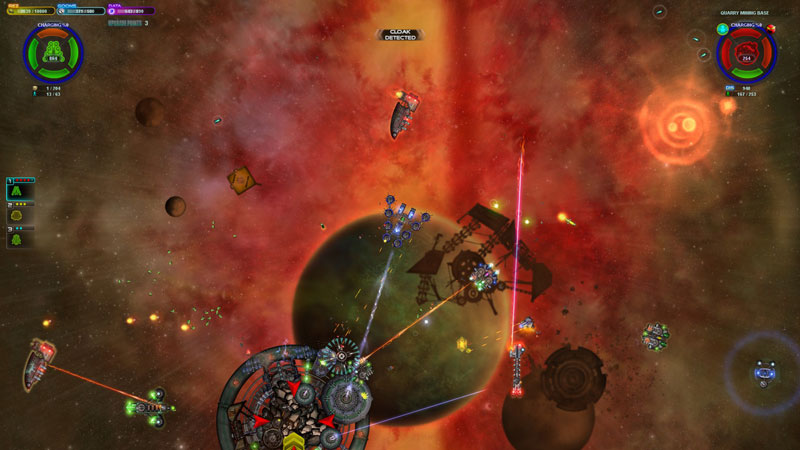
Amazing visuals for a 2-man indie game.
Originally, I pooh-poohed SPAZ based on the demo not being not particularly impressive. Having acquired the full game as part of an indie game deal, I decided to give the game proper another shot. And what I discovered, 38 hours later, is both a deeper, more impressive game… and one sorely in need of a larger-than-two-developer crew.
The basic structure of the game is destroying other spaceships, reverse-engineering their designs so you can build them, collecting Rez to build said spaceships, and basically having around seven different excuses missions to destroy said spaceships. In many ways, SPAZ is sort of like Gratuitous Space Battles aside from being able to control the ships flying around. The underlying problem with the setup though, doesn’t creep up until around hour 10-15: pacing.
The early game is extremely exciting with each new encounter resulting in new ships to pilot, there being many new components/weapons to try out, and so on. Unfortunately, the game becomes considerably less fun when you are piloting the same exact ship you were dozens of hours ago. Then, when you finally get towards the endgame and unlock those capital ship designs, the game’s difficulty evaporates as you steamroll them with a clearly overpowered design. I defeated the last boss in literally 20 seconds of holding the left mouse button down while stationary.
Overall, it’s tough to be too critical though, especially considering the game held my attention for 38 hours. There is a lot to like about the things SPAZ accomplishes well, and rather than being disappointed with some of its failings, I simply wish MinMax Games had the additional resources to polish up on its potential.
Review: Mass Effect 3
Game: Mass Effect 3 + Multiplayer + DLC
Recommended price: $40
Metacritic Score: 89
Completion Time: ~32 hours
Buy If You Like: Mass Effect; story-driven, cover-based sci-fi shooter RPGs.
By far, Mass Effect 3 (hereafter ME3) is the hardest review I have ever tried to write.
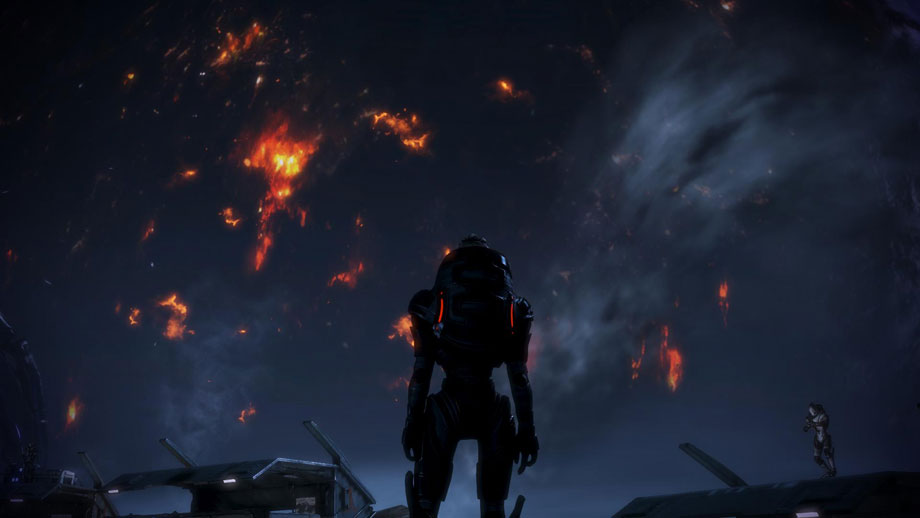
Cue the Stages of Grief
There are three entirely different prisms through which this game can be judged. The first is as the 5-year culmination of arguably the most important sci-fi videogame story of our time. The second is as a comparison between the individual components of the trilogy, as in how it stacks up compared to the first two titles. The third is as an independent game, divorced from the accumulated emotional detritus and hype of the series.
The distinctions are important precisely because no matter how grating certain features or design decisions are in isolation, I have found myself literally incapable of escaping the rose hue of the first prism. This is not to say I did not notice the deficiencies, but rather they seemed to matter less in the final analysis. Your mileage may vary.
For example, things feel off from the very start. The Reaper invasion – the nightmare scenario that formed the impetus to action in the first two games – has finally arrived. Earth is under attack. And… I feel nothing. Outside of a Lunar sidequest in Mass Effect 1, this is the first time Earth has ever actually appeared in the series in any real way. My Paragon Commander Shepard has never been fighting for Earth, or even humans specifically, but for the right of all sentient life in the galaxy to exist. Indeed, humanity has almost represented a background bumbling bureaucratic force, a one-dimensional foil to Shepard’s actions throughout the trilogy that lacks the novelty of the alien scenarios.
It does not help that throughout the Earth invasion, throughout your leaping from burning building to burning building, throughout the panning of cameras to the monstrous Reaper capital ships landing among the skyscrapers… there is nothing but an eerie, empty silence. Where is the stirring music? I spent the first twenty minutes of Mass Effect 3 wondering if my game had glitched, perhaps setting the music volume slider at 0%. There are plenty of amazing songs in the rest of the game – the absolutely haunting “Leaving Earth” comes to mind, or the stirring “The Fleets Arrive” – so the lack has to be some inexplicable design choice.
Certainly, it won’t be the last such inexplicable choice.
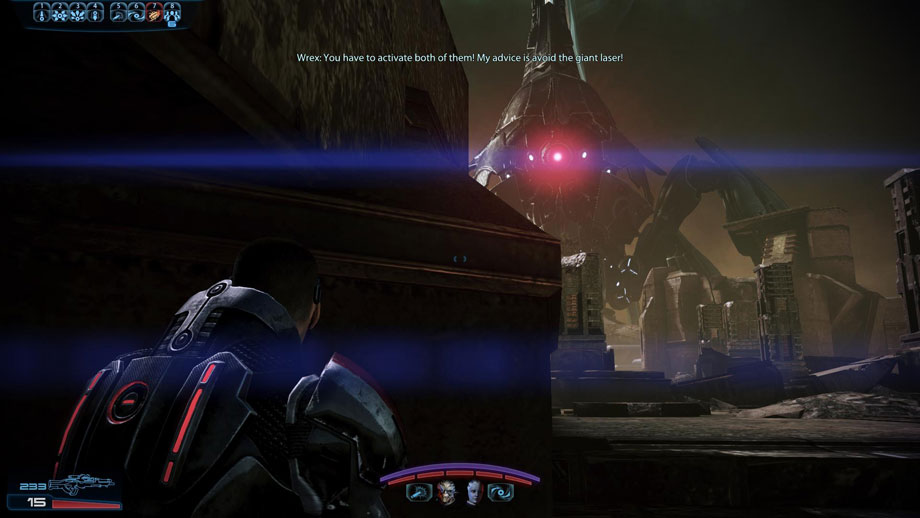
Wrex: the Krogan Sun Tzu
Once Commander Shepard is back aboard the Normandy though, the game once again feels like Mass Effect. And it really was not until ME3 that I could point out what that even meant. The brilliance of the series, in my mind, is the notion that one ship and one crew can make a difference, in a relatively believable manner – the sort of “right place, right time” effect. At no point did I feel like Shepard was a god amongst men, even as I was performing miracles and uniting species after centuries of war. Flying around the galaxy in a desperate attempt to cobble together a coalition for a final stand against the Reapers… yes, this is Mass Effect.
One thing that deserves special attention is the combat system. Simply put, it’s rather brilliant. For the most part, combat in ME3 is the same as ME2 aside from some subtle, key differences. The first is the inclusion of Carrying Capacity, which I will admit to having a strong negative reaction to at first. Shepard and crew can carry all five types of weapons if they wish, but the lower the percentage of Carrying Capacity utilized, the greater rate at which Biotic/Tech abilities recharge. In other words, if Shepard takes an assault rifle, shotgun, and sniper rifle into battle, he/she may get a -150% modifier on cooldown times. Alternatively, if Shepard only takes a sniper rifle and pistol, he/she may have a +50% modifier. Given the radically increased power of Biotic/Tech abilities this time around, choosing a loadout actually becomes a choice, especially since some guns are balanced around their weight.
On a related note, the gunplay in the missions themselves has never felt more fun and exciting. You will still spend 80% of the game crouching behind chest-high walls, but the obstructions are less obviously arbitrary, and the environment/graphics look amazing. More importantly, the enemies are radically more varied, have a deeply cunning AI that will flank you or flush you out of cover with grenades, and otherwise keep you in the moment and on your toes.
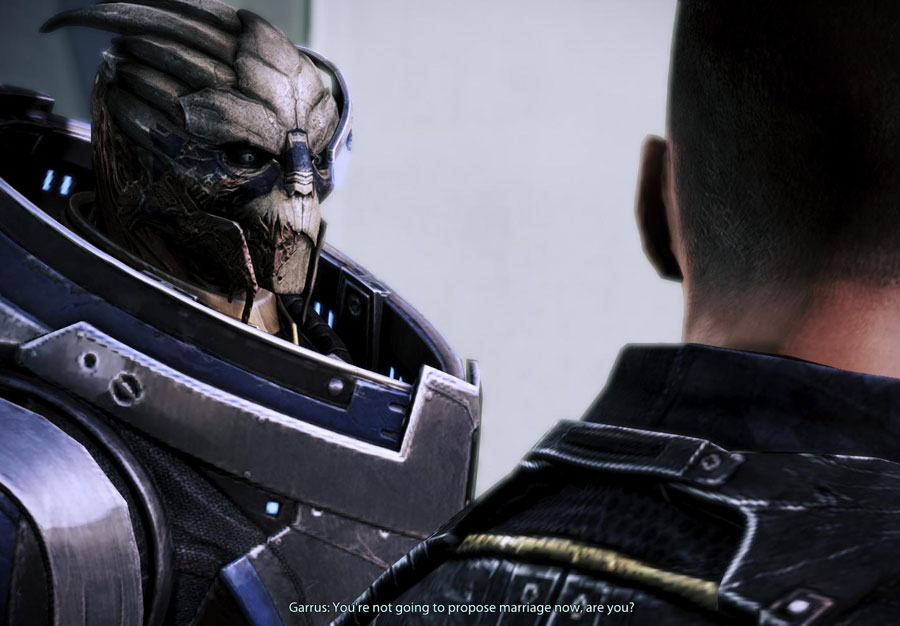
Damn, Garrus. Way to shoot me down.
Any review of ME3 would be remiss to not mention what has become, if not the most, at least one of the most controversial endings in gaming history. Without getting into spoilers, the thing to understand about why it is as big a deal as it has been in the gaming media comes down to this: catharsis. Simply put, there was not any. And with as much passion as the franchise has generated, I do not find it surprising in the least that so many people have taken the pent-up energy to the forums and blogs (as I myself have done). As of the time of this writing, Bioware has taken the rather extraordinary step (if you think about it) to begin development of a free, epilogue DLC to be released this summer. If said epilogue is able to honor the choices players have made in this franchise, if it is capable of giving me the catharsis I hunger for months after the fact, then Mass Effect could very well unseat the sacred cows of Chrono Trigger, Final Fantasy 7, and perhaps even Xenogears in my Top 3 games of all time.
As it stands, there is really no question that you should play Mass Effect 3 if you have at all enjoyed the first two titles in any capacity. Objectively, I think Mass Effect 2 as an independent experience (insofar as that is possible) edges out Mass Effect 3, but… well. To quote Fight Club: “You know how they say you only hurt the ones you love? Well, it works both ways.” Without a doubt, Mass Effect 3 has wounded me in ways no other game has ever done, and that in itself is a remarkable triumph.
“I think we ought to read only the kind of books that wound and stab us… We need the books that affect us like a disaster, that grieve us deeply, like the death of someone we loved more than ourselves, like being banished into forests far from everyone, like a suicide. A book must be the axe for the frozen sea inside us.”
–Franz Kafka
Multiplayer
The multiplayer that comes with Mass Effect 3 deserves its own special section, because in many ways it is almost a second, complete game. Indeed, its development started originally as a first-person shooter spinoff before it was enfolded into ME3 proper.
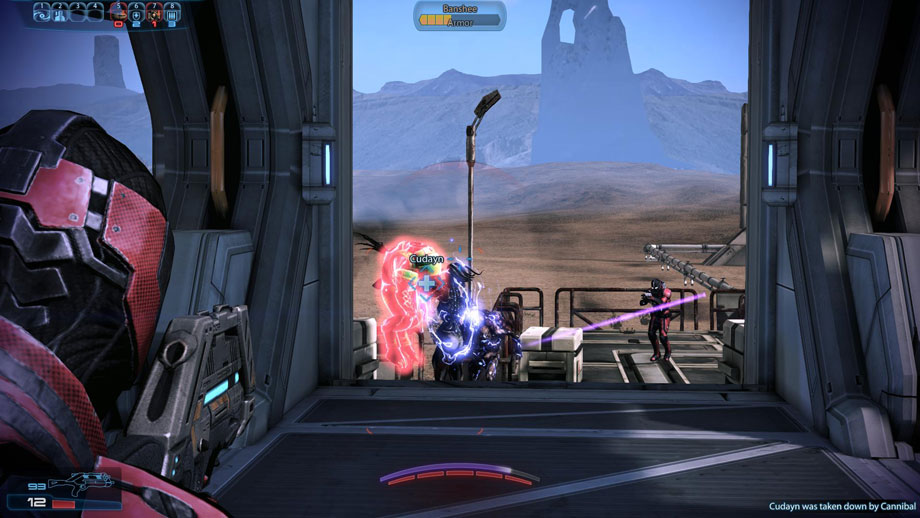
You're going to need a LOT of Medigel for that one, buddy.
In effect, multiplayer is a stand-alone, four-person co-op survival mode. Although winning multiplayer matches increases the Galactic Readiness Rating in the single-player game (essentially allowing you to skip sidequests and still achieve your goals), there is otherwise zero overlap. You pick one of the six classes, one of the five races, a weapon loadout, a difficulty level, and then head into one of the six maps to face one of the three enemy factions. Each map has 11 waves, three of which will consist of special objectives that will be a King-of-the-Hill, activating four beacons, or assassinating four specific enemies amongst the others. Successfully completed maps will take around ~30 minutes, you will gain XP for the class you chose (with a level cap of 20), and Credits.
The replay factor, aside from the entertaining gunplay, comes from the unlocking of packs. Starting out, you have access only to the five most basic weapons and human versions of the six classes. As you earn Credits, you can purchase different levels of packs – Recruit, Veteran, and Spectre – which unlocks new weapons, weapon mods, races, character customization options, and one-use items or buffs to give you an edge. Obviously this can lead to frustration at times, especially if you opt to buy packs via Bioware Points (i.e. microtransactions) instead of Credits, but it does give you an incentive to try and make weapons or classes you would not typically pick, work.
The sort of bottom line is this: if you had fun with Mass Effect’s combat system, you will have a ton of fun with the multiplayer. I have already spent more time playing multiplayer than I have playing Mass Effect 3 itself. And at the time of this writing, there is a free multiplayer DLC (Mass Effect 3: Resurgence Pack) coming to introduce two new maps, new race combinations (including Geth and Batarian), and new weapons. Given that packs can be purchased with real money via Bioware Points, it is entirely possible all future multiplayer DLC may be free.
DLC: From Ashes ($9.99)
From Ashes is the poster-child for everything evil about Day 1 DLC: it is hideously overpriced, lacking in content, and has fundamentally shifted my perspective about the nature of the Mass Effect plot. What you are purchasing is one throwaway stand-alone mission, a Prothean squad-mate (Javik), a new weapon (a particle rifle with regenerating ammo), and a bunch of new dialog between Javik and the other party members (especially with Liara).
The problem is that without the DLC, the Protheans were always this unknown, almost magical race who fell to the Reapers in the last cycle and whose artifacts you spend a lot of time collecting. Interacting with Javik, however, reveals the Protheans as a belligerent, almost xenophobic race that would have enslaved or destroyed the races we have come to love in the Mass Effect franchise. In other words, by the end of the game I honestly felt that the Reapers did us a big favor by wiping out the Protheans.
So while From Ashes is not in any way essential to the plot of Mass Effect 3, I personally believe that its absence radically limits the scope of the narrative. In other words, I consider it both required and overpriced. Then again, honestly, you could probably just read the Mass Effect Wiki and watch the Youtube videos for the same effect, saving yourself $10.
Review: Mass Effect 2
Game: Mass Effect 2
Recommended price: $25
Metacritic Score: 94
Completion Time: ~36 hours
Buy If You Like: Mass Effect, or cover-based 3rd person action-RPG shooters
It was with no small amount of trepidation that I booted up Mass Effect 2 (hereafter ME2) for the first time a few weeks ago. Having been so late to the Mass Effect party generally, the ongoing internet narratives surrounding ME2’s quality and “worthiness” as a sequel had already congealed into a crusty shell of opinion. I heard claims about “dumbing down,” that Bioware was losing its way and letting the RPG bits drift, abandoned in the dark places between stars. What would I find, coming from the original which so thoroughly and completely sucked me into a new universe?
What I found in ME2 was highly enjoyable, more… streamlined game.

Commander Badass reporting for duty.
A lot of my issues with the original Mass Effect came down to Bioware trying to shoehorn in RPG bits where they did not really fit. There were talents and upgrades and items without the underlying structure of, say, inventory management or character stat screens. In ME2, all of that has basically been removed. You can still find or purchase new weapons, but each weapon is not necessarily better than the ones you already have – it is more akin to alternate weapons in normal FPS games. There still is not a coherent stat screen, but the talent/power-choosing process has been truncated down to the point where it is not necessary.
While that is an improvement over the last game, I was left with the nagging feeling that it doesn’t really make sense to have levels and XP at all anymore; since you inevitably level up after each mission, why not just give players the talent points? Similarly, I was also left with the impression that there really was not much difference between Biotic and Tech-based powers. I could not tell you offhand what the mechanical difference between Tech and Biotic was in the original Mass Effect, but it seemed pretty clear that Biotics was supposed to be special and rare. Now it seems like more than half my crew was Biotic along with most of the organic enemies.
Although the nuts and bolts being streamlined could be viewed as good or bad depending on tastes, the combat itself feels much, much better in ME2. Taking cover feels a lot more fluid, firefights are longer and include more enemies, and with the radically shortened cooldown on Powers, you can do some pretty outrageously dynamic things. There may have been a lined crossed somewhere along the way – perhaps when I was warp-charging through cover every 6 seconds to punch heavily-armored bosses in the face – but I will take dynamic, exciting combat over rote realism any day. After all, how believable is it to have ample chest-high obstructions in every other room to begin with?
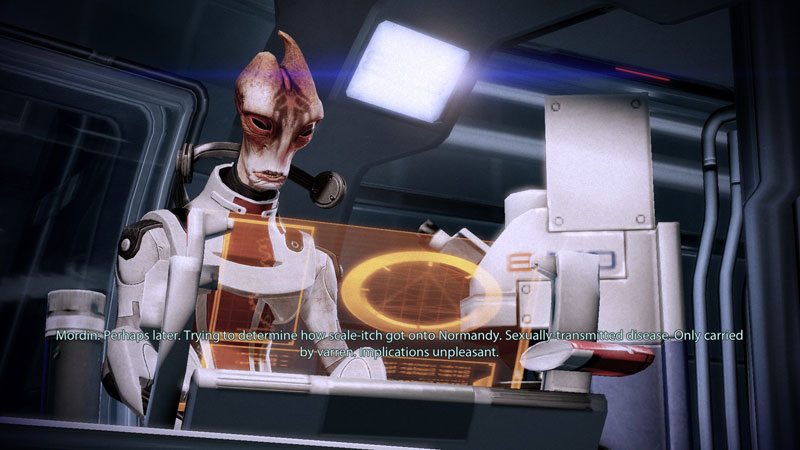
Best party member since Minsc.
My favorite aspect of the original Mass Effect was the integration of non-verbal dialog into the narrative, and the general narrative itself. In ME2, that is kicked up a notch^². Characters smile, nod, gesture, facepalm, wink, and otherwise emote in subtle, natural ways. Indeed, these little actions end up becoming part of the dialog, creating nuance and meaning that words themselves could not convey. Some scenes are punctuated with Quick Time Event-esque moves, such as interrupting a bad guy speech by just shooting him, or stopping someone from doing something they will later regret. While QTEs are normally cheap, annoying gimmicks to force players to pay attention, the ones in ME2 felt a natural part of the narrative… including when you went ahead and let a teammate squeeze off a round in the criminal’s kneecap. I have not played a proper RPG since starting up this Mass Effect experiment, and I am still nervous about whether I could ever go back to static character portraits, scrolling text, or (well-done) narrative QTEs again.
One other thing about the dialog that deserves special mention: this is one of the most goddamn hilarious games I have ever played. Sometimes ME2 crosses the line into absurdity – the cigar-smoking Elcor shopkeeper, anyone? – but most of it evoked more literal LOL moments than eyerolls. That is not to say there is not any drama or serious things going down. Rather, it is precisely these moments of sardonic levity that drive home stakes. You end up liking these characters, wanting to hear what quip they will bust out next, and then are suddenly confronted with the very real possibility they will die based on your actions.
What really ended up surprising me was when what originally appeared to be a simple “alien + personality quirk” party member, suddenly unfolded into a paper crane of origami complexity. I am specifically talking about Mordin, whom I felt practically stole the show aboard the Normandy. The transition between him being a “stereotypical” Salarian with a humorous ADHD staccato manner of speaking, to a weary doctor haunted by the ethical ghosts of his past is nothing short of brilliant. In fact, it is not even really a transition of his character, but a transition of your perception of his character; he didn’t become deeper, you merely discovered the depths. While the other characters are perhaps less complex in comparison, that is practically true of most characters in any RPG that I can recall.
Dialog and characterization aside, I am sympathetic to claims that ME2 streamlined the plot a bit too much. I wasn’t a huge fan of driving the Mako on every random planet, but when that option is replaced with a (decently fun) scanning minigame and combined with exploration mechanics that discourage exploration (we have fuel now?), it ends up making the universe seem a bit too small. Plus, I am not a huge fan of the Restart at Level One trope to begin with, or really how it was presented here. Instead of an epic, unified journey, ME2 really felt like 2-3 missions with about a dozen sidequests between you and the third. I want to stress though, again, this is a weakness with the story structure, rather than the story itself. Each of those episodic sidequests were worth experiencing on their own, but I do recognize how little effect they seemed to have on the overall plot.
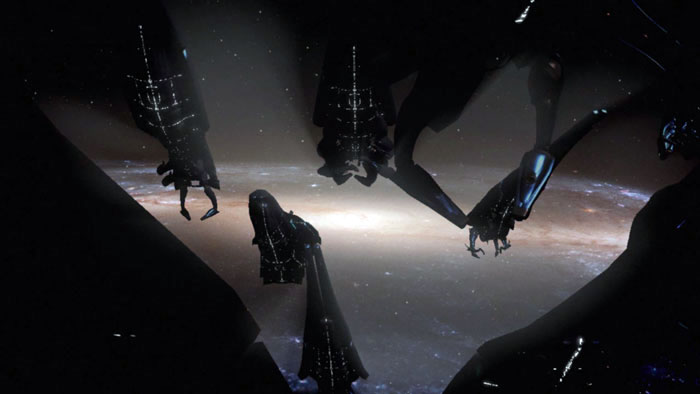
"You know, somehow, 'I told you so' just doesn't quite say it."
Is Mass Effect 2 as groundbreaking as the original? Of course not. The first game had the task of creating an entire universe filled with races and peoples, and had to go about getting you to care about learning more about them. In that respect it succeeded admirably. It is difficult to add something to an already completed picture though, and so I got the impression that Mass Effect 2 was concerning itself with making you care about Shepard. Not in the sense that Shepard is the most interesting man/woman in the galaxy, but rather in the sense that you genuinely care about the choices you will soon be forced to make in the coming war. Mass Effect was about world-building, and Mass Effect 2 about filling that world with individuals. As Mordin says:
No. Aware survival unlikely. Actually contacted him for personal connection.
Hard to imagine galaxy. Too many people. Faceless. Statistics. Easy to depersonalize. Good when doing unpleasant work.
For this fight, want personal connection. Can’t anthropomorphize galaxy. But can think of favorite nephew. Fighting for him.
Does Mass Effect 2 emulate the mechanics of RPGs as well as the first game? No. Did Mass Effect 2 capture the soul of RPGs, the essence of what makes them worth experiencing?
Absolutely.
Review: Mass Effect
Game: Mass Effect
Recommended price: $15
Metacritic Score: 89
Completion Time: ~32 hours
Buy If You Like: 3rd-person pseudo-RPG shooters

Subtitles: On.
It is somewhat difficult trying to review a franchise-launching game like Mass Effect years after its initial release. Should it be compared to the standards of games of today, or of its time? Is it even realistic to believe the experience can be compartmentalized away from the knowledge $200 million MMOs are using its primary narrative mechanics 4 years later?
As I watched the ending credits this past weekend, it became clear in my mind that the concerns were largely moot. I loved this experience, I loved the narrative, I loved the setting where the writers were taking me. And I loved these things despite the weakness of the actual game bits of the game.
The combat system in Mass Effect is a cover-based 3rd-person shooter meets half-assed RPG elements. The shooting elements were decent on their own, even if the majority of the fights seemed to oscillate between completely trivial to instant death (at least towards the beginning). Your squad members are mostly competent in straight-up fights, although controlling them was sufficiently awkward that I was glad it mostly seemed irrelevant to the outcome.

Owned.
The “RPG elements” of the game though? I have mentioned this before, but there is really no point in having gear with stats – or talents that grant stats – if there is no way to actually look at your stats. Talent A gives me 3% more Hardening, but Talent B decreases the cooldown on my Throw ability by 5%. And yet I have no idea what my Hardening percent currently is (or, honestly, what it even does) or what my cooldown on Throw is currently sitting at. The first talent point in the weapon skills appears to boost damage and accuracy by crazy amounts (~10% vs 1-2% increments), but it is difficult to feel clever about making good choices when you never actually get to see numbers go up.
After the first area is cleared, the game map opens up most of the galaxy and gives you free reign to plow through dozens of side quests in a fairly non-linear fashion. The problem here is that it is all the same… literally. Each system has a landing planet where you are dropped off in a vehicle, drive around collecting junk, and cap off the experience in one of the two possible building layouts that are otherwise copy-pasted across the universe. Sure, the box maze is slightly different, but there are only so many times one can endure entrance corridor, large room, T-tunnel, two side rooms (or big room, small side room, stairs, small side room) before the very thought of landing on a planet becomes nauseating.
But then I asked myself why I was doing all these side quests to begin with. And the answer was that I loved it here. I didn’t want the game to end. I wanted to stick around in a game setting that people took the time to actually try and make intelligible. How is faster than light travel possible? Element Zero reduces mass, i.e. the Mass Effect. Why don’t we care about ammo? “Bullets” are just shavings off a brick of nondescript metal, accelerated at high speeds. Why can people take a bunch of bullets to the face? Kinetic shielding.
Mass Effect is Sci-Fi, but it doesn’t feel like the hand-waved or mystical Sci-Fi of settings with hyperspace or The Warp. Element Zero is fantastical, sure, but its interactions within the realms of physics largely makes sense. In other words, Mass Effect has more in common with Dune than Star Wars. And that is amazingly refreshing.

See you soon, space cowboy.
What is more than merely refreshing is the inclusion (and highlighting) of non-verbal dialog in an RPG. All dialog is fully voiced, which goes a long way in bringing otherwise disposable NPCs to life. But when they start winking at you, touching your character, raising an eyebrow… you realize how far the genre has come since Kefka’s 16-bit laugh of madness. Mass Effect might not break a lot of ground plot-wise, but it does break ground in the sense of being drawn into caring about the plot in ways most other RPGs can not achieve.
Overall, I was very, very impressed with my ~32 hours spent in this new universe, and eagerly look forward to spending some more in Mass Effect 2. And if they shore up some of the rough edges in the combat system, all the better.
Reviews: Torchlight, Orcs Must Die!
Game: Torchlight
Recommended price: $0
Metacritic Score: 83
Completion Time: ~17 hours
Buy If You Like: Bad, bad dungeon crawlers
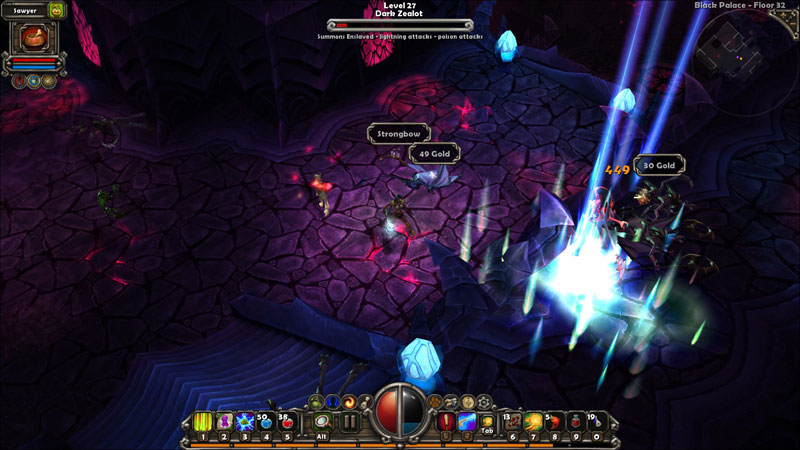
Four enemy types, 20 different skins. *Yawn*
According to Wikipedia, the Uncanny Valley is a hypothesis in robotics and 3D animation which holds that when human replicas look and act almost, but not perfectly, like actual human beings, it causes a response of revulsion among human observers. In other words, humans respond positively to human-like robots up to a point, after which our reaction to its failings is far more negative than would be towards a clearly non-human machine. Based on my overall experience with Torchlight, I firmly believe there is an Uncanny Valley of Game Design, which Torchlight cratered into face-first.
To call Torchlight a Diablo-clone is misleading; I would term it more a Diablo-mockery, although that implies Torchlight was intentional in its failings rather than simply being a cheap knockoff, like Chinese powdered milk laced with industrial solvents.
At first, everything is classical Diablo in a Warcraft 3 skin: isometric, dungeon-delving gameplay, hordes of monsters, loads of loot. There even appears to be a lot of improvements to the formula. The dog/cat companion makes the delving feel more homely. The three classes are actually modular archetypes, such as being able to make the “archer” into a rogue, the “mage” into a tank, and even the “barbarian” into a ranged magic-user. Four generic spell slots for your character and two for the pet let you do some interesting things to complement your own class abilities. I thought the Fame mechanic (Fame is like a second XP bar that only gives you extra talent points) was a clever way of making the killing of named mobs important without necessarily making you overpowered.
It was around hour six though, that I realized that Torchlight had not yet blinked its glassy, vacuous eyes.
There is no real gear progression in Torchlight. Let that sink in for a moment. I received an orange-text Unique neck item around level 4 that I was unable to replace for the duration of the entire game. Random stats are random, but when a random level 10 green is as powerful as a random level 30 green, the entire loot-centric nature of this particular genre collapses. The consolation prize mechanic is Enchanting, where you put an item in a box and have about even-odds that you paid someone 10% of your wealth to destroy said item. No, seriously. Find a decent weapon, put it in a box, pay ~1200 gold for a chance to add a random stat upgrade on it, a chance that nothing happens other than your gold evaporating, or an increasing chance your item gets disenchanted, completely wiping all its stats. The first item I tested this on got disenchanted on a 4% chance, and the second was an Unique-quality bow that was disenchanted on the first, 2% attempt.
I got an achievement for it. No, seriously.

Bum Luck: You installed this game.
Now it did occur to me that perhaps they were attempting something novel, a kind of re-imagining of the transitory nature of loot in Diablo-esque games. An upgrade isn’t an upgrade off the ground, but only after you “win it” from the Enchanter, or something. The problem is that whoever balanced this garbage was a goddamn moron. Enchanting costs gold. A lot of gold. The items you pick up off the ground never really increase in value the deeper you dungeon delve, such that each time you unload your haul in town you get the same ~2500g at level 10 that you do at level 30. Even Epic or Unique items sell for complete peanuts; the highest price I got for a sale was 1,809g for the level 4 Unique necklace I mentioned earlier, which the vendor turned around and was trying to sell for 82,432g. That’s right, instead of the typical 1/3rd or 1/5th cut you see in normal games, Torchlight is operating on GameStop levels of Fuck You resale value. If something could be worse than selling at 1/45th value, it would have to be the necessity of Transmuting four pieces of magic gear to turn into a random crappy gem, which needs to be transmuted with ~12 more crappy gems to get a mildly useful gem, to have something to put into the sockets of the level 8 shoulders you are otherwise never going to replace.
I am spending all this time talking about loot because loot matters in these games. Once you cease expecting any upgrades, the endless, nondescript corridors are filled not with opportunity or excitement, but are instead arteries clogged with the fatty plaque deposits of meaningless mobs. The original Diablo did not have much of a plot beyond “save us from evil” that I can recall, but the setting of gritty evil provided its own sense of gravitas. Conversely, Torchlight does not even bother. “Sidequests” are perversions of the term, and amount to simply killing mobs you were going to kill anyway slogging towards the stairs. Even worse, the “quest rewards” for these things are randomized green items. Look at this shit:
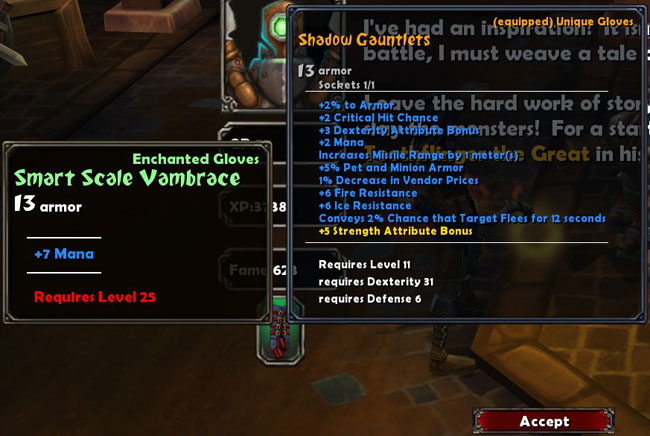
Equipped item on right, "Quest Reward" on left. Note the Required Levels.
The thing I kept hearing regarding Torchlight was that former Diablo 1 & Diablo 2 designers worked on it. If their contribution to that series is at all representative of what I experienced in Torchlight, then all I can say is good goddamn riddance.
Well, that, and I have never looked forward to Diablo 3 more than I have now.
Game: Orcs Must Die! + DLC
Recommended price: $10 (DLC included)
Metacritic Score: 84
Completion Time: ~11 hours
Buy If You Like: More trap-based Sanctum tower defense
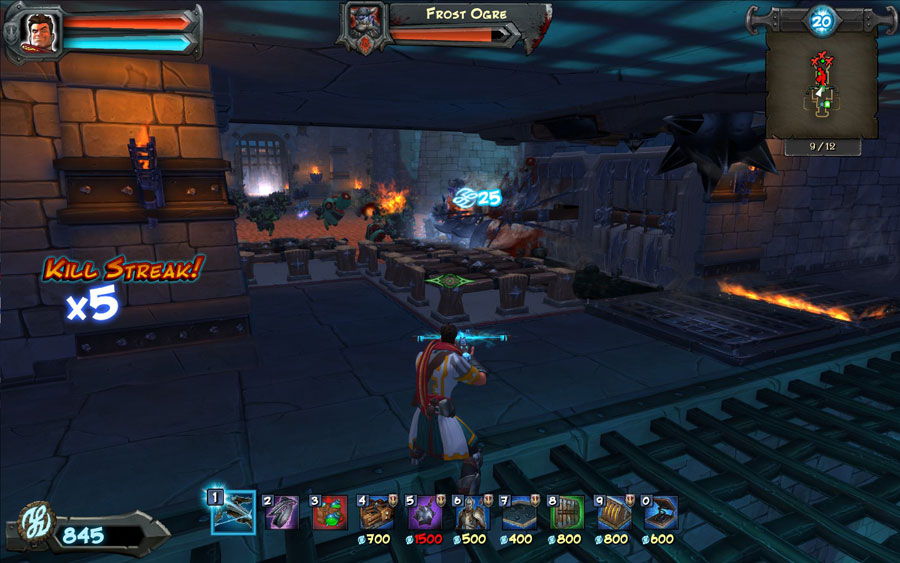
Few things feel better than killing orcs. Maybe Nazis. Or maybe Nazi zombie orcs.
Orcs Must Die (hereafter OMD) is one of the best, purest non-Tower Defense… Tower Defense games I have played. The premise is simple: the orcs are at the gates, and you must stop them. The rest of the game follows a simple elegance undermined only by the limitations of genre conventions.
To be honest, OMD felt like it had more in common with the brilliant PS1 Deception series than it does with Tower Defense. You start off each level by choosing a limited number of traps from your collection, in addition to personal weapons/spells that you will be using to kill the orcs. Traps range from spikes that impale from the the floor, to arrows that shoot from the wall, to mechanized swinging maces from the ceiling, to archer guardians; weapons include Fire/Ice/Lightning/Wind rings, to melee battlemage staves, to your trusty magic repeating crossbow. Later on, you can further select from 1 of 3 “Weavers” for that level, whom act as mini-talent trees that boost your effectiveness in different ways. Once your arsenal is selected, setting up traps costs a set amount of currency from a limited pool that grows between waves and from your merciless slaughter of orcish hordes.
And yet OMD deviates from the standard Tower Defense genre in many key, innovative ways. The most obvious is the fact that your Ash-from-Evil-Dead character can (and must!) get down and dirty in the fighting himself. While certain trap setups essentially make victory guaranteed, you typically won’t have enough currency to set them up in the early waves, and certain levels contain too many chokepoints to trust to traps alone. The standard orcs will actually chase you around if you are nearby, which can buy you some time for allow for traps to reset. Moreover, there are some enemy types like the ogres (fire, ice, and armored varieties) whom are too tough for typical traps to kill outright, and the downright scary Gnoll Hunters who leap over your orc-stopping waist-high barriers and hunt specifically for you.
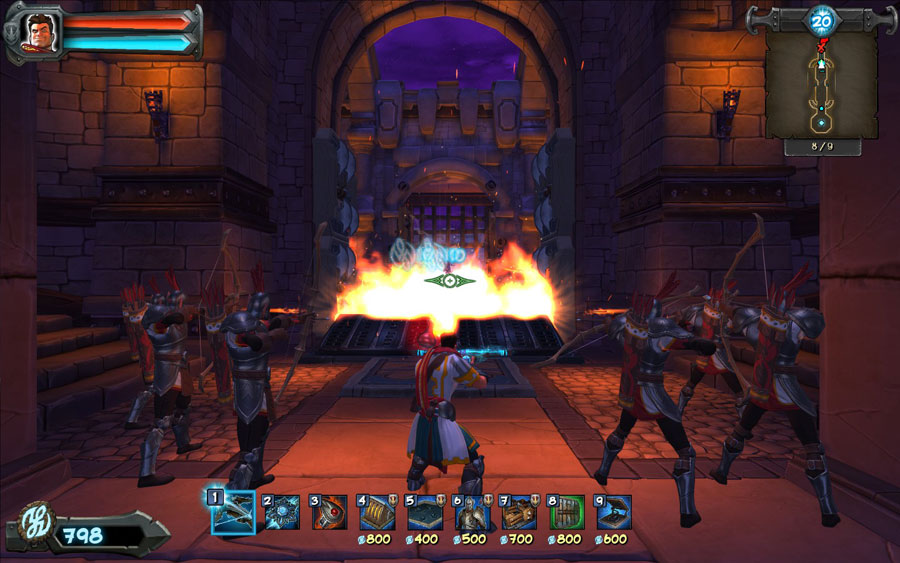
Ain't no one going home tonight.
The other area in which OMD forges ahead is in its rather brilliant, non-standard level design. In typical Tower Defense, everything is gridded out in neat, orderly squares. While traps require certain precise placement, I never got the impression from any of the levels that they were build specifically to place your traps “just so.” Fluted columns and flying buttresses foil wall and ceiling traps respectively, while floor traps cannot be placed on stairs. Any time I actually saw a 2-3 “square-trap-wide” corridor, I would get excited, like I won the goddamn architectural lottery rather than feeling this was exactly where the designers wanted my traps to go.
While there are some additional innovations like permanently upgrading traps by spending the orc skulls you earn based on level performance, OMD is unfortunately limited by genre conventions. I applaud OMD for not falling into the Tower Defense trap (har har) of simply increasing the HP of the enemies as a crutch for increased difficulty among waves, but after a while you will come up with trap setups that are essentially unbeatable. Much like in every Tower Defense game I have ever played, the slow traps (e.g. Sticky Tar Trap) are fairly overpowered; similarly, some traps and weapons feel too good, especially compared to others that don’t seem to have a place. I almost feel as though the game would have been improved if there was a mode or option to where you get a randomized list of traps, rather than entirely relying on level design to inform your decision. Or if there was some kind of incentive to utilize the “bad traps” in unique ways – since the Leaderboards are based entirely on points, I could imagine some kind of score multiplier for trying to use the Steam Trap or Push Wall Trap effectively.
Ultimately, OMD provides for some very enjoyable orc-killing and trap-setting Tower Defense gameplay. There is a Nightmare mode available for the masochists out there that hate more than 3 seconds inbetween waves, or you can try and top the Leaderboards on the traditional levels; the latter is actually fairly addicting when you have Steam friends who have the game, since their scores are highlighted in comparison to your own. Even if you are not interesting in replay value, the general play value of OMD is exceptionally high for what amounts to an inexpensive indie game.
DLC – Artifacts of Power
This pack comes with two weapons and two traps. The Alchemist Satchel lets you toss down a sort of glass caltrop which you can detonate at any time with a right-click, by shooting it, or letting a trap trigger it for you; the explosion is huge and will one-shot every orc in range, making this a fairly overpowered weapon for the early game (before the later rings). The Vampiric Gauntlets essentially lets you drain health from whomever you are aiming at, while the right-click turns your own health into mana; overall, the effect is pretty weak compared to your other options. The Shock Zapper ceiling trap is ostensively for killing flying enemies, but considering it only triggers from enemies flying directly beneath it and the fact that flyers usually path nowhere near ceilings (nevermind that even if they did, there would be better traps for that) makes this damn near the most useless trap in the game. Finally, the Floor Scorcher is a combination mini-springboard/flamethrower that has made itself a staple of all of my setups. If you set a Floor Scorcher near a ledge but facing away, it will burn everyone in a horizontal line while launching whoever is standing on top off the edge. More importantly though, it is a floor trap with a ~3-square range, which allows you to layer on the pain.
I would never buy this DLC for the $2.49 normal price, but on a deep discount the Floor Scorcher alone might make it worth a purchase.
DLC – Lost Adventures
This pack gives you 5 new levels, at least one of which is a remake of a prior level (just in reverse), and the Mana Well. The Mana Well is a fairly expensive “trap” that essentially recharges your own mana bar when you get close to it. The extra levels allows you to get additional skulls if you want to upgrade more of your traps, but overall I was not entirely impressed with them. There is no additional story behind the levels or extra dialog, which kind of makes them feel extraneous. With a default price of $3.99, or over 25% of the cost of the entire game, you would have to be crazy to purchase this DLC outside of a 75% off Steam sale.
Reviews: EYE: Divine Cybermancy, Gratuitous Space Battles, Hard Reset
Game: E.Y.E: Divine Cybermancy
Recommended price: $5
Metacritic Score: 60
Completion Time: ~14 hours
Buy If You Like: Half-Life 2 meets Deus Ex meets Warhammer 40k meets mostly hollow FPS frame
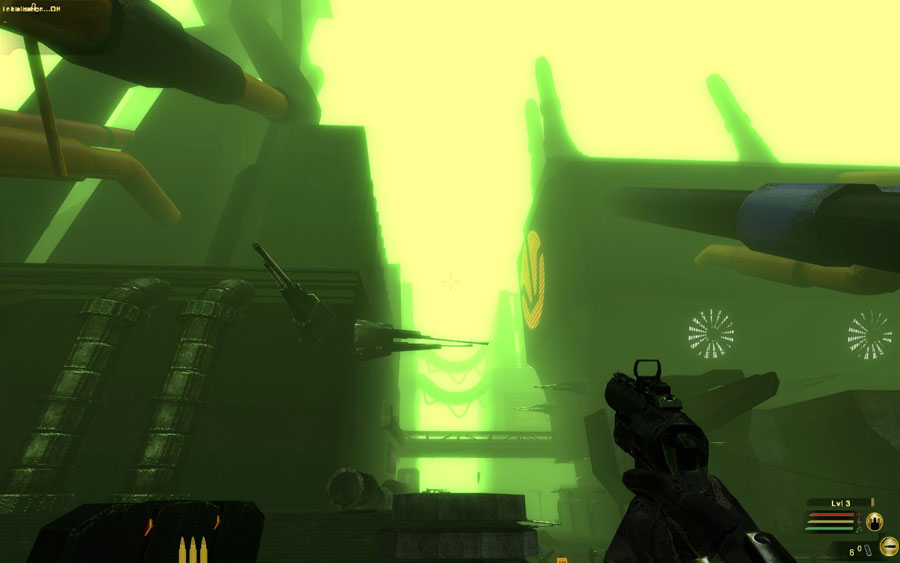
Welcome to the future.
Everything you need to know about E.Y.E.: Divine Cybermancy (hereafter EYE) are the first two lines from its Wikipedia page:
E.Y.E: Divine Cybermancy is an indie action/role-playing first-person shooter video game created by the 12-person French development team Streum On Studio, and built using Valve Corporation’s Source engine. It is a cyberpunk themed game based on the role-playing board game “A.V.A.” developed by Streum On Studio in 1998.
In other words, yes, this is a FPS built in the Half-Life 2 engine based on a board game and designed by 12 French guys.
The funny thing is that EYE plays exactly how the Steam gameplay videos look, e.g. cool. After character generation, you start out in a weird dreamscape area before jumping through a Martian gate and waking up in a cave. From here, the game takes you through impossibly large Blade Runner-esque settings, and has you kill (usually) never-ending waves of AI bots on your way to completing various objectives in – have I mentioned impossibly large? – locations. Despite the AI bots behaving very obviously like AI bots, the combat in EYE nevertheless remains deeply satisfying for reasons I cannot express.
The problem is that you can never really shake off the vague sense of hollowness that pervades the entire game. You gain XP for kills and damage, and as you level you spend skill points raising stats that allow access to either better weapons, better tech, or better PSI powers. You can upgrade your various implants by spending Brouzouf, the games currency, or you can spend it researching various technologies that may grant you additional stat points or unlock other items (or be a total waste).
And yet… none of it really matters. The game’s plot is the most convoluted, strangely localized mess I have ever seen. And despite “branching paths” the story very clearly was never meant to drive the game in any particular direction. I mentioned earlier that all the enemies behave like AI bots and I meant that – there is never any sense of scripting in the encounters you face, it very much feels like a Counter-Strike match against bots. Each map you complete can be played again as a “secondary mission,” where you are given three random objectives and placed in the middle of a never-ending firefight on said map; ironically, these secondary missions usually end up being more coherent and fun than the plot itself.
All that being said, I actually stuck through EYE to the end and found myself replaying the secondary missions quite a few times. I realize now that my experience is probably colored by my love of the sort of Deus Ex/Warhammer 40k/Half-Life 2/Blade Runner zeitgeist of the game, but I certainly did find the game more amusing than a 60 Metacritic score would seem to suggest.
If you find yourself gravitating towards cyberpunk games regardless of quality, you cannot go wrong with EYE… provided you find it on sale.
Game: Gratuitous Space Battles
Recommended price: bundle
Metacritic Score: 72
Completion Time: ~7 hours
Buy If You Like: The modular unit-designing of space games, without all the pesky gameplay
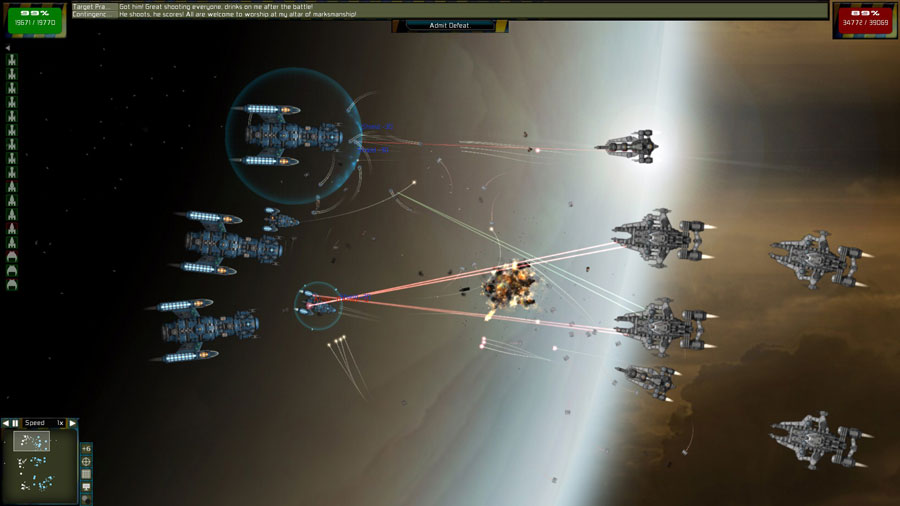
You have no chance to survive make your time.
Gratuitous Space Battles (hereafter GSB) is one of those indie games that is so ballsy that I am almost inclined to overlook the fact that there is no real game to speak of. Straight from the Steam description:
Who needs backstory? Who needs resource-gathering? Diplomacy is so last year. Gratuitous Space Battles cuts right to the chase of sci-fi strategy games, and deals with large, completely unjustified space battles between huge opposing space fleets.
Do you know in space-sim games when you are designing new hulls? You know, fitting components in the empty slots, trying to balance power/crew limitations while keeping costs under control? That is basically all you do in GSB: design space ships, place them on the left-hand side of the screen until you reach the resource cap, edit their orders a bit (ignore fighters, keep in formation, escort the cruiser, etc), and then press Fight.
Now, I will admit there is something deeply satisfying about watching epic space battles and see shit blow up. The very fact that it is impossible for you to influence the battle once it has begun is oddly comforting in ways that is typically impossible in RTS games.
But… that is the entire game. Design ship, place, watch result. There are 14 “levels” counting the tutorial and two endless modes, but the only difference in levels is the resource cap and occasionally the “anomalies” that might prevent fighters from being placed, reduce max engine speed, forbid shields, and so on in an effort to shake up otherwise unassailable strategies. And believe me, by the 2nd map I had a fleet composition that was basically impossible to defeat.
The ballsy part is how the base game costs $19.99 and there is currently $36.94 worth of DLC. A casual look reveals most of it consists of different races with their own unique hull components, and then a $6.99 DLC that turns the title into a full strategy game. If you are as disinterested in that as I am, the base game will take you about 7 hours to beat with the default race. There are two other races you can unlock to stretch that further, and you can always download player-generated scenarios to pit your fleet against theirs. Since there is zero rewards in doing so though, it is debatable as to why you would bother outside the novelty of the thing.
Game: Hard Reset
Recommended price: $10
Metacritic Score: 73
Completion Time: ~5 hours
Buy If You Like: Cyberpunk FPS meets Devil May Cry
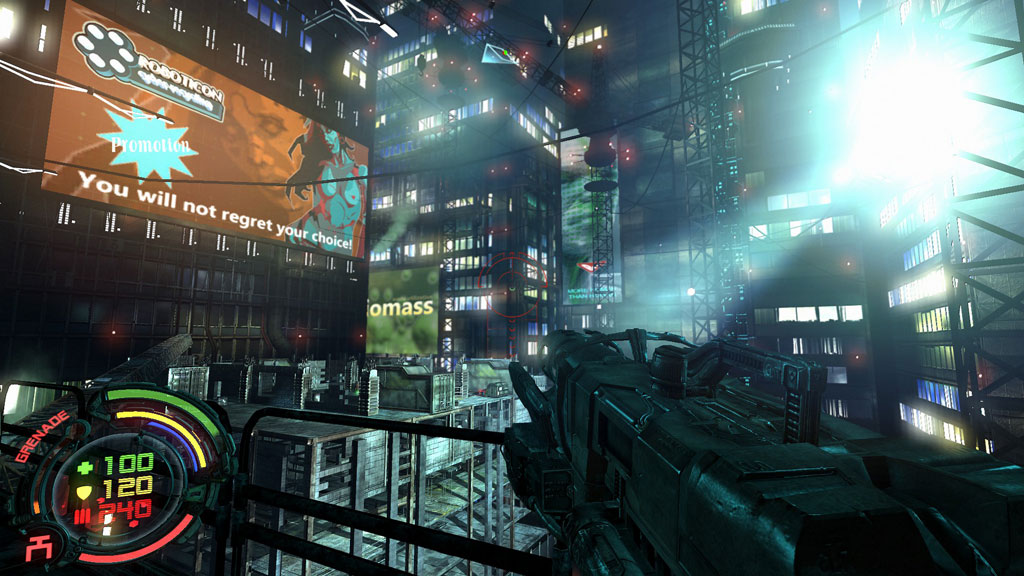
Cyberpunk hard-on: engage.
Hard Reset is one of the best-looking, most frantic, disappointingly short, unforgiving FPS games I have ever played. Set in a dystopian Blade Runner meets Matrix future, you control Fletcher as he mows down huge waves of robotic enemies using two highly moddable gun types and a cornucopia of destructible environment set pieces.
Starting out with a machine gun and a plasma rifle bound to the Q and E buttons respectively, you can upgrade them by collecting currency hidden around the levels or as drops from enemies. The machine gun can turn into a shotgun, a grenade launcher, a mine-layer and so on; the plasma rifle gets an AoE electricity mode, a rail gun, a Smart Gun mode that can track enemies through walls, and so on. The key to surviving robot attacks usually comes down to a combination of moves, such as launching a Gravity Grenade (unlockable secondary fire for grenade launcher) to trap a bunch of small bots next to an exploding barrel or what have you, and then launching a normal grenade at the pile.
Er… so yeah, that particular “combo” is fairly straight-forward. And I suppose that leads me to the disappointing aspects of the game: namely the wildly oscillating difficulty.
When you can use the One-Two grenade launcher combo, the game is actually depressingly easy; although bigger bots won’t die instantly, the gravity grenade works on everything but bosses. If one or two little bots escapes the gravity well, or spawn only after the first group blows up in spectacular fashion, watch out. The sheer density of exploding set pieces means you will frequently backpedal into a deathtrap a mere buzz-saw attack away from taking your life. That is when you experience the bizarrely out of place Checkpoint save system (no Quicksaves here), which probably sends you four waves and an upgrade into the past.
The game is also, as previously mentioned, disappointingly short. The story is not nearly as bad as other reviewers have stated, but right as it appears that the game is ready to head in a new direction while tying up some loose ends, the game… well, ends. The brevity of the game is such a hot-button issue that the developer has a passive-aggresive thread on the Steam forums called “Official announcement about GAME LENGTH” that starts out with:
Ok let me make some things clear.
You can finish Quake in 11 minutes.
You can finish Super Mario in less than 10 minutes.
You can finish Doom in less than 30 minutes.They are still good games.
You can’t finish Call Of Duty in less time than the developers wanted because it’s heavily scripted, with all the cutscenes, NPC preventing you from going somewhere etc.
Hard Reset was designed to be an oldschool game.
In spite of the truncated narrative, in spite of how it’s sometimes difficult to tell that you are actually dealing damage to robots with some weapons, in spite of how I would have preferred a cyberpunk FPSRPG over a Devil May Cry Arena-style FPS, I still find myself having enjoyed the (few) hours of Hard Reset immensely. There is reportedly a sequel or expansion in the works, and if the forum poll results are any indication, the team is well aware of how their nascent fan base feels about the necessity of Quicksaves, new story arcs, standalone single-player levels, level editing tools and mod support, and all sorts of other fantastic goodies.
If even half of the list makes it in, I personally can’t wait for Hard Reset 2.0.
Reviews: Metro 2033, Blocks That Matter, Far Cry, Atom Zombie Smasher, VVVVVV
Game: Metro 2033
Recommended price: $15
Metacritic Score: 81
Completion Time: ~12 hours
Buy If You Like: Half-Life meets STALKER meets FEAR
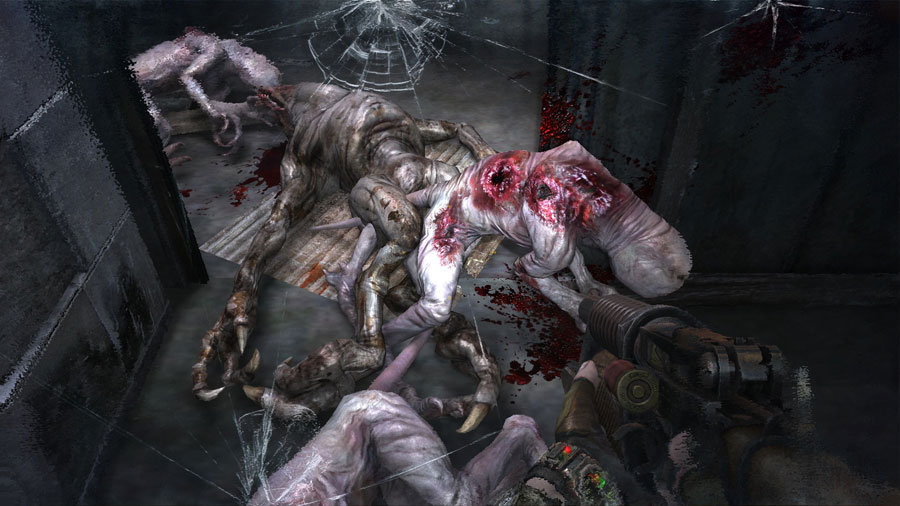
Notice the lack of an interface. You don't need one.
Metro 2033 is one of the most surprisingly authentic post-apocalyptic FPS games I have ever played. A game’s “realistic simulation” aspect is never something I particular care about, as all too often it is used as an excuse for bad gameplay mechanics. In the case of Metro 2033 however, all of the simulation bits impact the game in nothing but positive ways. For example, you start off with a flashlight with a fairly weak default luminosity that can be juiced with a handheld Universal Charger. To do so, you put your gun away, bring out this scrappy-looking device, and then pump the mechanism by clicking the mouse over and over while watching the smudged dial slowly increase with each pump. Although you will be performing this ritual hundreds of times over the course of the game, there was something so… correct about the activity that I actually looked forward to those moments. There are several weapons that require similar attention – an air-pump speargun, an electric railgun-esque weapon that shoots ball bearings – and the fidelity they engender as you huddle against a wall in the darkness or behind your increasingly fogged/damaged gas mask is wholly unique experience in videogaming.
Beyond those brilliant touches, the rest of the game itself is similarly well-designed. Although most of the game occurs in subway tunnels, the environments are surprisingly varied; you frequently are required to head to the toxic surface, which ironically feels more oppressive than the tunnels by its hostile nature, or exploring abandoned military complexes. There is a good mix of fighting mutants and humans, exploration is rewarded with pre-war ammunition (which brilliantly doubles as the game’s currency), stealth mechanics are actually supported, and the difficulty curve is relatively smooth while still escalating throughout the game. At one point there is a section where you carry a child on your back through this mutant-infested area, and the child’s weight impacts your ability to turn and aim at the monsters he is warning you about.
This is the kind of game Metro 2033 is, and I would not have it any other way.
Game: Blocks That Matter
Recommended price: $3
Metacritic Score: 79
Completion Time: ~5 hours
Buy If You Like: Indie puzzle games with robust player-generated map support
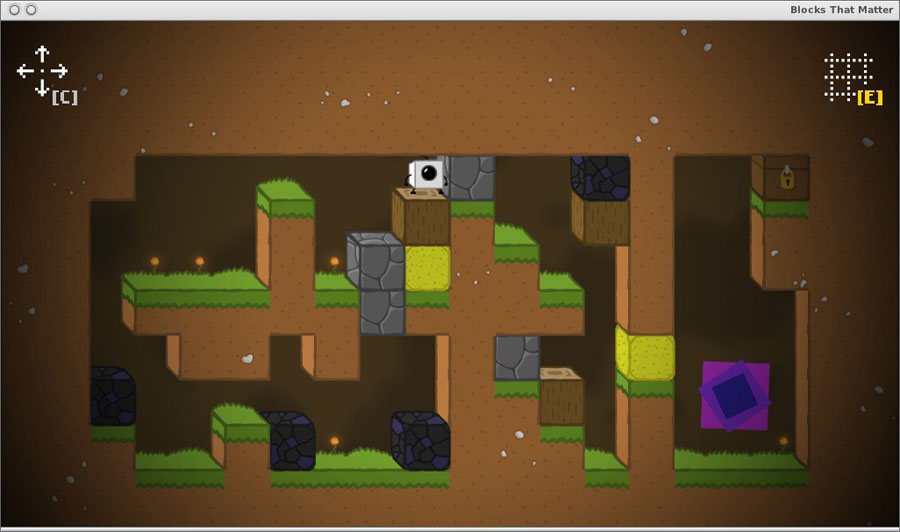
Not as easy as it looks.
Blocks That Matter is one of those “pure” puzzle games that starts with an unique, arbitrary premise and goes on to demonstrate how deep the gameplay can go. With the, ahem, building blocks of a 2D platformer, the “schtick” is that you collect blocks either by breaking them Mario-style or drilling them horizontally, but you can only place them in connected groups of four (at least one block has to be attached to a surface as well). Getting to the exit portal is usually straight-forward, but the real mind-melting begins when you decide to go after the treasure chests on the various levels. Later on, the characteristics of each block begins to matter (sand falls down if not supported, wood burns, etc) and when layered upon the sometimes extreme platforming aspects of later levels, it can definitely lead to frustration if you aren’t prepared for it.
One of the best aspects of Blocks That Matter though, are the hundreds of player-generated maps available for free download via the interface. While I only tried a handful, each one was rather brilliant in its own way and definitely complementary to the ~40 in the normal game. These maps can be sorted by highest-ranked as well, so you are sure to come across additional hours of entertainment if you enjoyed what came before.
Game: Far Cry
Recommended price: $5
Metacritic Score: 89
Completion Time: ~13 hours
Buy If You Like: Being kicked in the balls by a FPS
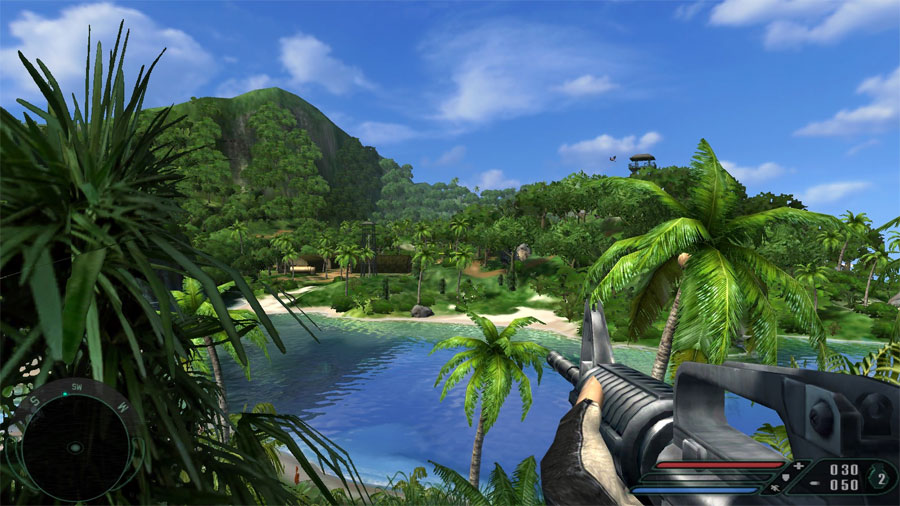
There are about 20 ways to die on the other side, and you will experience all of them.
Far Cry is hands-down the hardest, most frustrating FPS I have ever played. Setting Metro 2033 to Ranger Hardcore mode might take the cake, but you would actually have to make it through the chef cock-slapping you through the kitchen normal-mode that Far Cry offers before you could even think of baking said cake. I seriously uninstalled Far Cry twice, before achieving that head-smashing zen state necessary for slogging through the game to the bitter, bloody end.
Typically, frustrating difficulty is due to bad game design and isn’t something I suffer gladly. In Far Cry’s case, the insane difficulty actually stems from a coherent nod towards realism that says getting shot in the face or eaten by a Grue kills you. Which is fine, whatever. The frustration that settles in is how Far Cry operates entirely on a Checkpoint Save system wherein you can systematically kill 40 enemies without taking any damage, achieve 2/3 of the objectives, and then die to a rocket that was launched from a mile away, slip off the side of a mountain, stand too close to an exploding barrel, or any manner of “oops!” deaths and be forced to start all over again. There are checkpoints within levels, but you never know where they are or when they will kick in, sometimes leaving you stranded with 30 health a door away from a massive firefight you have zero chance of exiting alive. At one point in the game, I was making my way across the deck of a ship and had to learn via trial-and-error, e.g. dying, the location of the nine guys who killed me in their opening salvos. On the 10th checkpoint reload, I killed them all losing only 80% of my HP, only to be shot by a tenth guy at the end of the stern.
Aside from masochism, one of the things that kept bringing me back though was the compelling nature of the enemy AI and open-endedness of the game itself. You are being pitted against a mercenary force that reacts to noises, fans out in search of intruders, engages in pincer maneuvers, investigates dead bodies, and otherwise works together in a completely non-scripted way. Sure, a lot of the time they can magically spot you in the bushes from 100 yards away. Sure, sometimes their incidental gunfire leads you certain doom while you desperately search for a medkit. But this was the first FPS I have played in which I actually felt hunted, or at least surrounded by an intelligent enemy that fostered a sort of manic paranoia.
Like a particularly difficult bowel movement though, I am glad Far Cry is finally over and I am not looking forward to similar experiences again. At least, not ones lacking quicksaves.
Game: Atom Zombie Smasher
Recommended price: $5
Metacritic Score: 75
Completion Time: ~8 hours
Buy If You Like: Compelling indie strategy games
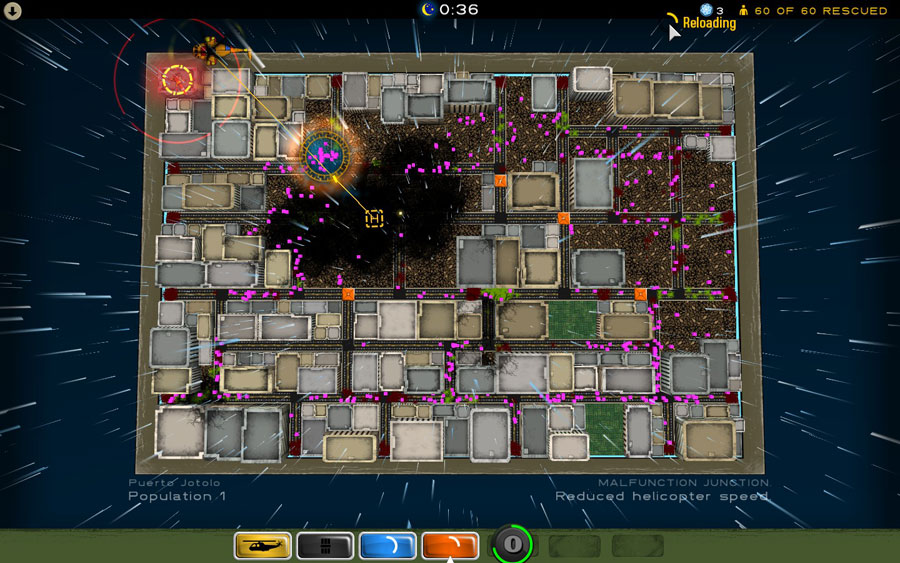
Evacuation complete.
I basically already reviewed Atom Zombie Smasher in a post entitled Population: 1. This is one of those indie games which justify the existence of indie games, and the continued need to ensure that more such works of brilliance are supported and nurtured.
What I will add though, is that I hope the game continues to go through some additional iterations. The city gameplay is excellent, and between the random selection of troops each month (“What? Only barricades, landmines, and TNT?!”) and the random buff/debuffs, even the same city layouts can feel like entirely new games each time you load it up. The map gameplay that nests the city gameplay, however, needs some work. It is ridiculously easy to fall behind and essentially make winning impossible. Similarly, a few early wins can make the rest of the game largely a joke. So while I am glad that developer chose to focus on the city gameplay as opposed to the map gameplay, the unfortunate side-effect is that the replay value suffers for it, at least to me. If they can tighten up the map, it may actually give me reason to keep playing.
Game: VVVVVV
Recommended price: bundle
Metacritic Score: 81
Completion Time: ~2 hours
Buy If You Like: Innovative retro 2D platformers
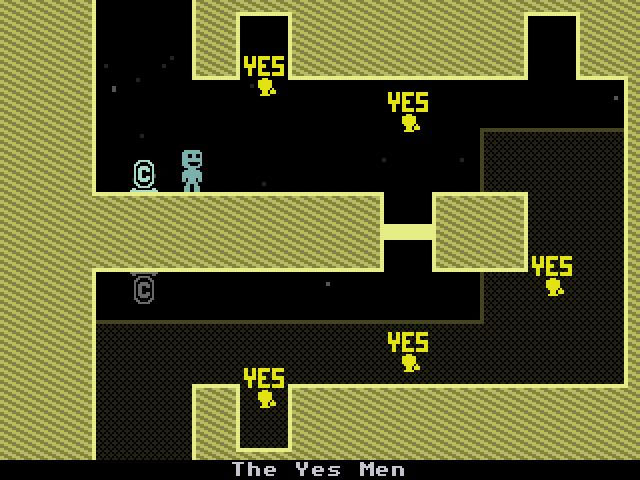
Err... what else is there to say, really?
VVVVVV is a retro indie game that takes the traditional elements of platforming and stands them on their head.
…that pun was lame, even for me.
Essentially, instead of a jump button, VVVVVV simply flips the gravity of your character around such that you end up walking on the ceiling. Since you cannot change direction in mid-air, this leads to some pretty fiendishly novel puzzle-platforming situations in which you have to make full use of ceiling and floor. Gameplay is pretty brisk, and the frequent use of checkpoints and a focus on single-room platforming (with some exceptions) means it is all action, all the time. Which, of course, means you end up beating the game pretty quickly as well. The game gets pretty difficult towards the end, and I ended up dying in a single room 50+ times, but overall the experience was pleasant.
For the length of gameplay though, the retail price of $5 is a bit much; it makes for a perfect indie bundle though, if you find one with VVVVVV in it.
Review: Deus Ex: Human Revolution
Game: Deus Ex: Human Revolution + DLC
Recommended price: $25
Metacritic Score: 89
Completion Time: ~38 hours
Buy If You Like: A (more) cyberpunk Metal Gear Solid
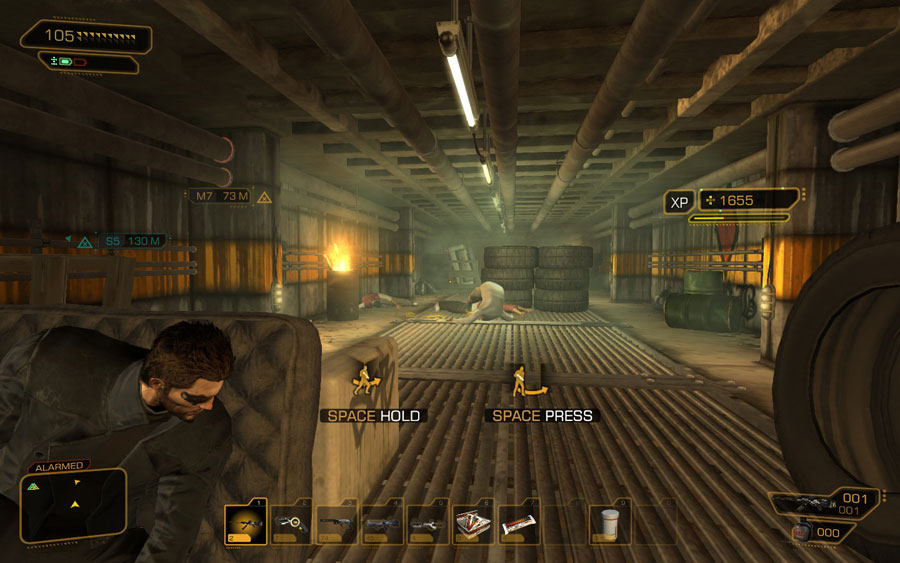
I would be “Alarmed” too.
The thing to understand right from the start is that Deus Ex: Human Revolution (hereafter DX:HR) is three separate things. The first is a prequel to the original groundbreaking Deus Ex released in 2000. The second is a genre showcase of cyberpunk sensibilities. And the last? The actual game.
The distinction between the three is extremely important because it is easy for someone to write off the entire game because it does not live up to the Deus Ex heritage. Or for someone else to watch trailers like these and fall so deep in love of the cyberpunk spirit of the game that the actual mechanics becomes irrelevant. Or in my specific case, struggle within the dichotomy of loving the setting so much that it (almost) washes away all the sins of not being Deus Ex: New and Improved, while the game bits themselves simply show up to work and get the job done.
One of the defining characteristics of the original Deus Ex was the multiple ways in which the player could progress through the game. Want to treat the game like a normal FPS? You could do that. Want to sneak through the air vents, hack into the computer systems, and bypass all security measures without firing a shot? You could do that too. DX:HR does its best to live up to that open-choice legacy, without really understanding how the original maintained a level of coherency: limited, metered choices. In DX:HR, 100% of the augmentations are available to the player right at the beginning of the game; the choice simply comes down to which ones you want to unlock in which order. What this means in gameplay terms is that since all of the choices are available, the designers included ways in which all of the choices are useful.
For example, about a third of the way through the game you will be tasked to get past a locked lab door. Your options include:
- Kill the guards (personally or via hacked security bots), loot the key.
- Hack the lab door.
- Grab an extra pass in the security room, present to guard.
- Sneak through ventilation.
- Use the Strength augment to move a vending machine, climb on top and jump to 2nd floor balcony.
While it felt liberating to know there were so many different ways to progress at first, it also meant that none of the ways you did progress felt particularly clever. The natural inclination to explore all the rooms to make sure you didn’t leave behind valuable items (despite none ever really existing), quickly reveals how many paths lead to the same outcome. Considering all 5 of the different paths occur within 30 feet of each other, you begin to question whether the choices actually matter. And that answer is, unfortunately, “No.”
But that is the rub. Had this been any other other FPS title, I would have been praising it for its Deus Ex-qualities instead of damning it for the same. Compared to the generic FPS flair of games like Singularity, DX:HR blows them out of the water. Indeed, DX:HR feels more coherent than even open-world titles like the STALKER and Far Cry series, insofar as the latter games mostly present “options” in the form of exploiting AI than necessarily discreet choices.
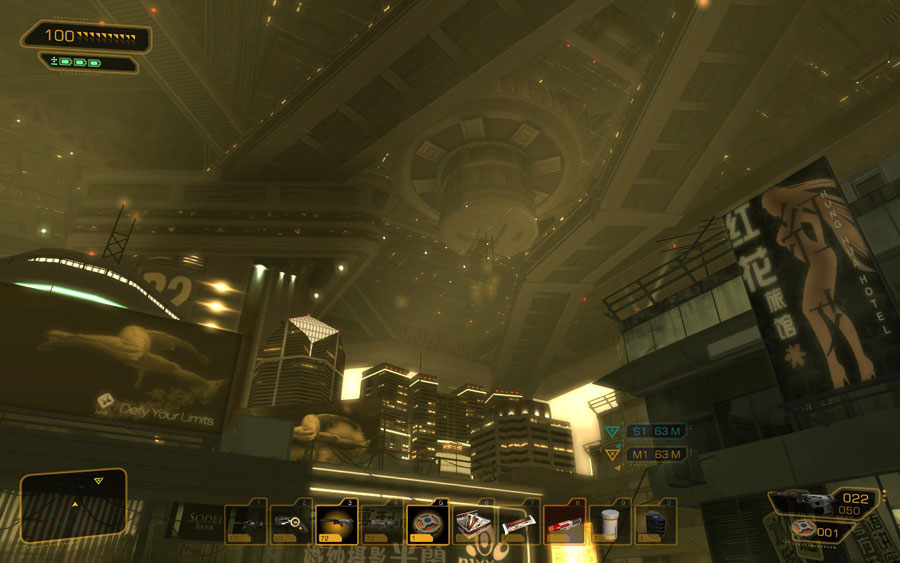
This Midgar-looking city makes me want a FF7 remake soooooo bad.
Legacy issues aside, DX:HR as a game within itself is a rather brilliant experience. Someone looking for a challenging run-n-gun cover-based shooter will find DX-HR an acceptable challenge. The stealth mechanics do not feel tacked on like so many other FPS titles (Far Cry, etc). While the augmentation choices might not matter in a metagame sense, they are useful in making you better at whatever playstyle you are accustomed. The oft-maligned boss battles do indeed feel a bit out of place, although I would be more disappointed if they were handled entirely in cut scenes or if I, say, was able to one-shot them in a takedown move or whatever. The visuals and vistas are top-notch, and the soundtrack is one of the best I have ever heard.
As a final note, I would be remiss if I did not mention the horrible, horrible technical issues I had with the game. With a four-month old game being played on a $1300 gaming rig bought a month ago, I experienced complete Crashes-To-Desktop (C2D) roughly every ~20 minutes for the entire 38 hours I played. Sometimes it would C2D within 3 minutes, sometimes I would actually go a full, uninterrupted hour. Two of the big plot-twisting cinematics were completely unwatchable in that it would C2D at a certain point 100% of the time, and I was never able to watch any of the various ending cinematics in their entirety; in all such cases, I skipped them in-game and Alt-Tabbed to watch them on Youtube in order to proceed. While it could be entirely Nvidia’s fault, or user-error for that matter, it is something to keep in mind.
And honestly, the fact that I endured hundreds of C2Ds over the span of 38 hours to reach the game’s conclusion is perhaps the highest endorsement I can give. Whether it was because of the zeitgeist of the cyberpunk setting, or the ghosts of Deus Ex past, or if it came down to the gameplay itself, all I know for sure is how I felt at the very end:
“Please, sir, I want some more.”
Human Revolution DLC Review:
Missing Link ($14.99) – To be honest, the Missing Link DLC to Deus Ex: Human Revolution was one of the first DLCs I have ever played which felt like a legitimate “deleted scene” from the main game. This is both a good and bad thing. Good in that it feels like a relatively seamless addition despite being on its own 2gb installer and featuring the vastly overused (gaming) trope of the hero losing all of his/her powers. Bad in that, well, most deleted scenes are deleted for a reason.
Taking place in the middle of a fade-to-black scene change in the middle of the original game, Missing Link does not add anything of plot value to the game proper aside from, well, around four more hours of gameplay. While you end up getting access to most of the weapons/augments from the main game, I definitely experienced a mental disconnect between the choices I was making, knowing that none of it mattered since no data was going to be transferred. Want to explore every nook and cranny? Okay… but why? No data, no XP, no weapons, no credits, nothing will endure past the final encounter. Which, incidentally, takes the form of how all the boss battles in Human Revolution should have played out.
Aside from that, and a frustrating amount of pointless backtracking past a 20-30 second in-game “loading screen,” Missing Link is a good enough dessert to the main course that was the original game. Provided, of course, you can snag it for less than the outrageous $15 retail price. Less than $5 or included in a Game of the Year edition would be ideal.
Reviews: Shadowgrounds, Anomaly Warzone Earth, NightSky, ARES
Game: Shadowgrounds
Recommended price: bundle
Metacritic Score: 74
Completion Time: ~6 hours
Buy If You Like: Atmospheric, top-down shooters
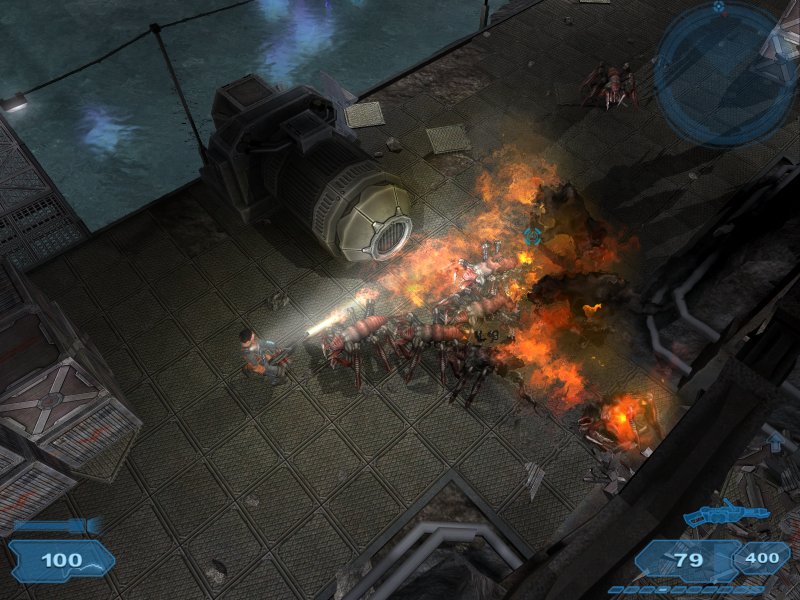
Burn them with fire.
Shadowgrounds is one of those indie games you wish received the polish of a full budget. The premise is an alien invasion of the human colony on Ganymede, one of Jupiter’s moons. What is great about Shadowgrounds is the atmospheric top-down shooting which combines elements of Smash TV/Binding of Isaac with survival horror. What this means is that you will frequently face hordes of aliens, but you lack the infinite ammo that would typically reduce the experience to holding down the fire button. There is also a strong sense that the game started out as a “shadow simulator” given the uncharacteristically amazing dynamic shadows generated by your flashlight.
With a dozen weapons with differing upgrade options and a good mix of alien types that never become trivial, Shadowgrounds makes a surprisingly strong entry in its own hybrid genre. It is just a shame that the designers felt it necessary to close up every loose end in the game’s conclusion.
Game: Shadowgrounds: Survivor
Recommended price: bundle
Metacritic Score: 79
Completion Time: ~5 hours
Buy If You Like: Even more atmospheric, top-down shooters

Seriously though, make these "real" games.
With Shadowgrounds: Survivor, Frozen Byte took the formula of the original and tweaked it in some of the right ways, and some of the wrong ways. As a prequel to the original, Survivor follows the paths of three separate survivors of the original attack on their way to evacuation. Each of the three characters is essentially their own “class,” with access to only a handful of the weapons of the original game. It makes for a more focused experience when you don’t have to choose between 12 weapons to exterminate an incoming enemy horde, so that actually works out. What also works out is the inclusion of a lot more human blood and body parts in the background, cementing my belief that this franchise could possibly see success remade as a perhaps B-level game.
What I felt didn’t work though, was the inclusion of experience points. While the original game had an upgrade system based on drops from enemies, I never really felt the need to kill every alien around. With XP though, the entire tone of the game changes to where you find yourself hunting down every last straggler to make sure you hit the XP cap for each level. Instead of “surviving,” it felt a lot more like “hunting.” Aside from that, the game really does feel like an improvement on the original.
Game: Anomaly Warzone Earth
Recommended price: $5
Metacritic Score: 80
Completion Time: ~5 hours
Buy If You Like: Slick, tower defense on wheels
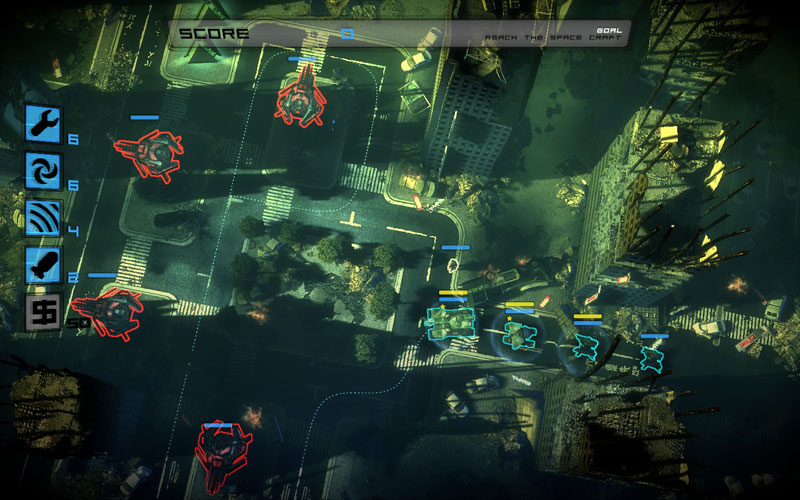
If only a game was as fun as it looked.
The big buzz surrounding this indie title was the term “reverse tower defense.” While it is technically accurate that the enemy is the one with towers in a maze of city streets, Anomaly plays a lot closer to “tower defense on wheels” than anything else. You control an immortal commander that runs around on the ground, capable of placing one of four different types of effects on the battlefield to support your convoy: repair zones, smoke screens, decoys, and airstrike zones. A press of the button will bring up your map screen where you can change the route of your convoy, buy or upgrade units, or switch their order. The game itself is one of the slickest I have ever seen, as far as graphics and interface goes.
While there are varied alien tower types and plenty of tactical placement of your special powers, Anomaly suffers immensely from the fact that there is an optimal convoy configuration that never makes sense to deviate from. Basically: tank, shield, missile, missile. While some of the alien towers will force you to move away from your convoy and still others will force you to drop powers in only a few areas, the banality of the convoy configuration itself makes the destruction of the alien towers a forgone conclusion. I almost think the game would be a lot deeper if you had no control over the convoy composition – it would change how you deploy the special powers, at a minimum.
Game: NightSky
Recommended price: bundle
Metacritic Score: 78
Completion Time: ~4 hours
Buy If You Like: 2D physics indie puzzle games + jazz
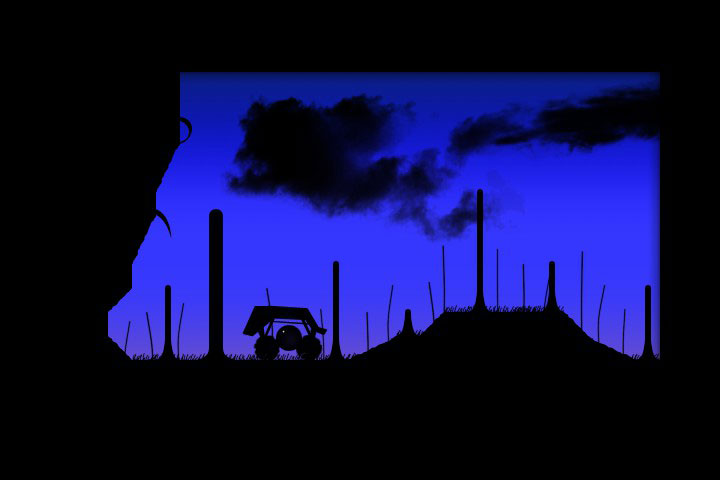
Only thing more elegant than the visuals is the soundtrack.
In NightSky you control a metal sphere that has to roll its way past a number of 3-screen sets of physics-based puzzles. On some screens you have abilities like a super-speed up, a super-friction move, and even reverse gravity. These powers come and go, along with some more esoteric ones like being placed inside of a hollow-out RC car, or not being able to move at all while controlling the release of wheels, hammers, and other physics-based items as your only source of motive force.
There is nothing too groundbreaking going on in NightSky, but I must say it has one of the best jazz/environmental music in any indie game I have ever played. Combined with the gorgeous artwork that makes us each level, NightSky actually made for an amazingly relaxing game experience in the hour or so before going to sleep. There is a little bit of depth with some secret areas and hidden stars to collect, but this game is just long enough on its own to whet your appetite for more of what these designers are cooking.
Game: A.R.E.S.: Extinction Agenda
Recommended price: nothing
Metacritic Score: 68
Completion Time: ~2 hours
Buy If You Like: Bad side-scrolling shooters

Like spiderweb-flavored cotton candy.
What a terrible game. ARES is a side-scrolling shooter in the vein of Megaman, but anyone who actually played Megaman (or any side-scrolling shooter) will immediately recognize how utterly vapid the gameplay ends up being. Most enemies die without even doing anything that needs avoiding, and the boss encounters require no real strategy. It is almost as if the designers looked at an ingredient list of classic NES games, and then just tossed them all in a pot and called it a day. Pro-tip: if you want platformer-esque gameplay, you might want to ensure that your game includes jumping mechanics that don’t rely on a non-renewable resource, i.e. grenades.
What makes things worse to me, is how obvious the designers were in trying to pad the game. Each robot you destroy leaves behind a smattering of three different types of parts. Collecting these parts enable you to make health packs, grenade types, and upgrades to your weapons. Thing is, enemies will literally respawn two feet to the left or right of off-screen territory, giving you a not-so-subtle indication to go ahead and farm them for parts. Which might be fine if A) they didn’t essentially self-destruct once coming into view, B) they had attacks you needed to avoid, or C) bosses didn’t roll over and die without you ever really knowing what you were supposed to be doing, even on Hard mode. Graded performance *might* get perfectionists back again, but the lack of any compelling gameplay whatsoever limits that particular population to the most extreme of the OCD. And even then, they would probably have more fun counting toothpicks.
 In An Age