Category Archives: Review
Reviews: Shadowgrounds, Anomaly Warzone Earth, NightSky, ARES
Game: Shadowgrounds
Recommended price: bundle
Metacritic Score: 74
Completion Time: ~6 hours
Buy If You Like: Atmospheric, top-down shooters
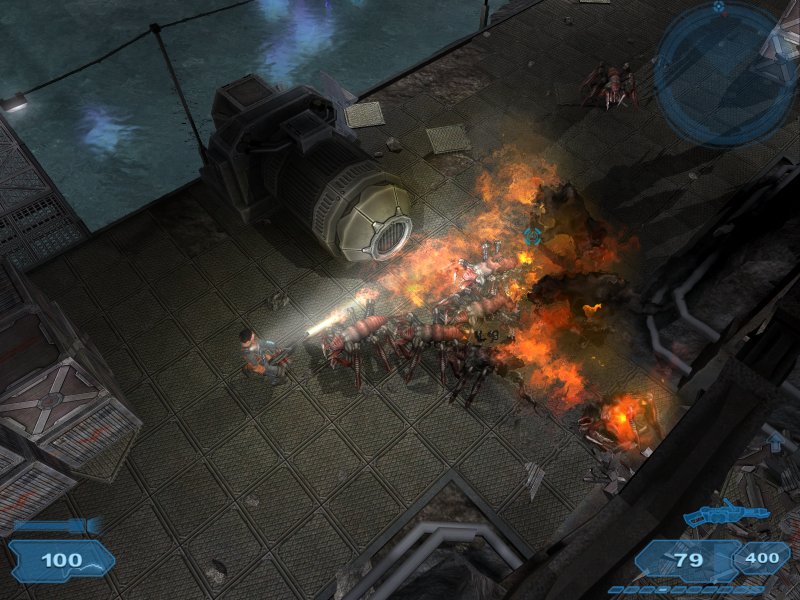
Burn them with fire.
Shadowgrounds is one of those indie games you wish received the polish of a full budget. The premise is an alien invasion of the human colony on Ganymede, one of Jupiter’s moons. What is great about Shadowgrounds is the atmospheric top-down shooting which combines elements of Smash TV/Binding of Isaac with survival horror. What this means is that you will frequently face hordes of aliens, but you lack the infinite ammo that would typically reduce the experience to holding down the fire button. There is also a strong sense that the game started out as a “shadow simulator” given the uncharacteristically amazing dynamic shadows generated by your flashlight.
With a dozen weapons with differing upgrade options and a good mix of alien types that never become trivial, Shadowgrounds makes a surprisingly strong entry in its own hybrid genre. It is just a shame that the designers felt it necessary to close up every loose end in the game’s conclusion.
Game: Shadowgrounds: Survivor
Recommended price: bundle
Metacritic Score: 79
Completion Time: ~5 hours
Buy If You Like: Even more atmospheric, top-down shooters

Seriously though, make these "real" games.
With Shadowgrounds: Survivor, Frozen Byte took the formula of the original and tweaked it in some of the right ways, and some of the wrong ways. As a prequel to the original, Survivor follows the paths of three separate survivors of the original attack on their way to evacuation. Each of the three characters is essentially their own “class,” with access to only a handful of the weapons of the original game. It makes for a more focused experience when you don’t have to choose between 12 weapons to exterminate an incoming enemy horde, so that actually works out. What also works out is the inclusion of a lot more human blood and body parts in the background, cementing my belief that this franchise could possibly see success remade as a perhaps B-level game.
What I felt didn’t work though, was the inclusion of experience points. While the original game had an upgrade system based on drops from enemies, I never really felt the need to kill every alien around. With XP though, the entire tone of the game changes to where you find yourself hunting down every last straggler to make sure you hit the XP cap for each level. Instead of “surviving,” it felt a lot more like “hunting.” Aside from that, the game really does feel like an improvement on the original.
Game: Anomaly Warzone Earth
Recommended price: $5
Metacritic Score: 80
Completion Time: ~5 hours
Buy If You Like: Slick, tower defense on wheels
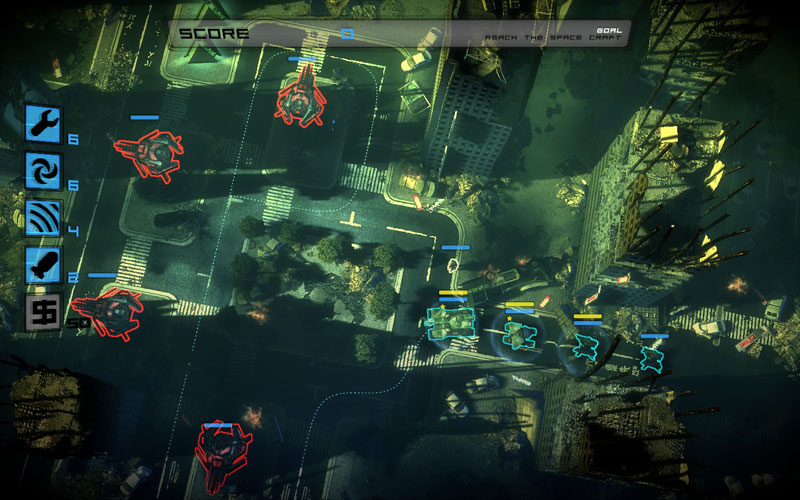
If only a game was as fun as it looked.
The big buzz surrounding this indie title was the term “reverse tower defense.” While it is technically accurate that the enemy is the one with towers in a maze of city streets, Anomaly plays a lot closer to “tower defense on wheels” than anything else. You control an immortal commander that runs around on the ground, capable of placing one of four different types of effects on the battlefield to support your convoy: repair zones, smoke screens, decoys, and airstrike zones. A press of the button will bring up your map screen where you can change the route of your convoy, buy or upgrade units, or switch their order. The game itself is one of the slickest I have ever seen, as far as graphics and interface goes.
While there are varied alien tower types and plenty of tactical placement of your special powers, Anomaly suffers immensely from the fact that there is an optimal convoy configuration that never makes sense to deviate from. Basically: tank, shield, missile, missile. While some of the alien towers will force you to move away from your convoy and still others will force you to drop powers in only a few areas, the banality of the convoy configuration itself makes the destruction of the alien towers a forgone conclusion. I almost think the game would be a lot deeper if you had no control over the convoy composition – it would change how you deploy the special powers, at a minimum.
Game: NightSky
Recommended price: bundle
Metacritic Score: 78
Completion Time: ~4 hours
Buy If You Like: 2D physics indie puzzle games + jazz
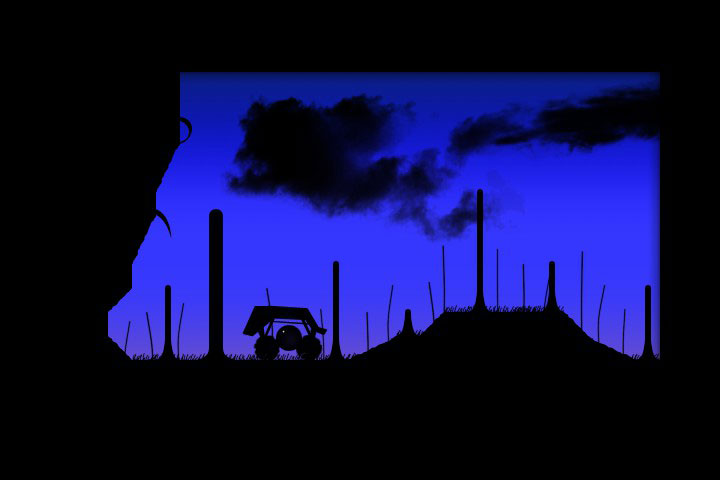
Only thing more elegant than the visuals is the soundtrack.
In NightSky you control a metal sphere that has to roll its way past a number of 3-screen sets of physics-based puzzles. On some screens you have abilities like a super-speed up, a super-friction move, and even reverse gravity. These powers come and go, along with some more esoteric ones like being placed inside of a hollow-out RC car, or not being able to move at all while controlling the release of wheels, hammers, and other physics-based items as your only source of motive force.
There is nothing too groundbreaking going on in NightSky, but I must say it has one of the best jazz/environmental music in any indie game I have ever played. Combined with the gorgeous artwork that makes us each level, NightSky actually made for an amazingly relaxing game experience in the hour or so before going to sleep. There is a little bit of depth with some secret areas and hidden stars to collect, but this game is just long enough on its own to whet your appetite for more of what these designers are cooking.
Game: A.R.E.S.: Extinction Agenda
Recommended price: nothing
Metacritic Score: 68
Completion Time: ~2 hours
Buy If You Like: Bad side-scrolling shooters

Like spiderweb-flavored cotton candy.
What a terrible game. ARES is a side-scrolling shooter in the vein of Megaman, but anyone who actually played Megaman (or any side-scrolling shooter) will immediately recognize how utterly vapid the gameplay ends up being. Most enemies die without even doing anything that needs avoiding, and the boss encounters require no real strategy. It is almost as if the designers looked at an ingredient list of classic NES games, and then just tossed them all in a pot and called it a day. Pro-tip: if you want platformer-esque gameplay, you might want to ensure that your game includes jumping mechanics that don’t rely on a non-renewable resource, i.e. grenades.
What makes things worse to me, is how obvious the designers were in trying to pad the game. Each robot you destroy leaves behind a smattering of three different types of parts. Collecting these parts enable you to make health packs, grenade types, and upgrades to your weapons. Thing is, enemies will literally respawn two feet to the left or right of off-screen territory, giving you a not-so-subtle indication to go ahead and farm them for parts. Which might be fine if A) they didn’t essentially self-destruct once coming into view, B) they had attacks you needed to avoid, or C) bosses didn’t roll over and die without you ever really knowing what you were supposed to be doing, even on Hard mode. Graded performance *might* get perfectionists back again, but the lack of any compelling gameplay whatsoever limits that particular population to the most extreme of the OCD. And even then, they would probably have more fun counting toothpicks.
Review: Sanctum + DLC
Game: Sanctum + DLC
Recommended price: $10 (as in $10 for game + DLC)
Metacritic Score: 70
Completion Time: 12-20 hours
Buy If You Like: A little FPS in your Tower Defense
Sanctum is a Tower Defense game combined with FPS elements that starts blurring the definition of an “indie” title. The gameplay mechanics are tight, the background environments are amazing, and there is an overall degree of polish not necessarily seen in $10 games. About the only thing missing is something in the way of a narrative, which would arguably be out of place in a Tower Defense game anyway.
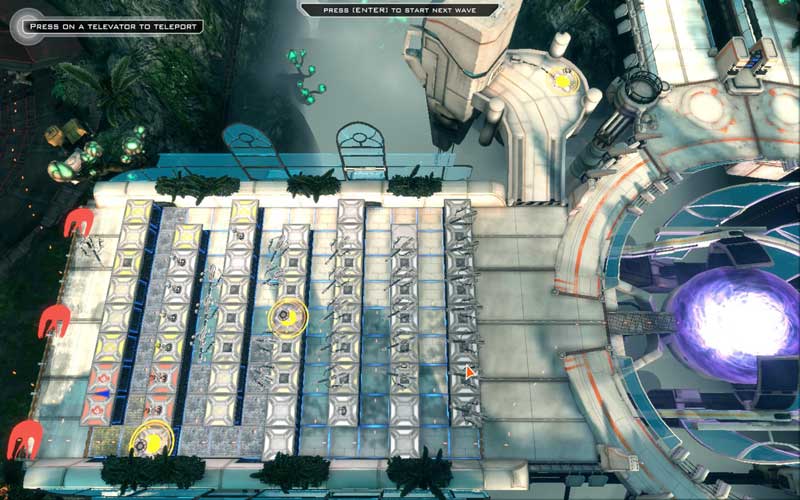
Not the most efficient maze by any means, but I was a noob.
That is not to say that Sanctum gets everything right. The base game goes for $9.99 on Steam, but includes includes only 6 maps. While you may spend 1-2 hours per map depending on whether you beat the 25-30 waves of aliens on your first try or not, the maps themselves correspond closer to archetypes than maps per se. For example, there is one completely open map, one map with aliens spawning on opposite sides, one ultra-huge map, one map with a maze pre-built, and so on. If you particularly enjoyed ultra-huge maps, well, you get just the one. Theorhetically Coffee Stain Studios can simply add more, but given the fact that four maps have been added as $2 DLC, it may soon start getting too expensive for the entertainment generated.
The one thing Sanctum has going for it is that each map supports a lot of customization options in terms of building mazes and placing towers. Indeed, the building of the maze to begin with feels like its own distinct game (which it arguably is). So if your favorite map is Arc, as long as you don’t build the same maze with the same towers while equipped with the same guns, it will be subtly different. Combine that with up to 4-player co-op and 4 different Survival Modes and 4 different difficulties, and the limited map options feel less oppressive.
That being said, keep in mind that Sanctum is a Tower Defense game at heart with FPS thrown in as well. Each wave is stronger than the last not through numbers or strategy, but simply an increase in alien HP. While upgrading your weapons and towers with resources generated via completed waves generally keeps pace (at least on Normal), the “difficulty” of the game really comes down to shooting the same thing more times. And since there is no randomness in alien behavior, the waves or types (you can see what’s coming 5 waves down the line), playing for long periods of time can quickly burn you out. Which probably could be summed up with “it’s Tower Defense, stupid.”
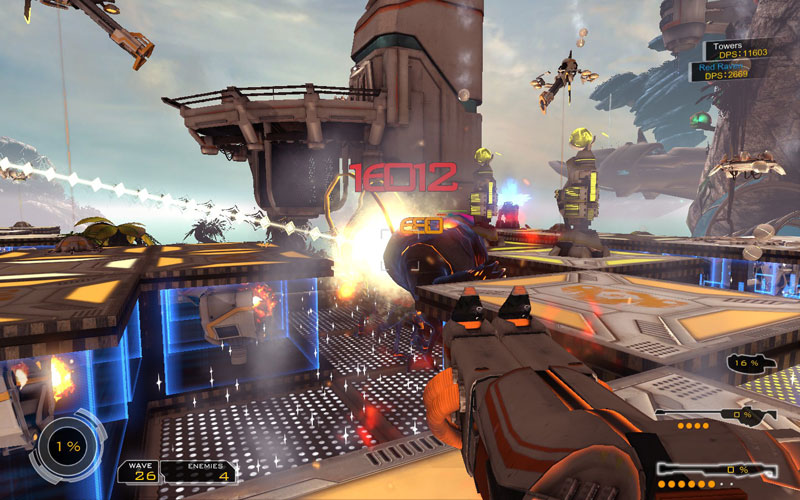
There is something very satisfying about getting your hands dirty.
Sanctum DLC Review:
Killing Floor ($0.99) – Floor tile that acts as a rechargeable land mine. The one big plus of this tile is that it consistently will damage Hoverers (i.e. the floaty aliens immune to damage from the front). That being said, I have found these fairly weak in comparison to standard Slow Fields or Amp Fields which come with the base game.
Penetrator ($0.99) – Tower block that shoots a beam that damages all enemies in a line. Sounds amazing at first, but its slow rate of fire and tracking issues means it will shoot diagonally most of the time and otherwise completely waste its multi-damage capability. Not recommended.
Violator ($0.99) – Tower block that creates a floating sniper rifle with a monsterous range that can hit ground or air targets with a single, powerful shot every few seconds. Personally, this is about as close as you can get to Pay To Win in a non-competitive game. The Violator can be a liability if you get both a bunch of fast ground AND air aliens since it may waste its shots on the little ones, but otherwise… god damn. This is typically my go-to Tower once the early Towers are out of the way.
Map: Aftermath ($1.99) – I am not a huge fan on this map for three reasons. The first is that the sloped middle section makes it much more difficult to traverse the tops of blocks. Second, there are frequently small gaps between blocks that can lead you to falling inbetween them in a heated moment. And finally, the overall layout prevents much Tower overlap, even with Violators. That aside, it has three decently-sized rectangle areas for maze placement and good Line of Sight to enemy spawn locations.
Map: Aftershock ($1.99) – Much like with Aftermath, this map features three main areas, has some angled terrain, and the possibility of falling inbetween some blocks. However, the map itself is more compact (good Violator/Morter coverage) and the maze itself is practically pre-built for you. That can either be good or bad depending on your tastes.
Map: Cavern ($1.99) – This is a heavily multi-tierred, practically pre-built non-air gauntlet. Cavern also introduces the concept of teleports for the first time, along with a sort of jump pad that will quickly send you flying up to higher levels. On Normal difficulty, I found this pretty ridiculously easy.
Map: Slums ($1.99) – Once again, a heavily-tiered map that essentially consists of two squares and two small rectangles to build mazes in. One of the complicating factors is that there are multiple teleports on each level, which can make planning even a simply maze feel like three-dimensional Chess. Since ground units emerge from a single location though, I found this map overall ridiculously easy on Normal difficulty – most foes died before they could make it off the first “island.” Combined with a default of only 13 waves, this felt like the shortest map in the game.
DLC Summation:
I received the three weapons for free as part of a bundle, and picked up the four maps on a Steam sale for $5. Given that I got everything for essentially $10, I am satisfied. Picking these up at non-sale prices… I would probably skip everything but the Violator. The four maps are fine, but since Aftershock, Cavern, and Slums come essentially pre-built, I don’t see much in the way of replay value.
Review: The Binding of Isaac
Game: The Binding of Isaac
Recommended price: $5 (full price)
Metacritic Score: 84 (!)
Completion Time: Technically ~1 hour, or 20+ hours
Buy If You Like: Twisted, roguelike Flash games
The Binding of Isaac (hereafter Isaac) is a game that, strictly speaking, I should not enjoy. Indeed, I did not enjoy it at all the first few times I played it. But I did keep playing it, and once I sort of stumbled my way out of fifteen years of safe game design, Isaac rekindled a bit of that stubborn old-school gamer flame that propelled my younger self face-first into Battletoads hour after bloody hour.
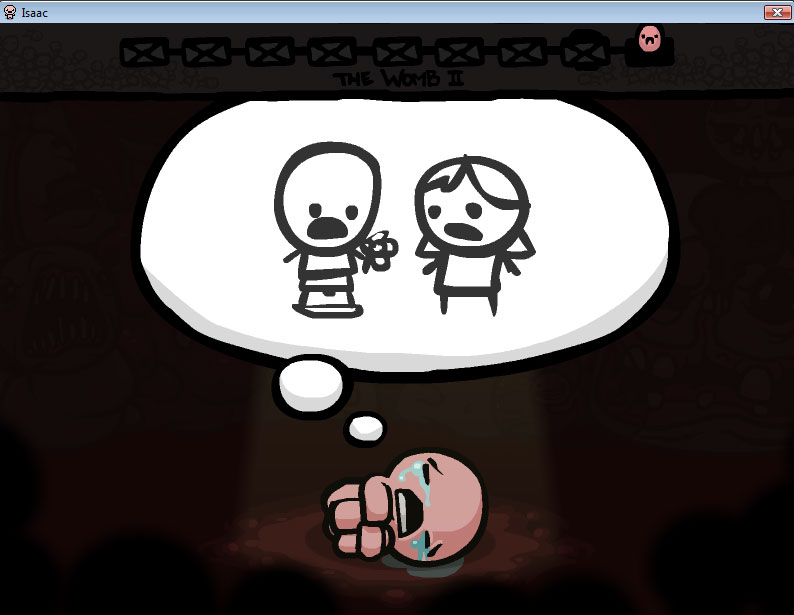
This is what the first few hours will feel like.
Isaac plays like Smash TV from the olden days, with WASD controlling movement and the arrow keys controlling which direction you eject the streaming tears from your naked body at the merciless demons haunting your childhood nightmares. Map layouts and room contents are randomly determined each time you start the game, with the only consistency being the number of total levels, and there being Item and Boss rooms on every level (until the last few, which have no Item rooms).
As I mentioned, the game did not seem terribly fun the first few times. There is no quick-save, there are no checkpoints, and I got the feeling that I was lucky to even have a pause button. Death is permanent, none of the items you receive are really explained before you use them, many items can actively harm you in some way, some room setups are completely unfair, and it is both entirely possible and very likely that you will get screwed right from the very start with things only getting progressively worse.
Sometime around my fourth attempt, it suddenly all clicked: this is like Solitare. A game you play because you aren’t sure you want something heavier, a game that you don’t have an expectation to beat every time, and yet something you still find fun hours and hours later.
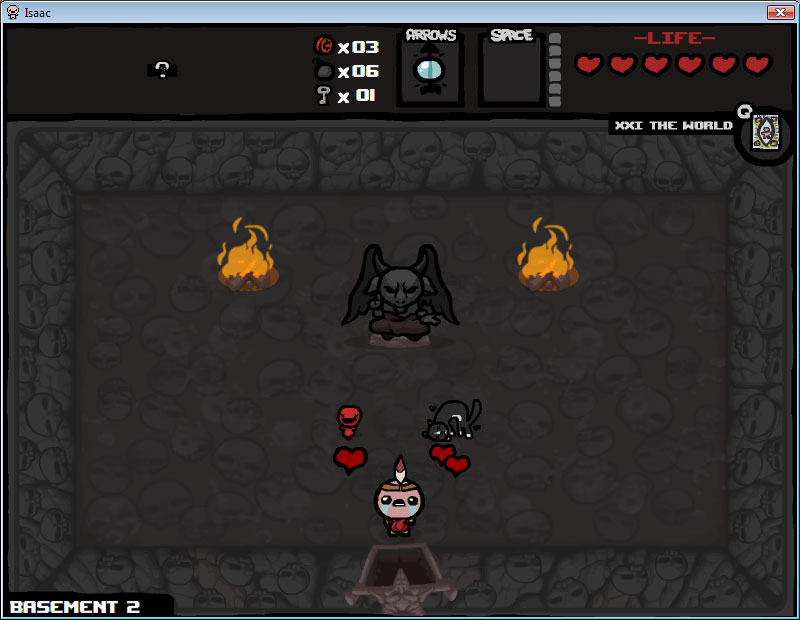
Isaac gives you plenty of opportunities to make bad decisions.
And I have indeed been having fun hours and hours later; 20+ hours to be exact. Although you never carry over items you accumilate, beating the game or getting specific achievements will unlock new items that are then added to the random roster, some of which will radically change the tenor of a particular run. I have a few more specific achievements to grab by beating the full game with different characters (basically different starting load-outs) before getting to the truly ridiculous “take no damage for X levels” kind, so it will be interesting to see if the game is still fun once those dry up.
But you know what? Getting more than 20 hours of game time in a roguelike, a genre that I was hitherto convinced I would despise on principal, is an absolute goddamn steal at $5.
Review: The Witcher
Game: The Witcher: Enhanced Edition Director’s Cut
Recommended price: $10 (current full price)
Metacritic Score: 86
Completion Time: ~52 hours
Buy If You Like: Immersive, mature, point-and-click action RPGs

Expansive views.
The Witcher is a lot of things. Deserving of an 86 Metacritic score is not one of them.
To be charitable, The Witcher can be seperated into two overarching qualities. One of those is the setting: the implied world, the zeitgeist, the plot, the dialog, the visuals and sounds and mood. All of those things are based on a series of novels by Polish author Andrzej Sapkowski, so in one respect The Witcher “cheated” compared to other games that had not the benefit of an established world. Then again, The Witcher absolutely possesses a personality that comes across perfectly fine to someone with zero knowledge of the books, to say nothing of the games impressive visuals and music which have no written analog.
Unfortunately, the other overarching quality is a little-known thing called “the actual game.” And this is where things begin to break down.
See, The Witcher is able to create a compelling setting through the implied world, of which you see very little at all in actuality. This is not unlike the Japanese art concept of Ma, which means “negative space,” in that it paints enough of a picture that you as the viewer fill in the rest. This works for art… but it does not work for gameplay at all. Combat in The Witcher appears to have a depth to it, but as the thin veneer rubs off from frequent use you begin to realize how much negative space the designers were actually papering over.
On the surface, Geralt of Rivia has two swords, one steel and one silver, and there are three fighting techniques for each: Strong, Fast, and Group. Additionally, there are charge-up attacks for each of the six combinations, and each combination has up to four chained attacks. Then there are the five magic spells which also have charge-up secondary functions. Finally you have potions (more on that in a bit) which can alter your fighting prowess and oils/poisons you apply to either of your blades. Oh, and there are bombs too.
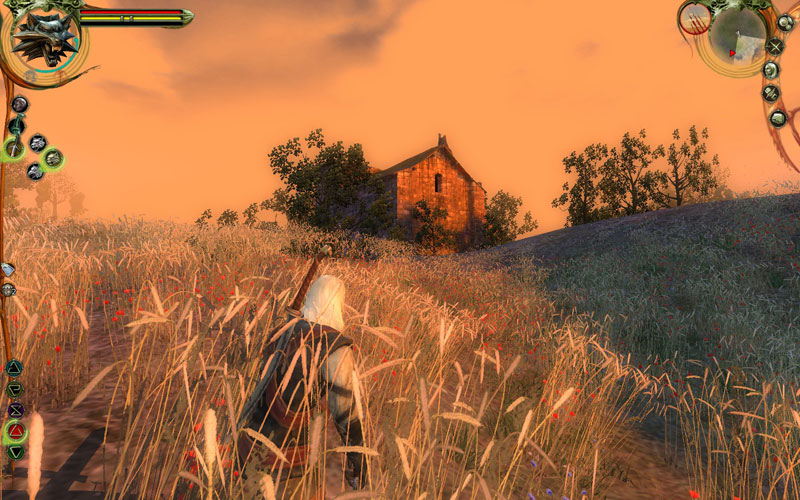
Kidding aside, daaaamn, this looks good.
Beneath the surface though? You left-click on a mob, Geralt performs a fancy sword move, you wait until the cursor “lights up” to left-click again in order to move onto the 2nd hit combo, and so on. If you click too fast or too slow, the attack is interupted and you just do it again. Repeat. In the “Making Of…” videos the designers mentioned how they wanted The Witcher to be more action-oriented than the sort of Neverwinter games they were inspired by, but I have to wonder whether Diablo was ever released in Poland. I ask because The Witcher straddles (and then falls off) that line between Diablo-esque quality mouse-clicking action and a mind-numbing Quick Time Event that is solved entirely by fixating on an inch square of the screen and left-clicking every 3-4 seconds. The motion captured moves are very impressive the first hundred times you see them, but eventually my eyes would unfocus in the interm period while waiting for the cursor to light up. Once you recognize the enemy and whether to use steel or silver, whether to use Strong or Fast styles, combat is essentially a forgone conclusion. You press Q-X (or similar), then Left-Click every few seconds until dead.
Nowhere is the thin veneer more aparent than the Talent trees or the Alchemy aspect, both of which are usually touted as Big Deals in reviews of this game. Simply put, the Talent system in general is a diluted mess of vague game mechanics. You have Bronze, Silver, and Gold talents, and you start out by getting just Bronze ones, then Silver, and so on. In practice, you will have damn near 100% of the Bronze talents and more than enough Silver ones, so all the vaunted “choices” boil down to which ones of the remotely useful talents you want first. Similarlly, Alchemy allows you to collect a huge sum of plant and monster parts to create ~20 different potions, only 3-4 of which are at all especially useful. There is also a Toxicity aspect of potions, presumably designed to prevent players from stacking huge amounts of potion buffs. However, since most potions last for 8 hours and Toxicity can be reduced to zero after resting for 1 hour… well, you see where that is going. Perhaps this sort of “exploiting” is necessary for the harder difficulties, but honestly, why bother otherwise?
There is one more negative aspect I wanted to mention because it is likely the cause of 90% of the players who quit the game before finishing: all the goddamn running around… which gets completely absurd when combined with a Day/Night cycle. At one point in game, I had to perform an autopsy to move the story forward. When I approached the nurse friend about this, she told me to wait until after-hours to talk about it. So I waited until dusk, then talked with her. Then she told me to get the body from the Gravedigger on the other side of town. I go to the other side of town, but the gravedigger isn’t around at night. So I waited until morning, talked with the Gravedigger, and he said he’d deliver it at midnight. So I had to wait until midnight, then run back across town, perform autopsy. Afterwards, nurse friend wants to schedule a get-together, asks me to get booze and invite someone. I run across town to buy booze, but the tavern doesn’t have all the required types. I wait until morning, buy from the vendor near the nurse’s house, wait until dusk. I go to where the friend I want to invite is usually located at, and he isn’t there. I run across town trying to find him, but fail. Then I wait until morning, finally find him where he usually is during the day, invite him, then wait until night to have the party.
You will be doing quests like this all the goddamn time, at least in the first half of the game. And have I mentioned that despite a Day/Night cycle, you can only pass time at campfires or very specific NPCs who might wander off or inexplicably refuse to give you the option to Meditate? Well, consider it mentioned.
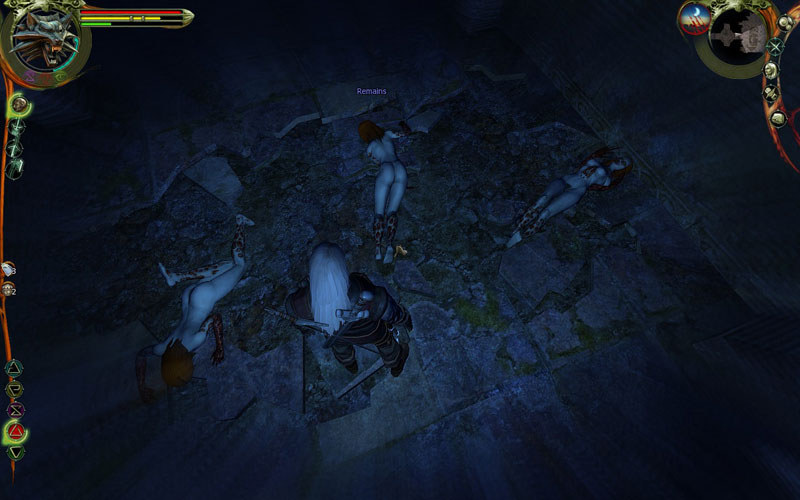
Nothing quite like a screen full of Alp ass.
The Witcher is one of those games that leave me in the uncomfortable position of deciding whether I want to meet it halfway or not. In the sort of verisimilitude of its narrative, The Witcher had me at damn near hello. Even the “contravserial” sex cards or naked vampires/dryads added to the gritty zeitgeist of a world where witchers mutate themselves into monsters to fight monsters, all for a populous unwilling to acknowledge a difference until they are in mortal peril. I want so much to give the rest of the game a pass… but I simply cannot. Combat is almost non-interactive; managing the massive amounts of ultimately useless inventory is a pain; there is so much goddamn running around; Day/Night cycles without a convenient Wait Anywhere feature is sadistic; frequent loading screens for indoor areas discourages exploration; hitting Quicksave creates a new 15-20 MB file every single time (my save game folder was 3.97 GB by the end of Chapter 1), and so on and so forth.
Ultimately, I do not at all regret my time spent in The Witcher’s world – I took more screenshots here than in Fallout: New Vegas – but it is not a game that I can recommend without caveats. And honestly, I am probably being so harsh because of how well Projekt RED nailed the non-game bits of The Witcher. But, well, the game bits of games are important too.
Reviews: Eufloria, Kane & Lynch 1 and 2, Osmos, Trine
Game: Eufloria
Recommended price: Bundle
Metacritic Score: 63
Completion Time: 16 hours
Buy If You Like: Ambient indie quasi-puzzle games
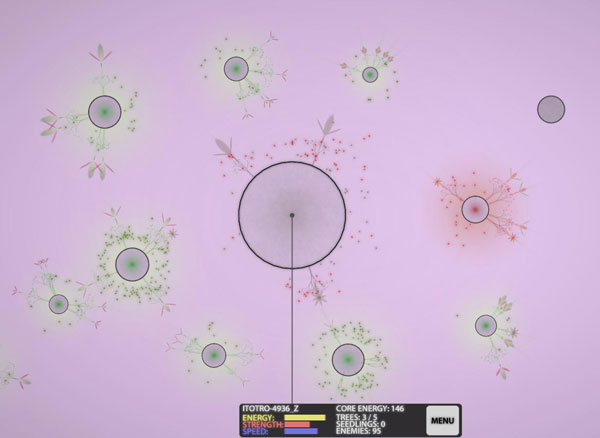
You have no chance to survive, make your time
Eufloria is an ambient indie strategy/puzzle game that blurs the line between strategic depth and shallowness. Your goal is to colonize all the asteroids in the playing field using your fleet of organic plant ships called Seedlings. Each asteroid has three characteristics – Strength, Speed, and Energy – and their varying levels determines the qualities of the resulting Seedlings that are grown from the Dyson trees. You see, to control of an uninhabited asteroid, you essentially sacrifice 10 of your Seedlings to grow a Dyson tree, which makes more Seedlings indefinitely. If said asteroid is inhabited by the enemy, your forces must attack any enemy Seedlings there, blow up one of their Dyson trees, and then kamikaze themselves through the root system to sap the core. Once the core is sapped, the asteroid is yours and any surviving Dyson trees are automatically converted to your side.
While all of this undoubtedly sounds strategic and exciting, the actual core gameplay can best be summed up by sitting around until you zerg the ever-living hell out of the enemy. There are actually additional strategic elements involved such as Defensive trees, tree-boosting flowers, and Death Star-esque multi-laser flower ships… but, again, all of them are problems that can be solved with the hammer of the zerg swarm.
The interface is clean, the ambient music relaxing, and the overall experience is somewhat refreshing in a distilled water sort of way. The last group of missions actually does require some strategic elements, but even then the issue ultimately comes down to surviving against the swarm long enough for your swarm to outnumber their swarm. Ultimately, I believe Eufloria to be one of those games that would unequivocally be better suited to the iPad or the Touch rather than computer proper.
Game: Kane & Lynch: Dead Men
Recommended price: $5
Metacritic Score: 67
Completion Time: ~4 hours
Buy If You Like: Controlling a dark, over-the-top revenge movie
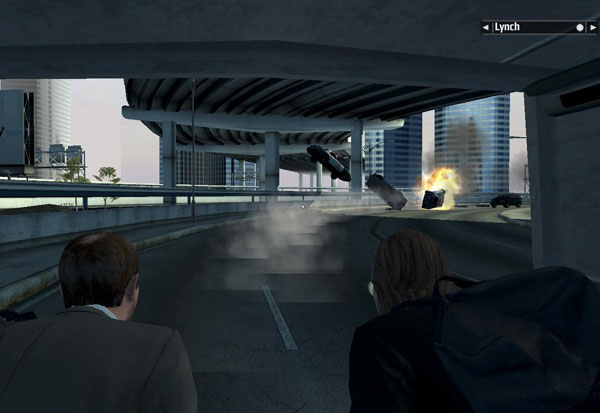
One grenade, half a dozen crimes against humanity.
I actually played Kane & Lynch 2 before the original, so my experience with the series is somewhat disjointed. This game follows Kane, an ex-mercenary in prison on his way to being executed. Along the way, he is “rescued” by Lynch along with the surviving members of The7, a mysterious organization that Kane betrayed in the past presumably because he believed them to have been killed in a botched mission. Actually, the whole convoluted backstory remains largely unexplained to the extent that it feels like you walked into a movie halfway over.
The game itself is an over-the-shoulder shooting spree as you navigate Kane through areas of cover and increasingly ridiculous scenarios. The7 has kidnapped your wife and daughter, and to get them back you rob a bank, escape by murdering half the police force in the western United States, fly (!) to Tokyo, fly (!!) back to the US, kill some more people, fly (!!!) back to Tokyo, and fly (!!?!) back to the US and other locales, as if there is no such thing as a no-fly list in the year two thousand and goddamn seven.
Despite the over-the-top ridiculousness of the entire scenario, despite the somewhat clumsy game mechanics, and despite everything else that I should objectively dislike about the game… the Kane & Lynch series is one that I actually enjoyed. For $5, but still. Both Kane and Lynch are completely unlikable characters, until you start finding their chemistry (if nothing else) rubbing off on you. To that end the voice acting is excellent to the point that you really do feel like you are playing a movie. Perhaps a bad movie, but by the end you want it so much to be a good one that you meet it halfway.
Game: Kane & Lynch 2: Dog Days
Recommended price: $5
Metacritic Score: 66
Completion Time: ~4 hours
Buy If You Like: Controlling a dark, over-the-top handycam revenge movie
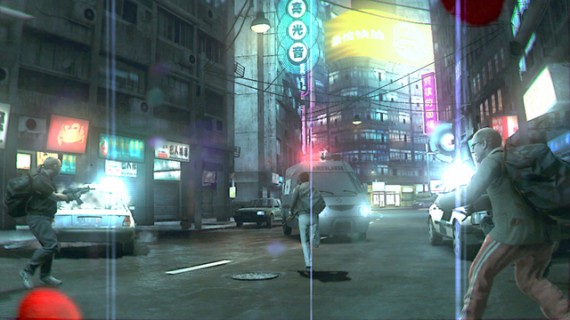
Now with 100% more lens flare.
Much like the original, Kane & Lynch 2 is an over-the-shoulder cover shooting spree that sees you playing as Lynch, the self-medicated psychopath, rather than the ex-mercenary Kane. One of the notorious aspects of the game is the camera system, which was definitely designed to give the impression that a drunk guy with a handycam is the one filming yet another outlandish slaughter by this dastardly duo.
Although this game actually has a lower Metacritic score than its predecessor, it is actually far superior than the original in many key ways. For one thing, Kane & Lynch 2 has a much more reasonable escalation of violence. Starting out with a botched mission in Shanghai, you move through the Chinese underground being chased by the gang you wronged, followed by who they were working for, then eventually the police and military. Compare that with the original in which you kill American police officers and hostages in the opening acts and freely take international flights multiple times later on. So from a narrative perspective, one of series’ strong points, the sequel out-shines the original quite nicely. Plus, in how many other games are the main characters brutally tortured only to escape and run around shooting people while completely naked and covered in box-cutter scars?
This is not to say that, strictly speaking, Kane & Lynch is a good game. You are not likely to play the game again, and you may have trouble even completing a single play-through if the first 5-10 minutes does not grab you (as that represents pretty much what you’ll be doing the entire time). Personally, I enjoyed myself quite a bit even though I developed a headache from the rather punishing lack of lulls in the action. Ultimately, I am glad that games like Kane & Lynch exist, because they definitely explored directions that few (if any) other games have ever dared. Even if those dank, dark corners of interactive fiction proved ultimately fruitless, at least we finally explored them.
Game: Osmos
Recommended price: $5 / Bundle
Metacritic Score: 80
Completion Time: ~5 hours
Buy If You Like: Elegant, ambient indie puzzle games

You are the blue orb, red orbs will kill you, good luck.
Osmos is a deceptively simple, intuitive puzzle game that turns out to be extraordinarily complex in many ways. The premise is that you control a blue orb, and you are tasked with absorbing those orbs smaller than you while avoiding being absorbed yourself. Movement is accomplished by ejecting small bits of yourself, which causes your orb to not only shrink, but also causes other orbs to grow if they end up absorbing the launched matter. You are aware at all times which orbs are smaller than you (e.g. capable of being safely absorbed) by their color: blue is safe, while red is not. Indeed, this elegant “scoring” has been one of the most psychologically satisfying mechanisms I have ever seen in a game – there is nothing quite analogous to finally absorbing a target orb and watching the rest of the playing field suddenly turn blue.
Honestly, “elegant” is simply the best way to describe the game period. The background, the ambient soundtrack, the visuals, the gameplay… everything about the game simply fits.
Once you complete the starting missions, the game branches out in three “gametypes” which you can complete in any order. One branch is Sentient, where all the levels feature, well, sentient orbs that will move around and attempt to absorb you. Sentient levels becomes somewhat a race against time as your opponents gobble up orbs and each other while you try and do the same. The second branch is Ambient, where all the levels feature massive amounts of stationary orbs all over the level. In these, you typically start out completely surrounded by orbs that will kill you if you bump them, and the idea is to push them into each other without letting one get too big to absorb yourself once you clear a path. The last branch is Force, in which the levels literally revolve around a sort of “star” with a gravitational pull. The later Force missions are simply diabolical, and require a level of patience and skill that I simply was not able to possess.
Overall, if you are able to simply let go of those levels/branches that you do not enjoy, Osmos is a mentally stimulating game that happens to also be deeply relaxing as well. When I think of indie games that push the genre/medium in general forward and have no AAA analogy, Osmos ranks towards the top of that list.
Game: Trine
Recommended price: $10
Metacritic Score: 80
Completion Time: ~6 hours
Buy If You Like: Gorgeous indie physics puzzle-platformers
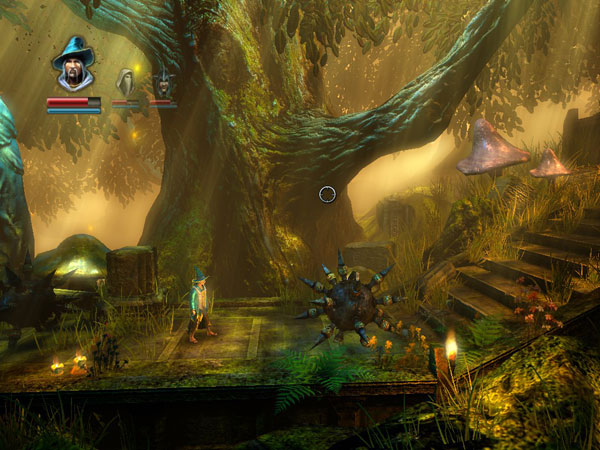
God this game is gorgeous.
Trine is one of those rare games that you forget isn’t some AAA title in the midst of playing it; an indie game that pushes the genre and medium as a whole forward when so many big studios are cashing in on derivative sequels.
The premise of the game is that a mage, a thief, and a knight walk into a bar end up touching the Trine, a plot object that explains why you can instantly swap out one character for another one at the touch of a button. The mage is able to conjure into being steampunk-esque cubes, planks, and eventually floating triangular platforms, in addition to being able to manipulate said objects (and others) by moving them around telekinetically. The thief is extremely agile, shoots arrows, is able to perform a limited wall-jump, and has a grappling hook that allows her to swing around. Finally, the knight has a sword and shield, can lift heavy objects, and can break barriers down with a giant hammer.
The plot itself is fairly generic fantasy storybook fair, but the lack of its depth is easily compensated by the puzzle platformer aspect of the rest of the game. See, you’ll come across “puzzles” like a pit with a bunch of spikes in it that is too far to jump over. You can “solve” it as the mage by conjuring cubes to drop onto the spikes, conjuring planks to lay over the spikes/across the cubes, build a cube tower to give you enough height to jump across, and so on. Alternatively, you can use the thief’s grappling hook to grab onto any overhanging wooden branches and swing across. Or you can have the mage conjure a floating platform, and then have the thief grapple the platform to swing across. Or just have the mage conjure multiple floating platforms. Or… you get the idea.
I put “puzzles” in scare quotes because they are never really presented as puzzles per se. Some are, sure, but many are not. What’s great about the system is that each of your three characters level up and get to choose where to spend “talent” points, for lack of a better term. For example, I may decide that I want the mage to be able to conjure three cubes instead of just two (at the expense of two planks, or upgrading the floating platform to be wooden, so the thief can grapple onto it). That choice has a profound impact on how you end up getting past certain areas, as you can imagine.
Even though the characters do not end up being terribly balanced against one another – the thief can generally complete 99% of the game by herself, if you have quick enough reflexes – the game as a whole is delightful, absolutely gorgeous, and ends far, far too quickly. I would have easily been entertained for another 20 hours had there been that many more levels.
Review: Bastion
Game: Bastion
Recommended price: $15 (Full Price)
Metacritic Score: 88
Completion Time: ~6 hours
Buy If You Like: Extremely well designed, short works of action-RPG art.
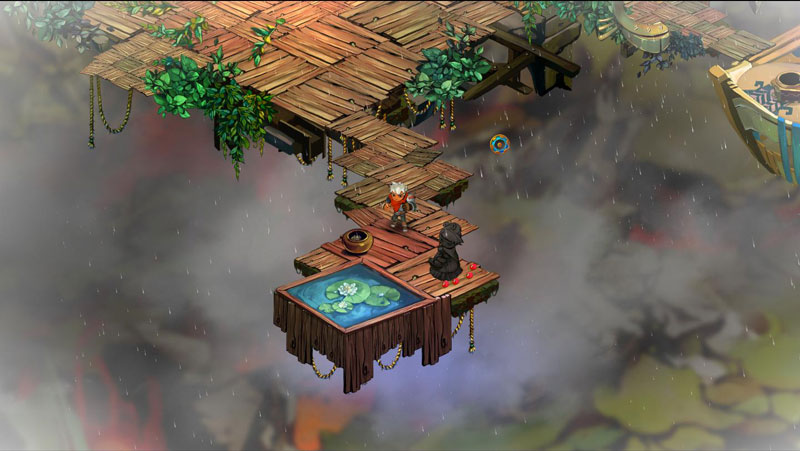
Like LIMBO, another entry in the "Games As Art" category.
Much like LIMBO before it, Bastion puts me in the unfortunate position of having to tell you about an amazing game that concludes much too soon. But let’s not get ahead of ourselves.
On a superficial level, Bastion is a so-so Action RPG in the vein of Diablo meets Kingdom Hearts. You move your character around with WASD on an isometric field, and repeatedly Left-Click or Right-Click depending on which of the two selected weapons you want to use. There is also a dodge (Spacebar) and Block (Shift) button, the latter of which can straight up counter attacks completely if you press it at the right time. There are a bit more than a dozen enemy types, only a few of which require tactics other than simply shooting them with a ranged weapon or repeatedly mashing the melee button. You pick up orbs from killing/breaking things to use as currency for upgrades, leveling doesn’t change much beyond max HP and opening new passive ability slots, and… that’s about it.
By the way, the Mona Lisa is just a chick sitting in front of a river, Starry Night is just some swirls, Seurat liked making a lot of dots, Moonlight Sonata is some piano noises, etc etc.
How things are presented is incredibly important, and it is in this way that the designers of Bastion demonstrate a level of mastery that is damn near sublime. Bastion is a game with its own zeitgeist.
One of the first things people mention about Bastion is the narration by Logan Cunningham, who incredibly has never done voice-acting before. Before I played the game, I thought the concept of background narration a cute “gimmick.” By the end of Bastion, I had no idea how I would cope in games without it. The narration is so much more than a workaround for a silent protagonist and a lack of formal written dialog. Yes, it reacts to things you are doing on-screen – “Kid just rages for a while” (when just smashing objects), “And then the Kid falls to his death… I’m just playin'” (when you fall off the edge of the maps). But it solves a crucial problem endemic in most RPGs: how do you succinctly express emotion? Written dialog only takes you so far, and emotive character models generally do not work outside of LA Noir-esque settings, nevermind how that shackles you into a certain artistic style. Obviously Bastion is not the first game to use voice acting to “solve” the problem, but I am coming up at a loss as to what other game nailed it as hard as this one.
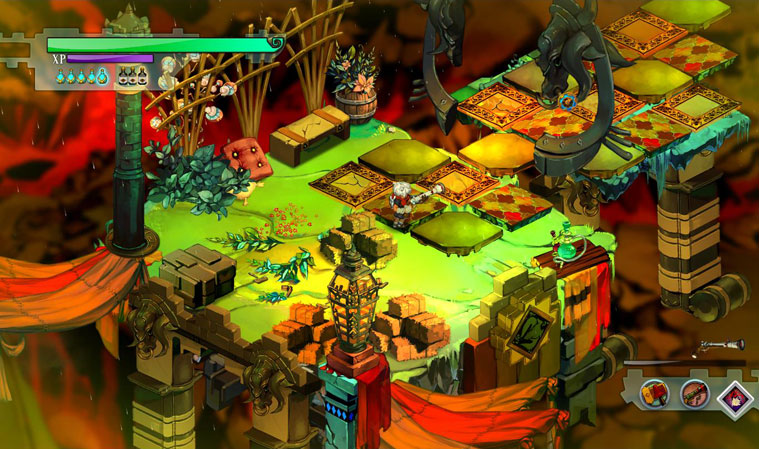
Seriously, Bastion has ruined other games for me, art-wise.
The other aspect that unfortunately does not seem to get as much press time are the visuals. It is somewhat difficult to truly appreciate it during gameplay, but this is the first time I have felt like I was playing a literal work of art since Saga Frontier 2. And it is just not that everything looks amazing; everything simply fits. For example, take a look at any of the screenshots. Do you ever really notice the background? In the entire time I was playing, I recognized that there were edges I could fall off of, and yet never once was I distracted by what that abyss consisted of. That doesn’t happen by accident. Also, the elegance that is the ground flying up to form your path is the sort of design epiphany that solves a more mundane problem (how to prevent the player from seeing their isometric path) in a way that makes the game as a whole better. In other words, it felt like an integral part of the experience rather than arbitrary.
Finally, I would be remiss to not mention the amazing soundtrack. It fades in and out at all the right moments, and is of a quality far beyond what one would expect in a $15 indie game. Part Western, part Eastern, part hip-hop, trip-hop, blues, techno and altogether perfect for what it is. I would not go so far as to buy the $10 soundtrack – typically, battle music isn’t what I look for when I want to relax/browse the web – but you might want to check out Build That Wall (Zia’s Theme) and Mother, I’m Here (Zulf’s Theme) and the hybridized Setting Sail, Coming Home (End Theme). Even if you never actually play the game, those three songs alone will likely make their way to the top of your playlist. Mother, I’m Here in particular so perfectly channels a moment in the game, that it creates a feedback loop with your memory of the experience (which includes the song) that results, at least for me, a reaction far beyond what I actually felt at the time. I literally have not experienced this feeling from a videogame song since Chrono Trigger, FF7, and Xenogears.
Honestly, the only thing stopping this game from rocketing its way towards my Top 5 game list is its six hour duration. That is not to say it felt rushed or incomplete; quite the opposite, in fact! Bastion puts its arm around your shoulder, spins you a fantastic tale, pats you on the back and then saunters off into the sunset. For the completists and sentimentalists, there is a New Game+ option that lets you keep your upgraded weapons and adds more gods to the Shrine, which buffs enemies in various ways to voluntarily increase the challenge.
All good things come to an end though, and god damn if I wished Bastion lasted two, three, hell, five times as long as it did. Lord knows worse games do.
Review: LIMBO
Game: LIMBO
Recommended price: $5-$10
Metacritic Score: 89
Completion Time: 3 hours
Buy If You Like: Giving charity to promising indie game designers.
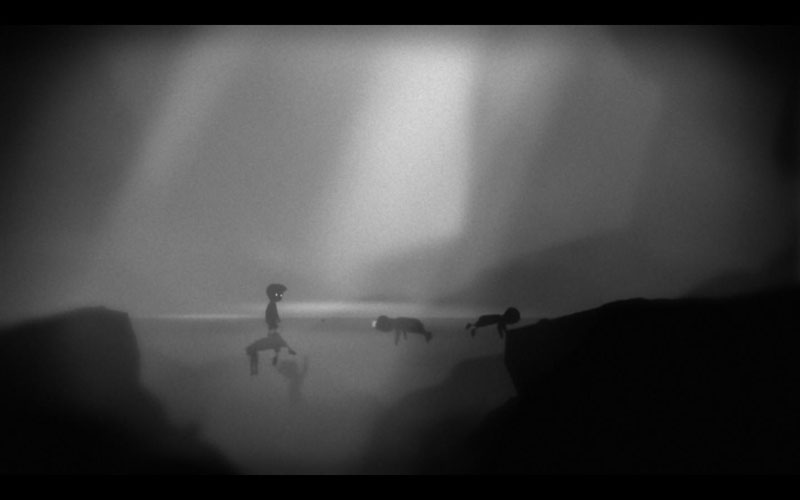
Most atmospheric game since ICO.
Review: Singularity
Game: Singularity
Recommended price: $5-$10
Metacritic Score: 76
Completion Time: 8-10 hours
Buy If You Like: Shameless Half Life 2 / Bioshock knockoffs
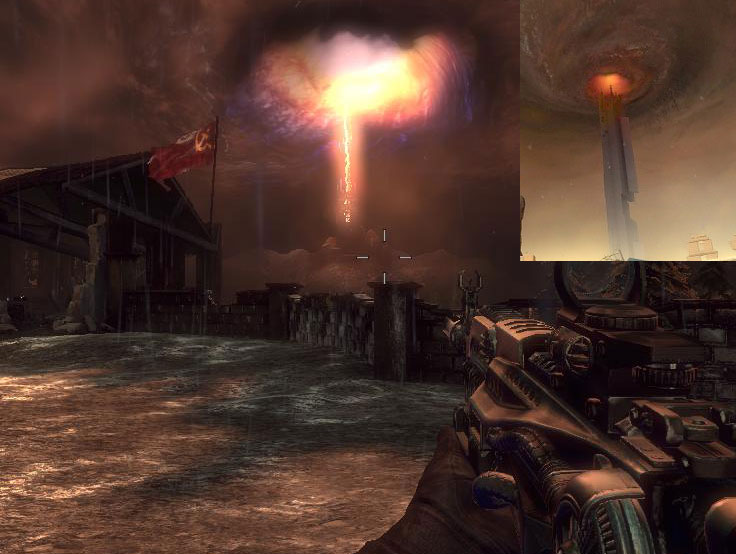
The lines between imitation, parody, homage, and plagiarism are as tangled as the plot.
Review: And Yet It Moves
Game: And Yet It Moves
Recommended price: $1 / Steam deal
Metacritic Score: 75
Completion Time: ~2 hours
Buy If You Like: Proof of concept physics-based indie puzzle platformers
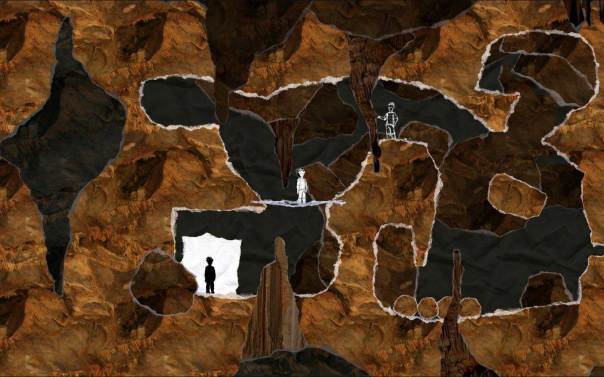
- Get those balls from A to B without hurting yourself. Always harder than it looks.
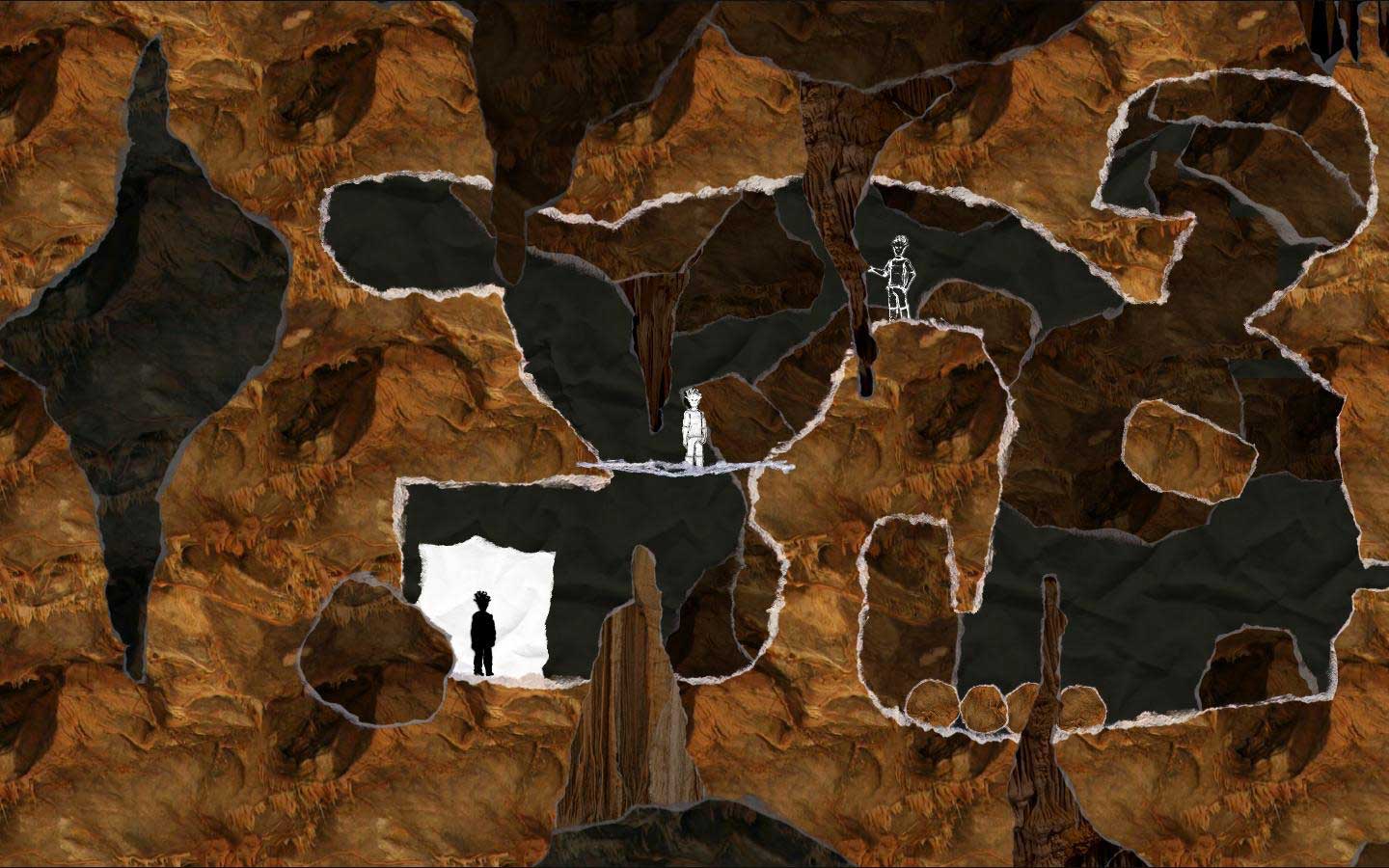
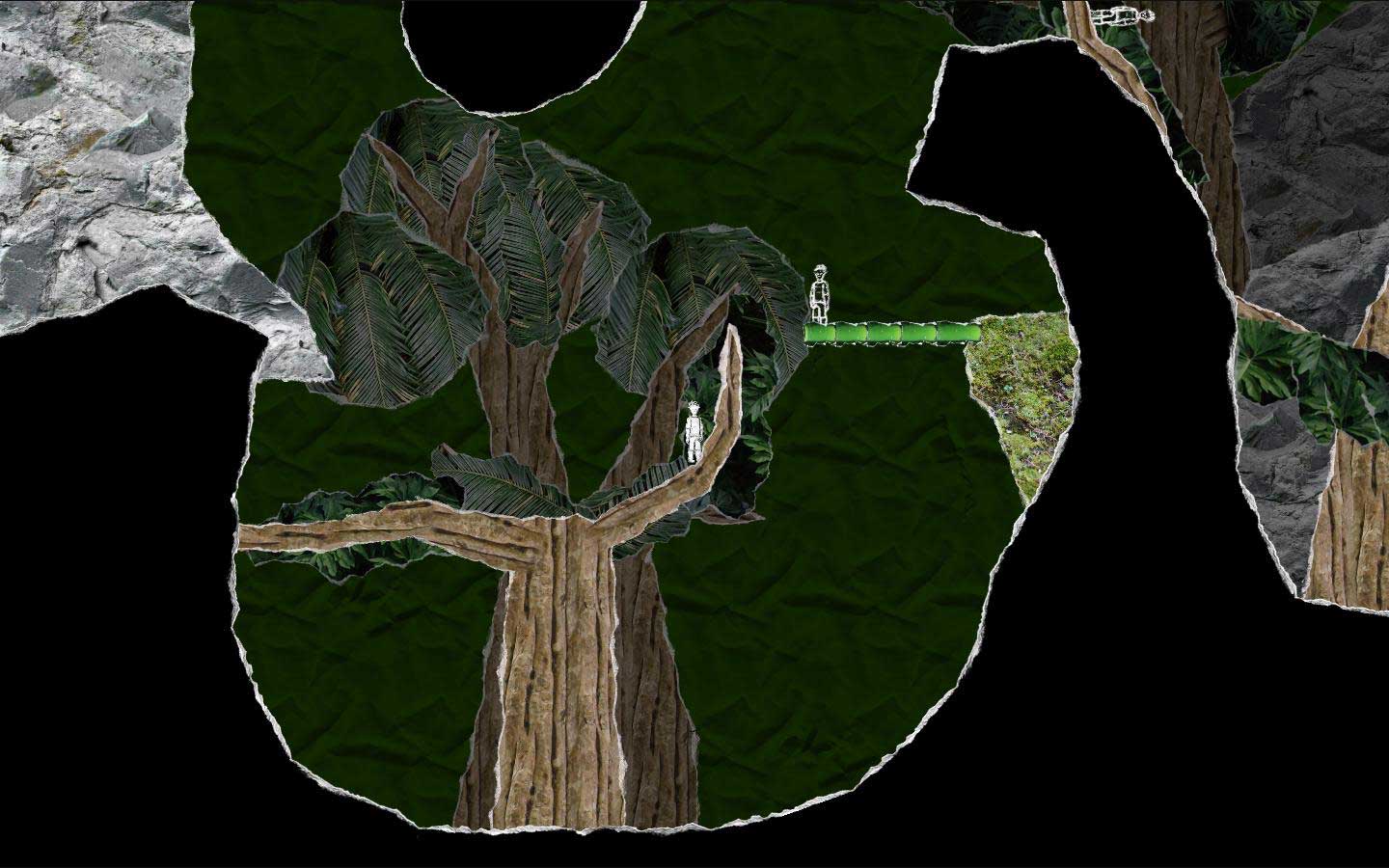
The great thing about the indie game phenomenon is how moving beyond the necessity of fully-realized 3D graphics not only allows smaller companies to compete with commercialized behemoths, but also exposes us to visual styles that are equal parts game and art. Quite apart from anything else, one of the best points about And Yet It Moves is how well the paper mache slash magazine cutout slash last minutes of Rejected Cartoons comes across. The visuals along with the “death” animation along with the ambient soundtrack and sound effects all mesh into an unified narrative, so to speak, that simply works.
The game itself works too… as a proof of concept goes. You move the avatar left and right and can jump, but the lion’s share of gameplay takes place by the ability to rotate the entire game-world in 90 degrees increments (with a quick 180 option as well). The physics puzzles primarily have to do with the short distances your avatar can fall before he explodes into paper confetti – momentum is conserved during the rotations, which can quickly result in terminal (for you) velocity. These physics also apply to various paper boulders and other debris that may be nearby, so care has to be maintained lest you blithely turn a floor into a wall and get crushed by the scenery.
Overall, the game is fairly addictive between its charming indie qualities and excellent pacing, but there is simply not enough of it to go around. Frequent checkpoints thankfully save you from having to redo each major puzzle element of the level should you die afterwards (you will), though this does scoot the player to the credits in less time than most movies. At a default price of $9.99, that is fairly ridiculous. If you see And Yet It Moves as part of some Steam or indie game pack deal, you can rest easy in the knowledge that this game’s inclusion does add value to the purchase. Just not enough to justify the full MSRP.
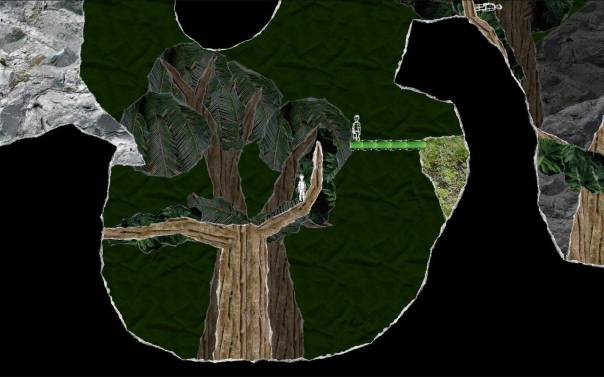
- You quickly lose all sense for up and down, without the pesky disorientation.
Review: Far Cry 2
Game: Far Cry 2
Recommended price: $5-$10
Metacritic Score: 85
Completion Time: 19 hours
Buy If You Like: Novel, immersive FPS games with bad pacing and one-dimensional missions.
Get used to this. In a... bad way! Er...
Grand Theft Africa
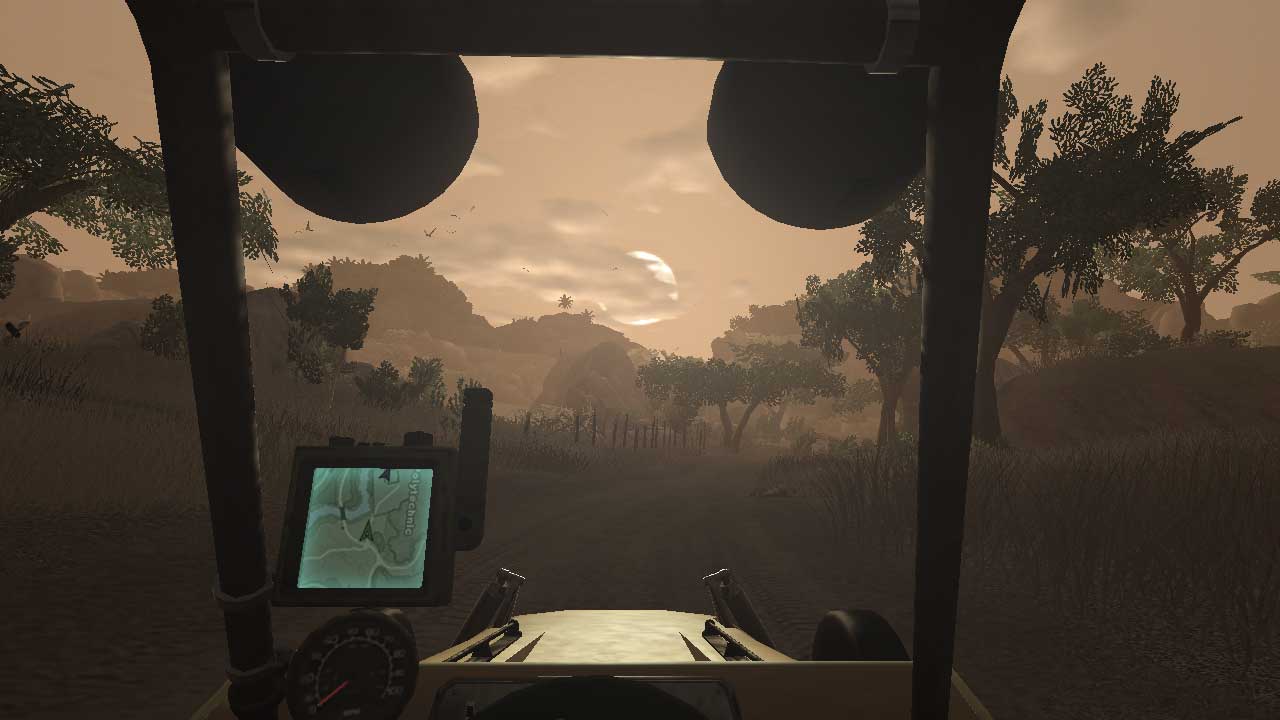
The very first thing to understand about Far Cry 2 is that the designer intent is for you to be immersed in the story and setting. Unlike most games that also want this to occur, Far Cry 2 is unapologetic about its meta-story approach. Every single mission involves either killing a guy, or blowing something up and then killing a guy. These missions are not meant to be interesting, nor are the reasons you are given for doing them. Rather, the idea is for you to muse on what it means for you to be doing them, and why every mission is repetitive nonsense but you do it anyway.
Of course, the danger is always that too much is being read into what is objectively a beautiful, immersive if badly-paced game. I am giving the designers the benefit of the doubt though.
The premise of Far Cry 2 is that you are a bounty hunter or assassin or whatever, flying into a chaotic African nation to kill The Jackal, an arms dealer who sold weapons to both sides and arguably made the conflict possible. After an extended driving sequence reminiscent of Half-Life’s opening tram ride, you arrive at the hotel and collapse from malaria fevers. The Jackal shows up in your hotel room, taunts you a bit, and leaves just as a civil war erupts outside your window. You stumble around in your fever haze, before collapsing just outside of town. As far as intros go, it is refreshingly novel. I do wish the designers saw fit to show you being bitten by the mosquito in-game, but malaria’s quickest incubation period is 7-10 days, so I suppose that is a point in favor of Far Cry 2’s realism.
How convenient! I barely have to aim.
Once in the game proper, you are given a few “this is your ass, this is a hole in the ground” tutorial missions before suddenly Africa opens up as your gasoline-soaked, civil war-tincted oyster. To move the plot forward, you get episodic missions from both forces of this civil war, oscillating between the two factions with apparently zero regard for tact and subterfuge. Both sides see you as their “secret weapon,” and send you unsupported to deal damage to the other side, in the form of assassination and blowing things up. The problem is that “unsupported” means that the soldiers of whichever faction you are working for will shoot to kill, which is fine, but more troubling is that these faction leaders never once suggest that you should, you know, not shoot their own soldiers. At the height of Far Cry 2’s absurdity, one of the faction leaders straight up tells you that he knows you are doing missions for the other side… and then carries on like nothing happened. There is no identity between the two factions, no choice in doing missions for one over the other, no real choice in declining missions (at one point you have to blow up experimental malaria vaccines), and since everyone shoots at you, no real difference between anything whatsoever.
But again, given the meta-story that becomes more clear in the game’s final hours, it may be less bug and more feature.
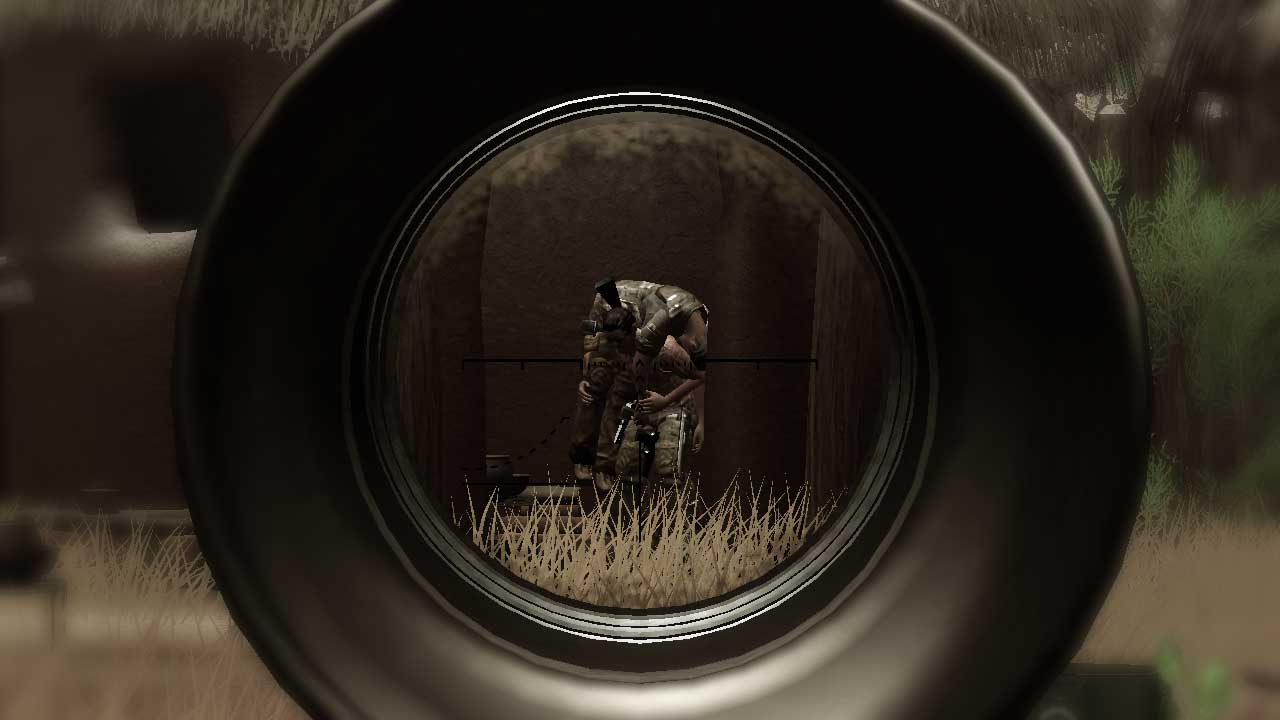
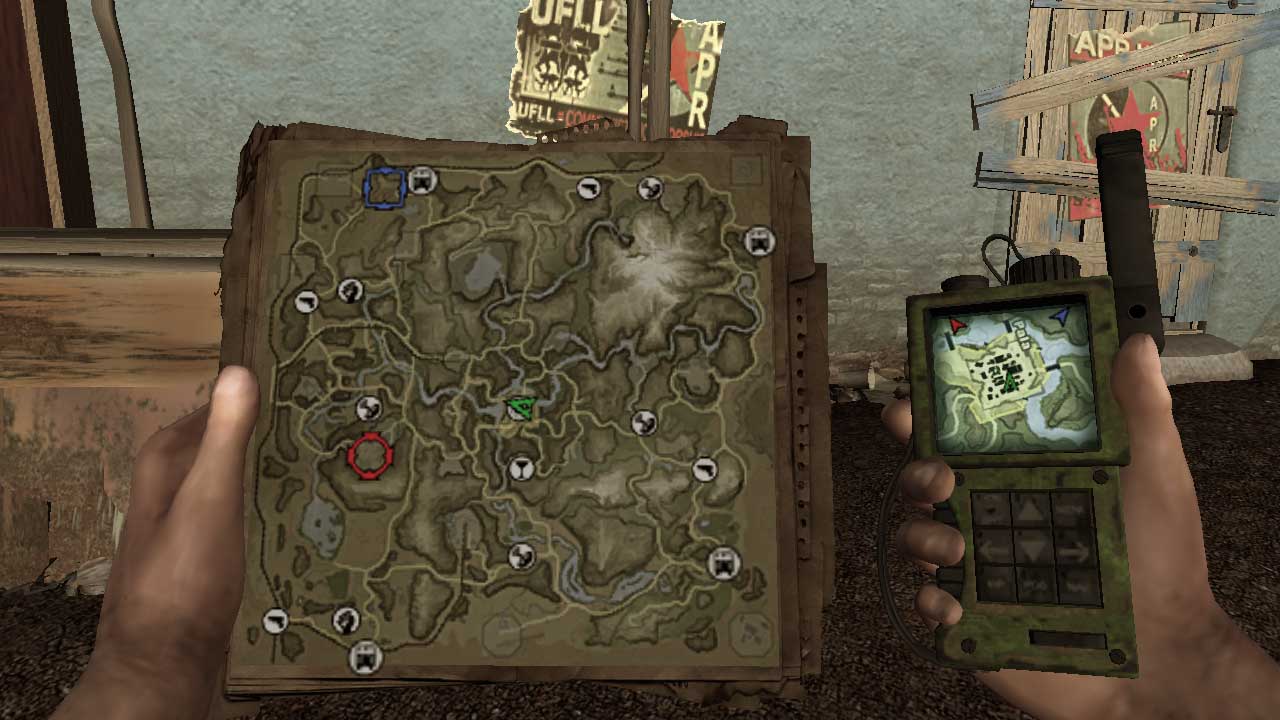
Measured in raw game hours, Far Cry 2 is more of a driving game than a FPS. The game takes place in two Acts, each with their own 25 square kilometer game maps featuring realistically shitty African roads winding all over the place. There happens to be instant transportation in the form of Buses, but most of these are at the far corners of the map and generally shave off only ~20% of the driving distance at best. Given the nature of these maps, there are rarely opportunities to avoid the frequent guard checkpoints – which I suppose is a primary feature of good guard checkpoints, so another point for realism – which inevitably results in firefights every 3-4 minutes. While your enemies are decent shots out in the bush, their bullets transform into auto-tracking, Jeep Wrangler-seeking projectiles when you try to speed past them. It was originally satisfying creeping into these checkpoints, killing everyone, and being awarded (achievement-wise) for “scouting” the bases, but it has zero long-term impact on the game. No matter how many checkpoints you wipe out, it will always be fully staffed and stocked by the time you return.
Optional blue objective is (thankfully) optional.
One of the more ballsy moves on the designers’ parts was having crosshairs disabled by default. In fact, generally speaking, there is no HUD at all until you reload or take damage. This definitely gives Far Cry 2 a more primal feel as opposed to arcade shooter, even though you look down iron sights most of the time. Reinforcing this primacy are little touches like how “health kits” are morphine ampules injected into your wrist veins. Indeed, if you are close to death, “healing” becomes pulling bullets out of your arm with needle-nose pliers, yanking your wrist/elbow/shoulder back into their sockets, cutting shrapnel out of your leg with a knife or extracting pieces of rebar out of your thigh. If you recruit a combat buddy, they can even swoop in when your health reaches zero to save you from a hard Game Over, in an extended sequence of dragging your semi-conscious form to cover before stabilizing you. All this happens wherever you are, not some stock footage, and that combat buddy will still be there helping shoot the enemies that (almost) took you out. If they go down, you have the option of returning the favor by stabilizing them, or putting them out of their misery with a coup de grace.
Ultimately, it is difficult to recommend Far Cry 2 as a game game when it plays out more like an interactive, philosophical art piece. The FPS elements are solid, but you only utilize them sporadically as you drive around. The sandbox feel of the maps and interface immerse you into the setting, but all roads lead to Rome. And the story… well, the story is disjointed and awful, but Far Cry 2 successfully transported me into the mind of the protagonist by the end. To me, that sort of experience is worth something… in the neighborhood of $5-$10.

