Category Archives: WoW
The Pre-4.3 Numbers
As I did back in June – has it really only been five months? – for posterity’s sake here is a screenshot of WoWProgress’s Firelands numbers as they stood on Tuesday, November 29th, at around 2am:
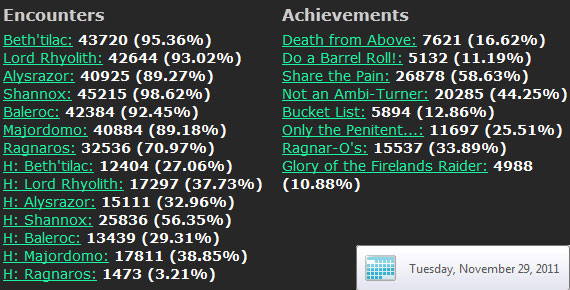
Since there is no 100% boss (but Shannox gets close), a little reverse-engineering results in a total of 45,839 guilds having killed at least 1 boss this tier. I would do a further breakdown as I did last time, but what’s the point? About 71% of every guild that started Firelands in some fashion finished it. Unlike last time around, Blizzard rolled out the content nerf before the patch hit, which obviously influences the completion rates in this bizarre way.
Speaking of last time, there were 62,405 guilds that downed at least one 1 boss in T11 content. Compared with today, that is a drop in activity of 26.55%, or 16,566 guilds that fell off the grid.
As always, the numbers get a little fuzzy if you want to look at the number of players instead of guilds. If we assume a generous 18 raiders per guild, 825,102 players have killed 1 boss in Firelands, down from 1,123,290 killing 1 boss in T11. Back in June I had what I assumed was a reasonably accurate count of all non-Chinese subs (i.e. all guilds WoWProgress tracks) at 6.5 million, but obviously that has changed in the midterm. Back then, it meant only 17.28% of players raided. Today that would be just 12.69%, but only if the overall population had not decreased as well.
To understand exactly how generous I am being vis-a-vis the 18 people per guild estimate, WoWProgress says that only 4934 guilds killed Shannox on 25m, compared with 39,861 10m kills. In other words, there are over eight (8) times as many 10m kills of Shannox than 25m of the same. That 8x figure is fairly consistent across all bosses until you hit Ragnaros, interestingly enough. In fact:
| Boss | 10m guilds | 25m guilds | Difference |
| Beth’tilac | 39,165 | 4,821 | 8.12x |
| Lord Rhyolith | 38,122 | 4,704 | 8.10x |
| Alysrazor | 37,086 | 4,467 | 8.30x |
| Shannox | 39,861 | 4,934 | 8.07x |
| Baleroc | 38,320 | 4,574 | 8.37x |
| Majordomo | 37,619 | 4,516 | 8.33x |
| Ragnaros | 27,595 | 3,991 | 6.91x |
If those 25m numbers don’t seem jarring to you, perhaps this will illustrate it better:
| Boss | 10m guilds | 25m guilds | Difference |
| The Siege of Ulduar | ??? | 31,993 | n/a |
| Beasts of Northrend | 86,187 | 58,801 | 1.46x |
| Anub’arak | 84,044 | 52,903 | 1.58x |
| Lord Marrowgar | 84,136 | 59,356 | 1.41x |
| Lich King | 48,523 | 11,567 | 4.19x |
| Magmaw | 60,390 | 4,395 | 13.74x |
| Nefarion | 39,390 | 4,580 | 8.60x |
I was not actually aware of the Magmaw discrepancy until just now, but… wow. Assuming that Blizzard making it difficult to differentiate between 10m and 25m kills achievement-wise doesn’t impact the accuracy of WoWProgress, this seems an armor-piercing argument that the merging of lock-outs (and possibly of gear) is not just killing 25m raiding, but driving it before us, while we hear the lamentation of its women.
While I understand the LFR system may address the casual PuG content gap, these numbers cannot bode well for the future of 25m raiding. Less than 5k guilds running normal 25m content means all that content is being made/balanced/tuned for the entertainment of less than 90,000 150,000 people. There will likely be three two times that number of players engaging in Pet Battles at any given time of day, let alone overall.
Hmm, perhaps the decision to include that as a major feature is not so incongruous after all.
Warlocks as the MoP Baseline
If you look at nothing else regarding the Mists of Pandaria Talent Calculator, browse the warlock section. Having looked at all the classes, it is pretty clear which among them have received the most designer attention. Which is not to suggest this pre-alpha build indicates which classes will be screwed or whatever. I’m simply saying that if the warlock design can be considered a baseline, Blizzard has a very real chance at blowing everyone’s fucking minds.
Demonic Portal alone… here, just let me show you again:

*cue the sound of one jaw dropping*
The sheer number of potential shenanigans boggles the mind. Set this up in a WSG flag room. Set this up in an AV tower. Set this up for your raid team as a handicap accessible ramp for those that struggle moving out of the fire fast enough. Set this up between the goddamn mailbox and AH. Five charges is not a lot, but I bet there will be a Glyph for more.
I don’t want to call a spell like this a “game-changer,” but I am finding it difficult to express what it does in any other terms. So many “new” spells and abilities in WoW are iterations of what came before. Malefic Grasp is the Affliction filler and acts as equal parts Drain Life and Shadow Bolt, with a speeding up of DoT damage innovation. Refreshing, and feels like something Affliction should do. Demonic Portal though is so out of the box that it feels like I have to approach the game in a fundamentally different way, even though it technically is an iteration too (“What if everyone could use a warlock’s Demonic Circle?”).
The rest of the warlock spells/talents show a similar level of left-field thinking. Look at the T3 talent line-up:
- Spell Drain: Next single-target spell/ability focused at you deals no damage and heals you for half of what it would have dealt. Lasts 4 seconds, 15 second cooldown.
- Soul Link: Probably same ~X% damage reduction.
- Sacrificial Pact: Demon sacrifices 50% of its HP to make you immune to damage for 10 seconds. 3 minute cooldown.
I think Spell Drain is going to be redesigned completely by the time Blizzard is through – no way it lasts with a 15 second cooldown – but all three of those are really, really hard choices. Yeah, raiders will probably stick with Soul Link unless the boss has an uber-move you can cheese with Sacrificial Pact, but I’m looking at this from more of a PvP standpoint. Or, hell, what about leveling/soloing old instances/running heroics/etc? Tough choices.
Now, look at T4:
- Blood Fear: Your Fear is instant, but costs 10% of your maximum health.
- Burning Rush: Your Life Tap causes you to move 25% faster for 8 seconds.
- Dark Bargain: Absorbs damage equal to 20% of your maximum health, lasts 30 seconds. Any shield remaining when the spell expires is dealt to you in damage. 30 second cooldown.
When I read this tier, I forgot these talents were from WoW; it felt like I was reading off some Dragon Age: Origin interpretation of a warlock. In a good way. These choices are more… warlock-y than warlocks have been in WoW since their inception. Before this, there was what? DoTs and Life Tap? Outside of the class quest to unlock the Succubus, I felt there was always a bit of weird, thin line between mages and warlocks. DoTs + pets vs nukes, sure, but once DoTs are up the warlock simply nukes too. And there never seemed to be much conceptual distance between Destruction warlocks and Fire mages. Now, with this kind of flavor and direction? Much, much better.
Everything can change between now and the Beta, let alone between the Beta and release (and the hotfixes, and mid-expansion overhauls, etc). But if the remaining classes can siphon off even a fraction of the creative juices oozing from these pre-alpha warlocks, MoP could end up making WoW feel like an entirely new, high fidelity experience to even the most bitter of veterans. I am indeed that impressed.
Thoughts on MoP Paladins
General:
- Judgement has a 6 second cooldown, 30 yard range baseline. At level 5. Cool.
- No Auras anymore. Crusader Aura is passive, self-only.
- Well, Holy paladins get a ridiculous cooldown version of the missing Auras.
- Blinding Shield has returned as Blinding Light.
- It will surf through beta, then hotfix-nerfed Day 1.
- Seriously, Hungering Cold gets a cast time, and another instant mass-AoE spell is designed?
- Plus, paladins. What’s not to nerf?
Talents:
- T1 – Speed of Light is a real oddball cooldown here. Consider that it is another 20% DR on a 1 minute cooldown for Holy, on top of Divine Protection, on top of Divine Shield, on top of Hand of Protection, on top of Devotion Aura (20% less Fire/Frost/Shadow damage, immune to interrupts/Silence for 6 seconds), on top of potentially Ardent Defender*. And you move faster with it up. The Prot version of Speed of Light increases damage done by 10% and is thus the more “raid tank” choice, but what does extra damage and moving faster have in common really? And Ret will skip it to grab the somewhat clunkier Long Arm of the Law. Or potentially Pursuit of Justice depending on how quickly Holy Power expires.
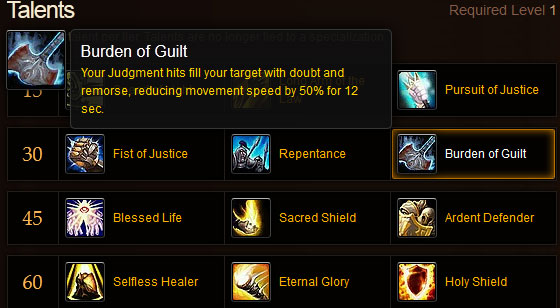
- T2 – We already tried the 6 second stun on a 30 second cooldown, Blizz. You said it didn’t work. As excited I am about Burden of Guilt, Repentance is really the only logical choice.
- T3 – /yawn. I want Sacred Shield as a tank, assuming the boosted healing doesn’t evaporate when the bubble pops, but I’m pretty sure Blessed Life will be required all the time, by every spec, everywhere. Constant raid damage, anyone?
- T4 – Selfless Healer is P-I-M-P. Thank you for bringing back my Ret from Wrath. Besides, it was getting a little dumb that warriors and rogues could heal themselves better/faster than my paladin while leveling.
- T5 – This whole row needs redesigned.
- T6 – Ditto this row. Boring.
- Misc – Blessed Life + Pursuit of Justice is actually a pretty funny talent “combo.” The more you damage a paladin, the faster they run around. Wish they would turn that more into a paladin kit.
Specs:
- [Ret] Nothing too terribly different than what we have now, aside from extra polish. For example, Inquisition now lasts 10 seconds per Holy Power, up from 4, making it more Slice n’ Dicey. Exorcism is Ret-only, instant-cast baseline, has no cooldown (!), generates Holy Power, and automatically fires ala DK’s old-school Sudden Doom talent (before it got moved to Unholy). Hrm… they might be intending for Ret to not be able to push the button until it lights up ala Arcane Missiles. Actually, yeah, both say “activate.” Lame.
- [Prot] /yawn. Could we have a few more passive abilities, Blizzard? Getting activated abilities at 10, 20, and 40 is too much. I might actually have to use a second row of my action bar.
- [Holy] I don’t roll Holy, but I find those rolling damage reduction cooldowns to be a tad of the ridiculous side.
Overall, I may have gotten a little too excited yesterday over the legitimate 50% snare thing. Especially considering the absolutely batshit crazy insane shenanigans going on in the Warlock department.
Consider yourself foreshadowed.
P.S. Did anyone else notice that mages no longer have Teleport/Portal: Theramore, but Stonard is still on the roster? Blatant Horde favoritism! Unless… unless… Alliance mages can send careless raid/random BG members to Stonard too. In which case: well played, Blizzard. Well played.
*Obviously not all at once, or in that sequence. However… 10 second DivPro, 12 second SoL, 10 second ArdentD, 6 second DevoAura, 8 second DivShield… which leaves you with 14 seconds until DivPro comes back off cooldown. Which you can fill with a 20 second Avenging Wrath, Guardian of Ancient Kings, or you know, actually healing through normal damage.
Paladin Ranged Snare
They did it, they really did it.
*cue We Are the Champions*
Obviously it is on the same row as a 30 second HoJ replacement and the paladin Sheep, both of which are likely to be better picks in a general sense. Obviously it is not game-breaking and who even knows what will be considered “balanced” at level 90. But… my god, gentlemen. To be denied for seven years, to endure the rationalizations as why paladins don’t need a proper snare, and to have this appear at 4 am on a random Wednesday… it is a sweet, sweet release.
A more thorough examination of the newly revised talent trees will have to wait until tomorrow.
P.S. My god, it’s full of stars…
*cue the sound of one jaw dropping*
Class Q&A Highlights
There were 11,786 words in the latest Class Q&A. Here are the more interesting 668 of them.
Q: A lot of warriors feel like the stance mechanic is a bit outdated. Are there any plans to make changes to warrior stances in MoP such as giving the passive stance bonuses to each spec or allowing all of the warrior abilities to be usable in all stances? I say the latter because I know a lot of Arms warriors would love the 10% damage boost over the 5% damage boost and 5% damage reduction. Thank you.
A: At the moment, we are considering Berserker as a +AE damage stance and removing all stance penalties and restrictions. Just use Battle for single-target and Zerk for AE. That isn’t set in stone of course.
The funny thing about answers like this is how many people would leap about with their cries of “Dumbing down!” and “Homogenization!” without examining the actual value of the original design. I do not have a warrior main, but I did have a warrior that I played long enough to be completely baffled as to how the Stance system survived for so long. Simply put: how in god’s name did the designers intend the class to play out? I specifically bought a new mouse with buttons on the side solely for playing my warrior, and it amazes me that there is not an in-game tutorial on macros when warriors essentially require them to function even on a basic level.
Maybe the argument is that Blizzard did not intend for skills like Spell Reflection and Shield Wall to be usable as an Arms warrior in PvP – they are certainly impossible to use effectively (if at all) without macros and addons “out of the box.” Then again… stance dancing to avoid fears as a Prot tank has been in the game since Day 1, and PvP has to be balanced around what happens, regardless of the intention. It just seems like bad design odd to me for a class’s skill gap to actually include completely “new” buttons.
I was waiting for a new talent to make Spell Reflection no longer require a shield, for example. It’s tough enough to gauge the optimal moment to utilize the skill, let alone make the determination far enough in advance for your weapon-switching/SR macro to work. Compare that to using, say, Grounding Totem, a spell interrupt, or even “Vanishing the Death Coil.”
Q: Class homogenization has been problematic in the eyes of the player base. How are you planning to make classes feel unique while still maintaining the “bring the player, not the class” ethic?
A: Homogenization is one of *the* hardest challenges we face. Players become upset if they feel like they are losing what is uniquely theirs, but then they get just as frustrated when they lack e.g. self-healing or mobility or a cool toy that another class gets. With 11 classes and parties, (some) raids and PvP teams much smaller than that, we can’t make every class mandatory and we don’t think it’s reasonable to have 11 (or even 34 if you include specs) spells, buffs and mechanics that are unique but completely equal. We just try to keep the pulse on the community and see when players think we have gone too far or not far enough.
This next bit might start a firestorm of controversy, but we heard from a lot of 10-player raiders who asked “Why make a rogue legendary? We don’t have a rogue.” When we asked why, they said ‘Rogues don’t bring anything we need, so we don’t want them.” That’s not cool. I’m not saying the legendary is the answer for why bring rogues, but you should feel like you have room for rogues without sacrificing something else and that rogues should bring something that makes you happy they are there.
I think the biggest benefit of Ghostcrawler’s more open communication model is to highlight how much of game design is wild-ass guessing. And I do not mean that to be snarky. A designer could be “correct” in saying that change X isn’t increasing homogenization, but if the players feel differently… what does it matter? If a good design leads to decreased revenues, then can we really say it’s good? I would like to think so – what is Good and Right is not necessarily popular in politics and philosophy, for example – but then again games exist to be played.
As for the nonsense about rogues, a better answer to “Why don’t you have a rogue?” would have been “No one picked one/they aren’t fun to play.” Bring the Player is a design model centered around playing with people you enjoy playing with. So to suggest that we should “feel like we have room for rogues” is asinine if everyone you want to play with independently decided not to use one as their main. And it is asinine to make an entire legendary quest-line for a single class anyway, whether it was rogues, paladins, shaman, or whatever.
Q: I’m glad to see you guys are still interested in making the talent system as unique as possible, but it seems like by giving so few choices that cookie cutter specs will be even MORE easy to come up with then now. i know there will always be “the best choice”. but if you guys do all this redesigning just to have the same outcome, what do you have in store to try and fix it from there? and are you concerned the new talent trees might not offer the unique build options players want to have?
A: Since so many of the talents focus on survivability, movement, and utility we are skeptical that there will ever be a talent build that is the perfect build for every PvE fight in the game. It is likely that as players learn specific encounters, each spec finds an ideal set of talents for that encounter. Those will be the “cookie cutter” builds. However, that will mean that players are interacting with the system and picking a unique set of customizations on a frequent basis. This is a vast improvement over a system that is solved once by a dps spreadhseet and then everyone copies that build once and ignores their talents for the rest of the expansion. In addition, there will be likely disagreement over which talents are best for which encounters.
This, to me, is one of the best possible answers they can make in response to a lot of the talent criticisms.
Q: Some of the MoP talents seem really “OP”, is this intended?
A: One of our core design philosophies is “Make it Overpowered”. As much as possible, we like to start with abilities being very strong, and then correct problems as they occur.
I don’t know if this is more amusing as a joke, or if they were serious. Well played.
Q: How will low level balance be fixed in Mists of Pandaria.Right now you can one shot a lot of npcs or players at low levels.
A: We plan to put some additional careful effort into balancing low level combat for MoP.
Balancing the leveling game will be Big News to a lot of bloggers, should it actually occur. We’ll see, although it will likely be much too late for a lot of people who actually care about the fidelity of the leveling experience.
Delving Into the Earnings Call
The last time I talked about an Activision Blizzard earnings call, I had just quit the game myself. Now in Q3, you have undoubted heard that a further 800k subs were lost, bringing WoW down to 10.3 million. For those keeping track at home, the last time WoW was at ~10 million was in 2008 right during the release of TBC in China.
While sites like MMO-Champion and WoW Insider are nice for giving us summaries, I’m interested in the nuance inside the earnings call itself. Feel free to read alongside me at home (curtsey of Seeking Alpha).
1. Majority of the sub loss is occurring in the East.
You have probably already read the above bullet-point summary, so I’m here to assure you that Morhaime does not get more specific than this.
2. Implicitly, the difficulty of Cataclysm content was the cause of sub losses.
Feel free to try and read something different from these paragraphs (emphasis added):
That said, we know there are improvements that we can make in gaming content. The level-up content in Cataclysm is some of our best works. But it was consumed quickly compared to our past expansions set, Wrath of the Lich King. Once players reached max level, the end-game content in Cataclysm is more difficult. Balancing this content for our diverse player base can be very challenging.
Our development team is constantly analyzing the game, and we’re continuing to explore ways that we can adjust the game to better satisfy both hard-core and casual players. To that end, our next free major content update for World of Warcraft is already in testing and will be available for players in the coming weeks.
Now, the funny thing about this is how Blizzard may have cost themselves millions of dollars in lost revenue by pushing Cataclysm on the Chinese instead of letting Wrath work its magic. After all, Cataclysm was released in China on July 12th whereas Wrath was out in mid-August of 2010, a difference of 11 months. I am not sure whether Cata heroics came pre-nerfed like they ended up in the West, but even if they did it would still be worlds different than how it was in Wrath.
Which, no matter your feelings on the expansion, gained ~1 million subs and largely kept them until Cataclysm.
3. Expect some (more) “aggressive” World of Warcraft marketing.
Specifically: “We have other aggressive marketing plans in the coming months for World of Warcraft, but we’re not ready to share details yet.” Morhaime was then grilled in the Q&A section for further information.
Can you give us some additional color on what’s happening to engagement and subscriber levels for World of Warcraft, particularly following that big expansion pack announcement? Where do you think the subscribers are actually going? And I’ve got a quick follow-up.
Okay. Well, as you know, we don’t provide a forecast on subscribership levels. But I’ll say is that the announcements at BlizzCon were incredibly well received. There’s a lot of excitement around the expansion and the upcoming content in the next patch, which will be introduced in the next couple of weeks. It is currently in test on our public test realm, and we’re very excited about that content. I guess, I can say this, the majority of the declines were in the East. China still represents more than half of our global player base and historically, December has been a very good month for subscriber trends. We have a number of initiatives planned. We plan to be very aggressive in terms of our marketing promotions, and we’re looking forward to the end of the year.
It is an open question what kind of aggressive marketing Blizzard can even do with WoW. If they lowered prices on some of the other services like server transfers or even weekend sales or whatever, that might go a long way in getting me back – I’m not coming back to a dead server and then immediately spending $35+ to move one toon and just 10% of my wealth somewhere else.
Beyond that, what can they do? I doubt something like the cost of the box is keeping people away.
4. Patches are more about recapturing the recently churned.
Nothing ground-breaking, I just find it interesting.
Just out of curiosity, when you’ve had big patches before with World of Warcraft, what type of subscriber uplift do you typically see?
Well, historically, with the content updates that we’ve done, it’s really not intended to go out and drive new user acquisition, that’s a whole other strategy. But it does drive engagement with the game, and so that will impact churn, if we do it successfully and eventually will drive win back, as players tell each other about the content they’re enjoying. We’ll hopefully see a lift in our ability to win back players that may have already churned.
And that wraps up the earnings call.
Dailies and “Bad Design”
There is a fascinating conversation going on in the General Forums right now with Daxxarri concerning daily quests and how they are “bad design.” This exchange in particular piqued my interest:
This is just a bad design. A game should not ask for daily commitment to enjoy what it has to offer.
[…] I get concerned when I see players throwing out words like ‘bad design’. Perhaps an individual dislikes a design choice, and that’s fine. We do our best, but World of Warcraft can’t be all things to all people, all the time. That said, making a value judgment about whether the design is ‘bad’ or not is not only un-constructive, but in the vast majority of the cases I’ve seen, such an assessment reveals that the design was not well understood to begin with.
Followed up later with:
That being said, why are you harping on the OP’s use of the term “bad design”?
Because language is important, and also, because it’s often used in the phrase, “That’s just bad design.” to justify why a mechanic or feature is undesirable to the poster in question. It presupposes the correctness of an opinion which may not, in fact, be correct. It also tells me nothing useful, except “I don’t like it”, but it makes, “I don’t like it.” sound more erudite, knowledgeable and sophisticated. It still boils down to, “I don’t like it.”, which isn’t particularly useful without a context.
Point taken, Daxxarri. I have deployed the “bad design” argument here and in comments elsewhere, using it as short-hand for “this feature isn’t catering to me.” It is an open question of whether I should be catered to, and at whose expense. Personally though, I vote for being catered to 100% of the time, everywhere.
This does raise the question of “What can be considered good design?” It would seem to me that we need to know the intention of a design before it could be judged good or bad. Without designers coming out and explaining intentions though, is there any real way to know? Are subscriptions and profit margins the only metrics that matter?
And the further complication for subscription-based MMOs, for me, is that I cannot trust the designers to not include time-sinking as one of the principle intentions of everything they do. Do patches really come out 8 months apart because it takes that long to polish… or because that extra month means millions more dollars at little extra cost? Did Blizzard really feel Molten Front was best paced at 35 straight days of dailies? Why not, say, 25 days?
All that aside, I do want to highlight the original statement again for your consideration:
A game should not ask for daily commitment to enjoy what it has to offer.
To be clear, the poster is talking about World of Warcraft, a Massively Multiplayer Online Role-Playing Game. And you know what? I think I agree with him.
Speaking of Rorschach Tests
Ghostcrawler made another community blog post about the Great Item Squish (or Not) of Pandaria. I read it, went “Yep, tis a pickle,” and moved on. Motstandet of That’s a Terrible Idea instead went on a bizarre rant:
Unquestioning and steadfast in their decisions, the WoW designers make seemingly contradictory choices. Why doesn’t GC want level 85’s to do higher level content? I could only assume it’s so players do the leveling “content” first. Yet they constantly assault the leveling game, […]
The article goes on, discussing various methods which could bandage WoW’s broken attribute system, and then he unloads this gem: “If your answer is that stat budgets don’t have to grow so much in order for players to still want the gear, our experience says otherwise.” Silly plebes with your naive remedies; I have data to dismiss your predictable suggestions!
Ignoring the arrogance, what metrics could they possibly have to discredit this simple solution?
I answered the post over there, but I think it is useful to talk about some of the underlying design issues of expansion-based themepark MMOs.
Design Issue 1: The “assault” on the leveling game.
The matter of pacing is of huge concern in videogame design. Even in single-player RPGs (or really any game), you still see the steady metering of items and abilities as the game progresses; going from Stone Sword –> Iron Sword –> Steel Sword and so on. I do not think I played even a FPS where I had access to all the guns in the game right off the bat. By handing out new guns or powers or abilities in a measured way, the player has time to focus on useful applications of said gun/power/ability before deciding which one(s) they want to use.
So given that, why does Blizzard continually assault the leveling game with patch notes such as “The amount of experience needed to gain levels 71 through 80 has been reduced by approximately 33%?” The issue is twofold.
First, look at the experience from a brand new player or even potential player perspective. The designers may have crafted the original WoW leveling experience to take an average of 300 hours to go from 1-60. In other words, the designers felt that 300 hours was a long enough journey to get to the endgame. When expansions are released though, an additional 50 hours is added to the leveling experience and the endgame moves farther along the timeline. Assuming that each expansion adds another 50 hours and no other changes were made, someone picking up all the WoW boxes would be staring at a 500 hour leveling wall come Mists of Pandaria.
So, assuming that 300 hours is a sweet-spot of sorts, it makes sense to truncate the leveling experience so that it always takes 300 hours to get to the endgame. The alternative of doing nothing means that all the commercial and word-of-mouth advertising would be concerning (endgame) content a new player would have to spend weeks and weeks getting to.
This is not to suggest there are not side-effects to XP reduction, such as out-leveling a zone before all the quests are complete. Then again, as long as the quests are sufficiently non-linear, why should anyone care? After all, skipped content adds to replayability. It is not entirely different from RPGs today with optional side-quests and how you can beat the game without being max level.
Second, and perhaps more importantly, one has to look at the experience from a veteran player perspective. I say “more importantly” because there are more ex-WoW players than WoW players, and thus more people who have already experienced the leveling content at least once. If I want to experience the endgame as a different class, each expansion makes the decision to roll an alt even more difficult – every hour I spend leveling an alt is an hour I potentially fall behind in progression (which is, incidentally, why it is useful to have diminishing returns and plateaus). While it is important to pace the game for new players, it makes less sense to do so for players who already learned all the lessons a slow pace was designed to encourage. I may not have ever played a druid, but I played a rogue, a warrior, and a shaman, so pacing things like I have no idea how to move around simply makes me bored and impatient.
So why doesn’t Blizzard simply make a Death Knight option (starting at level 55) for all classes? Good question. I wish they would. Heirlooms were a rather brilliant “solution” insofar as they took something they were going to do anyway – reducing XP required – and then made you spend time buying them, rather than getting them for free. That being said, from a business standpoint there is still probably value for them to have me spend 20+ hours leveling up as that is time spent in-game in those leveling ranges, making things there a little less of a ghost town.
Design Issue 2: Why not just have flatter progression?
Well, if you noticed, Blizzard is kinda doing this already. The standard ilevel upgrade between tiers used to be 13 ilevels, but now it is closer to 7 ilevels. Moreover, Blizzard combined 25m and 10m gear, so that instead of four tiers between raids, there are only two.
The problem with flatter progression is that it, in effect, removes “content.” To understand this point, let us all acknowledge what really is going on under a random loot system: the loot is random so as to give you a reason to beat a boss more than once. If the boss had “smart loot” that only dropped items tailored to the raid who defeated it, that raid would have less reasons to kill that boss week after week. As long as you continue to care about the loot a boss has, that boss remains legitimate “content” to you. I keep putting air quotes around the word “content,” because let’s face it, in every other scenario the only reason you would want to kill the same boss again is if it was fun to do so.
Another issue is when there simply is not enough of difference between gear to matter… or when older items are better. Spending weeks on a boss to gain +2 Strength is not my idea of a productive use of my free time, even if objectively there is no difference between that and +20 Strength. The way something feels is as important (if not more so) than the objective measure. There is a good reason why things are priced at $9.99 instead of $10, after all.
Flatter progression though also leads to those scenarios in which older items were strictly better than newer ones. Before relics were changed to be stat sticks, the Holy paladin Libram of Renewal reduced the mana cost of Holy Light by 113. That relic was available from the beginning vendors in T7 content and ended up being Best-in-Slot for (nearly?) the entire expansion. And yet Blizzard designed and itemized Holy paladin librams for T8, T9, and T10. If you used those, you were actually doing it wrong. And while new paladins could always just buy the T7 libram, there were situations in WoW’s past where an older item remained BiS (Dragonspine Trophy) and basically led to people farming obsolete content for years. That is not my particular idea of a good time, especially when you were basically farming an item for just a handful of people.
The Design Solution: Business (Mostly) As Usual
To be honest, I don’t think there is much different that Blizzard should have done. There were missteps for sure, such as when they introduced hardmode raiding in the middle of Wrath and had itemization quickly spiral out of control. But from a player experience, I was very grateful that my having Lich King loot did not trivialize Cataclysm leveling content the same way my having TBC gear left me slogging through hundreds of Northrend quests with zero upgrades. I can empathize with people who have all their hard work rendered moot each expansion/tier, but I also believe that the alternative is worse.
If Sisyphus had to look at the entire mountain each time instead of just focusing on pushing the boulder, I don’t think he’d ever make it to the top.
That being said, there shouldn’t be an issue with Blizzard introducing an option to slow down leveling much like they have an option to currently turn off XP gain entirely. And I would also like to see a Hero Class solution for veterans, possibly via the Cash Shop.
Hardcore Causality
The perennial semantic debate of the Hardcore vs Casual descriptors has reared its zombie horse head again, and it amuses me somewhat seeing the Rorschach results. My own take?
Casual and hardcore relate to the seriousness in which an activity is undertaken.
Length of time has nothing to do with it: as is frequently mentioned, top-tier raiders can clear 7/7 heroic Firelands in 2 hours and then not play at all for the rest of the week. Compare that to someone who levels alts or otherwise plays for 50 hours a week.
Of course, “seriousness” is somewhat subjective. Then again, there are a few objective metrics in which I believe can determine (arbitrary) positions on the seriousness scale. For example:
- Read forums or Wiki pages. +1 seriousness
- Posts on forums. +1 seriousness.
- Download mods or external programs. +3 seriousness
- Ignored phone calls in middle of the game. +3 seriousness
- Schedule your real-life around in-game events. +5 seriousness
It is important to note that while raiding (agreeing to log in at 7pm on Thursday) does not automatically make you hardcore, it is certainly more hardcore than someone who does not seriously consider convincing their other friends to move Poker Night to Wednesdays so they can make Thursday raid night.
The design of the games themselves absolutely has an impact on seriousness too. To be sure, human beings are 100% capable of making otherwise casual activities the most hardcore thing imaginable – stamp collecting, Lego models, Chess, and so on. However, the nature of the game can also lend itself to being taken more seriously. The difficulty of raiding, for example, is such that a random group of ten people thrown together is not likely to achieve success.¹ That encourages people to schedule play sessions; the social ties generated thereby encourages structuring your IRL commitments around game time instead of vice versa. I absolutely know people that asked for Tuesdays off from their retail work because, well, raids reset on Tuesdays and you would let the team down if you don’t show up.
Difficulty and social ties aren’t the only game designs that skew people towards hardcore-ness. Sometimes the game makes it hard to reasonably progress without a minimum amount of sunk time. I have been playing The Binding of Isaac recently, for example, and much as other roguelike games you cannot Save and quit, death is permanent, and so on; there is literally no point in playing The Binding of Isaac for 10 minutes, because you cannot beat the game, you cannot unlock anything, you cannot really do anything of value. Games based on Checkpoints such as Far Cry 1 also fall into this mode.
I know I mentioned time spent playing is irrelevant, but here is the nuance: if you know you need at least an hour free to get anywhere in the game, and you chose to continue playing, you are more apt to start rearranging your real life around the game life. I am not saying life rearrangement is bad or ridiculous – I do it all the time – but it does indicate you are more of a hardcore player of said game. Compare that with Angry Birds or Plants Vs Zombies or Red Remover which I play only when I am sitting around in a doctor office or at the DMV or wherever and I immediately turn it off when I am no longer waiting.
In any case, that is my contribution to the field of loaded verbiage.
In regards to the topic at large, i.e. for whom was the leveling game changed, I would suggest that leveling was indeed made faster for the hardcore. However, I would NOT agree that this somehow makes the game less casual-friendly. The boredom of disaffected veterans is not analogous to a brand new player of the game – I cannot imagine someone with zero WoW experience complaining about or even recognizing leveling “too fast” or the game being “too easy.” Indeed, a new player more than likely died several times before level 10 and then spends the remaining 75 levels being overly cautious. Or being skilled enough to recognize the lack of danger, which indicates they would have been bored no matter which way leveling was designed.
And besides: the more quests and zones that are skipped on the way to the level cap, simply means the more replayable content exists, right?
¹ We’ll see how Looking For Raid works out, eh?
John LaGrave Interview
At the tail end of the Instance’s #250 podcast (The Panda Reality Distortion Field), there was an interview of Blizzard’s John LaGrave, Senior Game Producer, with Scott Johnson and Veronica Belmont. Much like I have done in the past, I extracted that particular interview and posted the full 23-minutes on Youtube for posterity.
Some of the more interesting questions/responses:
Q: […] So what do you say to those just seeing the Kung-Fu Panda style of it right now and not getting the nitty-gritty details that we are all hearing at the conference? What do you say to ease their fears of …
A. Sure, sure, sure. Of course we rely on you guys to give your impressions of what you’re seeing here at the conference, and let them know the starting experience isn’t particularly one… [of that] overly-influencing movie, if you will. What I say is “give us a shot.” Look at what the press is going to say, look at what we’re going to do, look at what we’re going to do through the beta and evaluate on your own.
I mean, what we try to do in Blizzard development is take something we think is going to be awesome, something fun, and make it our own. Make it cool. And that’s our goal here. We’re not trying to make that movie. We’re not trying to make Drunken Master. We’re not trying to do that. What we’re trying is to take elements we like from that, improve upon those and make them our own. And that’s it.
So I would say look at what the press has to say about it overall, and know that if there are aspects that you don’t like… honestly, it’s probably going to change.
Q: […] This [new expansion] feels like we can breathe a little bit. A little bit of “ahhh, I can take some green tea.” […] From a development side, did you guys see it as a way to shift tone in a way that is significant but still shifting tone that way?
A: […] It gets back to what we did and what was awesome about Classic, which was: when you walked into a world you didn’t know about. All you really knew was if you played some of the original Warcraft; you had some notion of Orcs vs Humans, and it’s Horde vs Alliance. And we’re getting back to that theme. […]
Q: Is there any kind of imperative [concerning mods/websites] of wanting to reign them in, or is it more of an inspiration? (paraphrasing)
A: We’ve looked a mods and went “That’s a great mod, why aren’t we doing that?” […] Quest Helper and Outfitter […] we literally looked at that stuff and went “Yeah, we’re retarded for not doing this. We got to do this; this is a great thing.”
There was a rather large, but interesting section about pet battles I didn’t want to transcribe because, well, it’s a lot of text. It starts around the 16 minute mark and it is described as “one of the most complex things we’re ever putting into the game.” Towards the end, John mentions he’s a huge Civ nut, if that makes you feel any better.
Q: […] Is it to the point now where you guys say “Yeah, 90 levels, yeah you probably seen a lot of this content before, but it has been a while now for a lot of you so 1-90 isn’t going to seem like the work you think it is. You’re actually going to enjoy yourselves.” Was there that thought, maybe?
A: It’s an interesting thought… I must say that we don’t have that thought. But totally valid. One of the things we like about having that neutral race and making that decision is…
When we first made WoW, you know, there was an expectation that you were a pretty savvy MMO player, like that you had played EverQuest, or you played Ultima Online, that you were really familiar with that notion of what an MMO was. And we were also expecting that you mostly knew a Blizzard game.
As we have gotten into a broader and broader spectrum of appeal, yeah, there are a lot of people coming fairly naive into it. And they don’t know Horde and Alliance, what those are and what those mean. And literally being able to play that experience and then as you play through you get more and more information about Horde and Alliance, and making that decision informed as opposed to blind. Yeah, we think that will be a more interesting and better playstyle too.
While trying to figure out what John’s job title was, I found a bevy of other interviews from BlizzCons past. Here’s John a few months before Cataclym’s launch when they undoubtedly knew Pandaren were coming. Here’s an interesting video interview during BlizzCon 2010, but again before Cataclysm – he talks about how raiding was designed for the hardcore in Classic, then how it was made easier via training and equiping players better, and then about how Cataclysm will be much more difficult. Kinda funny given how that played out, eh? Finally, another pre-Cata print interview that has this bit in it:
Gameplanet: And you’ll be going for that “bite-sized raiding” philosophy? We can expect it to be smaller?
Lagrave: Yeah, certainly. In the past with things like Naxxaramas back in patch 1.12 – way, way back then – we were all about making enormous dungeons, right? And the idea was to spend a lot of time going through it, and we “winged” them so that it would be easier to do. You could go through one after the other. Now we want to acknowledge – and we recognise the fact – that raiding styles have changed. People want to go through about three hours of content in a night, maybe even call it quits for the week. So yes, definitely, it is more “bite sized” and that’s just the way the MMO genre has changed.
Just thought a lot of this was somewhat topical given all the recent blog discussion about WoW getting more casual vs more hardcore vs whatever else.
I think listening to these designers definitely gives you a different impression of the process of game design going on than perhaps you get just from internet debates. For example, I think there is no doubt WoW 1.0 was made for a different audience than WoW 3.0 – LaGrave came out and talked about how, essentially, WoW was originally designed as a niche title for people already familiar with EverQuest and Blizzard games.
That being said, I absolutely do not get the impression that these designers approach the WoW as we know it as “catering to the lowest common denominator” or “dumbing down the game” or anything like that. The impression that I get is that these designers would have launched the game as we know it today with its breezy leveling and integrated Quest Helper and so on if they had the technology and knowledge back in 2004 that WoW was going to be as successful as it was. In other words, the game in 2004 was shaped by whose population they were trying to lure away (EverQuest/Ultima), and not what they imagined WoW to be necessarily.
 In An Age