Category Archives: WoW
The Torticoli Rebuttal
Our goal with the Guardian Cub is to provide alternative ways for players who don’t want to spend real money to add these pets to their collection.
Bashiok, in the explanation for the Guardian Cub being BoE.
I know, right? It’s not like there’s a game where players can obtain non-combat pets through in-game means, such as looting bosses and grinding reputation. Or crafting. Or achievements. Stuff that does not require real world money.
Torticoli’s rebuttal, on the MMO-Champ forums.
Ouch.
Philosophically, I do not see this as the beginning of some slippery slope – it is just, in fact, a slalom flag more than halfway down the ski course. In many respects, the Diablo 3 RMT AH deal was a dry run for this and future F2P-lite experiments without killing the subscription cow outright. The more, ahem, diabolical aspect of the Disco Cub is how Blizzard once again pulled an utterly massive business coup in the rollout. While it is getting some ire in the forums, what is typically being glossed over is:
- Store pet is no longer BoA, meaning more sales to have them on multiple toons.
- The customer base for pets is being broadened to include speculators.
It is pure, insidious genius, when you think about it. Hypothetically, if market for this pet was ~200,000 accounts, those two changes might have just doubled revenue at zero cost to Blizzard. One of my guild officers was/is a pet collector and she has bought every single pet in the store. She might up and decide to buy two, one to keep and one to sell. Or perhaps she will try and buy one off the AH and save money, but the sale itself is exactly the same to Blizzard… except now she won’t have that same pet on all her toons. And if she ever switches mains… cha-ching!
Edit: In case it wasn’t clear, I’m 100% fine with these cash shop shenanigans, and cannot wait until I can buy level-capped characters on the AH like we will be doing in Diablo 3, or perhaps EVE-esque game cards. You cannot fight the future. It’s simply that the “community managing” spin is pretty grating, especially when Blizzard employees treat it as if value is being added to the transaction, when the reality is quite different. If BoE pets converted into a BoA version of itself after “using” it, that would be a different story.
What Have They Done to Me?
I have a lot of positive feelings towards Blizzard’s 4.3 patch, primarily because of Transmogification. But… why? It has been 50 (!) days since I quit WoW. So why do I get excited about dressing up an avatar in a game I no longer play? Is it a function of my ~7700 hours of play time? Or perhaps unfulfilled dreams of legitimately using Ghoulslicer on every character that can equip 1H swords? I like cool armor as much as the next guy, but I behave this way in no other videogame, even ones that have item sets. Maybe it’s an MMO thing?
Anyway, imagine my consternation when the paladin PvP set was revealed:
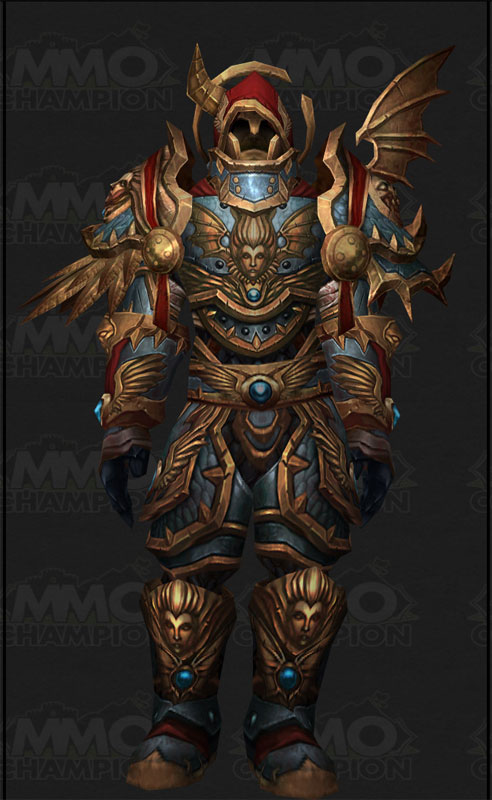
...holy shit...
Prior to today, I was a big believer that paladin T6 was the best paladin set in WoW, Judgement be damned. I never legitimately raided Black Temple or got any of the tier set, but I did do quite a bit PvP in TBC (since that was all there was to do) and Season 3’s Vengeful Gladiator’s Vindication set was just as good as the real thing (or arguably better, if you prefer the red recolor to the normal blue). So my sort of fantasy tank set would have been Vindication + Bulwark of Azzinoth + Ghoulslicer. According to Wowhead, the whole thing would have looked like this:
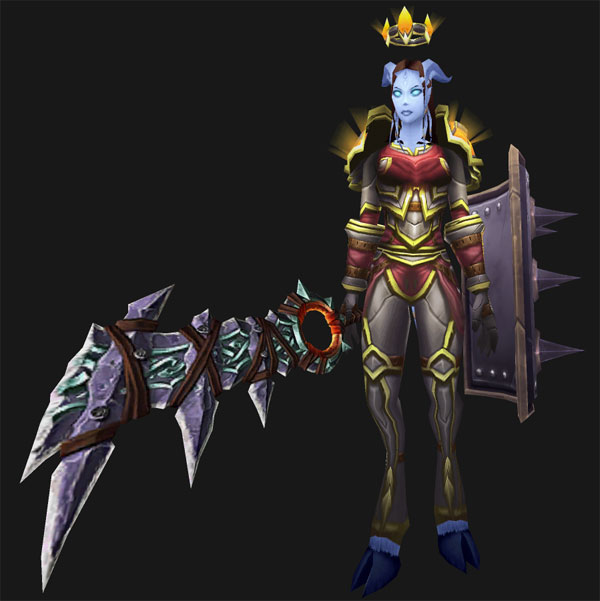
Shut up. It looks WAY cooler in my head.
But Blizzard, defying years and years paladin-degrading precedence, has come out with a PvP (!) armor set that not only makes the PvE one look like a total joke, but honestly steals the whole goddamn Deathwing show from every other class. The only sets that come as close as this one is the Priest T12 and Priest Season 3. Between this new PvP set and the fact that they are putting older Season PvP gear back on vendors – letting me complete the Vindication set and/or get the priest set on an alt without scraping together a BT raid group – you have no idea how goddamn tempting it is to spend $15 on a dress-up simulator.
The only thing stopping me? My nine alts, seven of whom are level 85, are trapped on low-pop Alliance Auchindoun with full heirlooms, max level professions with most non-ultra rare recipes, and approximately 450,000g in liquid wealth. I am not paying $55 per character to move them and a max of 50,000g, nor am I interested in straight-up rerolling without the benefits my ~7700 hours of seniority entitle me. So until Blizzard gets their head out of their ass and tweak the server/faction transfer service price-points (seriously, would a weekend deal kill them?), all this renewed interest and goodwill is going to waste.
Which, given the ridiculousness of my desires in the scheme of things, is perhaps win-win anyway.
More Glimpses into Blizzard Design
About two weeks ago, I pointed out how the Diablo 3 forums are really the place to be if you are interested in Blizzard’s evolving, internal design philosophies. It is not every day that you hear Bashiok come out and say that WoW has been “[…] struggling with how to cope with a skill tree system, which has huge inherent issues with very little benefit, for years.” Nor the disdain that Jay Wilson feels towards PvP affecting PvE game balance. Now there is another nugget of design insight from Bashiok which, while not as bombastic, is still rather interesting:
In some cases though we are purposefully avoiding affixes we just don’t think promote good gameplay, like +damage to X. We want people to play the game and have fun, not feel crappy because they’re in an area full of ‘beasts’ and are stacking +damage to demons. It also encourages a whole host of other divergent gameplay like holding sets for specific types of enemies, or building sets to run specific areas at end-game. Lastly it’s very difficult to make affixes like that compelling, and not necessary. Either it’s powerful enough where people do all those crazy things to leverage the bonuses in destructive ways, or the affix is just de-emphasized to the point of meaninglessness.
Feel free to read the actual thread for the full context, and the full quote for that matter.
I find it interesting because it perhaps speaks towards the larger question of specialization, and what role (if any) that it should play in games generally¹. Is having and collecting a demon-slaying set not fun? I remember back in the Quel’Danas dailies circa TBC how I would typically skip the non-demon quests on my paladin since having Holy Wrath made the impaling-demon-corpses quests that much quicker/more entertaining. Here was a time to flex an oft-neglected muscle in a thoroughly satisfying way!² Of course, the flip side of specialization also in TBC was how paladins were heroic 5m tanking demigods and largely unbalanced garbage raid tanks.
Honestly, Blizzard probably has the right idea here. Specialization with equipment sounds nice on paper, but it also devolves into the D&D-esque “golf bag” problem when you simply “specialize” in everything, and whip out the demon-slaying sword for one fight, and then the beast-slaying sword the next. Similarly, class specialization is usually long periods of underpoweredness punctuated by brief moments of awesomeness… assuming the class is balanced to begin with.
¹ Pun maybe intended.
² Err… no comment.
Diablo Learns from WoW
All the cool stuff is happening on the Diablo 3 forums, as far as roundabout WoW internal design philosophy goes. For example, this is Bashiok:
You’re overestimating what stat points actually provided, customization-wise in Diablo II, and really overestimating what skill points did.
Diablo (1) did not have skill trees, it was a feature added to Diablo II, and then more or less copied by World of Warcraft. Some could say to World of Warcraft’s detriment as it’s been struggling with how to cope with a skill tree system, which has huge inherent issues with very little benefit, for years. Diablo III, like Diablo II, is an evolution of the series and game systems.
Saying that Diablo III shouldn’t learn from the successes and mistakes in World of Warcraft, let alone Diablo II or any other game, is just nonsensical.
Bashiok went on to post some Youtube links of Jay Wilson being interviewed about a host of Diablo 3 design questions. One off-shoot of that was about Diablo 3 PvP, in which he very strongly expressed disgust about how “PvP wags the tail” when it comes to WoW design, and that it would be “over his dead body” for the same to happen in Diablo 3. In fact, this is what he literally said vis-a-vis WoW:
Even the amount that PvP can alter the PvE game in WoW is unacceptable to us. Whenever we run into a case of “this would be really cool for us in PvE,” the PvP guy goes [raises hand] “That kind of screws PvP,” the answer is always “Shut up, PvP guy. It’s awesome in PvE and so that’s what we’re doing.”
This is not particularly groundbreaking news (the tension between PvE and PvP has been officially recognized for years), but it is fascinating to me hearing a more candid take on these subjects from designers. And, of course, what it could mean in design moving forward. Given that PvP is essentially free, infinitely recurring content while patches take 6-7 months to phone in lovingly craft, such hostility is… instructive.
Legendaried
As you may or may not have seen on MMO-Champ, there was an interview with J. Allen Brack, Lead Producer of World of Warcraft, in which he dropped a Legendary bomb:
Brack: There’s one more piece which is an announcement that we’re releasing a rogue legendary weapon. Specific for rogues, so it will be a dagger. There will be some sort of quest, traditionally we’ve done these quests that players need to participate in order to create the legendary weapon in this case we’ll be focusing on rogues that will try to make that happen. […]
We haven’t decided on the name and how it’s going to work, we just know that we really want a legendary weapon to come out of this tier and we really want it to be a rogue dagger. That’s really all we know at this point. As time goes on we get a lot more lore, a lot more story, an “in” to the creation of all the legendary weapons. We really did a lot with the legendary axe that you got out of Lich King and then we’ve had other legendaries with the Cataclysm tiers that have had these storylines, we’re hoping this one’s going to be the most exciting, the most epic legendary quest line.
what is this I don’t even

Where do I start?
- Did no one in the design meeting raise their hand and question how “the most exciting, most epic legendary quest line” can even happen if you don’t have the least-played class in WoW in your raid team? Hey, Brack, you know that cool quest line you did for Shadowmourne? People saw and participated in that because THREE HUGELY POPULAR CLASSES were capable of taking it. Same deal Dragonswrath, same deal with Val’anyr, same deal with every single crafted legendary¹.
- At what point was it decided that legendary weapon quests were good uses of design time while class quests were not? Is the idea that legendary quests are like class quests that only a handful of classes even have access to?
- Legendary quest lines never really made any sense to me in an MMO setting to begin with. Is the collection of fragments of an ancient weapon cool? Yes. Is infusing them with the souls of your fallen foes awesome? Yes. Is a quest line that takes dozens of people weeks to accomplish epic? Yes! Er… unless you aren’t the guy getting the legendary. Don’t get me wrong, it feels great being part of something bigger than yourself. Problem is that an item to just one person is NOT something bigger than yourself. Legendaries in WoW, aside from one brief flirt with sanity in TBC, are designed for RPGs, not MMORPGs. If it has “worked” in vanilla and Wrath and Cataclysm thus far, it is working in spite of the terrible design.
I get that it was forewarned (in the tank Q&A of all places) that the 4.3 legendary “will have much more narrow appeal.” But… really? Remember the blue post back in June that speculated about why rogues are the least-played class? I am almost wondering if this legendary dagger is a cynical attempt at rectifying that discrepancy.
¹ Meaning more than one class could use it, not that all of them had 3 popular classes or whatever.
Inevitability of Decline
Nils and I have been debating here lately over whether the decline of WoW’s growth had something to do with Wrath and Cataclysm’s design. One of my biggest pet peeves when it comes to WoW discussion is the notion that subscription numbers are somehow correlated with endgame design. They are not. As I mentioned in that article, only ~20% of subscribers killed the easiest (non-Naxx) boss in the entirety of Wrath and the stats for Cataclysm thus far¹ are not any better: 17.9% have killed Magmaw, even after the nerf. But my actual argument goes further than that:
The decline of WoW was/is inevitable. That is to say, WoW’s subscription growth would have slowed and eventually declined no matter what Blizzard did. This is in contrast to the implied argument from Nils and others that had Blizzard simply copy & pasted TBC, they would have gained 2 million subs per year into perpetuity. My argument about the inevitability of decline has further consequences when it comes to MMO game design, because I believe that good design decisions can still lead to net loss in subscribers. Bad design decisions can certainly increase the magnitude of the hemorrhaging, but the best you can hope for with good design is to stave off the inevitable as long as necessary. This argument rests on a few premises.
Premise 1: Fun has diminishing returns.
I explored this premise a bit in The Diminishing Returns of Fun post. The basic idea is that Novelty is the ineffable quality of “newness” of a game that is consumed as the game is experienced. It can also be expressed by the quotes “You can’t go home again” and “You can’t step into the same river twice.” Novelty can be about learning new systems (i.e. rules) within a game, but it can also be about seeing new areas². Part of the “ineffable” problem is that novelty is not just about new things in of themselves. A jigsaw puzzle you previously solved does not become novel simply because new rules are introduced, like forcing yourself to not start with edge pieces or playing Tic-Tac-Toe before being able to place a piece. Once you feel confident of the contours of an experience, the remaining novelty quickly evaporates.
Nils described this once as: “The longer you play a game, the lower its potential to keep your mind busy, because you get ever better at it. If you so want, the game is in the cache now and you don’t have to think as much to play it.”
How this relates to WoW can be expressed in this investor call quote from Blizzard president Michale Morhaime:
“As our players have become more experienced playing World of Warcraft over many years, they have become much better and much faster at consuming content,” he said at the time. “And so I think with Cataclysm they were able to consume the content faster than with previous expansions, but that’s why we’re working on developing more content.”
Players become much better and faster at consuming content because the novelty of said content has already been experienced. A quest that might once have been novel (despite being built from un-novel components like Kill X Foozles, etc), becomes much less so the Nth time around. With the novelty gone, there is no compunction against finishing the content as quickly as possible – the quest becomes a task to be completed, instead of an experience to be sensed. Anyone can open a book to its final chapter and read how it ends, find a plot summary or otherwise “spoil” it. That we do not do this is a function of our desire to experience the story, which (typically) only occurs by limiting ourselves to reading it in order from beginning to end.
Unfortunately for Morhaime, developing more content will not stop the decline, no matter how good it is.
Premise 2: Market Saturation exists.
As I talked about in Saturation, Tom Chilton made the intriguing comment in an interview that:
” […] if you look at the way the population breaks down, we’re at a point in our history where there are more people that played World of Warcraft but no longer play World of Warcraft than currently play World of Warcraft.”
If measured at the peak of WoW’s reported subscription rate of 12 million, that means roughly 24 million people have played WoW at some point in time. How many more people would play WoW that have not done so already? That is somewhat of an open question. However, if we look at the Wikipedia list of best-selling games of all time we see that more people have bought World of Warcraft than Halo 1-2-3 combined (5m, 8m, 8.1m), more than Super Mario World (20m), more than Super Mario 64 and Mario Kart 64 combined (11.62m, 9m), more than The Sims (16m), and damn near two-thirds of the way of overcoming the original Super Mario Bros that came with every single NES (40m).
I doubt that Chilton was including Free Trial downloads in his statement, but either way, it is difficult to believe that the market has been anything other than tapped. If we assume that Blizzard is staffed with rational bussinessmen (if not designers), then we can infer from Chilton’s statements that the market for WoW has peaked according to Blizzard’s own data, and further sub growth is more likely to come from additional localizations than, say, capturing/retaining more US/EU subs.
Premise 3: Players consume content faster than designers create it.
The difference between this and Premise 1, is that Premise 1 is about how it becomes increasingly difficult to create subsequent content as novel as the original. This particular premise is simply how long it takes to create content versus how long it takes to consume it, novel experience or no.
Factoid: There were 8.75 million subscribers in vanilla.
Back in my Subscription and Correlation post, I augmented a graph from MMOData.net to show the release date information of the WoW expansions for illustration purposes. This is what it looked like:
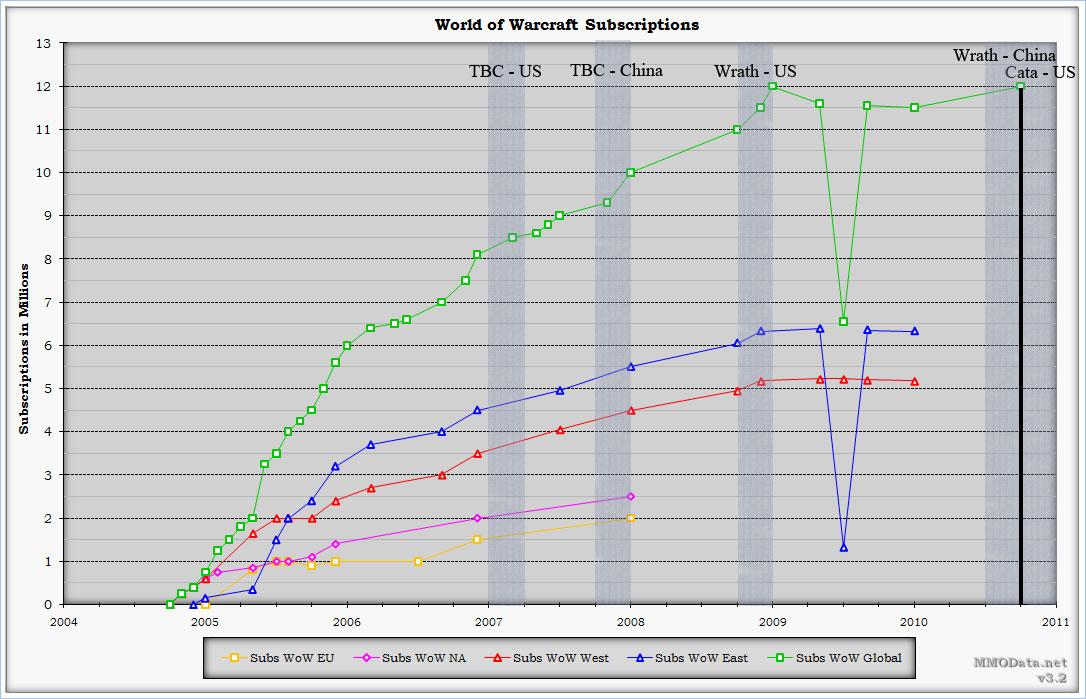
The interesting thing to note is that the total subscription numbers (the green line) is actually above 8 million before the release of TBC. China did not get TBC until the end of 2007, so if you add that interim period (the blue line) to the whole, we get WoW’s vanilla population at 8.75 million.
I believe this factoid is important because that 8.75 million segment can be considered the Baby Boomers of WoW. Indeed, between 2006 and 2007 the sub population grew from 6 million to 8 million – churn notwithstanding, it is possible that 6 million subs aged for an entire year. Compare that with 2005 to 2006, where less than a million subs could be said to be one year old by the end. In other words, starting in 2006 the volume of veteran players more than likely outpaced new players.
Premise 1 + 2 + 3 + Factoid = The decline of WoW was/is inevitable.
Ultimately, I wanted to stake out this argument because A) I do not see many people that do despite implicitly acknowledging it (e.g. growth is always finite), and B) good MMO design decisions tend to be indistinguishable from the bad when viewed through the one-dimensional prism of subscription numbers.
For example, the general (blogging) zeitgeist surrounding Wrath of the Lich King was that it killed the goose that laid the golden eggs. What does not get separated was, say, how the questing experience was orders of magnitude better than questing in TBC (does anyone seriously disagree?), and how I feel that the episodic raiding model is a lot more honest, and better designed than a strict linear progression model. Yes, raid difficulty was poorly handled. Yes, turning heroic dungeons into 5-man daily quests burns people out (starting with TBC, mind you). None of those raiding missteps can realistically can be responsible for more than a fraction of sub losses, but that is neither here nor there.
The mechanics of what I am asserting can be visualized in the crude image below:
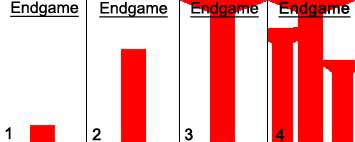
In frame 1, a player has just begun playing. In frame 2, they have carved a path through the majority of the game on their way to the level cap. In frame 3, they have reached the endgame, where most of their activities involve repeated content such as dungeon runs, raiding, dailies, and so on. In frame 4, the player either rolls alts or otherwise backtracks in search of novel experience in the content they missed (different leveling zones, class-specific quests, the opposing faction, etc). As expansions are added, the frames get taller… but not by much. Whereas the original leveling experience might have taken 300 hours, leveling in an expansion takes a fraction of that. If an expansion is released when you are in frame 2 or 3, that is fine. But if you are in frame 4… the end is (already) near.
So, in summation, WoW would have inevitably declined no matter what Blizzard did. That the decline “began” during Wrath is largely an irrelevant coincidence compared to the Baby Boomer population wave reaching the natural end of their novel experiences. The Baby Boomer hypothesis can be falsified should we ever get average age of account statistics or character maps of activity, but it would not affect the soundness of the underlying argument either way. Raid design decisions are unlikely to have anything but marginal effects on subscriptions compared with what the bulk of players are doing – which we know to be not raiding. And I believe that a lot of better game design could be achieved if we spent less time fixating on a drawn-out, endgame experience.
The deserved popularity of WoW proper came from the strength of its IP narrative, its pacing, its humor, the vastness of its game world, the underlying character of each of its zones, the uniqueness of its classes and how each demonstratively created their own novel experience. We should not take its declining subscription rates as anything more than the natural decline of an otherwise well-lived life. Here is to hoping that Blizzard opts for hospice care instead of the intensive life support that is currently in vogue.
If not… well, here is a raised glass to Diablo 3 and Titan.
¹ WoWProgress says 64,642 guilds have killed Magmaw as of the time of this writing. Assuming 18 raiders per guild (charitable considering 10-man raiding is vastly more popular), that means 1,163,556 players. WoWProgress only tracks NA/EU/KR/TW guilds, which number ~6.5 million. Ergo, 17.9%.
² You can probably argue that exploration equates to “learning the rules.”
Saturation
There is a fascinating quote from WoW’s Tom Chilton in this IGN interview that, I believe, conclusively discredits the notion that Wrath of the Lich King (or really any expansion) was somehow responsible for the stagnation and peaking of subscriptions:
Moving forward beyond 4.3, Chilton explained the focus of the development team. “I would say that the majority of our mindshare as a team goes toward our existing player base. How do we keep them entertained and how do we keep them enjoying World of Warcraft? I don’t know if that’s necessarily the right approach as time keeps going on. If you look at, if you look at the way the population breaks down, we’re at a point in our history where there are more people that played World of Warcraft but no longer play World of Warcraft than currently play World of Warcraft. That was totally not true four or five years ago, and so in a way the demographic of the potential returning player becomes more and more important over time.”
On the one hand, some might argue that this phenomenon is not particularly noteworthy at all. If a MMO sells 100 copies and two months later only 49 are still subscribed, then more players have played that MMO and stopped than continue to play it – that does not means that there could not be another 100 potential customers who might not have known about the MMO.
The difference with WoW, of course, is one of magnitude. Depending on when Chilton looked at the population breakdown, that means WoW could have had in the neighborhood of ~24 million players overall. How much bigger can we imagine the market for a fantasy-based Warcraft IP MMO be? While we can only speculate, I think it is reasonable to assume based on Chilton’s response that the market is saturated to the point that Blizzard’s time is better spent recapturing lapsed players than it is marketing new ones. Surely they have done the market research, and if we accept them as rational businessmen, then this interview (and their actions) confirm the hypothesis of market saturation. In which case, as I argued several months ago, raid/reward philosophy shifts in Wrath of the Lich King (and Cataclysm) likely had little to nothing to do with slower subscription growth.
Beyond that, what is similarly fascinating about that interview is the very next paragraph:
“I don’t think we’ll ever be able to stop feeding the beast,” said Chilton. “It’s kind of what we call trying to keep the players entertained, you know the guys bored right now and you know what are they going to do next month? But I think that for us to continue to be successful we have to think more and more about the new players that are coming into the game now and the potential returning players. What are we doing to the game that lowers those barriers to entry?”
I suppose it could be read multiple ways, but I got the impression that going forward Blizzard’s design will be less centered on keeping existing players happy and more on enticing back former players. Obviously, things like tier sets on vendors and more accessible raids make hardcore players unhappy, but this seems a confirmation that – in true triage form – the designers would rather make you (an existing customer) unhappy if they could potentially lure back two former customers. The ideal would be that they could both make you happy and former players happy simultaneously, of course. That said, this is the first time I have come across so candid a game designer.
As a former player myself, it will be interesting to see how this shakes out.
Mobile AH Game Changer?
[Edit: I may or may not have been a bit premature. If the change below doesn’t auto-update the price as I assumed (in a sort of reverse-eBay bidder style), it merely matches the functionality of addons like Auctionator et tal. Apologies for the excitement, although if Blizzard continues down a road of making canceling/relisting easier, it could begin to cross over into premium competitive advantage.]
This is, by far, one of the most game changing features to the World of Warcraft AH I could ever imagine:
The iPhone World of Warcraft Mobile Armory has just been updated! Check out all the improvements we’ve included in the latest version:
- Automatic price undercutting: Set the default buyout price of your auctions to match or undercut the current lowest buyout price for an item.
- etc (source)
In one fell swoop, Blizzard has introduced a premium feature that simultaneously grants an unbeatable competitive advantage that destroys an entire economic methodology AND damn near makes AH botting obsolete. And possibly even entire addons. What am I talking about? I am talking about how AH barons can become immune to undercutting for $3/month. The simplicity and genius of it boggles my mind.
Just think about the glyph industry in WoW. The entirety of blog posts and guides devoted to becoming a captain of the glyph industry revolves around pushing other players out of the glyph market. Why? Because glyphs, by their very nature, are easy to create and have trivial listing fees. If I post a glyph for 200g and someone else lists the same glyph for 199g99s99c, I just lost that sale. In order to recapture it, I will have to cancel my undercut listing(s), collect the mail, and then go to AH and A) undercut the other guy by 1 copper, B) undercut deeply, or C) engage in economic/psychological PvP to drive this guy from the market.
Simply put, this changes everything. There are thousands of articles across the internet about setting up addons like Zero Auctions (etc) in creating Fallback prices and thresholds and so on, which this change completely invalidates. Toss your Glyph of X on the Mobile AH for 300g and set the threshold at 20g (or whatever). If someone pulls a 299g99s99c, they instantly get undercut by you. While they are spending time canceling, emptying the mailbox, and relisting, you are doing nothing. Relist goes up to 299g99s97c, automatically undercut again. There is no way to beat this. No longer will you be checking your glyphs 2-3 times a day, doing 12 hour posts, posting at 6 AM or other odd hours, emptying thousands of mails, etc. Assuming you set a sale threshold you are willing to accept, camping the AH as an economic strategy becomes obsolete. I am trying to come up with historical examples of strategies that have becomes this obsolete… and I am drawing a blank. Knights in full plate armor against the crossbow? Castles as defensive structures after gunpowder? Trench warfare after the invention of mustard gas?
One of the biggest reasons to NOT use the Mobile AH feature, aside from it costing $3/month, was how it was always more efficient and convenient to use your existing addons. While I do not think the Mobile AH is particularly well-suited for heavy AH usage interface-wise, the auto-undercut feature alone makes not using it impossible in an environment where anyone is. Forget glyphs for a second… what about gems or epics or other goods with non-insignificant deposit fees? I assume the auto-undercut feature will not charge you each time (that seems too large a trap for an unwary premium feature user), but if that is the case then you can literally bleed other stubborn goblins dry as they cancel and relist items with Xg deposits. Assuming the undercut logic is programmed well, you may not even need to care what the market price is for a good at all: just list everything starting at 300g and let it auto-adjust downwards for you.
The one negative implication – aside from people who forgo the app and to whom this entire announcement spells economic ruin – is when you get one or more persons with this app in the same market: without collusion, prices will automatically bottom out at the lowest threshold. Good news for the average player, of course, but bad news for anyone looking for margins that justify the crafting time. Then again, perhaps you could bait someone with this app into automatically bottoming out their prices, buying all the stock, and then relisting higher as they blithely go about enjoying their day in the knowledge that the app is doing their work for them. So perhaps some of the old strategies can still work…
In any case, this feels like a strange new economic world, my friends.
Culpability of Questionable Design
Is Blizzard responsible for players doing unenjoyable activities for rewards? Or is the player responsible for wanting something they shouldn’t?
For the context of this question, consider the Zul heroic dungeons in Cataclysm. These represent a second “tier” of heroics that offers better gear drops and double the amount of Valor Points, at the cost of a higher level of difficulty and being longer in general. In the last 4-5 months of their release, a number of players have complained about fatigue and burnout from having run these two specific heroics seven times a week for months, as opposed to the nine (9) other heroic options available because those, while easier, offer a sub-standard amount of VP (and leaves you short of the weekly cap). The fairly common counter-argument comes in the form of Bill’s comment in this MMO Melting Pot post:
Nobody is forcing people to do ZA/ZG all the time. In my battlegroup, normal heroic queues are 2-3x faster and less stress than ZA/ZG ones . So I can do half and half. For raiders, they have the option to knock of a few nerfed farm bosses from T11 to help them reach cap.
Also, even at this point in the expansion, not everyone is ZA/ZG ready. Yes, really.
You want choices? You have choices.
I would argue that the “choice” is between efficiency and inefficiency – not a particularly meaningful choice – but it is somewhat worse than that because I get the impression most players do not have fun running heroics for VP in the first place. Is “enduring unfun things because the end result is fun” Blizzard’s fault for designing the game badly? Or is it the player’s fault for choosing to bore themselves for a treat at the end? And even if it is the player’s fault (masochism is a real thing), does that abdicate Blizzard of any responsibility in their game design?
We do know that a lot of rogues appeared to reroll DK, at least when the class was first introduced. We also think rogues were more popular back in the day before flying mounts and instance-teleportation, where ganking someone out in the wilderness was more common. We saw a surge in the popularity of hybrid classes, especially druids and paladins, as running heroic dungeons became something nearly every player did instead of a more dedicated minority. (source)
In terms of heroic dungeons specifically, I do blame Blizzard. There have been many interesting articles on the subject already, but the short version is that the role of heroics and the equivalent of VP (Badges of Justice, etc) has changed radically since their introduction in The Burning Crusade. Back then, the apparent design goal was to allow non-raiders to have a seperate, but parallel endgame gear progression path of their own to raiders. This philosophy obviously changed in the Lich King era when full tiers of gear began to be offered up on the JP vendors of that day, but I did not have a problem with it back then because A) prior tier gear was required for their episodic content model to work, and B) heroics were breezy, 15 minute affairs. That breeziness did, dare I say, make them fun in a multiplayer Diablo kind of way.
Come Cataclysm, it is clear that the Blizzard designers took the difficulty complaints as personal insults, and tuned Cata heroics up to extra-crispy levels. While they were never particularly challenging to skilled individuals and guild groups, they were absolutely brutal to pugs, whom remain the bulk of the LFD population. Blizzard doubled-down on difficulty with the Zul heroics in 4.1, which sort of makes sense given that they drop 353 gear instead of 346 and more VP besides. No one feels forced to do Heroic raids versus Normal raids for gear, right? Yes… but that sort of demonstrates the disconnect. Outside of a few BoEs, there is no way of obtaining heroic raiding gear other than from heroic raiding. Conversely, there are several ways of obtaining gear from VP (and JP) vendors. That VP gear is orphaned, unattached to any particular method of acquisition. Pressing the LFD button and waiting for the queue to pop is orders of magnitude easier than finding/creating a 10m raid group and downing bosses. And moreover, there is now a pseudo-experience point bar in our faces, reminding us how below the (weekly) cap we are at any given time.

Your life is *this* incomplete
It is in this sense that I feel that it is Blizzard, not the players, who are at fault with the state of the endgame. Blizzard took a mechanic designed to give the “more dedicated [heroic-running] minority” a legitimate progression path, and inverted the design to make heroics the endgame for everyone for an entire expansion. Then they “priced” people out of doing them during the early days of Cata, then relented, then made the same damn mistake again with trying to funnel everyone through the Zul heroics. Given that heroics are supposed to be endgame for ~70% of players… where is the beef? It will soon be four months since 4.1, and while 4.3 is slated to be released at the end of this year with three new heroics, are the two Zuls really supposed to have sustained non-raiders for the better part of a year when their endgame is designed to be heroics?
 In An Age
Community Aspects
Oct 11
Posted by Azuriel
Nils is reaching the end of his WoW rope in his latest experiment, and my response probably fits better in a post than comment. Nils says:
WoW has NEVER put you in a community. At all. The most you could say is that in the early days people had somewhat of an incentive to seek out strangers because it would be impossible for them to complete (group) content otherwise – something that sounds more like Facebook games now that I think about it. The “community” could be summed up the sort of proto-typical “LF1M tank H Ramps” spam, where the alternative was having nothing to do. But if Nils doesn’t feel like joining a guild, he probably would not feel like joining a random Trade chat pug either. Or perhaps he is saying that since you can press the LFD button, one has no incentive to join Trade pugs?
Honestly, there was as much community when I finally quit as there has ever been, and I saw people trending towards tighter guild/social bonds than ever before. In TBC, the only way to see content was to “trade up,” leap-frogging Kara guilds into SSC/TK guilds into BT guilds into Sunwell guilds. Choosing friendship and sociality meant you simply dead-ended, unless you won the guild lottery and got into one that progressed. Incidentally, this was my fundamental problem with articles like the one I talked about yesterday, insofar as those never seem to be written from the majority standpoint of raiders whose expansions just end mid-tier because the guild is not good enough to progress (be it skill, drama, or other).
Nowadays, at least pre-Cata, you could have your cake and eat it too, progressing with friends at relatively your own pace without having to worry about people trading up. Yes, solo players have no “real” incentive to join guilds/groups since they can get groups formed for them. Then again… well, as we’ve seen from LFD, some of the groups you get are so horrible that there is every incentive to do LFD runs with as many people you know as possible.
Posted in Commentary, WoW
11 Comments
Tags: Difficulty, LFD