Ownership
How important is it for you to own your movies and books and videogames?
I am one of those people who fills with righteous indignation on hearing stories about how EA or Steam can (allegedly) ban people from playing the games they paid for based on what they did on the forums. And yet I endeavor to only buy games on Steam – if there is no Steam version and its not an MMO, it doesn’t exist to me. The last console I owned was a PS2.
As I was reflecting on this seeming dissonance, I glanced over at my bookshelf. And what I saw were a lot of DVDs I had not touched in nearly a decade (or more), and unlikely to touch ever again.
What I realized I wanted was:
- the ability to play a game, watch a movie, or read a book.
- the ability to do so again, at some later date, without paying again.
- paying a discounted price for the loss of ownership.
To be clear, by “ownership” I am referring to my ability to resell or gift the item.
My Steam library is sitting at 205 games. There are exactly two titles out of those 205 that I paid full MSRP for, and they were Fallout: New Vegas and Portal 2. At $40, Skyrim was the next highest amount of money I was willing to pony up for the Steam service for an individual game since I first downloaded the client with the Orange Box.
So when people ask that “what if Steam shuts down?” question, a large part of it is moot: there is no scenario in which I’d miss Singularity or KOTOR or Far Cry. I might want the possibility of booting up Portal or Half Life 2 (like when Episode 3 comes out, cough) years down the line, but in all likelihood they would share the same fate as my pristine copies of Xenogears, the Tenchu series, and FF7-FFX in indefinite shelving purgatory.
“Judged According to Its Aspirations”
In a Ten Ton Hammer interview with CCP’s incoming Chief of Marketing Operations, David Reid says (emphasis added):
Q: CCP is clearly excited about launching DUST 514 in 2012. Help us understand why those of us in the PC gaming market (and specifically the MMO crowd) should be excited about a PlayStation 3-exclusive online shooter.
Hilmar Pétursson: The thing that many people have raised with us is that they love everything about EVE Online, apart from playing it. It’s such an interesting world, there are so many exciting things going on, but it takes a lot of commitment to get into.
David Reid: The opportunity with DUST is tremendous – it’s an opportunity to bring this universe that plenty of people in the MMO side of the market have enjoyed – the persistent universe, the world’s most vibrant and “real” virtual economy. But not everybody is a fan of flying in space.
We want to bring this experience to people who may not know EVE Online or CCP to the 60 million or so people connected on the PlayStation Network, the bulk of whom know what it’s like to play a shooter and can imagine the opportunity presented by interacting inside of this mature EVE universe.
Beyond that, we also have the phenomenon that EVE Online has been all of these years. Eight years running, EVE Online is the only game in the West that has shown consecutive growth year after year, in light of the tumble World of Warcraft saw last year.
With DUST 514 shipping this year, with bringing in the tens of millions of people that play shooters on PSN into the New Eden universe, EVE could be the biggest game in the world at the end of 2012. To end the year on that upswing, it just blows my mind the opportunities we have here to keep building on this awesome universe.
Alright, David Reid… ~10 million Dust 514 players by the end of 2012. Consider it duly noted.
In trying to find out whether Dust 514 was still going to be selling for $20 or if it was F2P with microtransactions, I came across this other Q&A with Dust514.org. This exchange happened:
Eve Online is an MMO notorious for its stories of spying and backstabs. With the ease of creating alternate accounts in the PSN, how will Dust 514 discourage the inevitable creation of large amounts of alternate accounts for griefing and other skullduggery?
We don’t necessarily want to discourage spying and backstabbing  . There are a lot of mechanisms in game to ensure battles are managed well, while not cutting into the freedoms that the EVE Universe provides.
Will Dust players be able to kick team killers at will? Hoping for a positive answer on this one.
We understand that friendly fire is not so friendly and that intentionally killing teammates can be very annoying. To keep this from getting out of control we will allow players control of their team’s composition.
As I mentioned before, I actually liked the concept of Dust 514. All the gameplay videos looked like a sci-fi Battlefield 2, which is a game I played with an MMO-level of engagement for three years straight. But PS3 exclusive? Really? It boggles my mind. And considering that the PS3 is at the end of its lifecycle – may not hear about a PS4 until 2013, but still – it seems bizarre to come out with an exclusive pseudo-MMO on a platform not guaranteed to be backwards compatible with its successor.
The SWTOR Figures Thus Far
You have probably already heard about the 1.7 million subscription number, 2 million boxes sold, and so on surrounding SWTOR’s launch. What I am finding a bit more interesting are some of the investor call break-downs as gathered by Darth Hater. For example:
Q: What are your plans at expanding the global market?
A: We are looking at the Asian market. Expanding into Australian market on March 1st. We’re looking specifically at opportunities to expand in the Asian market.
Q: How long will it take to get into the Asian market?
A: Australia/New Zealand is the low-hanging fruit. Think in months rather than weeks. Individual Asian markets will be announced in the future, we’re bound by confidentiality agreements. When WoW was introduced in 2004, they were in Korea shortly after, and 9 months after in China. It was easier in those days – server outages were considered par for the course, that is not the case today. We hope to execute as well in Asia as we did in the NA/Europe launch.
Q: You’ve previously said you need about a half million subscribers to be profitable, is that still the case?
A: At 500,000 subscribers, we’d break even. At a million, we’d be making a profit but nothing worth writing home about. As it scales up from there, we’re talking about a nice profit. At this point with the successful launch, we can take the worst case scenarios off the table.
The ability for SWTOR to launch in Asian markets was one of the biggest concerns I had with the game from a success standpoint, as you may recall. Indeed, if/when the game is released in China, that will be the moment beyond which we will be unable to talk about its subscription numbers with any sort of coherency – not because it will necessarily be super-popular over there, but because, just like with WoW, millions of Eastern subs obfuscates armchair analysis. Remember Nils saying “[…] I would now say that EA could be happy if they had 500k subscribers one year after launch”? Would it “count” if there was some Western mass-exodus down to 250k but 2 million Chinese subs?
In any event, there are still legitimate questions about how the game will perform 3 to 6 months down the road, when there is less ambiguity surrounding whether 1.7 million was as-of December 31st or as-of the investor call (and what “most” means in the context of “Most of those 1.7m are paying at this point”). Then we have Frank Gibeau who says:
In the next phase, our goal is to grow the number of subscribers with frequent releases of content that make the game even more exciting. […] We plan on delivering another major update, even larger than the first, in March.
It is kind of interesting, on several levels. Can Bioware keep such a pace for any length of time, or will there be a drought soon after March wherein the reserve content drys up? Do frequent patches even drive subscription growth to begin with? Blizzard’s Mike Morhaime said back in November that patches were mainly about reducing churn, not growth. Maybe it’s different for games below market saturation? And speaking of games and markets, let’s not forget at least a half dozen high(ish) profile MMOs will also be dropping this year, including the mythical Guild Wars 2 and Mists of Pandaria. No doubt there will be some impact, eh?
Time will tell, but so far so good.
P.S. If you had bought EA stock after it dropped 3% in mid-January, when people were laughing about SWTOR’s “disastrous launch” based on that one analyst, you’d be sitting on a 10.22% return on your investment a little more than two weeks later. Or, hell, a 6.1% return between yesterday and today.
P.P.S. Christ. BRB opening eTrade account.
Role Playing
One of the most meaningful quests I have ever completed in World of Warcraft actually occurred in Cataclysm. It was called “A Bird in Hand.” Ostensively, it was just another boring, linear quest in a string of half-hearted attempts to spice up the killing of X mobs. Then came this part:
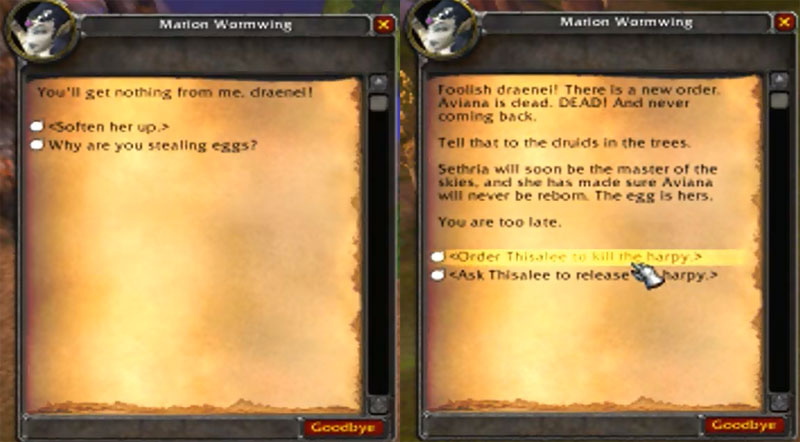
Originally, I pummeled her repeatedly for the sheer novelty of it.
For those unfamiliar, the quest asks you to choose between roughing up the harpy or simply yelling at her. You can mix and match a bit, or you can continue to pummel the harpy until she eventually tells you everything she knows. At the end of this dialog “tree,” you have the option of either letting the harpy go, or having the NPC slit the harpy’s throat. Which options you pick is entirely irrelevant to the game. No future NPC references your actions in any way, the rewards are the same, each option takes an equal amount of effort.
And it was, in all seriousness, one of the best moments in WoW questing.
Because it was not until that moment that Azuriel the draenei paladin was anything other than a mere user interface element. The quest forced me, as a player, to step back and ask myself a question that was never hitherto asked: is your avatar you? What would Azuriel do? And what I found in answering that question was a hidden depth to the game, an unburied black monolith that was full of stars.
Of course, then the quest is over, the fever-dream passed.
So allow me to disagree with anyone who has suggested that the choices in SWTOR are dumb, meaningless, a waste of time. The fact that every Trooper has the same general story as any other Trooper is irrelevant. The biggest success of SWTOR – regardless of what happens in the future – is NOT necessarily voices and deeper narratives, it is that the game represents one of the biggest moves into mainstreaming the RP in the MMORPG that I have seen in years, perhaps ever.
When I played through Deus Ex, or Fallout, or any typical single-player game, the main character was a stand-in for me. What would I do, as a cybernetic super-solider? How did I feel about letting bandits go? What would I say in the ridiculous, impossible situation so far removed from my own life? I don’t know whether it is the first-person perspective of those games or their overall structure, but I do feel different when it comes to MMOs, and my time with the SWTOR beta specifically.
It is one thing to get someone to put themselves into a game, and quite another to get them to bring a character to life and imagine what this entity separate from themselves would do. Mainstreaming the mechanics of empathy, making it fun? That is some Nobel Peace Prize shit going on. And I am only half-joking.
“Our character is what we do when we think no one is looking.”
-Jackson Browne
Having our game decisions result in discrete consequences makes for a better simulation, yes. Then again, in the real world the decisions we make when the consequences are irrelevant or unknowable is a definitive aspect of one’s character. If you helped an old lady cross the street, and she got hit by a car a block later, was your original decision truly meaningless? Are consequences the only arbiter of morality? Is intention irrelevant? You tell me.
All I know is on that soot-filled day in the burning mountains of Hyjal, skin caked with sweat and the still-warm blood of ten harpies, the paladin Azuriel beat Marion Wormring to within an inch of her life. To an inch… and no farther. For in that one, singular moment did Azuriel have a choice: the choice to walk away. And so… she did.
Kingdoms of Amalur, Used Game Sales
As you may or may not be aware, there was a minor kerfuffle surrounding Kingdoms of Amalur: Reckoning. The gist is that Amalur is an EA-published single-player RPG with an Online Pass that unlocks Day 1 DLC, which is like a triple-word score on the Scrabble board of controversy. The thread on the forums ballooned to 48 pages of indignation, Curt Schilling (CEO and some baseball guy) responded in an eminently reasonable manner, and now the thread is about three times as big.
The irony in all of this is that this particular incident is not that big a deal. However, it touches on so many things that ARE a big deal, that it becomes something that should be a big deal. Specifically, the demonization of used game sales, which has came up before in an unfortunate Penny Arcade post back in August 2010. Later on in the Amalur thread, Curt Schilling laid out the issue:
Herein is the dilema no one wants to talk about right? We CANNOT in ANY WAY cater to people that buy used games exclusively right? We see ZERO revenue. Now as a consumer you may care nothing about that, and that is absolutely your right and we respect that.
However we are a business, we have 400 people, every single one of them is awesome, but I just can’t get them to work for free, so we need to make money to pay them, to make more awesome games.
Now the issue is the straddler, there are people like me, never ever bought a used game in my life, or pirated one, and never will, and people that ONLY buy used because they don’t have the means to buy new or whatever, but they have their reasons, agree with them or not it’s not relevent.
The straddler does both, he buys new and used, he turns in used to buy new, and that new game could be ours right? How do we handle that? How does the industry handle that? Industry? That’s the huge challenge.
I want to talk to the executives out at EA and other game companies for a moment. Are you guys listening? Get ready to write this down:
Fuck you.
A used game sale is a guaranteed new game sale at a lower price point.
Don’t you see? These people are ready and willing to give you money, and YOU ARE NOT LETTING THEM. No one is buying used games because used is better; used games are universally worse, with possibly scratched disks, missing manuals, missing cases, and so on.¹ No one is buying used games to specifically deny money to the developers; otherwise they would simply pirate it. People buy used games because they are otherwise being priced out of the market (which includes people who don’t feel a game is worth full MSRP).
I understand it’s EA or whoever’s right to set their merchandize at whatever price point they like. I have doubts that $59.99 is the precise intersection of Demand and Supply, but whatever. My point here is that used game sales is literal demand that is being filled by other people expressly because you refuse to accept any less than an arbitrary amount. The idea of Online Passes is to get something back from the secondary market, right? Instead of selling $10 Online Passes, how about, I dunno, dropping the price of the game by $10?
Maybe the Online Pass thing makes them more money. If a game is resold ten times, that is potentially $100, right? But if that game was resold for $40 ten times, that means EA could have sold TEN NEW COPIES AT $40. Gamestop could sell used copies at $35, sure, and maybe no game company one wants to get into such a race to the bottom. But at that point, I would hope that EA and friends would get on the right side of incentives instead of the wrong.
Because here’s the thing: this is all about the continual erosion of Consumer Surplus. When you buy a brand new game for $59.99, the ability for you to sell that game to Gamestop for $20 when you are done with it is Consumer Surplus. It is value, whether you explicitly exercise it or not. We can imagine a world where used games somehow don’t exist in any form.² In such a world, you have LOST $20 worth of value and have likely received NOTHING in return – probably LESS than nothing, if the mechanism that prevented used games inconveniences legitimate customers the same way DRM harms actual customers. This is the reason DLC (especially Day 1 DLC) is troubling, the reason Cash Shops are troubling, the reason being forced to go online and register offline, single-player RPGs is troubling: all of these things are signs of Consumer Surplus extraction.
Remember back, say, 20 years ago? When a game company only received greater profit by ensuring they put out quality products? Those days are long gone. It is no longer about generating more sales, but from extracting more dollars from the sales that ARE made. Whoever came up with the phrase “value-added services” is a goddamn Doublespeak genius. Instead of simply getting those extra costume options, we pay for them. Instead of getting free map packs, we pay for them. Instead of being able to earn Sparkleponies and Disco Lions, we pay for them. This incentivizes game designers to have us pay more for less, instead of pay less for more.
The Kingdoms of Amalur controversy is not that big a deal in the scheme of things. Indeed, when you put it in the context of pre-order bonuses and Collector’s Edition items, it’s hard to see 38 Studios “giving away” DLC as particularly nefarious. Lesser evil is still evil though, and I can’t help but wonder whether in a different age those seven quests would have been included in the game, or in a free patch later on. Or as a poster in the Amalur thread said:
Is it just me or does that PR statement just admit that they develope DLC at the same one as the game, or in non moron speak, the game you’re paying 60 bucks for is having parts removed so you could buy then later.
AHow incredibly fucking nice of them to give Us the entire game up front, oh wait, they just admired to holding that back.. What else did they pull out? What other content did they strip from the title to bilk us for later?
Looks like $20-30 GOTY edition it is.why would I pay full price when I can’t trust or believe I’ll actually get the full….Fucking…. Game?
¹ Remember when games came with cloth maps and game posters? I still have the two game posters that came packaged in the FF6 box. Those sure as hell didn’t show up with your used game copy.
² Just look at Steam: no used game sales. Of course, you should also look at Steam because they are on the right side of consumer incentives. In return for DRM and no resale of games, we get hassle-free DRM, truly ludicrous sales (consumer surplus!), automatic game updates, amazingly fast downloads, integrated community, and the ability to manage a library of titles without worrying about CDs or CD keys. Compare that to the typical ham-fisted Ubisoft or EA implementation of DRM.
Skyrim Design Nettles
Skyrim thus far has been as amazing an experience as everyone says. There is something to be said about how the fidelity of an experience engenders instant immersion in ways videogaming might not have achieved even five years ago. I already posted the screenshot of what I saw exiting the tutorial dungeon for the first time, and I was immediately struck by the same awe and infinite possibility I felt leaving the Vault in Fallout 3.
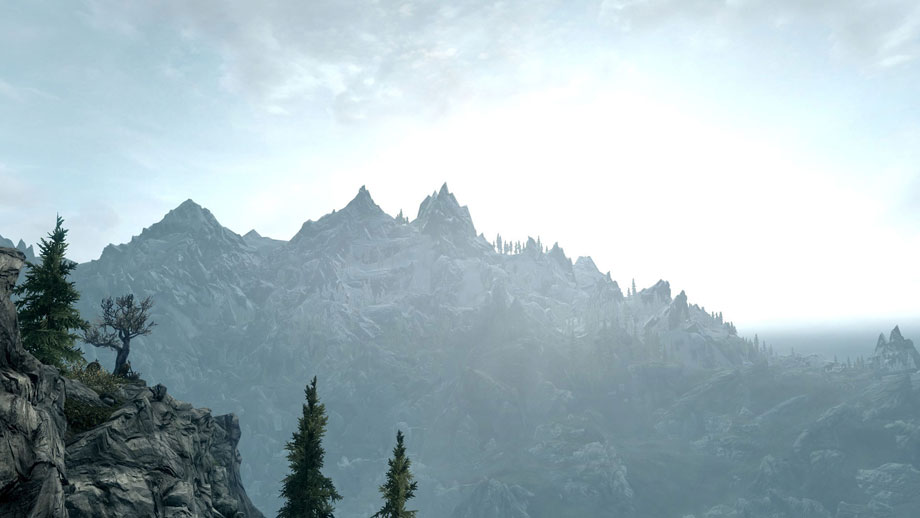
My current desktop background. Well, at +1000 resolution.
What I want to talk about today though, are the Design Nettles in Skyrim. These are the little things that take me out of the experience with their sting, no matter how much I try and ignore them. Every game has its idiosyncrasies, but what elevates these particular annoyances is either how out of place they seem within the context of a fidelitous experience, or how much they are artifacts of a bygone design era.
Imbalanced Skill Gains
Raising one’s Sneak level by auto-running into the wall for an hour has been a staple of Bethesda design since at least Morrowind. Why they choose not to fix that isn’t the problem. The problem is simply the imbalanced skill gains generally.
I gained two entire character levels in the first town from simply pickpocketing; going from level 6 to level 8 within the same house, in fact. Indeed, I gained 5 skill points for pickpocketing ONE ITEM, a magic ring from a sleeping guy. My pickpocketing skill is currently north of 70, I am level 21, and I haven’t even seen a 3rd city or a dragon yet. Meanwhile, I have probably picked 30 locks in the same time period and received ~4 skill ups. Same with Blacksmithing, Alchemy, Enchanting, Sneaking, Archery, and so on and so forth.
This is more of a problem in Skyrim than it was in Oblivion, because gaining any skill points increases one’s level, which in turn increases the level of all enemies in the game world. More insidiously, you can go hours (or specifically 18 hours in my case) before the problem even begins to manifest itself. I ran into some bandits on a bridge who were immune to my normal tactics which had hitherto worked in every encounter, and I only succeeded by “gaming” the system in rather ridiculous ways – playing Ring-Around-the-Cookpot and ladeling myself 16 servings of Apple Cabbage Stew in Matrix-esque bullet-time.
Enemies on Minimap
I can appreciate the design challenge that comes from choosing to have enemies appear on the minimap. Specifically, once you do that, you cede the ability to create tension via unknown enemy placement without resorting to dumb gimmicks. I like to call this the Silent Hill effect – unlike Resident Evil or other survival horror games where monsters can jump out at you at any moment, Silent Hill gives the player a radio that plays static whenever enemies are about. No static, no monsters.
Silent Hill as a series gets around this “limitation” by being fucking scary even when there aren’t enemies around (and by segmenting the game into rooms), but Fallout 3 and Fallout New Vegas fall into the trap of essentially lying to the player; “You can see enemies, and even raise stats to see them from farther away, unless we need to generate tension in which case your abilities will be useless.”
Skyrim attempts to have it both ways, while simultaneously stepping into one of my biggest pet peeves in “realistic” games.
In Skyrim, enemies that have aggro’d to your presence appear as red dots on the map-bar. You can even track the movement of these enemies through walls and barriers. Other than that, nothing appears on the map-bar other than locations. Which is… fine, right? Resident Evil, Half-Life, etc, don’t have minimaps with enemies on them either. My peeve though, relates to how high-fidelity games play out as if my highly skilled avatar is as clueless as me, the player.
Look. It’s clear the Skyrim designers decided not to put animals/people/etc on the minimap in order to increase realism. If I’m chasing butterflies to eat their delicious wings, it’s fair play that the tiger I wasn’t even looking for gets its turn too. But if I’m specifically hunting that tiger, or I’m sneaking up on the bandit camp, it simply feels dumb to be surprised due to lack of information. I can’t hear the guy in full plate walking around because the designers refused to give me that input; or if they did, they made audio-only to the point where I’d blow out my desktop speakers trying to hear it.
You can’t ask me to put myself in that field, and deny me access to my normal senses. And you can’t pretend that my normal senses are adequately represented in your arbitrary, game design way.
In other words, Christ, I want NPCs on that minimap. It obviously changed my behavior in the Fallout series knowing where people are even through walls and such, but removing it and pretending my character is as careless as I am playing the game is worse. Indoors? Yes, it works well to force people to be careful. Outdoors? Completely ruins any semblance of stealth-ish gameplay. At least, until I “beat the system” by Quick-Saving every 30 seconds and simply reloading if I stumble into a bandit camp without the opportunity to sneak attack someone.
Doublespeak: Blizzard edition
File this one under Dissonance, Cognitive:
One of our upcoming goals in Mists of Pandaria is to make the gap between the overall DPS/healing of both PvE and PvP items smaller. In fact, we have design plans for new PvP combat mechanics that will make PvP gear and weapons markedly better in PvP than equivalent level PvE gear and weapons.
The overall goal is to reduce the barrier for crossing between PvE and PvP (and vice versa), as well as to also ensure that PvP gear is the best in PvP, and PvE gear is the best in PvE.
I read that, and now feel like I’m losing my ability to understand language.
I mean… okay, making the gap between PvP and PvE gear smaller. Got that, that’s good. But then they’re making “new PvP combat mechanics that will make PvP gear and weapons markedly better in PvP.” So… err… they want the gap to be larger. Even if I somehow imagine that the DPS/healing difference will be smaller between the two gear sets, if these new combat mechanics makes PvP gear “markedly better” in PvP than PvE gear… then what the hell? You are right back where you goddamn started!
Up cannot be Down. We can’t have always been at war with Uranus Eurasia!
The only sort of thing I can imagine is if, for example, each piece of PvP gear reduced the cooldown of your PvP trinket, but otherwise had the same relative DPS/healing as PvE gear. Maybe that would be a lower barrier to entry? But if CC was balanced with lower trinket cooldowns in mind, then a fresh player would still be at a high, relative disadvantage. Perhaps not in BGs or even Rated BGs – respawning and getting back to the fight erodes a large chunk of your timer naturally – but absolutely in Arenas, which was the thrust of the thread the blue responded to.
Regardless, how would Blizzard ensure that PvE gear would be better in PvE in ways that didn’t affect DPS? Having 4000 resilience means you have 4000 less Haste/Mastery/Crit, right? It’s a huge difference.
I am so confused right now.
By The Way: Mass Effect edition
I believe this was my favorite line in the game:
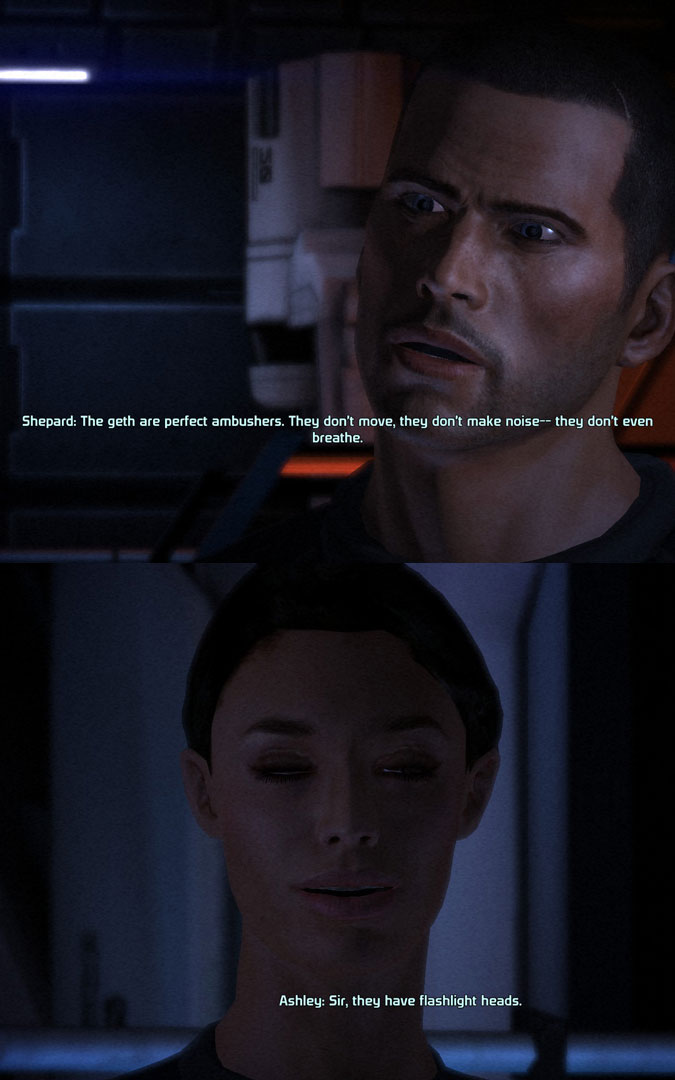
Ashley's unintentional "Derp" face only enhances the experience.
I laughed for probably a whole minute. This wasn’t bad either:
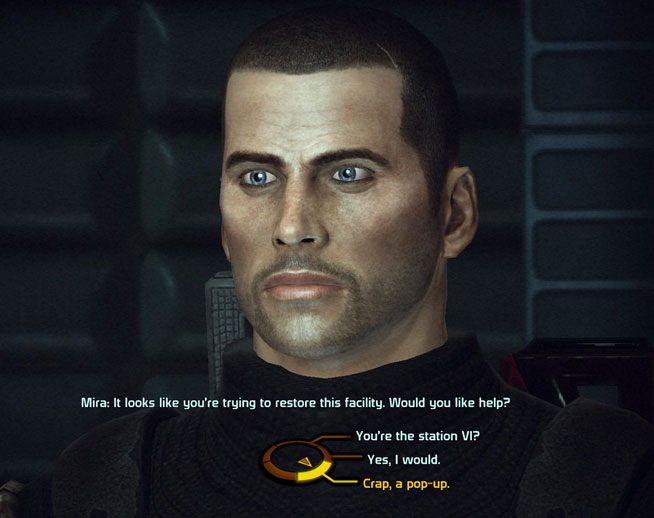
Oh you, guys.
Review: Mass Effect
Game: Mass Effect
Recommended price: $15
Metacritic Score: 89
Completion Time: ~32 hours
Buy If You Like: 3rd-person pseudo-RPG shooters

Subtitles: On.
It is somewhat difficult trying to review a franchise-launching game like Mass Effect years after its initial release. Should it be compared to the standards of games of today, or of its time? Is it even realistic to believe the experience can be compartmentalized away from the knowledge $200 million MMOs are using its primary narrative mechanics 4 years later?
As I watched the ending credits this past weekend, it became clear in my mind that the concerns were largely moot. I loved this experience, I loved the narrative, I loved the setting where the writers were taking me. And I loved these things despite the weakness of the actual game bits of the game.
The combat system in Mass Effect is a cover-based 3rd-person shooter meets half-assed RPG elements. The shooting elements were decent on their own, even if the majority of the fights seemed to oscillate between completely trivial to instant death (at least towards the beginning). Your squad members are mostly competent in straight-up fights, although controlling them was sufficiently awkward that I was glad it mostly seemed irrelevant to the outcome.

Owned.
The “RPG elements” of the game though? I have mentioned this before, but there is really no point in having gear with stats – or talents that grant stats – if there is no way to actually look at your stats. Talent A gives me 3% more Hardening, but Talent B decreases the cooldown on my Throw ability by 5%. And yet I have no idea what my Hardening percent currently is (or, honestly, what it even does) or what my cooldown on Throw is currently sitting at. The first talent point in the weapon skills appears to boost damage and accuracy by crazy amounts (~10% vs 1-2% increments), but it is difficult to feel clever about making good choices when you never actually get to see numbers go up.
After the first area is cleared, the game map opens up most of the galaxy and gives you free reign to plow through dozens of side quests in a fairly non-linear fashion. The problem here is that it is all the same… literally. Each system has a landing planet where you are dropped off in a vehicle, drive around collecting junk, and cap off the experience in one of the two possible building layouts that are otherwise copy-pasted across the universe. Sure, the box maze is slightly different, but there are only so many times one can endure entrance corridor, large room, T-tunnel, two side rooms (or big room, small side room, stairs, small side room) before the very thought of landing on a planet becomes nauseating.
But then I asked myself why I was doing all these side quests to begin with. And the answer was that I loved it here. I didn’t want the game to end. I wanted to stick around in a game setting that people took the time to actually try and make intelligible. How is faster than light travel possible? Element Zero reduces mass, i.e. the Mass Effect. Why don’t we care about ammo? “Bullets” are just shavings off a brick of nondescript metal, accelerated at high speeds. Why can people take a bunch of bullets to the face? Kinetic shielding.
Mass Effect is Sci-Fi, but it doesn’t feel like the hand-waved or mystical Sci-Fi of settings with hyperspace or The Warp. Element Zero is fantastical, sure, but its interactions within the realms of physics largely makes sense. In other words, Mass Effect has more in common with Dune than Star Wars. And that is amazingly refreshing.

See you soon, space cowboy.
What is more than merely refreshing is the inclusion (and highlighting) of non-verbal dialog in an RPG. All dialog is fully voiced, which goes a long way in bringing otherwise disposable NPCs to life. But when they start winking at you, touching your character, raising an eyebrow… you realize how far the genre has come since Kefka’s 16-bit laugh of madness. Mass Effect might not break a lot of ground plot-wise, but it does break ground in the sense of being drawn into caring about the plot in ways most other RPGs can not achieve.
Overall, I was very, very impressed with my ~32 hours spent in this new universe, and eagerly look forward to spending some more in Mass Effect 2. And if they shore up some of the rough edges in the combat system, all the better.
 In An Age
Quote of the Decade
Feb 9
Posted by Azuriel
Today, Kotaku reposted an earlier article from Rock, Paper, Shotgun entitled “Do We Own Our Steam Games?” which was the inspiration for yesterday’s post. The example scenario that makes up half the article is not exactly the most flattering, as it involves a Russian gamer who, quote, “[…] openly admits that he’s gifted games to people in exchange for money, to help them get them cheaper.”
In other words, some Steam games are cheaper in Russia, so you could call this guy up, have him buy LIMBO for the equivalent of $0.50 instead of $9.99, have him gift the game to you, and then you give him $3 or buy him a beer or whatever in exchange. Of course, regional price differences sometimes work the other way too. For example, Deus Ex: Human Revolution costs $29.99 in the US, but €49.99 in Europe… the equivalent of $66.36, or an increase of 121.27%.
That sort of thing will get you banned, of course.
It was around this time in the comments that someone named “iteyoidar” dropped this gem:
Yeah. Yeah. Is there a particularly good reason why we tolerate price discrimination on identical, digital goods? Other than, of course, that companies wouldn’t like it?
I get that standards of living are different, that you can’t ask for $15/month in China when the average person makes $20.27 a day, and so on. But as a consumer, why should I care? Spare me the “holistic” crap of feeding game devs and races to the bottom, because obviously that shit only works one-way when it comes to outsourcing jobs. Why is it okay to presume a business has a right to profit, but a consumer lacks the equivalent? Because that hurts businesses?
Oh. Oh, I see.
The people that can pay more should pay more, eh? Where have I heard that before?
Posted in Commentary
15 Comments
Tags: Kotaku, Price Discrimination, Quote of the Decade, Rock Paper Shotgun, Steam