Paladin Ranged Snare
They did it, they really did it.
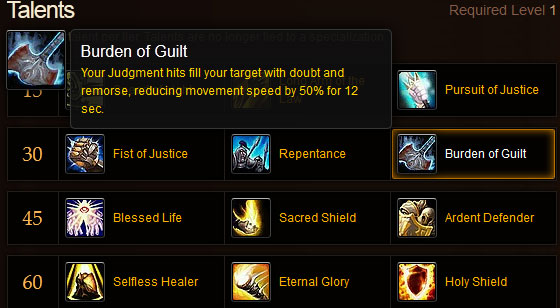
*cue We Are the Champions*
Obviously it is on the same row as a 30 second HoJ replacement and the paladin Sheep, both of which are likely to be better picks in a general sense. Obviously it is not game-breaking and who even knows what will be considered “balanced” at level 90. But… my god, gentlemen. To be denied for seven years, to endure the rationalizations as why paladins don’t need a proper snare, and to have this appear at 4 am on a random Wednesday… it is a sweet, sweet release.
A more thorough examination of the newly revised talent trees will have to wait until tomorrow.
P.S. My god, it’s full of stars…

*cue the sound of one jaw dropping*
Designer Responsibility
How responsible are game designers in the balancing of their (single-player) game?
Syncaine swerves to the right:
One theme I’m seeing is the debate about what is OP [in Skyrim], and how easy it is to min/max the game. I find this… odd. As Nil’s himself pointed out, you can turn godmode on if you want, and be as ‘maxed out’ as you can possibly get. Hearing that people are ‘exploiting’ the game by running into a wall for hours while hidden to max out stealth makes no sense to me. Why waste all that time, just go into the character file and put stealth to 100. […]
“Am I to blame?”
Yes.
Luckily the solution is easy; remove one or more of the enchanted pieces, or up the difficulty, or RP a reason why you no longer require mana to cast spells.
I’d rather you do that then Bethesda spend time hardcoding a solution over adding yet-another-quest, or whatever other content they could do in that time. Or have the hardcoded solution prevent me from play “how I want”.
If this was an MMO, 100% valid point. If it was a multiplayer game like Dungeon Defenders, still 100% valid. An sRPG that is far more about the journey than the end-goal? Naw, non-issue IMO.
Nils has a more center-oriented approach:
I agree that it is partly in the player’s responsibility to not optimize the fun out of his game. An example would be sneaking against a wall until you have maxed out stealth in Skyrim.
On the other hand, I just uploaded a video to youtube that shows how I enchanted four items and now can cast destruction and restoration spells witout any mana cost. This is a game changer, as the mana constraint was important in the game – until then. Many of my perks in the talent trees are suddenly useless. The game becomes worse. Playing it is less fun if I can just spam a single spell without looking at mana.
I optimized the fun out of Skyrim. Am I to blame?
The problem is that I ended up enchanting my equipment this way not by sneaking against a wall. I simply skilled enchanting and then used reasonable enchantments on my equipment.
My point is this: A game cannot use the cartot, that character power progression (CPP) is, to increase the player’s engagement with the game, and at the same time allow him to optimize the fun out by hunting the carrot in a reasonable way.
My own left-leaning approach is the same as I outlined in the Culpability of Questionable Design, the very first post I made under the In An Age banner. Essentially, it is (almost) always the designer’s fault.
Don’t Hate the Player, Hate the Game
As I commented on Syncaine’s post, I find it bizarrely apologetic to state that it is a player’s responsibility to not ruin the game for themselves. The specific situation in Skyrim Nils had brought up was the ability to eliminate all mana/stamina costs of spells and abilities via Enchanting. Nils had gotten his Enchanting skill up “legitimately,” as opposed to, say, getting 100 Sneak by auto-sneaking into a corner for a several hours. For the record, I see zero difference between those two activities – both are simply examples of incredibly poor design ridiculous failures of imagination.
In Oblivion there existed a Magic College where you could invent your own spells and magic items, within certain constraints. Making a Fireball spell that dealt 100 damage was expensive, whereas a 50 damage Fireball cost less. Similarly, a buff/debuff that lasted an hour was more expensive than one that lasted for only 1 second. After about an hour of playing with the various sliders, I left the College with a ranged spell that decreased the HP of the creature it touched by 100 for 1 second. The practical effect was that it instantly killed everything in the game, at least until I gained many more levels – even then, if I fired it quickly, the second hit would kill anything with less than 200 HP since it stacked with itself. I called this spell Finger of Death, and later added it to a sword along with the Soul-draining property so that as the sword instantly killed who it touched, it refueled itself.
I did not set out to break Oblivion, nor did Nils set out to break Skyrim; the both of us were simply using the tools the designers gave us and taking them to their logical conclusions. It is the responsibility of the designers to ensure that incredibly obvious things (at least in retrospect) like “-25% mana usage” does not stack with itself, that temporary decreases in HP scale the same as damage abilities when their effects are indistinguishable, and so on, are balanced. Arguing to the contrary is to admit that WoW leveling is not too quick since the player can manually shut off XP, that facerolling mobs and instances is a player failure as said player could play with just one hand, play with a gamepad, play with Resurrection Sickness, or any number of entirely arbitrary self-imposed restrictions. It is to abdicate, wholly and completely, any responsibility of the designers to present a balanced, well-paced experience.
Syncaine is right about these games being about the journey, not necessarily getting to the end as quickly as possible. And yet I derive deep satisfaction in the execution of strategies, figuring out how rules/objects work, and finding more efficient ways of doing tasks; those things constitute the journey to me. Turning on god-mode in the console may have the same end result, but it skips all the fun, thinking bits inbetween, just like skipping to the last chapter of a book. In other words: optimization is fun.
And so I believe it is – and has to be – the designer’s responsibility to ensure that if a game can be optimized, that it still continues to be fun and challenging when it inevitably is. Anything less is laziness, incompetence, or both.
The 5 Stages of PC Shopping
Stage 1: Denial
I just got a new computer about two years ago. Everything runs completely fine!* What would I even do with the old computer? You know those people who buy a brand new car every other year, and how much you hate them? Don’t be that guy.
Besides, you have plenty of indie games and MMOs to keep you busy practically for years to come. Who cares that everyone is talking about Skyrim?
Stage 2: Anger
Why do developers do this shit?!
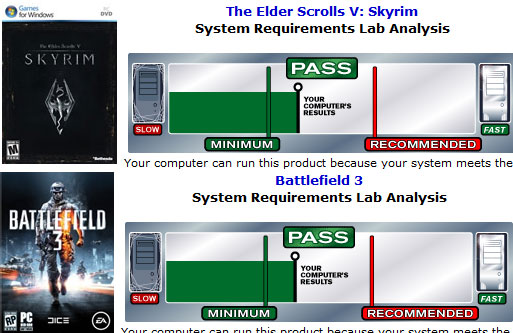
I paid something stupid like $1400 on a computer two years ago and already I’m being priced out of videogames? I could have spent that money on a PS3 and XBox 360 on launch day and been good for the next seven years! This is why there will always be a market for consoles; what kind of insane person buys the equivalent of $700 videogames?
And when did the computer component world pass me by? “Sandy bridge” my ass.
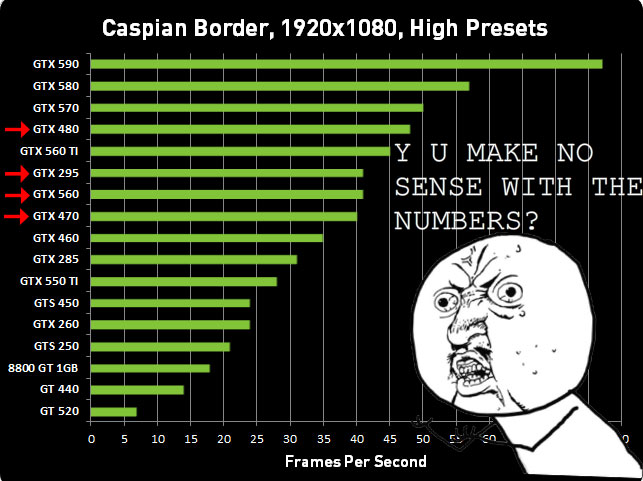
You know, I had a real handle on graphics card models back in the day. I could explain that a NVidia 8700 was more powerful than a 9500 – the trick was that the first number was a model number, and only the last three digits meant anything important. Nowadays, the NVidia guys are telling me that their goddamn GTX 295 outperforms their GTX 560. Sounds sorta like the old system, right? But wait! The GTX 480 spanks them both. You can’t explain that!
Stage 3: Bargaining
Okay, you win. I spend probably close to 90% of my free time using the computer, and two years is like a decade in internet years anyway. If I just cave and buy a console, I’ll miss out on all those ridiculous Steam deals; the money I’ll save probably makes the price a wash. Nevermind that my computer monitor is larger than any TV in the house… and I really, really want to play Battlefield 3/Skyrim/etc.
I don’t need the bleeding edge stuff. Maybe something that, you know, is done bleeding but still warm. For about $1000.
Stage 4: Depression
I have no idea WTF I am doing. NVidia helpfully says I can buy everything off of Newegg for ~$700 and then build it myself. That’s great… until I start reading shit like this:
Static electricity is the biggest danger to the expensive parts you are about to assemble, even a tiny shock, much too small for you to feel, can damage or ruin the delicate electronic traces, many times smaller than a human hair, that make up your CPU, RAM and other chips. It’s important to use your anti-static wrist strap to prevent damage to these components. Once you have the power supply installed in the case, clip the end of the wrist strap to the outside of the power supply. (Never plug your computer in while you are connected to it by a wrist strap.)
[…]
Installing the CPU, and the CPU’s heat-sink and fan, are by far the most difficult steps you’ll have to complete during your build. Here, more than anywhere else, it will pay to read the instructions carefully, look at the parts, study the diagrams that came with your CPU and/or third party cooling solution, and make sure you thoroughly understand what you are going to do before you try to do it.
There is no getting over the sense of impending doom that is knowing it is possible to destroy a CPU with static I won’t even feel, and can probably launch just by looking at it funny. Christ, I cannot even look at a Micro SD chip without getting an insane urge to put it in my mouth.
There is no way this is going to work.
Surely though, with components at $700 I could find some place willing to build it for me for like $300, right? Everyone tells me its easy, so that should be an easy $300. Except… not so much. Oh wait, this computer looks pretty cool. Hmm, let me check out the comments.
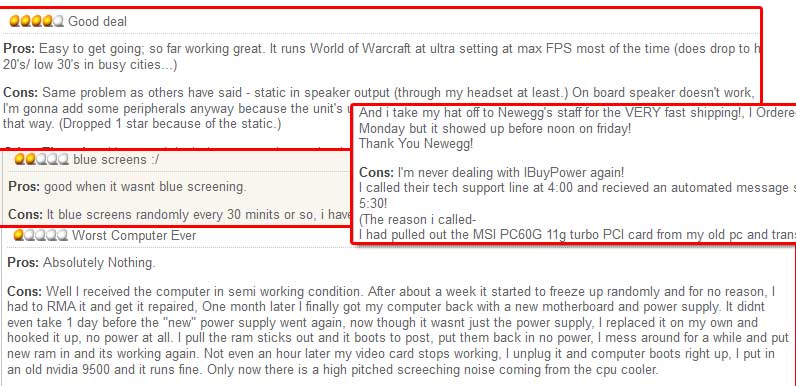
Negative Newegg.com comments make me mistrust all technology, everywhere.
I don’t know what to do anymore. Maybe I shouldn’t scrimp on a computer. My current computer was like $1400 at the time, so maybe I should look at the higher end machines and just go for it.
Wow… look at this $1600 machine. Liquid cooling is badass. Alright, having the liquid cooling leak all over the inside of the computer during shipping sounds less cool in the comments. I suppose I could at least look at the Youtube video they provided.
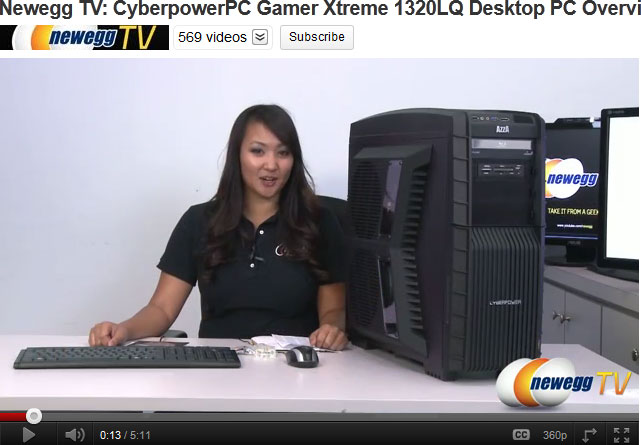
Holy mother of Christ, is that Asian chick just tiny or is that case really the size of a goddamn diesel generator?
You know what? I can’t do it. I just can’t. That thing costs about 1/4th of what I spent on my car, and is about 1/4th the size of the car to boot – at this point, I would be shopping for a new desk just to have somewhere to place a computer, a new chair to fit the desk, and renting a crane to lower the case through a recently installed skylight. All the while praying to any god that would listen so that some component I cannot begin to touch without frying it did not come loose in shipping.
I can troubleshoot software no problem. But I know just enough about hardware to know I will A) screw it up building it myself, B) get screwed buying pre-built machines on the cheap, or C) get screwed buying expensive pre-built machines only 1% better than the half-priced prior generation machines.
Stage 5: Repeat Stages 1-4.
Until I break down and buy something from Best Buy simply because it offers the safety of having a physical location to direct my ire. Not that any of them ever have an idea of what they’re talking about, aside from sending the computer off to Asscrack, Alaska for the next eight weeks.
But hey, the devil you know…
*For given amounts of fine. For example, my audio-out only delivers sound from the left speaker. Headphones work fine, but I have bought 3 different sets of external speakers over the years, and all of them had the same problem. Of course, none of the audio cables fit in all the way, but I’m tired of spending $20 a pop guessing.
[Metanarrative] Population: 1
What does Atom Zombie Smasher, Far Cry 2, and Xenogears have in common?
I don’t actually know what to call it. But maybe I can describe it.
Just recently I completed Atom Zombie Smasher, a pseudo-puzzle indie game with some rockin’ Hawaiian surf guitar music. You basically try and save as many civilians as possible before the zombies eat them, with only a handful of various mercenary units. The game looks like this:
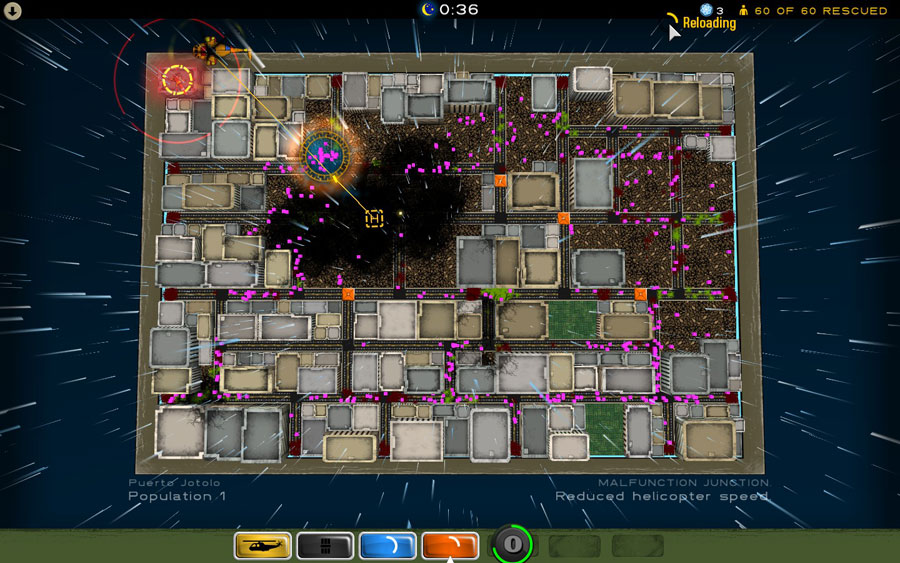
Evacuation complete.
At some point while playing it, I suddenly realized that this is the first zombie apocalypse game I have played that evokes the full horror of the scenario. The traditional vantage point is being the survivor hero struggling against insurmountable odds on your desperate run towards the helicopter.
In Atom Zombie Smasher you are the helicopter.
Specifically, you control where the helicopter lands, along with the deployment of snipers and artillery strikes and so on. Your life is not at stake here. All you have is your dispassionate duty to save 60 civilians out of the 125 in this section of the city. Other sections have higher populations, but the requirement is always a fairly low percentage of the total.
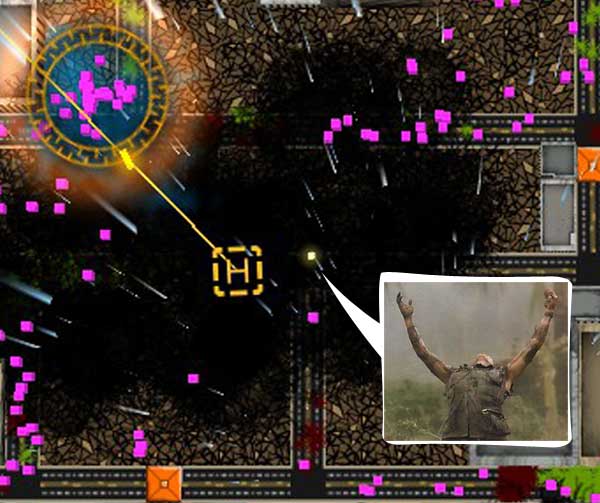
NOOooOOOoooOooo!!!
And that is when the horror comes in. When you see that lone purple dot making its way towards the desperate, waiting crowd of yellow dots. All it takes is one zombie; I’ve seen it happen. The panicked movements as the civilians catch on. They’re packed in so tight, so tight. The helicopter was just here – most of them are exhausted, having ran after hearing the fog horn from three blocks away. A single sniper shot would save their day. Their day, not the day – the 874th Rising Lightning sniper squad are the only thing keeping 5th and Main intersection clear of zombies, and the eventual airlift of the 50 civilians on the other side of town.
I make the call.
As the helicopter flies overhead and beyond the sight of the crowd, I like to imagine that all their faces stay turned skyward, despite the feeding frenzy beginning at their periphery. That the last thing most of them feel is not being eaten alive, but the fading sun on their face, followed by the merciful and cleansing fire of an artillery blast. I cannot save everyone, but I can save them from that fate. And… and… they are easier targets to hit than zombies.
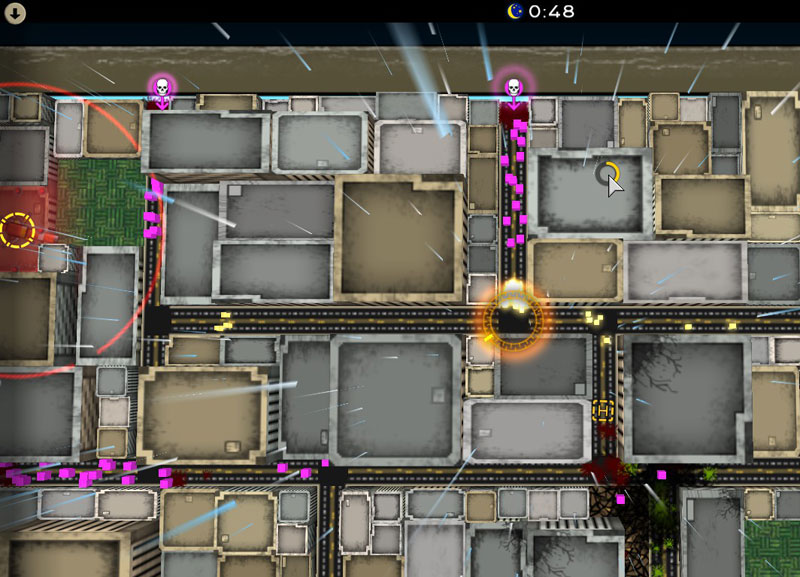
I never even knew their names.
May God have mercy on my soul.
Review: Sanctum + DLC
Game: Sanctum + DLC
Recommended price: $10 (as in $10 for game + DLC)
Metacritic Score: 70
Completion Time: 12-20 hours
Buy If You Like: A little FPS in your Tower Defense
Sanctum is a Tower Defense game combined with FPS elements that starts blurring the definition of an “indie” title. The gameplay mechanics are tight, the background environments are amazing, and there is an overall degree of polish not necessarily seen in $10 games. About the only thing missing is something in the way of a narrative, which would arguably be out of place in a Tower Defense game anyway.
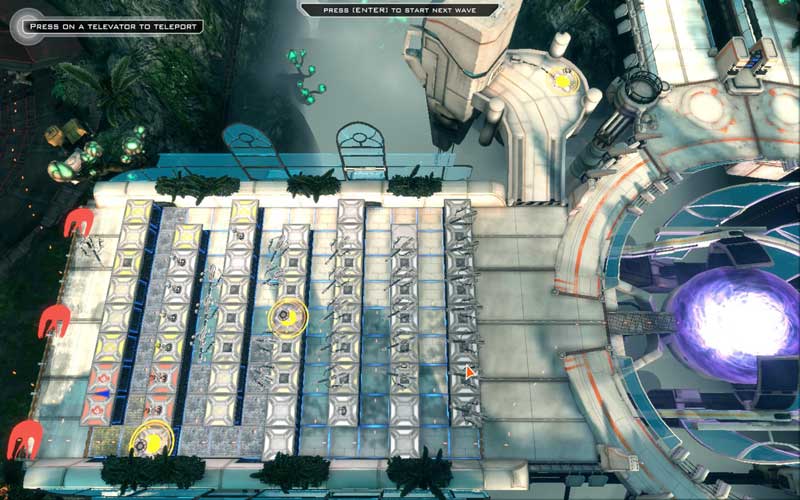
Not the most efficient maze by any means, but I was a noob.
That is not to say that Sanctum gets everything right. The base game goes for $9.99 on Steam, but includes includes only 6 maps. While you may spend 1-2 hours per map depending on whether you beat the 25-30 waves of aliens on your first try or not, the maps themselves correspond closer to archetypes than maps per se. For example, there is one completely open map, one map with aliens spawning on opposite sides, one ultra-huge map, one map with a maze pre-built, and so on. If you particularly enjoyed ultra-huge maps, well, you get just the one. Theorhetically Coffee Stain Studios can simply add more, but given the fact that four maps have been added as $2 DLC, it may soon start getting too expensive for the entertainment generated.
The one thing Sanctum has going for it is that each map supports a lot of customization options in terms of building mazes and placing towers. Indeed, the building of the maze to begin with feels like its own distinct game (which it arguably is). So if your favorite map is Arc, as long as you don’t build the same maze with the same towers while equipped with the same guns, it will be subtly different. Combine that with up to 4-player co-op and 4 different Survival Modes and 4 different difficulties, and the limited map options feel less oppressive.
That being said, keep in mind that Sanctum is a Tower Defense game at heart with FPS thrown in as well. Each wave is stronger than the last not through numbers or strategy, but simply an increase in alien HP. While upgrading your weapons and towers with resources generated via completed waves generally keeps pace (at least on Normal), the “difficulty” of the game really comes down to shooting the same thing more times. And since there is no randomness in alien behavior, the waves or types (you can see what’s coming 5 waves down the line), playing for long periods of time can quickly burn you out. Which probably could be summed up with “it’s Tower Defense, stupid.”
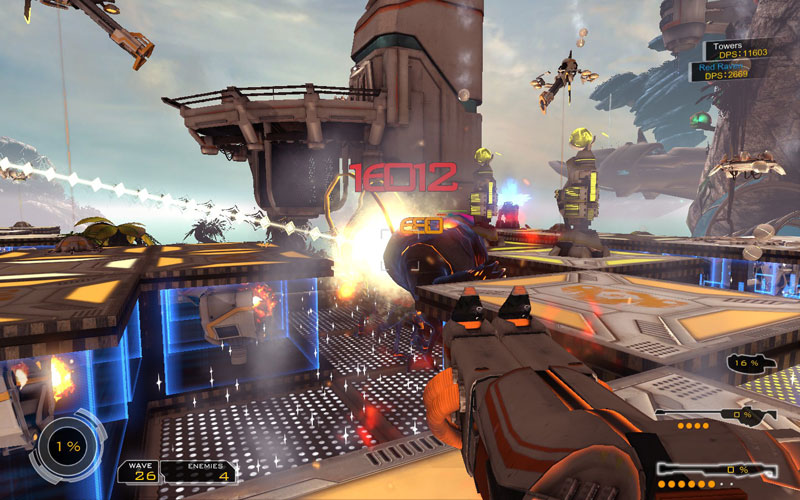
There is something very satisfying about getting your hands dirty.
Sanctum DLC Review:
Killing Floor ($0.99) – Floor tile that acts as a rechargeable land mine. The one big plus of this tile is that it consistently will damage Hoverers (i.e. the floaty aliens immune to damage from the front). That being said, I have found these fairly weak in comparison to standard Slow Fields or Amp Fields which come with the base game.
Penetrator ($0.99) – Tower block that shoots a beam that damages all enemies in a line. Sounds amazing at first, but its slow rate of fire and tracking issues means it will shoot diagonally most of the time and otherwise completely waste its multi-damage capability. Not recommended.
Violator ($0.99) – Tower block that creates a floating sniper rifle with a monsterous range that can hit ground or air targets with a single, powerful shot every few seconds. Personally, this is about as close as you can get to Pay To Win in a non-competitive game. The Violator can be a liability if you get both a bunch of fast ground AND air aliens since it may waste its shots on the little ones, but otherwise… god damn. This is typically my go-to Tower once the early Towers are out of the way.
Map: Aftermath ($1.99) – I am not a huge fan on this map for three reasons. The first is that the sloped middle section makes it much more difficult to traverse the tops of blocks. Second, there are frequently small gaps between blocks that can lead you to falling inbetween them in a heated moment. And finally, the overall layout prevents much Tower overlap, even with Violators. That aside, it has three decently-sized rectangle areas for maze placement and good Line of Sight to enemy spawn locations.
Map: Aftershock ($1.99) – Much like with Aftermath, this map features three main areas, has some angled terrain, and the possibility of falling inbetween some blocks. However, the map itself is more compact (good Violator/Morter coverage) and the maze itself is practically pre-built for you. That can either be good or bad depending on your tastes.
Map: Cavern ($1.99) – This is a heavily multi-tierred, practically pre-built non-air gauntlet. Cavern also introduces the concept of teleports for the first time, along with a sort of jump pad that will quickly send you flying up to higher levels. On Normal difficulty, I found this pretty ridiculously easy.
Map: Slums ($1.99) – Once again, a heavily-tiered map that essentially consists of two squares and two small rectangles to build mazes in. One of the complicating factors is that there are multiple teleports on each level, which can make planning even a simply maze feel like three-dimensional Chess. Since ground units emerge from a single location though, I found this map overall ridiculously easy on Normal difficulty – most foes died before they could make it off the first “island.” Combined with a default of only 13 waves, this felt like the shortest map in the game.
DLC Summation:
I received the three weapons for free as part of a bundle, and picked up the four maps on a Steam sale for $5. Given that I got everything for essentially $10, I am satisfied. Picking these up at non-sale prices… I would probably skip everything but the Violator. The four maps are fine, but since Aftershock, Cavern, and Slums come essentially pre-built, I don’t see much in the way of replay value.
Review: The Binding of Isaac
Game: The Binding of Isaac
Recommended price: $5 (full price)
Metacritic Score: 84 (!)
Completion Time: Technically ~1 hour, or 20+ hours
Buy If You Like: Twisted, roguelike Flash games
The Binding of Isaac (hereafter Isaac) is a game that, strictly speaking, I should not enjoy. Indeed, I did not enjoy it at all the first few times I played it. But I did keep playing it, and once I sort of stumbled my way out of fifteen years of safe game design, Isaac rekindled a bit of that stubborn old-school gamer flame that propelled my younger self face-first into Battletoads hour after bloody hour.
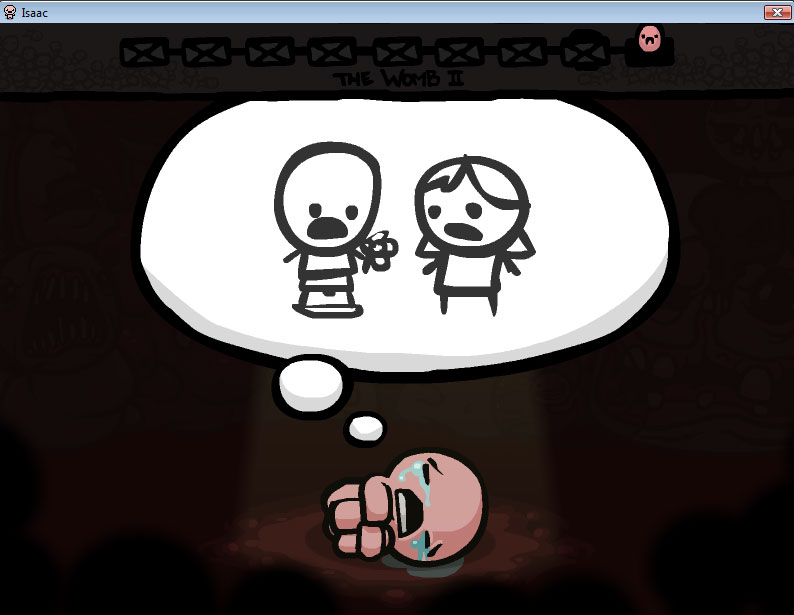
This is what the first few hours will feel like.
Isaac plays like Smash TV from the olden days, with WASD controlling movement and the arrow keys controlling which direction you eject the streaming tears from your naked body at the merciless demons haunting your childhood nightmares. Map layouts and room contents are randomly determined each time you start the game, with the only consistency being the number of total levels, and there being Item and Boss rooms on every level (until the last few, which have no Item rooms).
As I mentioned, the game did not seem terribly fun the first few times. There is no quick-save, there are no checkpoints, and I got the feeling that I was lucky to even have a pause button. Death is permanent, none of the items you receive are really explained before you use them, many items can actively harm you in some way, some room setups are completely unfair, and it is both entirely possible and very likely that you will get screwed right from the very start with things only getting progressively worse.
Sometime around my fourth attempt, it suddenly all clicked: this is like Solitare. A game you play because you aren’t sure you want something heavier, a game that you don’t have an expectation to beat every time, and yet something you still find fun hours and hours later.
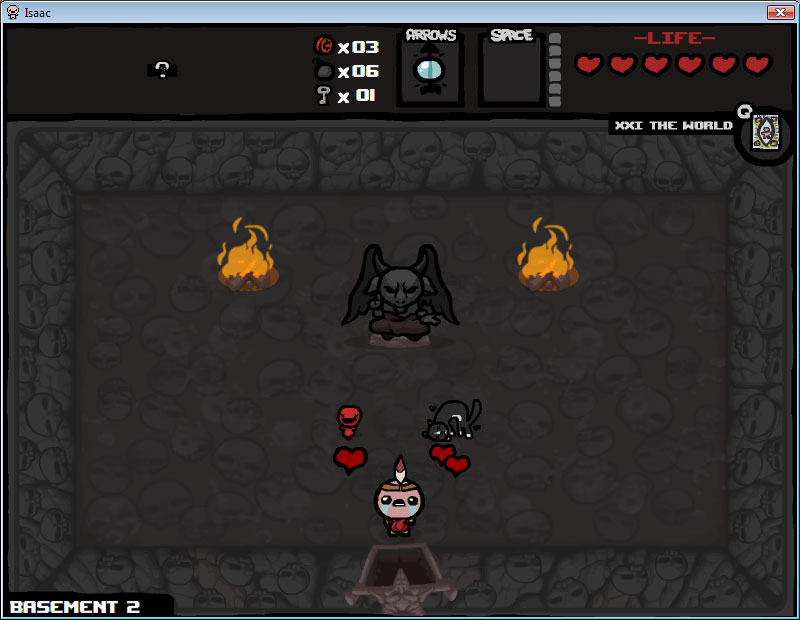
Isaac gives you plenty of opportunities to make bad decisions.
And I have indeed been having fun hours and hours later; 20+ hours to be exact. Although you never carry over items you accumilate, beating the game or getting specific achievements will unlock new items that are then added to the random roster, some of which will radically change the tenor of a particular run. I have a few more specific achievements to grab by beating the full game with different characters (basically different starting load-outs) before getting to the truly ridiculous “take no damage for X levels” kind, so it will be interesting to see if the game is still fun once those dry up.
But you know what? Getting more than 20 hours of game time in a roguelike, a genre that I was hitherto convinced I would despise on principal, is an absolute goddamn steal at $5.
Class Q&A Highlights
There were 11,786 words in the latest Class Q&A. Here are the more interesting 668 of them.
Q: A lot of warriors feel like the stance mechanic is a bit outdated. Are there any plans to make changes to warrior stances in MoP such as giving the passive stance bonuses to each spec or allowing all of the warrior abilities to be usable in all stances? I say the latter because I know a lot of Arms warriors would love the 10% damage boost over the 5% damage boost and 5% damage reduction. Thank you.
A: At the moment, we are considering Berserker as a +AE damage stance and removing all stance penalties and restrictions. Just use Battle for single-target and Zerk for AE. That isn’t set in stone of course.
The funny thing about answers like this is how many people would leap about with their cries of “Dumbing down!” and “Homogenization!” without examining the actual value of the original design. I do not have a warrior main, but I did have a warrior that I played long enough to be completely baffled as to how the Stance system survived for so long. Simply put: how in god’s name did the designers intend the class to play out? I specifically bought a new mouse with buttons on the side solely for playing my warrior, and it amazes me that there is not an in-game tutorial on macros when warriors essentially require them to function even on a basic level.
Maybe the argument is that Blizzard did not intend for skills like Spell Reflection and Shield Wall to be usable as an Arms warrior in PvP – they are certainly impossible to use effectively (if at all) without macros and addons “out of the box.” Then again… stance dancing to avoid fears as a Prot tank has been in the game since Day 1, and PvP has to be balanced around what happens, regardless of the intention. It just seems like bad design odd to me for a class’s skill gap to actually include completely “new” buttons.
I was waiting for a new talent to make Spell Reflection no longer require a shield, for example. It’s tough enough to gauge the optimal moment to utilize the skill, let alone make the determination far enough in advance for your weapon-switching/SR macro to work. Compare that to using, say, Grounding Totem, a spell interrupt, or even “Vanishing the Death Coil.”
Q: Class homogenization has been problematic in the eyes of the player base. How are you planning to make classes feel unique while still maintaining the “bring the player, not the class” ethic?
A: Homogenization is one of *the* hardest challenges we face. Players become upset if they feel like they are losing what is uniquely theirs, but then they get just as frustrated when they lack e.g. self-healing or mobility or a cool toy that another class gets. With 11 classes and parties, (some) raids and PvP teams much smaller than that, we can’t make every class mandatory and we don’t think it’s reasonable to have 11 (or even 34 if you include specs) spells, buffs and mechanics that are unique but completely equal. We just try to keep the pulse on the community and see when players think we have gone too far or not far enough.
This next bit might start a firestorm of controversy, but we heard from a lot of 10-player raiders who asked “Why make a rogue legendary? We don’t have a rogue.” When we asked why, they said ‘Rogues don’t bring anything we need, so we don’t want them.” That’s not cool. I’m not saying the legendary is the answer for why bring rogues, but you should feel like you have room for rogues without sacrificing something else and that rogues should bring something that makes you happy they are there.
I think the biggest benefit of Ghostcrawler’s more open communication model is to highlight how much of game design is wild-ass guessing. And I do not mean that to be snarky. A designer could be “correct” in saying that change X isn’t increasing homogenization, but if the players feel differently… what does it matter? If a good design leads to decreased revenues, then can we really say it’s good? I would like to think so – what is Good and Right is not necessarily popular in politics and philosophy, for example – but then again games exist to be played.
As for the nonsense about rogues, a better answer to “Why don’t you have a rogue?” would have been “No one picked one/they aren’t fun to play.” Bring the Player is a design model centered around playing with people you enjoy playing with. So to suggest that we should “feel like we have room for rogues” is asinine if everyone you want to play with independently decided not to use one as their main. And it is asinine to make an entire legendary quest-line for a single class anyway, whether it was rogues, paladins, shaman, or whatever.
Q: I’m glad to see you guys are still interested in making the talent system as unique as possible, but it seems like by giving so few choices that cookie cutter specs will be even MORE easy to come up with then now. i know there will always be “the best choice”. but if you guys do all this redesigning just to have the same outcome, what do you have in store to try and fix it from there? and are you concerned the new talent trees might not offer the unique build options players want to have?
A: Since so many of the talents focus on survivability, movement, and utility we are skeptical that there will ever be a talent build that is the perfect build for every PvE fight in the game. It is likely that as players learn specific encounters, each spec finds an ideal set of talents for that encounter. Those will be the “cookie cutter” builds. However, that will mean that players are interacting with the system and picking a unique set of customizations on a frequent basis. This is a vast improvement over a system that is solved once by a dps spreadhseet and then everyone copies that build once and ignores their talents for the rest of the expansion. In addition, there will be likely disagreement over which talents are best for which encounters.
This, to me, is one of the best possible answers they can make in response to a lot of the talent criticisms.
Q: Some of the MoP talents seem really “OP”, is this intended?
A: One of our core design philosophies is “Make it Overpowered”. As much as possible, we like to start with abilities being very strong, and then correct problems as they occur.
I don’t know if this is more amusing as a joke, or if they were serious. Well played.
Q: How will low level balance be fixed in Mists of Pandaria.Right now you can one shot a lot of npcs or players at low levels.
A: We plan to put some additional careful effort into balancing low level combat for MoP.
Balancing the leveling game will be Big News to a lot of bloggers, should it actually occur. We’ll see, although it will likely be much too late for a lot of people who actually care about the fidelity of the leveling experience.
Delving Into the Earnings Call
The last time I talked about an Activision Blizzard earnings call, I had just quit the game myself. Now in Q3, you have undoubted heard that a further 800k subs were lost, bringing WoW down to 10.3 million. For those keeping track at home, the last time WoW was at ~10 million was in 2008 right during the release of TBC in China.
While sites like MMO-Champion and WoW Insider are nice for giving us summaries, I’m interested in the nuance inside the earnings call itself. Feel free to read alongside me at home (curtsey of Seeking Alpha).
1. Majority of the sub loss is occurring in the East.
You have probably already read the above bullet-point summary, so I’m here to assure you that Morhaime does not get more specific than this.
2. Implicitly, the difficulty of Cataclysm content was the cause of sub losses.
Feel free to try and read something different from these paragraphs (emphasis added):
That said, we know there are improvements that we can make in gaming content. The level-up content in Cataclysm is some of our best works. But it was consumed quickly compared to our past expansions set, Wrath of the Lich King. Once players reached max level, the end-game content in Cataclysm is more difficult. Balancing this content for our diverse player base can be very challenging.
Our development team is constantly analyzing the game, and we’re continuing to explore ways that we can adjust the game to better satisfy both hard-core and casual players. To that end, our next free major content update for World of Warcraft is already in testing and will be available for players in the coming weeks.
Now, the funny thing about this is how Blizzard may have cost themselves millions of dollars in lost revenue by pushing Cataclysm on the Chinese instead of letting Wrath work its magic. After all, Cataclysm was released in China on July 12th whereas Wrath was out in mid-August of 2010, a difference of 11 months. I am not sure whether Cata heroics came pre-nerfed like they ended up in the West, but even if they did it would still be worlds different than how it was in Wrath.
Which, no matter your feelings on the expansion, gained ~1 million subs and largely kept them until Cataclysm.
3. Expect some (more) “aggressive” World of Warcraft marketing.
Specifically: “We have other aggressive marketing plans in the coming months for World of Warcraft, but we’re not ready to share details yet.” Morhaime was then grilled in the Q&A section for further information.
Can you give us some additional color on what’s happening to engagement and subscriber levels for World of Warcraft, particularly following that big expansion pack announcement? Where do you think the subscribers are actually going? And I’ve got a quick follow-up.
Okay. Well, as you know, we don’t provide a forecast on subscribership levels. But I’ll say is that the announcements at BlizzCon were incredibly well received. There’s a lot of excitement around the expansion and the upcoming content in the next patch, which will be introduced in the next couple of weeks. It is currently in test on our public test realm, and we’re very excited about that content. I guess, I can say this, the majority of the declines were in the East. China still represents more than half of our global player base and historically, December has been a very good month for subscriber trends. We have a number of initiatives planned. We plan to be very aggressive in terms of our marketing promotions, and we’re looking forward to the end of the year.
It is an open question what kind of aggressive marketing Blizzard can even do with WoW. If they lowered prices on some of the other services like server transfers or even weekend sales or whatever, that might go a long way in getting me back – I’m not coming back to a dead server and then immediately spending $35+ to move one toon and just 10% of my wealth somewhere else.
Beyond that, what can they do? I doubt something like the cost of the box is keeping people away.
4. Patches are more about recapturing the recently churned.
Nothing ground-breaking, I just find it interesting.
Just out of curiosity, when you’ve had big patches before with World of Warcraft, what type of subscriber uplift do you typically see?
Well, historically, with the content updates that we’ve done, it’s really not intended to go out and drive new user acquisition, that’s a whole other strategy. But it does drive engagement with the game, and so that will impact churn, if we do it successfully and eventually will drive win back, as players tell each other about the content they’re enjoying. We’ll hopefully see a lift in our ability to win back players that may have already churned.
And that wraps up the earnings call.
 In An Age
Great Timing
Nov 22
Posted by Azuriel
When I originally saw the MMO-Champion post about free SWTOR beta keys, I was excited. And, hey, I actually got a key! Oh… what? It’s a key to enter the drawing for a chance at downloading and playing a 20+ gig client for more than a day 1.5 weeks from now? Wow. I am still trying to imagine a scenario in which downloading a 20 gig game to play for 24 hours or less is not a thinly-veiled “fuck you.” I do not suffer under bandwidth caps, but there is absolutely a cap on my attention span and tolerance for bullshit.
That was a week ago. Last night at 3:23 am, I get the email talking about how I was magically selected for the upcoming weekend beta. I quickly click the link in the email, because apparently the speed at which you click determines the duration of the cock-tease. Fantastic, there is an error. Apparently SWTOR wants everyone who registered before a certain date to reset their passwords. I press the password reset button and wait for the email. And wait. And wait. It arrives at 4:29 am, having taken the equivalent of Pony Express speeds through the Internet tubes, about fifteen minutes after I went to sleep.
Today, I finally reset the password, and attempt to log on to redeem my weekend beta code.
Couldn't they spend, say, $5 million of that $300 million making a goddamn website that works?
Gee whiz, guys. With how concerned EA/Bioware is with a smooth launch, one would assume their goddamn website would be able to handle the traffic generated by the miserly metering of beta codes a week ago.
But you know what? I’m over it. If you notice down at the lower right of the screenshot, there is a Steam notification that Aquaira finished downloading. Aquaria and Crayon Physics Delux and Darwinia and other indie titles for $3.53 care of the latest Humble Bundle that went up today. Not to mention the next Indie Royale bundle will be going up on Friday, along with the inevitable Steam sales over Thanksgiving.
When I quit WoW, I was somewhat concerned about what I would do with all the time freed up by no longer doing daily quests, running heroics, playing the AH and so on. After all, when you averaged the ~7700 hours out it was in the neighborhood of 5 hours a day (albeit most of that encompassed when I was unemployed). What I discovered is that time gets filled up no matter what I do – there is never a time when I am bored for lack of games to play, blogs to read, or things to do. And so I am wondering if I will even have the time or inclination to fit in mediocre MMO gameplay propped up by social strings and glue anymore. Having friends is great; making friends is an awkward pain in the ass.
And unless/until SWTOR starts impressing me a lot more than it currently is, I may stick to the vastly cheaper, and amusingly better quality indie gameplay.
Posted in Commentary, MMO
Comments Off on Great Timing
Tags: Humble Bundle, Indie, IndieRoyal, SWTOR