Blog Archives
[Baldur’s Gate 3] Random Tips
The internet is replete with Baldur’s Gate 3 (BG3) tips, but most of them seem to be the same sort of obvious nonsense you pick up in the first 10 minutes of pushing buttons. I am… also probably going to give you a few of those too. However. Tip #3 may surprise you!
Transferring items across characters is instant, even in battle. If one of your party members is taking an unfortunate amount of damage in combat, but you just now realized they don’t have any healing potions, don’t fret. Just click on whomever has the potions, go into their inventory, right-click said potions, and choose Send To –> X. Viola! This works with anything, actually, including Alchemist Fire, Blunt weapons to give to your Barbarian to take advantage of vulnerabilities, and so on. You can also send Camp supplies out of your inventory at any time, freeing up a lot of weight.
Seize your potential (energy). Everyone finds out pretty quick that attacking from higher ground confers Advantage. What you might not know is that Throwing weapons/objects from higher ground introduces Crushing Damage to the (F=m*a) equation. And there’s no damage roll for Crushing Damage – your enemies just get slapped by science and that’s it. For example, one character threw a Javelin and dealt 10 damage from dice, and dealt an additional 9 Crushing damage for hitting someone with a 0.9kg object from a 10.2m drop. That’s a lot of extra damage not normally accounted for on the preview pane. Also, if your character gets 2 attacks, they get two throws as well. You don’t need to go full Barrelmancy here, but just understand that the lowly Javelin and similar tools/objects can pump out some serious numbers when you have the high ground.
Do not sleep on Sleep. The text: “Put creatures into a magical slumber. Select targets up to a combined 24 hit points. 18m range.” Now, you may be asking why anyone would bother with this spell over something a bit more direct, like Chromatic Orb or whatever. But here’s the thing: there is no saving throw for Sleep. If the target(s) have less than 24 HP, they just lose their next two turns… unless you hit them first, which is automatically a critical hit. Even better, the effect can be split between multiple enemies. Three 7 HP goblins giving you grief? Not anymore!
Is Sleep better than Fireball? No. Also, that’s a level 1 spell vs level 3. But it’s a great follow-up to Fireball to ensure problematic enemies (including bosses!) don’t get a chance to turn things around. It’s just as powerful on your weakest character as the strongest. And bonus tip: the Warlock version of Sleep is always automatically upcasted, letting you knock out higher HP totals for the same Short-Rest slot.
Hello Darkness, my old friend. There is a classic cheese strategy involving using the spell Darkness combined with the Devil’s Sight invocation option granted via Warlock 2: cast Darkness, stay in Darkness, ???, Profit! Basically, you can attack as normal and everyone else cannot. The cheesiness doesn’t end at combat though, as Darkness comes in real handy when doing nefarious things… like stealing. Specifically, Darkness will give you cover to pocket anything not nailed down in the environment, with relative impunity. Just note that shopkeepers will positive ID you 100% of the time if you fail a Sleight of Hand check, even fully engulfed in Darkness.
Spirit Guardians is better than you think. When I read the text, I assumed the spell would cast like a stationary whatever in a 3m range, blah blah, who cares about 3d8 damage when Wizards have Fireball? What actually happens is that the Cleric gains a 3m aura effect that deals 3d8 damage to enemies you walk by. Emphasis on walk by. Since your team is immune, your Cleric can spend all their movement walking in a straight line, zig zagging, or whatever movement set brings one or more enemies 0.1m past the edge of the aura. While you unfortunately cannot just dance back and forth to hit the same enemy multiple times (it only deals damage once per round per target), the aura will stick around an deal additional damage next turn as long as you maintain Concentration. It also reduces enemy movement speed, which generally keeps them close by.
Glyph of Warding is also better than you think. You wouldn’t know if from the awful tooltip, but Glyph of Warding is an amazing spell with seven distinct features, which can be used as traps or just straight-up fired off (if an enemy is inside). Five different flavors of 5d8 elemental damage, a large AoE pushback effect, or a no-HP cap Sleep effect. Granted, the Sleep effect (and others) provide a DEX save which is not always ideal, but it’s hard to argue with how powerful a CC that can be.
One time, at (band) Camp. I’ve talked about this before, but you can rather easily leverage the fact that you have both a large roster of party members and a means to instantly interact with them from anywhere (Camp button). More specifically, you can designate a few members (including the generic hirelings) to be buff bots to the A Team. For example, suppose your main character is a Sorcerer. Should you spend one of your limited slots on Mage Armor? No need! Smash that Camp button, add the buff bot to your party, and have them cast Mage Armor on you and/or any other companions waiting around the camp, then sit them back on the bench where they belong. Some relevant spells:
- Mage Armor
- Light
- Goodberry
- Longstrider
- Aid
- Darkvision
- Warding Bond
- Protection from Poison
- Daylight
- Death Ward
- Freedom of Movement
If you drop a character out of your party, they get super sad and automatically lose Concentration on any spells, so don’t bother trying that.
My Ward is my Bond. Just to highlight this hilarious interaction from the previous list a bit more: you can get a Hireling to cast Warding Bond on your character and then keep the hireling in camp. This will give your character +1 AC, +1 Saving Throws, and only take half damage. Granted, the hireling back in camp will be the one taking the other half of your damage, but who cares about them?
You are not Prepared… but can be! In a big departure from tabletop rules (and general balance), spellcasters with Prepared spell slots can change those slots at any time. Like, any time any time, aside from during combat. As a practical example, a Wizard could cast Mage Armor on themselves and then switch that spell out for something else. Where things get goofy is when the spells in question are Rituals. Casting a Ritual spell (outside combat) means you can get the benefit of the spell without using up a spell slot. So, to put two plus two together, simply knowing these Ritual spells at all means you can effectively cast them at will as long as you play with the UI a bit. A list:
- Disguise Self
- Feather Fall
- Find Familiar
- Enhance Leap
- Speak with Animals
- Speak with Dead
- Detect Thoughts
- Silence (weirdly)
For the most part, this perk is primarily a benefit to Wizards. But, honestly, they deserve it for how much the other spellscasters eat their lunch.
[Baldur’s Gate 3] Too Late Now
One of the infographics from Larian regarding Baldur’s Gate 3 (BG3) is how over 93% of players created a custom character for themselves. I… did not. And it is very clearly a mistake. One that I cannot possibly “fix” now that I’m like 45 hours deep into Act 1.

Why did I not create a custom character? I thought that the game was going to be like Divinity: Original Sin 2 wherein there were very specific story beats that would be better with an Origin character. Although, to be fair, I am not exactly certain that was the case even in that game. But it seemed important enough to do there, so I did so here as well, picking Gale.
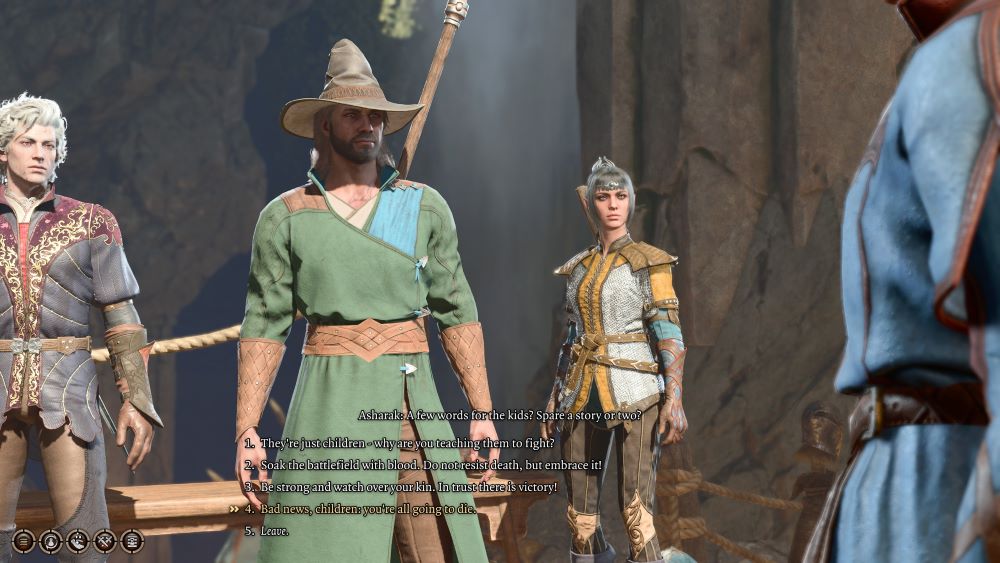
If you are one of the overwhelmingly vast majority of players who haven’t rolled an Origin character, let me explain why it is a mistake: your character doesn’t speak. Yes, custom characters don’t speak either, but I am assuming that Gale has a lot more to say about things beyond 1-2 quips at the conclusion of side quests. I have no clue how much of his background is normally explained by the end of Act 1 (around where I’m at), but I assume that it’s more than practically nothing. Beyond talking to a cat with wings about my mother – of whom I know nothing and have no reason to care about – all this “origin story” business appears to be about as deep as the blurb you read on the character select screen.
Maybe things open up in the later Acts? But what I’m worried about is how that plays out narratively. Are there exclusive scenes that you only see if you are playing as Gale? That would be the ideal, I imagine. But I’m also worried about how much any of that really matters in comparison to just doing his companion quests. For example, I was all down for smooching Shadowheart until the awkwardly direct Karlach literally stole the show. What about Gale though? What is his personality like? What kind of hilarious banter would he be getting into with my current party? I’ll never know, because I am him, and I don’t say shit, apparently.
Well, I choose all the dialog, but you know what I mean. It’s not the same.
Kinda makes me wonder if this is a uniquely Larian game problem. Most other RPGs don’t have “Origin” characters, right? Or they do, with no option for a custom character, so you’re not stuck in this dilemma. Which apparently is only impacting me and the other 7% suckers. Oh well.
[Baldur’s Gate 3] (Un)Intuitive
I continue to play a lot of Baldur’s Gate 3. Indeed, I’m at 40 hours and still in Act 1.
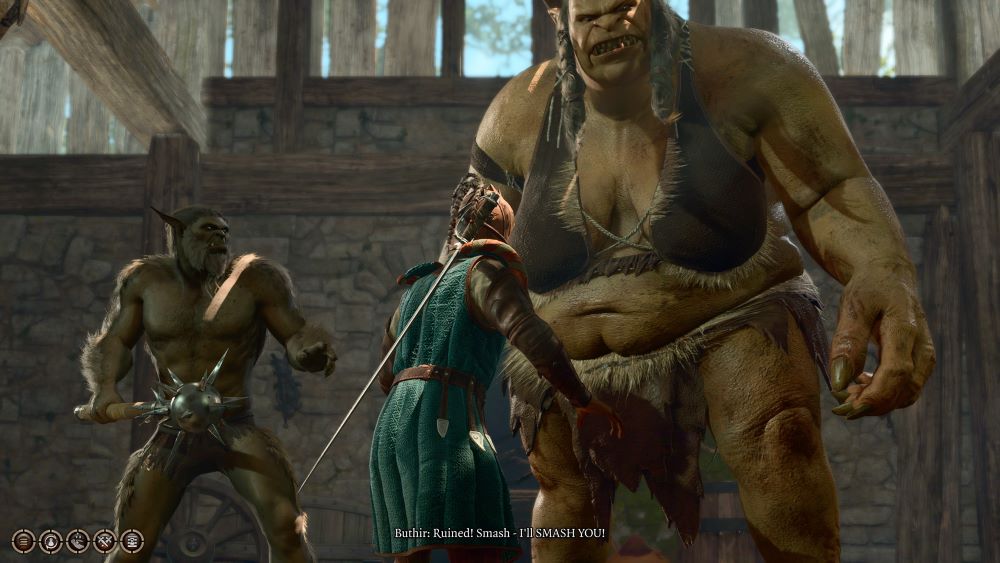
Some of the problems I have with the game are my own fault. I was super into 3.5e D&D way back in the day, and a lot of my “intuitive” understanding of such systems are still based on that clearly superior ruleset. Just kidding – stuff like Short/Long Rests and similar refinements over the years are definitely welcome. But it did come as a bit of a shock that, say, Rogues are only able to get one Sneak Attack per round in 5e (and BG3). Back in my day, the only way a Rogue could keep up with spellcaster DPS output was being able to poke someone three times in one round and get a pile of d6s each poke.
Okay, that’s clearly my bad. But then the line starts getting a little blurry.
For example: Mage Armor says to increase a target’s AC to 13 + DEX modifier, as long as the target isn’t wearing armor. This sounds like a great bonus for a Barbarian who is already encouraged to not wear armor… but it doesn’t “stack” with their own Unarmored Defense ability (Add CON and DEX modifier to AC when unarmored). Like, I get that it would probably be a bit overpowered, but I had to reread the text several times to understand why it didn’t work – Mage Armor specifically puts AC to “13 + DEX” instead of simply increasing the base AC of 10 to 13.
Of course, that’s just the classical Mage Armor gotcha, that apparently has been getting people for 8+ years. Worked in 3.5e, by the way, but clearly if you read page 14 of the 5e Player’s Handbook: “if you have multiple features that give you different ways to calculate your AC, you choose which one to use.” Okay, Rules As Written, got it. But riddle me this, Batman… what does the BG3 spell Warding Bond do?
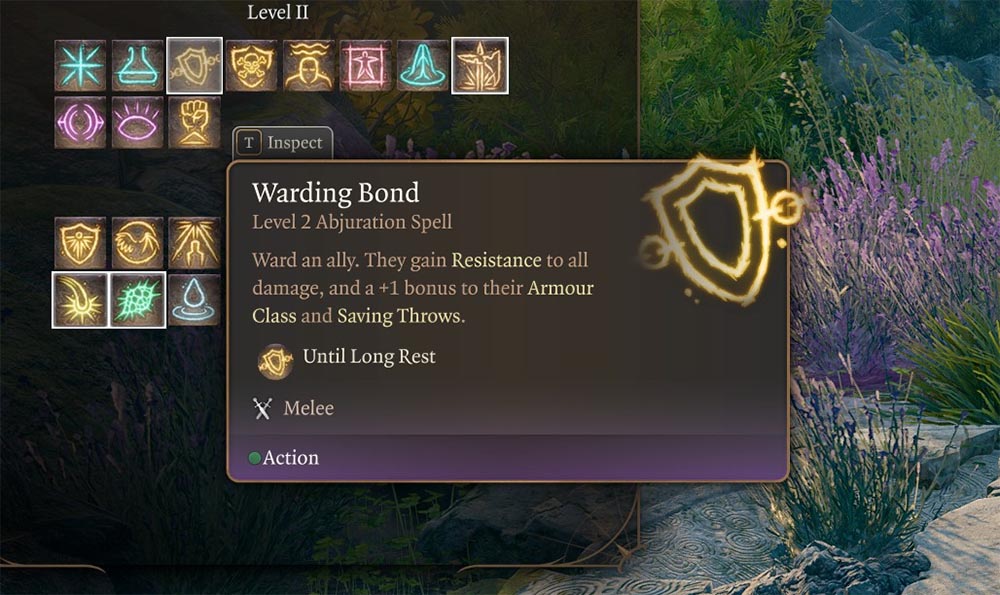
If you answered “create an unstoppable priesthood of clerics that only take half damage from everything,” you would obviously be wrong. Conspicuously absent from the BG3 description of Warding Bond is that the missing half of the damage you take can be found on the casting Cleric. Imagine my chagrin when I found that out, only after reading the “buff” that appeared on Shadowheart. But this is again a case of “just read the 5e Player Handbook to know how this 2023 CRPG works.”
Oh, hey, did you know that in BG3 prepared spells can actually be changed at any time outside combat? This is a big change from traditional (and 5e!) D&D rules that otherwise force you to, well, prepare which spells you can cast that day. What this means is that you can cast Mage Armor on yourself (which lasts until a Long Rest), and then drop it out of your list and put something else more useful in its place. You still use up one “casting” for the day, but now you get more options.
You can take things a bit further than that though, by having characters you’re not actively using cast things like Mage Armor while in camp. For example, you can have Gale cast Mage Armor on whomever, then swap Gale out for someone else. I had already been building my party in such a way that one person took utility spells and everyone else took offensive options, but knowing I could basically press the Camp button to essentially hotswap anyone at a moment’s notice took things to the next level. Now you can have your very own early-WoW era buffbot paladin, whose sole purpose is to stay at camp and buff your team.
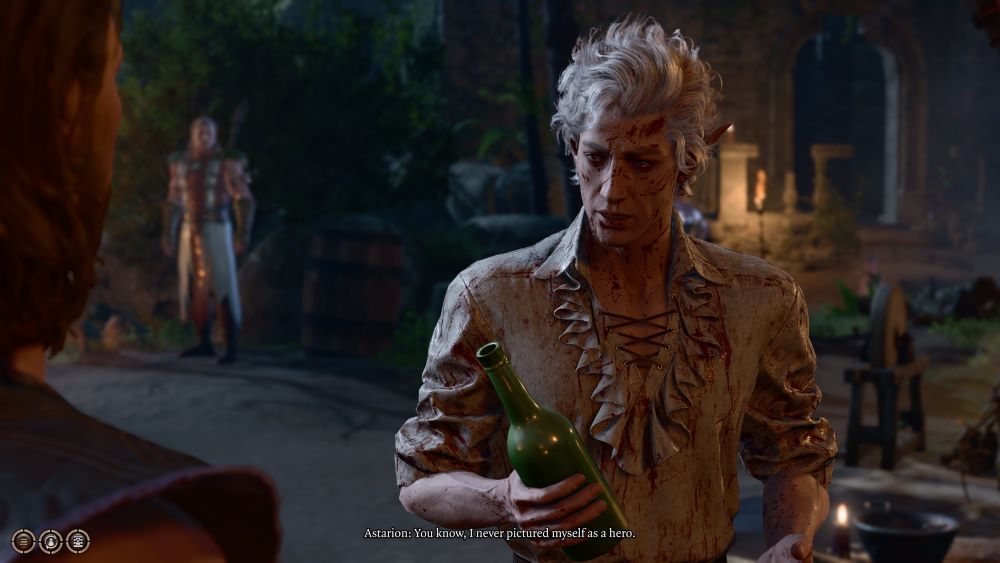
A lot of this highlights perhaps the biggest issue I have with BG3 at the moment: its inscrutability. A lot of the media praise thus far as been for the exact opposite, that the game is making 5e D&D or CRPGs in general more approachable. And that could certainly be technically accurate. But consider this: there’s no in-game way to determine what your characters will get at the next level up… until you level up. You can’t browse a list of magic spells. There’s a staff you pick up that gives you +1 to unarmed attacks and I have no idea how that works. Do staff attacks count as unarmed? Do you hold it in your off-hand and then make unarmed attacks with your on-hand? Does it only work with Flurry of Blows? I don’t even have a Monk character for which this would be relevant, but it vexes me.
And who knows, I might well turn Gale into a Monk next time I gain a level.
Perhaps the “average” player doesn’t care about any of this and will just take their character to level 12 just as they are. But that doesn’t mean Larian shouldn’t also include some kind of indexed in-game encyclopedia or something. If you have time for a Show Genitals button, surely you can have a Preview Level button. I would settle for a Wiki worth a single god damn, because the Fextralife one is near unusable and filled to the brim with outdated Early Access nonsense.
Anyway. Larian has indicated that they are working towards a Patch 1 with a “gigantic list of tweaks and changes.” Here’s to hoping that a little more clarity and intuitiveness is amongst them.
Impressions: Baldur’s Gate 3
Basically Divinity: Original Sin 2.5. But (more) balanced this time!

First, let’s acknowledge the obvious: Baldur’s Gate 3 (BG3) is already a smash hit. As of this post, Steam indicates a peak of 814,466 concurrent players, which makes it the 8th out of the top 10 of all time. Concurrent players doesn’t really mean much in a vacuum, but it is an impressive feat given its peers on that list. It makes me wonder if, like Elden Ring before it, BG3 will generate a renewed interest in an otherwise niche genre that no longer feels like such.
But what about the game itself? Is it as good as they say? Yes. And… sorta.
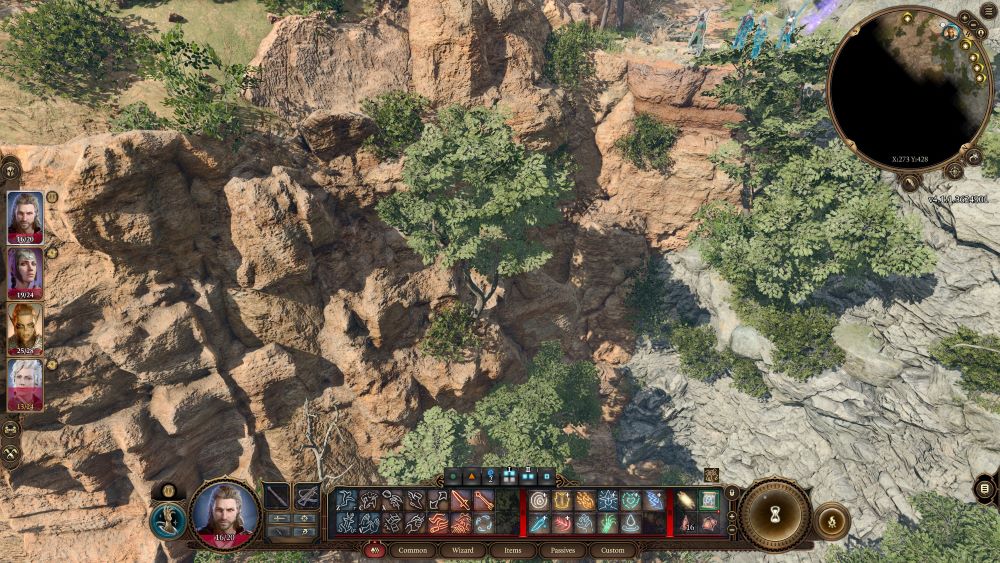
The game is gorgeous and highly, highly detailed. You have near-infinite freedom in designing your character(s), including the Cyberpunk-esque ability to mix-and-match genitals. There are Origin characters you recruit that have their own personal stories and special powers, or you can skip all that and just recruit mercs you make yourself. There are environmental dangers such as webs and oil slicks which you can combo with your spells. You can pick up damn near everything, including forks, knives, incense, exploding barrels, skulls, and most everything else your heart desires. Quests are detailed, dialog has multiple branching paths to take depending on skills, and there are many different ways to complete tasks.
Aside from the genitals though, all of that just describes Original Sin 2.
This is not necessarily a bad thing. My biggest issue with Original Sin 2 was the game balance, or lack thereof. A lot of those issues neatly evaporate in the near-RAW (Rules As Written) embrace of 5E D&D. There is no Physical Armor vs Magic Armor to worry about. Spells and abilities are much more limited, and (sometimes frustratingly) balanced thereby. You can still perform some crazy combos depending on the environment, but there is not an expectation that you will be electrifying pools of blood/water every battle without fail.
An embrace of “traditional” D&D rules can sometimes be annoying however. Spellcasters are limited to a finite amount of spell slots per Long Rest. This is perhaps more balanced than the alternative of being able to alpha-strike enemies all the time. The issue though is how the majority of attacks – at least at level 3 where I’m at – have, at best, a 65% chance of hitting. This naturally leads one to more highly consider the spells less reliant on attack rolls, which heads back into traditional Larian surface-prepping. And once you start heading (back) down that path, you start having your rogue collect explosive barrels and planting them next to foes while in stealth so you can blow up three enemies in the first surprise round of combat. While very fun to do, we’re right back into “Original Sin 2.5” territory.
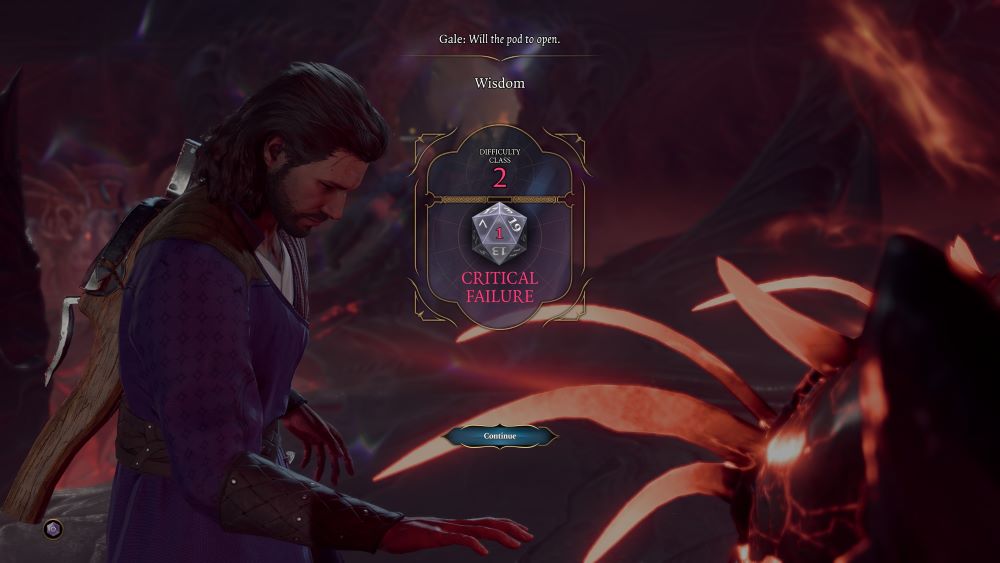
Also, can I just say that I am immensely annoyed that the devs have surpassed even Witcher 3 in the ludonarrative dissonance department? The game opens up with you getting a mind flayer parasite planted into your eye, and everyone repeatedly talking about how you will turn into an mind flayer yourself after 7 days. I am not very far into Act 1 as I understand it, but I have Long Rested twice thus far, and so I should only have five days left before I turn. But I presently see no indication that a time limit actually exists, and would probably have heard about it on the internet by now if it did. While I understand that perhaps the greater narrative will eventually expound on why we don’t turn after 7 days, this false sense of time-sensitivity – combined with the game mechanics of Long Resting for spellcasters – really rubs me the wrong way. It was absurd in Witcher 3 when you “just missed” Ciri despite spending 40 hours dithering around, and is even more absurd here in BG3.
If it seems like I’m just shitting on Baldur’s Gate 3, well… sorry. I have played for 19 hours thus far and the game came out like four days ago. It’s a fun game! But I do recognize that it is benefitting from an unusual sort of marketing zeitgeist way out of proportion to what it is currently (at least in the early stages) bringing to the table(top). It isn’t even the first game to faithfully recreate 5E rules either – Solasta came out three years ago. I have played both Solasta and Divinity: Original Sin 2, so none of what I’m seeing is particularly groundbreaking.
That said, if someone hasn’t played either of those two games or perhaps never seemed interested in CRPGs before, Baldur’s Gate 3 is probably the best place to start. It’s popular, it’s shiny, and it is certainly the most approachable the genre has ever been.
Time will tell whether Larian can stick the landing past Act 2 or if it’s all downhill after the bear sex.
 In An Age
Veni, Vidi, Vici… Vitavi
Mar 25
Posted by Azuriel
Fresh off their supermassive success with Baldu’s Gate 3, Larian Studios confirms… they out:
It’s an amazingly ballsy move to just, you know, move on from something like Balder’s Gate 3. At least, until you realize that Hasbro pocketed $90 million of those BG3 dollars for licensing reasons. Why continue that arrangement when you could just, you know, put the same work into Divinity: Original Sin 3 and keep all the money in-house? Mystery solved.
Or… is it?
Well then.
Good on them. In this age of cynicism, enshitification, and corporate greed, Larian’s stance of actually caring about their team is wildly refreshing to see outside the indie space. Not many companies would be willing to leave giant piles of money on the table. Then again, perhaps it is precisely the passion of new projects that Larian understands will lead them to find other tables with fresher piles of money.
Posted in Commentary
2 Comments
Tags: Baldur's Gate 3, Divinity: Original Sin 3, Interview, Larian, Money on the Table