Blog Archives
Hearthstone’s UI
As you may have picked up on in my Hearthstone Impression post, I am a huge fan of its UI. In fact, it is one of the best UIs I have ever seen in a videogame. Which is… kind of an unusual thing to say about videogames in general, right? Who cares about UI anyway?
Well, technically everyone. A game’s UI is how you interact with the game itself, or glean useful information about the game state. Sometimes you can get away without having an UI at all, like with LIMBO. Other times the designers might get all fancy and try to integrate the UI into the game world itself, like with Dead Space. Most times though, a game’s UI is simply there, and the most you can hope from it is to get the hell out of your way (Skyrim).
It is an extremely rare game that features a UI that actually makes the game itself better. Hearthstone is pretty much the only example I can think of. But why? Let’s break it down:
Emulates the Warcraft Experience
This might sound obvious, but Hearthstone: Heroes of Azeroth is derived from the Warcraft franchise and prominently features characters from said game world. It is one thing to use the likenesses though, and a completely different thing to emulate the color palette, the visuals, and the ineffable mood of the game as well. Everything from the menus to the animations to the sounds feels like it could have been pulled straight out of either WoW or Warcraft 3. In fact, I am pretty sure they did outright copy/paste a lot of the sound effects, at a minimum.
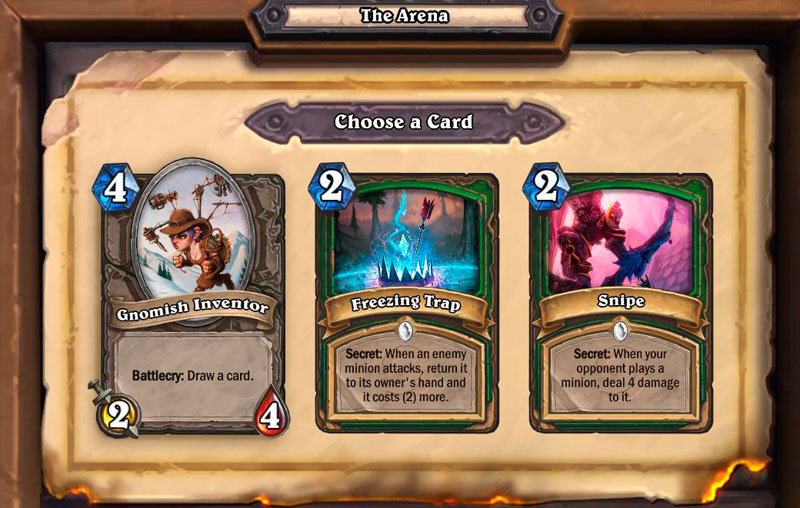
Not all of the iconic cards are good, mind you.
The result of this is that an otherwise completely new gameplay experience will instantly feel familiar to someone who may not have ever played a CCG before. And more subtly, assuming you still have fond memories of the other games, some of those are likely to bleed through via nostalgia.
UI Elegantly Informs the Gameplay
Digital card games differ from regular video games in that their UI essentially is the entire game; beyond the cards themselves, the rest of a CCG match takes place in each player’s head. Hearthstone is literally the first CCG I have played that has attempted to – and successfully accomplished – bring(ing) the mental game back into the visual realm.
For example, when your hero plays a Weapon card, it clanks and rattles next to your hero, while the hero tile itself lifts off the board and goes smashing into your intended target. Then, at the end of your turn, the weapon card (which has long since ceased being a rectangular object) gets hidden behind an oval sheet of iron, which sounds and looks like a full-plate helm shutting. You don’t have to know anything about the specific rules of Hearthstone to know intuitively, from this very UI design, that A) weapon cards let your hero attack, and B) your hero can’t use the weapon during an opponent’s turn.
There are “little” touches like this all over the place in Hearthstone. Creatures with Taunt have a different shape on the battlefield to distinguish them. Creature with Death-rattle (an ability that triggers on their death) has a little skull and crossbones icon on them, whereas a creature with a normal triggered ability has a lightning bolt. Even if you did not know what those icons meant at a glance, hovering your cursor over the creature quickly brings up an unobtrusive cheat sheet description. This is a UI scheme that both enables and enhances your ability to “grok” all the moving pieces extremely quickly.
3) Genre Game-Changing Innovation
Seriously guys, this screenshot has pretty much ruined all other CCGs for me:
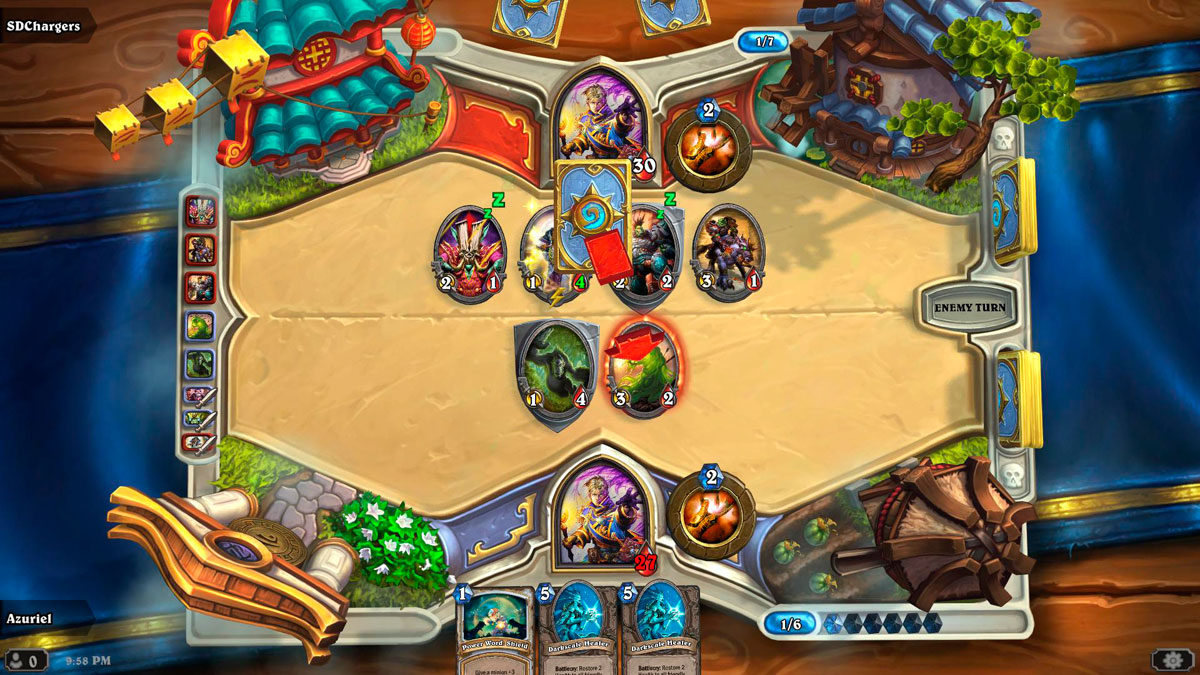
We can never go back.
If you are not quite sure what you are looking at, it is pretty simple conceptually: you can see what your opponent is looking at. If your opponent is hovering their cursor over your creature (to perhaps read its text), the creature glows. If they then cycle through their hand looking for a way to turn the game around, you see their cards glow one at a time. If they decide to target you with a creature or spell, a huge arrow appears where their cursor is, and you can watch as they debate with themselves as to which would be the better move.
This sort of thing is simply unprecedented in a digital CCG. And mandatory from now on, IMO.
Not convinced? Think about playing Chess in person versus playing against someone online. The pieces are all the same, the board is the same, everything is the same… except for the feedback. When you are face-to-face with someone, you can see where they are looking on the board, you can see them pick up a piece and start to move it before putting it back again. Aside from the mind games this opens up, at a minimum it might give you pause to consider that Bishop over in the corner that you had forgotten about until your opponent had briefly considered moving it.
Like I mentioned earlier, CCG battles always took place in the theater of the mind. You never really knew what your opponent was thinking or about to do… unless you happened to be lucky enough to be dueling them in-person. Can you imagine other games operating with this lack of feedback? Think about playing a FPS in which you could not hear another player walking or even which way they were facing when you did see them. An incredible amount of nuance would be lost.
Finally, at the bare minimum, consider the benefits of knowing that your opponent is actually at their chair and not AFK. I’m more than willing to wait a few minutes for someone to make their move as long as I know they are actually in the process of determining what move to make. Compare that to most other CCGs like Scrolls or SolForge or Magic Online where you are basically left watching the round timer count down.
4) Evokes the Physical Space
This last one is a lot more subtle than the others, but welcome nonetheless. Essentially, everything in Hearthstone feels… real. Like a three-dimensional object, with heft and contours and such. You don’t play cards by just clicking on them and then clicking on a target, you actually have to drag them from your hand and drop them on the target (assuming the card doesn’t automatically turn into a ball of flame or whatever midway through the action).
The way creatures are handled is similarly finely detailed. You might have noticed how creatures are sort of oval shaped, right? Well look at an unplayed creature card:

Clever girl.
That’s right, the creature oval “breaks off” from the card when you play it. When a huge creature is played, the oval crashes onto the playing surface, creating shock waves and a small crater. Attacking with said creature involves the oval flying towards the enemy hero, smashing into them and shaking the screen. You start to forget you are playing a CCG at all as it feels sorta like a miniature game at this point. And yet there is still a connection between the cards and their products. Compare that to Scrolls, which also summons creatures but has no real tie between the product (parchment scroll) and the result (animated sprite).
And let’s not forget how this oval thing also solves the problem in CCGs when it’s not easy to distinguish between creatures, enchantments, spells, and so on. Cards are generally of uniform size, and the artwork (which usually takes up 50% of the real estate) can sometimes work against your quick assumptions by having a bunch of dragons or whatever on a “Deal 5 damage” spell. This is not a problem in Hearthstone, as all creature cards have ovals inside them.
Seriously, this is like goddamn paperclip levels of elegance here.
Conclusion
As I mentioned in my Impression post, Hearthstone feels both visceral and whimsical simultaneously. The further pillow fight analogy comes from the sense of “slamming” the cards down on the table, almost feeling the creatures smash into your opponent’s face. Then there are the spell effects like Consecrate that could have easily gotten away with simply dealing 2 damage to all enemies and been done with it. Nope: all your opponent’s creatures and hero tile are lifted high off the table as cracks of golden light bleed through, and then everything slams down at once.
The whole thing reminds me of how it feels to roll dice in D&D campaign – the physicality of the action imparts a gravitas completely independent of the otherwise unremarkable generation of a random number. For Hearthstone to evoke this feeling using just sounds and what could be Flash animation is pretty amazing.
If CCGs are not your proverbial cup of tea, it’s unlikely that even an amazing UI is going to change your mind. If you enjoy the genre at all though, or are merely ambivalent, then suggest you give Hearthstone a try at release. Watching Youtube videos of other people playing does not replicate the experience dropping late-game bombs on your opponent and watching them futilely cycling through their hand trying to come up with a response.
 In An Age
Hearthstoned
Mar 22
Posted by Azuriel
Oh, my. I don’t think anyone saw this coming, but Blizzard is making a(nother?) Collectible Card Game.
Like I imagine many people in the non-apoplexy camp, I spent a large portion of my formative nerd years with Magic: the Gathering. My original shoebox of cards were from Ice Age, gifted from some obscure cousin of a family friend, but the first real entry into M:tG came with Tempest. Which then led into the Urza trilogy, with Urza’s Saga still remaining my favorite expansion of all time.
Not the most OP, but some of my favorite art/effects from Urza’s Saga.
My high school friends and I continued playing weekly up through, I believe, Ravnica. At that point, we were all scattered from life and interest waned. I dabbled with Magic: Online, still in the Ravnica era, and I was midway through busting out my credit card for another $17 tournament entry fee when I realized my objection to WoW and other MMOs with subscription fees was somewhat hypocritical.
I have little doubt that Hearthstone will be fun, at least for anyone who enjoys CCGs – it is difficult to screw up the innate simplicity and surprising depth to deck-building games. Any reservations I have is entirely based on the payment scheme.
Can we be frank for a second? Calling a Collectable Card Game “Free-to-Play” is such rank PR bullshit as to make even David Reid nauseous. Of course a CCG is free-to-play. You already bought the cards! Who is selling collectable cards and then charging a subscription for the privileged of keeping them? EA? This sort of nonsense is like calling Chess a F2P game. Maybe we are so mired in novel payment schemes that such a distinction (misleading as it is) is nevertheless necessary as signals to consumers.
And all of this obfuscates the underlying snare of all CCGs, Magic included: they are Pay-To-Win by design. I love M:tG, I really do. There are Pauper leagues (all common cards), Drafts, and some historical decks in which many of the key cards were no more than uncommon. But those things are only noteworthy insofar as they were the exceptions. If you look at standard tournament decks, they will cost between $250 to $650+ (!), stuffed as they are with Rare (or Mythic Rare, these days) cards. I used to read the WotC design articles, and at that time I almost swallowed their premise that these rares were justified in their rarity based on their complexities. “Commons are, well, common. You wouldn’t want the average player to crack open a pack of 12 complicated cards.”
Yeah, you’re right, we wouldn’t want that. It is just a huge coincidence that the more complex cards are the most objectively powerful and the most (artificially) rare, thereby forcing people to buy more booster packs in order to compete. I mean, we couldn’t possibly keep things proportional, like limiting rare cards to 1 specific card per deck instead of 4.
I mention all this because there is one indelible truth to CCGs: someone with more money to burn is going to ruin your day. Over and over and over again, until you can’t whip out your credit card fast enough. If you don’t think this is the first thing that will happen in Hearthstone, I don’t know what to tell you. Cynicism? Bitch, please. I am a Grade A recovering CCG addict and I know what’s coming for you and anyone else with less street-smarts to know that the first hit from the dealer is always free.
Posted in Commentary
9 Comments
Tags: CCG, David Reid, Deck, F2P, Hearthstone, Mike Rosewater, P2W, Urza's Saga