Blog Archives
[GGM] In the Beginning
I’m starting a new post series called Gratuitous Gaming Memories, or [GGM]. If you aren’t interested in new lil’ Azuriel lore drops, feel free to bounce when you see it. I’m mostly writing these posts for myself – hence the gratuitousness – and for Little Man to discover later, providing that the internet still exists in a recognizable state in ten years. Let’s roll.
My earliest memory of any videogame was the original Super Mario Bros for Nintendo. Getting there requires some setup.
I grew up in relative poverty, in a very poor state. At the time, I did not realize this, and so it didn’t bother me (neither then or even now); that was just how life was. My mother was young when she had me, like around 20, and my father was not much older. They divorced when I was 2 years old which, again, I did not particularly recognize as being outside the norm. Weekdays were spend with mom, weekends were spent with dad. Luckily, they were pretty amicable. Life moved on.
One of the things I always remembered with mom were our “expeditions.” Essentially, just walking around town. I do not recall whether it was a matter of necessity (car not working, etc), to combat boredom, and/or conduct healthy exercise. In any case, keeping a 5-6 year old boy occupied and on-task for a multiple-mile walk was difficult, so we often… kicked rocks. As in, I would kick a hefty rock down the sidewalk, then she would, then I would, and so on. Sometimes the rock would hit a crack at a crazy angle or perhaps you put too much force into it, but that was all part of what kept it fun.
At some point during the walk, I kicked the rock a bit too hard and it bounced up and hit the side of a parked car. Which was sitting in front of perhaps the largest, fanciest house in the small town we lived in. I wanted us to flee the scene, but my mother took us to the open front door and wanted to apologize. I’m not quite sure how the conversation went, but at some point I was sent to wait in the living room with the owner’s kids… just as they turned on Super Mario Bros.
I was transfixed. I don’t even really remember if I got a turn with the controller. In fact, I don’t have any memory at all of the following… however long it was. It’s like a dopamine cigarette burn in my head.
Afterwards, we left, and continued on our expedition. After putting some additional distance between us and the fancy house, we found the next rock for us to kick. I remember that very specifically.
But the seed had been planted.
Switch to Switch 2
Longtime readers may recall that I was debating between the Switch vs Switch 2 last year, once Little Man came to a videogame awakening. I ended up purchasing a new Switch OLED bundle with Mario Kart 8 for $275 total last July. Plus, a kinda dumb amount of games… almost all of which got played! He’s not quite ready for Smash Bros yet. I am overall pleased with how that situation shook out.
Now, a year later and almost exactly to the day, I also bought (and since received) a Switch 2.
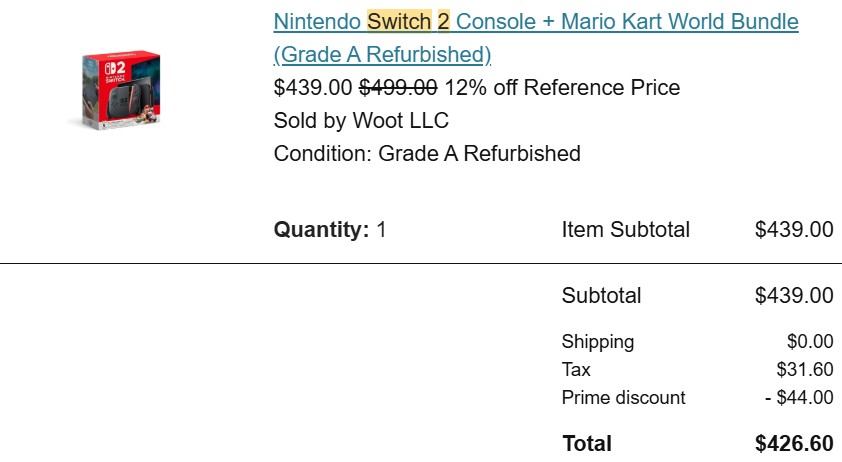
The Switch 2 bundle cost a total of $426.60, which is obviously much higher than the original Switch. Plus, you know, I still have the original Switch. What gives? Several kinda sorta related things.
- There is a pending $50 price hike for the console in September
- Zelda: Ocarina of Time Remake releasing in 2026
- I already own Zelda: Tears of the Kingdom plus have Nintendo expansion pass subscription, meaning I could get upgraded graphics/fps for when we start playing that
- Super Mario Sunshine is coming to the GameCube emulator (requires expansion pass)
- Missed the most recent Costco eShop gift card sale, e.g. $500 credit for $400 spent
- Donkey Kong Bananza is closest to Mario Odyssey, so Little Man may enjoy that
- Switch 2 version of Minecraft releasing in October
That, no doubt, sounds like a lot of explanation concerning a topic that should warrant none.
“Who you trying to convince?” Yes, me, myself. I routinely agonize over $15 game purchases, and whether 67% off is worth it considering the all-time-low was 70% three months ago. I once bought a game from an overseas storefront and ended up getting my bank account frozen “out of caution,” all trying to save $3 versus just buying it on Steam. I was not in any way depending on that $3, it was just the principle of the thing. I mean, hell, it was a Steam code in the first place!
Whatever. It’s done. The Switch 2 is fully functional – the refurbishment tag apparently referred to the box having beat-up corners – and has replaced the original Switch in all ways. I could sell the original for… looks like $160 on eBay at the moment, but my assumption is that it will stick around. Partly as a backup device, partly as an inheritable device, and partly because my wife mentioned she may want to play stuff on it. Theoretically, I could do local co-op with some games, but I have not yet done the research for which games require two copies and which can be shared.
It is kind of funny/sad looking at the list of games in the Nintendo eShop and realizing how many I already own on Steam, often for much less. Although, now that I’m looking, maybe not. For example, We Love Katamari REROLL is like $7.50 on Switch and the IsThereAnyDeal lowest was $5.77 two years ago. Donut County is $3.24 versus $2.43. I even bought that last one in a bundle deal like two months ago. Huh. For some reason I thought that something like Hollow Knight: Silksong retailed for more on Switch, but apparently the MSRP is the same.
I still prefer gaming on the PC, and Steam allows for me leverage my Retroid Pocket 6 if I need to go mobile, but this is starting to make me think about some things. Not for now, but perhaps in the future.
Out of Breath (of the Wild)
I may have mentioned in passing that I am playing through Legend of Zelda: Breath of the Wild (BotW). This was originally going to be supervised watching of Little Man playing, but the mechanics proved too punishing for him, and so he wants to watch me play. So I have been, for the last several weeks. I believe we are roughly halfway through the game, but it is hard to tell.
Broadly speaking, I don’t find BotW very fun at all. In fact, it feels like it’s designed to be un-fun.
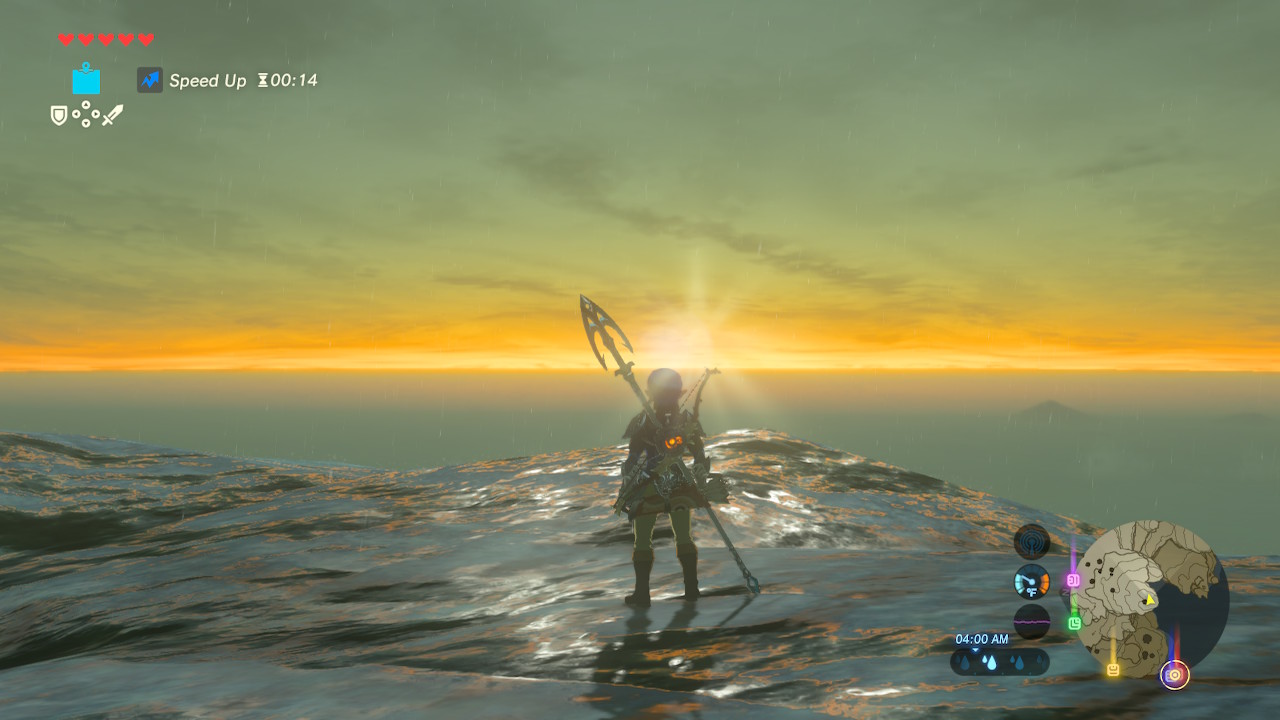
I’m certainly not treading any new ground here, but for posterity, the biggest offender for un-fun is weapon durability. In BotW, every single weapon you pick up in the game (sans one) will eventually shatter. In some cases, it makes sense, like your tree branch or skeleton arm breaking or whatever. Other times, you have Royal weaponry that has presumably survived countless battles over dozens of years… and it’s gone after fighting three goblins. “Realism!” I guess? No blacksmiths anywhere, but we have ancient robot technology and teleportation and food that makes you immune to lightning.
I can see the design goal. It’s exciting starting out practically naked and eventually becoming a force of nature by scrappy adventuring. Defeating a powerful foe and claiming it’s deadly weapon for yourself feels good! There’s also no reasonable way to introduce more than a dozen different weapons into a Zelda title without having a mechanism to enforce you not just using the strongest one all the time.
That said, it just feels awful at every stage in the game and warps player behavior. I think this is the first game I have played where the stronger you get, the more you are actively punished for engaging in combat. In the early game, you use whatever you can get to just survive. Later on, defeating some strong enemies give you powerful weapons… which you then have to stow away while you flee from every low-level enemy encounter, lest you waste precious durability on trash. At some point, no combat is worth engaging in. And when you do engage in extended combat sequences, you get the fun experience of pausing combat multiple times as you toggle through menus, debating which weak-ass weapon you are OK with breaking just to be rewarded with vendor trash, at best.
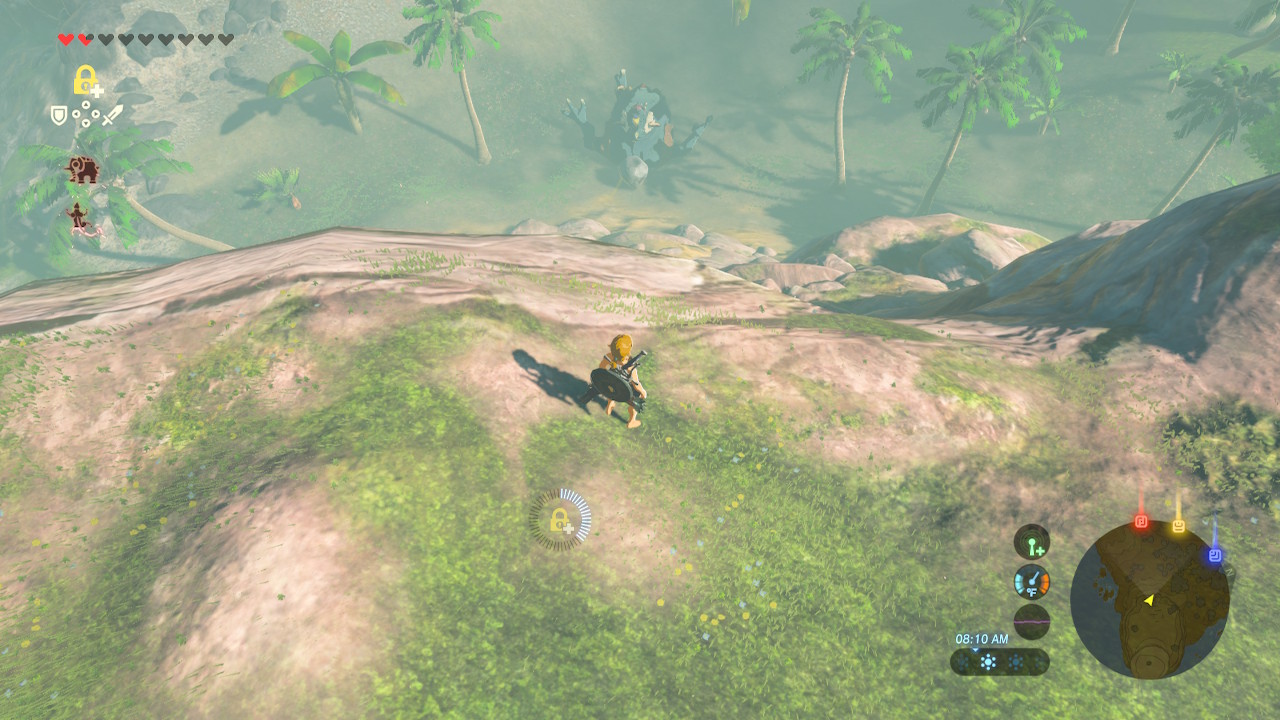
And oh god, the menus. Defeated enemies don’t drop hearts; you must consume food to regain life, or otherwise get back to civilization. There are dozens of different ingredients, all of which you have to – painfully slowly – experiment with to determine if the resulting meal is worth your time. 99% of the time, it was not. In fact, the vast majority of the food is functionally useless considering it might restore 8 hearts, despite you only have like 5 at the time. The only ingredients worth a goddamn are ones marked “Hearty X,” which when cooked (at a lit cookpot), result in a full refresh of all hearts plus some extra temporary hearts. So, you cook them, 1 at a time, because while you can technically combine up to five ingredients to stack the temp HP, it is much more functional to refresh all hearts plus get 4 temp ones X times than one refresh with 20 temp hearts once.
Meanwhile, your adventuring is entirely spent scouring the countryside looking for hidden shrines. Completing one shrine gets you one Spirit Orb. Turning four Spirit Orbs in lets you get one extra heart container, or one-quarter of an extra stamina meter. Where I’m at right now, I believe I have eight total hearts (started with 3) and a full second stamina meter, so… 28 shrines completed? I’m supposed to get to 13 hearts for reasons, so that’s another 12-20ish shrines depending on a few factors. Sigh.
It’s dumb, guys. When there’s actual quests going on, things are decent, but I was once awarded an heirloom weapon of a dead friend and even Little Man said “No, we can’t use it, because it’ll break!” Was that the vision? The developer intention? “Nothing lasts forever, kid. Get used to it.”
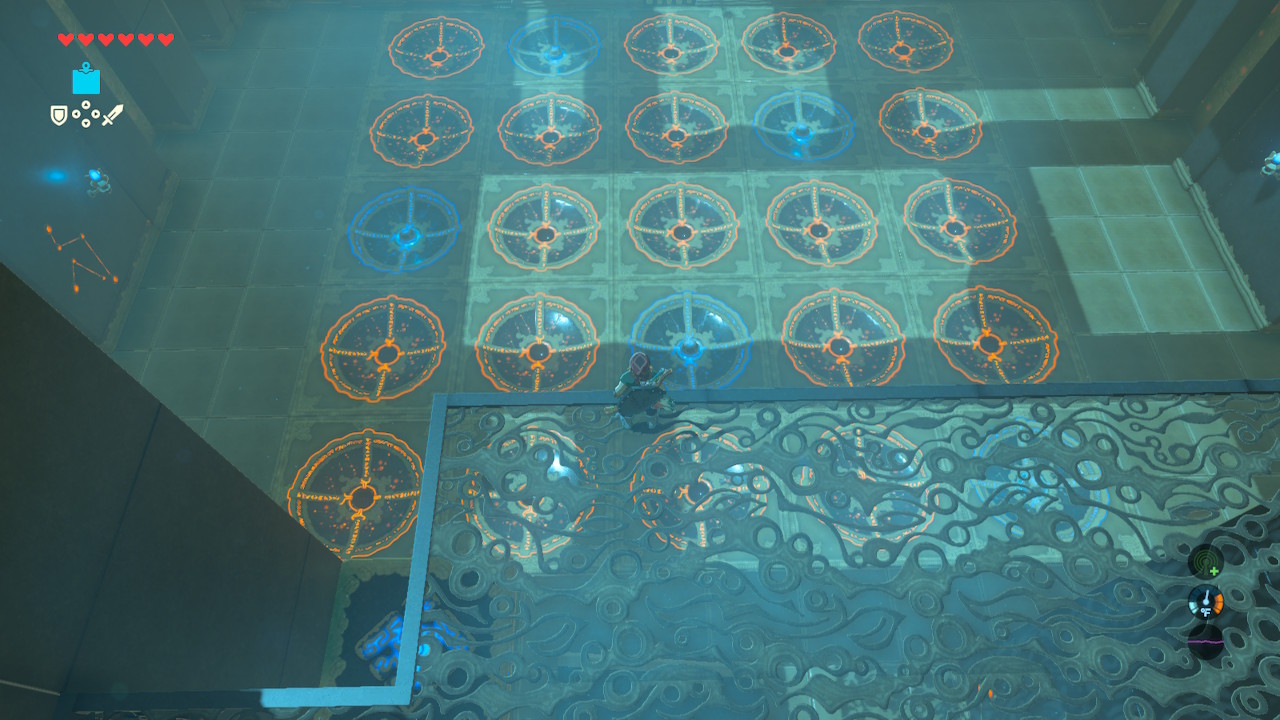
You know, maybe there was a zeitgeist I missed when Breath of the Wild first came out. Being able to climb literally everything was undoubtedly novel at the time. My first experience with that came from Craftopia, which unabashedly stole it and several other things from BotW, and so did every single open-world gacha game that came out since then, so experiencing it here in 2026 was no big deal. I’ve also heard all the stories about peoples’ minds being blown when they realized the first plateau was just the tutorial and how big the world was. Yeah, okay. I got that back in 2008 with Fallout 3, but I guess some players weren’t even born yet. Something has to be someone’s first.
But, seriously, I feel like I’m taking crazy pills or something. BotW is a big, beautiful… empty, sterile world that drains you of resources for interacting with it. In Fallout, I relish every opportunity to scour empty buildings of Aluminum cans or rolls of duct tape. Ghouls or Raiders appear? Fantastic! More loot, more XP, more character progression. Even if a particular ruin is a bust for any of those things, there are often environmental vignettes that can be poignant.
That doesn’t exist in BotW. There is zero reason to ever clear a goblin camp. The only reason to explore is to find either another Shrine (puzzle) or a Korak Seed (puzzle), to incrementally gain more HP/Stamina or more items slots, respectively. Every heart of damage you take or damage you deal is paid with busywork later. Sloooooooowly cooking up food, collecting up arsenals of garbage weapons, or enduring loading screens teleporting around to “farming spots” where you can more easily gather the best versions of either. That’s not exactly the power fantasy I’m expecting from a Zelda game.
That said, my opinion is clearly wrong: Breath of the Wild enjoys a ~97 Metacritic rating, and has sold 35 million copies. The game indeed embraces nonlinearity, encourages exploration (for the first few hours), has minimal onscreen UI for an open-world game, and has challenges that can be overcome in a number of (occasionally physics-based) ways. What more could the average gamer ask for?
Not being punished for interacting with said world, for starters, I would say. Apparently, that’s just me.
Entry Point
I am flabbergasted how any of us beat videogames as kids.
Little Man has been playing a lot of videogames with me lately, with some mix of modern and retro titles. The struggle is finding what I would consider a good entry point to the medium. Back in the day, we obviously had no choice in the matter – “you get what you get, and don’t throw a fit.” I personally started on the NES with Super Mario Bros and eventually Super Mario Bros 3, but I always remembered how much better Super Mario World felt once the SNES came out. So, having tandem-completed Super Mario Odyssey (twice!), I thought that handing over the controller (or specifically the RG35XXSP) to Little Man and letting him play Super Mario World solo would be a good idea.
Spoiler: it was not.
Even when I took over to help him out of a particularly hard part, I came to realize how much of Super Mario World consisted entirely of hard spots. It is also difficult to fully appreciate how bizarre the concept of holding down the run button 100% of the time is in a platformer. Seriously, just try playing any non-3D Mario game without running. It’s painful. And yet… why build it that way in the first place?
Anyway, I backed off of Mario platformers and introduced him to Kirby instead. Specifically, Kirby Super Star for the SNES. This ended up being a much better entry point, for several reasons. First, Kirby has an HP bar, which means you can take multiple hits from enemies while you learn their attack patterns. Second, Kirby can float, which eases you into platforming elements. Third, you can create an AI companion any time you have a power, which immensely helps you with bosses and surviving the level in general. There were still some tricky bits to the game, but the “training wheels” helped Little Man build confidence and develop controller-based skills.
Once Kirby was exhausted, we moved back to Super Mario Wonder on the Switch. There is a lot to like how Nintendo designed co-op in Wonder. When one player dies, they come back as a ghost that can float around for 5 seconds, reviving if they touch the surviving player. Later on though, there are some levels in which being revived will result in you immediately dying again, and “giving up” simply means draining both players of any extra lives. At that point, I had Little Man play solo and try a given level 3-4 times before he could tag out. It took a while, and I ended up playing the final parts of the game entirely myself, but we beat Wonder a few weeks ago.
The next game I wanted him to try playing was Super Mario 64. “It’s got platforming, but you don’t die in one hit. Should be fine.” Spoiler: it was not fine. In fact, it was one of the most disillusioning experiences I’ve had in quite some time. I remember spending a lot of time with Mario 64. I remember fully completing the game with 120 stars. I remember it being a great game.
What I apparently didn’t remember is the godawful camera. Like, legitimately bad. Even I had issues walking inside the castle, camera gyrating wildly while Mario starts drunkenly spinning in circles. Did the novelty of three dimensions paper over the terrible-feeling controls and camera? I let Little Man play for a bit, and then helped him get a few of the Stars to unlock other levels. I went into the Snow level and then tried the slide race… five (5) times. Never even made it past the first turn. WTF, mate.
Maybe it’s the official Nintendo emulator, maybe it’s the joy-cons, maybe the N64 claw controller was better at that specific task, maybe I’m just older and/or used to other (better) control schemes. Regardless… it just feels bad. It’s one thing to know you can’t go home again, but it’s another driving there anyway only to be surprised at the smoking ruins of your remembered youth.
Of course, there are games from that era and before that do hold up. I have no doubt that Super Mario World will make another appearance once Little Man is a bit older and has more platforming skills under his belt. And once he can read at an appropriate level, there are some classic RPGs that I would love to introduce him to. That said… yikes. I purchased Super Mario Galaxy 1 + 2 recently as a sort of Odyssey replacement (plus I never played them), and I’m starting to sweat. Surely this won’t be another Mario 64 moment… will it? And what do kids even start playing these days?
[Fake Edit] It’s been a while since I drafted this post, but we have since beat Mario Galaxy and are on the tail-end of Galaxy 2. Thankfully, it was not as bad as Mario 64… but it’s still a bit rough. For one thing: holy nausea, Batman! I cannot remember the last game that made me motion sick from its inherent design, but Galaxy’s whole schtick of running across little planetoids has not landed well.
That said, Little Man has made some significant progress in terms of timing and problem-solving in a 3D space. There are some aspects he Nopes right out of immediately – usually having to do with countdown timers and such, which is totally understandable – but there have been a few times where he has completed a full level by himself. Can’t wait to see if I can get him into the Zelda series next.
Review: Nex Playground
As I’m coming up on a full year of “ownership,” and with it being more topical this holiday season (e.g. 2nd best-selling console this past Black Friday), let’s talk about the Nex Playground.

Essentially, the Nex is a motion-controlled game console with an all-in-one subscription model. Think Kinnect or Wii Sports, minus the controllers. For $250 retail price, you get the Nex cube, a remote, and permanent access to five party-style games. The “real” experience requires a further purchase of a 12-month Play Pass for $89, or the 3-month Play Pass for an usurious $49. At the time of this writing, there are bundles on Amazon that include the Nex and a 12-month pass for as low as $288.
Is it worth it?
Well… do you have kids as of yet unsullied by Fortnite, Minecraft, and/or Youtube? Then: probably.
I’ll go into more detail on the games below, but it is important to reiterate that the Nex is a motion-controlled device. Not all the games require you to be standing, squatting, and/or jumping, but you will nevertheless be using your arms 100% of the time at a minimum. Even if you or your kids are physically active, this is not something you will likely be playing for 1-2 hours at a time. If your immediate thought after reading that was “well, no one should be sitting/playing videogames for that long anyway,” then, yeah, the Nex is probably for you.
Base Games
Without the Play Pass, you are limited to these five games:
- Fruit Ninja
- Whac-a-Mole
- Go Keeper
- Party Fowl
- Starri
The first three are basically “arcade” style games that may or may not amuse you or children for a length of time. Party Fowl is a sort of goofy Mario Party knock-off filled with 90-second minigames. An example would be squatting to empty a helicopter bucket full of water onto gingerbread men running around on fire. Or shaking up virtual pop bottles and spraying them at the other person.

One of the killer apps for the Nex system though is Starri. This is a rhythm game akin to a VR-less Beat Saber, or perhaps an arms-based Dance Dance Revolution. There is an eclectic mix of songs, including several ones from Imagine Dragons, some Lady Gaga, Sia, and other contemporary artists. Last year, there were also a large amount of K-pop, but many of those rotated out; there still are a lot of anime songs. Regardless, Starri feels like a full-fledged game, with each song having three difficulty levels, in-game cosmetic unlocks, two different hand “game styles,” and so on.
Of all the games available, Starri stands out as something an adult could play solo and enjoy long-term.
Play Pass Games

Tumbo Bots is one of the best-designed games on the system, hands down (or up). Basically, it’s a 1v1 battle game where you try to score points by hitting the red button on the other player’s head, and/or collecting coins if they’re available on the map. There’s also a soccer mode. What makes it fun are how your arms controls the legs of the bots, which requires you to swing them wildly about. QWOP-style, in order to move and jump. There is a large variety of maps and characters, and Little Man has gotten quite good at beating me even if I don’t totally sandbag my play (… but I still sandbag a bit).

Doodle Heads is another favorite, to a slightly lesser degree. It’s kind of a Galaga-style game if children drew all the sprites, but it does feature four different heroes and six bosses across 12 levels. Just be prepared to be waving your hands above your head the entire time, as that is how you shoot.
…and that’s primarily it.
In reality, there are 40 other games within the Play Pass, but not all of them are especially good. Or fun. For example, there is Teenage Mutant Ninja Turtles: Rooftop Mayhem, which is essentially a side-scrolling Temple Run. Does anyone remember Temple Run? Basically where you’re in a fixed perspective going along a track while avoiding obstacles? Little Man played TMNT for like an hour one day, but I doubt he ever goes back. And there are three more licensed games in exactly that same style: Miraculous Ladybug: Paris Dash; Care Bears: Rainbow Ride; Candy Land: Sugar Sprint. A waste, IMO.
The other licensed content isn’t as bad. Kung Fu Panda, How to Train Your Dragon, and Cookie Monster have all went different directions. The problem I have with many of these other ones though is what I consider missteps with the property. For example, the Kung Fu Panda game is about training by hitting logs, chopping wood planks, and so on. Good. All of this gameplay is only available after long, unnecessary (and unskippable) exposition by knockoff voice actors. Very bad.
This is actually a more general weakness with many of the games wherein there are a lot of clunky menus and “plot” when you just want to be throwing hands and legs as soon as possible. Or when there are menus upon menus for games for which the core audience may not be able to read yet. I’m looking at you, Cookie Monster.
Final Thoughts
Whether a Nex is a good addition to your home comes down to your projected use-case.
If you are buying a Nex because “it’s cheaper than a Switch 2,” then you’re probably in a for a bad time. The current Amazon sale price of $288 includes a year of the Play Pass, which is good value… compared to the standard price of $250 + $89. But even on sale, the best-case scenario – in which your kids are totally happy playing with just the Nex – is that you’re still on the hook for another $89 Year 2. That’s now $377. Still technically cheaper, but they pretty much got you stuck.
And, really, what are the odds that your kids aren’t going to what to play Mario Kart (etc)?
If instead you treat the Nex as (slightly) guilt-free form of screentime exercise for the kids, and potentially for the whole family? That’s another story. Obviously you can do comparable movement things with Switch Sports and the like, but it may mitigate drama to have an entirely separate ecosystem wherein Minecraft, Mario Kart, or whatever else isn’t staring them in the face. Indeed, in our house, we don’t really even call the Nex “videogames” – it’s just something we do when the weather is too bad to go outside and we need to burn some energy.


Vacation Over
Aug 31
Posted by Azuriel
I have survived another vacation.
As part of the packing for the trip, I brought the Switch 2, the Retroid Pocket 6, the RG35XXSP, and of course our phones. A full week away from my PC and typical setup would be a perfect use-case scenario for all these retro machines, right? And I would have been very happy to report how much use they had gotten given how much money was spent on their purchases.
…if I they had gotten much use.
In reality, what happened during the copious amount of downtime was… playing games on my phone. Specifically, a game called Slice & Dice, which I reviewed four years ago . It’s basically a dice-rolling roguelike where you have a selection of party members facing a variety of enemies, you have a choice between a few random items or class upgrade after each fight, and yeah, that’s basically it. I had “beaten” most everything a few years ago, but apparently the devs had released some more content since then, so I spent some considerable hours going through it again.
The other game I played the most of was actually Pokémon Pokopia on the Switch 2. This was purchased by my wife just prior to the trip, as she had a hankering for something similar to her Harvest Moon nostalgia of yore. To be clear, Pokopia is nothing like Harvest Moon, aside from the vibe. Anyway, I started up my own save – we have separate Switch profiles already – and played two longish sessions.
Pokopia a very weird game. You are actually a Ditto pokemon who becomes the image of the human you loved, in a sort of post-apocalyptic wasteland area devoid of both humans and pokemon, aside from a “professor”-looking one. Another pokemon appears in a near-death state (implied), you gain the ability to copy a sort of watering can-like ability to save them, and things start improving. As you heal the environment with the water, you can help start setting up specific pokemon habitats (four squares of tall grass, four squares of tall grass near a tree, etc) that will cause certain pokemon to spontaneously appear. The more pokemon, the more abilities you can copy, the more lively the world gets, the more building options open up, and so on and so forth.
The whole setup sorta reminded me of My Time at Portia, wherein there was certainly a cataclysmic event in the past that resulted in widespread death and destruction, but the event itself is not the focus. You can see the effects, but no one is especially dwelling on what was lost. That is a surprisingly ripe narrative juxtaposition, and I’m for it.
With Pokopia though, the childlike angle makes it particularly grim, IMO. The professor pokemon asks you to help restore the environment and destroyed human houses because, as evidenced by the returning pokemon, maybe the humans will come back too if only you restore their “habitat.” Maybe this will be played straight, with the humans emerging from underground bunkers or whatever once the entire wasteland is green once more or whatever. I could also imagine it not being directly resolved at all in a sort of Hachikō situation, because Japanese devs sometimes like crushing melancholy.
We shall see.
I did boot up the RP6 a few times, but only actually got into any games one time. I’ve talked about it before, but one of the problems with these retro machines is the fact that you have to be prepared to play them. In my case, that means headphones and the desire of solitude to put them on. For example, I got past the title screen of Final Fantasy Tactics and Chrono Trigger on two occasions, and turned them off because what is the point if you aren’t listening to the music too? It’s like eating without a sense of smell. Slice & Dice can easily be played without sound, turned off at a moment’s notice and easily gotten back into. These other games were never designed for quick, silent sessions.
Anyway, the two games on the RP6 I gave an honest college try with was Thomas Was Alone and Donut County. The former was utterly unplayable via GameNative despite being “compatible,” but the latter was perfectly fine. I got through some levels, which involves moving a hole around the map to swallow increasingly-large items, had some laughs at the dialog, and then turned it off. If shit really does hit the fan, I’ll be glad I can game on something that draws 6 watts instead of 600, but until then? Maybe not the most prudent purchases I have ever done.
I’m banking on Little Man eventually wanting his own console in his own room eventually, and maybe they’ll get a second (or first) life then.
Posted in Commentary
2 Comments
Tags: Little Man, Pokemon Pokopia, Retroid Pocket 6, Slice & Dice, Switch 2, Vacation