Blog Archives
Procedural Dilemma
One of the promises of procedural generation in gaming is that each experience will be unique, because it was randomly generated. The irony is that the opposite is almost always the case, as designers seem to lack the courage to commit. Or perhaps they recognize that true randomness makes for bad gameplay experiences and thus put in guardrails that render the “procedural” bits moot.
Both Starfield and No Man’s Sky feature procedurally generated planets with randomized terrain, resources, flora, and fauna. Both games allow you to land anywhere on a given planet. But neither1 game allows there to be nothing on it. There are desolate moons with no atmosphere, yes, but in both games there will be some Point of Interest (PoI) within 2 km of your landing location in any direction. Sometimes several. And the real kicker is that there are always more PoIs everywhere you look.
There is not one inch of the universe in these games that doesn’t already have monuments or outposts on it, and the ludonarrative dissonance of that fact is never resolved.
The dilemma is that true procedural generation probably leads to even worse outcomes.
Imagine that the next eight planets you land on have zero PoIs. No quest markers, no resources of note, no outposts, no nothing. How interested are you in landing on a ninth planet? Okay, but imagine you can use a scanner from orbit to determine there are no PoIs or whatever. So… the first eight planet scans come up with nothing, are you scanning the ninth planet? At some point players are going to want some indication of where the gameplay is located, so they know where to point their ship. Fine, scanners indicate one planet in this system has two “anomalies.” Great, let’s go check it out.
But hold up… what was the point of procedural generation in that scenario? There isn’t much of a practical difference between hand-crafted planets and procedurally-generated-as-interesting planets surrounded of hundreds of lifeless ones. Well, other than the fact that those random PoIs in the latter case better be damn interesting lest players get bored and bounce off your game due to bad RNG.
Minecraft comes up as an example of procedural generation done right, and I largely agree. However, it is “one world” and you are not expected to hop from one map to the next. The closest space game to resolve the dilemma for me has been Starbound + Frackin’ Universe mod – some planets had “dungeon” PoIs and/or NPCs and many did not. Each star system has at least one space station though, so it’s not completely random, but it’s very possible to, for example, land on a bunch of Eden planets or whatever and not find an exact configuration that you want for a base.
As I mentioned more than ten years ago (!!), procedural generation is the solution to exactly one problem: metagaming. If you don’t want a Youtube video detailing how to “get OP within the first 10 minutes of playing” your game, you need to randomize stuff. But a decade later, I think game designers have yet to fully complete the horseshoe of leaning all the way into procedural generation until you come right back around to hopping from a few hand-crafted planets and ignoring the vast reaches of uninteresting space.
- NMS may have actually introduced truly lifeless planets with no POIs in one of its updates. They are not especially common, however, as one would otherwise expect in a galaxy. ↩︎
28+ Days to Die
Okay, now I’m (probably) done with 7 Days to Die.
The one thing I really wanted to do was try and succeed at a randomly generated world. Which is kinda weird, since I’m not exactly a huge fan of procedural entertainment for its own sake. The issue in the absence of randomness is that… it’s not random – you know exactly where everything is. The specific loot might vary from seed to seed, but you’ll always know where the police station is, where there might be a gas station, ect.
Of course, random maps often end up like this nonsense:
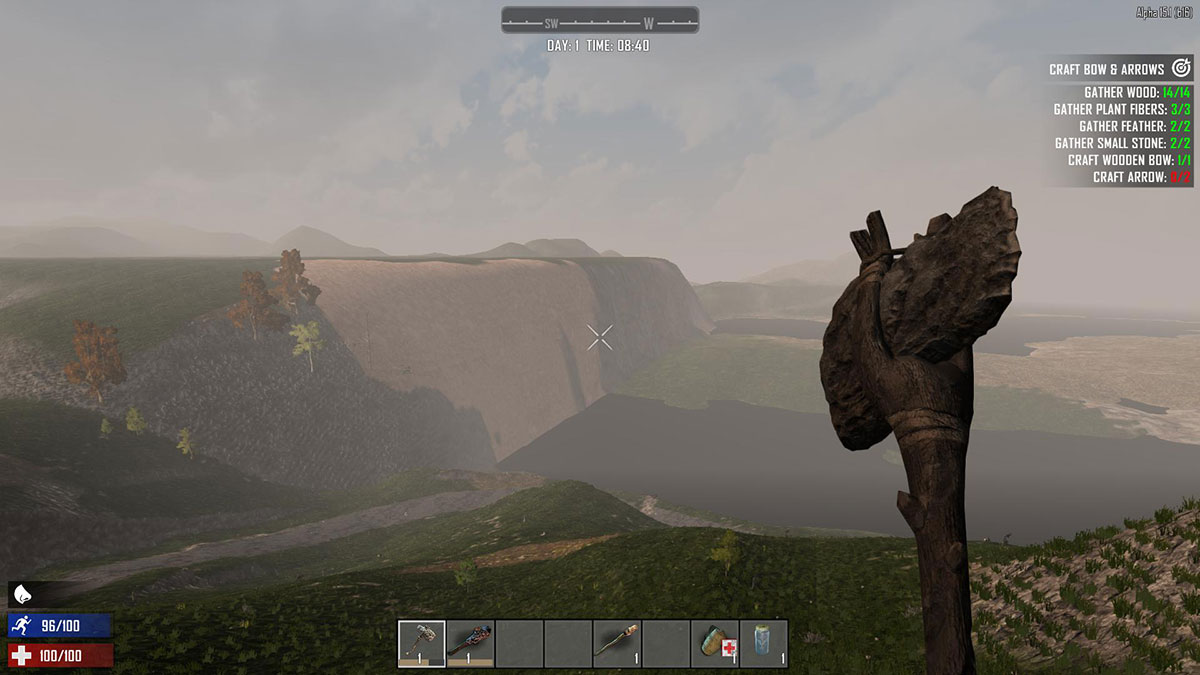
Seems legit.
I almost abandoned my attempt within the first 30 or so minutes, simply because of how annoying it is starting back over. In my prior save, I already had crossbows, iron sledgehammers, and nearly all gun recipes. The real meat of survival games happens in that inbetween time where you are desperately scavenging for supplies while establishing a base. So while it’s fun stepping foot into zombie town for the first time, loot possibilities endless, it’s also highly annoying trying to break down doors with a stone axe. Oh, a gun safe? I’ll just break the lock… ah, right, Stone Age.
I kept at it though, and before I knew it, I had an impenetrable zombie base. Actually, I knew exactly when I had such a base, because I recognized the weird structure that lays atop a “hidden” bunker, and also knew that zombies can’t dig anymore, so the game was effectively over. I mean, there was still the very real chance at death due to zombie dogs, which I encountered several times while venturing about. But as far as Horde Night goes? I could effectively just go AFK while browsing Reddit while it occurred in the background.
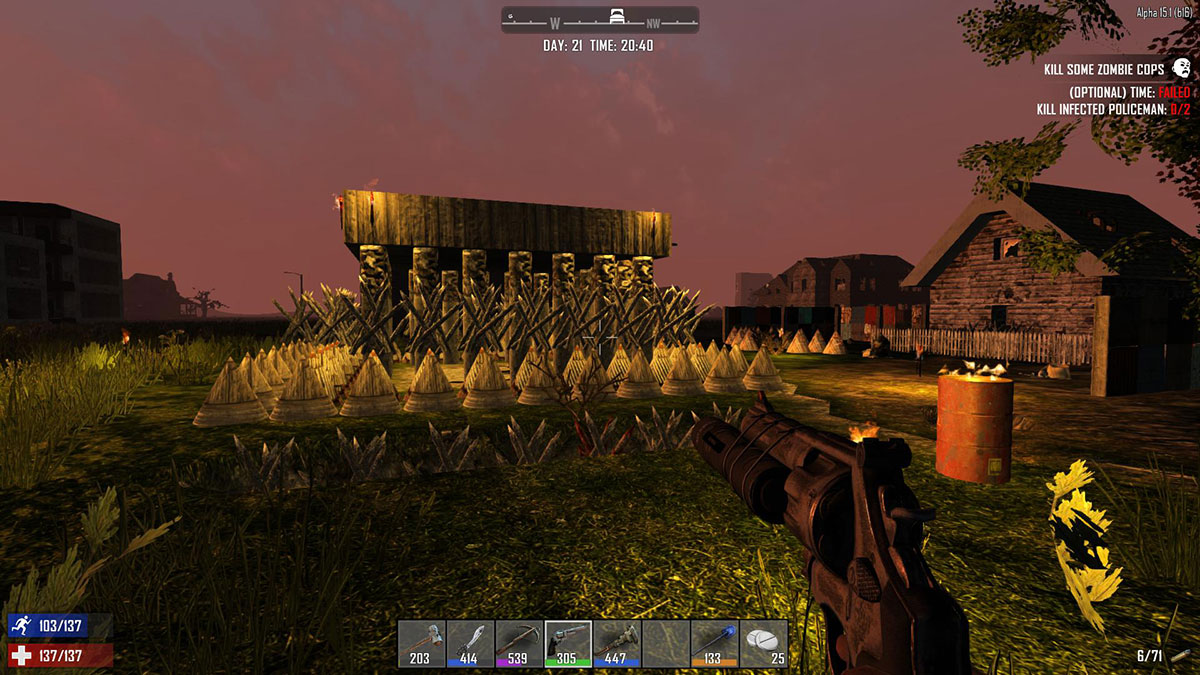
Welcome to Thunderdome.
Later, I created a zombie cage with bars and spikes such that I could shoot/stab through the bars and even loot while the zombies couldn’t do much. I have yet to encounter the Screamer or Cop Zombie types, so perhaps increasing the difficulty could engender some additional feeling of danger.
Alternatively, I might be effectively done. Which is fine, considering I have been obsessively playing it for the last two weeks and have racked up nearly 60 hours at this point. Not bad for a game in Alpha. Indeed, the next update is supposed to have a Behemoth zombie that will topple structures with ease. Unless they let zombies aim at the ground though, bunkers will still be an I-WIN button.
In any case, I highly recommend this game.
I might also recommend waiting until at least Beta to get the most enjoyment out of it. But hey, if you catch it at $5 or $10, it’s worth the money if you think you might like zombie Minecraft.
The Limits of Procedure
In a recent post, Tobold says:
After Everquest Next announced dynamic spawns with an ecosystem, destructible environment, and open world player housing, several people dismissed these claims as unrealistic with the argument that Ultima Online tried that and failed: Players kill mobs faster than they can reproduce, gather resources so fast that whole forests are turned into deserts, and build houses everywhere until no more flat surface is left. While that history is correct, the conclusion isn’t. As a counter-example look at Star Wars Galaxies, where open world housing clearly worked a lot better than in Ultima Online. So what is the difference, and how can a virtual world with a stable ecosystem be created without players destroying everything? The answer is simply in the size of the world, and the scale of the ecosystem.
Two paragraphs later though, he sort of undermines his own argument a bit (emphasis mine):
The Ultima Online ecosystem failed due to its small size and technical limitations of the time. But a procedurally generated world can be much bigger, even infinite. People don’t run out of world to modify in Minecraft. And if the world is big enough, you can put in enough mobs so that players can’t possibly make them extinct.
Er… if players cannot possibly make the mobs extinct, what’s the point in having an “ecosystem” in the first place?
But, never mind that. What I really wanted to talk about is the Minecraft bit. Because sometimes I get the feeling that “procedurally-generated” as a concept is being elevated as some paragon virtue of game design – a silver-bullet to boredom – when it is really nothing of the sort.
A procedurally-generated game solves exactly one problem: metagaming. That is not quite the correct word I want to use though, as you can still technically metagame a procedurally-generated world in several ways. Namely, by knowing its procedures. For example, no matter what Minecraft world is created (mods aside), diamond only spawns in layer 19 and below. Indeed, there is a whole bunch of Minecraft constants to consider (accurate circa 2010 anyway). All the Minecraft map being procedurally-generated does is prevent you from following a guide telling you to move North a hundred steps and then walk East to find a nice batch of Iron Ore near the surface. Avoiding those scenarios is certainly useful, and it’s always fun running into the truly bizarre and whimsical creations of the RNG gods.
The problem arises in treating the procedurally-generated whatever as “endless content,” when it is really not anything of the sort. As I talked about before, your knowledge of a game’s systems really only ever increases as you play; novelty has diminishing returns within the same game. Each Minecraft world generated may be completely different, but you are going to be doing the same sort of things each time: punch wood, make tools, make structure, dig for ore, etc. Different starting locations and details can spice up the gameplay for a time, but your “build order” is unlikely to change much no matter where you are.
Procedurally-generated content definitely has a place in gaming, usually in the context of roguelikes, but it will not solve any of EQN or any other MMO’s problems. Not that its application in MMOs made much sense in the first place – one of the defining characteristics of an MMO is a persistent world, which is incongruent with procedural generation. Even if it was just one world of infinite size (expanding at the edges), the amount of space surrounding objects of player interest would remain finite. And that’s assuming players would be willing to trudge out very far from their starting location in the first place.
No, just adding more space isn’t going to solve the issue. If anyone claims that an MMO’s world cannot be too big, simply point them at any given low-pop server of any game anywhere.
My Current Obsession: Don’t Starve
As I mentioned back in my Card Hunter post, it is pretty rare that I get 100% engrossed in a given game. The all-in immersion in a game’s delicious logical systems is precisely what I desire, but gaming today is typically focused on front-loading the fun, followed by a tapering off of stimulation. So color me surprised when I found myself playing Don’t Starve until 6am again, trying (in vain) to get myself prepared for a winter I have never survived long enough to see.
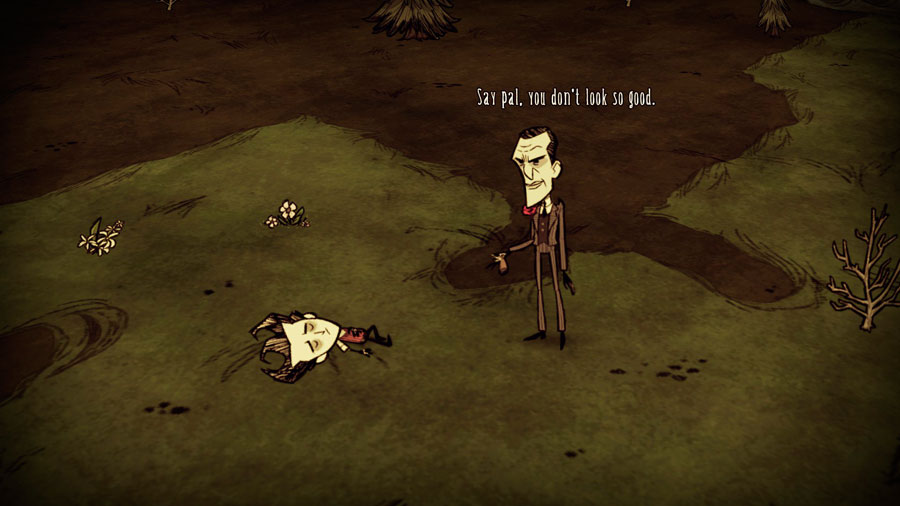
It’s all inevitably down-hill from here.
In a nutshell, Don’t Starve is an indie survival roguelike. You wake up, get taunted a bit by the above-pictured guy, and… that’s it. As the Steam store description states:
Uncompromising Survival & World Exploration:
No instructions. No help. No hand holding. Start with nothing and craft, hunt, research, farm and fight to survive.
They’re not kidding. Just when you think you’re getting the hang of a particular mechanic… BAM! You get stung to death by angry bees.
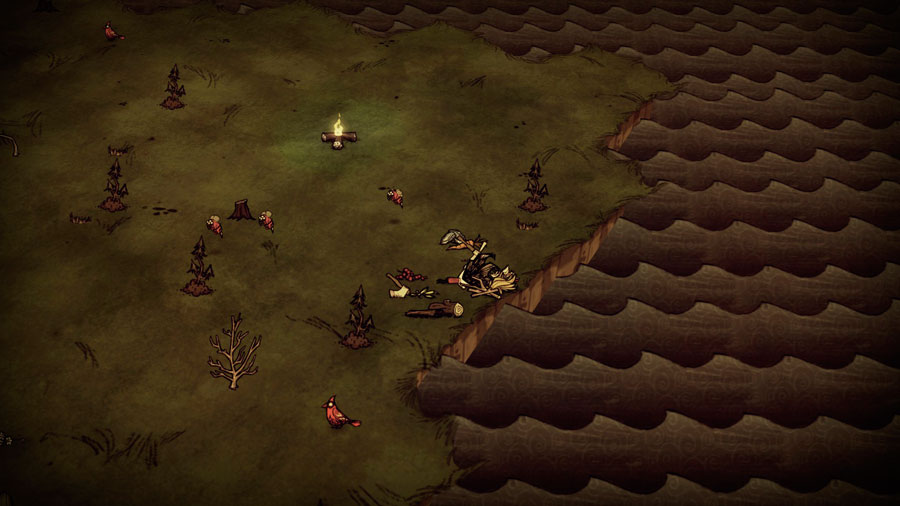
Not a good way to go.
If you die, that’s it, game over; your save file is erased. Occasionally there will be a sacrificial altar-looking thing, which acts as a one-time respawn mechanic. You can even construct your own Meat Effigy, which will also respawn you once… but you will have a lower maximum HP for as long as it exists. And keep in mind that you don’t resurrect with your gear – all of your shit is piled on the ground next to the giant spider nest or murloc Merm camp or swamp filled with giant tentacles or whatever nightmare area you died in.
And that’s another thing: there’s a sanity meter too.
But, seriously, Don’t Starve is one of the most brilliant games I have played in years. While I sort of feel like it’s still in beta (there’s a countdown until the next patch on the title screen), how all the game systems already interlock is astonishing. As you might imagine from the title, getting food is important. But actually getting enough food to survive is pretty easy. The problem is that actually foraging all that food will consume a large portion of your day, leaving you little time to explore before nightfall. You can’t just hoard food either, because it spoils. Even worse, no crops grow during the winter and the ponds freeze over and you can’t eat monster meat without going insane and… you get the idea.
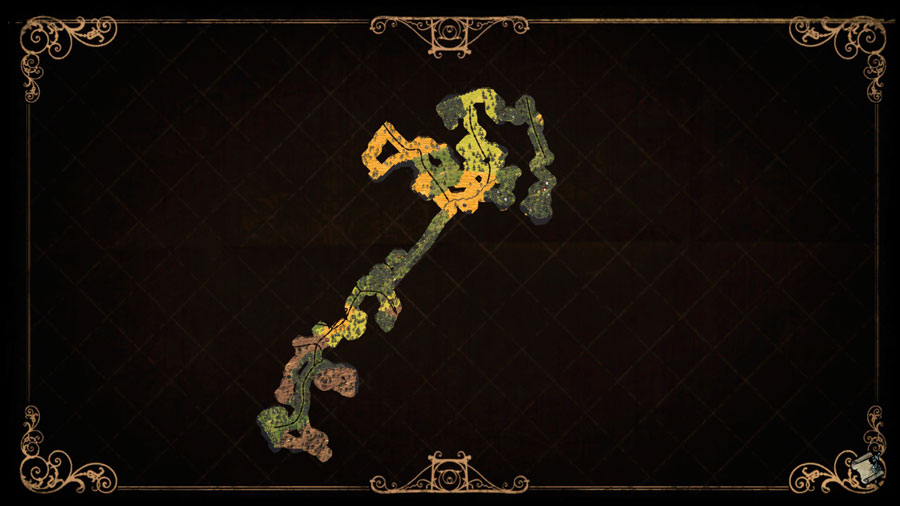
This is how far I walked looking for Flint, one time.
What I find so engaging is how I feel like I’m… juggling. You know in RTS games like Starcraft (etc) when you’re trying to micromanage some battles and having your base produce more units and sending scouts out to look for expansions? I actually dislike RTS games that are structured that way – I can do any one of them well, but not all simultaneously – but Don’t Starve somehow threads that needle. I would spend a few days making food supplies, then trek out into the wilderness looking for more of a certain resource I was lacking, foraging when I could, and trying not to get too far afield. Then come back, craft some new feature in my camp, and then get attacked by Hounds and die on Day 22.
And I’m not even mad.
Each world is procedurally-generated, which means next time I might be able to locate an even better starting location for my camp. Or maybe I’ll run across one of those random set-pieces and get a huge leg-up on survival with the ready-made supplies there. Or maybe I’ll actually find that goddamn Maxwell’s Door again and be able to play the game within a game. Oh, did I forget to mention that? The base game is a sandbox, but you can do Adventure Mode (a story-ish game mode) if you walk through Maxwell’s Door. If you die inside though, you get booted back outside into the “normal” world and it’s forever closed to you on this world. Collect four mysterious items though, and you can jump to a brand new world with another Maxwell’s Door located somewhere on it.
But let’s not get too far ahead of ourselves though, because none of us are likely to make it. As it says on the Steam page:
Randomly Generated New Worlds:
Want a new map? No problem! At any time you can generate a new living and breathing world that hates you and wants you to die.
One day, I will see the winter. And die horribly, no doubt. But seeing it will be enough. For now.
Review: Terraria
Game: Terraria
Recommended price: $10 (full)
Metacritic Score: 83
Completion Time: 50+ hours
Buy If You Like: 2D Minecraft, procedurally-generated Metrovania platformers
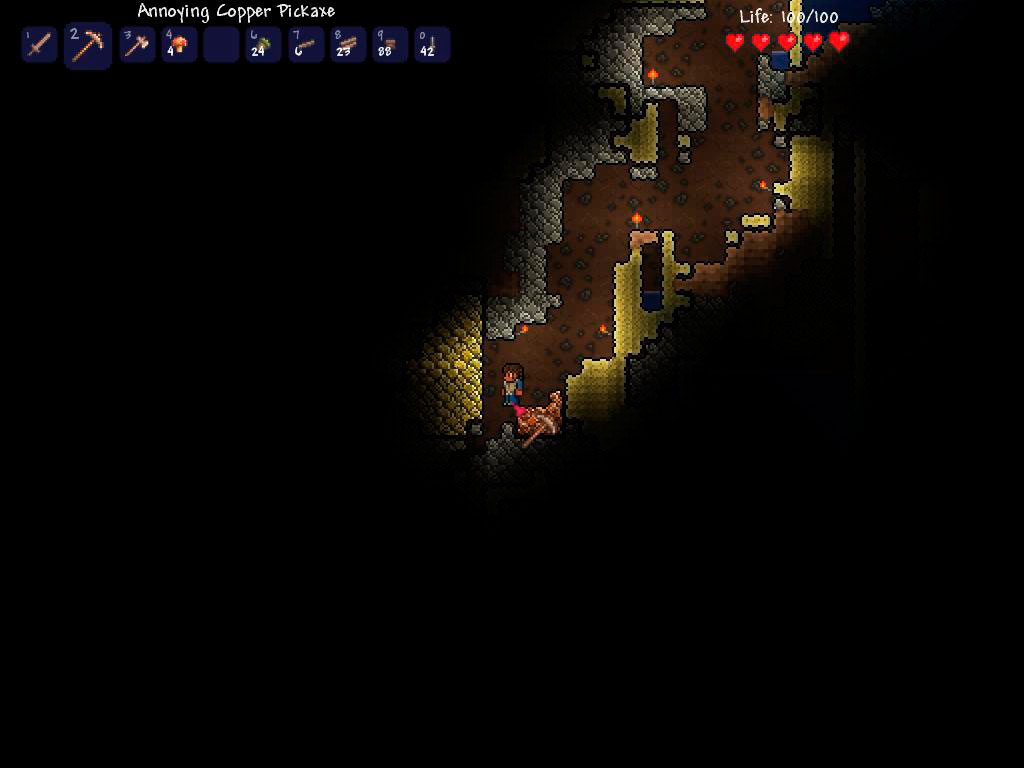
WHY IS THIS SO FUN?! *sobs*
Up until I started playing a few weeks ago, the entire mental space Terraria occupied for me can be summed up as “that 2D Minecraft knock-off.” I am not even sure which game came first, and it did not seem to matter: Terraria was just another game about digging for ore and crafting better pickaxes to mine for more ore. In only two dimensions.
After seeing an entire weekend evaporate in a flurry of clicking pixel blocks however, I am here to say that Terraria is not just a 2D Minecraft clone. It is an unholy union between all the addictive parts of Minecraft combined with legitimately entertaining Metrovania gameplay with a liberal dose of SNES graphical/musical nostalgia thrown into the mix.
Terraria starts out innocently enough, with your character equipped with a copper sword, axe, and mining pick. The beginning hours will be spent chopping trees, building your first crafting station, killing some slimes to turn their quivering innards into fuel for your torches, and so on. Much like Minecraft, zombies and other uglies come out at night which drives you to create shelter and then start digging underground for wont of something else to do.
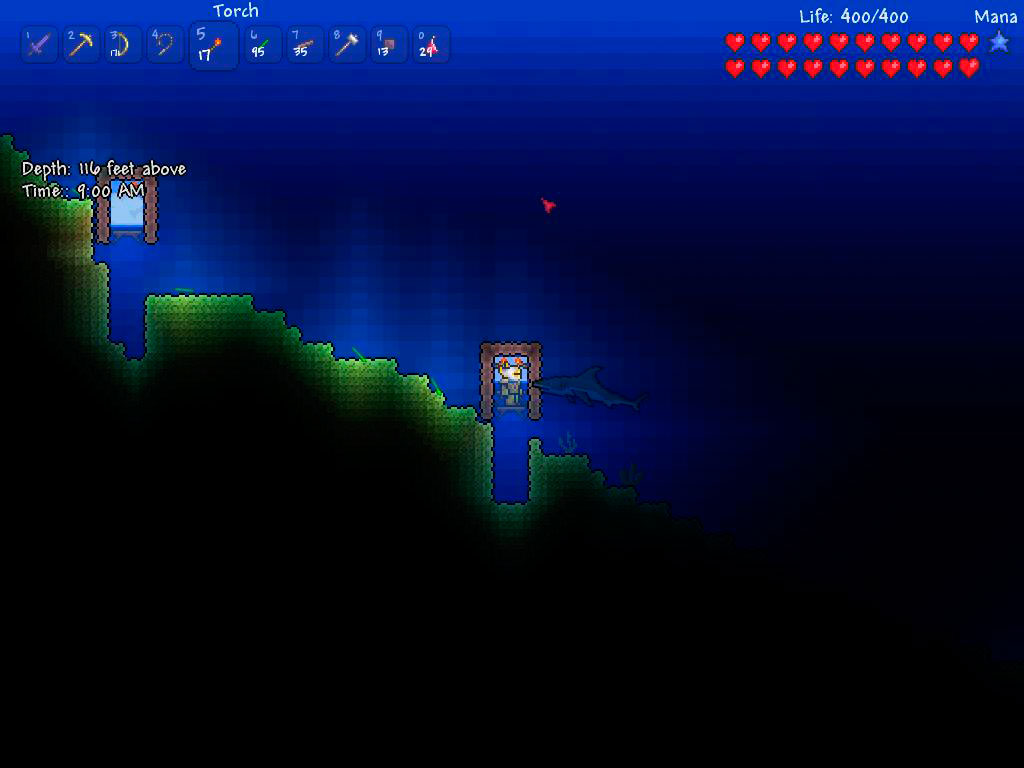
C’mon, this is easily more explainable than average Minecraft shenanigans.
While it might not initially seem so at first, there is a surprising amount of depth (har har) to Terraria’s gameplay. While you are hunting around for Copper and Iron ore, you will of course encounter enemies in the deep places of the earth. You will also frequently encounter priceless clay pots of a forgotten age which can be broken and looted for coins. You will eventually start coming across chests filled with goodies/equipment, and even crystalline Hearts, which can be broken and then consumed to increase your HP.
As you hit certain milestones, the world around you changes. Once you have accumulated 50 silver pieces, a Merchant will hang around your house, provided you build a room for him to sleep in. Finding and hoarding bombs will cause the Demolitionist to start peddling his explosive warez. And once you surpass 200 HP, there is an increasing chance the Eye of Cthulhu (the first boss) will settle its gaze upon your growing hamlet.
Not only does all this progression feel natural, it is also addicting. Your hunt for better ores to craft better armor and weapons to make your life easier leads to encountering stronger foes and ever more secrets. While crafting is a lot less complex than with Minecraft – you can talk to the Guide to see every craftable item that a given ingredient can produce – it simultaneously feels a bit deeper. Hitting Diamond could be accomplished relatively quickly in Minecraft, at which point you were essentially in the endgame. Contrast that with Terraria, where the natural hardiness of your foes directs your exploration of the whole of the game map before culminating in a Final Boss… whose defeat unlocks the Hardmode version of your world, with new enemies and even harder bosses.
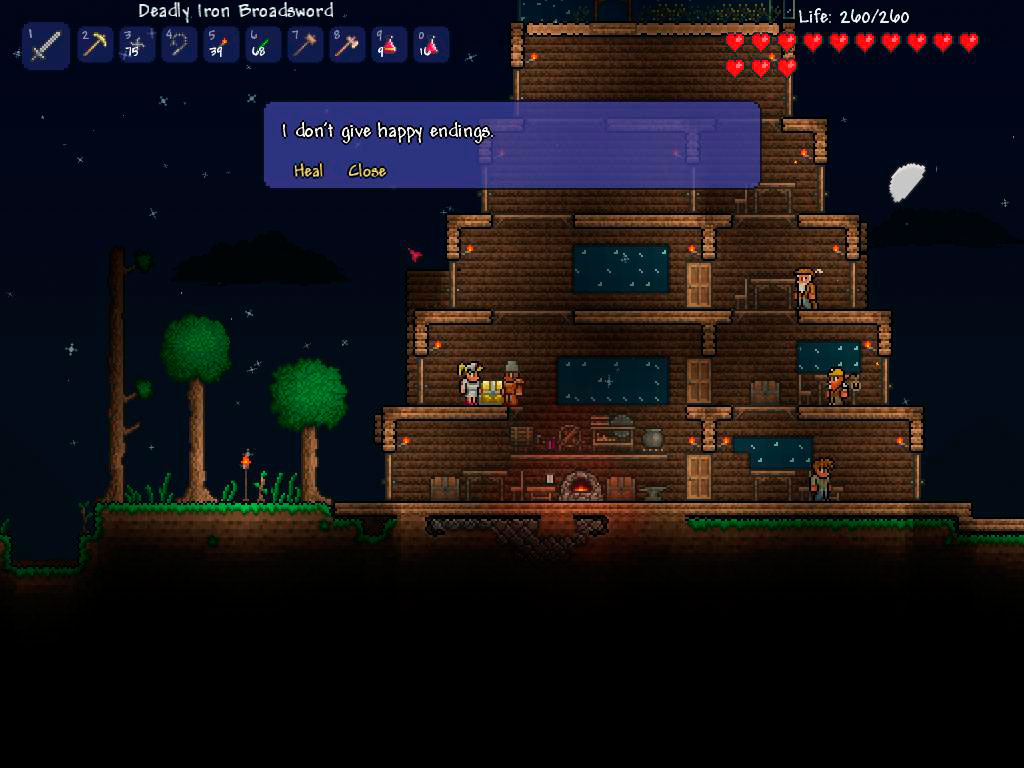
I… I’ll see myself out.
Of course, all of this implicit progression leads to a necessarily more finite resolution. While there are quite a few different set pieces to play around with, you are probably not going to spend the same amount of time building castles and mountain fortresses here as you would in Minecraft. That said, my game clock read 53 hours by the time I finished off the last of the Hardmode bosses and crafted the final piece of my ultimate armor. I could farm these bosses a few more times for their exclusive material drops – who wouldn’t want to run around with a flamethrower? – but it almost seems superfluous at this point. What would be next? Would I reroll a new character in a new procedurally-generated world? I could. But I feel I have already mastered these mechanics, and would simply arrive at the same destination a bit faster this time around. Hell, I could even equip my new character with the flamethrower and best pickaxe in the game to further speed along the process. Or I could go play something else.
Overall, the only real regret I have with Terraria was having spent all the time up to this point thinking of it as just a 2D Minecraft. Both games share many similar qualities, but why would another instance of “cause one to lose all track of time” or “become obsessed with mining better ore” be considered a deficiency? Both games are fun, in slightly different ways. Indeed, I am not even sure which one I would recommend first to someone who has played neither. Show Minecraft first, and like me, you might be a tad disappointed in the more limited forms of customization and Terraria not quite comparing to the sheer scale of an infinite 3D world. With Terraria going first though, you run the risk of having the person balk at Minecraft’s lack of direction and flat sense of progression.

Yes, that’s a lava moat below a lever-operated trapdoor.
In any case, having indie game companies force these tough choices on us when the AAA industry is falling over themselves pumping out derivative, 6-hour long sequels is ultimately a good problem to have.
 In An Age
Past is Prologue
Nov 15
Posted by Azuriel
Starfield has been a wild success. Like, objectively: it was the best-selling game in September and has since become the 7th best-selling game for the year. And those stats are based on actual sale figures, unmuddied by Xbox Game Pass numbers. Which is astounding to think about.
[Fake Edit] A success… except in the Game of the Year department. Yikes. It’s at least nominated for Best RPG, along with (checks notes) Lies of P? No more sunlight between RPG-elements and RPG anymore, I guess. Doesn’t matter though, Baldur’s Gate 3 is going to continue drinking that milkshake.
Starfield having so many procedurally-generated planets though, is still a mistake. And its a mistake that Mass Effect: Andromeda took on the chin for all of gamedom a decade ago.
Remember Andromeda? The eagerly-anticipated BioWare follow-up to their cultural phenomenon trilogy? It ended up being a commercial flop, best remembered for terrible facial animations and effectively killing the golden goose. What happened? Procedurally-generated planets. Andromeda didn’t have them, but the (multiple) directors wanted them so badly that they wasted months and years fruitlessly chasing them until there was basically just 18 months left to pump out a game.
You can read the Jason Schreier retrospective (from 2017) for the rest of the story. And in total fairness, the majority of the production issues stemmed from EA forcing BioWare to use the Frostbite engine to create their game. But it is a fact that they spent a lot of time chasing the exploration “dream.”
That’s how it begins. Granted, we wouldn’t see how No Man’s Sky shook out gameplay wise until 2016.
The irony though, is that BioWare started to see it themselves:
And there it is: “it was never fun.” It never is.
I have logged 137 hours in No Man’s Sky, so perhaps it is unfair of me to suggest procedural exploration is never fun. But I would argue that the compelling bits of games like NMS are not the exploration elements – it’s stuff like resource-gathering. Or in games like Starbound, it’s finding a good skybox for your base. No one is walking around these planets wondering what’s over the next hill in the same way one does in Skyrim or Fallout. We know what’s over there: nothing. Or rather, one of six Points of Interest seeded by an algorithm to always be within 2km walking distance of where you land.
Exploring a procedurally generated world is like reading a novel authored by ChatGPT. Yeah, there are words on a page in the correct order, but what’s the point?
Getting back to Starfield though, the arc of its design followed almost the reverse of Andromeda. In this sprawling interview with Bruce Nesmith (lead designer of Skyrim and Bethesda veteran), he talked about how the original scope was limited to the Settled Systems. But then Todd Howard basically pulled “100 star systems” out of thin air and they went with it. And I get it. If you are already committed to using procedural generation on 12 star systems, what’s another 88? A clear waste of time, obviously.
And that’s not just an idle thought. According to this article, as of the end of October, just over 3% of Xbox players have the “Boots on the Ground” achievement that you receive for landing on 100 planets. Just thinking about how many loading screens that would take exhausts me. Undoubtedly, that percentage will creep up over time, but at some point you have to ask yourself what’s the cost. Near-zero if you already have the procedural generation engine tuned, of course. But taking that design path itself excludes things like environmental storytelling and a richer, more tailored gaming experience.
Perhaps the biggest casualty is one more felt than seen: ludonarrative. I talked about this before with Starfield, but one of the main premises of the game is exploring the great unknown. Except everything is already known. To my knowledge, there is not a single planet on any system which doesn’t have Abandoned Mines or some other randomly-placed human settlement somewhere on it. So what are we “exploring” exactly? And why would anyone describe this game as “NASApunk” when it is populated with millions of pirates literally everywhere? Of course, pirates are there so you don’t get too bored exploring the boring the planets, which are only boring because they exist.
Like I said at the top, Starfield has been wildly successful in spite of its procedural nonsense. But I do sincerely hope that, at some point, these AAA studios known for storytelling and/or exploration stop trying to make procedural generation work and just stay in their goddamn lane. Who out here is going “I really liked Baldur’s Gate 3, so I hope Larian’s next game is a roguelike card-battler”? Whatever, I guess Todd Howard gets a pass to make his “dream game” after 25 years. But as we sleepwalk into the AI era, I think it behooves these designers to focus on the things that they are supposedly better at (for now).
We learn from our mistakes eventually, right? Right?
Posted in Commentary, Philosophy
2 Comments
Tags: Exploration, Mass Effect: Andromeda, procedurally-generated, Starfield